
Judge, 1915-06-12 · page 11 of 24
Judge — June 12, 1915 — page 11: what you’re looking at
What you’re looking at
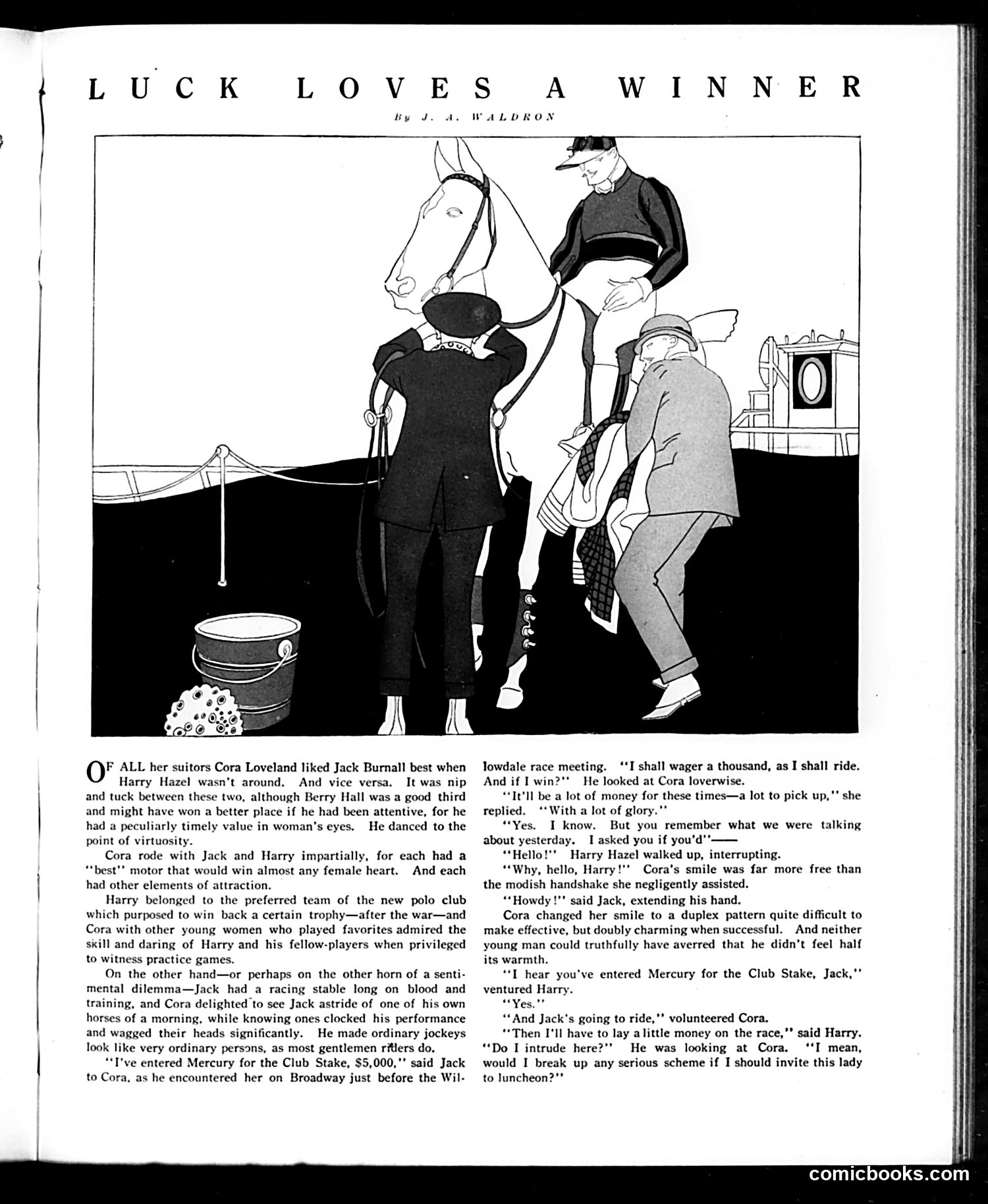
This is a romantic fiction story illustrated with a line drawing, not a political cartoon. The narrative satirizes wealthy American social circles circa WWI era through the romantic entanglements of Cora Loveland, a society woman pursued by three suitors: Jack Burnall (who owns a racing stable), Harry Hazel (a polo player), and Berry Hall (a dancer). The satire targets the superficiality of upper-class courtship: Cora's affection shifts based on which man's "motor" or sporting prowess currently impresses her. The story mocks both the young men's vanity in their competitive abilities and Cora's calculated flirtation—she performs different smiles for each suitor while they compete for her attention. The joke hinges on social climbing and materialism masquerading as romance: female preference follows male wealth and status, not genuine feeling. The title suggests that "luck" (timing, athletic performance) determines romantic success among the leisure class.
📄 Transcribed text from this page (OCR, searchable)
Machine-transcribed from the original scan — historical spelling and the odd misread are preserved.
LUCK LOVE By Ss A VALDRON WINNER F ALL her suitors Cora Loveland liked Jack Burnall best when Harry Hazel wasn’t around. And vice versa. It was nip and tuck between these two, although Berry Hall was a good third and might have won a better place if he had been attentive, for he had a peculiarly timely value in woman's eyes. He danced to the point of virtuosity. Cora rode with Jack and Harry impartially, for each had a “*best’’ motor that would win almost any female heart. And each had other elements of attraction. Harry belonged to the preferred team of the new polo club which purposed to win back a certain trophy—after the war—and Cora with other young women who played favorites admired the skill and daring of Harry and his fellow-players when privileged to witness practice games. On the other hand—or perhaps on the other horn of a senti- mental dilemma—Jack had a racing stable long on blood and training, and Cora delighted to see Jack astride of one of his own horses of a morning, while knowing ones clocked his performance and wagged their heads significantly. He made ordinary jockeys look like very ordinary persons, as most gentlemen riers do. “I've entered Mercury for the Club Stake, $5,000,"* said Jack to Cora, as he encountered her on Broadway just before the Wil- lowdale race meeting. ‘‘I shall wager a thousand, as I shall ride. And if I win?'’ He looked at Cora loverwise. “It'll be a lot of money for these times—a lot to pick up,"’ she repl “With a lot of glory.” “Yes. I know. But you remember what we were talking about yesterday. 1 asked you if you'd"’. “*Hello!’’ Harry Hazel walked up, interrupting. “Why, hello, Harry!"’ Cora’s smile was far more free than the modish handshake she negligently assisted. “Howdy !'" said Jack, extending his hand. Cora changed her smile to a duplex pattern quite difficult to make effective, but doubly charming when successful. And neither young man could truthfully have averred that he didn’t feel half its warmth, “*I hear you've entered Mercury for the Club Stake, Jack,"’ ventured Harry. Yes"? “*And Jack's going to ride,’’ volunteered Cora. “Then I'll have to lay alittle money on the race,’’ said Harry. “Do I intrude here?’’ He was looking at Cora. ‘‘I mean, would I break up any serious scheme if I should invite this lady to luncheon?’* comicbooks.com