
A complete issue · 24 pages · 1915
Judge — April 24, 1915
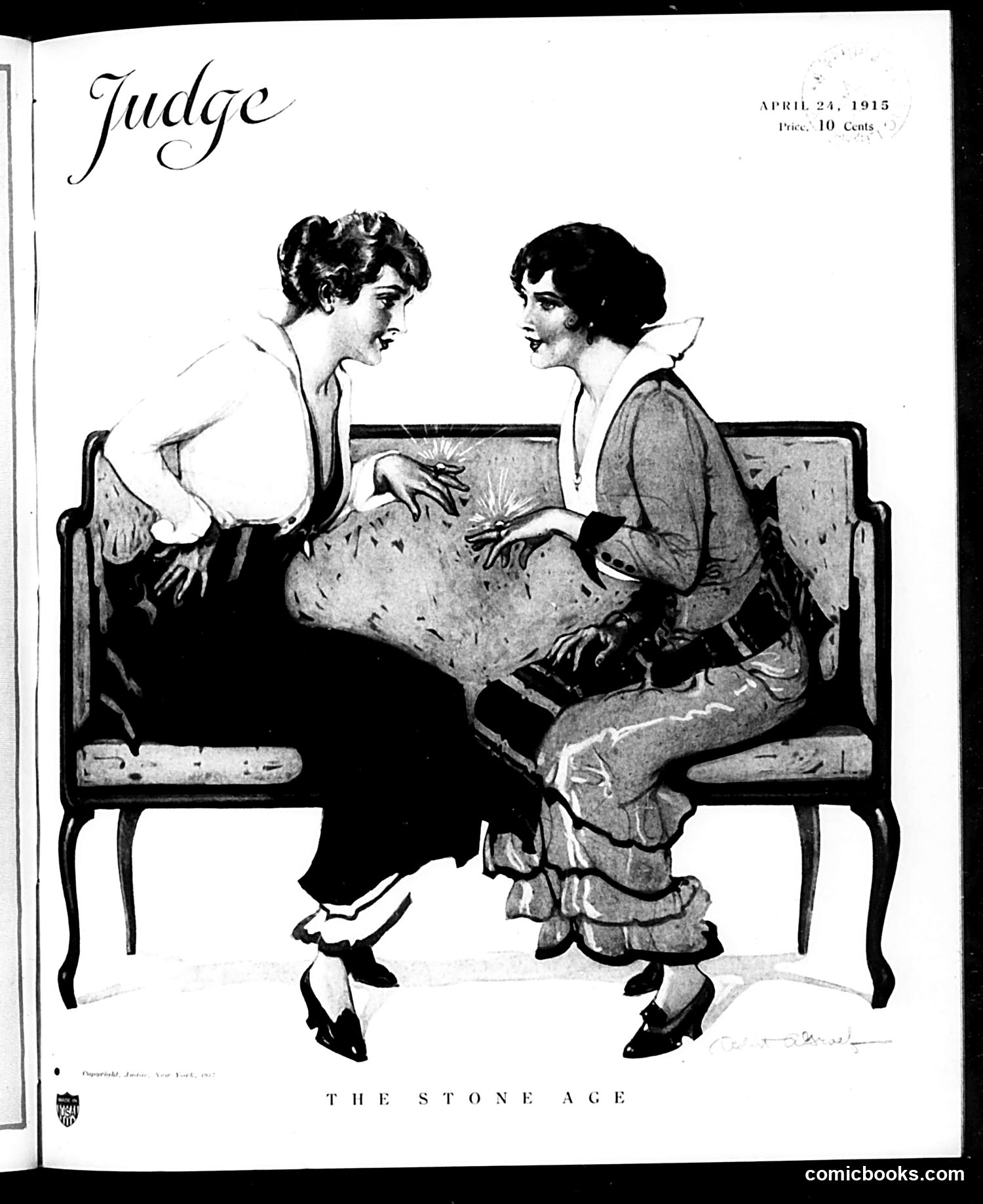
This cartoon satirizes women's fashion of the era, specifically the popular "hobble skirt" — an extremely tight, restrictive skirt that severely limited movement. The title "The Stone Age" is a pun: the women appear literally immobilized, as if frozen in stone, unable to move freely. The two fashionably-dressed women sit facing each other on chairs, their legs bound by the constrictive garment, appearing to struggle with basic movement. The satire mocks both the impracticality of contemporary women's fashion and, implicitly, the limitations it imposed on women's physical freedom and activity. Judge used the cartoon to critique how women sacrificed mobility and comfort for style during this period.
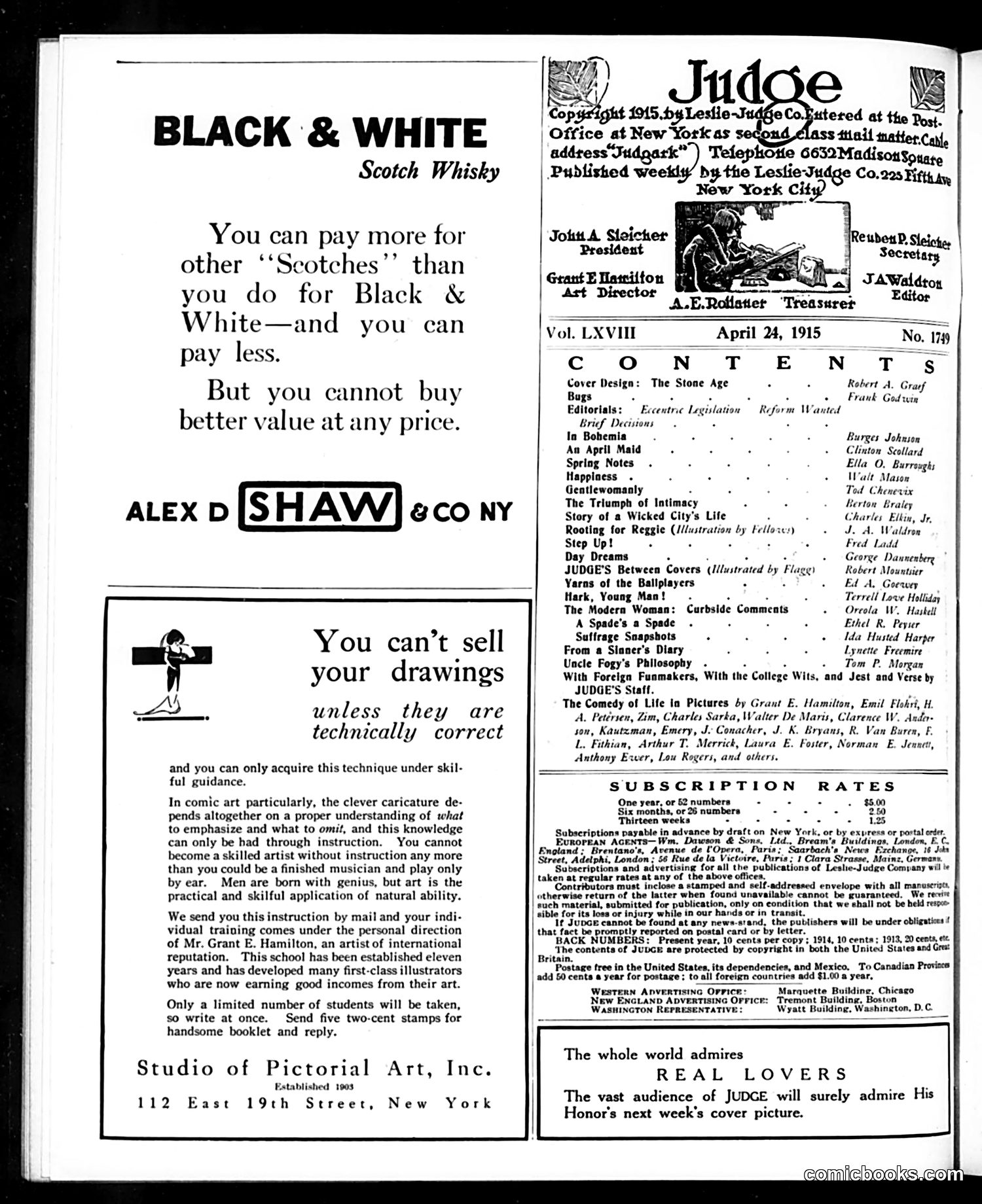
This page is primarily **advertising and masthead content** rather than editorial cartoons. The visible advertisements promote **Black & White Scotch Whisky** (emphasizing value) and the **Studio of Pictorial Art, Inc.**, which offers instruction in cartooning and illustration techniques under Grant E. Hamilton's direction. The right side contains the magazine's table of contents and subscription information. A brief teaser at bottom promises next week's cover will appeal to "REAL LOVERS," though the actual cover image isn't visible here. No political cartoons or satirical commentary are clearly visible on this particular page—it functions as a business/administrative section of the 1915 publication.
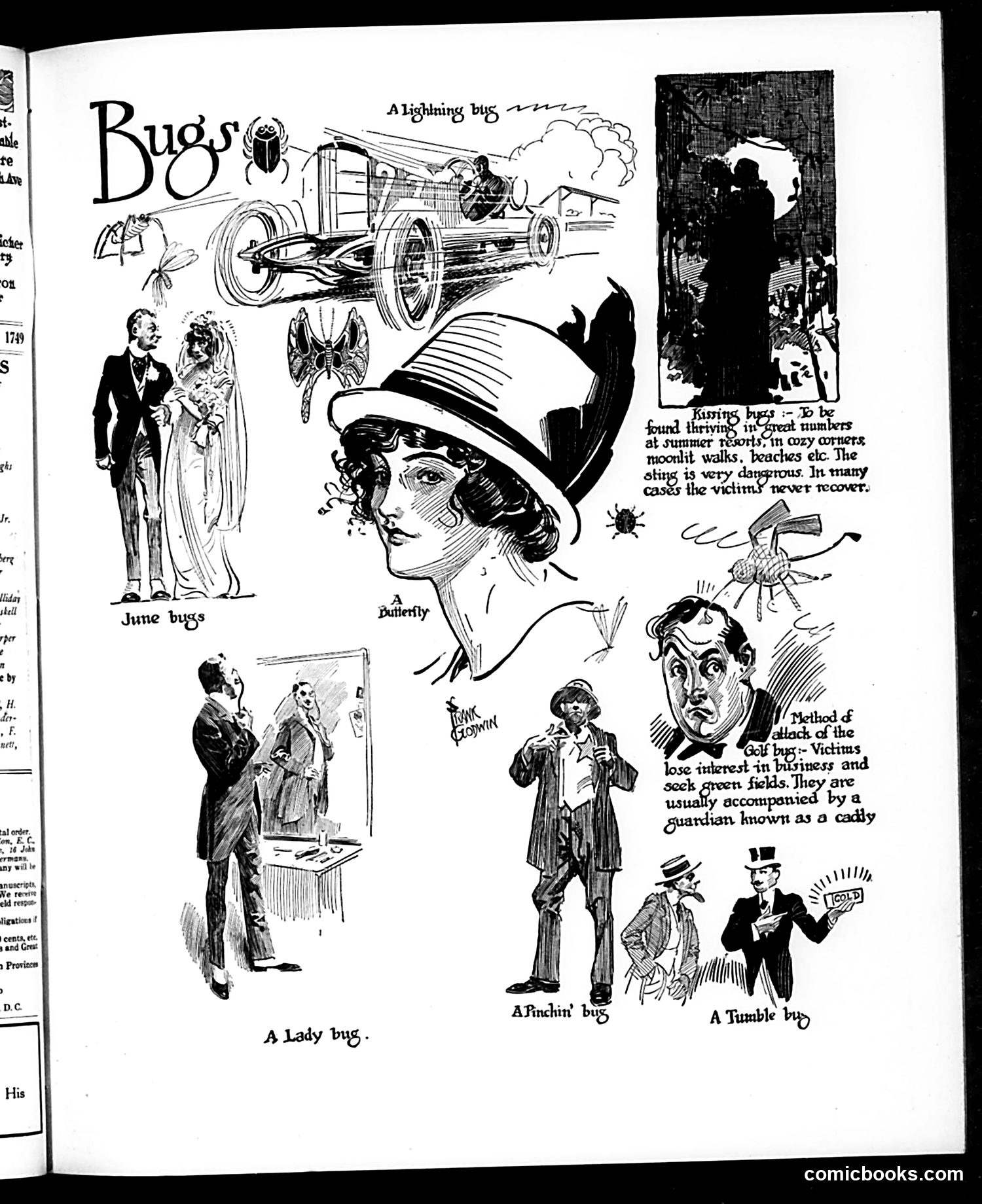
This page uses entomological puns to satirize social types of the era. Each illustrated "bug" represents a human character type: - **"June bugs"**: A romantic couple (marriage season reference) - **"A Lady bug"**: A woman at a vanity mirror, likely mocking vanity - **"A Butterfly"**: A fashionable woman in a hat, referencing frivolous excess - **"A Finchin' bug"** and **"A Tumble bug"**: Men in various states of financial or social distress - **"Lightning bug"**: A speeding motorcar, satirizing dangerous new automobile culture The text notes that "kissing bugs" attack victims at summer resorts, with stings that victims "never recover" from—likely sexual innuendo about romantic entanglements. The satire critiques contemporary social vices: materialism, frivolous fashion, financial schemes, and modern technology's dangers, all wrapped in insect-themed wordplay typical of Judge's style.
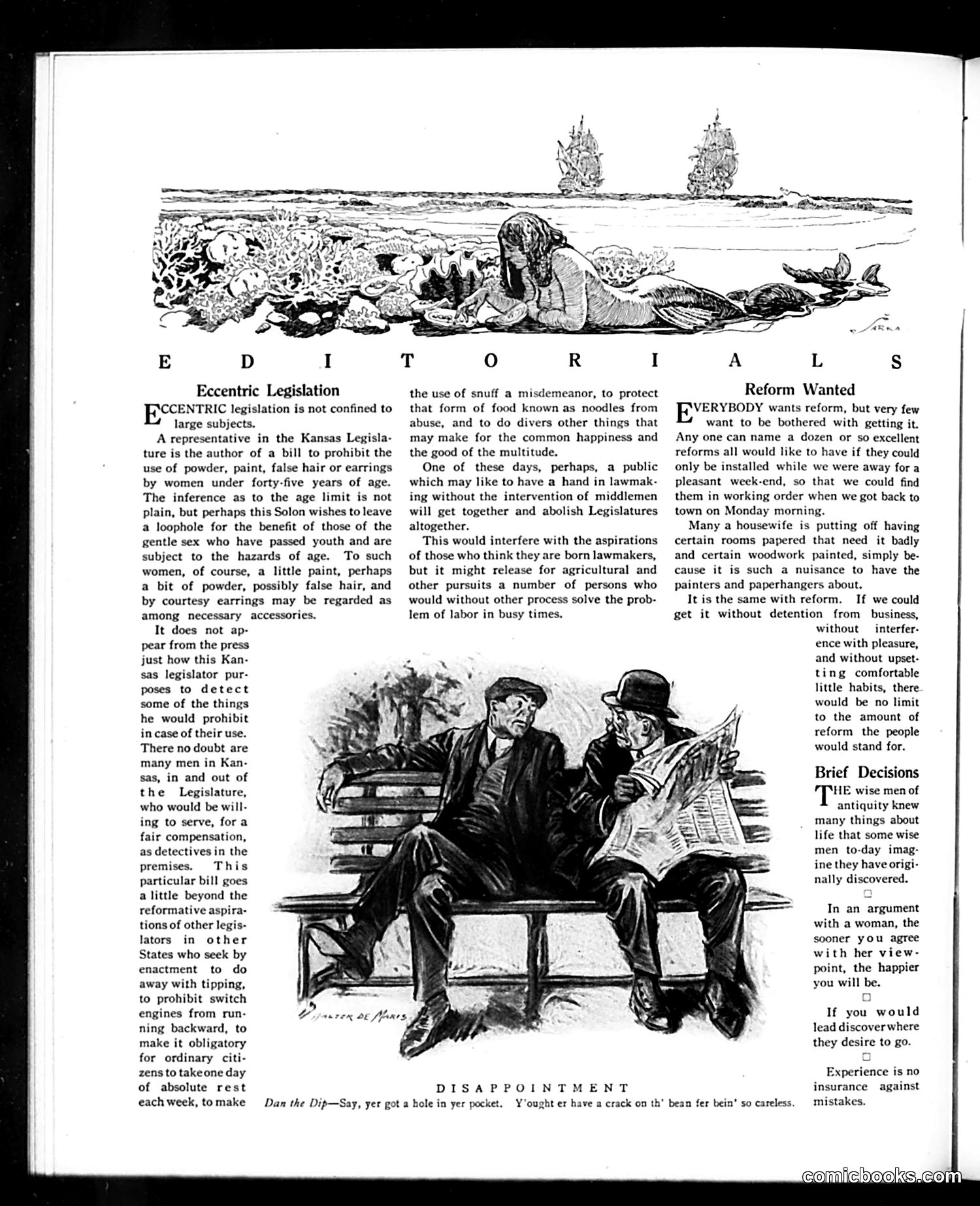
The page contains three distinct editorial sections: **"Eccentric Legislation"** critiques a Kansas legislator's bill to prohibit women over 40 from wearing paint, powder, false hair, and earrings. The satire mocks this as paternalistic overreach, questioning why legislators would waste time on such trivial matters rather than addressing substantive issues. **"Reform Wanted"** argues for practical domestic reforms (like wallpaper and room maintenance) implemented without government interference—contrasting with the absurdity of the Kansas bill. **"Disappointment"** is a sketch showing two men on a bench, with dialogue about a pickpocket ("Dan the Dip") who, despite stealing, remains poor—satirizing incompetence even in crime. The cartoons collectively mock legislative overreach in personal matters and societal hypocrisy regarding "reform."
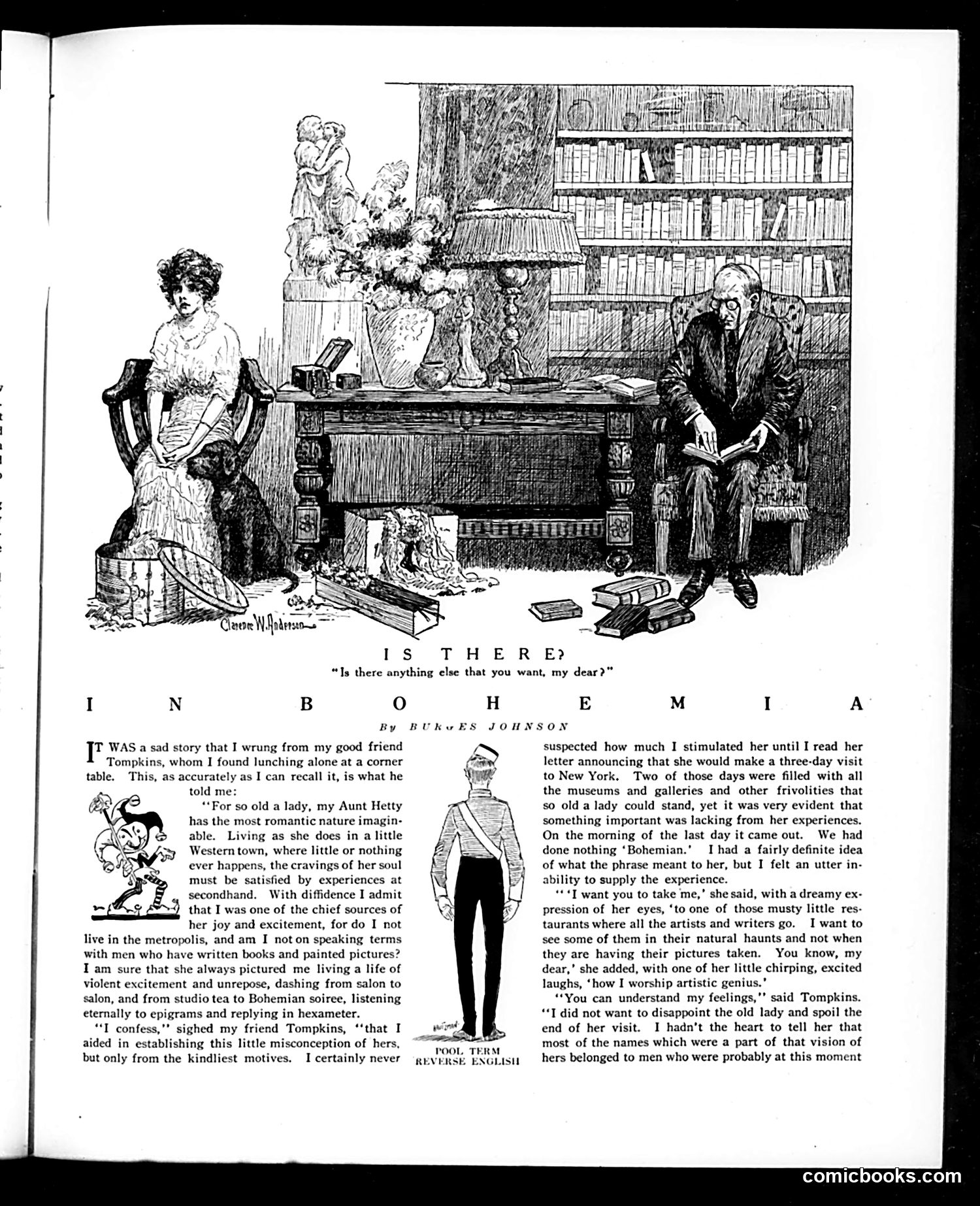
This page presents a short story illustrated by Charles Wilkinson. The narrative concerns a woman named Tompkins who lives a dull life in a Western town and craves cultural and romantic excitement. Her friend attempts to fulfill her wishes by arranging a three-day New York visit featuring museums, galleries, and artistic venues. The cartoon's humor derives from the gap between her romantic expectations of bohemian life and artistic society versus mundane reality. The illustration shows a well-dressed couple in a library—likely depicting the disappointed outcome of her cultural aspirations. The satirical point critiques how urban sophistication and "bohemian" experiences often fail to deliver the transformative excitement promised to provincial seekers.
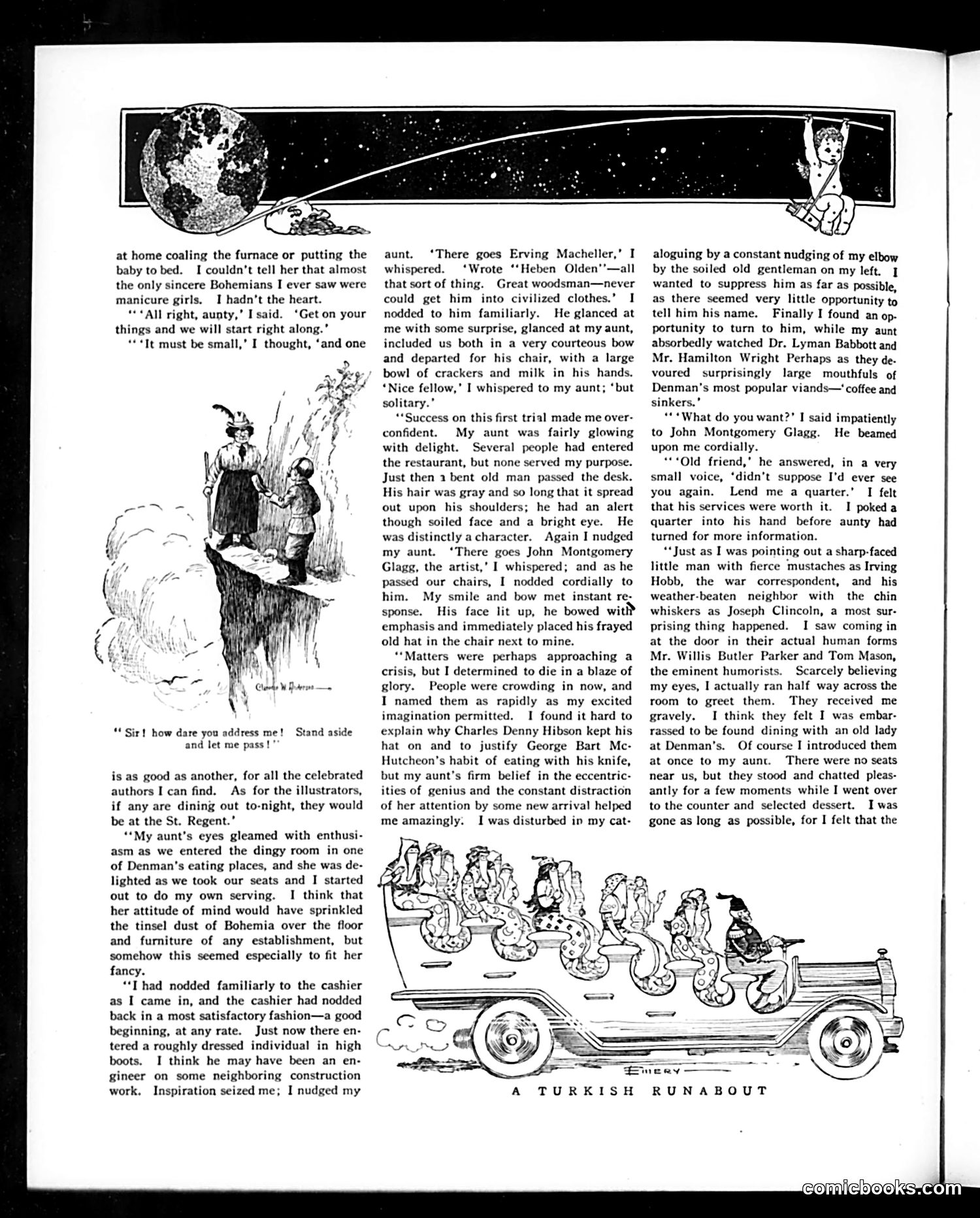
This page satirizes Bohemian pretension and romantic fraud. The narrator takes his aunt to a cheap diner (Denman's), falsely identifying ordinary working-class diners as famous authors and artists to impress her with "authentic Bohemia." The joke relies on period recognition of names like "Erving Macheller" and "George Bart McHutcheon" (likely real writers), whom the narrator fraudulently spots. His aunt, eager for glamorous artistic experience, accepts his fabrications wholesale—a working man in boots becomes "Erving Macheller," a shabby old man becomes "John Montgomery Glagg the artist." The irony peaks when the actual old man, genuinely named Glagg, appears and asks to borrow a quarter—exposing the narrator's game. The satire mocks both the aunt's gullible romanticism about Bohemian life and the narrator's opportunistic deception, while suggesting that authentic "Bohemians" are actually quite ordinary (or worse, broke).
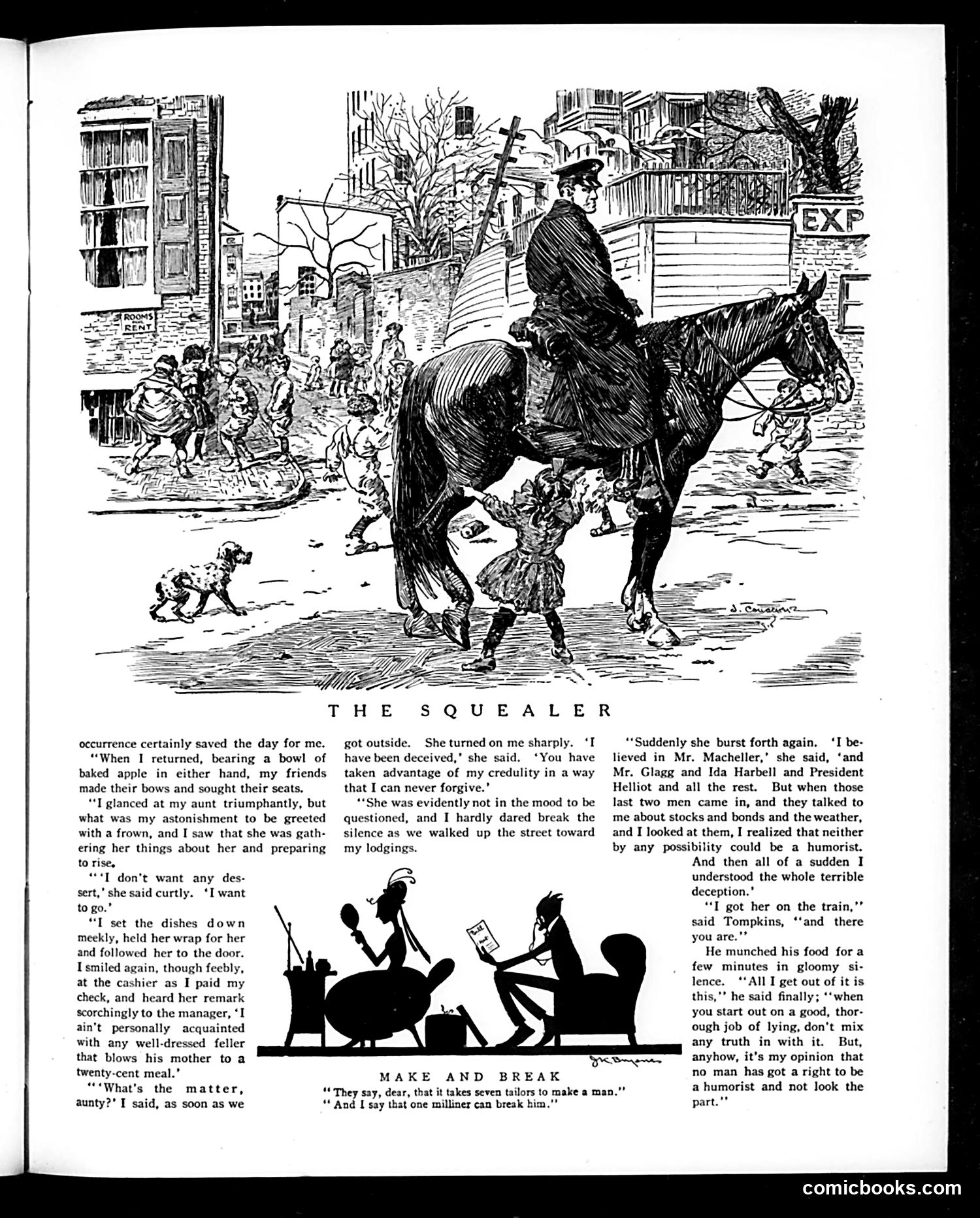
This page contains two satirical pieces from Judge magazine satirizing social pretense and deception. **"The Squealer"** depicts a narrator who deceived his aunt by fabricating acquaintances with prominent figures (Macheller, Glagg, Ida Harbell, and "President Helliot"—likely fictional or obscure references) to impress her. When two men he claimed to know arrived and couldn't maintain the humorist personas he'd attributed to them, his aunt realized the deception. The cartoon shows a mounted police officer confronting a street scene, visualizing the "squealing" on the narrator's lies. The satire mocks social climbing through false associations. **"Make and Break"** is a brief joke about female extravagance: while "seven tailors make a man," one milliner (hat-maker) can financially ruin him—commentary on women's spending habits, a common satirical theme of the era. Both pieces ridicule dishonesty and vanity in social situations.
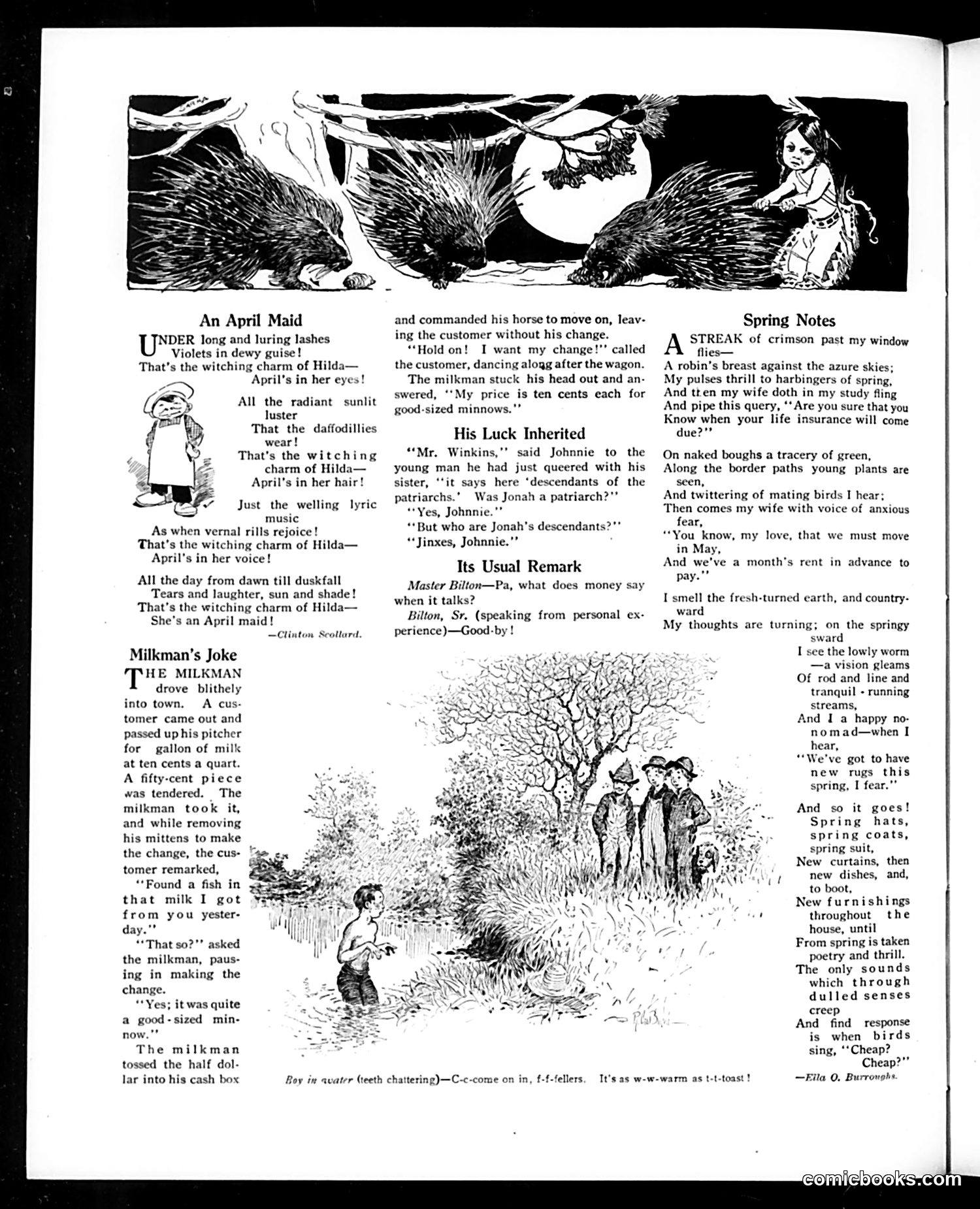
This page from *Judge* magazine contains three separate humorous pieces reflecting early 20th-century American life: **"An April Maid"** is a romantic poem celebrating spring and femininity, with no political content—pure sentiment. **"Milkman's Joke"** satirizes petty dishonesty in commerce. A milkman, offended by a customer's complaint about finding a fish in the milk, retaliates by keeping his change, claiming he now charges "ten cents each for good-sized minnows." The satire targets working-class fraud and tit-for-tat disputes over milk quality and pricing. **"Spring Notes"** and the domestic cartoons mock married life's financial burdens. A husband yearns for spring's romance and outdoor freedom, but his wife repeatedly interrupts with demands for new clothes, furniture, dishes, and rent payments. The satire—targeting middle-class consumer culture and wives' spending—reflects period anxieties about domestic expenses and changing gender dynamics in consumer society. The cold-water boy illustration appears unrelated contextual humor.
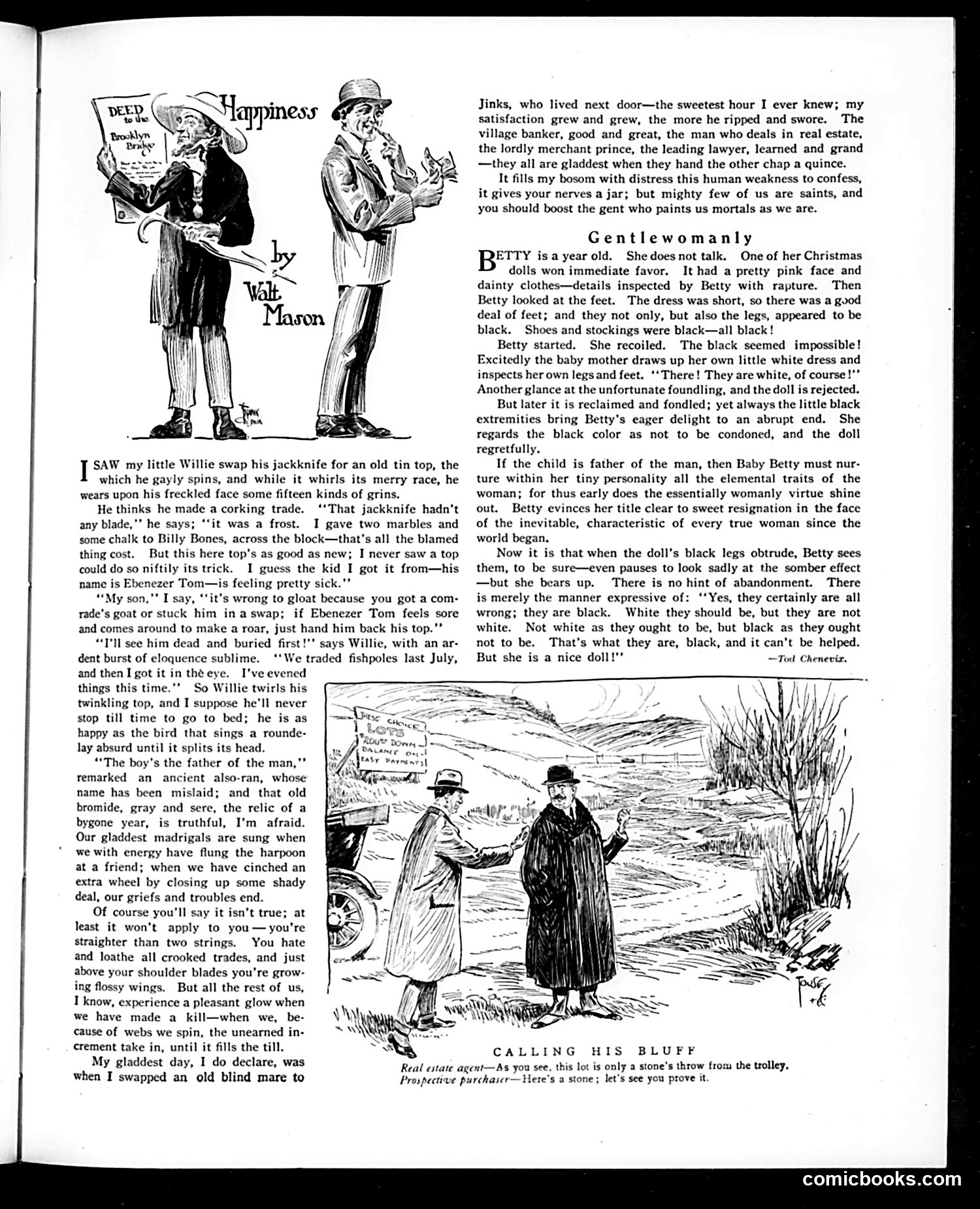
This page contains two separate satirical pieces by Walt Mason: **"Happiness"** (left): A father observes his son Willie gleefully trading away a broken jackknife to get a spinning top from a boy named Ebenezer Tom—apparently revenge for a previous unfair trade involving fishpoles. The satire critiques human nature: the father moralizes about fairness, but Mason's narrator reveals society's actual values. Bankers, merchants, and lawyers are "gladdest" when they've cheated someone. The piece mocks hypocrisy—we celebrate cunning and profit-taking while pretending to virtue. **"Gentlewomanly"** (right): A one-year-old girl named Betty rejects a Christmas doll because its painted legs and feet are black, while her own legs are white. She repeatedly reclaims and rejects it. Mason suggests this demonstrates how early children—particularly girls—absorb racist attitudes and standards of beauty from society. The satire criticizes how prejudice becomes "natural" through childhood conditioning. Both pieces use gentle domestic humor to expose uncomfortable social truths about greed and racism.
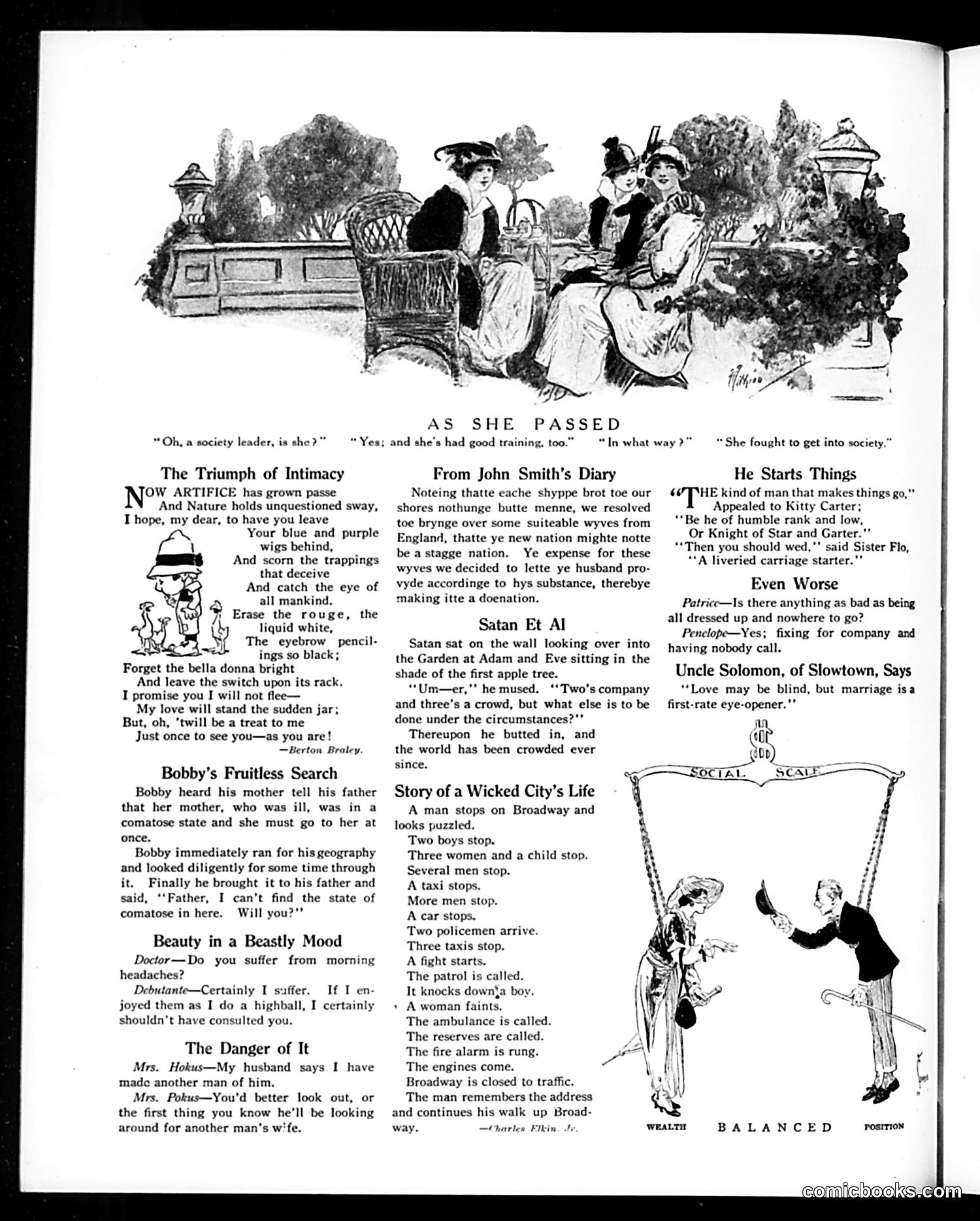
This page from *Judge* magazine presents several short comedic pieces mocking early 20th-century social conventions and urban life. **"The Triumph of Intimacy"** satirizes the era's obsession with feminine artifice—heavy makeup, wigs, and false beauty aids. The poem ironically presents a man claiming he wants "natural" women, yet his romantic appeal depends on these very fabrications he claims to reject. **"Bobby's Fruitless Search"** is a children's joke exploiting a child's literal interpretation: hearing his grandmother is in a "comatose state," Bobby searches geography books for this location. **"Satan Et Al"** offers dark humor about humanity's crowded world, suggesting Satan's original sin was merely inviting a third party to Adam and Eve's paradise. **"Story of a Wicked City's Life"** satirizes New York City's chaotic public culture—one confused man causes an escalating cascade of interference (crowds, traffic, fights, emergency responders), ultimately shutting down Broadway, before he simply continues his walk. The remaining pieces mock contemporary social anxieties: debutante drinking, marital transformation, and the desperation of social preparation gone unrewarded.
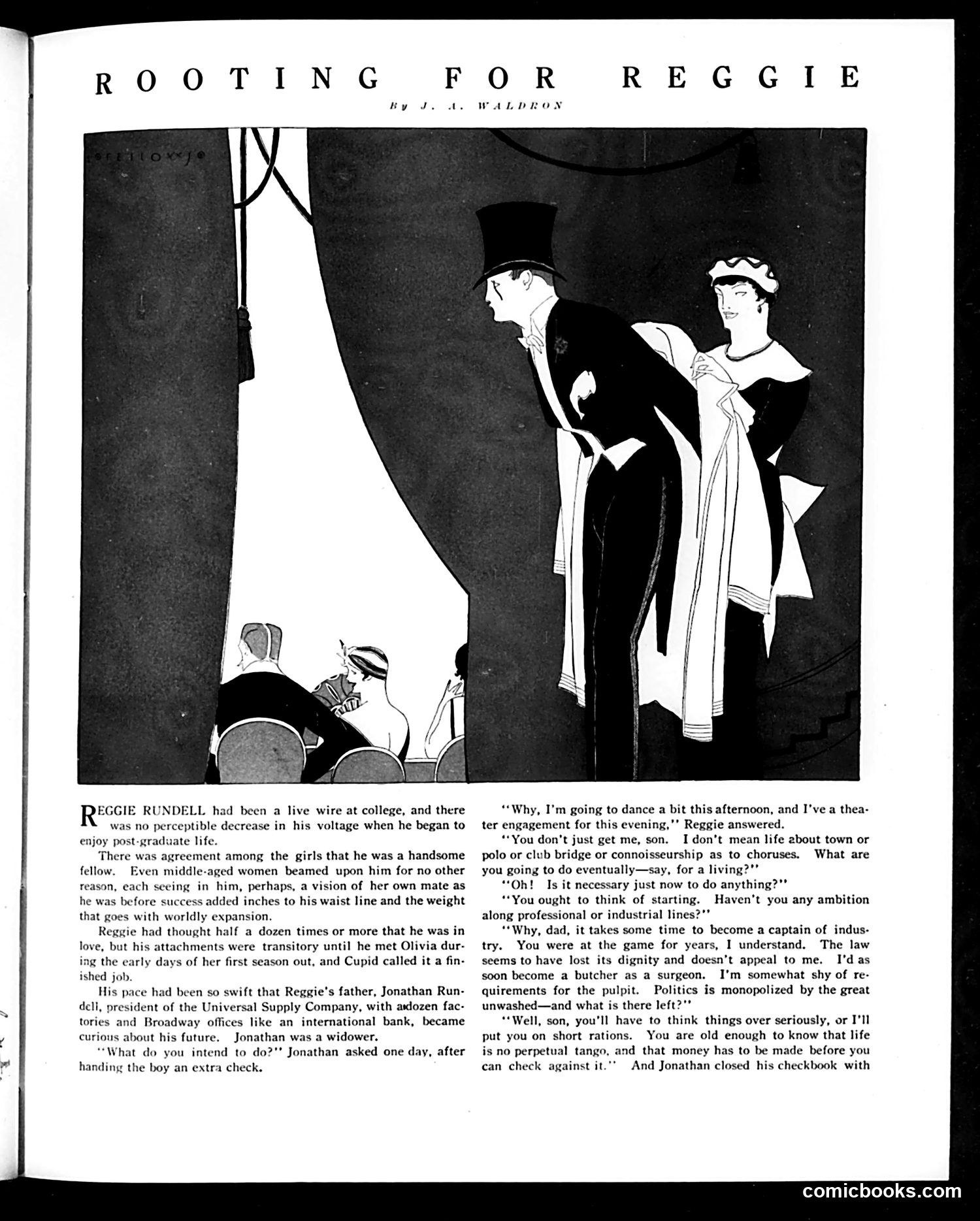
This is a satirical story about idle wealthy youth. Reggie Rundell, son of a successful industrialist (Jonathan Rundell, president of Universal Supply Company), represents the leisured upper class. While his father built an empire, Reggie spends his days dancing, theater-going, and pursuing romance with a debutante named Olivia. The satire targets Reggie's aimlessness and entitlement. When his father demands to know his life plans, Reggie dismisses all respectable professions—law, medicine, religion, politics—as beneath him or unappealing. He expects to live indefinitely on his father's wealth without contributing. The "rooting" reference suggests the story examines whether Reggie will develop ambition or remain a parasitic "live wire" dependent on paternal checks. Jonathan's ultimatum—think seriously or face financial cuts—sets up the narrative tension. The satire mocks the idle rich who inherit wealth but lack industry or purpose.
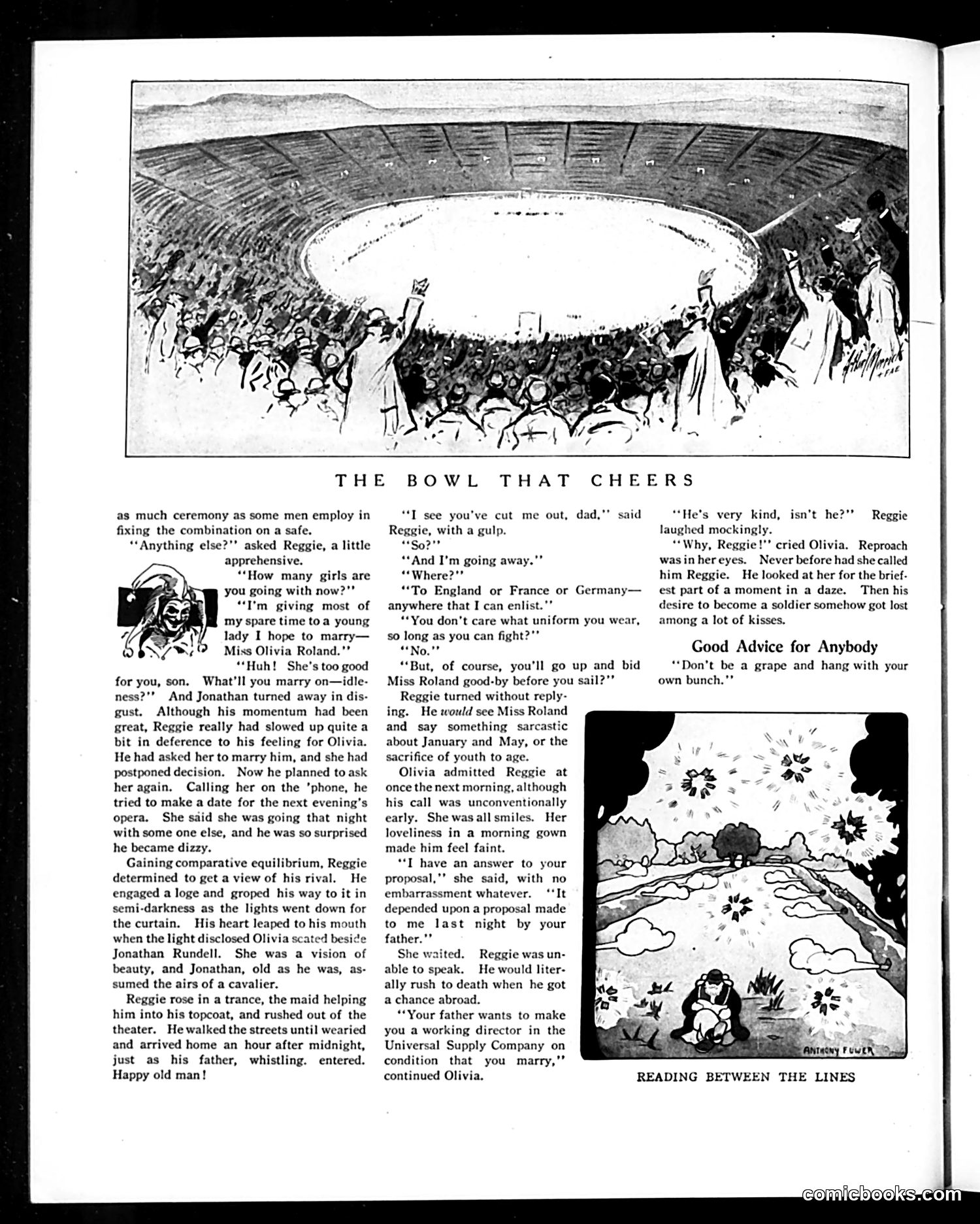
This story satirizes young men of leisure and their romantic entanglements during what appears to be the World War I era. Reggie, an idle young man, loses his girlfriend Olivia to his own father, Jonathan Rundell, who is portrayed as vigorous and cavalier despite his age. The satire targets Reggie's lack of purpose: he romanticizes enlisting in the war as an escape from romantic disappointment, but his father outmaneuvers him by offering Reggie a job at "Universal Supply Company" (likely war-related industry) conditional on marrying Olivia. This compromises Reggie's noble military intentions. The joke mocks both generational attitudes and young men who prefer dramatic gestures (enlisting) to productive work. The caption "Good Advice for Anybody—Don't be a grape and hang with your own bunch" suggests Reggie should have acted independently rather than passively following his impulses. The "bowl that cheers" likely references alcohol's role in male socialization.
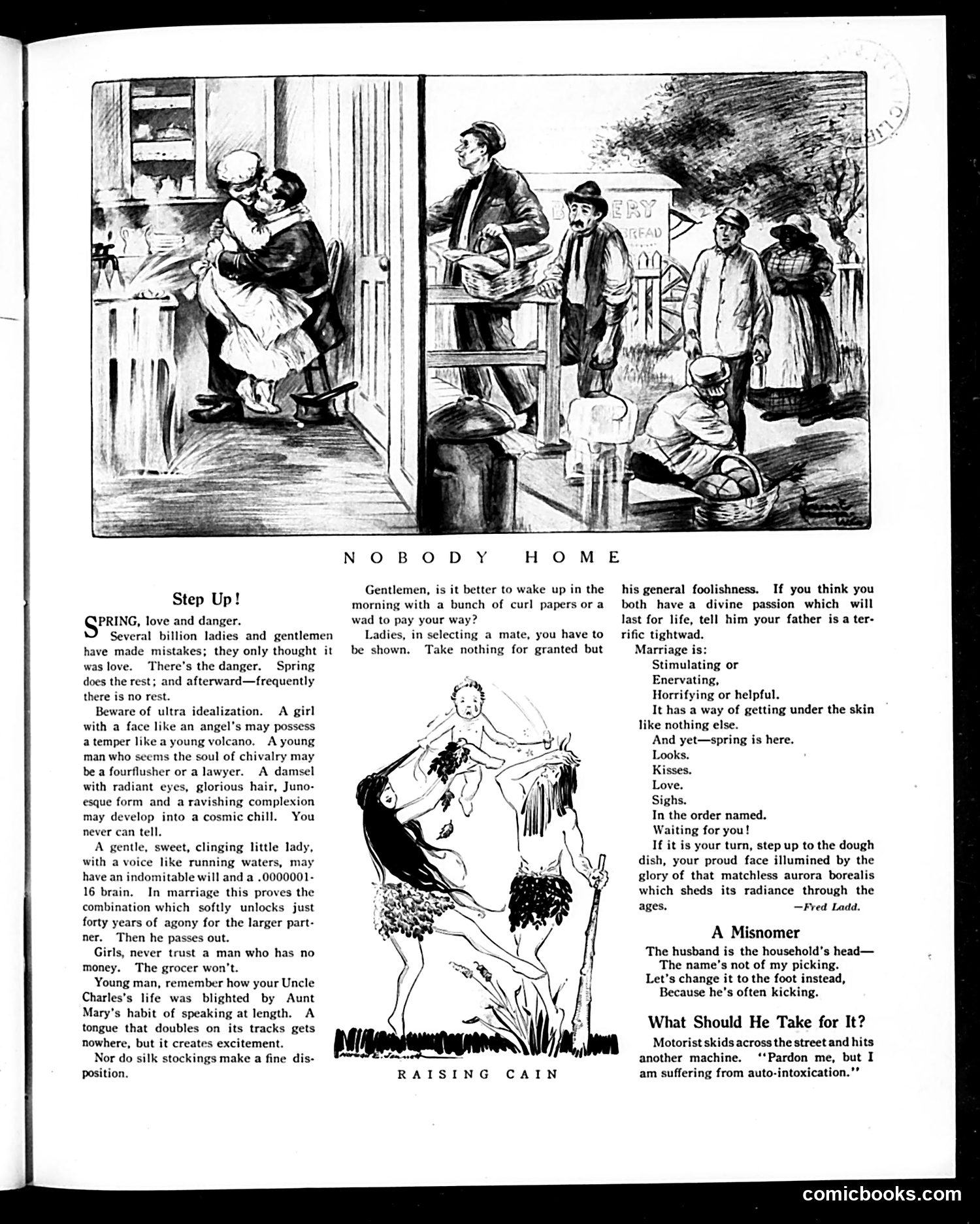
This page satirizes marriage and courtship, particularly targeting both genders' romantic illusions. **The main cartoon** ("Raising Cain," center) depicts a woman literally raising a calf—a visual pun mocking the notion of "raising Cain" (causing trouble). This illustrates the text's warning that idealized women often develop into difficult partners. **The essay "Step Up!"** cynically advises both men and women before marriage: - Women: Don't trust poor men; watch out for silent types (like Uncle Charles's talkative wife) - Men: Beware angel-faced women with volcanic tempers; sweet, simple-looking women may be stubborn and dim **The sidebar poems** continue the mockery: - "A Misnomer" jokes that husbands aren't really "heads" of households—they're "feet" because they're always being kicked - "What Should He Take for It?" uses "auto-intoxication" as a pun for car accidents and drunkenness The overall message: spring romance is dangerously deceptive; marriage inevitably disappoints both parties.
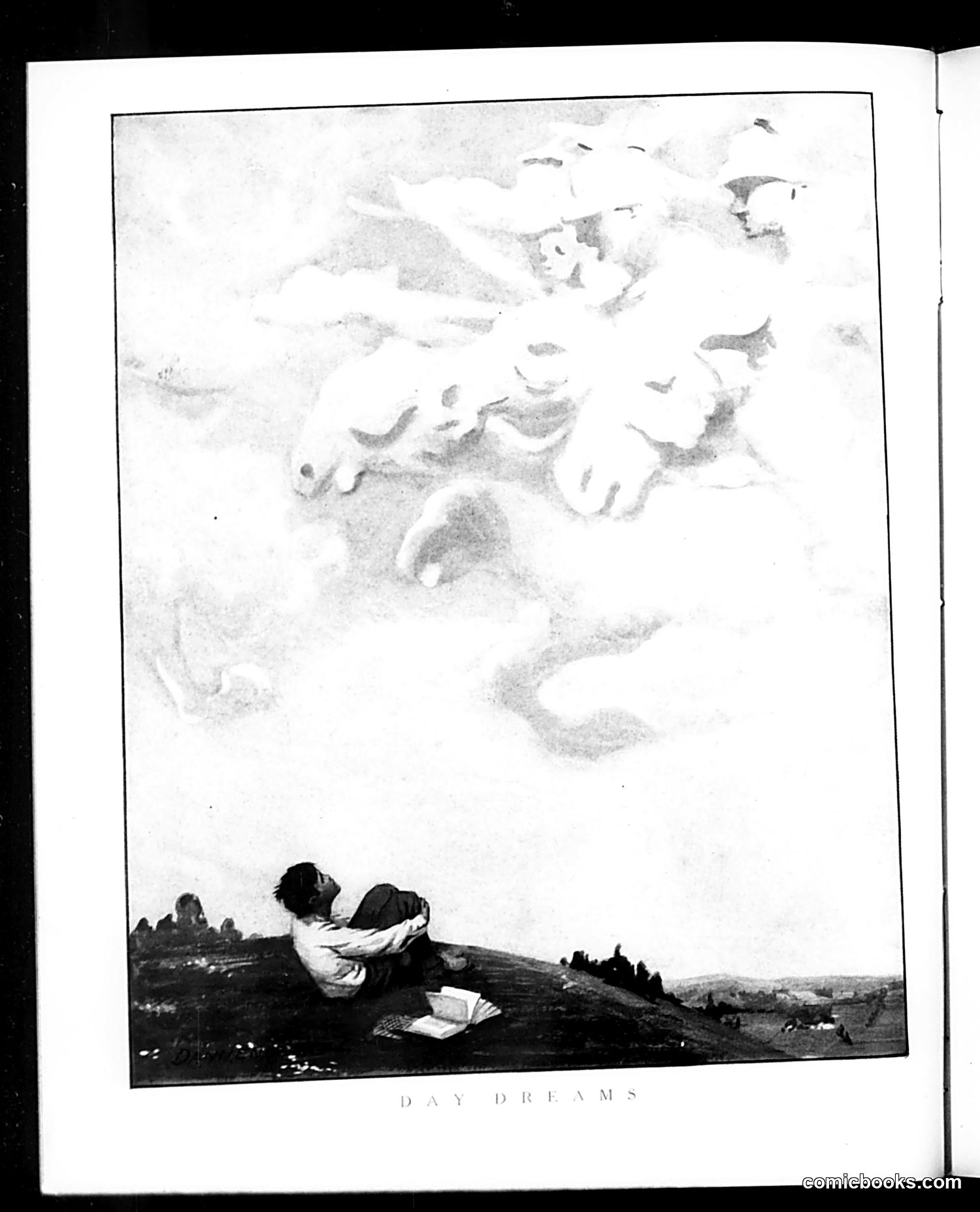
This illustration depicts a person lying on a hillside, gazing upward at clouds. The title "Day Dreams" suggests the romantic, escapist reverie the figure experiences while lounging in an idyllic pastoral landscape. The image appears to be a sentimental or philosophical piece rather than a political cartoon. It captures a common human experience—leisurely daydreaming outdoors—that would resonate with Judge magazine's readership. The composition contrasts the small, earthbound figure against the vast, imaginative sky above, visually representing how the mind expands during moments of idle contemplation. Without additional context or caption text visible, the specific satirical or social commentary, if any, remains unclear from the image alone.
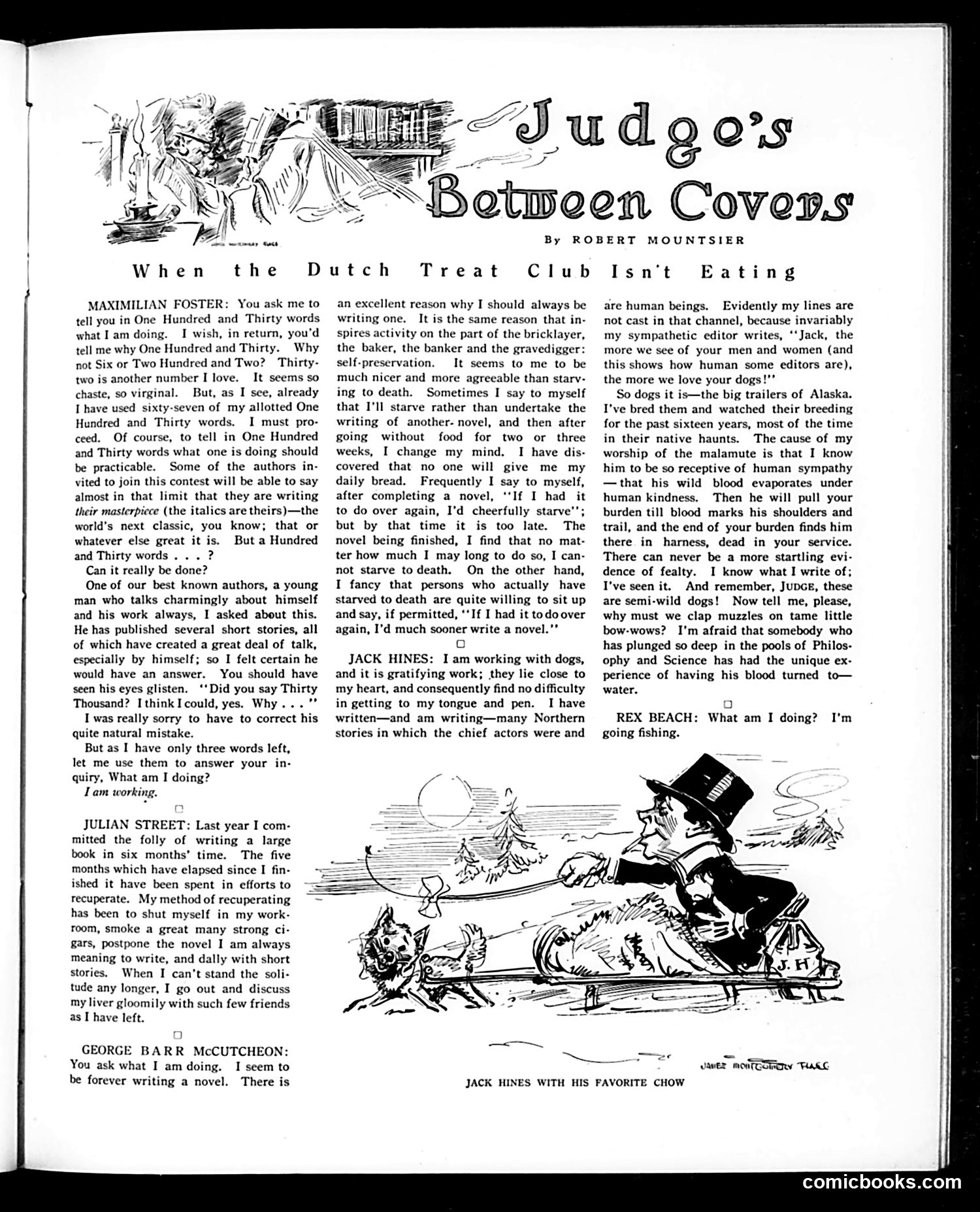
This page features brief comedic essays by established American authors responding to a constraint: describe what they're doing in exactly 100-130 words. The satire targets literary pretension and writers' excuses. **Key figures and their jokes:** - **Maximilian Foster** mocks the absurdity of arbitrary word limits, spending most of his allotment complaining rather than answering - **Julian Street** humorously depicts the exhaustion of completing a six-month novel, now recuperating through cigars and complaining to friends about his liver - **George Barr McCutcheon** uses economic necessity as a punchline—he must write novels constantly to avoid starvation, yet can't actually starve once he's finished - **Jack Hines** admits editors prefer his dog stories over human characters The cartoon below shows Hines with sled dogs, illustrating his point. The satire deflates romantic notions of authorship, revealing that professional writers are motivated by practical survival needs rather than artistic inspiration.
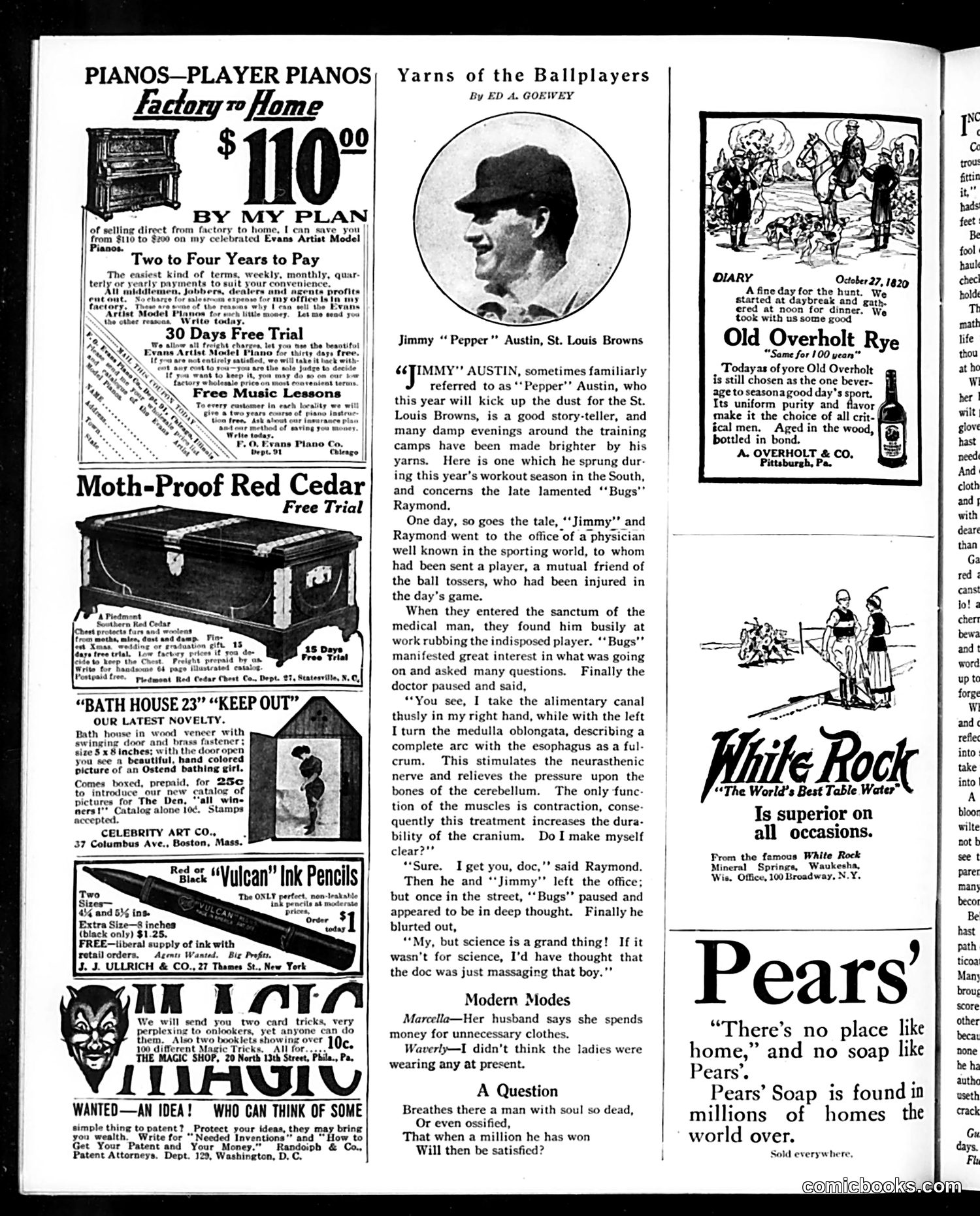
This page contains a sports humor piece titled "Yarns of the Ballplayers" by Ed A. Goewey, featuring Jimmy "Pepper" Austin of the St. Louis Browns baseball team. The main story is Austin recounting a tale about a player named "Bugs" Raymond visiting a physician. The joke's satire targets pseudo-intellectual jargon masquerading as expertise. A doctor uses elaborate medical terminology—"alimentary canal," "medulla oblongata," "neurasthenic nerve," "cerebellum"—to describe what is simply a massage. Raymond initially appears impressed by the scientific language, but once outside, admits he hadn't realized the doctor was "just massaging that boy," deflating the pretense of sophisticated medical knowledge. The surrounding advertisements (pianos, ink pencils, magic tricks, patent services) are typical Judge magazine content. A secondary joke references modern women's fashion scandalously—implying they wear little or nothing. This reflects early 20th-century American humor mocking both medical charlatanism and the mystification of simple practices through jargon.
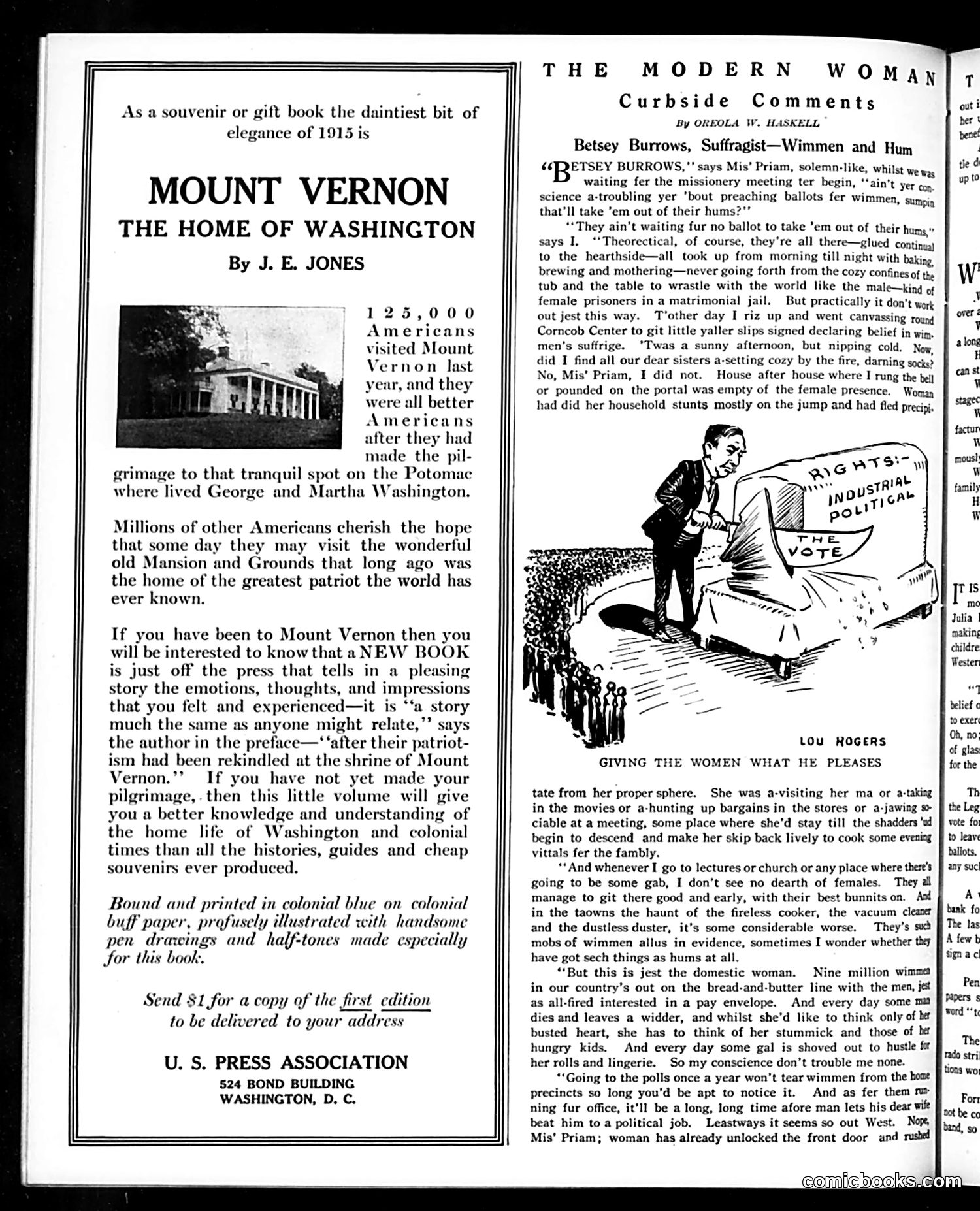
This page combines an advertisement for a Mount Vernon book with a satirical article titled "The Modern Woman: Curbside Comments" by Oreola W. Haskell. **The Cartoon:** Lou Rogers's illustration shows a man (likely a politician) distributing "Rights" labeled "Industrial Political" and "The Vote" to women, satirizing male politicians patronizingly "giving" women what they want rather than recognizing suffrage as a fundamental right women must claim themselves. **The Article's Satire:** Haskell critiques anti-suffrage arguments through a rural character's voice. The supposed contradiction—that women claim domesticity prevents them voting, yet are constantly absent from homes attending movies, lectures, shopping, and social gatherings—exposes the hypocrisy of those opposing women's suffrage. The implication: if women already leave homes freely for leisure, the excuse that voting would take them from domestic duties is baseless. The piece ridicules both anti-suffrage logic and the actual behavior of "domestic women," suggesting women's time allocation contradicts traditional arguments against their political participation.
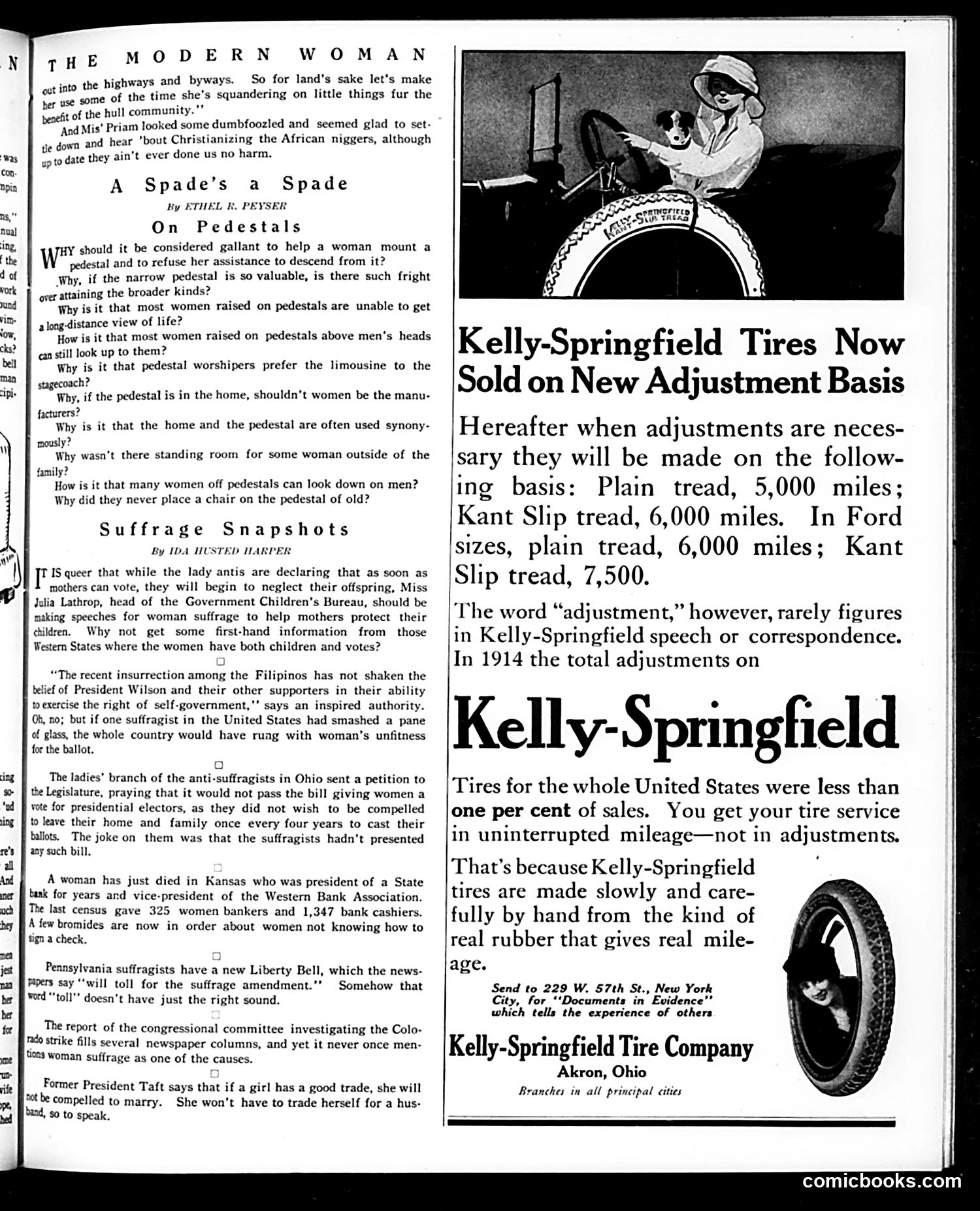
This *Judge* magazine page satirizes women's rights debates of the early 20th century. The left side contains three opinion pieces attacking women's suffrage and expanding female roles: **"A Spade's a Spade"** uses rhetorical questions to mock the notion that women deserve broader opportunities—sarcastically asking why women "raised on pedestals" can't manage real life. **"Suffrage Snapshots"** by Ida Husted Harper counters anti-suffrage arguments with ironic examples: she notes that anti-suffrage women claim voting mothers will neglect children, yet female government officials already advocate for mothers' rights; she highlights that women successfully manage banks yet are deemed unfit to vote. The opening passage contains period-typical racist language reflecting the magazine's 1910s context. The right side is a **Kelly-Springfield Tires advertisement**—unrelated editorial content typical of magazine layouts. The satire targets anti-suffragists' logical inconsistencies: women simultaneously portrayed as too delicate for public life yet already functioning in professional capacities.
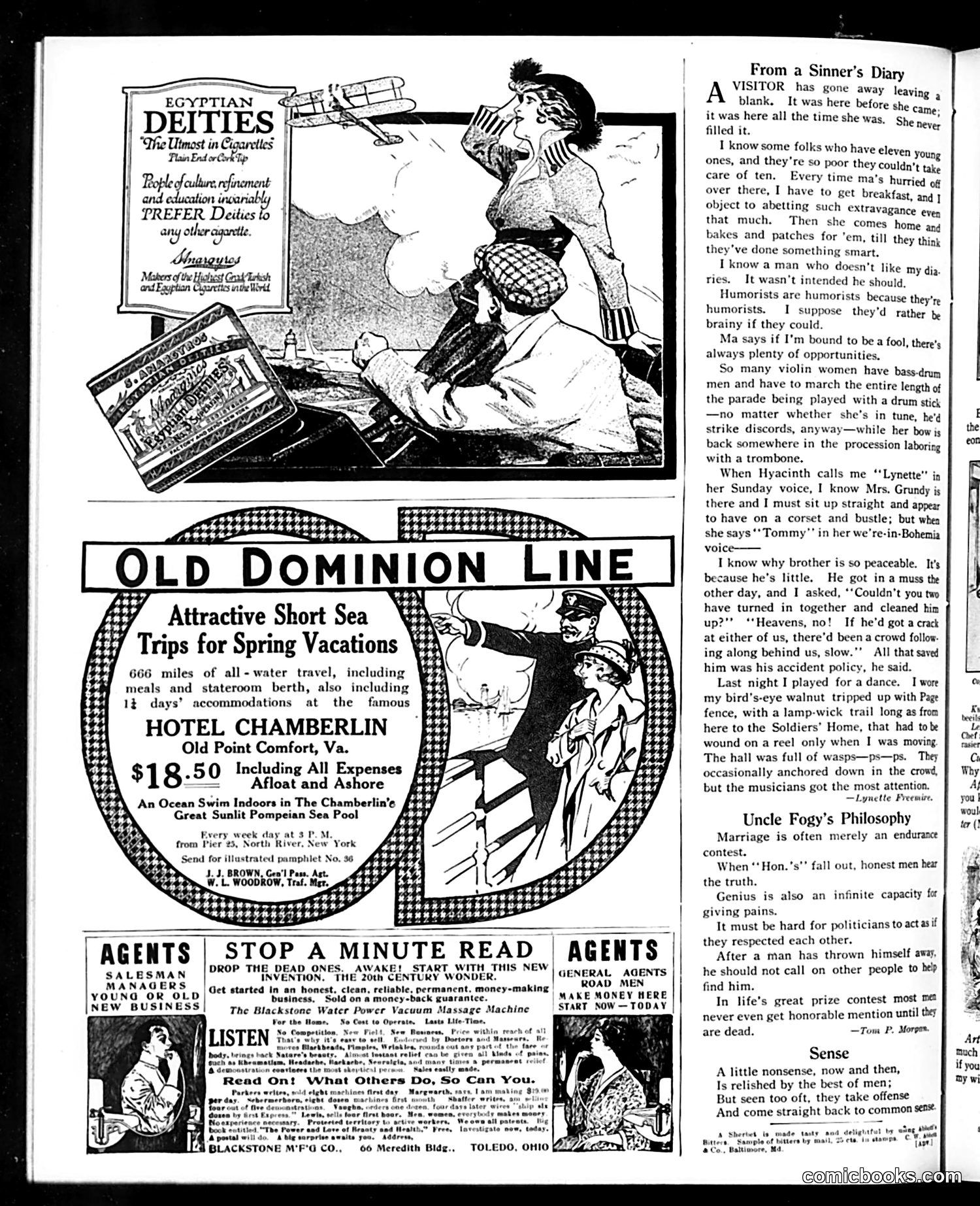
This page is primarily **advertising with humor columns**, not political satire. The top cartoon appears to be a cigarette ad ("Egyptian Deities") featuring a caricatured figure in an exaggerated style typical of the era—the exact identity isn't clear from the image alone. The main content consists of: 1. **Travel advertising** (Old Dominion Line steamship) 2. **Business opportunity ads** (agents, salesmen positions) 3. **Humorous columns** titled "From a Sinner's Diary" and "Uncle Fogy's Philosophy"—lighthearted domestic commentary about family life, music, and relationships The diary column's humor relies on period observations: complaints about large families, musicians in parades playing off-key, women's fashion (bustles), and marital dynamics. The philosophy section offers cynical wisdom about politics, marriage, and human nature. **Context for modern readers**: This represents Judge's mix of advertising revenue and humor content—what today would be magazine filler between ads. The jokes assume familiarity with early 20th-century social conventions around family size, courtship, and gender roles.
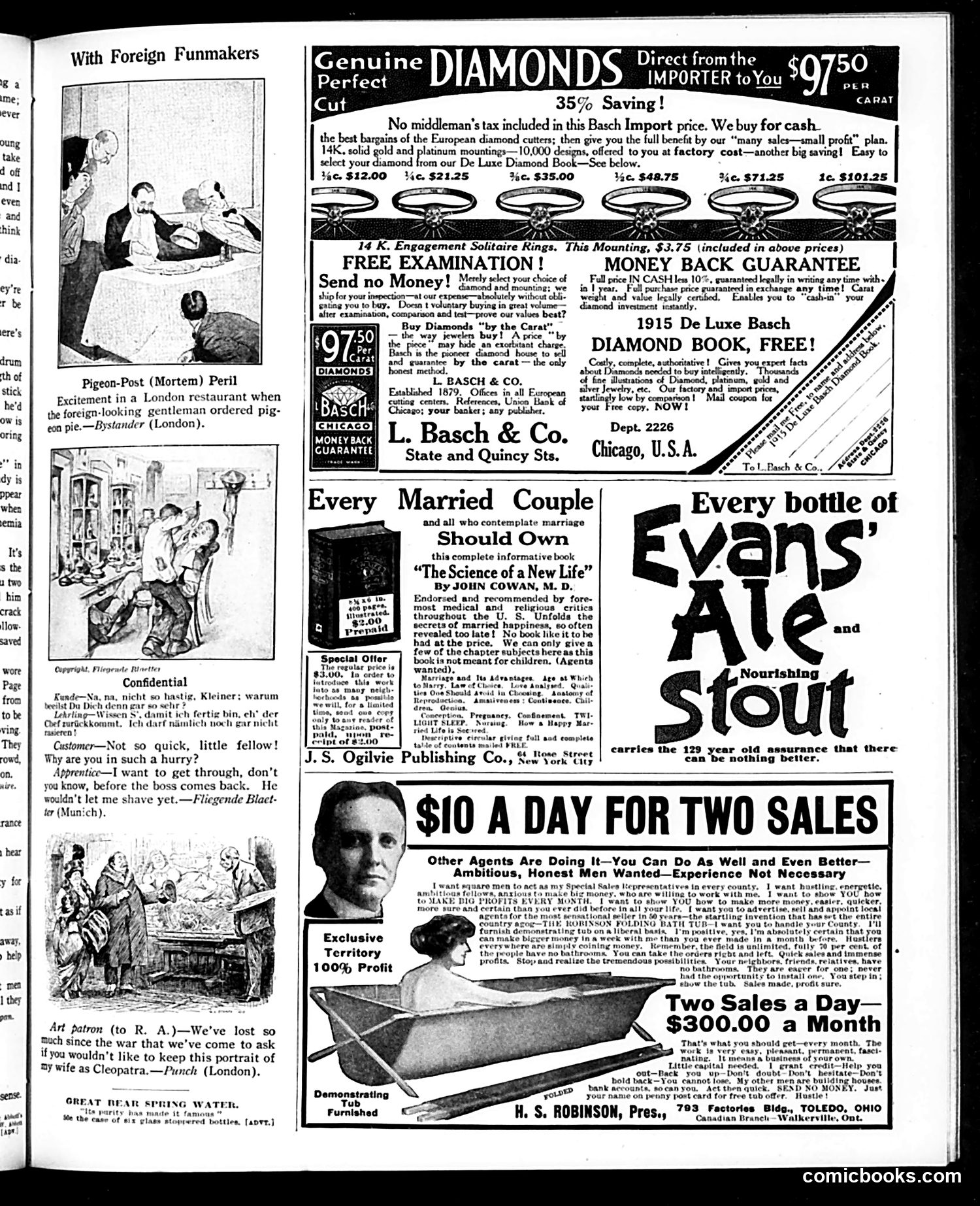
This page mixes European humor translations with American advertisements, typical of Judge's format. **Foreign Cartoons Section:** Three brief satirical sketches from European publications mock social awkwardness: a London diner's embarrassment ordering "pigeon pie" (likely evoking wartime food shortages or xenophobic anxiety), a German apprentice rushing to shave before his boss returns, and an impoverished art patron trying to sell his wife's portrait as "Cleopatra" post-WWI. **Advertisements:** The bulk of the page showcases period sales pitches: L. Basch & Co. diamonds (emphasizing direct importing to avoid "middleman's tax"), marriage advice books, Evans' Ale, and notably a "bathtub salesman" opportunity promising "$300 a month" with "100% exclusive territory profit"—typical Depression-era work-from-home schemes. The bathtub ad exploits rural America's lack of indoor plumbing. The cartoons' humor relies on pre-WWI European social contexts now obscure; the ads reveal contemporary consumer anxieties and economic desperation.
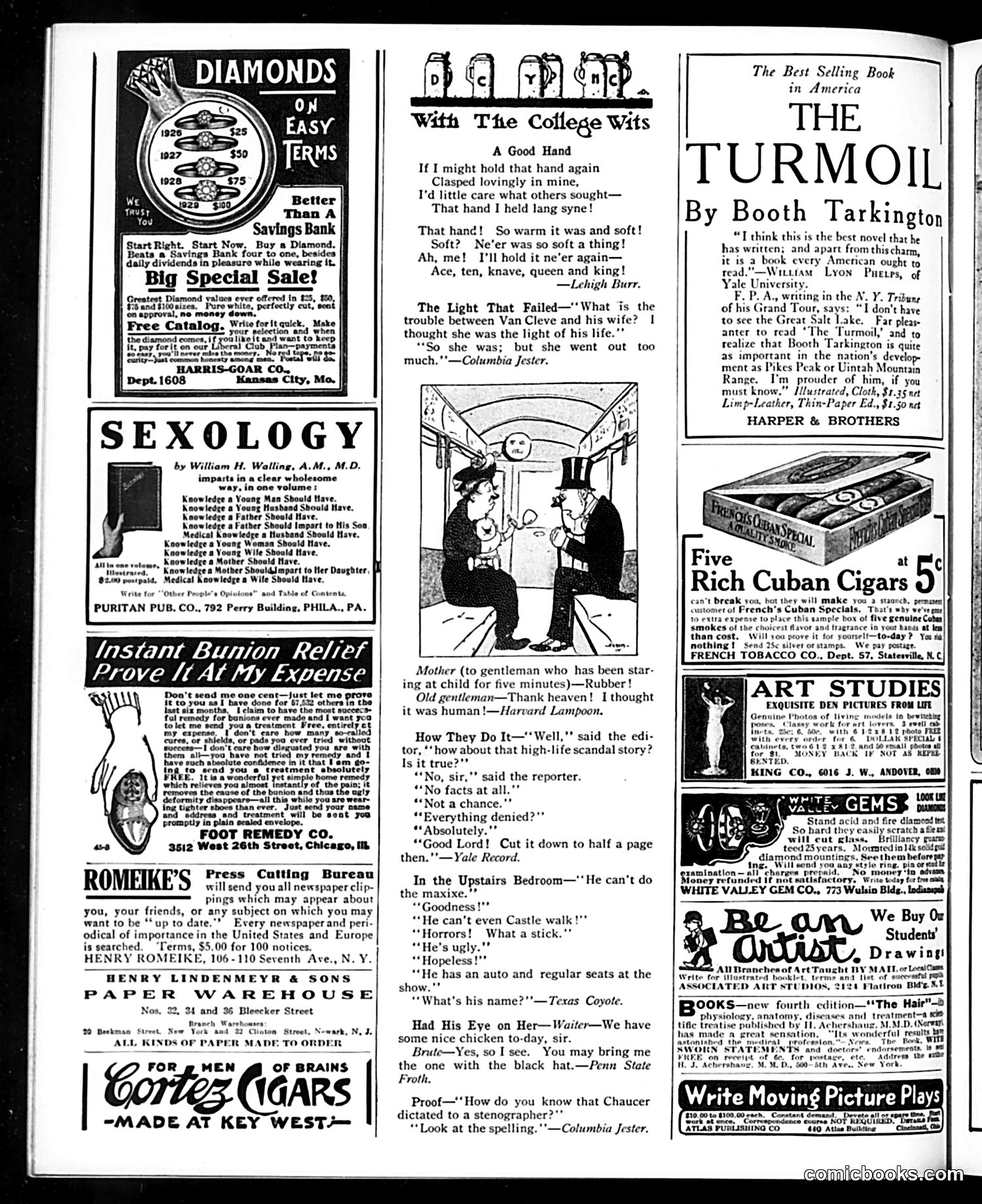
This is primarily a **advertisements and humor page** from Judge magazine, likely from the 1910s-1920s. ## The Content: The page features two cartoon sections labeled "With The College Wits"—a collection of brief jokes and witty exchanges attributed to college humor magazines (Lehigh Burr, Columbia Jester, Harvard Lampoon, Yale Record, Texas Coyote, Penn State Froth). The humor is **mild romantic/social comedy**: A man fondly remembers holding a woman's hand—revealed to be poker cards (Ace through King). A wife's "light" goes out because she leaves the house too often. A woman mistakes a rubber doll for a human baby. ## The Advertisements: The page is dominated by **mail-order ads typical of the era**: diamonds on installment plans, a sex education book promising wholesome knowledge, bunion remedies, and a newspaper clipping service—all promising solutions via postal order. **For modern readers**: This reflects an era when magazines subsidized content through aggressive advertising, and when mail-order businesses promised personal solutions to embarrassing problems.
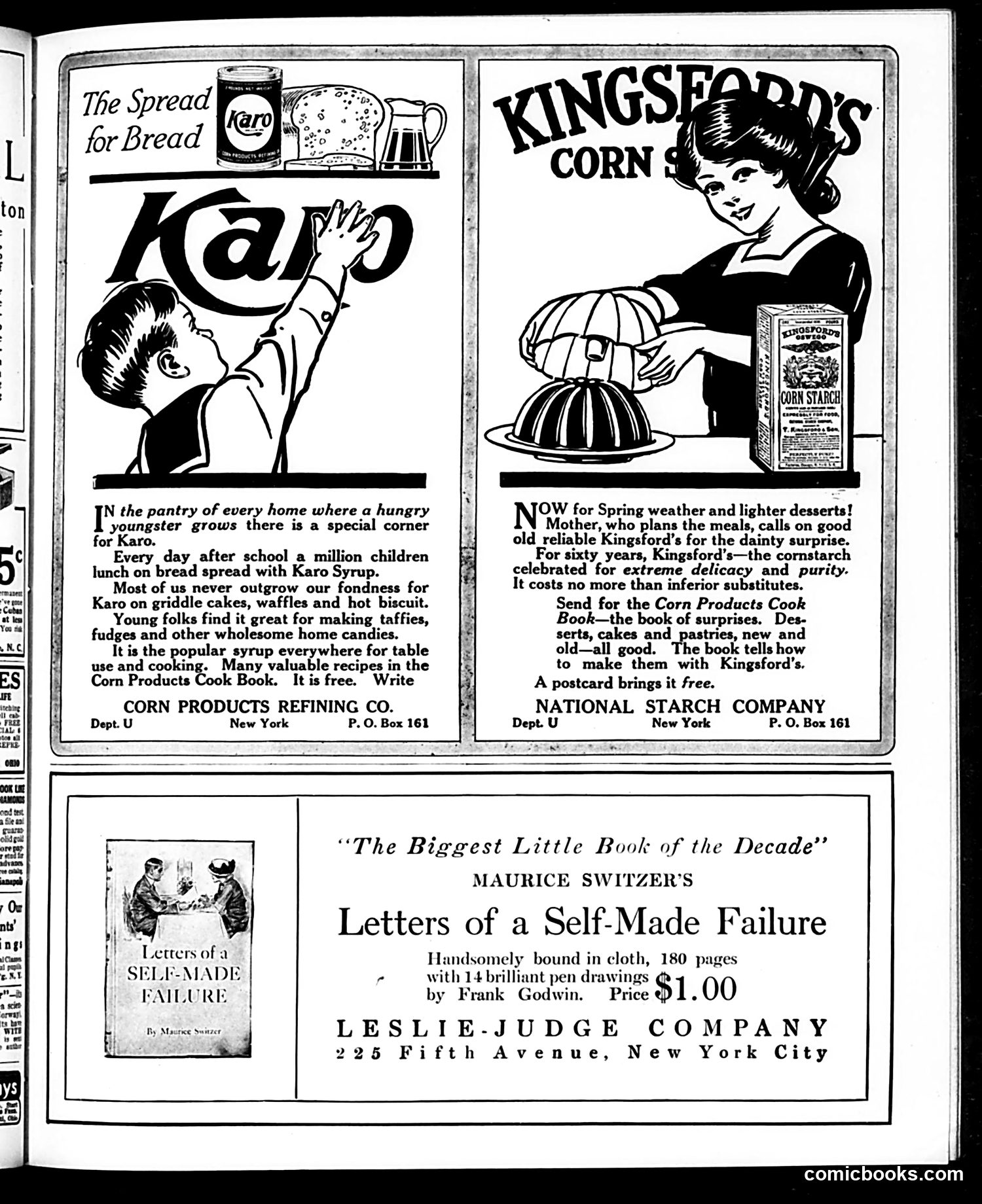
This is primarily a **advertising page**, not satire or political commentary. It contains three product advertisements from the early 20th century: 1. **Karo Syrup** (left): Shows a child reaching for the Karo logo. The ad appeals to parents by claiming the syrup is a wholesome staple in "every home where a hungry youngster grows," positioning it as essential for children's meals and homemade candy-making. 2. **Kingsford's Cornstarch** (right): Features a woman presenting molded desserts, marketing the product for "spring weather and lighter desserts." It emphasizes 60 years of reputation and claims superiority over "inferior substitutes." 3. **"Letters of a Self-Made Failure"** (bottom): Advertises Maurice Switzer's book as "the biggest little book of the decade," priced at $1.00, with illustrations by Frank Godwin. The page reflects early-1900s consumer marketing—targeting housewives and mothers with appeals to domestic duty, tradition, and economy. There is no apparent satire or political content.
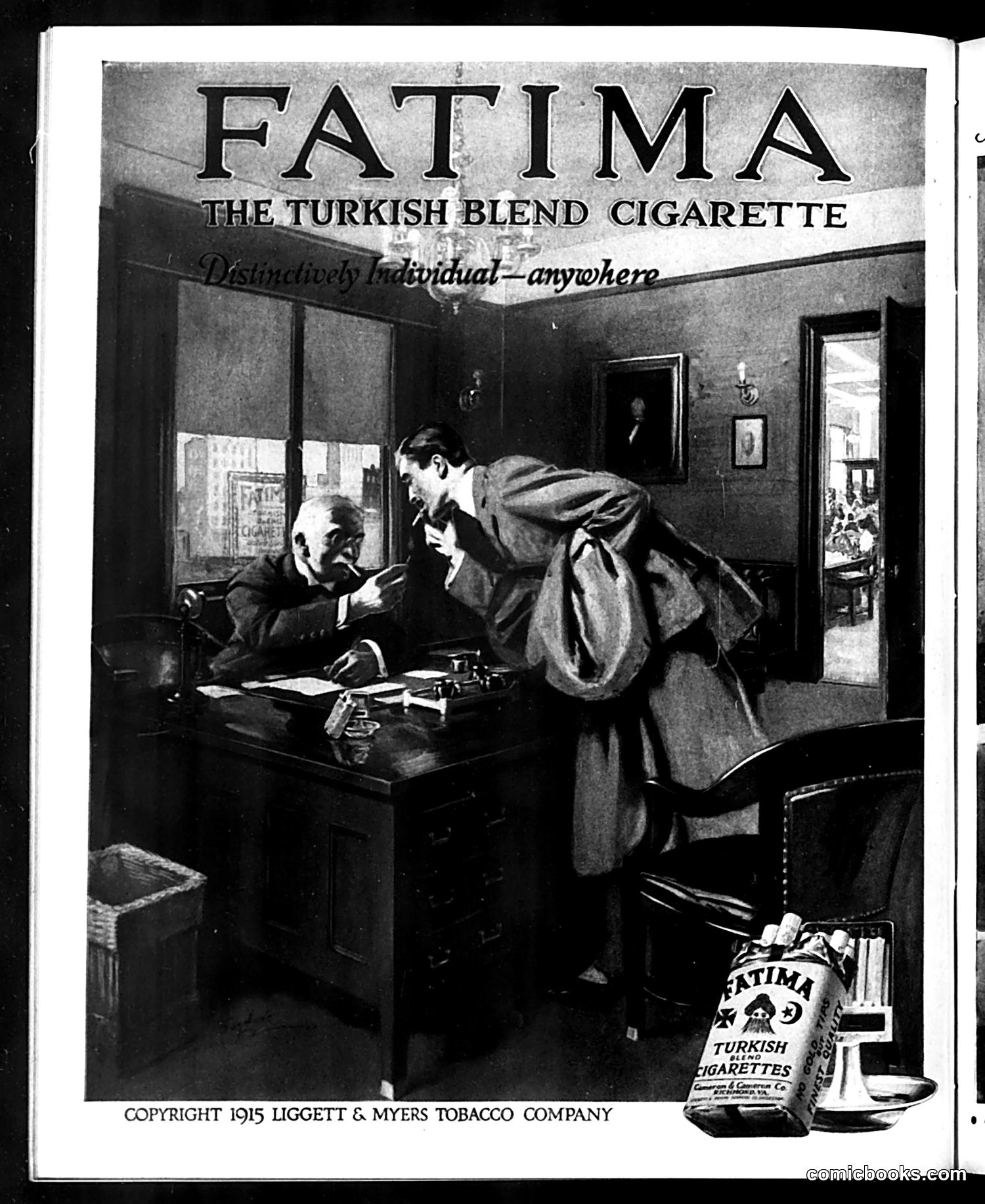
This is a **cigarette advertisement**, not editorial satire. It promotes Fatima Turkish blend cigarettes by Liggett & Myers Tobacco Company. The ad depicts an office scene where a well-dressed man leans toward a seated businessman's desk, apparently offering or discussing cigarettes. The tagline reads "Distinctively individual—anywhere," positioning the product as a sophisticated, portable choice for professionals. The lower right shows a Fatima cigarette package. This represents typical early 20th-century advertising strategy: using elegant imagery and aspirational office settings to market cigarettes to the business class. The "Turkish blend" designation was a major selling point of the era, suggesting exotic quality and premium status compared to domestic varieties.