
Judge, 1915-04-24 · page 11 of 24
Judge — April 24, 1915 — page 11: what you’re looking at
What you’re looking at
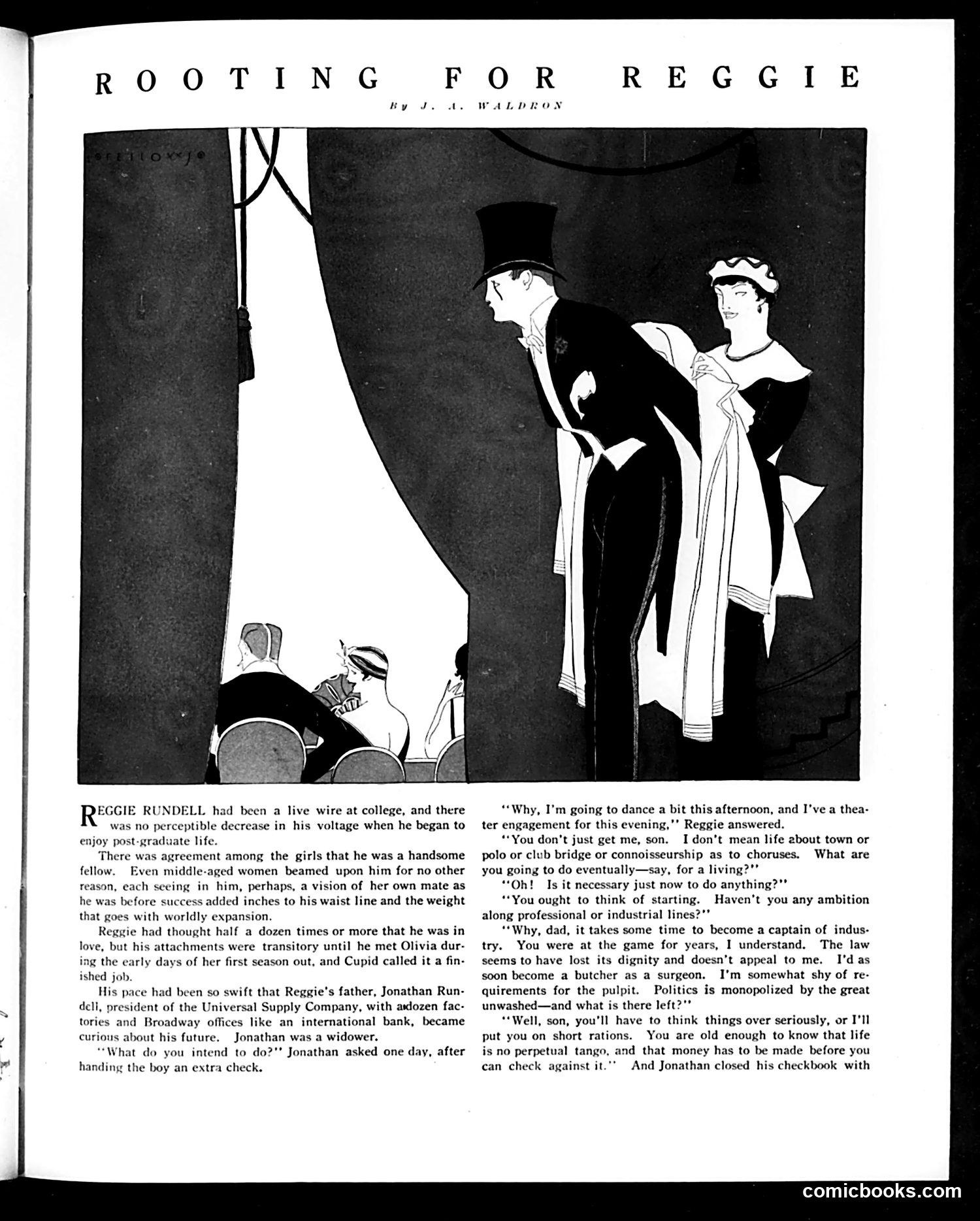
This is a satirical story about idle wealthy youth. Reggie Rundell, son of a successful industrialist (Jonathan Rundell, president of Universal Supply Company), represents the leisured upper class. While his father built an empire, Reggie spends his days dancing, theater-going, and pursuing romance with a debutante named Olivia. The satire targets Reggie's aimlessness and entitlement. When his father demands to know his life plans, Reggie dismisses all respectable professions—law, medicine, religion, politics—as beneath him or unappealing. He expects to live indefinitely on his father's wealth without contributing. The "rooting" reference suggests the story examines whether Reggie will develop ambition or remain a parasitic "live wire" dependent on paternal checks. Jonathan's ultimatum—think seriously or face financial cuts—sets up the narrative tension. The satire mocks the idle rich who inherit wealth but lack industry or purpose.
📄 Transcribed text from this page (OCR, searchable)
Machine-transcribed from the original scan — historical spelling and the odd misread are preserved.
ROOTING By J. R GIE RUNDELL had been a live wire at college, and there was no perceptible decrease in his voltage when he began to -graduate life. There was agreement among the girls that he was a handsome fellow. en middle-aged women beamed upon him for no other reason, each seeing in him, perhaps, a vision of her own mate as he was before success added inches to his waist line and the weight that goes with worldly expansion. Reggie had thought half a dozen times or more that he was in love, but his attachments were transitory until he met Olivia dur- ing the early days of her first season out, and Cupid called it a fin- ished job. His pace had been so swift that Reggie's father, Jonathan Run- dell, president of the Universal Supply Company, with asdozen fac- tories and Broadway offices like an international bank, became curious about his future. Jonathan was a widower. “What do you intend to do?" Jonathan asked one day, after handing the boy an extra check. enjoy po: OR REGGIE WALDRON “Why, I’m going to dance a bit this afternoon, and I've a thea- ter engagement for this evening,"’ Reggie answered. “You don't just get me, son. I don’t mean life about town or polo or club bridge or connoisseurship as to choruses. What are you going to do eventually—say, for a living?’"’ “Oh! Is it necessary just now to do anything?"’ “*You ought to think of starting. Haven't you any ambition along professional or industrial lines?"’ “Why, dad, it takes some time to become a captain of indus- try. You were at the game for years, I understand. The law seems to have lost its dignity and doesn’t appeal to me. I'd as soon become a butcher as a surgeon. I'm somewhat shy of re- quirements for the pulpit. Politics is monopolized by the great unwashed—and what is there left? “Well, son, you'll have to think things over seriously, or I'll put you on short rations. You are old enough to know that life is no perpetual tango, and that money has to be made before you can check against it. And Jonathan closed his checkbook with comicbooks.com