
Judge, 1915-04-24 · page 15 of 24
Judge — April 24, 1915 — page 15: what you’re looking at
What you’re looking at
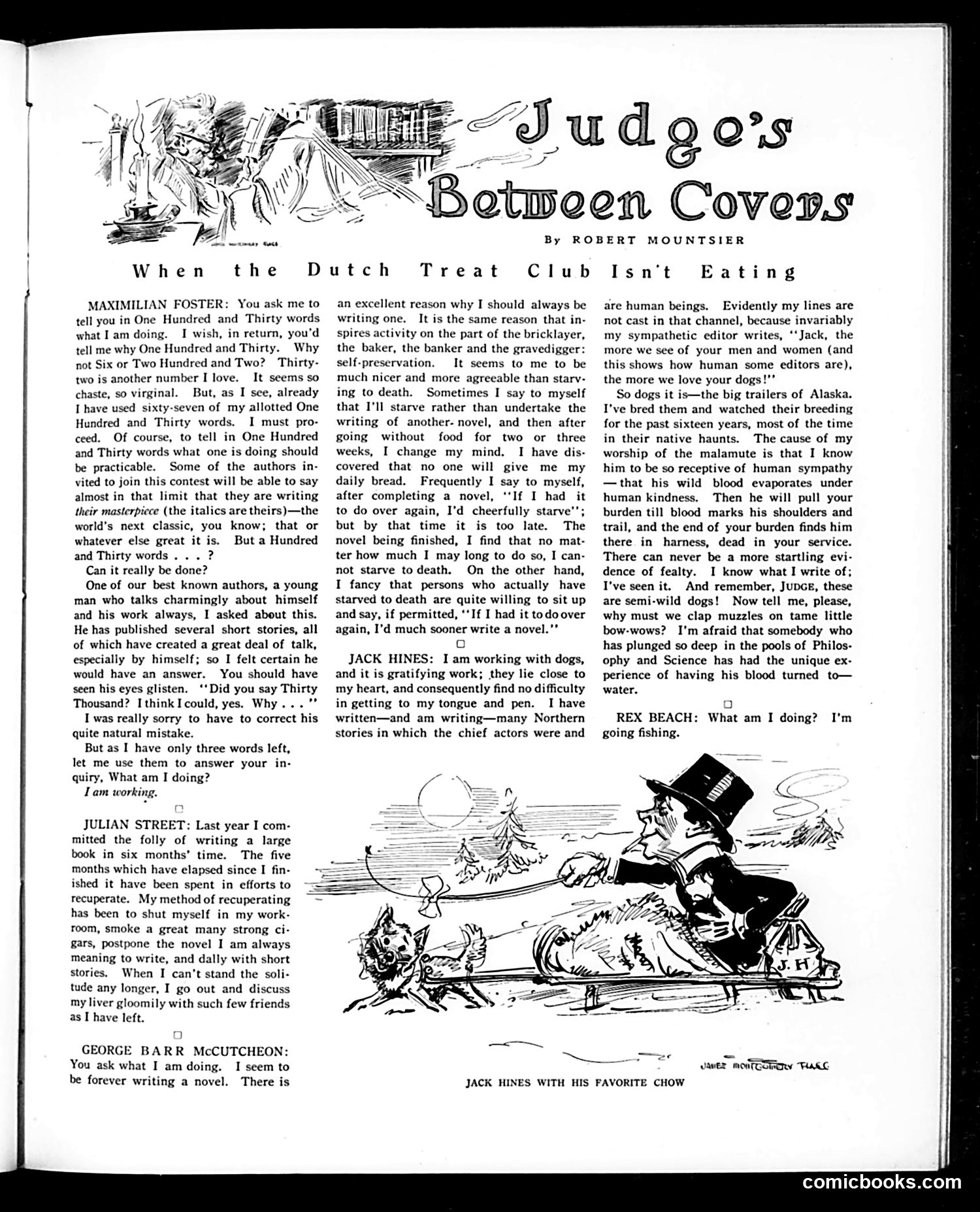
This page features brief comedic essays by established American authors responding to a constraint: describe what they're doing in exactly 100-130 words. The satire targets literary pretension and writers' excuses. **Key figures and their jokes:** - **Maximilian Foster** mocks the absurdity of arbitrary word limits, spending most of his allotment complaining rather than answering - **Julian Street** humorously depicts the exhaustion of completing a six-month novel, now recuperating through cigars and complaining to friends about his liver - **George Barr McCutcheon** uses economic necessity as a punchline—he must write novels constantly to avoid starvation, yet can't actually starve once he's finished - **Jack Hines** admits editors prefer his dog stories over human characters The cartoon below shows Hines with sled dogs, illustrating his point. The satire deflates romantic notions of authorship, revealing that professional writers are motivated by practical survival needs rather than artistic inspiration.
📄 Transcribed text from this page (OCR, searchable)
Machine-transcribed from the original scan — historical spelling and the odd misread are preserved.
When D MAXIMILIAN FOSTER: You ask me to tell you in One Hundred and Thirty words what Iam doing. I wish, in return, you'd tell me why One Hundred and Thirty. Why not Six or Two Hundred and Two? Thirty- two is another number I love. It seems so chaste, so virginal. But, as I see, already I have used sixty-seven of my allotted One Hundred and Thirty words. I must pro- ceed. Of course, to tell in One Hundred and Thirty words what one is doing should be practicable. Some of the authors in- vited to join this contest will be able to say almost in that limit that they are writing their masterpiece (the italics are theirs)—the world’s next classic, you know; that or whatever else great it is. But a Hundred and Thirty words... ? Can it really be done? One of our best known authors, a young man who talks charmingly about himself and his work always, I asked about this. He has published several short stories, all of which have created a great deal of talk, especially by himself; so I felt certain he would have an answer. You should have seen his eyes glisten. ‘‘Did you say Thirty Thousand? I think I could, yes. Why..." I was really sorry to have to correct his quite natural mistake. But as I have only three words left, let me use them to answer your in- quiry, What am I doing? Iam working. JULIAN STREET: Last year I com- mitted the folly of writing a large book in six months’ time. The five months which have elapsed since I fin- ished it have been spent in efforts to recuperate. My method of recuperating has been to shut myself in my work- room, smoke a great many strong ci- gars, postpone the novel I am always meaning to write, and dally with short stories. When I can’t stand the soli- tude any longer, I go out and discuss my liver gloomily with such few friends as I have left. o GEORGE BARR McCUTCHEON: You ask what I am doing. I seem to be forever writing a novel. There is “J udgo's tmeen Covers By ROBERT MOUNTSIER utch Treat an excellent reason why I should always be writing one. It is the same reason that in- spires activity on the part of the bricklayer, the baker, the banker and the gravedigger: self-preservation. It seems to me to be much nicer and more agreeable than starv- ing to death. Sometimes I say to myself that I'll starve rather than undertake the writing of another- novel, and then after going without food for two or three weeks, I change my mind. I have dis- covered that no one will give me my daily bread. Frequently I say to myself, after completing a novel, ‘‘If I had it to do over again, I'd cheerfully starve’’; but by that time it is too late. The novel being finished, I find that no mat- ter how much I may long to do so, I can- not starve todeath. On the other hand, I fancy that persons who actually have starved to death are quite willing to sit up and say, if permitted, ‘‘If I had it todoover again, I’d much sooner write a novel."* ia) JACK HINES: I am working with dogs, and it is gratifying work; they lie close to my heart, and consequently find no difficulty in getting to my tongue and pen. I have written—and am writing—many Northern stories in which the chief actors were and Club Isn't Eating are human beings. Evidently my lines are not cast in that channel, because invariably my sympathetic editor writes, ‘‘Jack, the more we see of your men and women (and this shows how human some editors are), the more we love your dogs!"” So dogs it is—the big trailers of Alaska. I've bred them and watched their breeding for the past sixteen years, most of the time in their native haunts. The cause of my worship of the malamute is that I know him to be so receptive of human sympathy —that his wild blood evaporates under human kindness. Then he will pull your burden till blood marks his shoulders and trail, and the end of your burden finds him there in harness, dead in your service. There can never be a more startling evi- dence of fealty. I know what I write of; I've seen it. And remember, JuDGE, these are semi-wild dogs! Now tell me, please, why must we clap muzzles on tame little bow-wows? I'm afraid that somebody who has plunged so deep in the pools of Philos- ophy and Science has had the unique ex- perience of having his blood turned to— water. o REX BEACH: What am I doing? I’m going fishing. aver moitGobery FAR JACK HINES WITH HIS FAVORITE CHOW comicbooks.com