
Judge, 1915-04-24 · page 8 of 24
Judge — April 24, 1915 — page 8: what you’re looking at
What you’re looking at
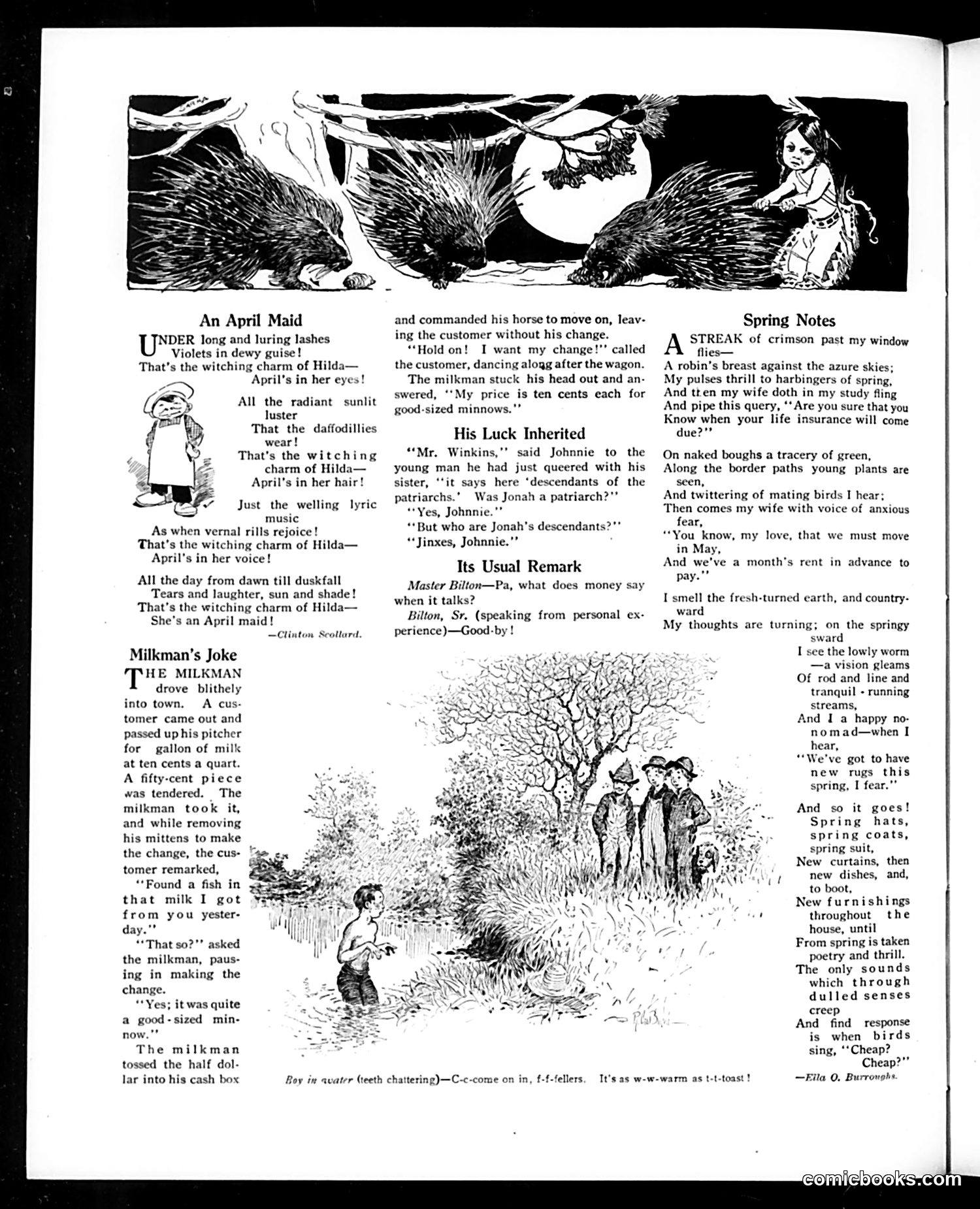
This page from *Judge* magazine contains three separate humorous pieces reflecting early 20th-century American life: **"An April Maid"** is a romantic poem celebrating spring and femininity, with no political content—pure sentiment. **"Milkman's Joke"** satirizes petty dishonesty in commerce. A milkman, offended by a customer's complaint about finding a fish in the milk, retaliates by keeping his change, claiming he now charges "ten cents each for good-sized minnows." The satire targets working-class fraud and tit-for-tat disputes over milk quality and pricing. **"Spring Notes"** and the domestic cartoons mock married life's financial burdens. A husband yearns for spring's romance and outdoor freedom, but his wife repeatedly interrupts with demands for new clothes, furniture, dishes, and rent payments. The satire—targeting middle-class consumer culture and wives' spending—reflects period anxieties about domestic expenses and changing gender dynamics in consumer society. The cold-water boy illustration appears unrelated contextual humor.
📄 Transcribed text from this page (OCR, searchable)
Machine-transcribed from the original scan — historical spelling and the odd misread are preserved.
An April Maid DER long and luring lashes Violets in dewy guise! That's the witching charm of Hilda— ‘April's in her eyes! All the radiant sunlit luster That the daffodillies wear! That's the witching charm of Hilda— April's in her hair! Just the welling music As when vernal rills rejoice! That's the witching charm of Hilda— April's in her voice! All the day from dawn till duskfall Tears and laughter, sun and shade! That's the witching charm of Hilda— She's an April maid! —Clinton Scoltard. lyric Milkman’s Joke HE MILKMAN drove blithely into town. A cus- tomer came out and passed up his pitcher for gallon of milk at ten cents a quart. A fifty-cent piece was tendered. The milkman took it, and while removing his mittens to make the change, the cus- © tomer remarked, “Found a fish in that milk I got from you yester- day." “That so?” asked the milkman, paus- ing in making the t was quite a good-sized min- The milkman tossed the half dol- lar into his cash box Boy in avater (teeth chattering)—C-c-come on in, f-f-fellers and commanded his horse to move on, leav- ing the customer without his change. “Hold on! I want my change!"’ called the customer, dancing alogg after the wagon. The milkman stuck his head out and an- swered, ‘‘My price is ten cents each for good-sized minnows."” His Luck Inherited “Mr. Winki said Johnnie to the young man he had just queered with his sister, ‘‘it says here ‘descendants of the patriarchs.’ Was Jonah a patriarch?"’ “Yes, Johnn “But who are Jonah's descendants?"* **Jinxes, Johnnie.”” Its Usual Remark Master Bilton—Pa, what does money say when it talks? Bilton, Sr. (speaking from personal ex- perience)—Good-by ! It's as w-w-warm as t-t-toast! Spring Notes A STREAK of crimson past my window flies— A robin’s breast against the azure skies; My pulses thrill to harbingers of spring, And tren my wife doth in my study fling And pipe this query, **Are you sure that you Know when your life insurance will come due?”’ On naked boughs a tracery of green, Along the border paths young plants are seen, And twittering of mating birds I hear; Then comes my wife with voice of anxious fear, “*You know, my love, that we must move in May, And we've a month's rent in advance to pay.”” I smell the fresh-turned earth, and country- ward My thoughts are turning; on the springy sward I see the lowly worm —a vision gleams Of rod and line and tranquil - running streams, And I a happy no- nomad—when I hear, “We've got to have new rugs this spring, I fear."’ And so it goes! Spring hats, spring coats, spring suit, New curtains, then new dishes, and, to boot, New furnishings throughout the house, until From spring is taken poetry and thrill. The only sounds which through dulled senses creep And find response is when birds sing, ‘*Cheap? Cheap?” —Eila 0. Burroughs. 3.08 / prArre