
Judge, 1915-04-24 · page 5 of 24
Judge — April 24, 1915 — page 5: what you’re looking at
What you’re looking at
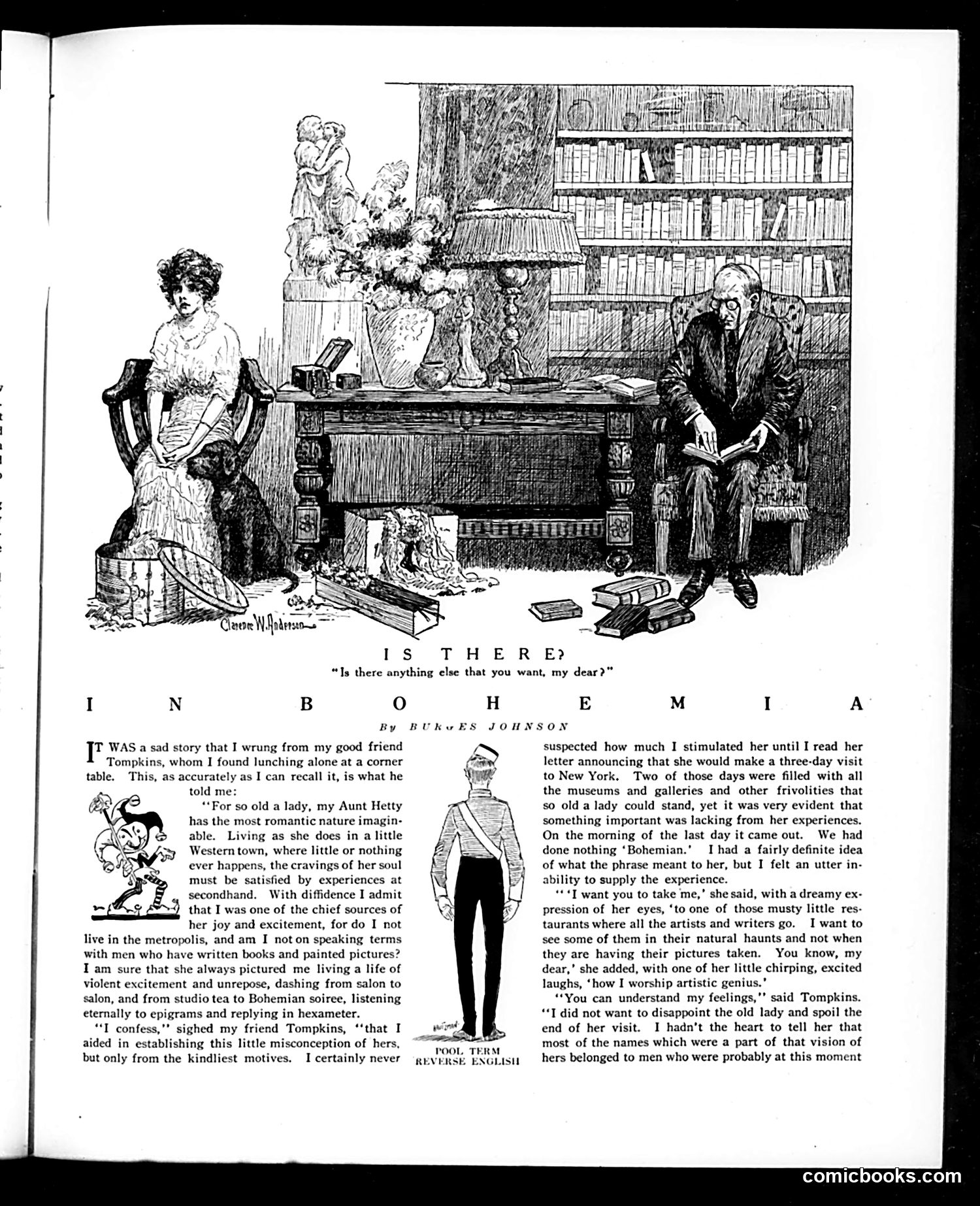
This page presents a short story illustrated by Charles Wilkinson. The narrative concerns a woman named Tompkins who lives a dull life in a Western town and craves cultural and romantic excitement. Her friend attempts to fulfill her wishes by arranging a three-day New York visit featuring museums, galleries, and artistic venues. The cartoon's humor derives from the gap between her romantic expectations of bohemian life and artistic society versus mundane reality. The illustration shows a well-dressed couple in a library—likely depicting the disappointed outcome of her cultural aspirations. The satirical point critiques how urban sophistication and "bohemian" experiences often fail to deliver the transformative excitement promised to provincial seekers.
📄 Transcribed text from this page (OCR, searchable)
Machine-transcribed from the original scan — historical spelling and the odd misread are preserved.
T HER E? “Is there anything else that you want, my dear?” I N B oO By T WAS a sad story that I wrung from my good friend Tompkins, whom I found lunching alone at a corner table. This, as accurately as I can recall it, is what he told me: “*For so old a lady, my Aunt Hetty has the most romantic nature imagin- able. Living as she does in a little Western town, where little or nothing ever happens, the cravings of her soul must be satisfied by experiences at secondhand. With diffidence I admit that I was one of the chief sources of her joy and excitement, for do I not live in the metropolis, and am I not on speaking terms with men who have written books and painted pictures? I am sure that she always pictured me living a life of violent excitement and unrepose, dashing from salon to salon, and from studio tea to Bohemian soiree, listening eternally to epigrams and replying in hexameter. “I confess,’’ sighed my friend Tompkins, ‘‘that I aided in establishing this little misconception of hers, but only from the kindliest motives. I certainly never H E M I A BUKwES JOHNSON POOL TER REVERSE ENGLISH suspected how much I stimulated her until I read her letter announcing that she would make a three-day visit to New York. Two of those days were filled with all the museums and galleries and other frivolities that so old a lady could stand, yet it was very evident that something important was lacking from her experiences. On the morning of the last day it came out. We had done nothing ‘Bohemian.’ I had a fairly definite idea of what the phrase meant to her, but I felt an utter in- ability to supply the experience. “**T want you to take me,’ shes with a dreamy ex- pression of her eyes, ‘to one of those musty little res- taurants where all the artists and writers go. I want to see some of them in their natural haunts and not when they are having their pictures taken. You know, my dear,’ she added, with one of her little chirping, excited laughs, ‘how I worship artistic genius.’ “You can understand my feelings,’’ said Tompkins. “‘I did not want to disappoint the old lady and spoil the end of her visit. I hadn't the heart to tell her that most of the names which were a part of that vision of hers belonged to men who were probably at this moment comicbooks.com