
Judge, 1915-04-24 · page 9 of 24
Judge — April 24, 1915 — page 9: what you’re looking at
What you’re looking at
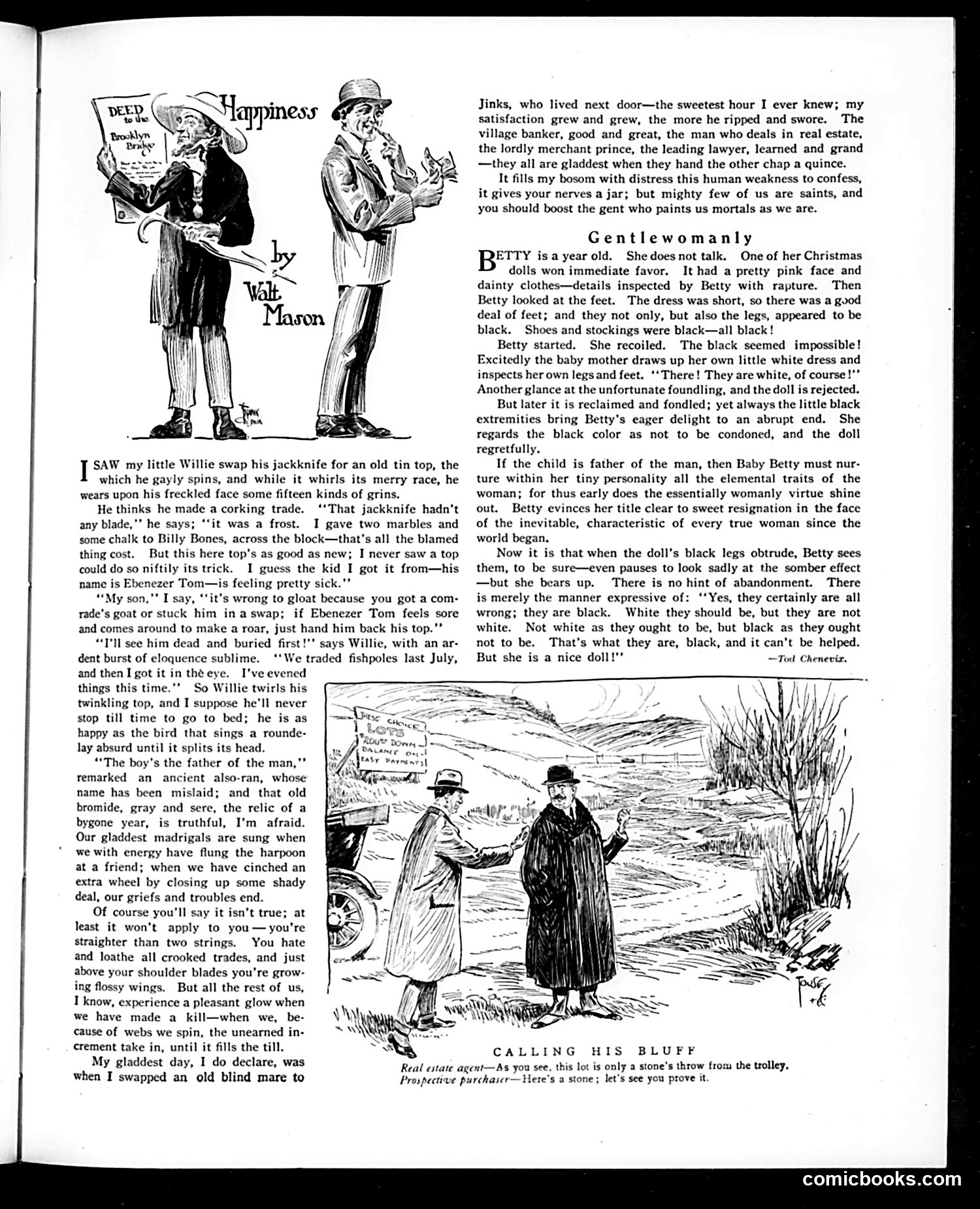
This page contains two separate satirical pieces by Walt Mason: **"Happiness"** (left): A father observes his son Willie gleefully trading away a broken jackknife to get a spinning top from a boy named Ebenezer Tom—apparently revenge for a previous unfair trade involving fishpoles. The satire critiques human nature: the father moralizes about fairness, but Mason's narrator reveals society's actual values. Bankers, merchants, and lawyers are "gladdest" when they've cheated someone. The piece mocks hypocrisy—we celebrate cunning and profit-taking while pretending to virtue. **"Gentlewomanly"** (right): A one-year-old girl named Betty rejects a Christmas doll because its painted legs and feet are black, while her own legs are white. She repeatedly reclaims and rejects it. Mason suggests this demonstrates how early children—particularly girls—absorb racist attitudes and standards of beauty from society. The satire criticizes how prejudice becomes "natural" through childhood conditioning. Both pieces use gentle domestic humor to expose uncomfortable social truths about greed and racism.
📄 Transcribed text from this page (OCR, searchable)
Machine-transcribed from the original scan — historical spelling and the odd misread are preserved.
SAW my little Willie swap his jackknife for an old tin top, the which he gayly spins, and while it whirls its merry race, he wears upon his freckled face some fifteen kinds of grins. He thinks he made a corking trade. ‘*That jackknife hadn't any blade,’’ he says; ‘‘it was a frost. I gave two marbles and some chalk to Billy Bones, across the block—that’s all the blamed thing cost. But this here top's as good as new; I never saw a top could do so niftily its trick. I guess the kid I got it from—his name is Ebenezer Tom—is feeling pretty sick.’” “My son,"’ I say, ‘‘it’s wrong to gloat because you got a com- rade’s goat or stuck him ina swap; if Ebenezer Tom feels sore and comes around to make a roar, just hand him back his top.’” “T'll see him dead and buried first!'’ says Willie, with an ar- dent burst of eloquence sublime. ‘*We traded fishpoles last July, and then I got it in theeye. I’ve evened things this time.’’ So Willie twirls his twinkling top, and I suppose he'll never stop till time to go to bed; he is as happy as the bird that sings a rounde- Jay absurd until it splits its head. “The boy’s the father of the man,”’ remarked an ancient also-ran, whose name has been mislaid; and that old bromide, gray and sere, the relic of a bygone year, is truthful, I'm afraid. Our gladdest madrigals are sung when we with energy have flung the harpoon at a friend; when we have cinched an extra wheel by closing up some shady deal, our griefs and troubles end. Of course you'll say it isn’t true; at least it won't apply to you— you're straighter than two strings. You hate and loathe all crooked trades, and just above your shoulder blades you're grow- ing flossy wings. But all the rest of us, I know, experience a pleasant glow when we have made a kill—when we, be- cause of webs we spin, the unearned in- crement take in, until it fills the till. My gladdest day, I do declare, was when I swapped an old blind mare to Jinks, who lived next door—the sweetest hour I ever knew; my satisfaction grew and grew, the more he ripped and swore. The village banker, good and great, the man who deals in real estate, the lordly merchant prince, the leading lawyer, learned and grand —they all are gladdest when they hand the other chap a quince. It fills my bosom with distress this human weakness to confess, it gives your nerves a jar; but mighty few of us are saints, and you should boost the gent who paints us mortals as we are. Gentlewomanly ETTY isa year old. She doesnot talk. One of her Christmas dolls won immediate favor, It had a pretty pink face and dainty clothes—details inspected by Betty with rapture. Then Betty looked at the feet. The dress was short, so there was a good deal of feet; and they not only, but also the legs, appeared to be black. Shoes and stockings were black—all black! Betty started. She recoiled. The black seemed impossible! Excitedly the baby mother draws up her own little white dress and inspects her own legs and feet. ‘‘There! They are white, of course!’’ Another glance at the unfortunate foundling, and the doll is rejected. But later it is reclaimed and fondled; yet always the little black extremities bring Betty’s eager delight to an abrupt end. She regards the black color as not to be condoned, and the doll regretfully. If the child is father of the man, then Baby Betty must nur- ture within her tiny personality all the elemental traits of the woman; for thus early does the essentially womanly virtue shine out. Betty evinces her title clear to sweet resignation in the face of the inevitable, characteristic of every true woman since the world began, Now it is that when the doll’s black legs obtrude, Betty sees them, to be sure—even pauses to look sadly at the somber effect —but she bears up. There is no hint of abandonment. There is merely the manner expressive of: ‘‘Yes, they certainly are all wrong; they are black. White they should be, but they are not white. Not white as they ought to be, but black as they ought not to be. That's what they are, black, and it can’t be helped. But she is a nice doll!’’ —Tod Cheneviz. HIS BLUFF Real estate agent—As you see, this lot is only a stone's throw from the trolley. Prospective purchaser—Here’s a stone; let's see you prove it CALLING comicbooks.com