
A complete issue · 24 pages · 1914
Judge — August 29, 1914
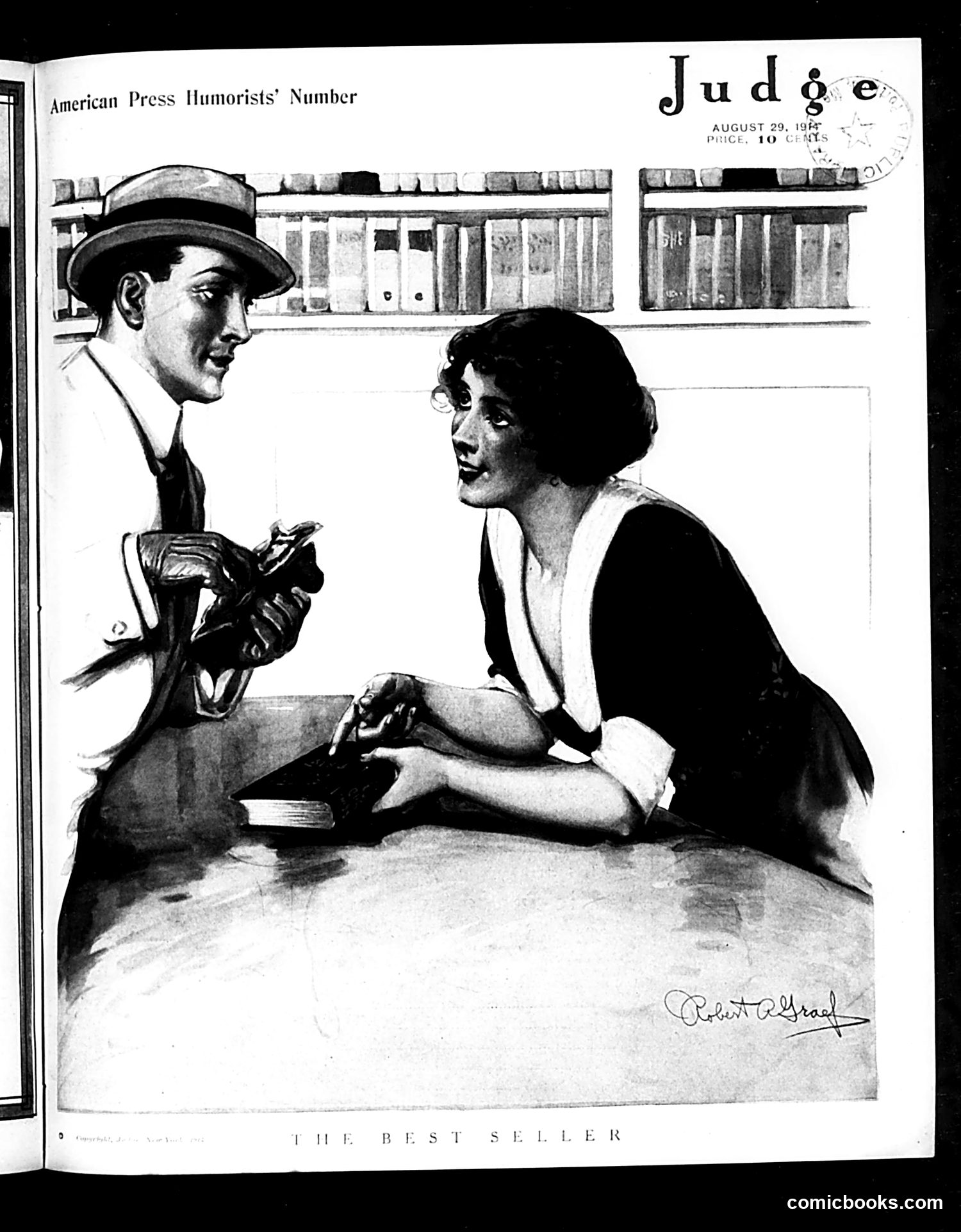
This cartoon depicts a commercial transaction, likely satirizing the publishing or retail industry of the 1920s. A well-dressed man in a hat presents what appears to be a book or product to a woman seated at a counter, with shelves of bottles visible behind them—suggesting a pharmacy, apothecary, or general store setting. The title "The Best Seller" is ironic commentary on commercialism. The cartoon likely mocks either aggressive salesmanship tactics, the commodification of literature, or possibly prohibit-era commerce (given the bottles in the background). The woman's skeptical expression suggests she's being persuaded to buy something of questionable value or necessity. The artist's signature appears to be present at bottom.
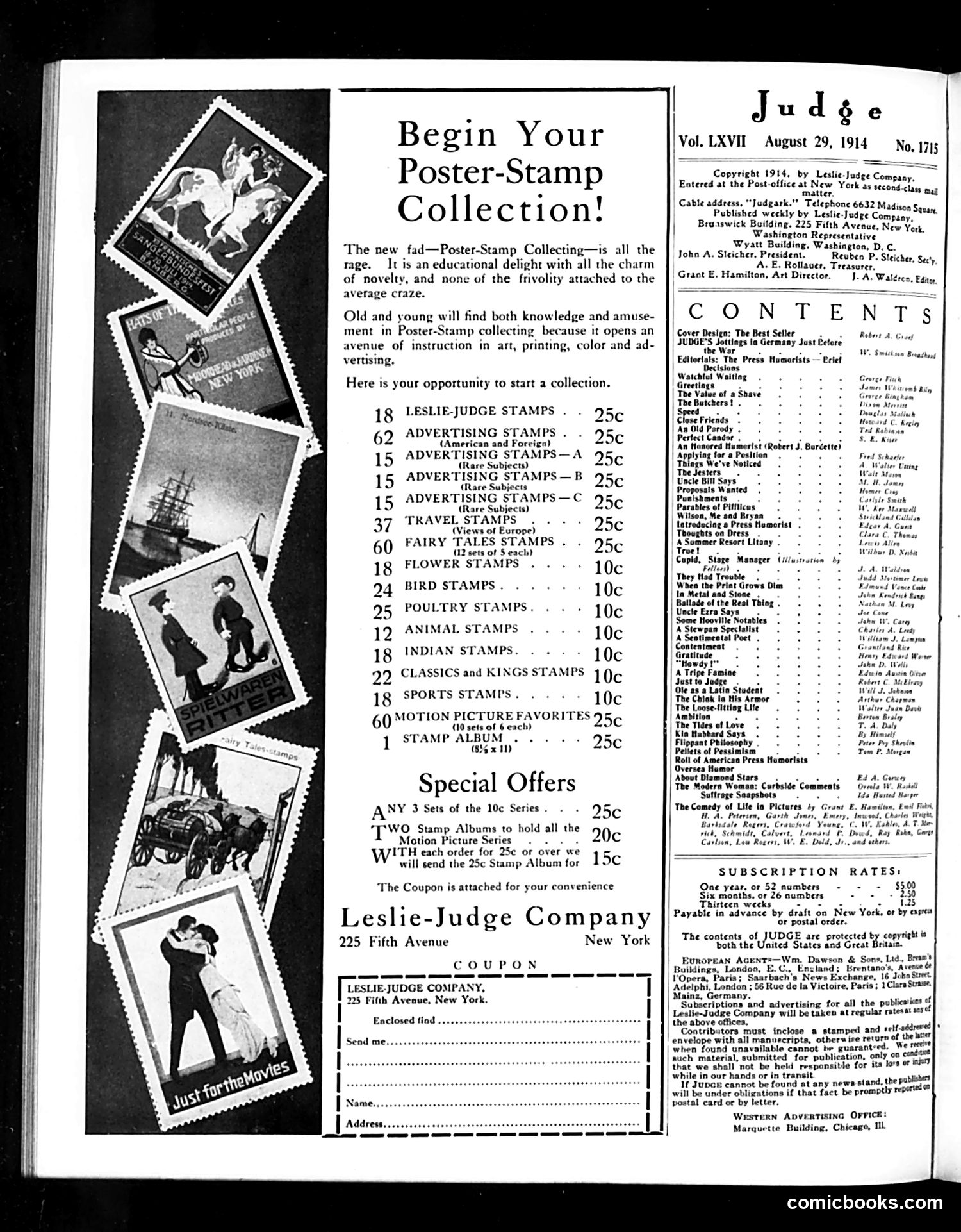
This page is primarily an advertisement for Leslie-Judge Company's "Poster-Stamp Collection"—a collectible series featuring small decorative stamps with various themes (advertising, fairy tales, animals, sports, etc.), priced at 10-25 cents per set. The left side displays sample stamps arranged vertically, showing the decorative nature of these items. The stamps appear to feature movie scenes and illustrated subjects, marketed as educational collectibles teaching "art, printing, color and advertising." The right side contains magazine masthead and contents listings for Judge magazine (August 29, 1914), but these are not clearly legible. This is essentially a commercial promotion disguised as editorial content—typical of early 20th-century magazine advertising practices where product promotions occupied significant space.
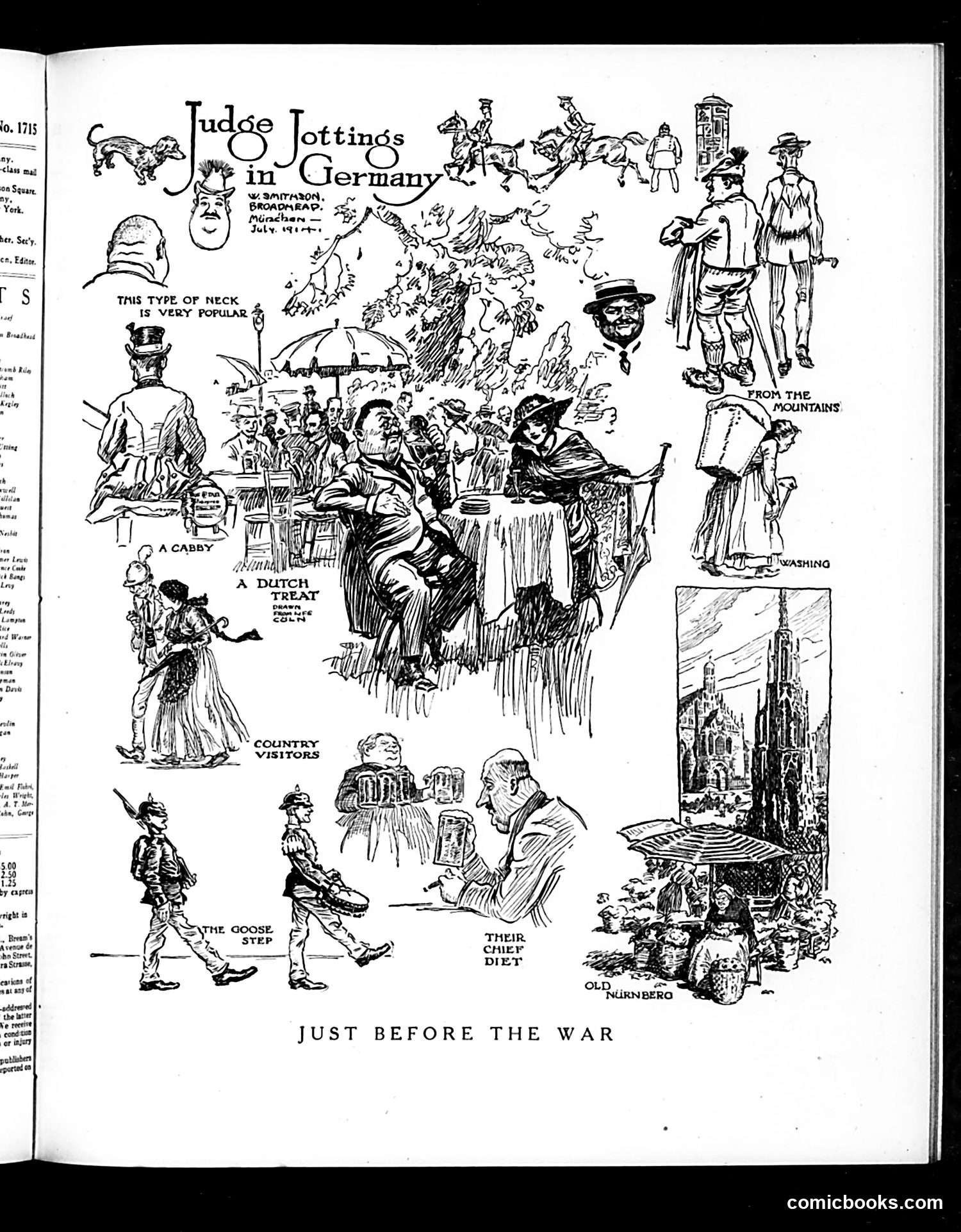
This page presents satirical observations of German culture and society "Just Before the War" (likely 1914, given the July 1914 date visible). The sketches mock various German stereotypes and customs through exaggerated caricature. The illustrations show typical German figures and scenes: a man with an oversized neck ("This type of neck is very popular"), military officers, traditional dress, and architectural landmarks like Nuremberg's cathedral. Labels reference German habits—"A Cabby," "Dutch Treat" (splitting bills), "Country Visitors," "The Goose Step" (military marching), and "Their Chief Diet." The satire appears to present Germans as militaristic, regimented, and peculiar to American eyes, using visual exaggeration and labeled vignettes to create comedic effect through cultural stereotyping common in pre-WWI American publications.
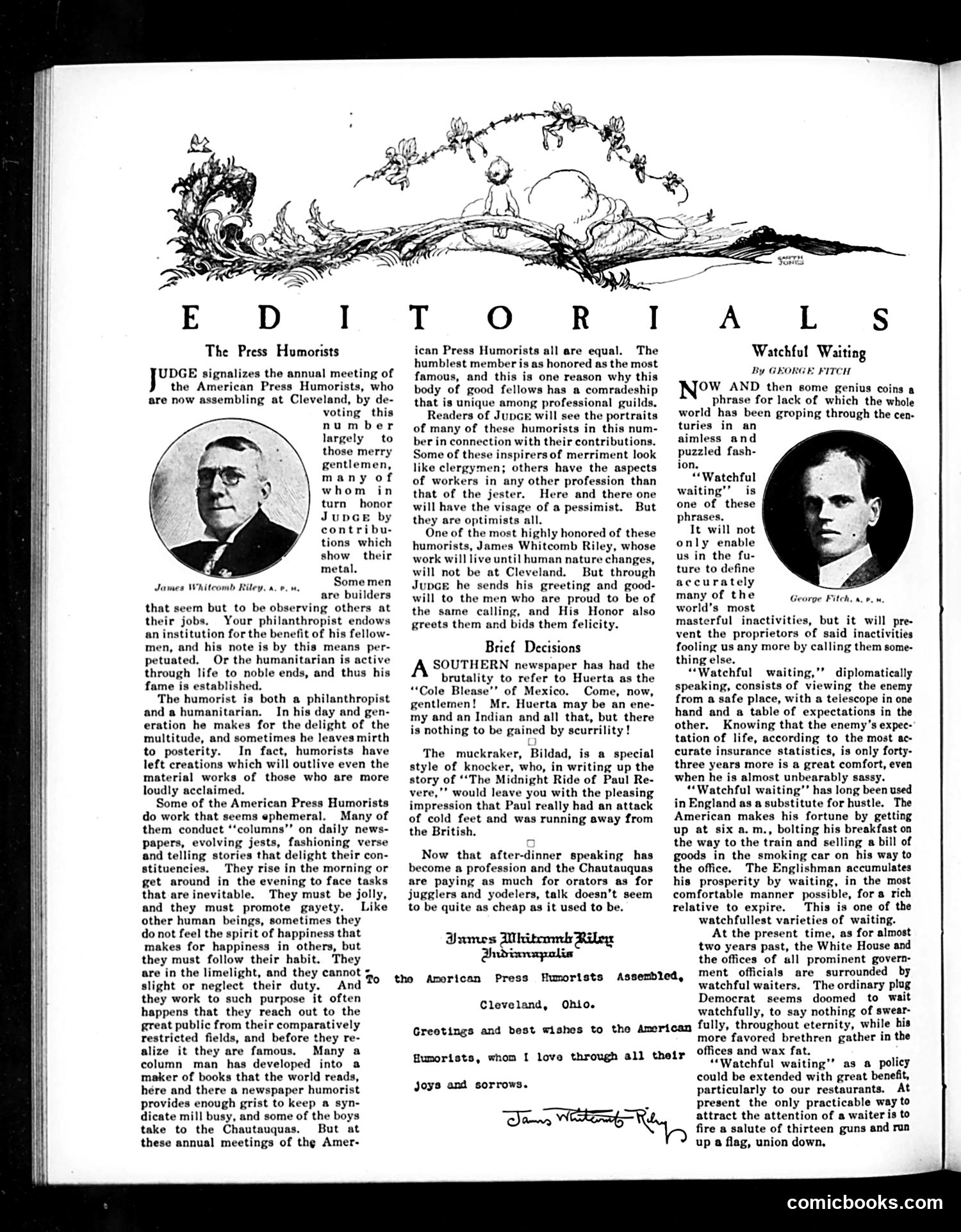
This is an editorial page from *Judge* magazine featuring commentary on the American Press Humorists' annual meeting in Cleveland. The page includes two portraits: **James Whitcomb Riley** (identified as a prominent humorist) and **George Fitch**. The main editorial argues that press humorists are uniquely positioned as philanthropists and social commentators—builders of institutions through their work. It defends humor as a legitimate profession worthy of respect. A secondary piece titled "Watchful Waiting" (attributed to George Fitch) satirizes a diplomatic phrase likely referencing U.S. foreign policy. The author mocks both the phrase's overuse and American officials' tendency to adopt passive stances, suggesting the phrase has become a convenient excuse for inaction or indecision. The satire targets both professional pretense and political rhetoric.
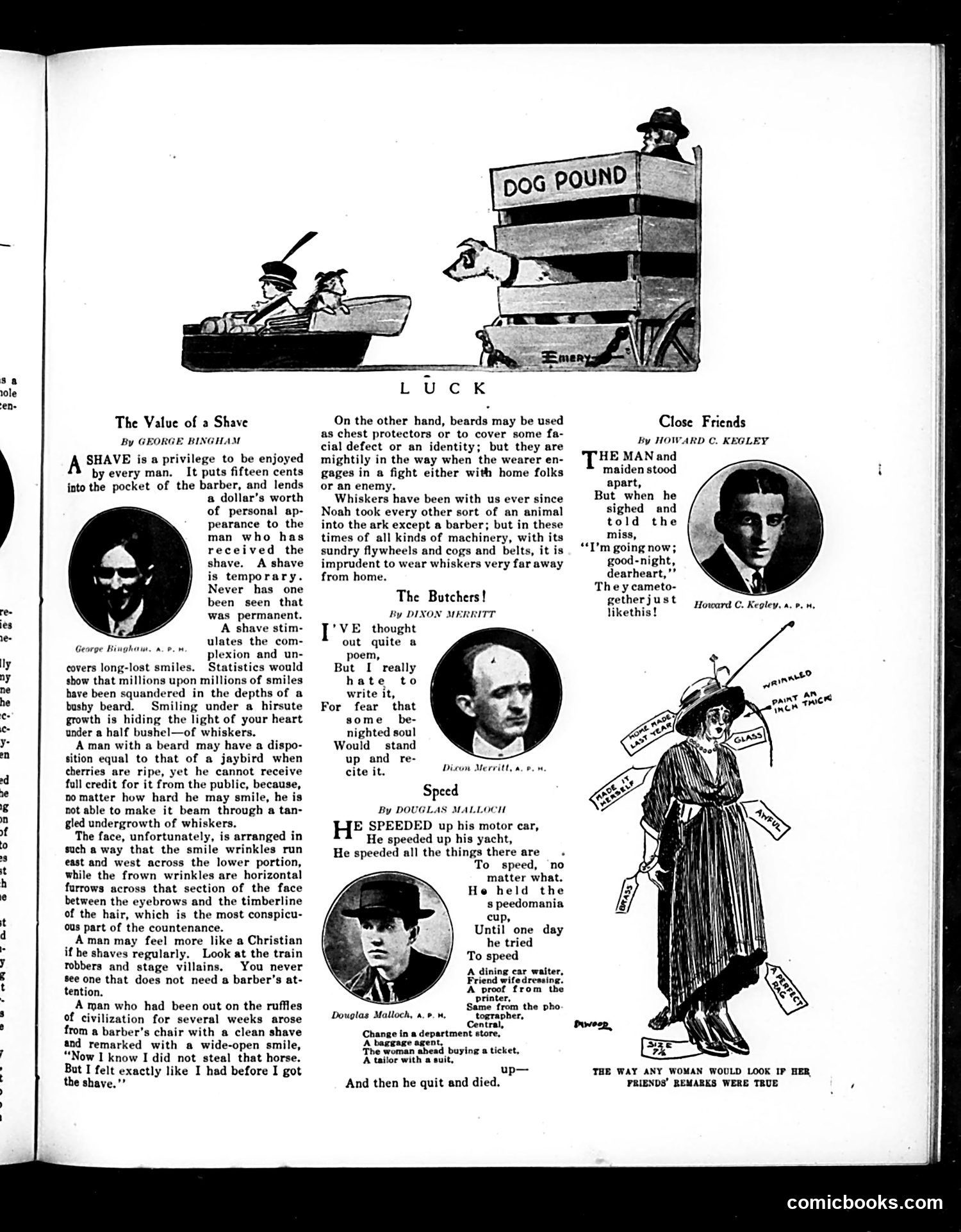
This page contains humorous essays and illustrations on various topics rather than political satire: **"The Value of a Shave"** by George Bixby features a portrait and discusses how shaving improves appearance and mood, with anecdotes about whiskers' disadvantages. **"The Butchers"** by Dixon Merritt is a short poem critiquing people who write poorly, though the connection is unclear. **"Speed"** by Douglas Malloch appears to be a cautionary verse about a man obsessed with speed who eventually dies in a motor car accident—likely reflecting early 20th-century anxieties about automobile dangers. **"Close Friends"** by Howard G. Kepley shows a woman with labeled bags of the things she'd miss about a man—domestic social satire about romantic relationships. The "Dog Pound" cartoon at top appears to be a separate comic gag.
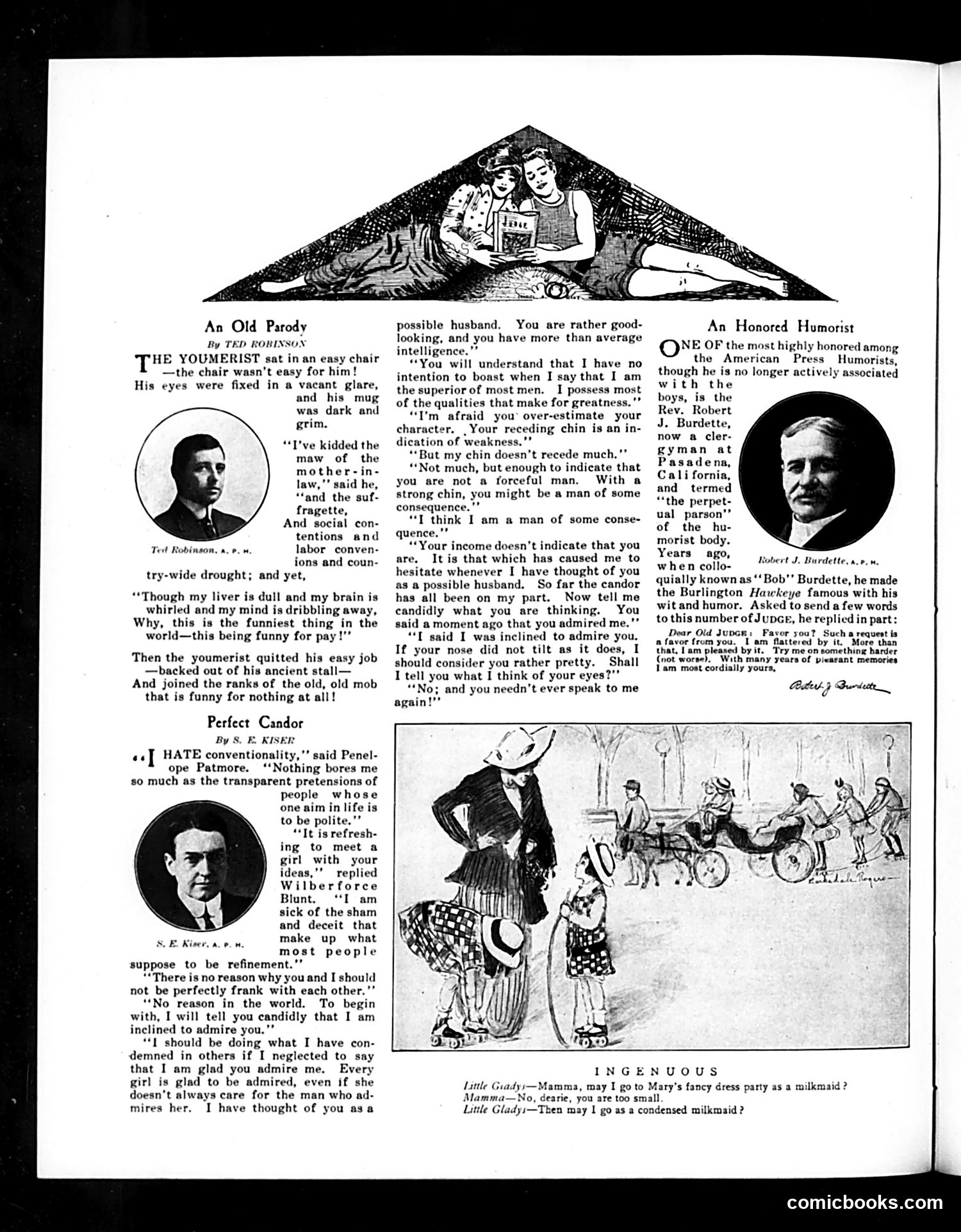
This page contains three distinct humor pieces satirizing American social conventions: **"An Old Parody"** mocks professional humorists who've exhausted their material—the protagonist has joked about mother-in-laws, suffragettes, and labor disputes so thoroughly that he abandons humor writing entirely. **"Perfect Candor"** satirizes the era's pretense of radical honesty. Two young people claim to reject social convention and politeness, but their brutally frank conversation about each other's appearance and income reveals they're simply substituting cruel directness for genuine refinement—still playing a game, just differently. **"An Honored Humorist"** pays tribute to Rev. Robert J. Burdette, a formerly prominent newspaper humorist (Burlington Hawkeye) now working as a clergyman in California. The bottom cartoon, "Ingenuous," is a simple pun: a child asks to attend a fancy dress party as a "condensed milkmaid," playing on the term "condensed milk." The page reflects early-20th-century anxieties about authenticity versus social performance.
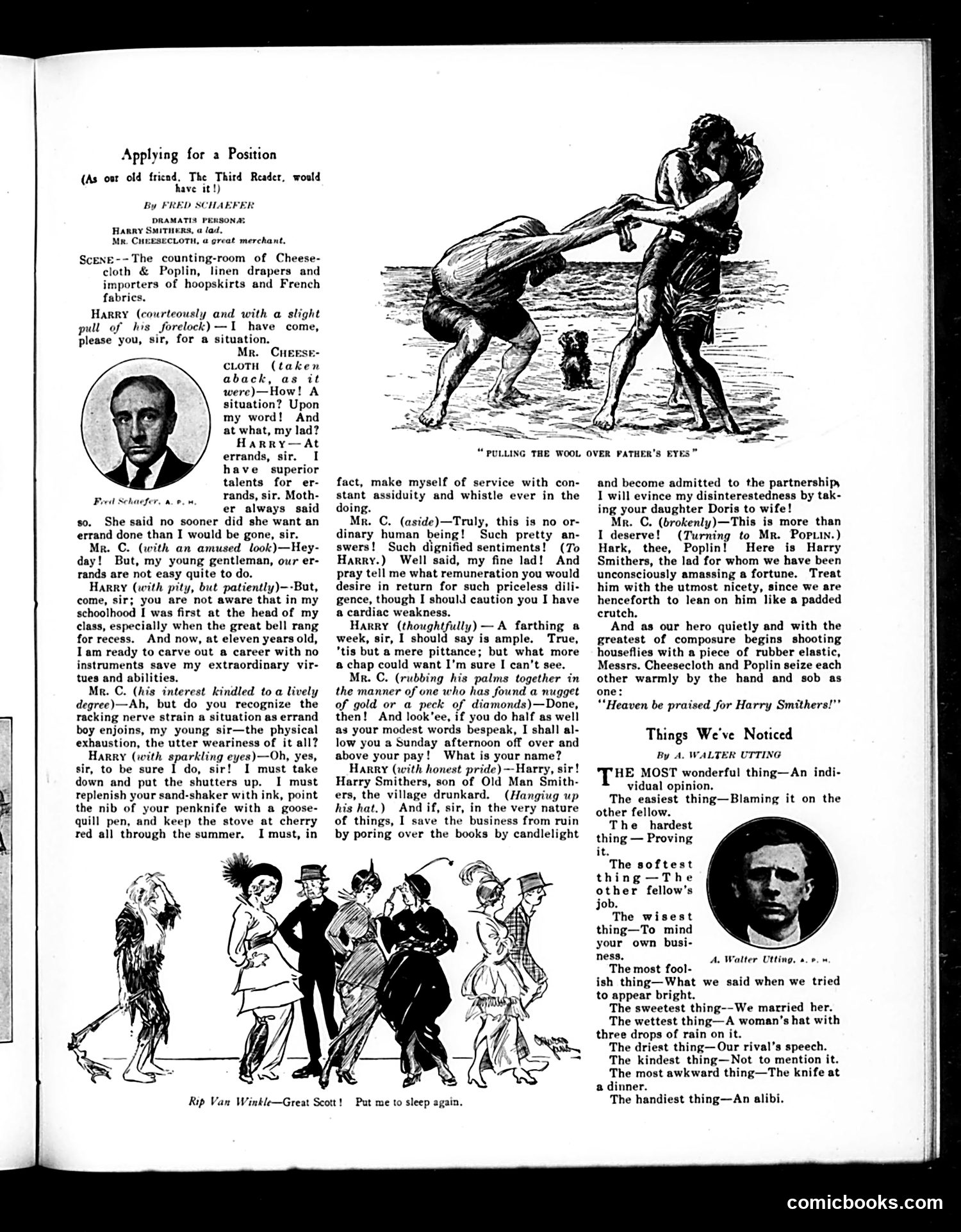
This is a satirical play-script mocking the exaggerated politeness and formal speech of the Victorian era. Young Harry Smithers applies for an errand-boy position with merchant Mr. Cheesecloth, speaking with absurdly flowery language and grandiose claims about minor tasks (keeping the stove "cherry red," sharpening pen nibs). The humor lies in the contrast between Harry's humble job aspirations and his pretentious vocabulary—he calls errand-running a "career," describes his talents as "extraordinary," and immediately proposes marrying the boss's daughter if promoted to partnership. Mr. Cheesecloth is equally ridiculous, becoming tearfully emotional over hiring a boy willing to work for a farthing weekly. The satire targets both working-class pretension and upper-class sentimentality, poking fun at how both classes inflated simple transactions with overwrought sentiment and formal speech.
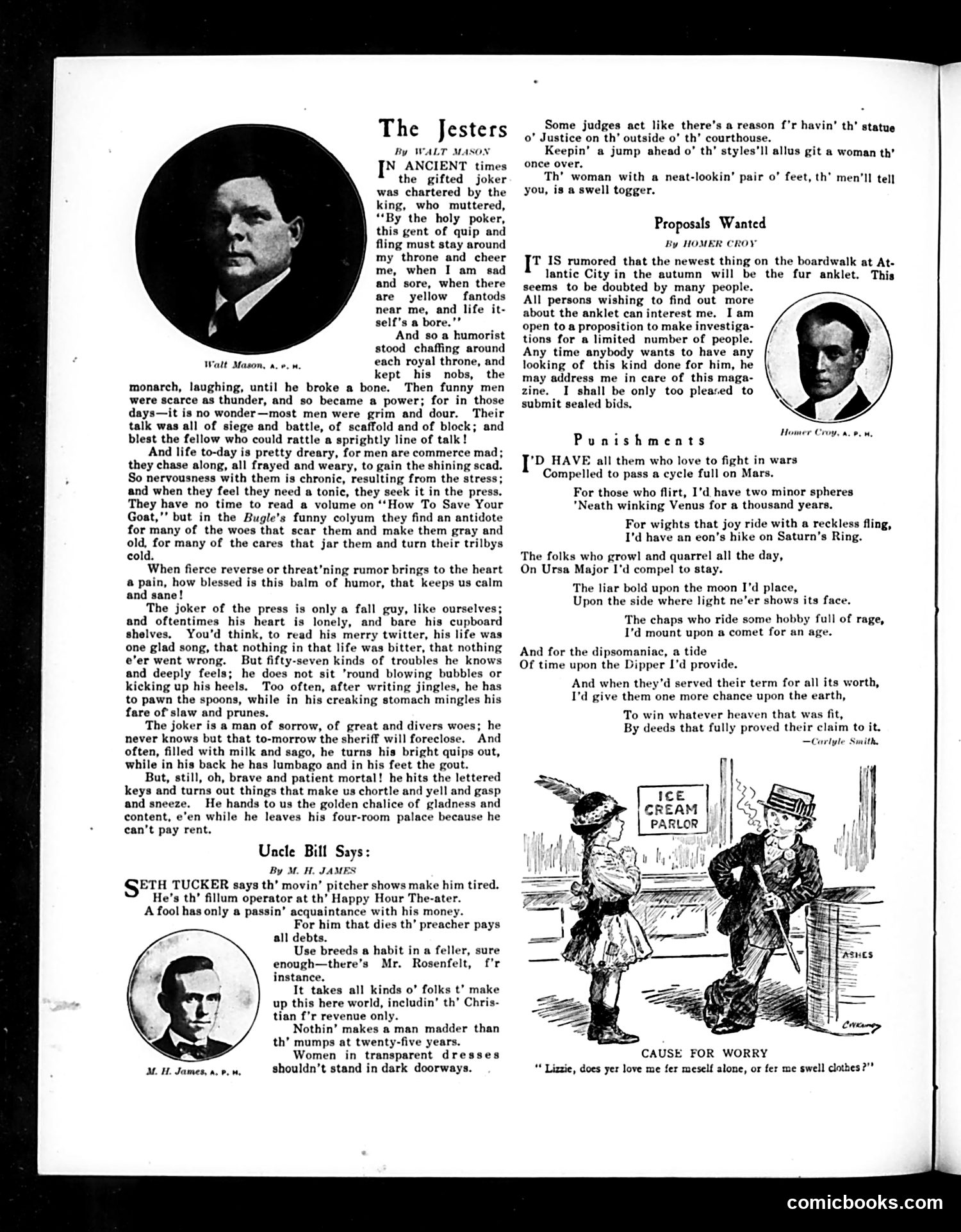
This page from the satirical magazine *Judge* contains three humorous pieces about American life circa early 20th century: **"The Jesters" (by Walt Mason):** A poem lamenting that modern comedians and humorists—despite making people laugh—live in poverty and hardship. Mason contrasts medieval court jesters (who were valued and supported by kings) with contemporary newspaper humorists who "pawn the spoons" and can't pay rent, yet still produce "bright quips" to entertain stressed, commerce-obsessed Americans. **"Uncle Bill Says" (by M.H. James):** A column of rural folk wisdom, where a character named Seth Tucker offers homespun observations—mocking film projectionists, commenting on women's fashion and propriety, and making social observations. **"Proposals Wanted" (by Homer Croy):** A humorous piece about a new fashion trend (fur anklets) at Atlantic City's boardwalk, with the author playfully offering to investigate women's ankles. The cartoon "Cause for Worry" depicts a gentleman anxious about whether his girlfriend loves him for himself or for his clothing—a light domestic humor piece typical of the era.
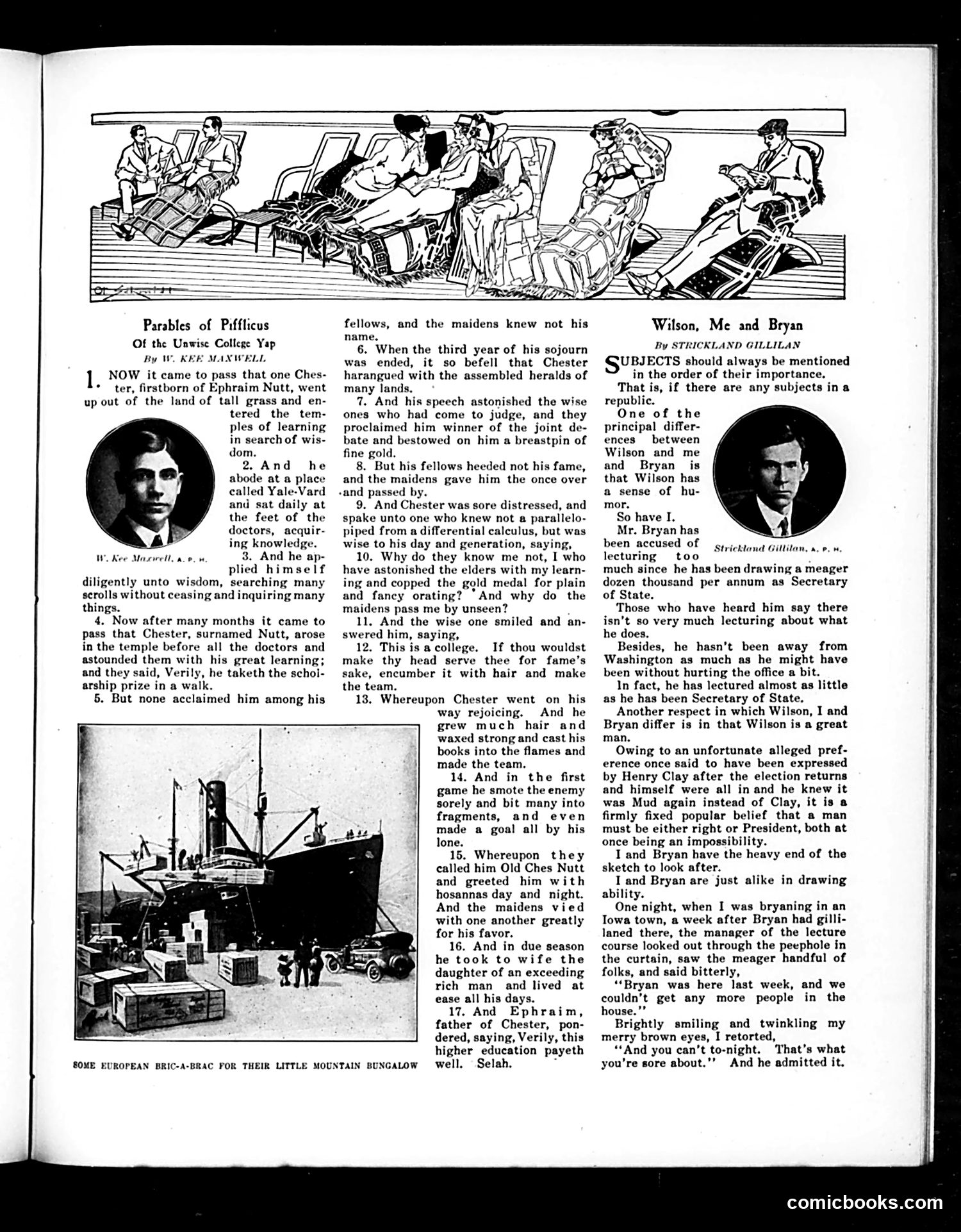
**"Parables of Pifflicus"** is a mock-biblical satire mocking the disconnect between academic achievement and social success at elite colleges (Yale-Vard appears to reference Yale). Chester Nutt excels intellectually—winning debate competitions and academic medals—yet remains invisible to peers and romantic interests. Only when he abandons scholarship to join the athletic team does he gain fame and marry well. The joke: colleges reward athletic prowess over intellectual merit, and society values physical achievement over learning. **"Wilson, Me and Bryan"** is author commentary comparing President Wilson, William Jennings Bryan (Secretary of State), and himself. The piece sarcastically defends Bryan against charges of excessive lecturing while touring, suggesting he's barely been away from Washington. It concludes with a jab at Clay-era politics: the belief that one cannot simultaneously be a great man and elected President—implying Wilson proves this rule. Both pieces critique American institutions and leadership through pointed satire.
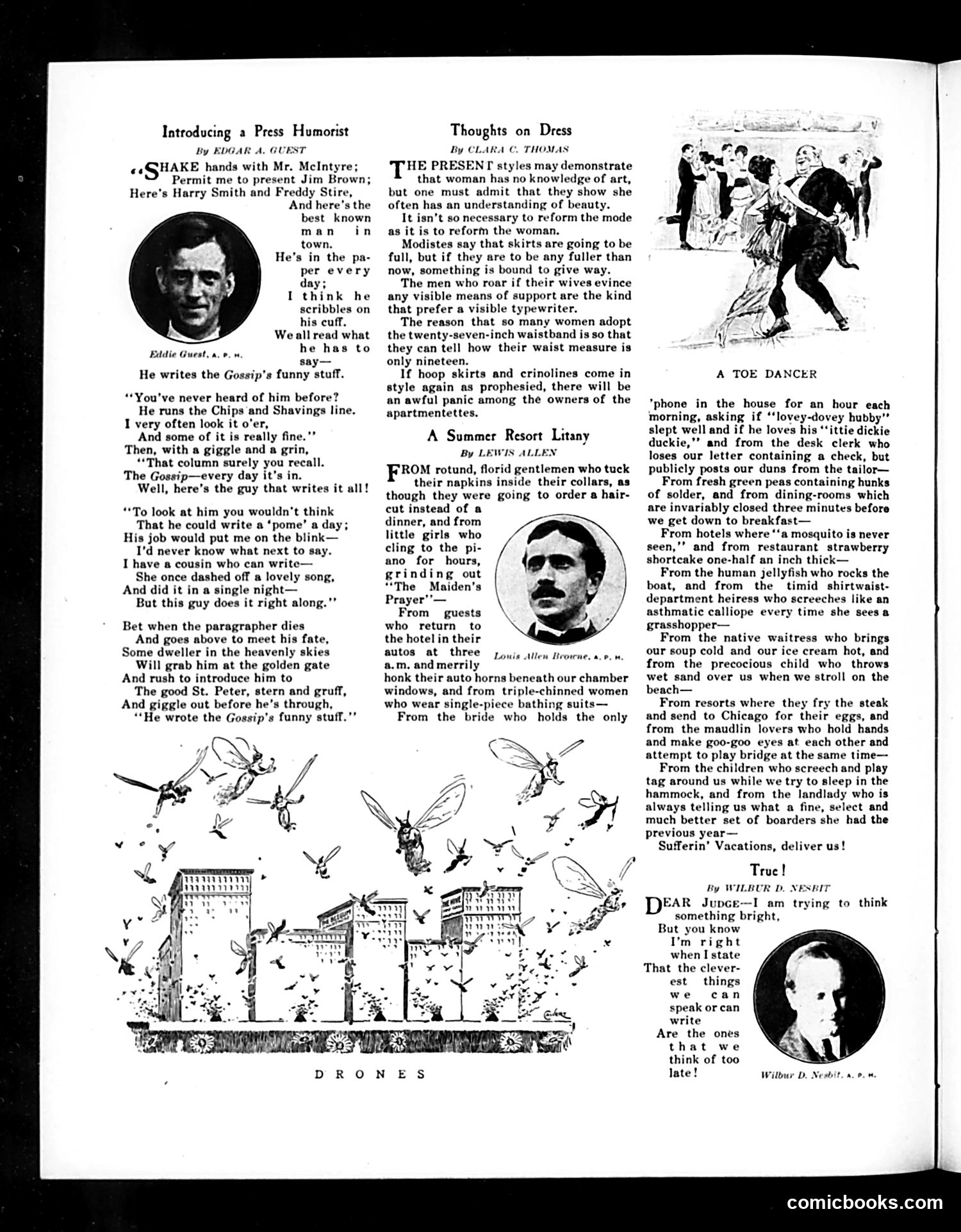
This page showcases three satirical pieces from Judge magazine: **"Introducing a Press Humorist"** (left): A poem by Edgar A. Guest introducing Eddie Guest, a gossip columnist. The humor lies in the ironic contrast—the speaker struggles to explain what Guest does ("scribbles on his cuff"), yet emphasizes his ubiquity and popularity ("in the paper every day"). The piece gently mocks both the columnist's prolific output and readers' fascination with trivial gossip. **"Thoughts on Dress"** (top right): Clara C. Thomas offers witty observations on women's fashion, suggesting women pursue beauty over art, and that tight corsets (27-inch waistbands) are deceptive. The humor targets women's fashion choices and vanity. **"A Summer Resort Litany"** (center/bottom): Lewis Allen catalogs annoyances at vacation resorts—rude guests, poor service, and maudlin behavior—presented as a mock-prayer format. It satirizes both resort guests' rudeness and the establishments' failures. **"Drones"** (illustration): Flying insects over buildings, likely representing the gossipy, buzzing nature of society talk.
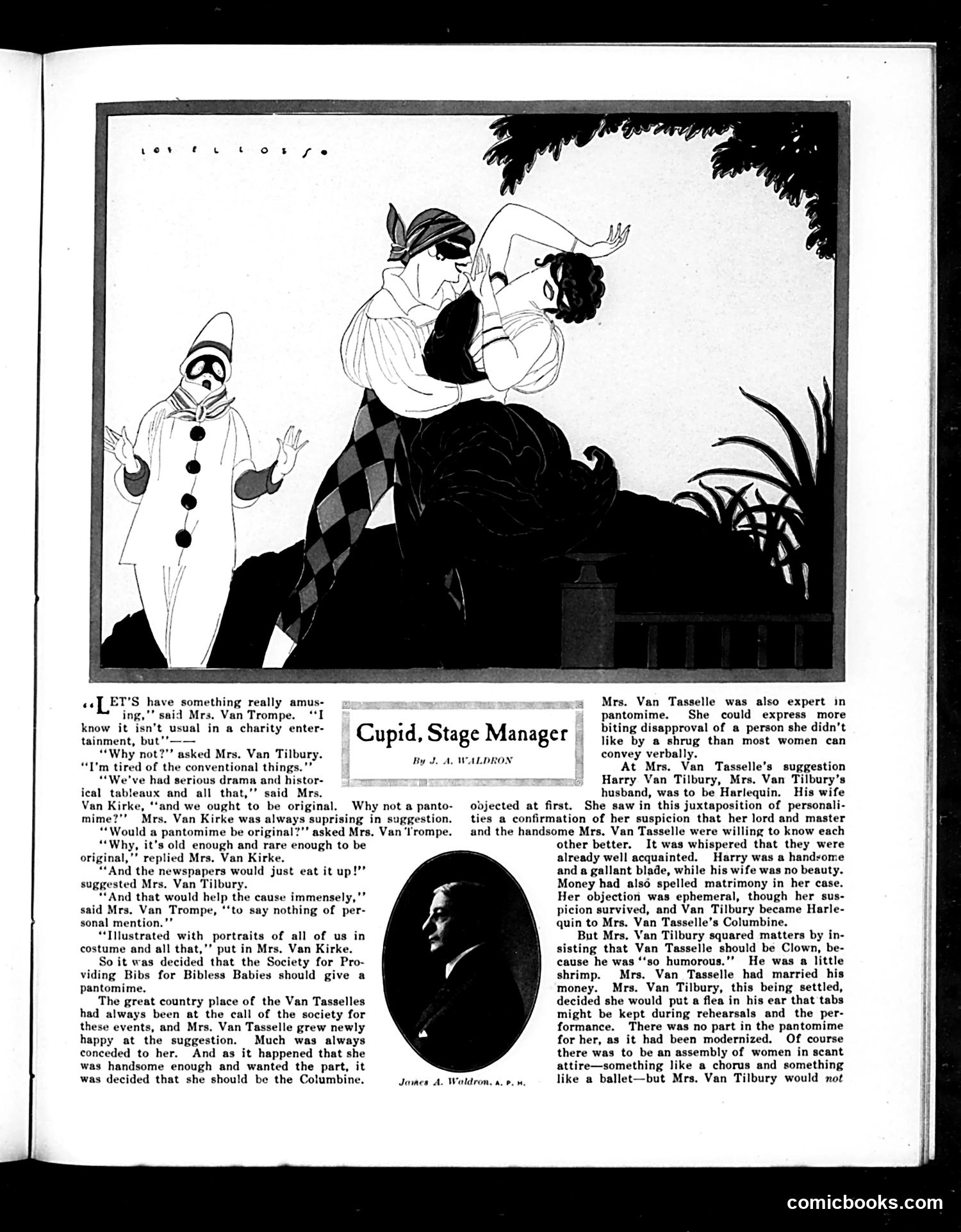
This piece satirizes wealthy society women organizing a charity pantomime for "Bibs for Bibless Babies." The humor centers on their pretense and ulterior motives beneath charitable work. The main joke: Mrs. Van Tasselle (the beautiful, handsome woman in the illustration) will play Columbine opposite Harry Van Tilbury as Harlequin—a casting that fuels Mrs. Van Tilbury's suspicions of an affair. Mrs. Van Tilbury retaliates by insisting Van Tasselle's own husband (Mr. Van Tasselle, described as a shrimp married only for his money) play the Clown. She then sabotages them by imposing rehearsal restrictions. The satire mocks how charity events among the wealthy become vehicles for social positioning, jealousy, and marital drama rather than genuine philanthropy. The women care more about newspaper coverage and personal appearance than the supposed cause. The "pantomime" setup allows slapstick comedy about infidelity suspicions and petty revenge among the leisure class.
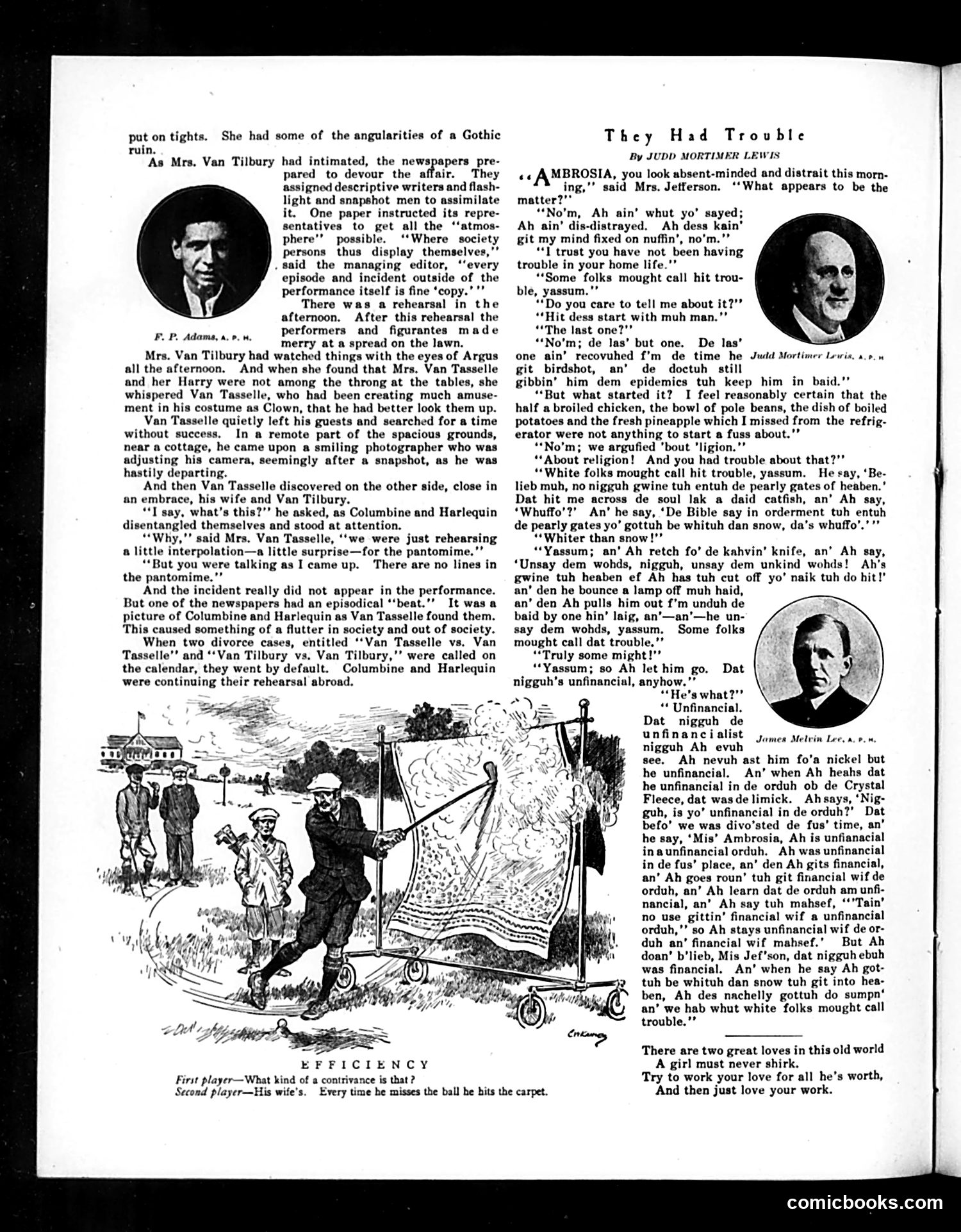
This page contains two distinct pieces of satirical content: **"They Had Trouble"** (right side): A dialect-humor piece featuring "Ambrosia," a Black domestic servant, recounting a domestic dispute with her partner. The humor relies on exaggerated African American vernacular and stereotypes common to early 20th-century publications. The conflict centers on religious doctrine—her boyfriend claiming Black people cannot enter heaven because they aren't white enough—prompting her violent response. This reflects both period racism and the genre's reliance on crude ethnic stereotypes for comedic effect. **"Efficiency" (lower left)**: A brief comic about a photographer capturing an infidelity scene at a society pantomime rehearsal. The joke satirizes newspapers' sensationalism and society's fascination with scandal. A photographer captures "Columbine and Harlequin" (two socialites) in a compromising position, leading to divorce proceedings and the couple fleeing abroad. Both pieces exemplify Judge's satirical approach: mocking social pretension, journalistic excess, and using stereotyped dialects for humor—practices that reflect their era's attitudes.
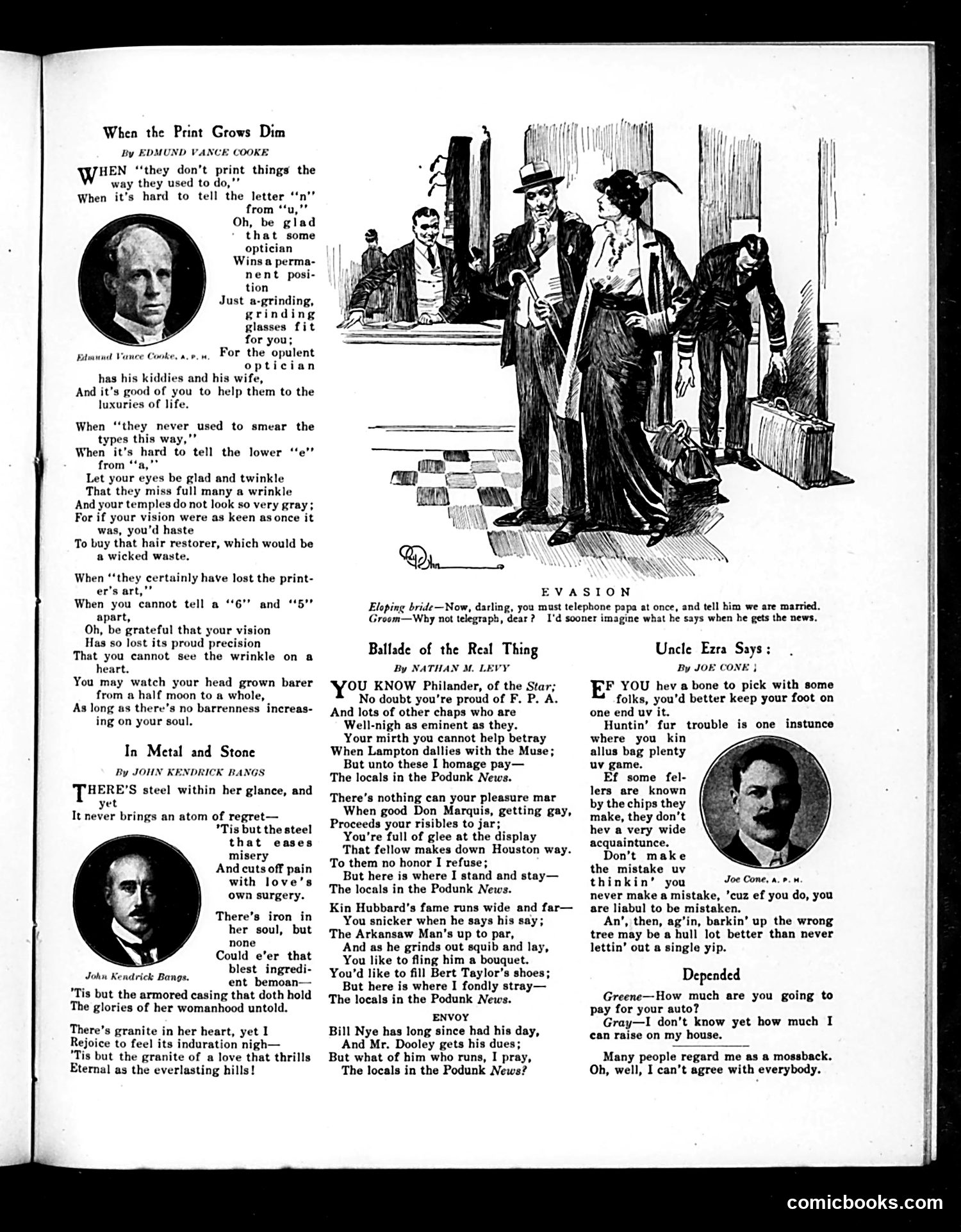
This page contains several satirical pieces typical of early 20th-century American humor magazines: **"When the Print Grows Dim"** (Cooke) — A tongue-in-cheek poem mocking declining print quality. The satire suggests that blurry printing actually benefits society: poor eyesight means people won't notice their own aging (gray hair, wrinkles) and won't waste money on hair restorers and vanity products. It's satirizing both printing standards AND consumer vanity culture. **"In Metal and Stone"** (Bangs) — A sentimental poem celebrating a woman's strength, using metaphors of steel, iron, and granite. Not political satire; rather romantic verse. **"Evasion"** — A brief comic sketch about an eloping couple. The joke: the bride wants to phone her father to announce the marriage; the groom suggests telegraphing instead—presumably to avoid an immediate angry reaction. **"Ballade of the Real Thing"** (Levy) — Satirizes literary snobbishness. While readers admire famous newspaper columnists and humorists, the author champions the humble "locals in the Podunk News"—small-town journalism that serves ordinary communities. **"Uncle Ezra Says"** — Folksy aphorisms offering practical life advice in rustic dialect, a common Judge feature.
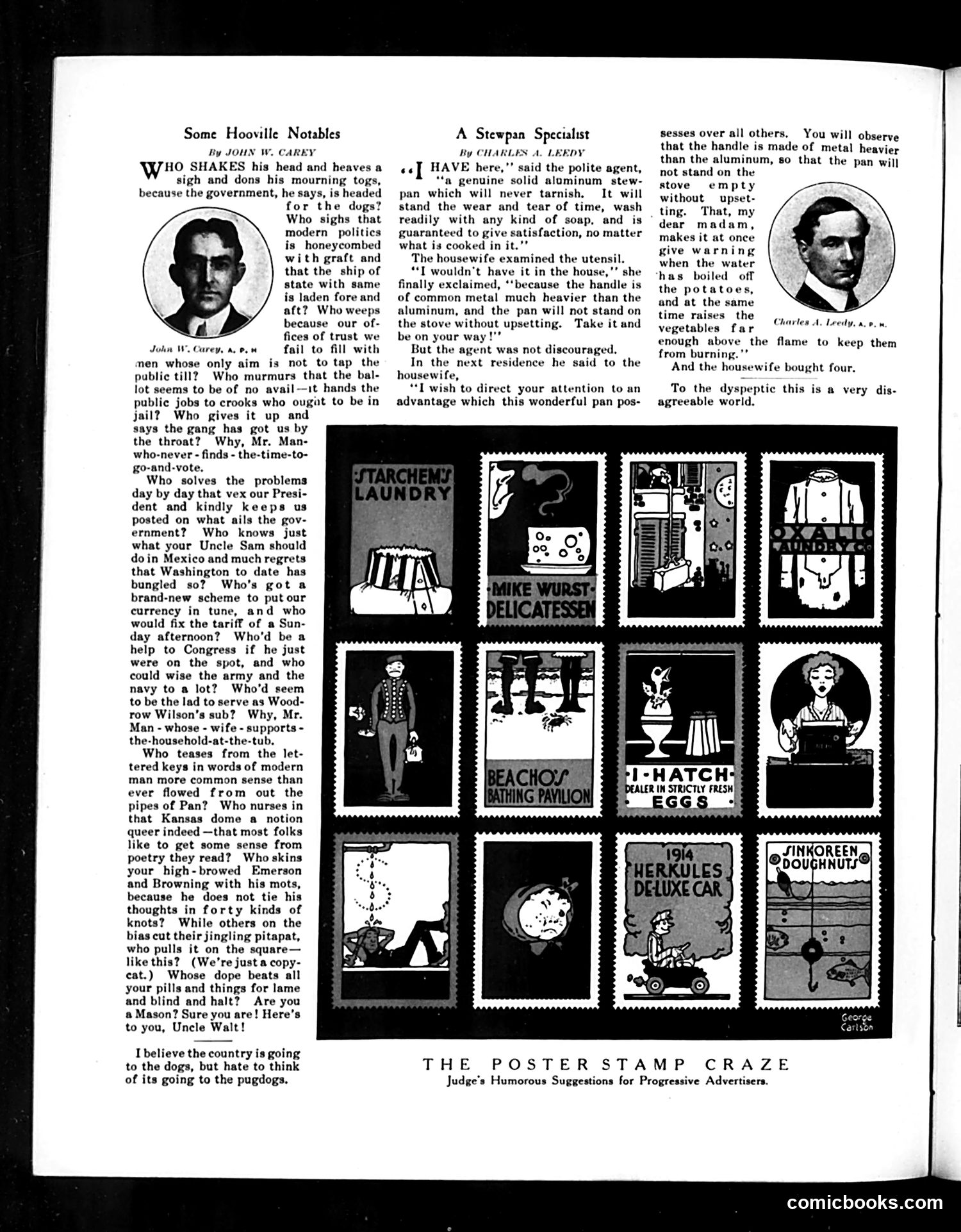
**"Some Hooville Notables"** is a satirical poem mocking the non-voting citizen who complains endlessly about government corruption, incompetent politicians, and poor policy—yet never votes or engages civically. The poem contrasts this "Man-who-never-finds-the-time-to-go-and-vote" with productive citizens (including Walt Whitman, a Kansas poet, and President Woodrow Wilson's advisors) who actually work to improve society. The final couplet jokes that while the country is "going to the dogs," at least not literally to "pugdogs" (pug dogs). **"A Stewpan Specialist"** illustrates clever sales technique: a salesman fails selling an aluminum pot by emphasizing its advantages, but succeeds by reframing the same "flaw" (heavy handle) as a *safety feature* that prevents burns. It's a joke about marketing psychology and persuasion. **"The Poster Stamp Craze"** at bottom appears to be an advertising section showing novelty promotional stamps—a collecting trend of the era.
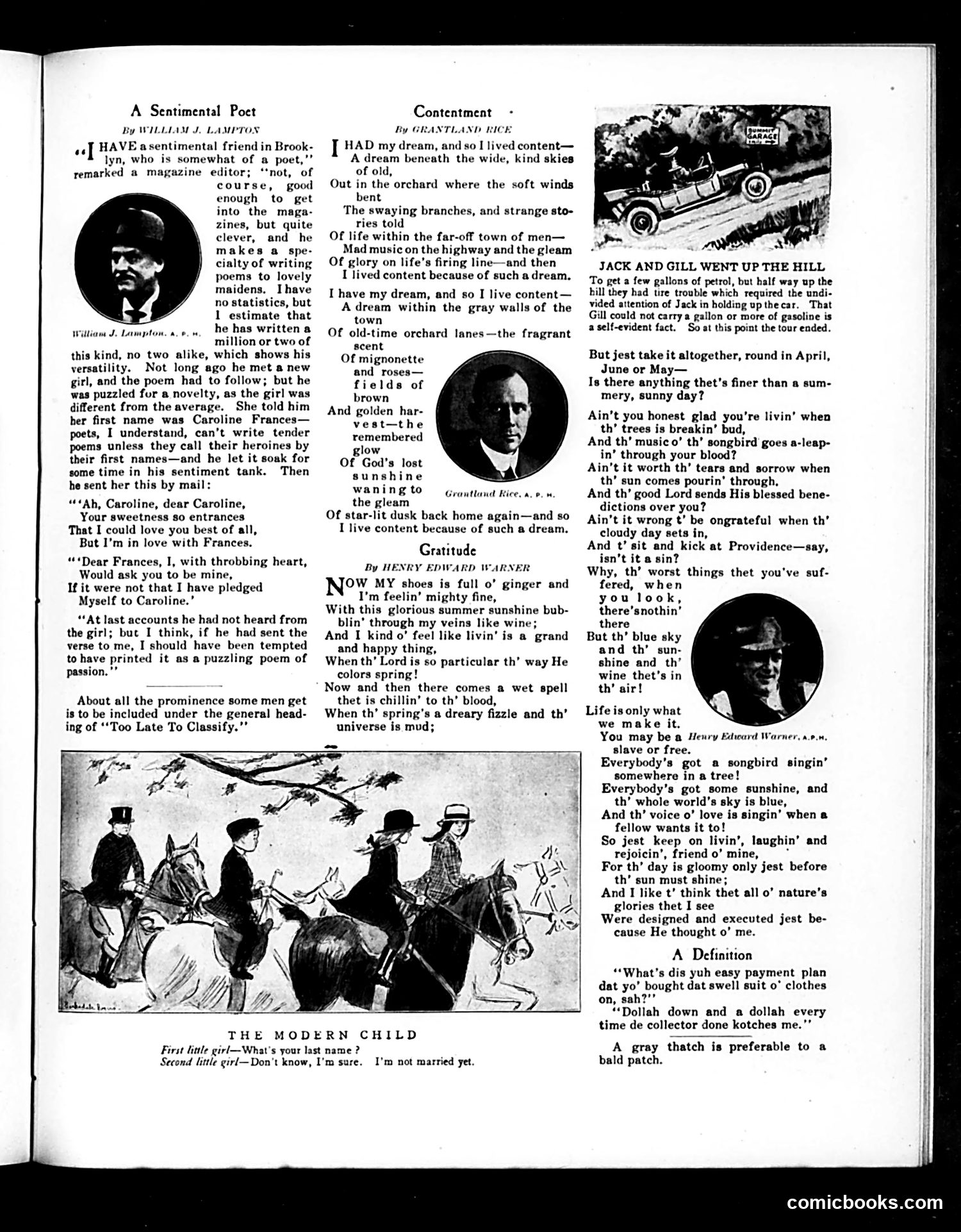
This page contains three humorous literary pieces typical of early 20th-century American satirical magazines: **"A Sentimental Poet"** mocks an overly earnest Brooklyn poet who writes countless love poems. The joke: he composes verses to a girl named "Caroline Frances" but becomes confused about which name to use, producing absurd contradictory stanzas declaring love to both "Caroline" and "Frances" simultaneously. The editor suggests rejecting it as too puzzling even for a "poem of passion." **"Contentment"** by Grantland Rice contrasts pastoral rural dreams with urban nostalgia—a common literary theme of the era reflecting anxiety about urbanization. **"Gratitude"** offers dialect verse celebrating summer's simple pleasures while warning against ingratitude. **"The Modern Child"** is a brief joke playing on changing social conventions: a girl admits she doesn't know her "last name" because "I'm not married yet"—implying women's surnames came from husbands. **"Jack and Gill Went Up the Hill"** modernizes the nursery rhyme, replacing the original's bucket with petrol (gasoline), mocking automobile troubles—a contemporary concern in the motor-car era.
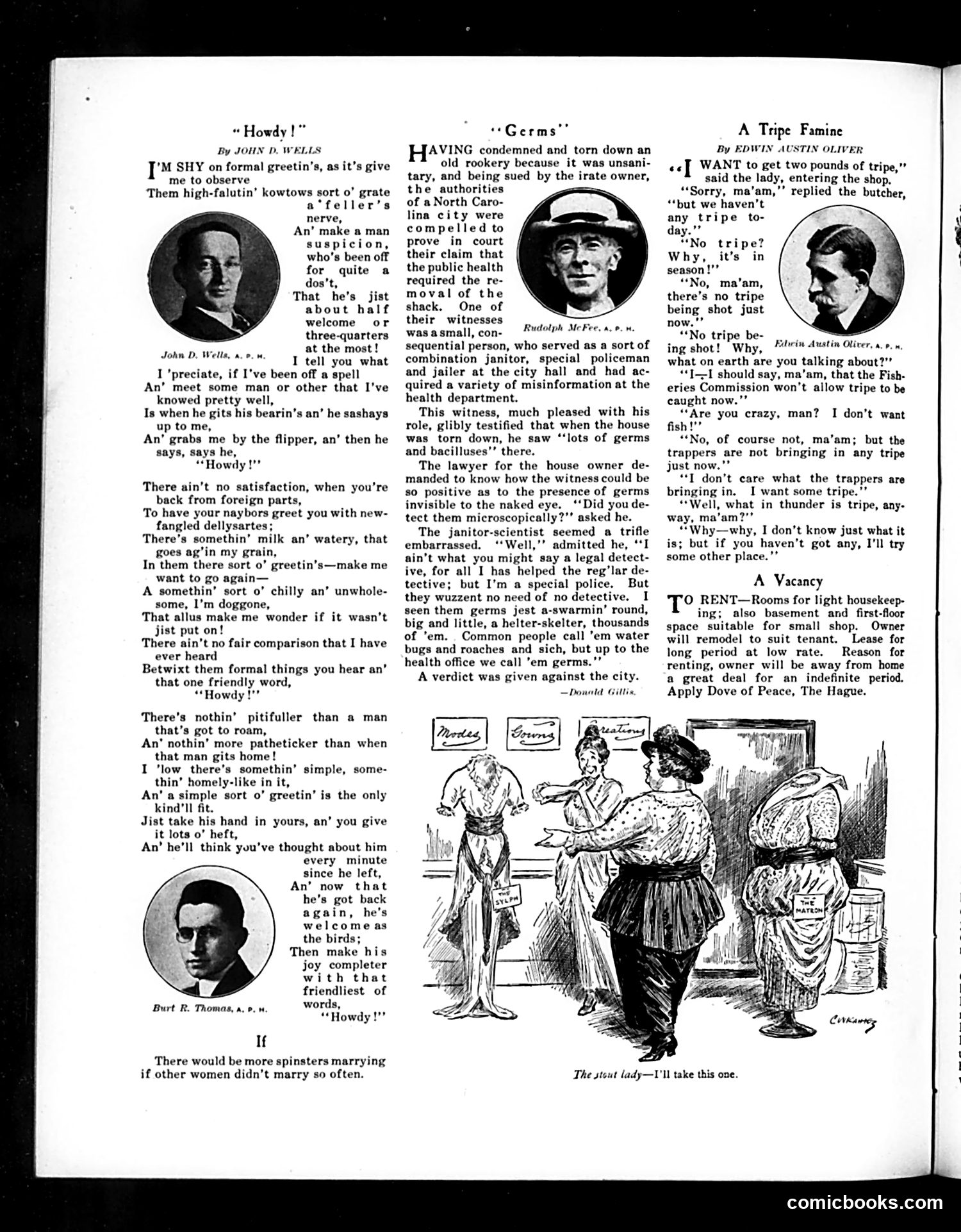
This page contains three separate humor pieces reflecting early 20th-century American vernacular and social concerns: **"Howdy!"** celebrates informal American frontier greetings over formal etiquette—a nostalgic preference for authentic "homely" friendliness rather than affected sophistication. **"Germs"** satirizes misguided municipal authority. A janitor-turned-witness testifies he saw "germs and bacilluses" swarming with his naked eye in a condemned tenement, then absurdly claims they require "detectives" to catch. The joke mocks both the witness's pseudoscientific ignorance and the city's reliance on unqualified officials, resulting in a verdict against the authorities. **"A Tripe Famine"** is a absurdist joke where a butcher claims tripe requires "trappers" and "fishing commissions" to "catch"—treating the organ meat as though it were game or fish rather than a butchered product. The lady's confusion highlights the butcher's ridiculous pretense. All three pieces use colloquial dialect and mock pomposity or incompetence through comedic exaggeration.
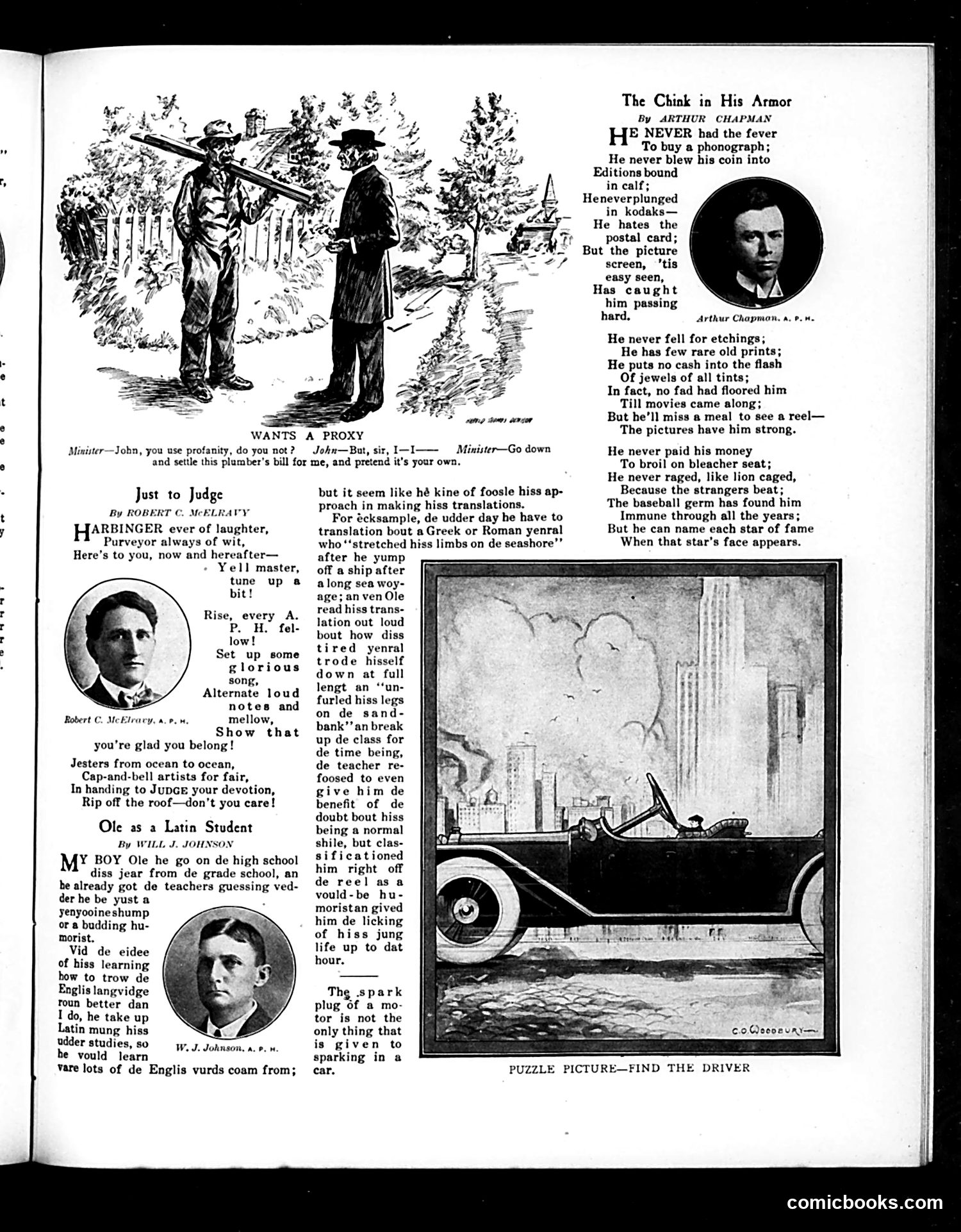
The main cartoon shows a minister asking a parishioner named John if he uses profanity. John stammers nervously, and the minister's response reveals the joke's hypocrisy: he instructs John to go settle a plumber's bill *pretending it's John's own debt*—essentially asking John to commit fraud on his behalf. The satire targets clergy hypocrisy and moral double standards: the minister condemns John's language while casually requesting dishonesty. The page also includes light humorous pieces: "Ole as a Latin Student" mocks immigrant speech patterns through a father's dialect as he describes his son's botched Latin translation ("unfurled his legs" for a general's stretched body), and "The Chink in His Armor" catalogs a man immune to various consumer temptations until movies captivated him—satire on cinema's emerging cultural grip.
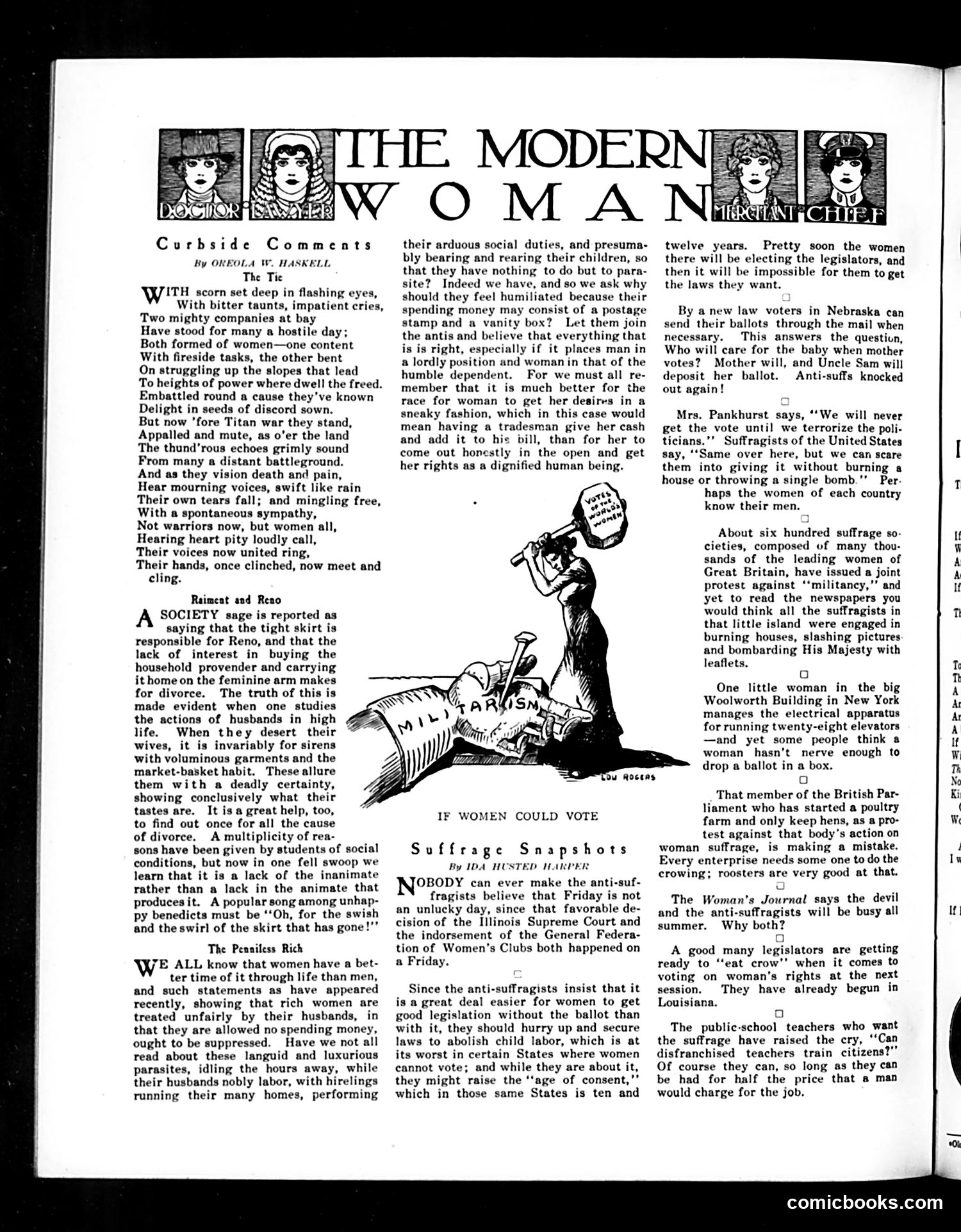
This Judge magazine page satirizes the women's suffrage debate circa 1910s through multiple pieces: **"Curbside Comments"** presents a poem about feuding women's factions—those supporting traditional domestic roles versus suffragists demanding political power—who unite when facing larger conflict (likely WWI), suggesting women's common humanity transcends their disagreement. **"Raiment and Reno"** mockingly blames divorce on women's tight skirts rather than acknowledging actual marital problems, sarcastically suggesting women should wear voluminous skirts to keep husbands satisfied—a critique of misogynistic reasoning. **"Suffrage Snapshots"** by Ida Husted Harper (a real suffrage advocate) uses irony to expose anti-suffragists' hypocrisy: they claim women don't *need* voting rights to achieve legislation, yet child labor persists in non-voting states. The "lucky Friday" reference involves an Illinois court decision favoring suffrage. The central cartoon depicts a man labeled "PARLIAMENTS" being knocked down by a woman wielding "VOTES," visualizing suffrage as a powerful force challenging male political dominance.
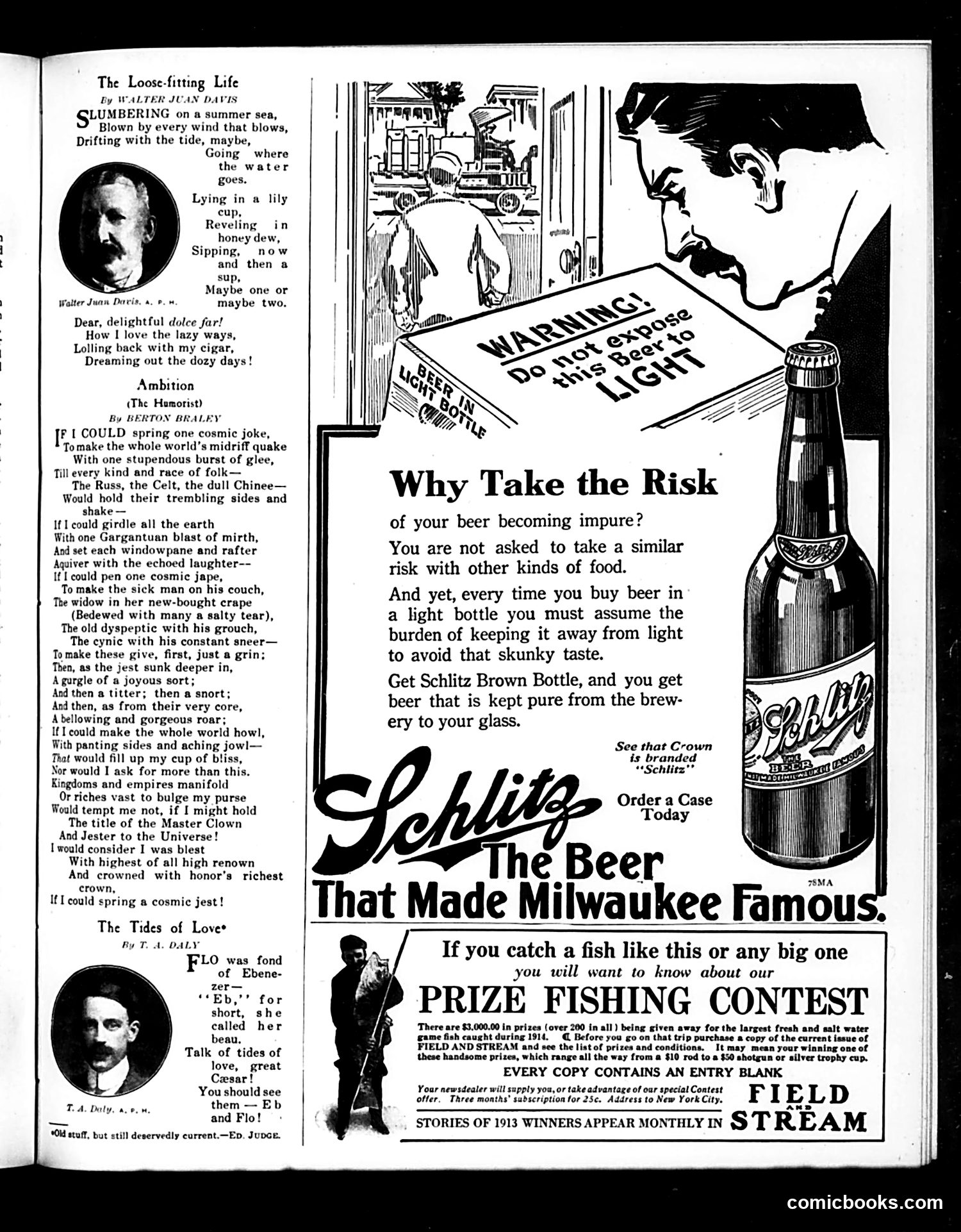
This is primarily a **literary and advertising page** rather than political satire. The content includes: **Literary pieces:** Three poems celebrate leisure and humor—"The Loose-fitting Life" romanticizes idleness, "Ambition" expresses desire to be a "Master Clown," and "The Tides of Love" plays on romance. **Main advertisement:** A **Schlitz beer ad** dominates the right side, addressing practical consumer concerns. It argues against buying beer in clear glass bottles, which allow light to damage the product and create a "skunky taste." Schlitz's brown bottle allegedly preserves purity "from the brewery to your glass." This reflects early 20th-century anxieties about product quality and food safety—concerns that became significant after 1906 food safety legislation. **Secondary ad:** A **Field and Stream fishing contest** promotes the magazine through prize giveaways. The page reflects early 1900s consumer culture and advertising's shift toward emphasizing product safety and reliability rather than mere claims of superiority.
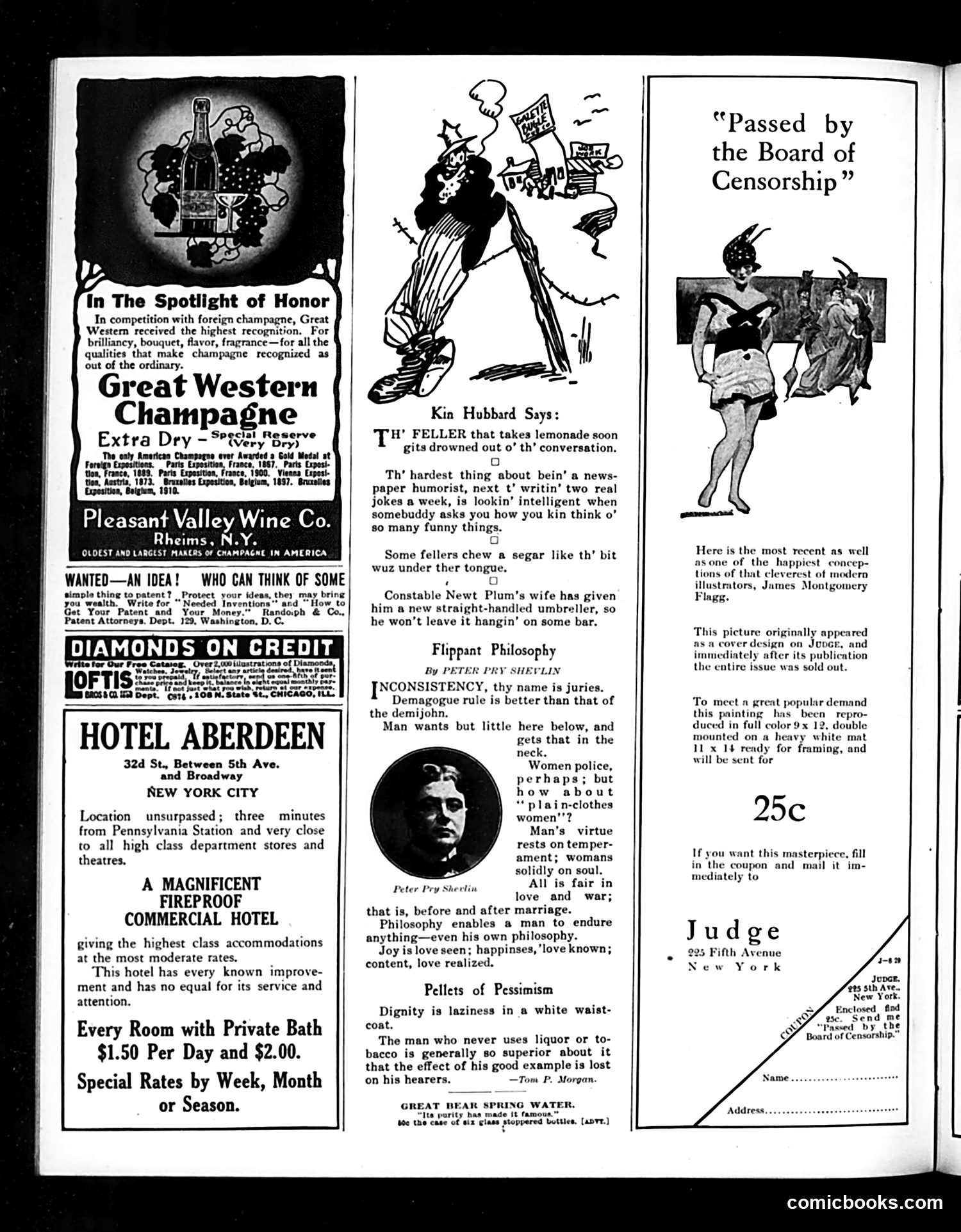
This page is primarily **advertisements and humor columns** with one notable cartoon element. The central attraction is a **cartoon by James Montgomery Flagg** titled "Passed by the Board of Censorship." It depicts a scantily-clad woman in a suggestive pose—the satire being that such an obviously risqué image supposedly received official approval from censors. This mocks the Board of Censorship's credibility and judgment, suggesting their standards are either nonexistent or hypocritical. The image sold out immediately after publication, and Judge is now offering a reproduction for 25 cents. The page also features **Kin Hubbard's folksy humor column** with rural witticisms about human nature, and **Peter Pry Shevlin's "Flippant Philosophy"**—pithy, cynical observations about consistency, marriage, and virtue. The remaining content consists of period advertisements: Great Western Champagne (emphasizing American quality over foreign imports), the Hotel Aberdeen, and various services typical of early 1910s publications. The Flagg cartoon's "censorship" angle reflects contemporary debates about artistic freedom and propriety standards.
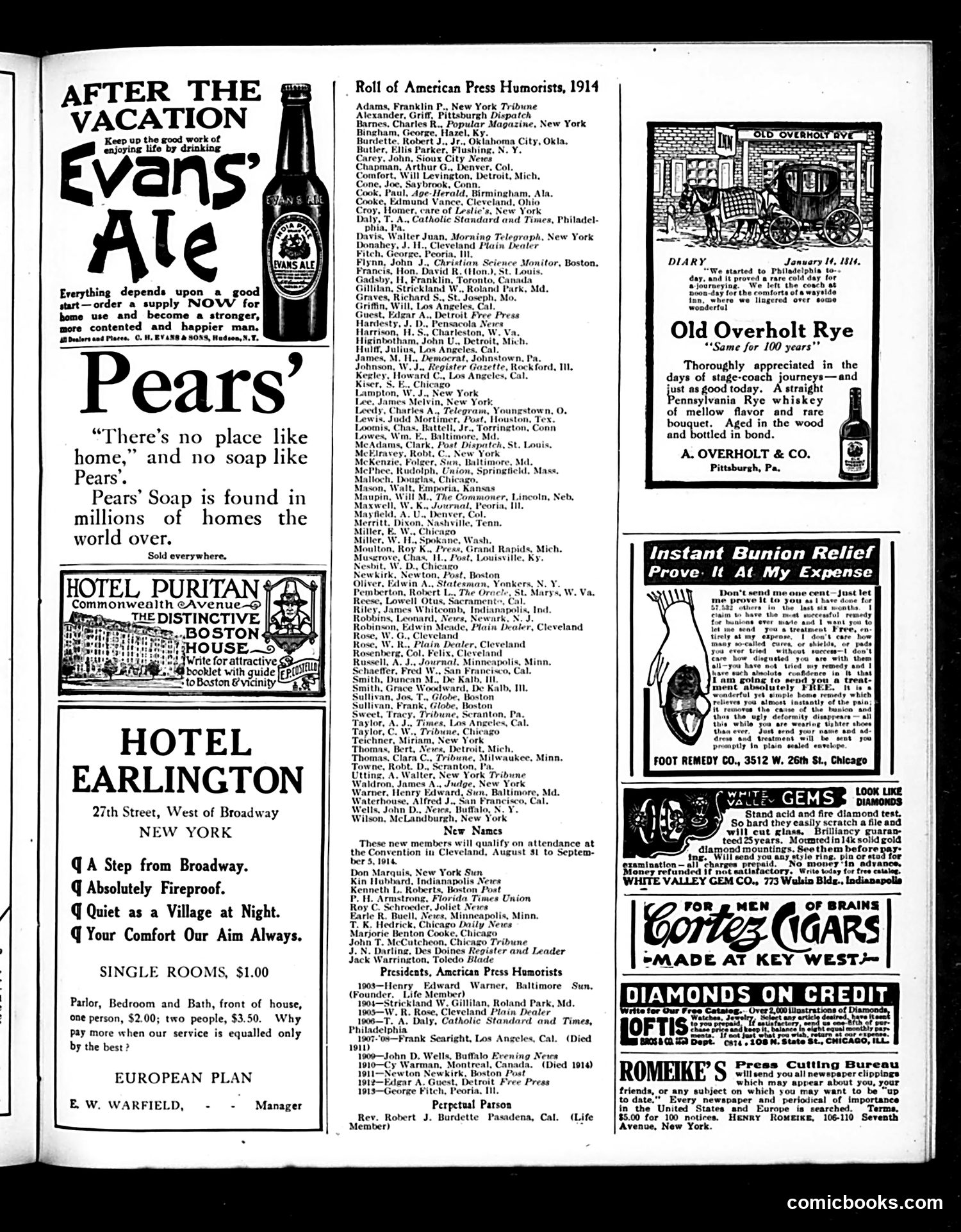
This page is primarily **advertising**, not political satire. It contains: **Main advertisements:** - Evans' Ale and Pears' Soap (lifestyle products targeting post-vacation consumers) - Hotel Puritan and Hotel Earlington (New York lodgings) - Old Overholt Rye whiskey - Bunion relief treatment, diamonds, cigars, and other patent medicines/goods **Editorial content:** The central feature is a "Roll of American Press Humorists, 1914"—a professional registry listing cartoonists and humor writers from major newspapers. This celebrates the American cartooning industry and lists past/current presidents of the American Press Humorists organization. **Historical context for modern readers:** This reflects early 20th-century advertising practices (patent medicine claims, luxury hotel pitches) and documents the organized professionalization of American newspaper cartooning as a respected craft. The page shows advertising revenue funding editorial content—a standard magazine practice then and now.
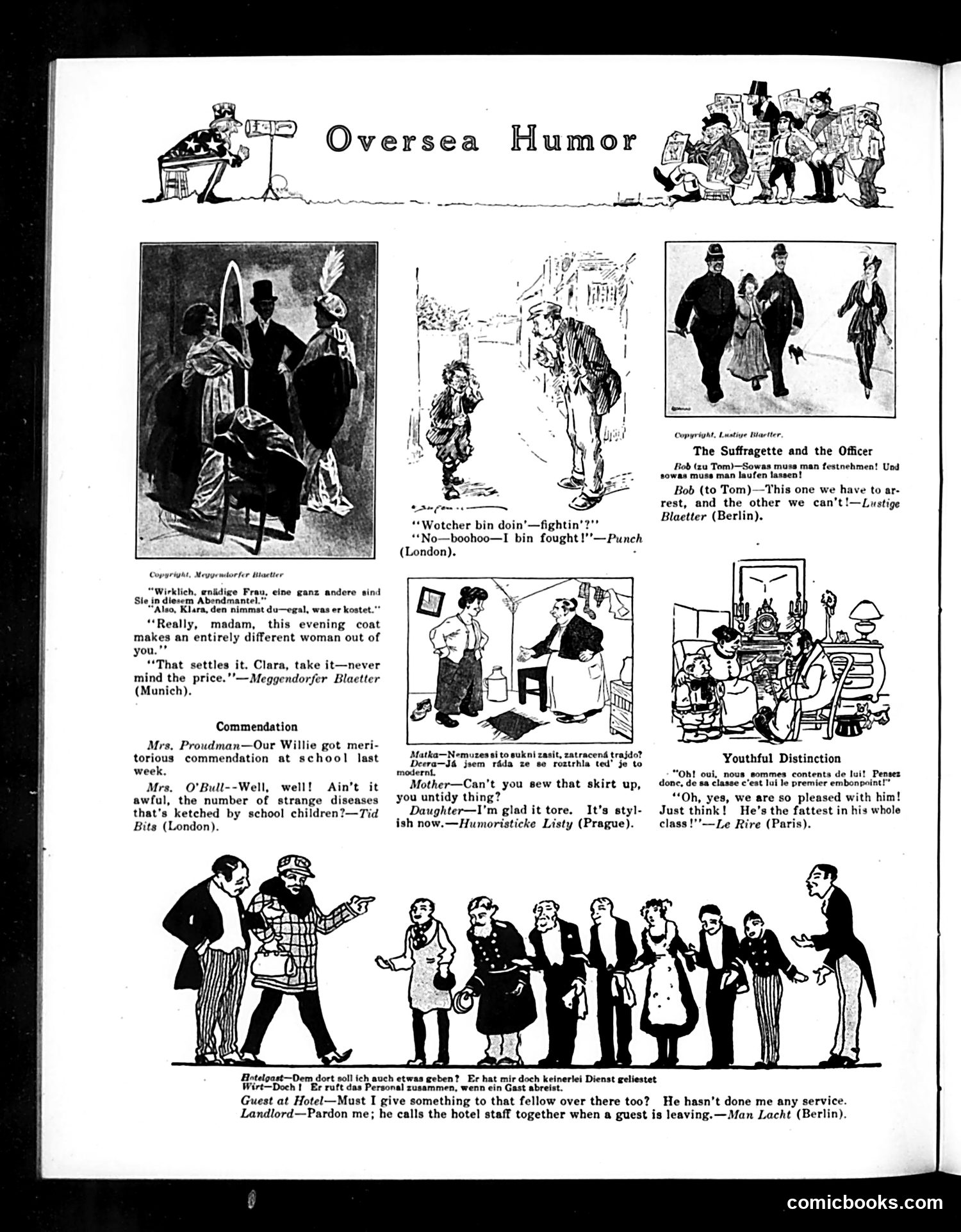
This page collects brief satirical comics from European publications, each making social observations: **"The Suffragette and the Officer"** depicts a police double standard: a suffragette (women's rights activist) must be arrested, while a male officer cannot be—commentary on gender inequality in law enforcement during the suffrage movement era. **"Youthful Distinction"** jokes about reversed parental values: French parents praise their son for being the "fattest in his class"—satirizing misplaced priorities or absurd measurements of success. **"Commendation"** plays on Mrs. O'Bull's misinterpretation: hearing her son received "meritorious commendation" at school, she assumes he's caught some disease—mocking either her ignorance or the prevalence of childhood illnesses. Other sketches target fashion vanity, children's misbehavior, and tipping customs. The comics are translated from German, Czech, and French sources, reflecting Judge's international scope and satirizing universal human foibles across cultures.
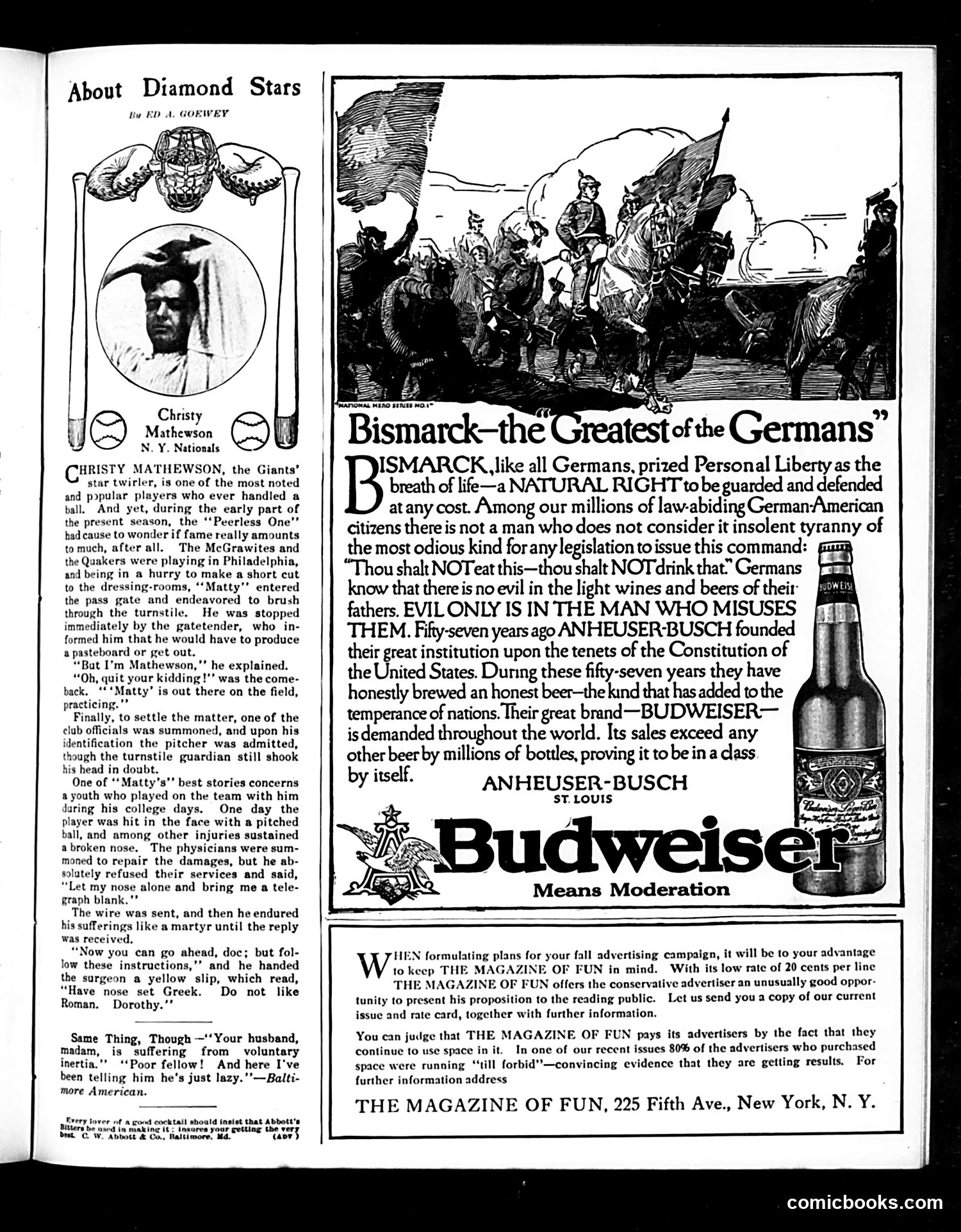
The left column contains anecdotes about **Christy Mathewson**, a famous New York Giants baseball pitcher. The stories illustrate his celebrity status and wit—he's so famous a gatekeeper doesn't recognize him, and he tells a clever story about a college teammate. These are light human-interest pieces. The dominant content is a **Budweiser advertisement** disguised as political commentary. It invokes **Bismarck** and German-American identity to argue against Prohibition—the temperance movement pushing alcohol bans. The ad claims Germans historically valued "personal liberty" and that beer itself is innocent; only misuse causes harm. By referencing the Constitution and fifty-seven years of "honest" brewing, it frames anti-alcohol legislation as un-American tyranny. This is a **pro-alcohol lobby advertisement** using nationalist and constitutional rhetoric to oppose what became the 18th Amendment (1919). The page dates from the Prohibition era, when such arguments were actively debated in American media.
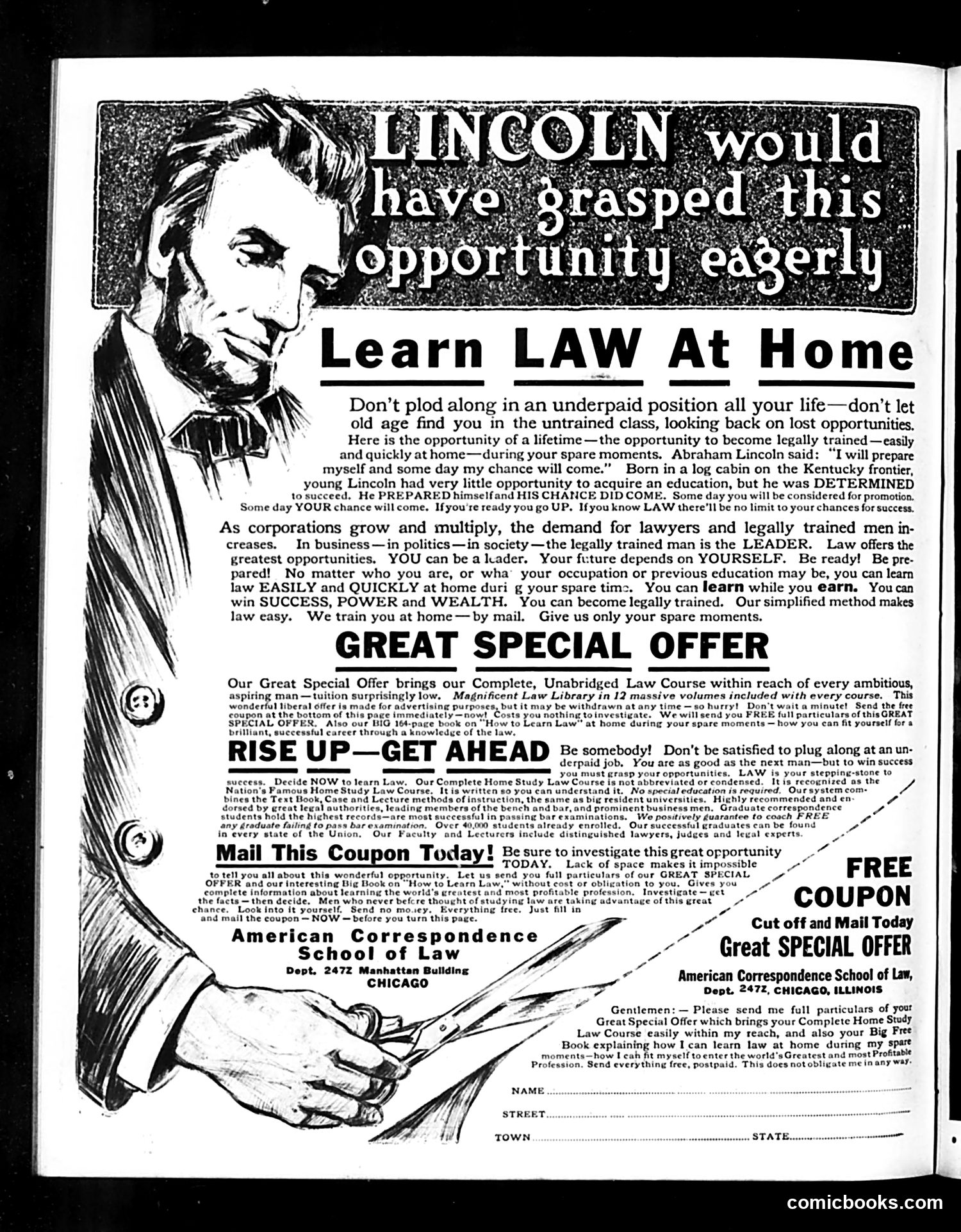
This is primarily a **full-page advertisement**, not a political cartoon, though it uses Lincoln's image strategically for marketing purposes. ## The Content: The American Correspondence School of Law is advertising a home-study law course. The ad exploits **Lincoln's rags-to-riches narrative**—his rise from a log cabin without formal education to the presidency—to motivate readers that they too can succeed through self-education and determination. ## The Appeal: The pitch targets **ambitious working-class men** stuck in "underpaid positions," promising legal training requires only "spare moments" and that lawyers are in high demand as "leaders" in business, politics, and society. The promise: learn law cheaply at home and transform your future. ## Why Lincoln? Lincoln serves as proof of concept—if an uneducated frontier boy could succeed through self-preparation, any reader could similarly rise through correspondence education. The ad's repeated emphasis on his determination ("I will prepare myself") repositions legal training as the modern equivalent of his self-made success. This reflects the early 20th-century American faith in self-improvement and correspondence education as paths to prosperity.