
Judge, 1914-08-29 · page 4 of 24
Judge — August 29, 1914 — page 4: what you’re looking at
What you’re looking at
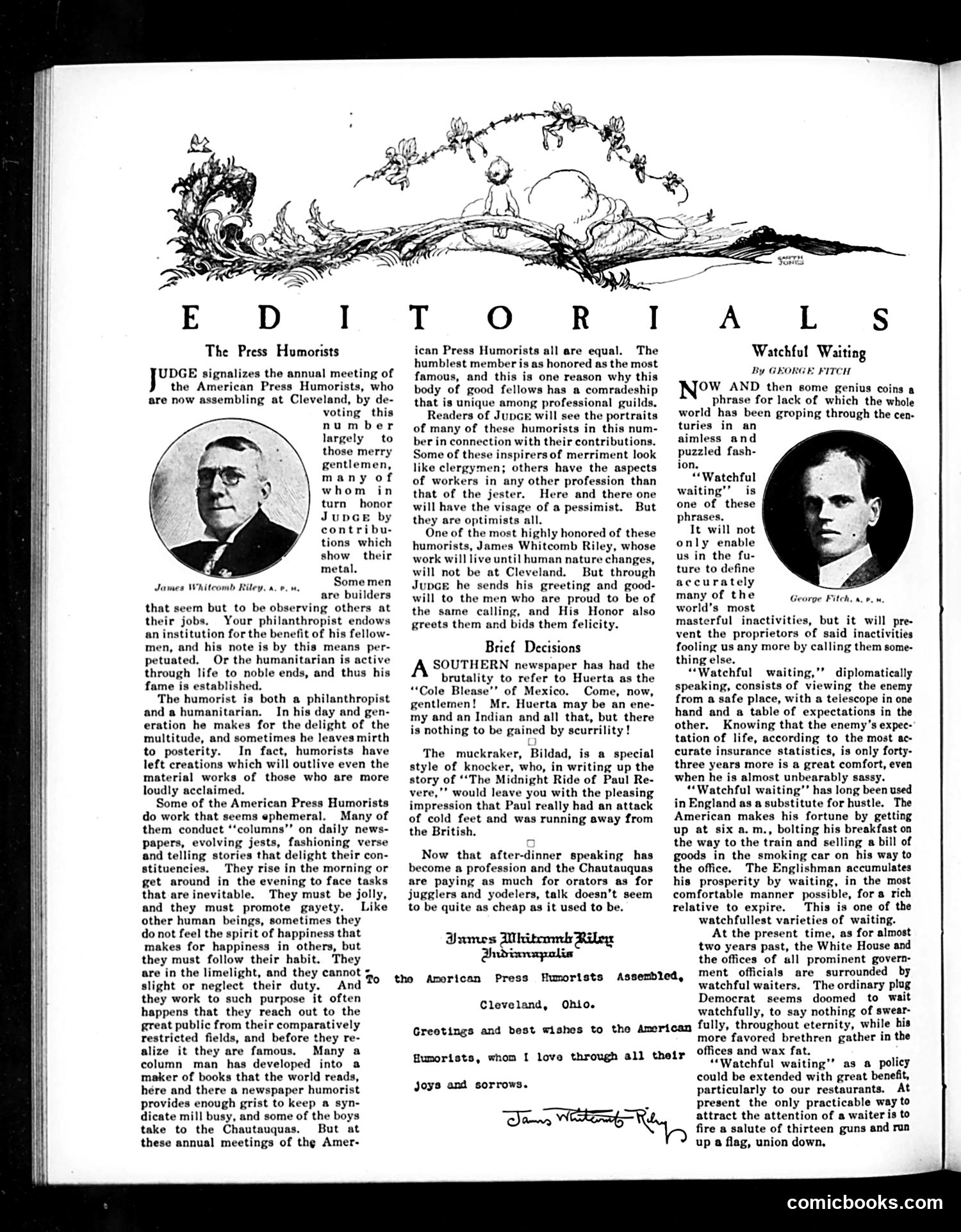
This is an editorial page from *Judge* magazine featuring commentary on the American Press Humorists' annual meeting in Cleveland. The page includes two portraits: **James Whitcomb Riley** (identified as a prominent humorist) and **George Fitch**. The main editorial argues that press humorists are uniquely positioned as philanthropists and social commentators—builders of institutions through their work. It defends humor as a legitimate profession worthy of respect. A secondary piece titled "Watchful Waiting" (attributed to George Fitch) satirizes a diplomatic phrase likely referencing U.S. foreign policy. The author mocks both the phrase's overuse and American officials' tendency to adopt passive stances, suggesting the phrase has become a convenient excuse for inaction or indecision. The satire targets both professional pretense and political rhetoric.
📄 Transcribed text from this page (OCR, searchable)
Machine-transcribed from the original scan — historical spelling and the odd misread are preserved.
The Press Humorists UDGE signalizes the annual meeting of the American Press Humorists, who are now assembling at Cleveland, by de- voting this number largely to those merry gentlemen, many of whom in turn honor JupGE by contribu- tions which show their metal. Some men are builders em but to be observing others at their jobs. Your philanthropist endows an institution for the benefit of his fellow- men, and his note is by this means per- petuated. Or the humanitarian is active through life to noble ends, and thus his fame is established. The humorist is both a philanthropist and a humanitarian. In his day and gen- eration he makes for the delight of the multitude, and sometimes he leaves mirth to posterity. In fact, humorists have left creations which will outlive even the material works of those who are more loudly acclaimed. Some of the American Press Humorists do work that seems ephemeral. Many of them conduct ‘‘columns’’ on daily news- papers, evolving jests, fashioning verse and telling stories that delight their con- stituencies. They rise in the morning or get around in the evening to face tasks that are inevitable. They must be jolly, and they must promote ga: Like other human beings, somet do not feel the spirit of happiness that makes for happiness in others, but they must follow their habit. They are in the limelight, and they cannot ry slight or neglect their duty. And i they work to such purpose it often happens that they reach out to the great public from their comparatively restricted fields, and before they re- alize it they are famous. Many a column man has developed into a maker of books that the world reads, here and there a newspaper humorist provides enough grist to keep a syn- dicate mill busy, and some of the boys take to the Chautauquas, But at these annual meetings of the Amer- ican Press Humorists all are equal. The humblest member is as honored as the most famous, and this is one reason why this body of good fellows has a comradeship that is unique among professional guilds. Readers of JupGE will see the portraits of many of these humorists in this num- ber in connection with their contributions. Some of these inspirers of merriment look like clergymen; others have the aspects of workers in any other profession than that of the jester. Here and there one will have the visage of a pessimist. But they are optimists all. One of the most highly honored of these humorists, James Whitcomb Riley, whose work will live until human nature changes, will not be at Cleveland. But through Jupce he sends his greeting and good- will to the men who are proud to be of the same calling, and His Honor also greets them and bids them felicity. Brief Decisions SOUTHERN newspaper has had the brutality to refer to Huerta as the “Cole Blease’’ of Mexico. Come, now, gentlemen! Mr. Huerta may be an ene- my and an Indian and all that, but there is nothing to be gained by scurrility ! The muckraker, Bildad, is a special style of knocker, who, in writing up the story of ‘‘The Midnight Ride of Paul Re- vere,’’ would leave you with the pleasing impression that Paul really had an attack of cold feet and was running away from the British. Now that after-dinner speaking has become a profession and the Chautauquas are paying as much for orators as for jugglers and yodelers, talk doesn’t seem to be quite as cheap as it used to be. Riley dames Whi udiereapolis American Press Cleveland, Ohio. Greetings and best wishes to the American Humorists, whom I love through all thet: Joys and sorrows. Humorists Assembled, Watchful Waiting By GEORGE FITCH OW AND then some genius coins a phrase for lack of which the whole world has been groping through the cen- turies in an aimless and puzzled fash- ion. “Watchful waiting’ is one of these phrases. It will not only enable us in the fu- ture to define accurately many of the world’s most masterful inactivities, but it will pre- vent the proprietors of said inactivities fooling us any more by calling them some- thing else. “Watchful waiting,’’ diplomatically speaking, consists of viewing the enemy from a safe place, with a telescope in one hand and a table of expectations in the other. Knowing that the enemy’s expec- tation of life, according to the most ac- curate insurance statistics, is only forty- three years more is a great comfort, even when he is almost unbearably sassy. “Watchful waiting’ has long been used in England as a substitute for hustle. The American makes his fortune by getting up at six a. m., bolting his breakfast on the way to the train and selling a bill of goods in the smoking car on his way to the office. The Englishman accumulates his prosperity by waiting, in the most comfortable manner possible, for a rich relative to expire. This is one of the watchfullest varieties of waiting. At the present time, as for almost two years past, the White House and the offices of all prominent govern- ment officials are surrounded by watchful waiters. The ordinary plug Democrat seems doomed to wait watchfully, to say nothing of swear- fully, throughout eternity, while his more favored brethren gather in the y Offices and wax fat. “Watchful waiting’? as a policy could be extended with great benefit, particularly to our restaurants. At present the only practicable way to George Fitch, a. 9.6. Can, WE Te attract the attention of a waiter is to fire a salute of thirteen guns and run up a flag, union down, comicbooks.com