
A complete issue · 24 pages · 1914
Judge — May 30, 1914
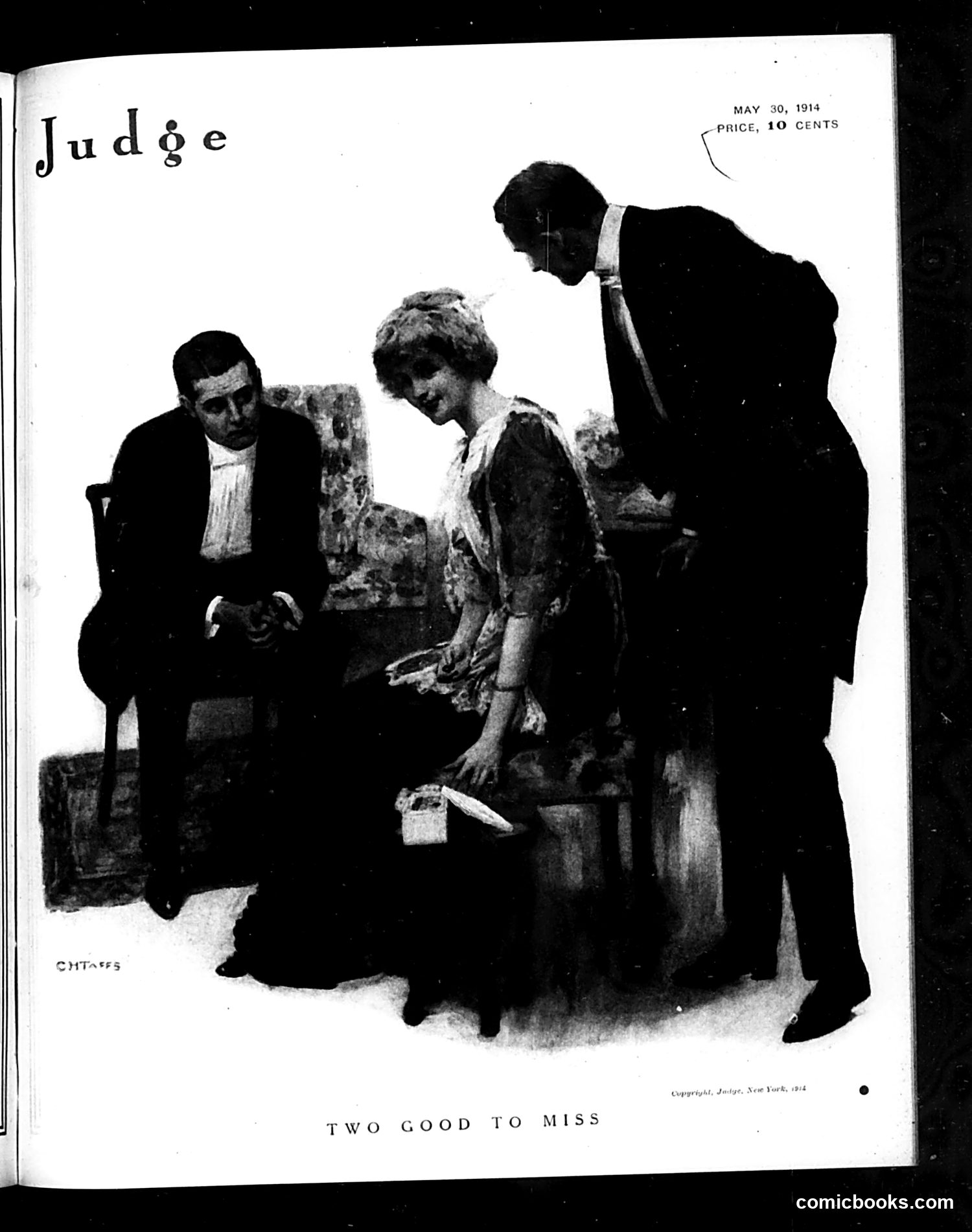
This Judge magazine cover from May 30, 1914 depicts a domestic scene with the caption "Two Good to Miss." The illustration shows a woman examining what appears to be fabric or clothing while two men observe—one seated, one standing and leaning in. The title suggests a commentary on courtship or marital prospects, likely satirizing contemporary attitudes about women's marriageability or desirability as potential wives. The formal attire and interior setting suggest upper-class society. Without additional context, the specific identities of these figures remain unclear, though the scene appears to comment on social conventions around marriage and gender relations during the Progressive Era. The "good to miss" phrasing could reference reluctance to let such a woman remain unmarried, reflecting period attitudes about women's roles.
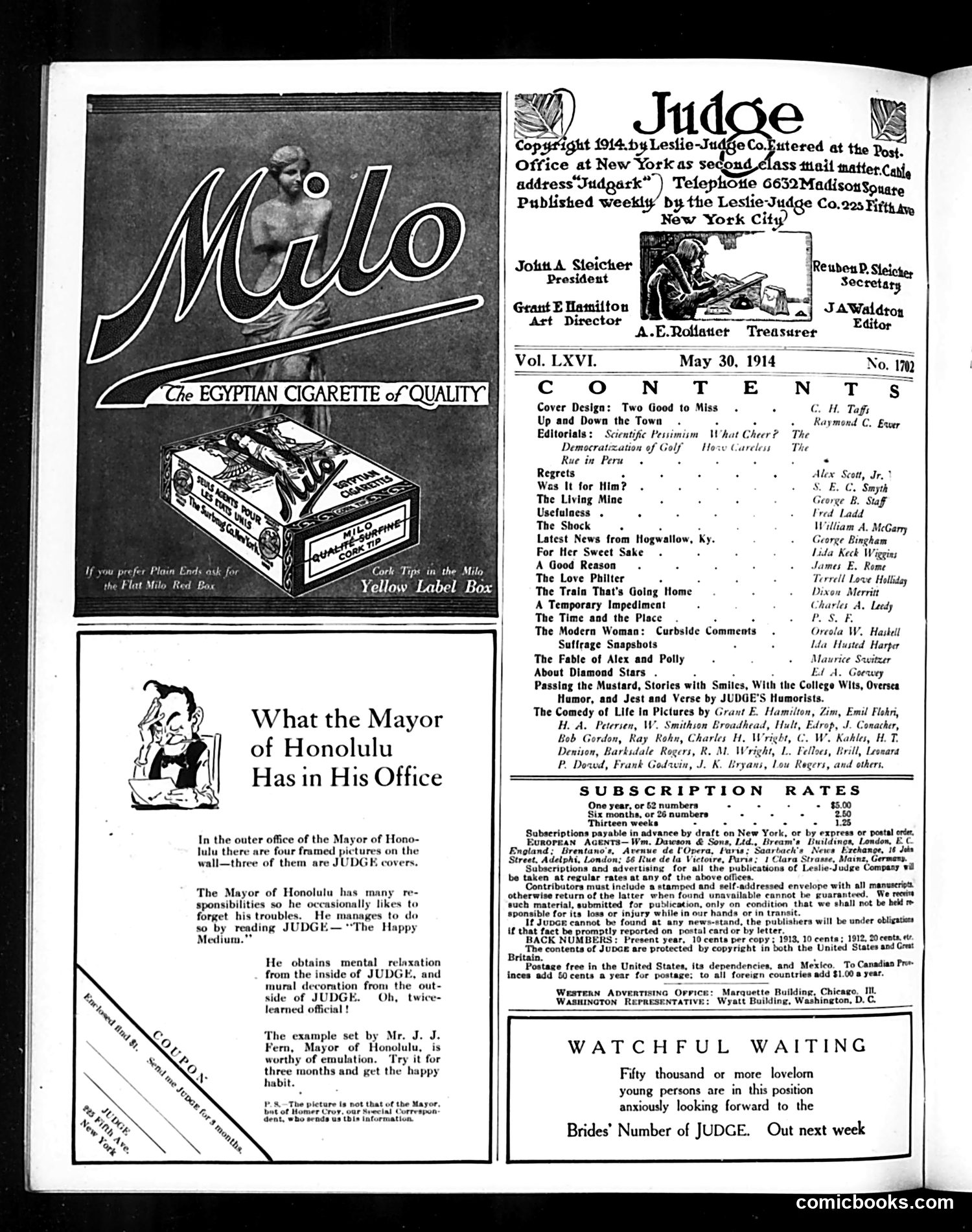
The main cartoon "What the Mayor of Honolulu Has in His Office" appears to be a satirical piece about the Mayor of Honolulu keeping framed pictures of JUDGE magazine covers in his office. The accompanying text explains that the Mayor reads JUDGE to relax and forget his troubles, finding it "The Happy Medium"—a pun on the magazine's purpose as a source of mental relief and "mural decoration." The joke relies on flattery: suggesting that even a busy executive finds JUDGE indispensable for stress relief. This is essentially self-promotional content masquerading as editorial humor. The left page is dominated by a Milo cigarette advertisement, while the right contains table of contents and subscription information typical of 1914 magazine layout.
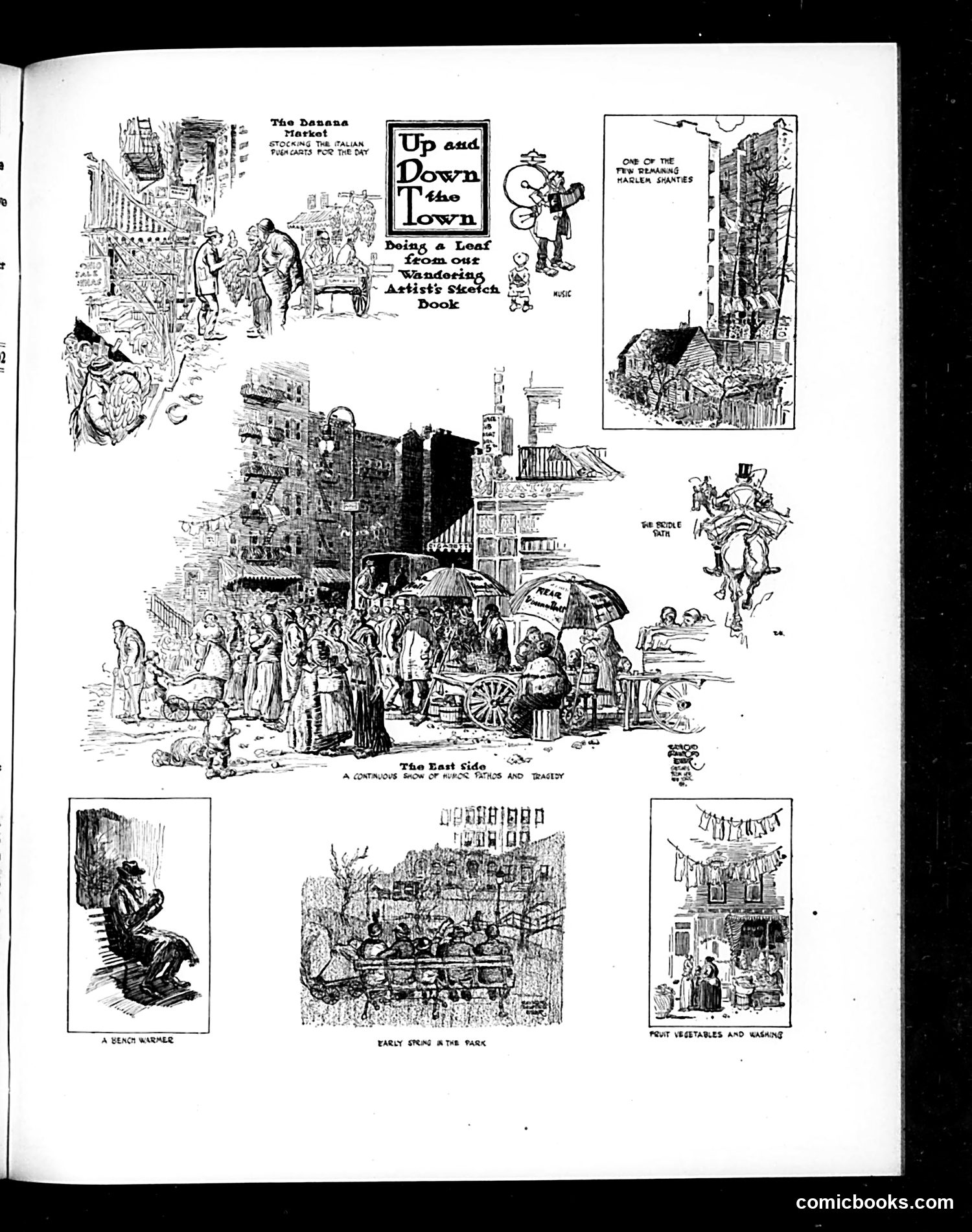
This is a illustrated feature titled "Up and Down the Town: Being a Leaf from Our Wandering Artist's Sketch Book." It presents observations of New York City life through pen sketches rather than political satire. The page depicts various urban scenes: The Banana Market showing Italian fruit vendors, the East Side illustrating crowded immigrant neighborhoods, a mounted police officer, and street scenes with umbrellas, street vendors, and park activity. Smaller vignettes show "A Bench Warmer," "Early Strolls in the Park," and "Fruit Vegetables and Barging." Rather than political commentary, these sketches capture daily city life—street commerce, public spaces, and working-class activities—reflecting Judge's interest in documenting contemporary urban American society through observational illustration.
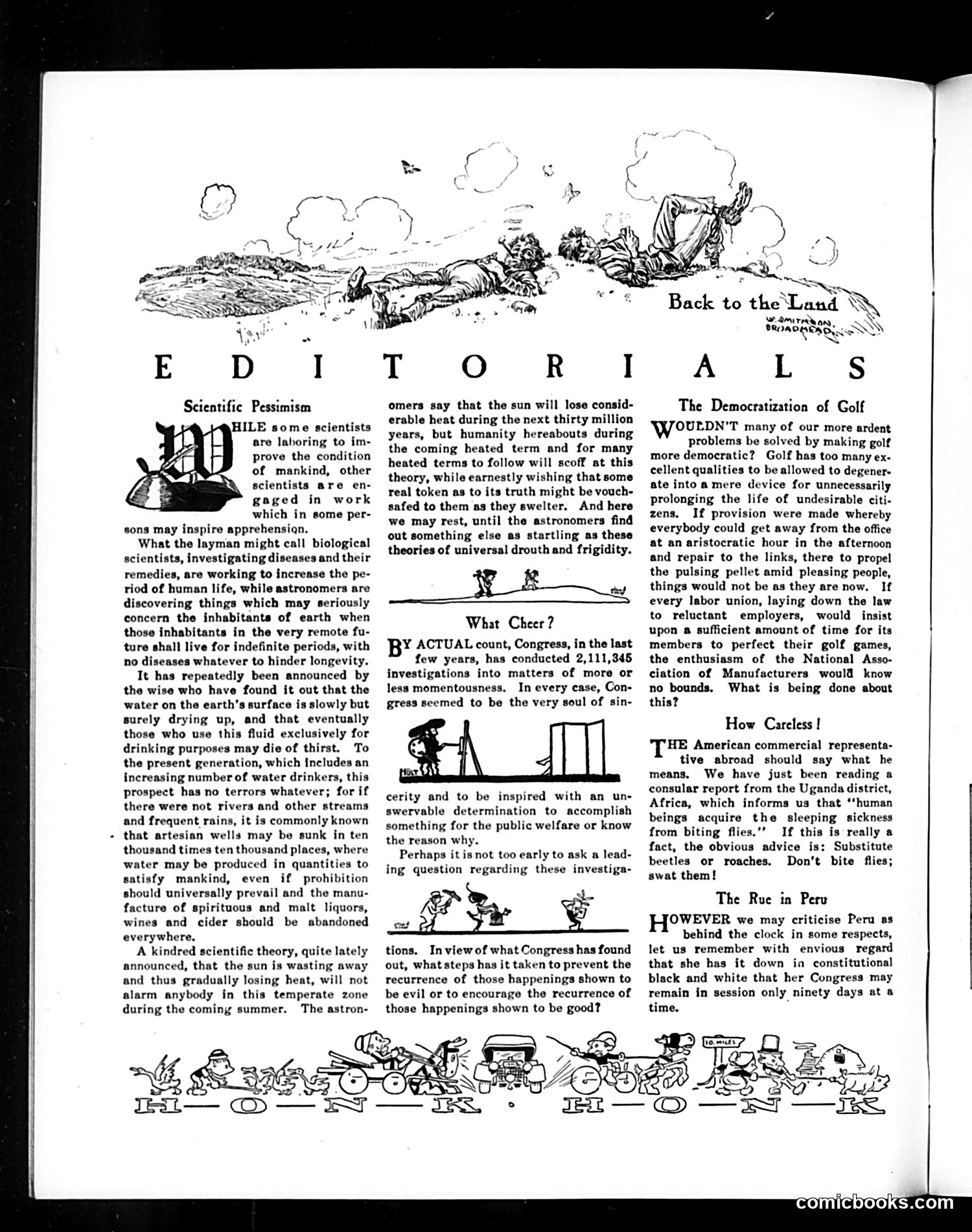
This page contains three opinion columns with illustrations: 1. **"Scientific Pessimism"** satirizes scientists predicting humanity's doom—specifically the sun's eventual heat loss—while ignoring present problems like water scarcity and alcoholism. 2. **"What Cheer?"** criticizes Congress for excessive investigations (2,111 in recent years) into minor matters, suggesting their focus on "sincerity" for public welfare is misplaced. 3. **"The Democratization of Golf"** mocks the idea that golf should be made democratic by requiring wealthy club members to work afternoon shifts as laborers, reasoning this would promote fairness. 4. **"The Ruc in Peru"** briefly comments on Peru's constitutional troubles. The cartoons use humor and exaggeration to critique institutional inefficiency and hypocrisy among elites, scientists, and politicians.
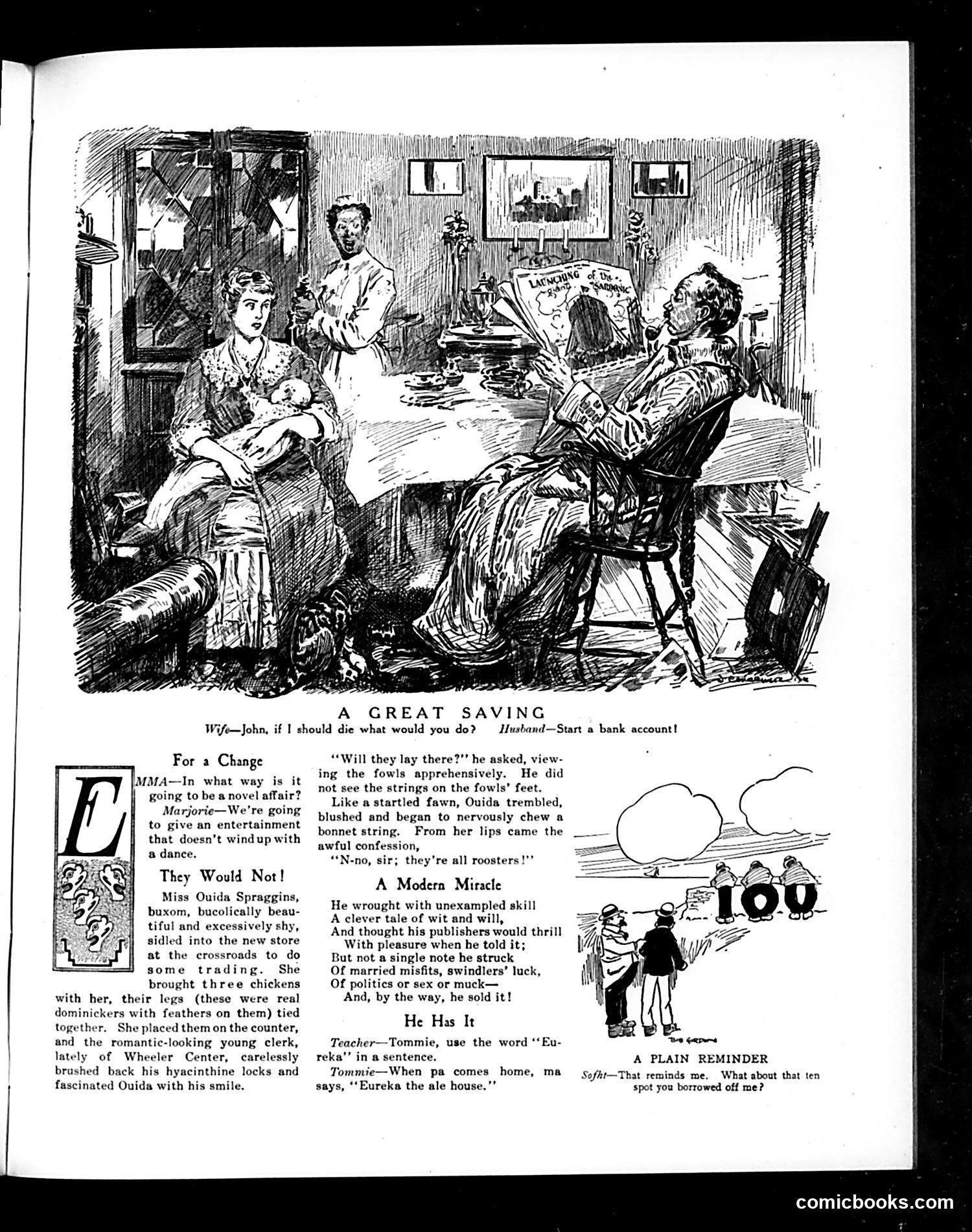
**Main Cartoon ("A Great Saving"):** Depicts a domestic scene where a wife asks her husband what she should do if he dies. His response—"Start a bank account"—satirizes married women's financial dependence in this era. The humor targets the husband's implication that his death would paradoxically *benefit* her by forcing financial independence, while also mocking wives' lack of control over household finances during marriage. **Side Stories:** Include humorous anecdotes about social awkwardness ("They Would Not!"), a clever writer's success ("A Modern Miracle"), and wordplay exercises. **"A Plain Reminder":** A brief comic about borrowing money. The page reflects early-20th-century concerns about gender, marriage, and financial autonomy, presented through Judge's typical satirical, comedic lens.
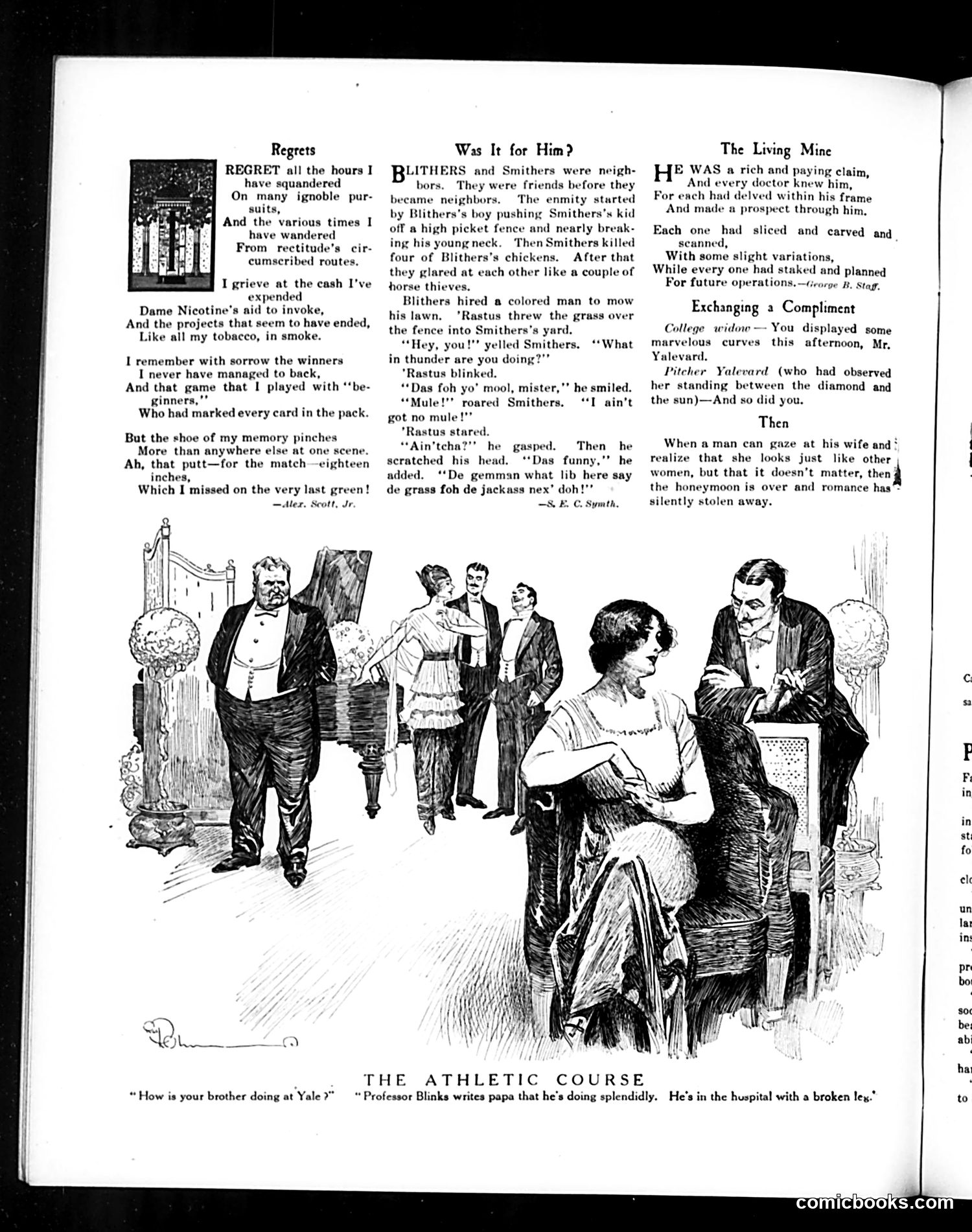
This page contains three satirical pieces typical of early 20th-century *Judge* magazine: **"Regrets"** is a humorous poem about life's disappointments—wasted money, failed gambling bets, and a missed golf putt. The nostalgia and self-recrimination are played for comic effect. **"Was It for Him?"** satirizes racial stereotypes through a dialect-heavy story where a Black groundskeeper ("'Rastus") insults his employer's neighbor by implying he's a "jackass." The humor relies on period-typical offensive caricature. **"The Living Mine"** uses mining metaphor to mock wealthy hypochondriacs who allow doctors to repeatedly operate/exploit them for profit. **"The Athletic Course"** cartoon jokes about Yale student life: parents receive letters claiming their son is doing "splendidly," but he's actually hospitalized with a broken leg—suggesting reckless athletic injuries were common and parents were deliberately misled. The page reflects early 1900s attitudes toward class, race, and higher education while satirizing American excess and pretense.
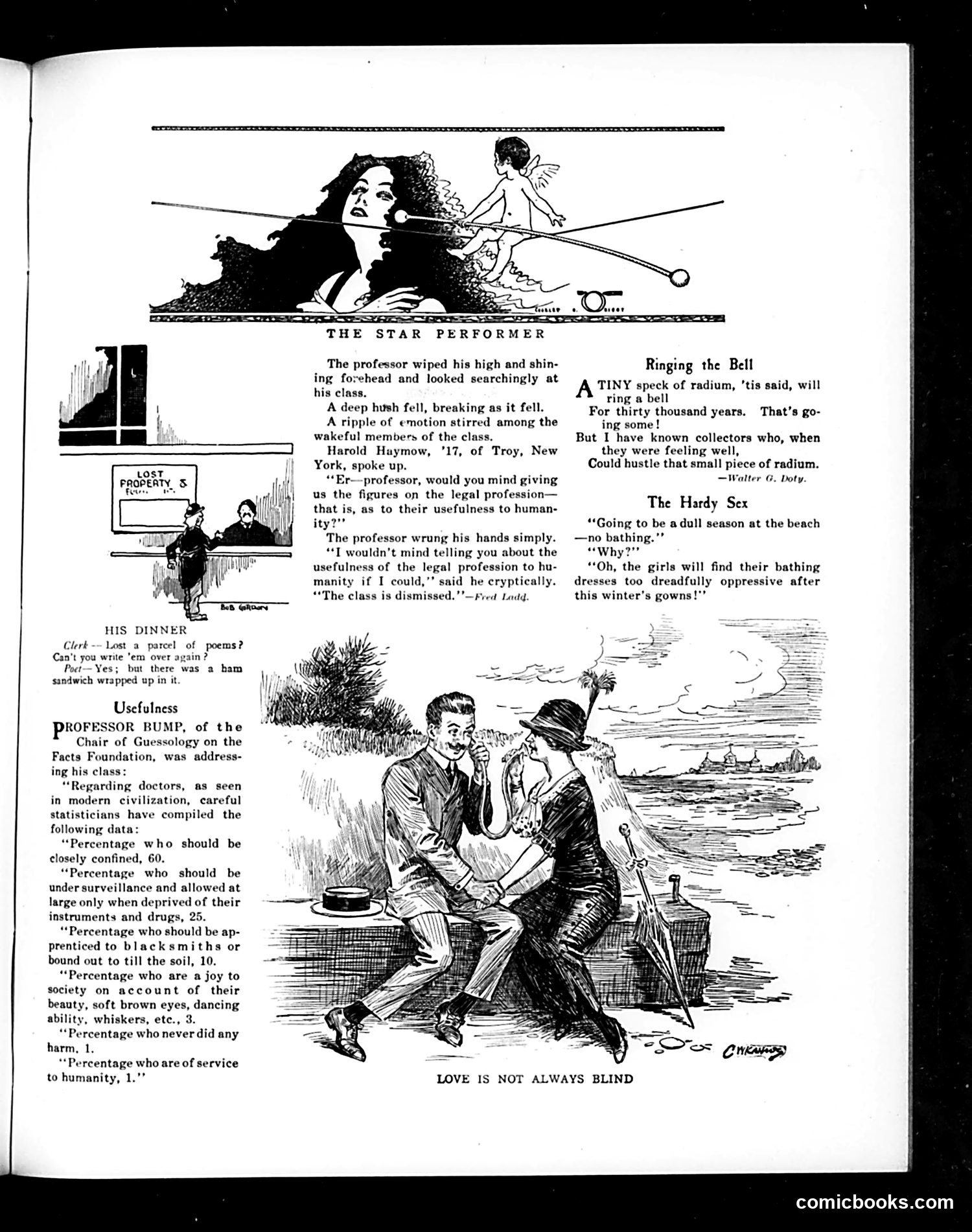
**"The Star Performer"** satirizes academic pretension. Professor Bump delivers absurd statistics classifying doctors as mostly incompetent or dangerous (60% should be confined, 25% under surveillance, only 1% helpful). When a student asks him to apply the same analysis to lawyers, the professor cryptically refuses and dismisses class—the joke being that lawyers are so useless he cannot even calculate their worth. This mocks both pseudo-scientific "guessology" and professional self-interest protecting fellow professionals from criticism. **"The Hardy Sex"** jokes about post-WWI fashion constraints. A woman predicts beach season will be dull because girls find their new bathing dresses "oppressive" compared to the heavy winter gowns women wore during wartime. The irony is that pre-war bathing costumes were actually more restrictive; the joke plays on evolving fashion standards and women adjusting to less constricting clothing. Both pieces represent typical Judge satirical humor targeting institutional absurdity and social change.
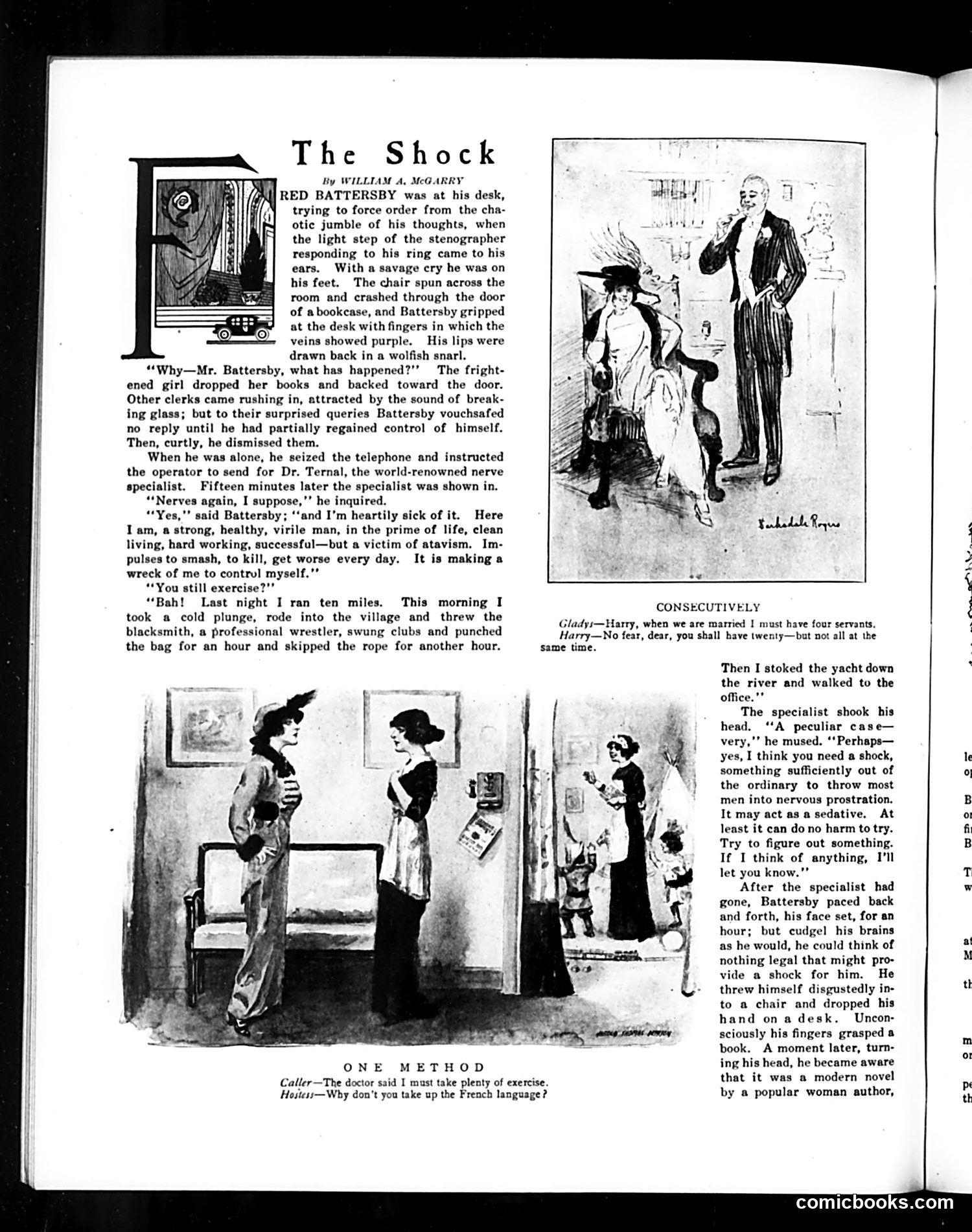
This is a humorous short story by William A. McGarry, not a political cartoon. The satire targets **nervous exhaustion and "atavism"** — late-Victorian anxieties about men's primitive impulses supposedly resurfacing despite modern civilization. The protagonist, Red Battersby, is a successful businessman plagued by violent urges he can't control. He consults a nerve specialist who prescribes an extreme "shock" as treatment. The joke concludes when Battersby accidentally picks up a "modern novel by a popular woman author" — implying this literary genre itself is shocking enough to cure his condition. The bottom cartoon titled "ONE METHOD" extends the satire: a caller asks why the hostess doesn't take up "the French language" as exercise, poking fun at faddish health remedies and linguistic pretension among the upper classes. The page satirizes contemporary medical pseudoscience, masculine anxiety, and literary snobbery typical of the early 1900s.
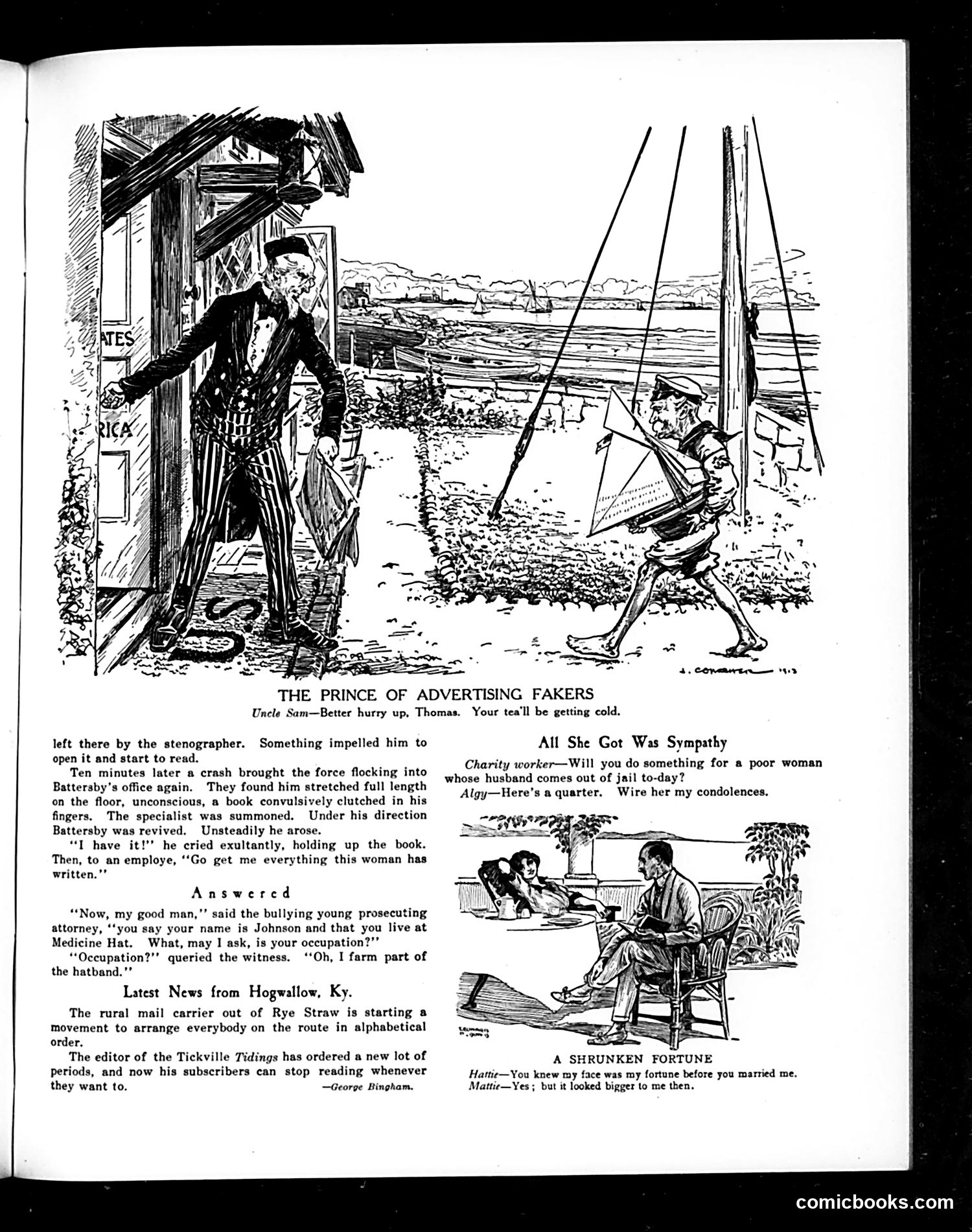
**"The Prince of Advertising Fakers"** (top cartoon): Uncle Sam confronts a man named Thomas about advertising deception. The cartoon satirizes fraudulent advertising schemes prevalent in the era. Uncle Sam represents the government/authority figure calling out false claims—a common Progressive-era theme of exposing con artists and fake advertisers who exploited consumers with exaggerated product claims. **"All She Got Was Sympathy"**: A brief gag about a charity worker offering hollow condolences (a quarter and "wire her my condolences") rather than substantive help to a poor woman—satirizing performative charity. **"A Shrunken Fortune"**: A domestic humor joke where a wife's physical appearance has declined since marriage, playing on the period's cynical view of marriage and women's aging. The remaining text consists of filler humor pieces and local news parodies typical of Judge's miscellaneous content sections.
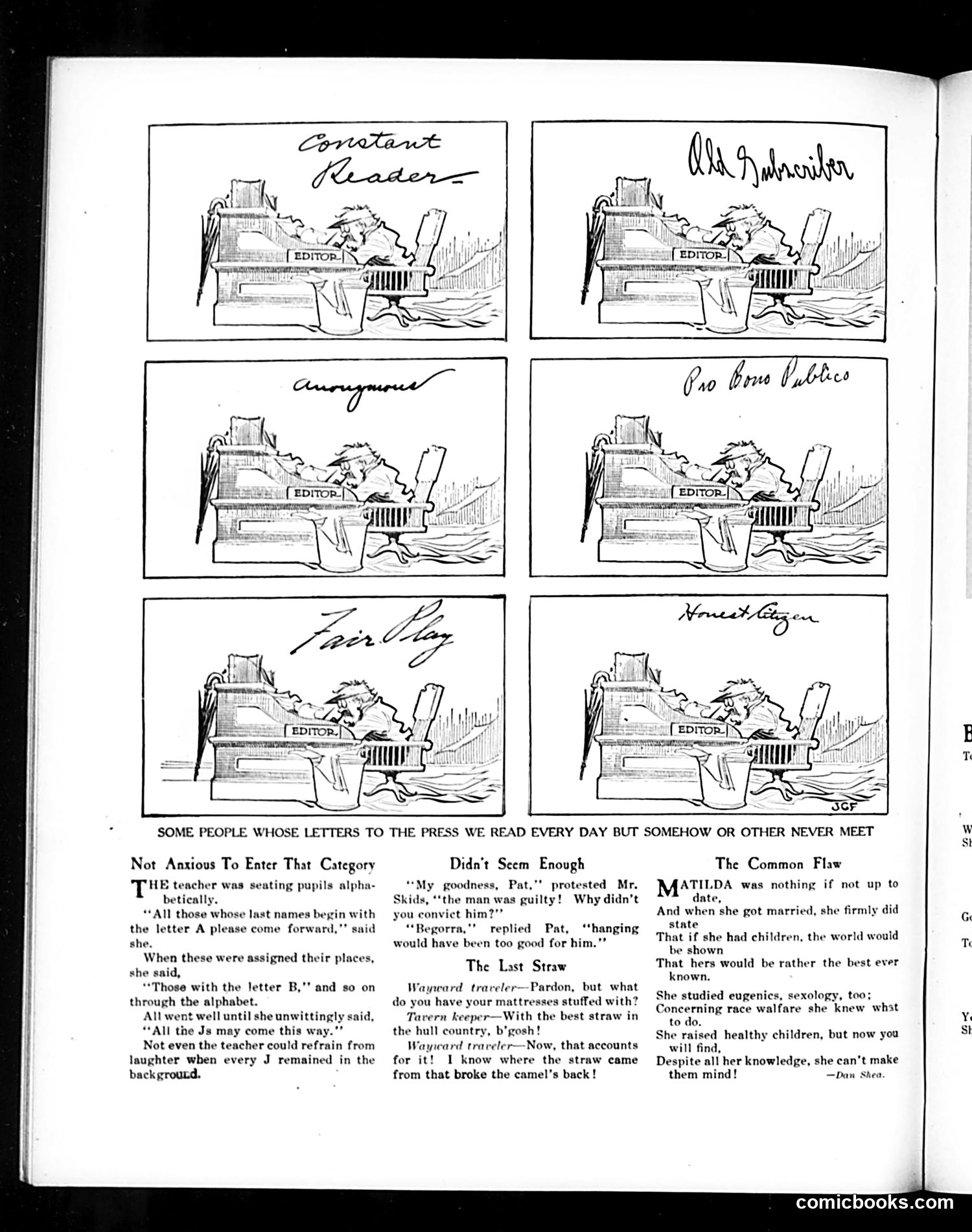
This page from *Judge* magazine presents six short humorous items about letter-writers to newspapers and magazines—people readers encounter through their published correspondence but never meet in person. The cartoons illustrate ethnic/class stereotypes common to early 20th-century American humor. "The Last Straw" features a traveler and tavern keeper with exaggerated Irish dialect ("b'gosh"), joking about straw quality. Similar dialect humor appears in "Didn't Seem Enough," where "Pat" and "Begorra" mark an Irish immigrant character. The title piece uses a schoolroom scenario to make a crude joke: when the teacher asks "all the Js" to come forward, **no one moves**—a racial slur targeting Jewish students, implying they wouldn't want to identify themselves. "The Common Flaw" satirizes modern women who study "eugenics, sexology" and "race welfare" (progressive early-1900s ideas) yet fail at basic child discipline—mocking educated women's pretensions. These pieces reflect period attitudes toward immigrants, Jews, and women's intellectual ambitions through what was then considered acceptable satirical humor.
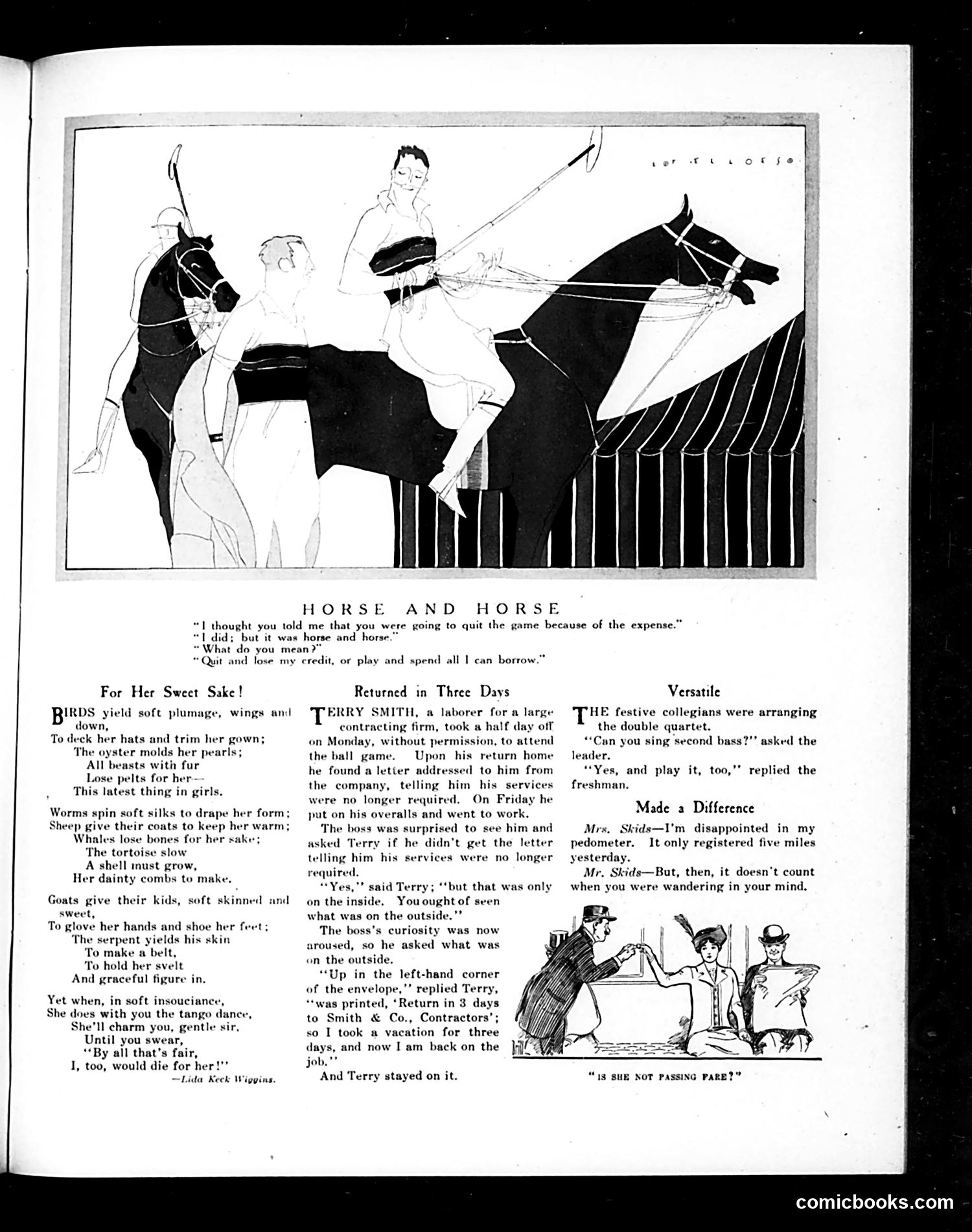
The main cartoon satirizes the gambling dilemma: a man claims he'll quit horse racing due to expense, but admits it's "horse and horse"—meaning he must choose between quitting *and* losing his credit, or continuing to gamble and spend all he can borrow. The joke captures the trap of addiction: both choices are financially ruinous. The page also includes lighthearted social commentary: - **"For Her Sweet Sake!"** mocks the extravagant fashion demands placed on women—birds lose feathers for hats, whales yield bone for corsets, etc.—yet men fall helplessly in love anyway. - **"Returned in Three Days"** is a workplace joke where Terry cleverly exploits his termination letter's "Return in 3 days" postal marking to justify a three-day vacation, then simply returns to work. - Minor humorous vignettes about college singers and a pedometer that doesn't count "wandering in your mind." The humor reflects early 20th-century concerns about gambling, consumer excess, and workplace absurdities.
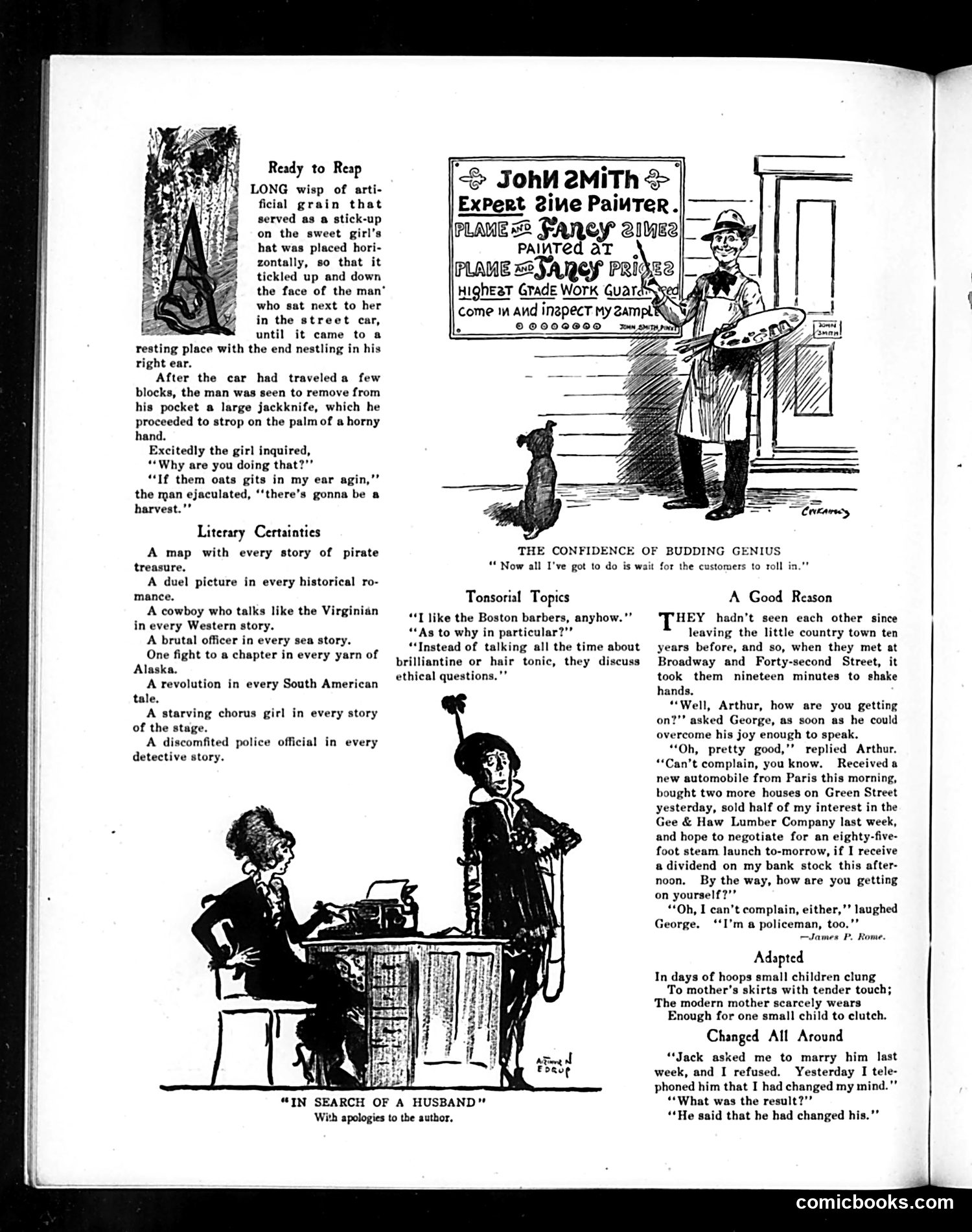
This page contains several satirical pieces typical of early 20th-century American humor: **"Ready to Reap"**: A crude joke about a woman's artificial grain decoration on her hat tickling a man's ear in a streetcar. His threat to "harvest" the oats with a jackknife is presented as dark humor about male irritation. **"Literary Certainties"**: A list mocking predictable formulas in popular fiction—pirate maps, duels in historical romance, stock cowboys, brutal sea captains, revolutions in Latin American tales, starving chorus girls, and incompetent police in detective stories. This satirizes how formulaic commercial fiction had become. **"The Confidence of Budding Genius"**: John Smith, a painter, displays samples while waiting for customers—suggesting naive optimism about his prospects. **"Tonsorial Topics" and "A Good Reason"**: Brief anecdotes about barber conversations and a wealthy man boasting to a newly-met policeman friend, satirizing class pretension and luck. The page reflects Judge's focus on social observation and literary mockery rather than overt political satire.
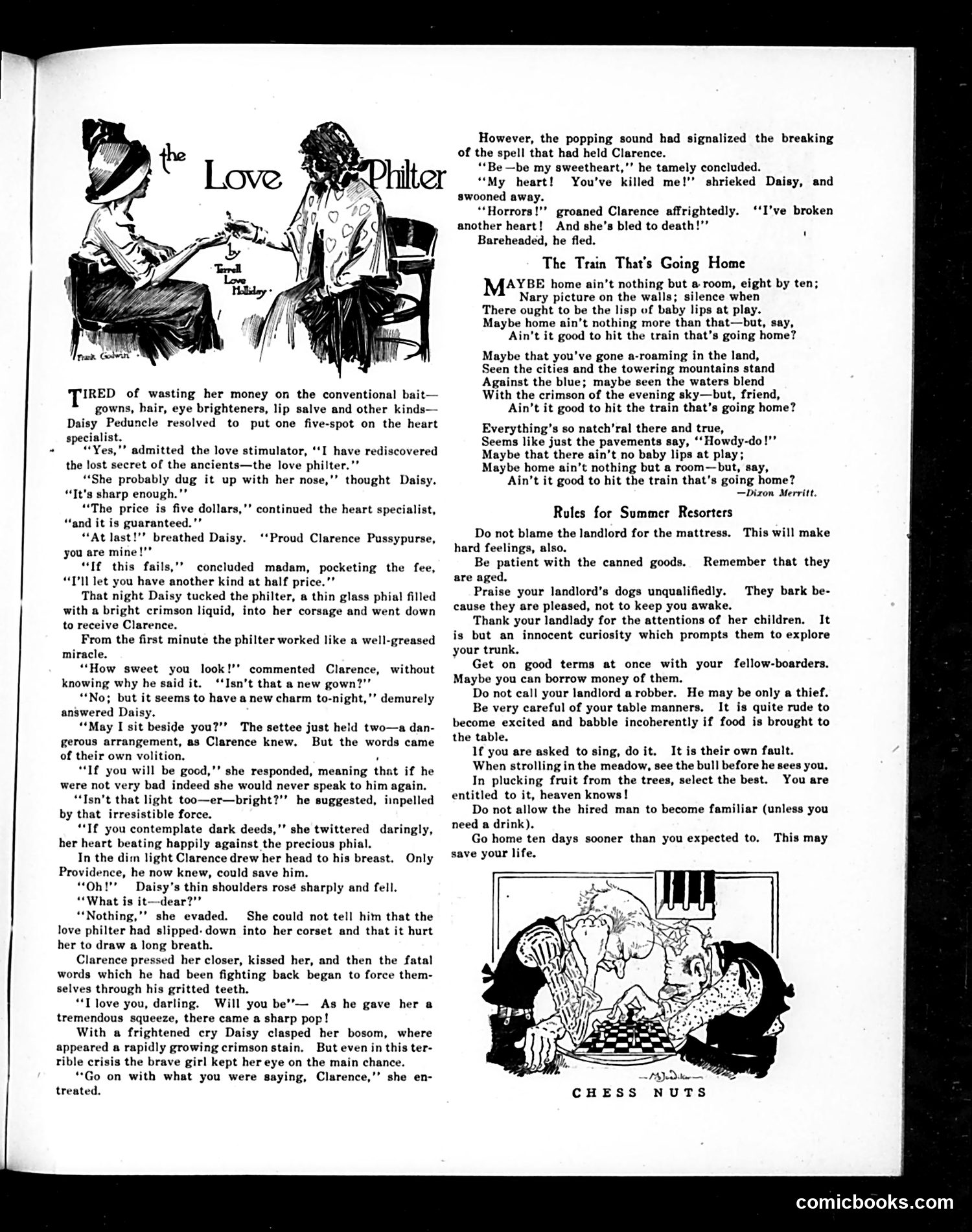
This satirical story mocks both romantic conventions and the pseudo-scientific "love stimulation" industry popular in the early 20th century. **The Setup:** Daisy Peduncle consults a charlatan "heart specialist" (a quack) who sells her a supposed love potion—a vial of crimson liquid—for five dollars, claiming it will make Clarence fall for her. **The Satire:** The joke exposes two targets: (1) women wasting money on beauty products and dubious "remedies" to attract men, and (2) the fraudulent practitioners promising guaranteed results. The specialist's condescending offer of "another kind at half price" if the first fails mocks scam tactics. **The Punchline:** The "philter" works—but accidentally, when it breaks inside Daisy's corset, the crimson liquid bleeds through her dress. Clarence, thinking she's dying, finally confesses his love (weakly: "be my sweetheart"). Yet Daisy, undeterred by actual injury, stays focused on "the main chance"—securing his proposal. The cartoon undercuts romance itself: true love emerges only through accident and misunderstanding, not magic or artifice.
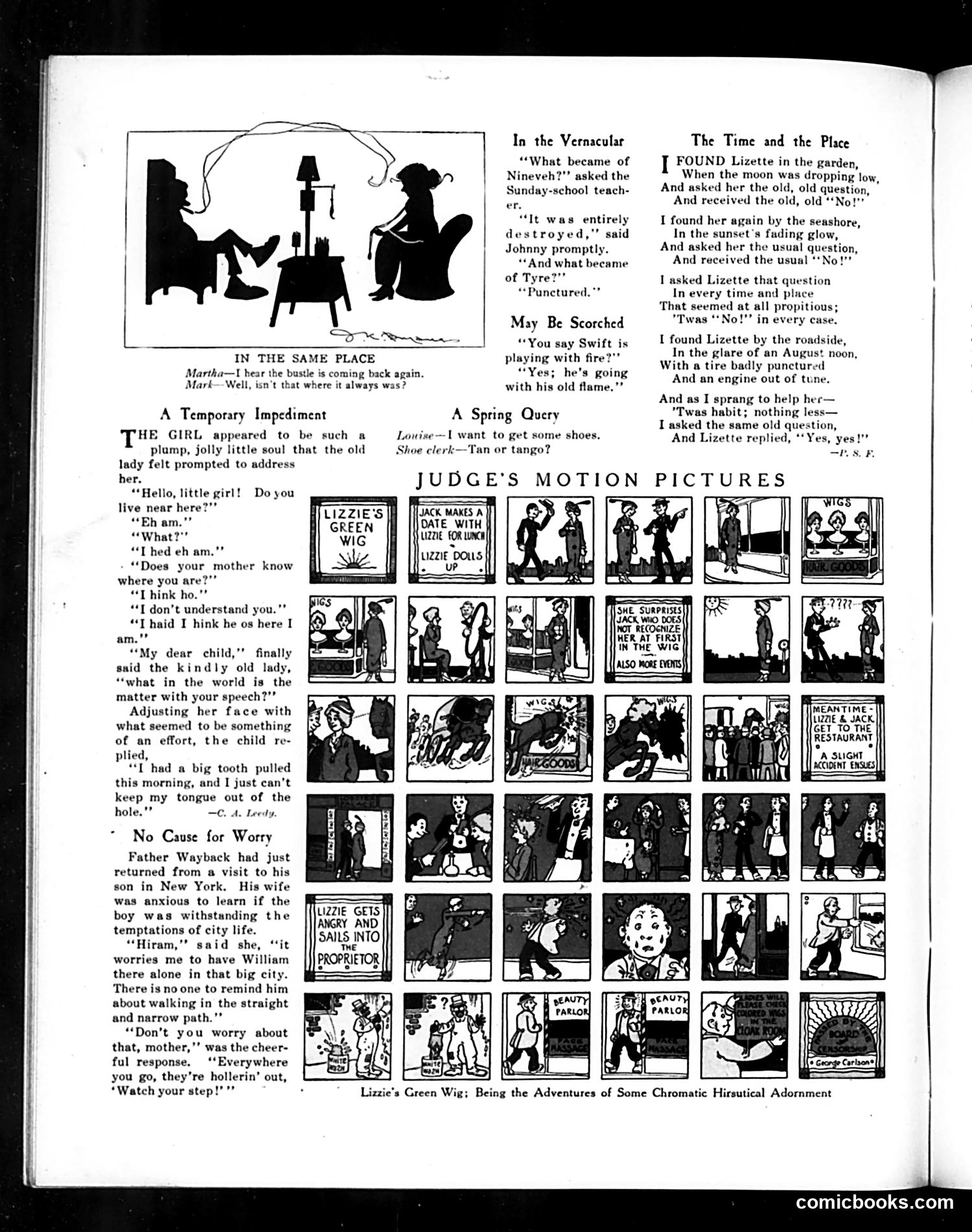
This page contains three humor pieces and a motion-picture comic strip about "Lizette's Green Wig." **The cartoons/jokes:** 1. **"A Temporary Impediment"**: A child with a recently extracted tooth cannot speak clearly, creating comedy through her garbled speech ("Thed eh am" for "There I am"). 2. **"No Cause for Worry"**: A father reassures his wife that their son won't stray in New York City because street signs constantly warn "Watch your step!"—a pun suggesting moral guidance ironically comes from traffic safety warnings. 3. **"A Spring Query"**: A shoe-clerk joke playing on fashionable dance crazes of the era—"tango" was a wildly popular new dance, so asking about shoe colors ("tan") versus dance styles creates wordplay. 4. **"The Time and the Place"**: A romantic narrative poem where a man repeatedly proposes to "Lizette" in various scenic settings, always rejected—until a car breakdown makes her vulnerable enough to say yes. The page reflects early-20th-century humor: innocent puns, sentimental romance, and everyday American situations.
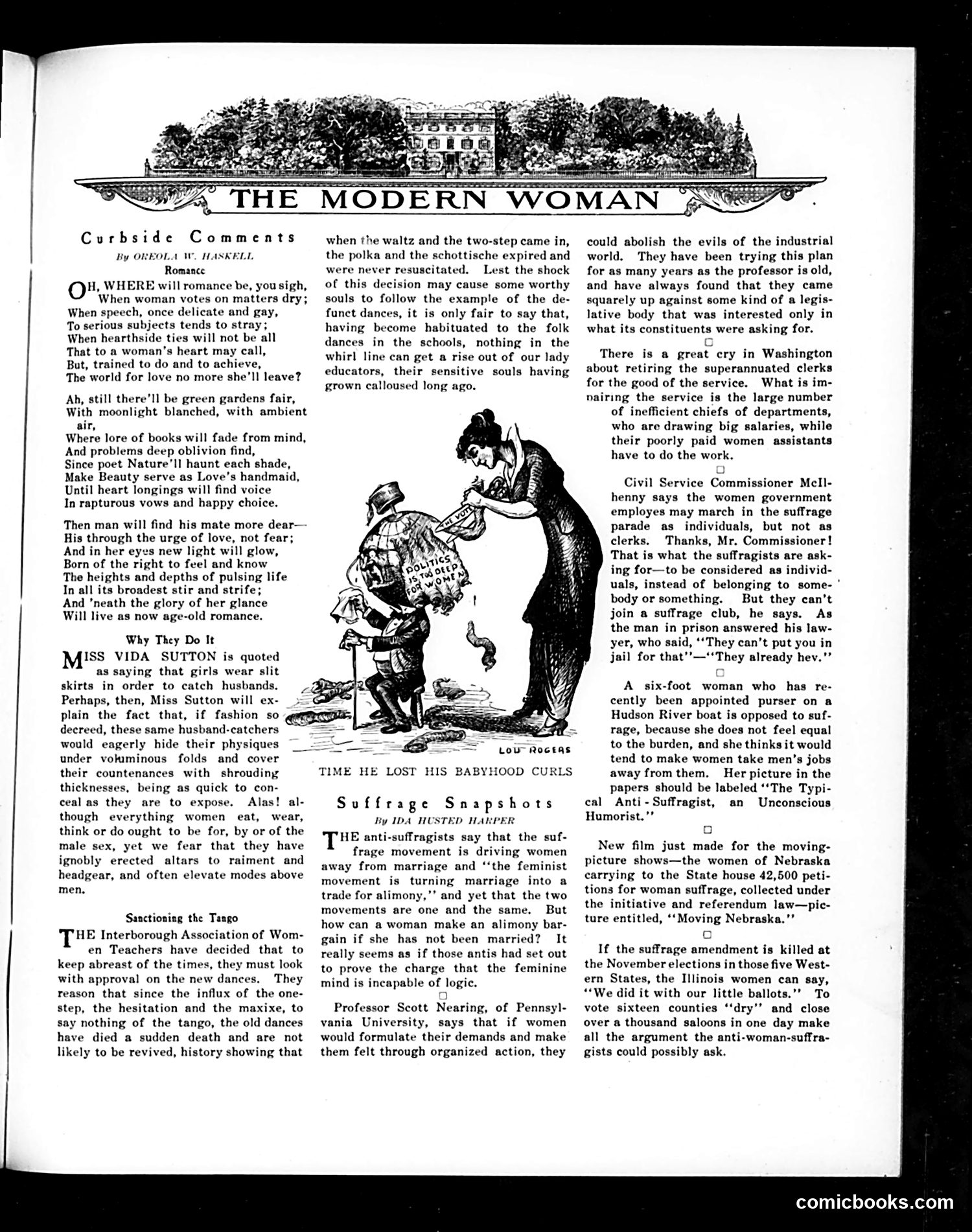
This page contains multiple satirical commentaries on women's suffrage and changing social roles circa early 1900s. **Key sections:** 1. **"Romance"** — A poem arguing that women's voting rights won't destroy romance, attempting to reassure anxious readers. 2. **"Why They Do It"** — Mocks Miss Vida Sutton's claim that women wear slit skirts to catch husbands, sarcastically noting women apparently prioritize fashion over male approval—a shocking notion to anti-feminist readers. 3. **"Sanctioning the Tango"** — Teachers' approval of modern dances (tango, one-step) is presented as inevitable social progress, comparing it to how older dances disappeared when new ones arrived. 4. **"Suffrage Snapshots"** — The cartoon (captioned "Time He Lost His Babyhood Curls") depicts a man being feminized or emasculated. The text ridicules anti-suffragist logic, noting they simultaneously claim suffrage drives women from marriage *and* turns marriage into alimony disputes—logically contradictory positions. The overall tone: satirical defense of women's rights against conservative opposition.
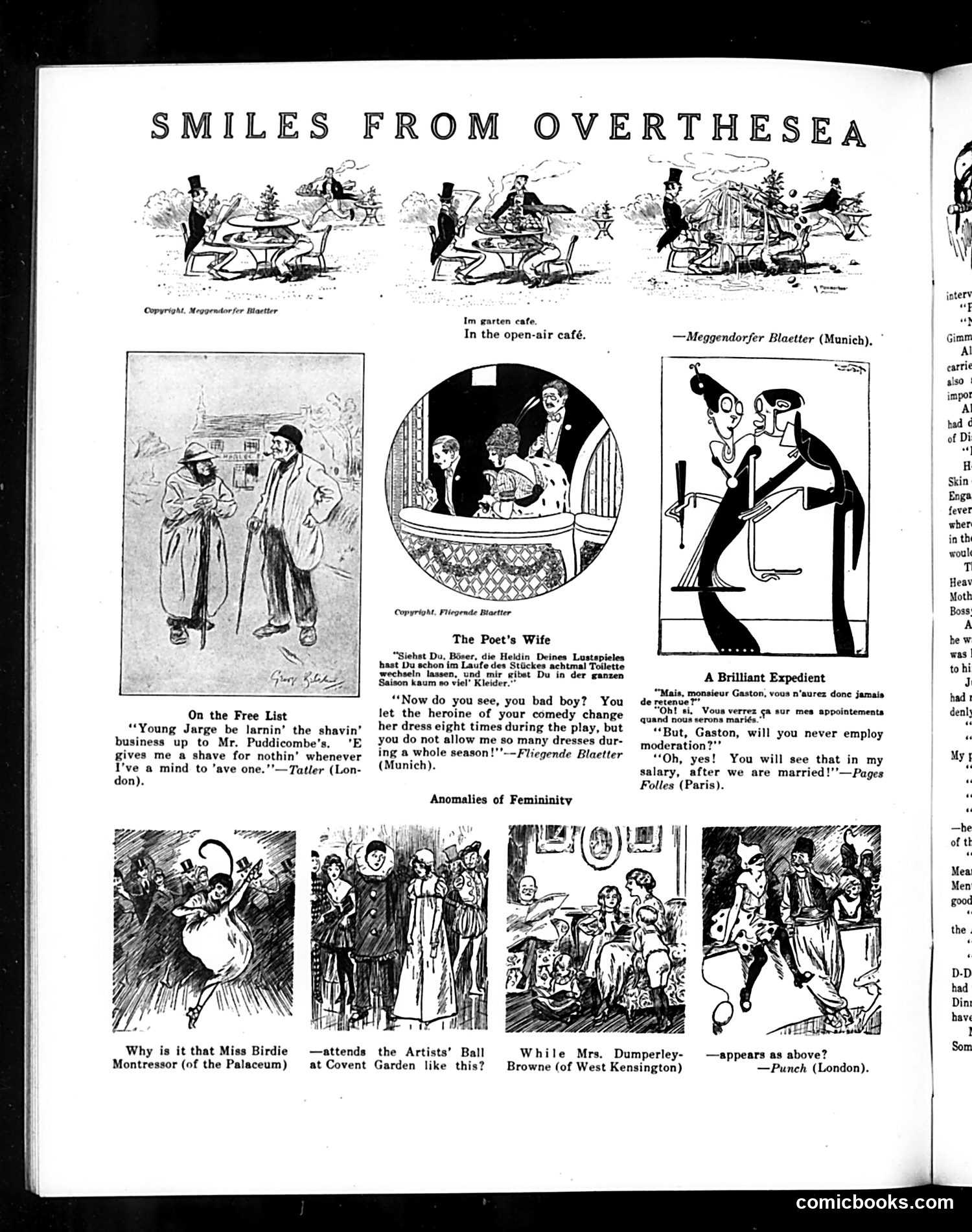
This page collects humorous cartoons from European satirical magazines (Meggendorfer Blätter, Fliegende Blätter, Punch, Pages Folles), presenting relatable domestic and social comedy. **Key jokes:** 1. **"On the Free List"**: A working-class man brags he gets free shaves by being a regular customer—satirizing penny-pinching practicality. 2. **"The Poet's Wife"**: A German cartoon mocking gender inequality: a playwright allows his stage heroine eight costume changes but gives his actual wife minimal new dresses yearly. It highlights the disparity between theatrical extravagance and domestic stinginess toward women. 3. **"A Brilliant Expedient"**: A Frenchman promises his fiancée he'll practice financial moderation—but only *after* marriage when deductions come from his salary, implying he'll spend freely beforehand. 4. **"Anomalies of Femininity"**: Four panels (captions partially unclear) appear to satirize women's eccentric or contradictory social behavior at events. The page presents universal marital and class humor recognizable across cultures.
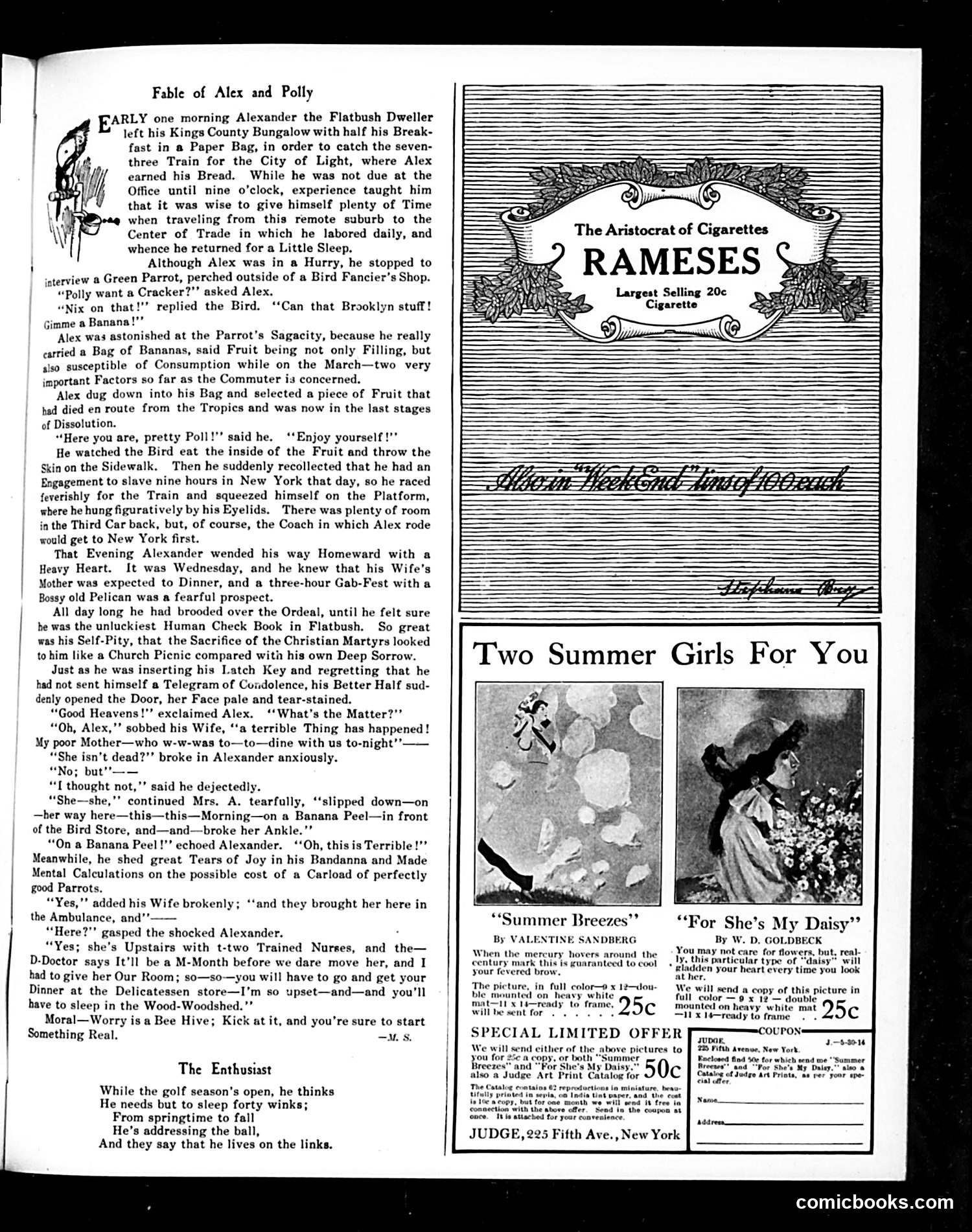
This is a satirical morality tale about a suburban commuter's karma. Alexander, a Flatbush resident who commutes to Manhattan for work, encounters a talking parrot and feeds it a rotten banana. The parrot discards the peel on the sidewalk. Later that evening, Alexander learns his mother-in-law has slipped on a banana peel in front of the bird shop, breaking her ankle. Trapped upstairs convalescing, she's forced upon him as an unwanted houseguest. The story ends with Alexander "shed[ding] great Tears of Joy" while calculating the cost of parrots—suggesting his misery at her presence is darkly offset by schadenfreude at the cosmic justice. The satire mocks suburban commuters' self-pitying attitudes and emphasizes karmic consequence: his casual littering results in his own punishment. The moral: "Worry is a Bee Hive; Kick at it, and you're sure to start Something Real."
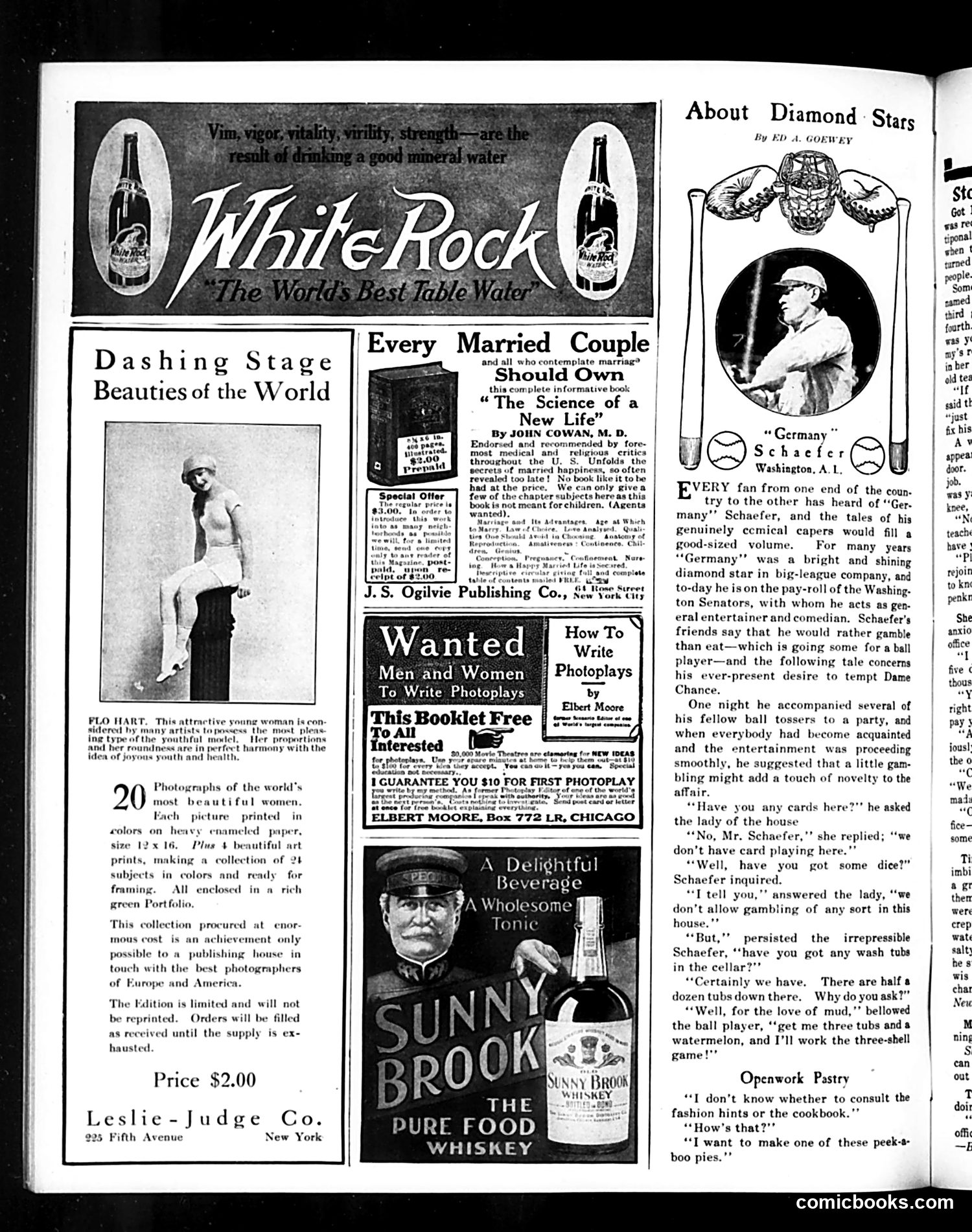
This page is primarily **advertising and entertainment content** rather than political satire. The main elements are: **"About Diamond Stars"** profiles "Germany" Schaefer, a real baseball player for the Washington Senators, known for clowning and gambling. The anecdote depicts him as an irrepressible gambler who attempts to organize gambling games (dice, card games, even a shell game with washtubs) at a respectable house party. The humor relies on Schaefer's reputation as a lovable, incorrigible character—his persistence and creativity in finding ways to gamble despite social disapproval. The page also contains typical Judge-era advertisements for books, photographs, and products (whiskey, mineral water). The "Openwork Pastry" quip is a mild double-entendre joke about recipes. **No significant political satire appears here**—it's largely lifestyle/entertainment content with period advertising reflecting early 20th-century publishing and consumer culture.
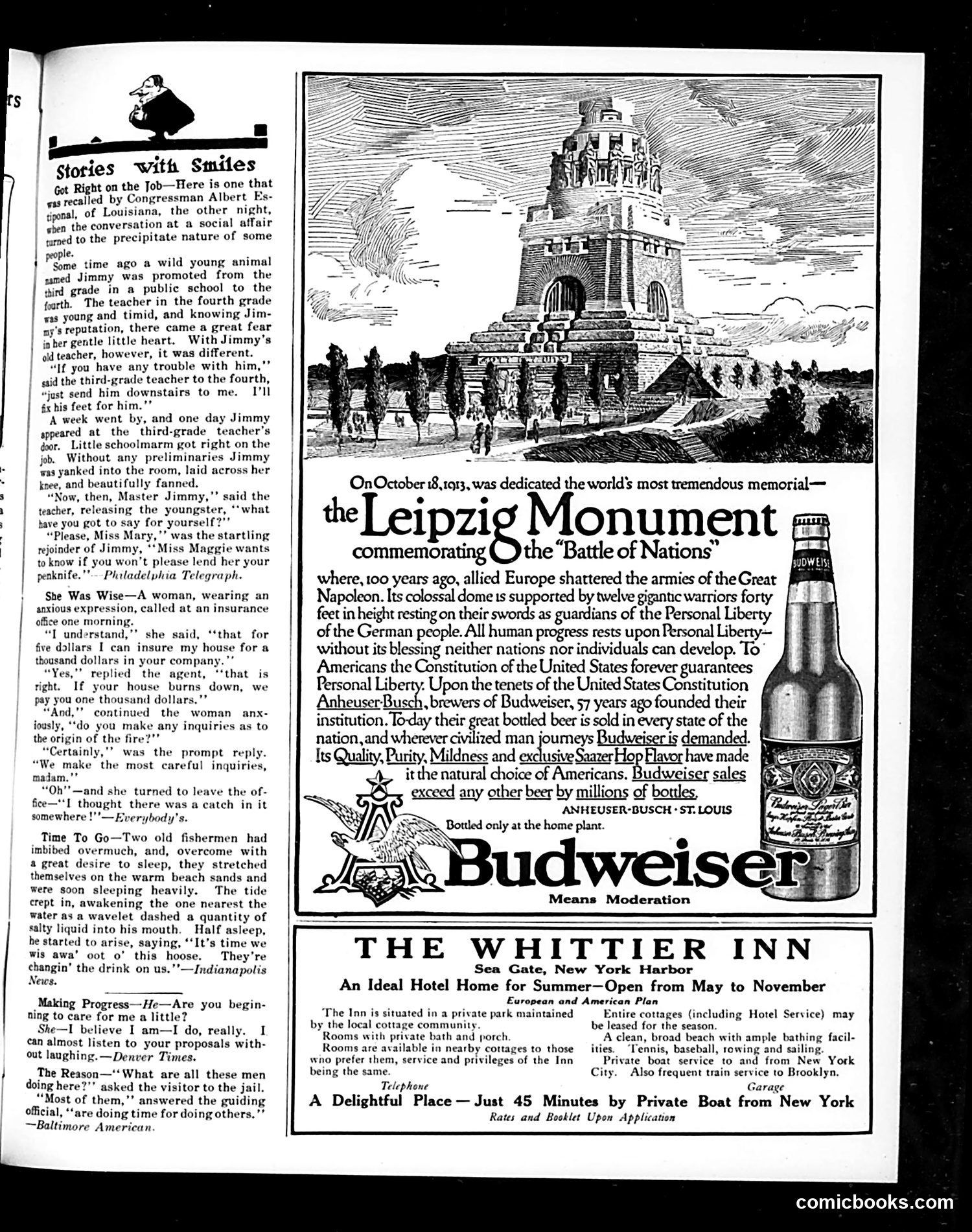
This page combines short humorous anecdotes ("Stories with Smiles") with a large **Budweiser beer advertisement disguised as patriotic messaging**. The ad's key elements: **The Leipzig Monument reference** (1913) commemorates Napoleon's defeat—framed as a celebration of European freedom and "Personal Liberty." **The propaganda technique**: Anheuser-Busch explicitly links their beer to American constitutional values, claiming their 57-year-old company embodies the same liberty principles as the U.S. Constitution. This is classic early-20th-century corporate branding: equating beer consumption with patriotism. **Modern context**: This reflects German-American breweries' attempt to counter growing Prohibition sentiment by wrapping their product in nationalist rhetoric. The ad essentially argues: drinking Budweiser = defending American freedom. The humor section is filler—schoolyard pranks and light domestic comedy typical of period magazines. The real content is the ad's audacious claim that beer sales equal national progress.
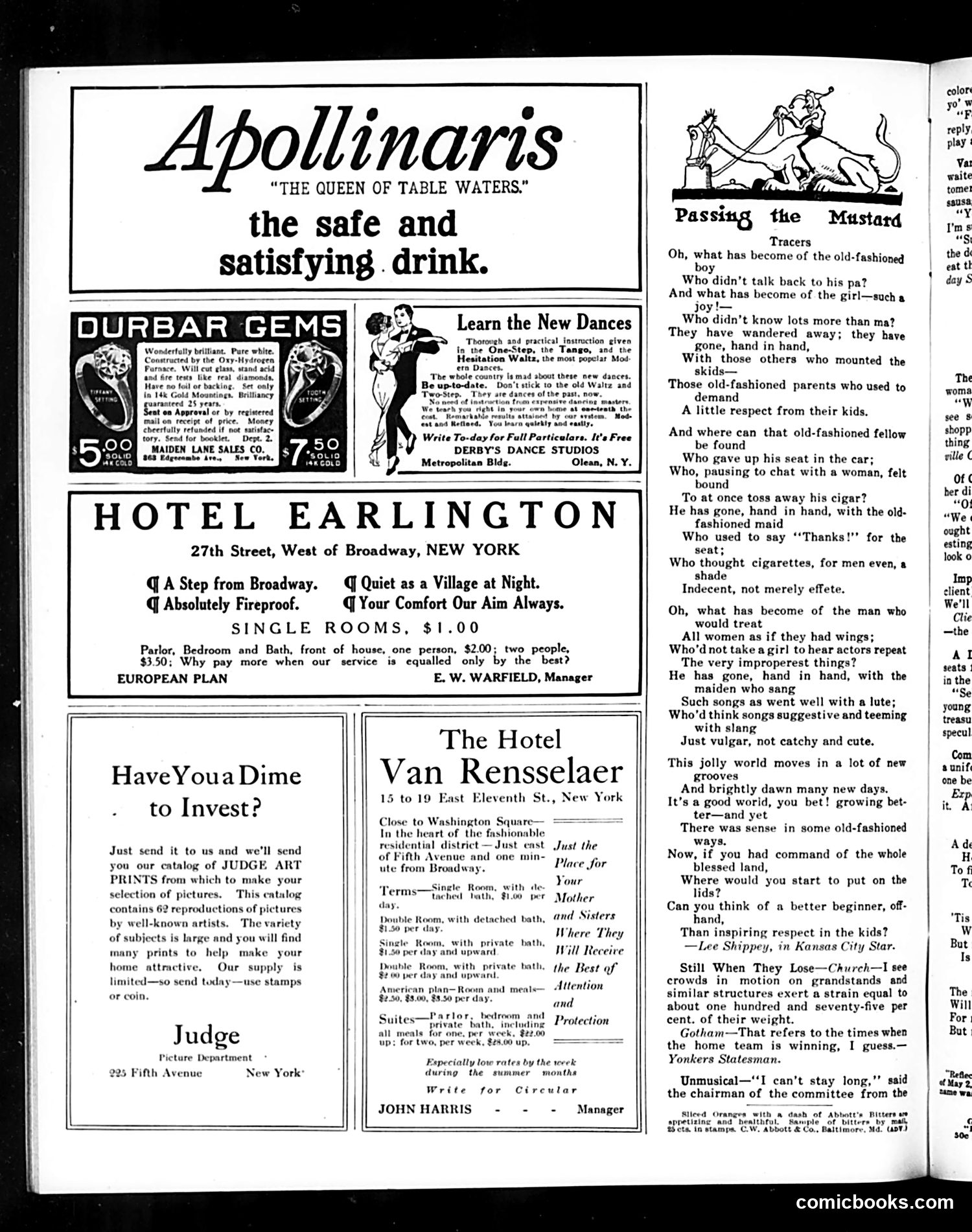
This poem satirizes the decline of old-fashioned propriety and respect among young people. The repeated refrain "they have gone, hand in hand, with the old-fashioned..." laments disappearing social norms: obedient children, respectful girls, gentlemen who surrender seats and quit smoking around women, and maidens who appreciate modest behavior. The author contrasts a vanishing era of deference and restraint with a "new world" of casual impropriety. Young people now talk back to parents, smoke cigarettes (shocking for women), listen to "suggestive" songs, and generally disregard traditional courtesies. The final question—"Can you think of a better beginner...Than inspiring respect in the kids?"—reveals the satirist's conservative worry: that modern society is losing moral discipline. The humor is gently nostalgic rather than cruel, but clearly judges contemporary youth as disrespectful and crude compared to their parents' generation. This reflects early 20th-century anxiety about rapid social change and generational conflict.
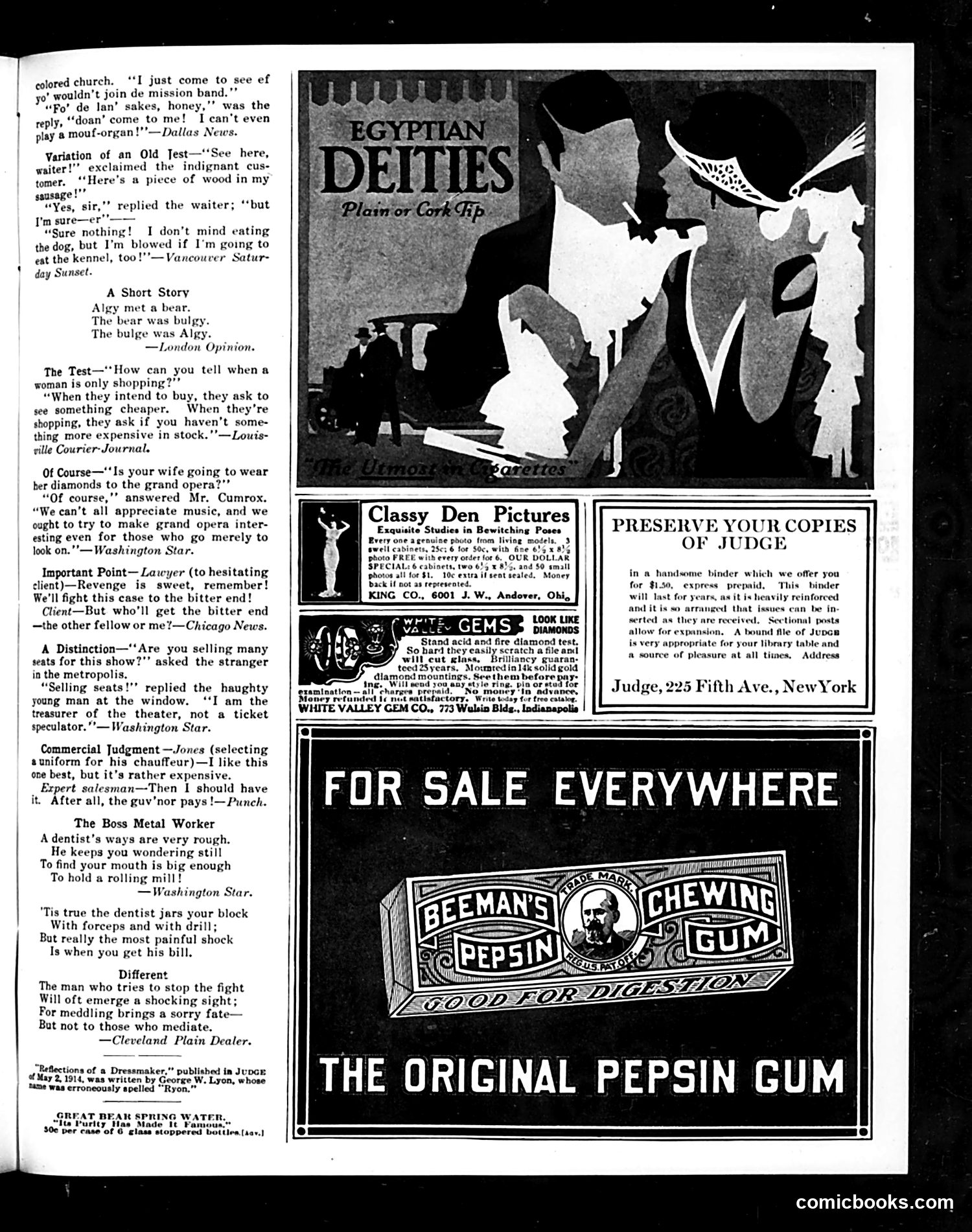
This page is primarily **advertisements and humor columns**, not political cartoons. The content includes: **Humorous Anecdotes**: Short jokes about social situations—a Black church member declining to join a mission band, a diner refusing to eat dog meat "but the kennel too," and jokes about women shopping, opera diamonds, and dentists' bills. These reflect early 20th-century American humor, including racial stereotypes typical of the era. **The "Egyptian Deities" illustration** (top) is decorative art advertising, not political satire. **Advertisements**: Most of the page features ads for Beeman's Pepsin Chewing Gum ("The Original Pepsin Gum"), White Gems diamonds, Classy Den Pictures, and a Judge magazine binder service. **No clear political commentary** is visible on this page. It's a typical Judge magazine issue mixing light social humor with commercial advertising. The racial dialect humor reflects period attitudes rather than advancing political critique.
This page is primarily **advertising and humor miscellany** rather than political satire. The content consists of: **College humor jokes** ("With The College Wits") featuring light jokes about lawyers, dancing, and romance—typical early 20th-century collegiate wit from various university publications (Nebraska Awgwan, Dartmouth Jack o' Lantern, etc.). These mock lawyers, dating rituals, and romantic sentimentality. **Prominent advertisements** for Club Cocktails, Vaseline Hair Tonic, the Hotel Imperial's Palm Garden dancing venue, and various business services (diamonds on credit, paper warehouses, patent assistance). **Brief satirical sketches**, including a "Real Love Scene" depicting awkward romantic dialogue and a joke using offensive racial stereotypes ("Mandy" seeking to drug her man). The page reflects period humor: sentimental romance, gender dynamics, and casual racism typical of 1920s American magazines. There's no coherent political message—it's a standard magazine layout mixing ads with reprinted college humor and filler content.
This page is a **beer advertisement, not a cartoon or satire**. It's a Schlitz beer ad from Judge magazine promoting their product's purity and shelf stability. The ad claims that Schlitz in brown bottles is uniquely trustworthy because brown glass allegedly preserves the beer's quality during distribution—a legitimate marketing point, since brown glass does protect beer from light damage better than clear bottles. The tagline "The Beer That Made Milwaukee Famous" references Milwaukee's historical identity as a major beer-brewing center. The instruction to "See that Crown is branded 'Schlitz'" suggests consumers verify authenticity by checking the bottle cap. This represents straightforward period advertising rather than satirical content.
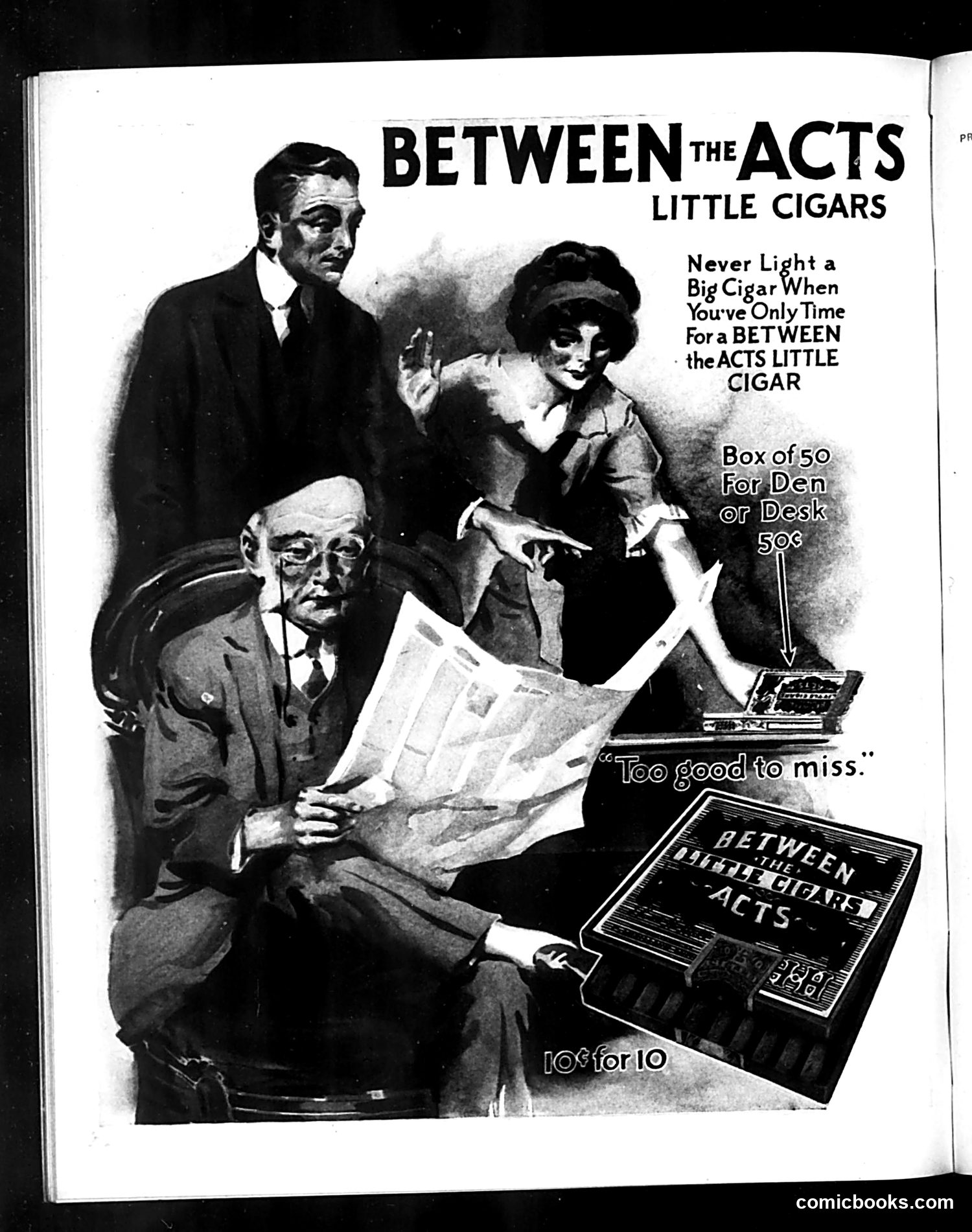
This is a vintage cigarette advertisement, not political satire. It promotes "Between the Acts" brand little cigars, marketed for quick smoking during theater intermissions. The ad depicts three well-dressed theatergoers: an older gentleman reading a program, a man in formal wear, and a woman. The tagline advises against lighting a full-sized cigar when time is limited—instead, use their compact "little cigars" for den or desk use (priced at 50¢ per box, or 10¢ for individual cigars). The phrase "Too good to miss" emphasizes the product's quality and convenience. This reflects early 20th-century tobacco advertising targeting middle and upper-class consumers during leisure moments. There is no political commentary present—this is straightforward commercial messaging from *Judge* magazine's advertising section.