
Judge, 1914-05-30 · page 15 of 24
Judge — May 30, 1914 — page 15: what you’re looking at
What you’re looking at
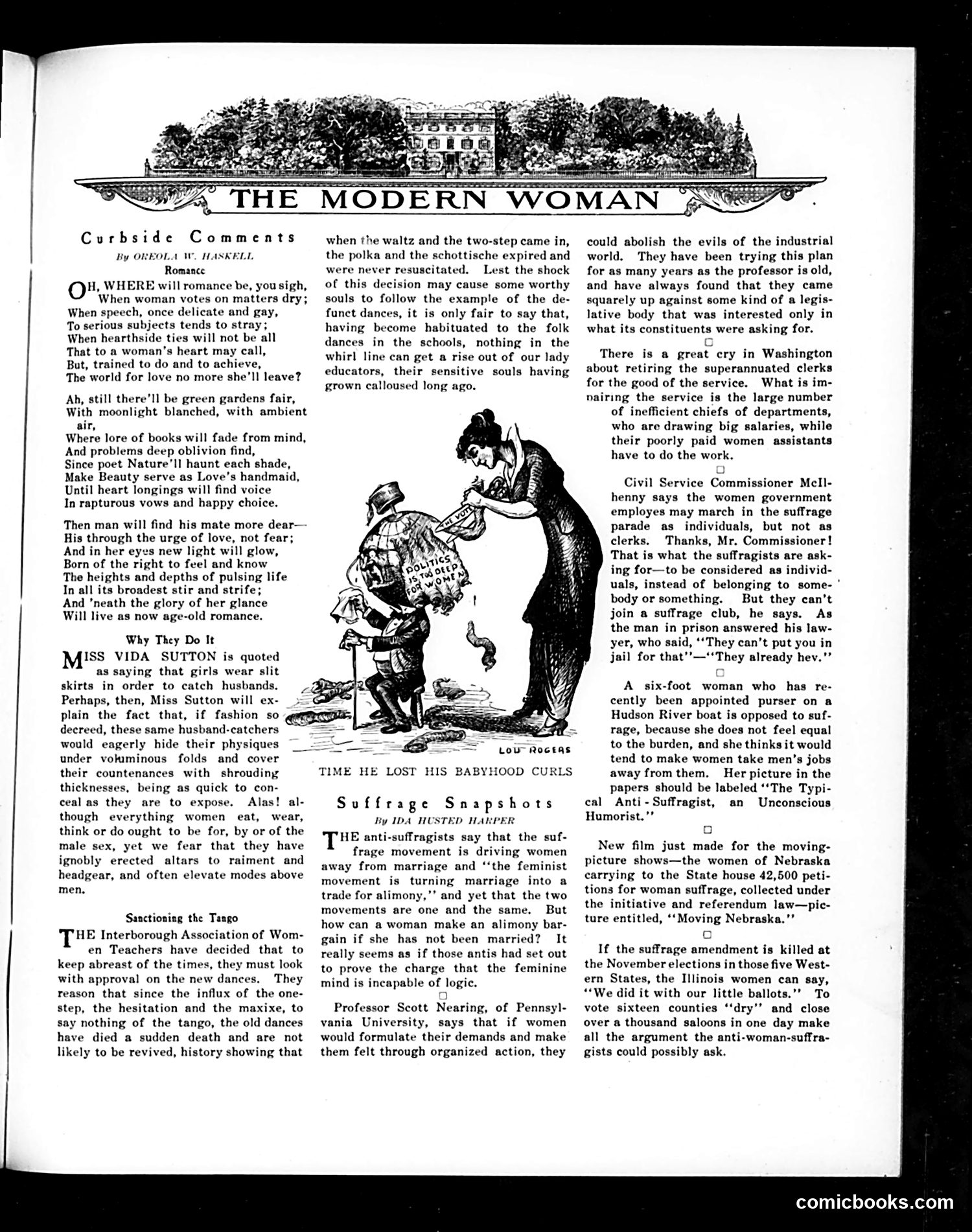
This page contains multiple satirical commentaries on women's suffrage and changing social roles circa early 1900s. **Key sections:** 1. **"Romance"** — A poem arguing that women's voting rights won't destroy romance, attempting to reassure anxious readers. 2. **"Why They Do It"** — Mocks Miss Vida Sutton's claim that women wear slit skirts to catch husbands, sarcastically noting women apparently prioritize fashion over male approval—a shocking notion to anti-feminist readers. 3. **"Sanctioning the Tango"** — Teachers' approval of modern dances (tango, one-step) is presented as inevitable social progress, comparing it to how older dances disappeared when new ones arrived. 4. **"Suffrage Snapshots"** — The cartoon (captioned "Time He Lost His Babyhood Curls") depicts a man being feminized or emasculated. The text ridicules anti-suffragist logic, noting they simultaneously claim suffrage drives women from marriage *and* turns marriage into alimony disputes—logically contradictory positions. The overall tone: satirical defense of women's rights against conservative opposition.
📄 Transcribed text from this page (OCR, searchable)
Machine-transcribed from the original scan — historical spelling and the odd misread are preserved.
MODERN WOMA Curbside Comments By OREOLA W. HASKELL Romance H, WHERE will romance be, you sigh, When woman votes on matters dry; When speech, once delicate and gay, To serious subjects tends to stray; When hearthside ties will not be all That to a woman's heart may call, But, trained to do and to achieve, The world for love no more she'll leave? Ah, still there’ll be green gardens fair, With moonlight blanched, with ambient air, Where lore of books will fade from mind, And problems deep oblivion find, Since poet Nature’ll haunt each shade, Make Beauty serve as Love's handmaid, Until heart longings will find voice In rapturous vows and happy choice. Then man will find his mate more dear— His through the urge of love, not fear; And in her eyes new light will glow, Born of the right to feel and know The heights and depths of pulsing life In all its broadest stir and strife; And ‘neath the glory of her glance Will live as now age-old romance. Why They Do It Mss VIDA SUTTON is quoted as saying that girls wear slit skirts in order to catch husbands. Perhaps, then, Miss Sutton will ex- plain the fact that, if fashion so decreed, these same husband-catchers would eagerly hide their physiques under voluminous folds and cover their countenances with shrouding thickness being as quick to con- ceal as they are to expose. Alas! al- though everything women eat, wear, think or do ought to be for, by or of the male sex, yet we fear that they have ignobly erected altars to raiment and headgear, and often elevate modes above men. Sanctioning the Tango THE Interborough Association of Wom- en Teachers have decided that to keep abreast of the times, they must look with approval on the new dances. They reason that since the influx of the one- step, the hesitation and the maxixe, to say nothing of the tango, the old dances have died a sudden death and are not likely to be revived, history showing that when the waltz and the two-step came in, the polka and the schottische expired and were never resuscitated. Lest the shock of this decision may cause some worthy souls to follow the example of the de- funct dances, it is only fair to say that, having become habituated to the folk dances in the schools, nothing in the whirl line can get a rise out of our lady educators, their sensitive souls having grown calloused long ago. Lou Roctas TIME HE LOST HIS BABYHOOD CURLS Suffrage By IDA HUs HE anti-suffragists say that the suf- frage movement is driving women away from marriage and ‘‘the feminist movement is turning marriage into a trade for alimony,”’ and yet that the two movements are one and the same. But how can a woman make an alimony bar- gain if she has not been married? It really seems as if those antis had set out to prove the charge that the feminine mind is incapable of logic. Snapshots ED HARPER Professor Scott Nearing, of Pennsyl- vania University, says that if women would formulate their demands and make them felt through organized action, they could abolish the evils of the industrial world. They have been trying this plan for as many years as the professor is old, and have always found that they came squarely up against some kind of a legis- lative body that was interested only in what its constituents were asking for. There is a great cry in Washington about retiring the superannuated clerks for the good of the service. What is im- nairing the service is the large number of inefficient chiefs of departments, who are drawing big salaries, while their poorly paid women assistants have to do the work. Civil Service Commissioner Mcll- henny says the women government employes may march in the suffrage parade as individuals, but not as clerks. Thanks, Mr. Commissioner! That is what the suffragists are ask- ing for—to be considered as individ- uals, instead of belonging to some- ‘ body or something. But they can’t join a suffrage club, he says. As the man in prison answered his law- yer, who said, ‘‘They can’t put you in jail for that’’—‘‘They already hev.”” A six-foot woman who has re- cently been appointed purser on a Hudson River boat is opposed to suf- rage, because she does not feel equal to the burden, and she thinks it would tend to make women take men’s jobs away from them. Her picture in the papers should be labeled ‘‘The Typi- cal Anti-Suffragist, an Unconscious Humorist.’’ New film just made for the moving- picture shows—the women of Nebraska carrying to the State house 42,500 peti- tions for woman suffrage, collected under the initiative and referendum law—pic- ture entitled, ‘‘Moving Nebraska."’ a If the suffrage amendment is killed at the November elections in those five West- ern States, the Illinois women can say, “We did it with our little ballots.” To vote sixteen counties ‘‘dry’’ and close over a thousand saloons in one day make all the argument the anti-woman-suffra- gists could possibly ask. comicbooks.com