
Judge, 1914-05-30 · page 6 of 24
Judge — May 30, 1914 — page 6: what you’re looking at
What you’re looking at
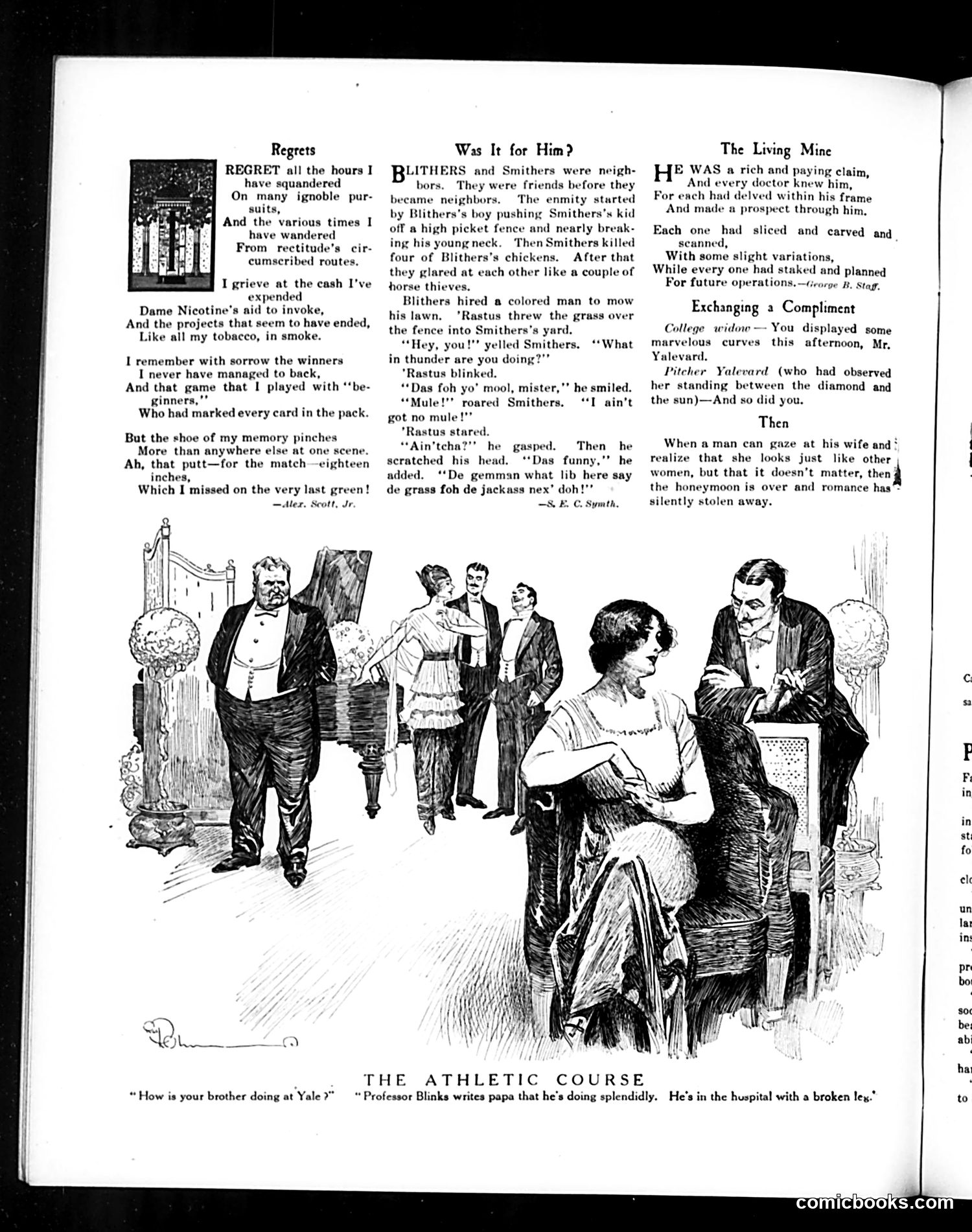
This page contains three satirical pieces typical of early 20th-century *Judge* magazine: **"Regrets"** is a humorous poem about life's disappointments—wasted money, failed gambling bets, and a missed golf putt. The nostalgia and self-recrimination are played for comic effect. **"Was It for Him?"** satirizes racial stereotypes through a dialect-heavy story where a Black groundskeeper ("'Rastus") insults his employer's neighbor by implying he's a "jackass." The humor relies on period-typical offensive caricature. **"The Living Mine"** uses mining metaphor to mock wealthy hypochondriacs who allow doctors to repeatedly operate/exploit them for profit. **"The Athletic Course"** cartoon jokes about Yale student life: parents receive letters claiming their son is doing "splendidly," but he's actually hospitalized with a broken leg—suggesting reckless athletic injuries were common and parents were deliberately misled. The page reflects early 1900s attitudes toward class, race, and higher education while satirizing American excess and pretense.
📄 Transcribed text from this page (OCR, searchable)
Machine-transcribed from the original scan — historical spelling and the odd misread are preserved.
Regrets REGRET all the hours I have squandered On many ignoble pur- suits, And the various times I have wandered From rectitude’s cir- cumscribed routes, I grieve at the cash I've expended Dame Nicotine's aid to invoke, And the projects that seem to have ended, Like all my tobacco, in smoke. I remember with sorrow the winners I never have managed to back, And that game that I played with ‘‘be- ginners,"’ Who had marked every card in the pack. But the shoe of my memory pinches More than anywhere else at one scene. Ah, that putt—for the match —-eighteen inches, Which I missed on the very last green! —dlexr. Scott, Jr a N 2) | en Was It for Him? BEITHERS and Smithers were neigh- bors. They were friends before they became neighbors. The enmity started by Blithers’s boy pushing: Smithers’s kid off a high picket fence and nearly break- ing his youngneck. Then Smithers killed four of Blithers’s chickens. After that they glared at each other like a couple of horse thieves. Blithers hired a colored man to mow his lawn, ‘Rastus threw the grass over the fence into Smithers’s yard. “Hey, you!" yelled Smithers. in thunder are you doing?"’ *Rastus blinked. “Das foh yo’ mool, mister,’’ he smiled. “Mule!’’ roared Smithers. ‘‘I ain't got no mule!"” "Rastus stared. “Ain'tcha?’’ he gasped. Then he scratched his head. ‘Das funny,’ he added. ‘De gemman what lib here say de grass foh de jackass nex’ doh!’’ —S ELC. Symth, “What The Living Mine HE WAS a rich and paying claim, And every doctor knew him, For each had delved within his frame And made a prospect through him, Each one had sliced and carved and scanned, With some slight variations, While every one had staked and planned For future operations, ve B. Stag. Exchanging 2 Compliment College widow — You displayed some marvelous curves this afternoon, Mr, Yalevard, Pitcher Yalevard (who had observed her standing between the diamond and the sun)—And so did you. Then When a man can gaze at his wife and realize that she looks just like other women, but that it doesn’t matter, then the honeymoon is over and romance has silently stolen away. THE ATHLETIC COURSE * Professor Blinks writes papa that he’s doing splendidly. “ How is your brother doing at Yale >” He's in the huspital with a broken ley.” A