
A complete issue · 24 pages · 1914
Judge — May 23, 1914
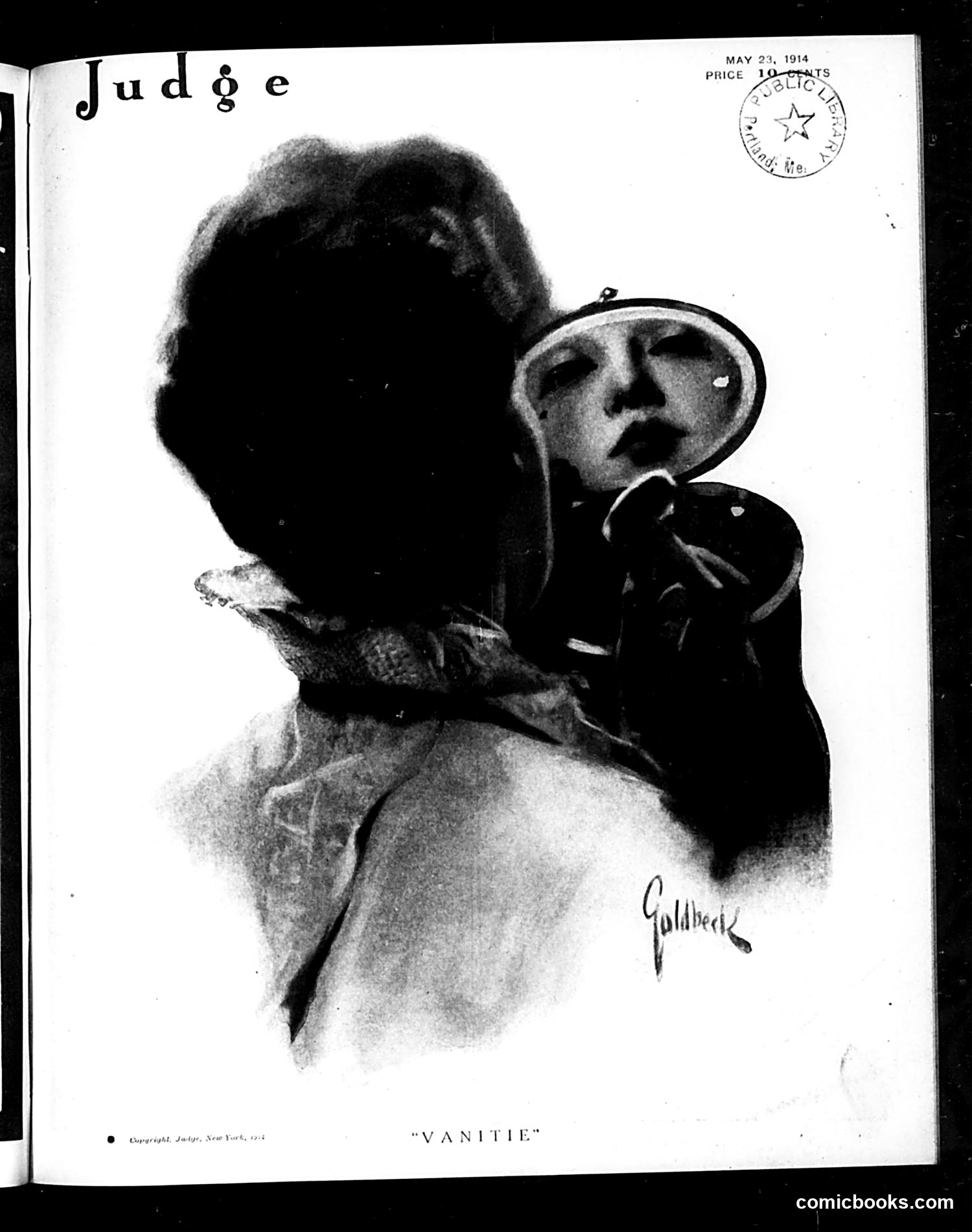
This illustration is titled "Vanitie" and depicts a woman gazing at her reflection in a hand mirror. The work appears to be social commentary on female vanity—a common satirical theme in early 20th-century magazines. The woman is drawn in profile, absorbed in admiring herself, while her actual reflection shows her face clearly in the mirror she holds. The artist has signed the work "Goldheick" (or similar). Judge magazine frequently published such character studies and social critiques. Without additional context clues, this appears to be general satire about women's preoccupation with appearance rather than commentary on a specific person or event. The "Vanitie" title makes the satirical point explicit.
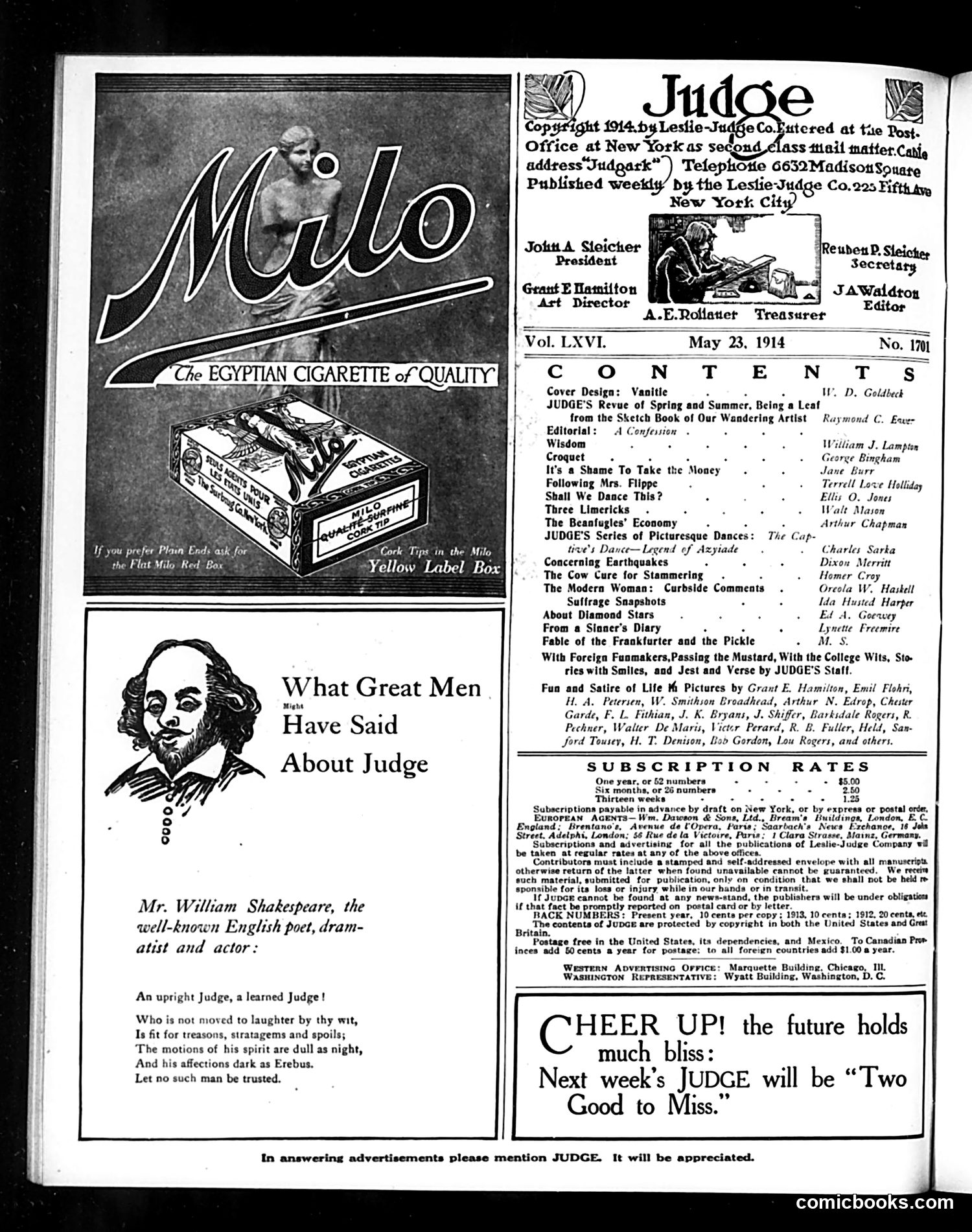
This page is primarily **advertising and editorial content** rather than political satire. The left side features a **Milo cigarette advertisement** ("The Egyptian Cigarette of Quality") and a section titled "What Great Men Have Said About Judge" that quotes Shakespeare praising judges as learned and witty figures. The quote appears designed to flatter the magazine's readership and lend cultural prestige to the publication. The right side shows the magazine's masthead, table of contents, subscription rates, and a teaser for next week's issue. There is **no clear political cartoon or satirical commentary** visible on this particular page—it functions primarily as a house advertisement promoting Judge magazine itself to potential subscribers and advertisers.
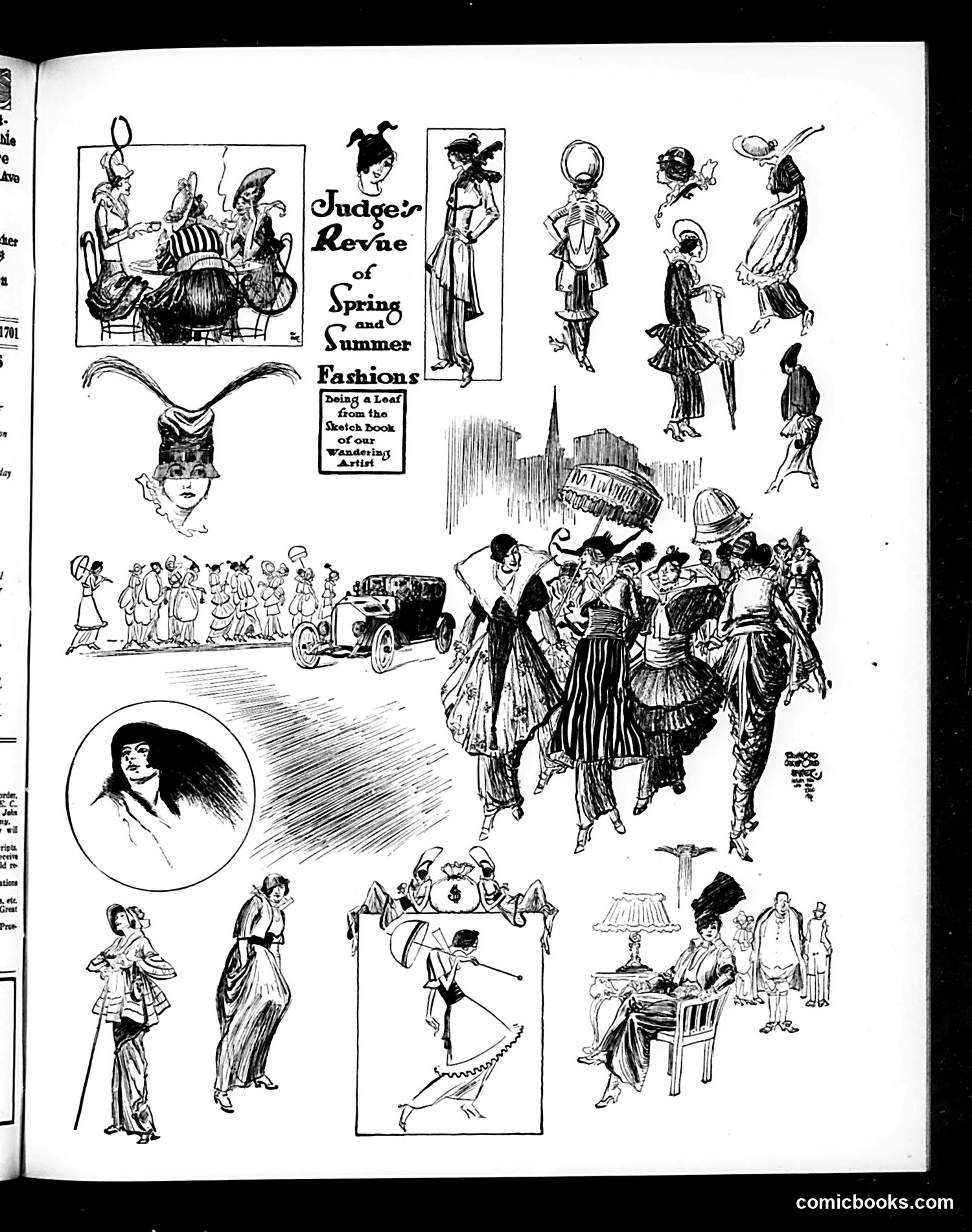
This page presents fashion satire from Judge magazine, subtitled "Being a Leaf from the Sketch book of our Wandering Artist." The central illustration depicts fashionable women parading through a city street, observed by crowds and a motorcar—establishing this as contemporary satirical commentary on women's fashion trends. The surrounding sketches mock exaggerated silhouettes and poses typical of the era's women's fashion: elongated figures, elaborate hats, and affected postures. The circular portrait (lower left) and various fashion-focused vignettes (lower right) emphasize Judge's satirical approach to society's obsession with seasonal style changes and the pretension associated with high fashion among the upper classes.
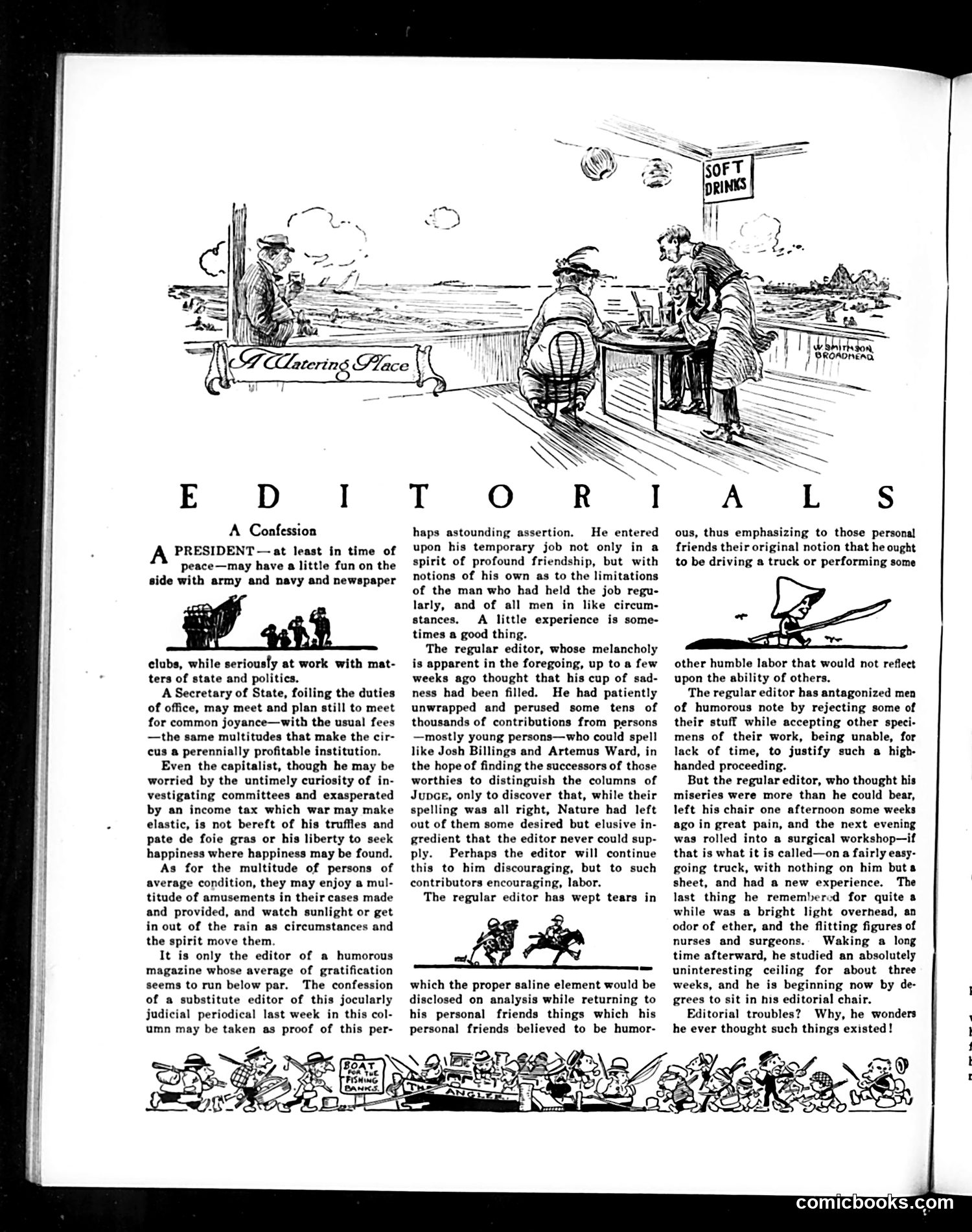
This editorial page from *Judge* magazine contains two sections: **Top Illustration:** A sketch of a roadside "Catering Place" with a "Soft Drinks" sign, depicting a casual dining establishment where travelers stop. **"A Confession" Editorial:** The main text humorously addresses the editor's conflicted feelings about his role. He confesses to occasionally enjoying lighter material alongside serious political and state matters. The piece describes how the editor previously rejected humorous contributions from readers but has since reconsidered, recognizing that humor has value. The editorial also mentions a past surgical experience that made him reconsider life's priorities and what constitutes worthwhile editorial content. The tone is self-deprecating, acknowledging that even serious publications benefit from occasional levity rather than unrelenting gravity. The cartoons at bottom appear decorative, illustrating the lighter content being discussed.
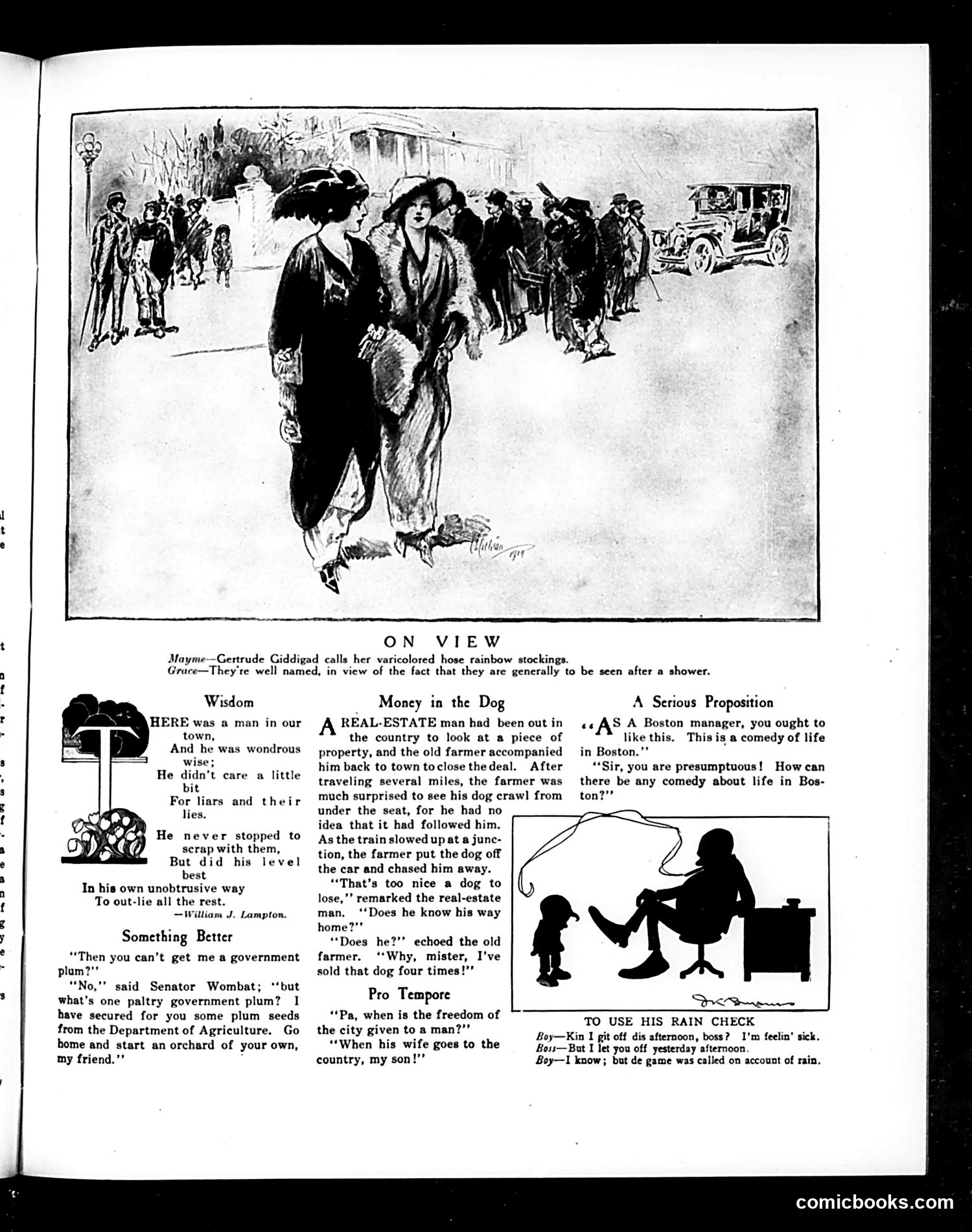
The top illustration depicts fashionable women on a city street, with the caption joking about "rainbow stockings" — a reference to the colorful hosiery that became popular in the 1920s. The humor suggests these stockings were primarily visible after rain or showers, implying women wore them for display rather than practical reasons. Below are four separate humor sections: **"Wisdom"** jokes about a wise man's philosophy of staying uninvolved. **"Money in the Dog"** recounts a real-estate agent selling the same dog repeatedly to farmers. **"A Serious Proposition"** uses a Boston manager character to make jokes about American comedic sensibilities. **"Pro Tempore"** and **"To Use His Rain Check"** present brief workplace humor exchanges. The page exemplifies Judge's blend of social satire, fashion commentary, and everyday humor typical of 1920s American magazines.
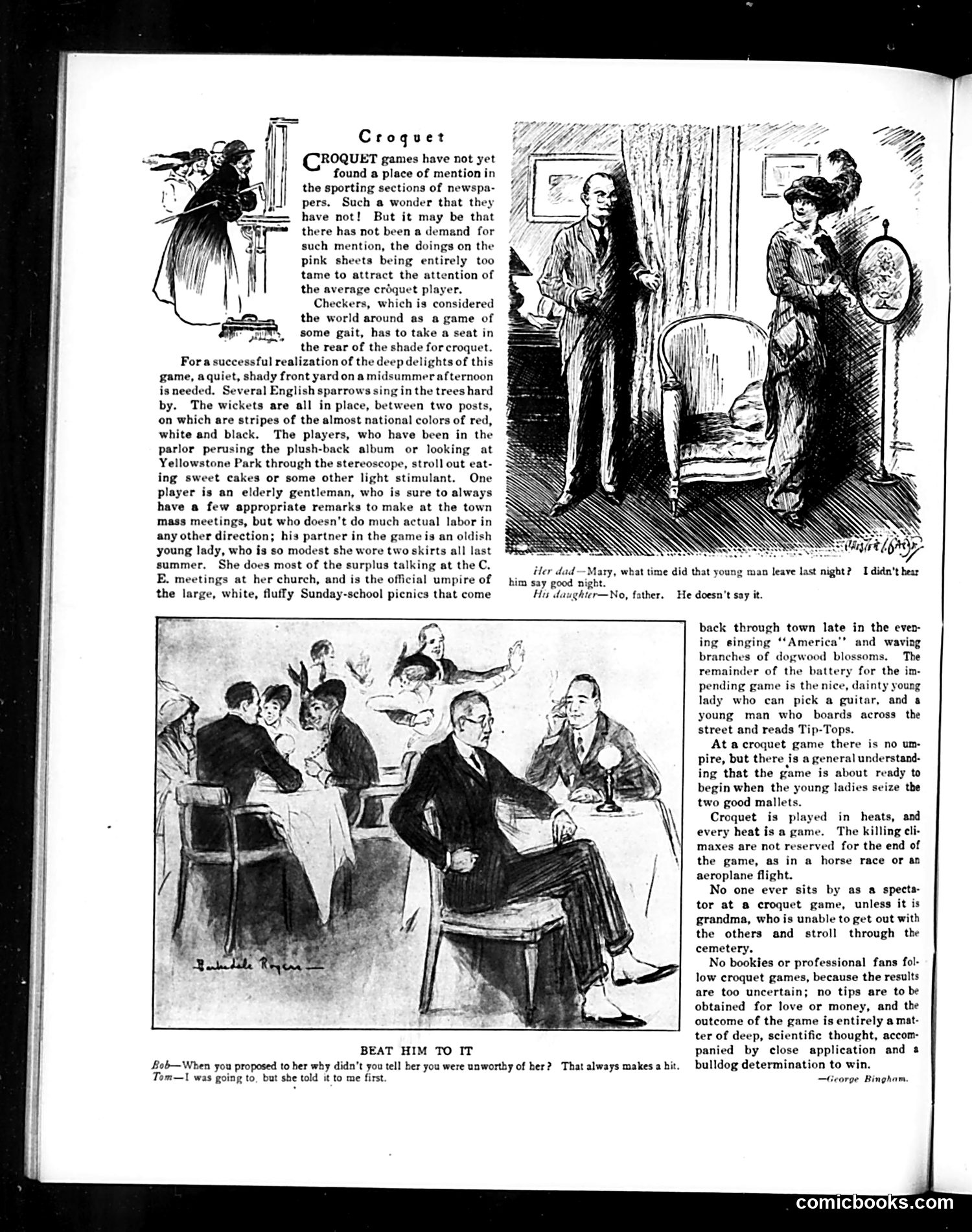
This piece satirizes the genteel social ritual of croquet among the American middle class. The author mocks how croquet players—described as idle elderly men who pontificate at town meetings, pious churchwomen, and loafing young men—treat this leisurely lawn game with exaggerated seriousness, calling it a matter of "deep, scientific thought" and "bulldog determination." The satire targets the pretension of Victorian leisure culture: players dress formally, consume "sweet cakes," and approach a simple game with absurd gravity. The accompanying cartoons illustrate these social types—elderly gentlemen, modest spinsters, guitar-playing young ladies. A secondary joke ("Beat Him to It") mocks courtship conventions: a man fails to propose because the woman preached self-deprecation first. The piece gently ridicules how the respectable classes invested trivial pursuits with false importance while avoiding genuine labor.
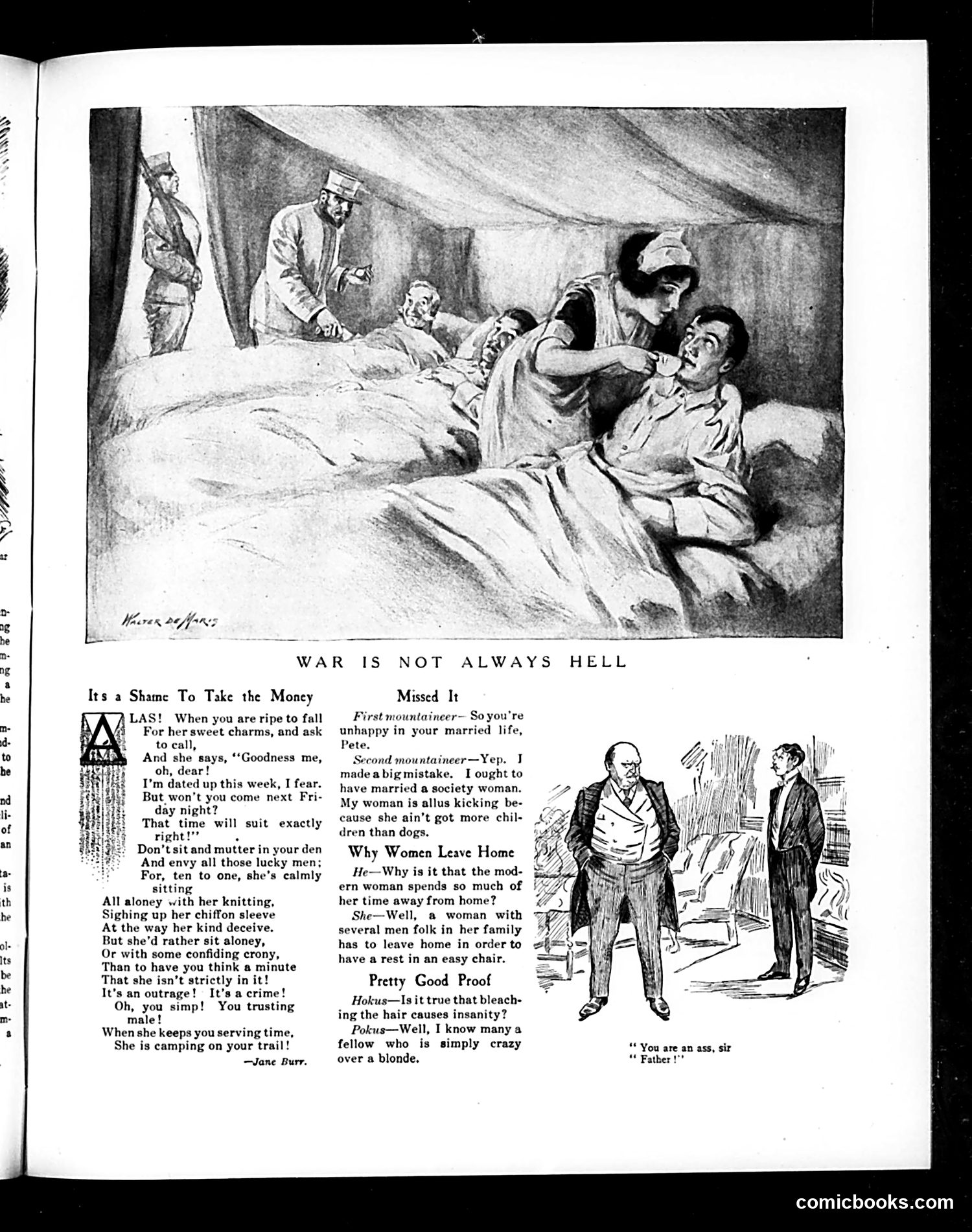
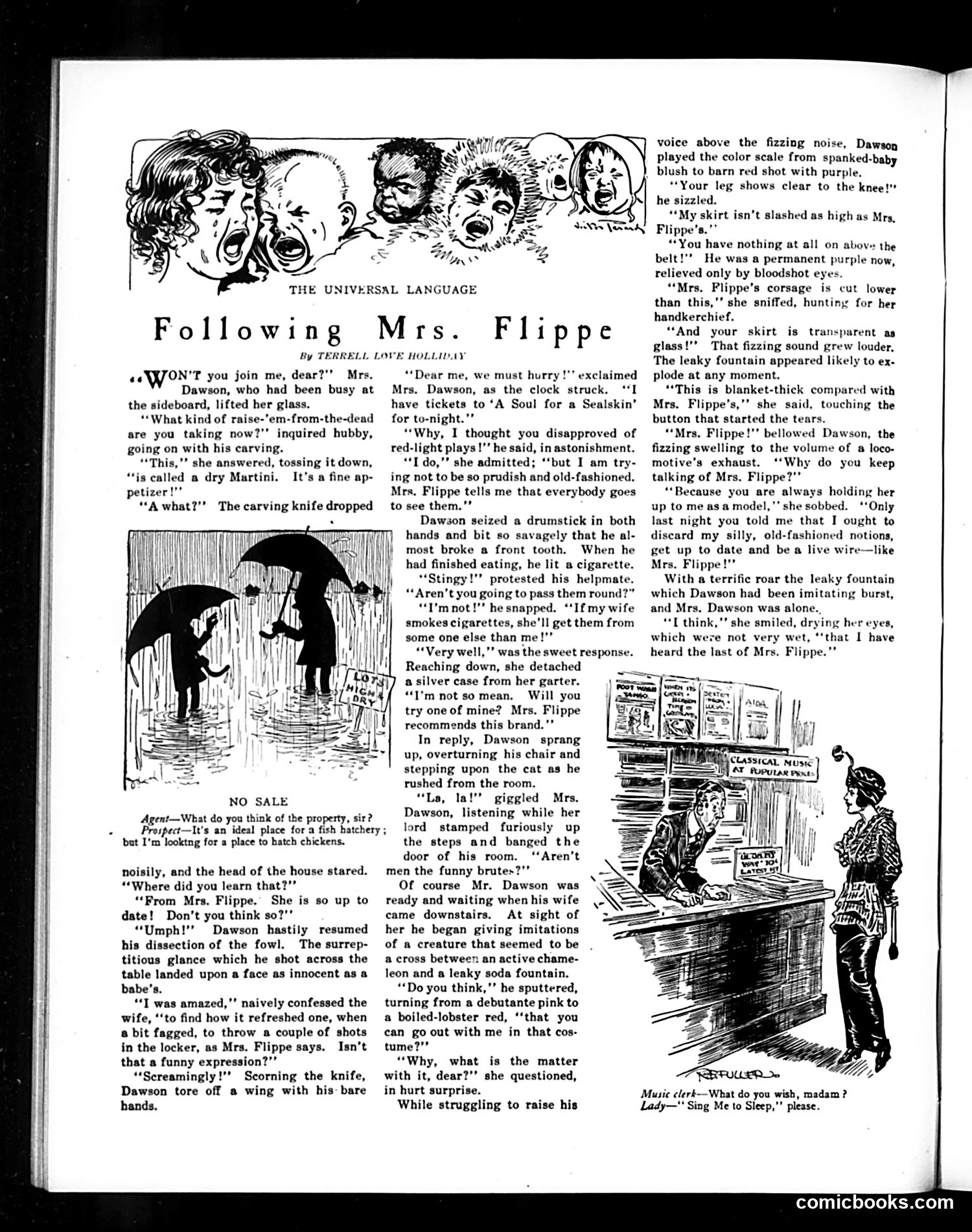
This story satirizes early 20th-century anxieties about women's changing social behavior and fashion. Mrs. Flippe (unseen) represents the "modern woman" — she drinks cocktails ("dry Martini"), attends risqué theater ("A Soul for a Sealskin"), smokes cigarettes, wears extremely short and revealing skirts, and sports low-cut corsets. Mr. Dawson, the conservative husband, grows increasingly apoplectic as his wife adopts these radical behaviors by imitating Mrs. Flippe, whom she constantly cites as authority. His escalating rage — depicted through color descriptions (turning "purple," "boiled-lobster red") — reflects period alarm about female independence and sexual liberation. The humor targets both the husband's outdated prudishness and the wife's trendy, uncritical mimicry of fashionable excess. The story mocks the "universal language" of modern female peer pressure replacing traditional marital authority.
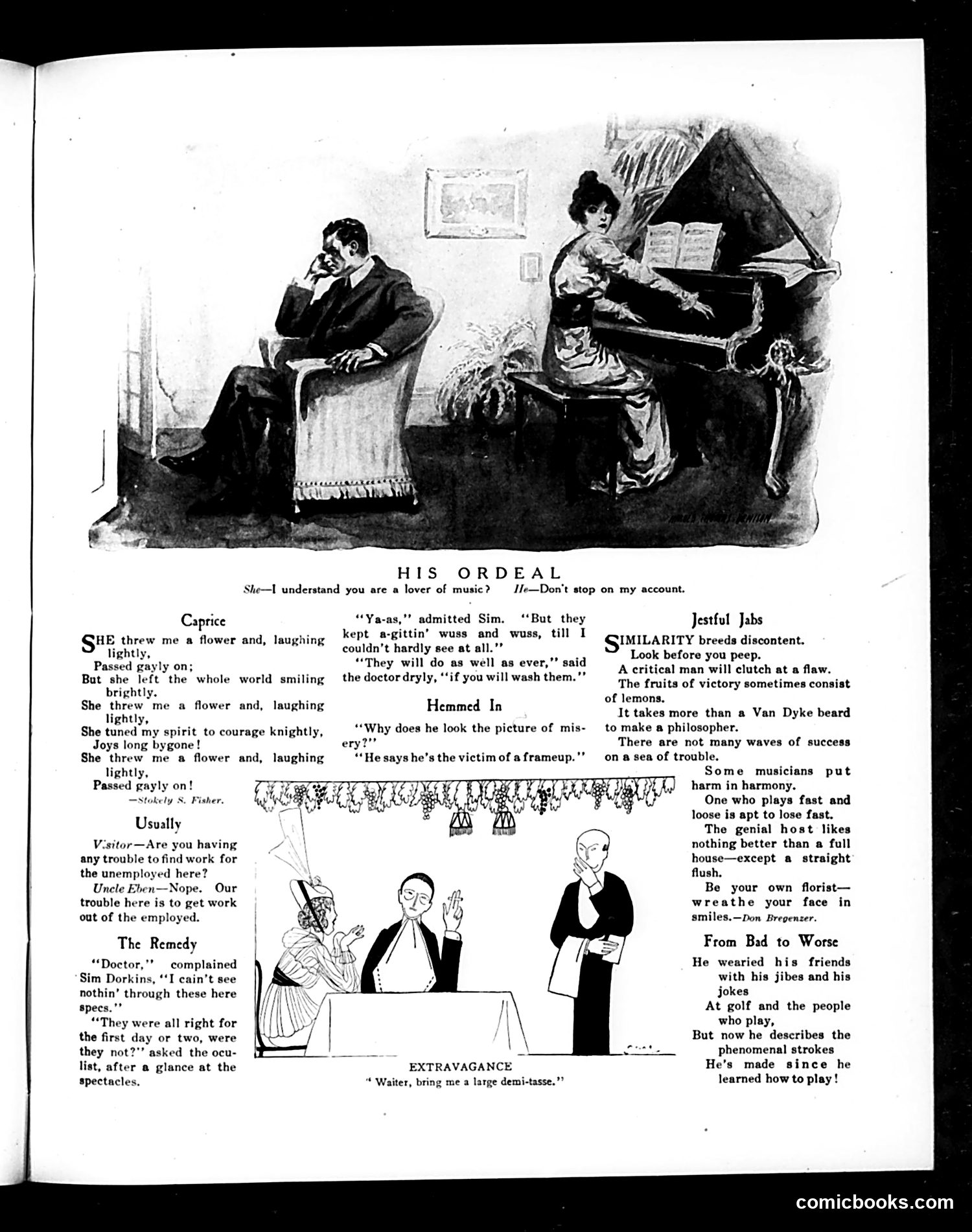
This page contains several unrelated humor pieces typical of Judge's satirical format: **"His Ordeal"** (top): A cartoon shows a man visibly uncomfortable while a woman plays piano. The caption joke plays on the phrase "lover of music"—she interprets his claim literally and subjects him to her playing, which he clearly finds torturous. The satire targets both pretentious musical culture and the gap between what people claim to enjoy versus actual reality. **Other pieces** include brief poems and joke sections ("Usually," "The Remedy," "Jestful Jabs," "From Bad to Worse") that mock everyday situations: unemployed workers, defective eyeglasses, a man defined by annoying jokes, and similar middle-class social awkwardness. **"Extravagance"** (bottom cartoon): Shows a diner ordering an expensive drink, likely satirizing nouveau riche or frivolous spending habits. The overall tone is genteel satire aimed at American middle and upper-class readers, focusing on social embarrassment and pretension rather than hard political commentary.
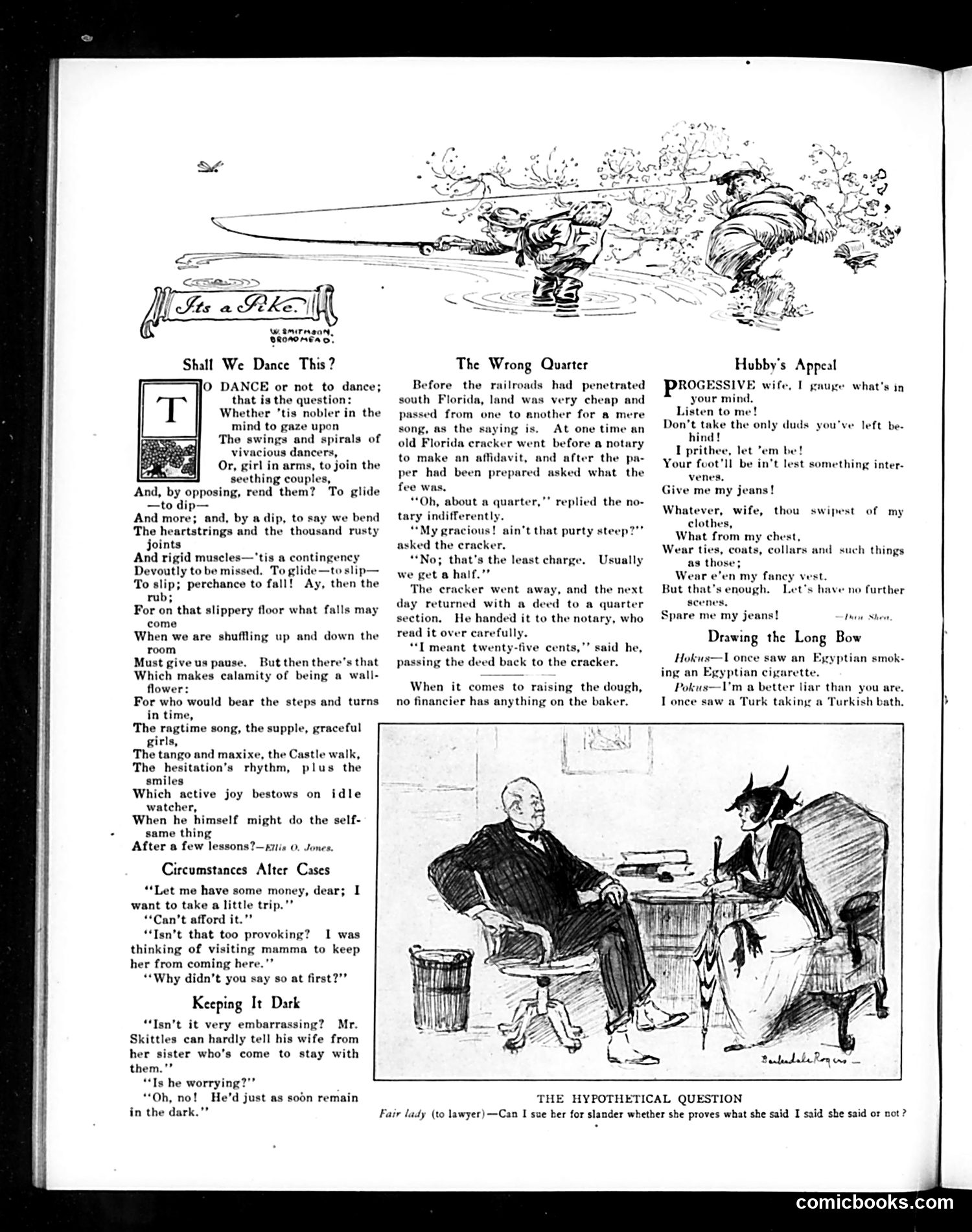
This page contains multiple humorous pieces typical of early 20th-century American satire: **"Shall We Dance This?"** parodies Hamlet's soliloquy, debating whether to dance modern dances (ragtime, tango, maxixe, Castle walk). The joke targets both the physical awkwardness of new dance crazes and social anxiety about participation versus wallflower status. **"The Wrong Quarter"** is a folk-humor piece where a Florida cracker misunderstands a notary's fee of "a quarter" (25 cents) as meaning a quarter-section of land, returning with a deed. It satirizes rural/frontier ignorance colliding with civilization. **"Hubby's Appeal"** features a husband pleading his wife not to take his jeans during a separation—the humor lies in prioritizing worn work clothes over finer garments. **"Drawing the Long Bow"** presents a brief tall-tale competition about exotic observations. **"The Hypothetical Question"** cartoon jokes about legal absurdity: a woman asks if she can sue for slander regardless of whether the defendant can prove the statement true. The overall tone is genteel, domestic humor reflecting leisure-class concerns and period anxieties about modern dance and marital squabbles.
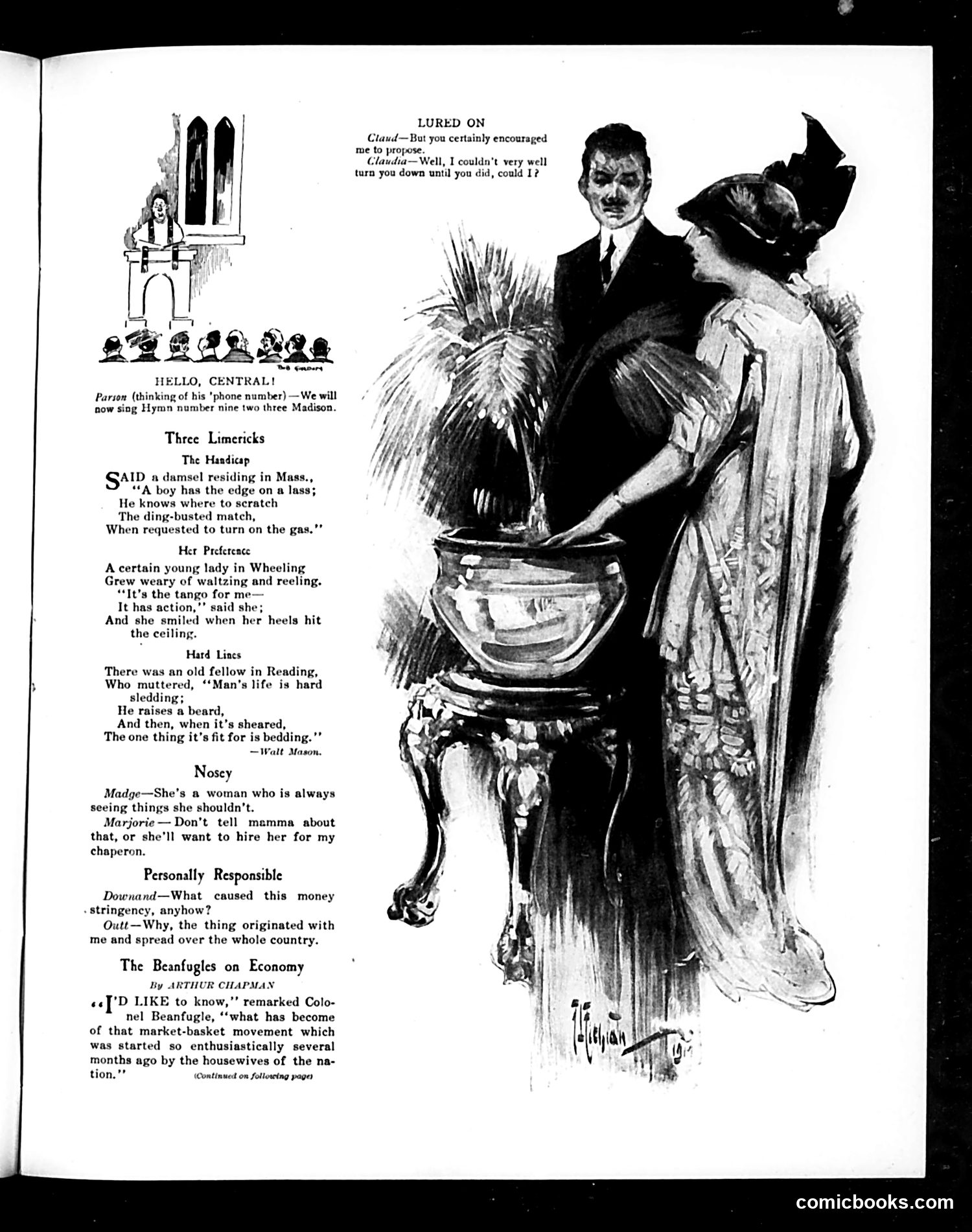
This page contains multiple brief satirical pieces typical of early 20th-century humor magazines: **Main cartoon ("Lured On"):** A woman admits she accepted a marriage proposal not out of genuine affection, but because she couldn't politely refuse once the man actually asked—satirizing the social awkwardness and gender dynamics of courtship rituals. **"Hello, Central":** Mocks clergy by suggesting a parson confuses hymn numbers with telephone exchanges (early telephone humor). **The limericks and brief jokes** target various social topics: gender differences, the tango craze, beards, nosiness, economic responsibility, and a "market-basket movement" (likely a consumer boycott or economy campaign by housewives). **The illustration** shows a well-dressed man and fashionably-dressed woman in what appears to be a social situation, drawn in the detailed pen-and-ink style of the era. The page exemplifies Judge's approach: light social satire about courtship, technology, fashion, and domestic economics rather than hard political commentary.
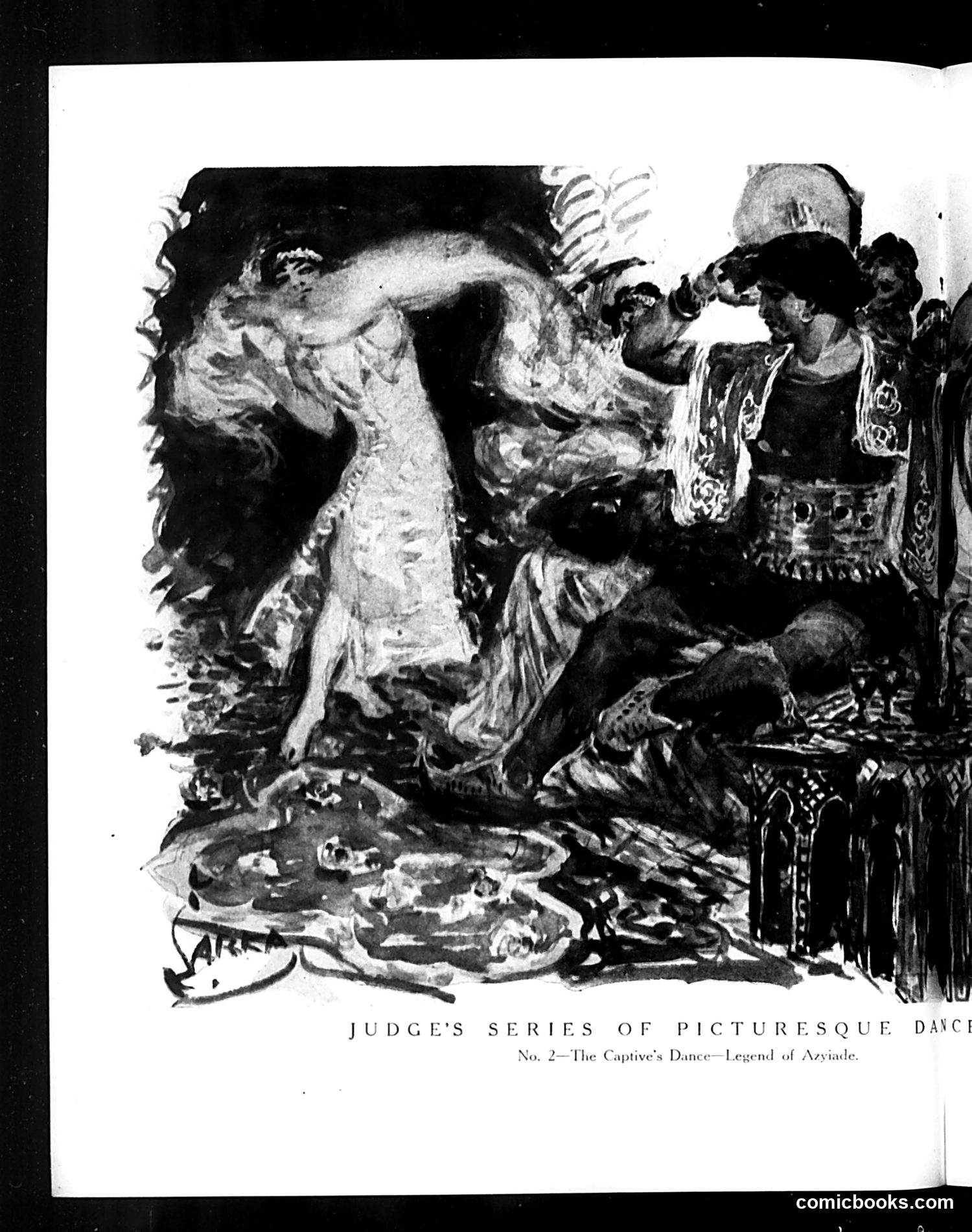
This is part of "Judge's Series of Picturesque Dances," specifically depicting "The Captive's Dance—Legend of Azyiade." The image illustrates a romantic/orientalist narrative rather than political satire. The scene shows a woman in elaborate costume performing for an audience of observers in period dress. "Azyiade" refers to a 19th-century French novel about a European woman captivated in an Ottoman harem—a popular orientalist romance theme. Judge magazine is presenting this as exotic entertainment, reflecting Victorian-era fascination with romanticized "Eastern" narratives. The illustration style and composition emphasize the theatrical, voyeuristic nature of the performance, typical of how such subjects were depicted in American satirical publications of that era. The satire, if present, likely targets contemporary trends rather than specific political figures.
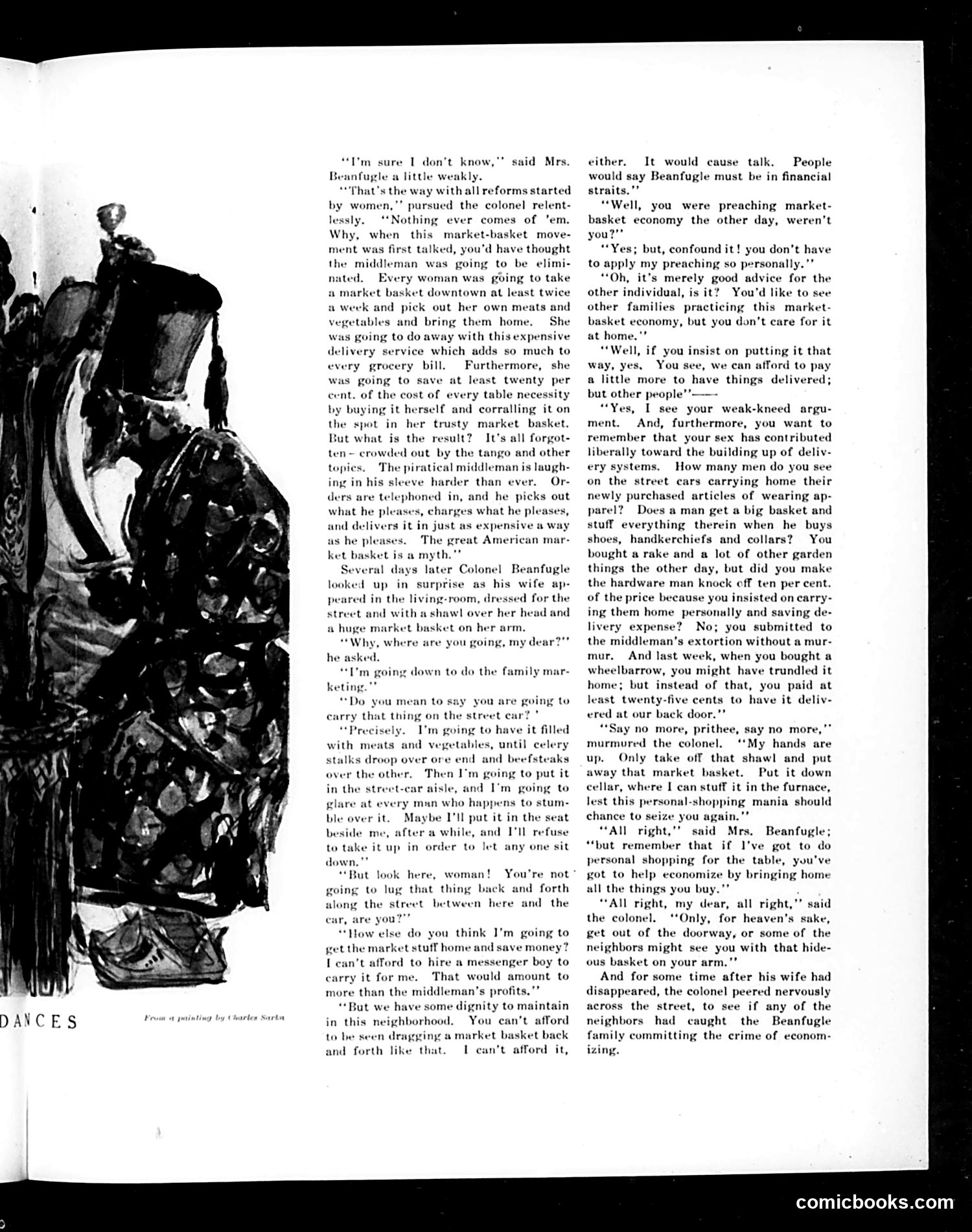
This page satirizes the early 20th-century "market-basket movement"—a reform campaign encouraging women to shop directly at markets and carry purchases home themselves, bypassing middlemen to reduce grocery costs. Colonel Beanfugle hypocritically advocates this economy publicly while dismissing it as impractical for his own family, fearing neighbors would think him financially troubled. His wife calls out this hypocrisy: she's willing to actually practice what he preaches, dragging a large basket on streetcars, yet he objects to the *appearance* of economizing. The satire targets masculine double standards—men gladly use delivery services without shame, yet expect women to perform manual labor for savings. The cartoon mocks upper-class anxiety about social status conflicting with genuine economic reform. The illustration shows a woman with an enormous, unwieldy market basket, emphasizing the impracticality Beanfugle secretly recognizes but won't admit.
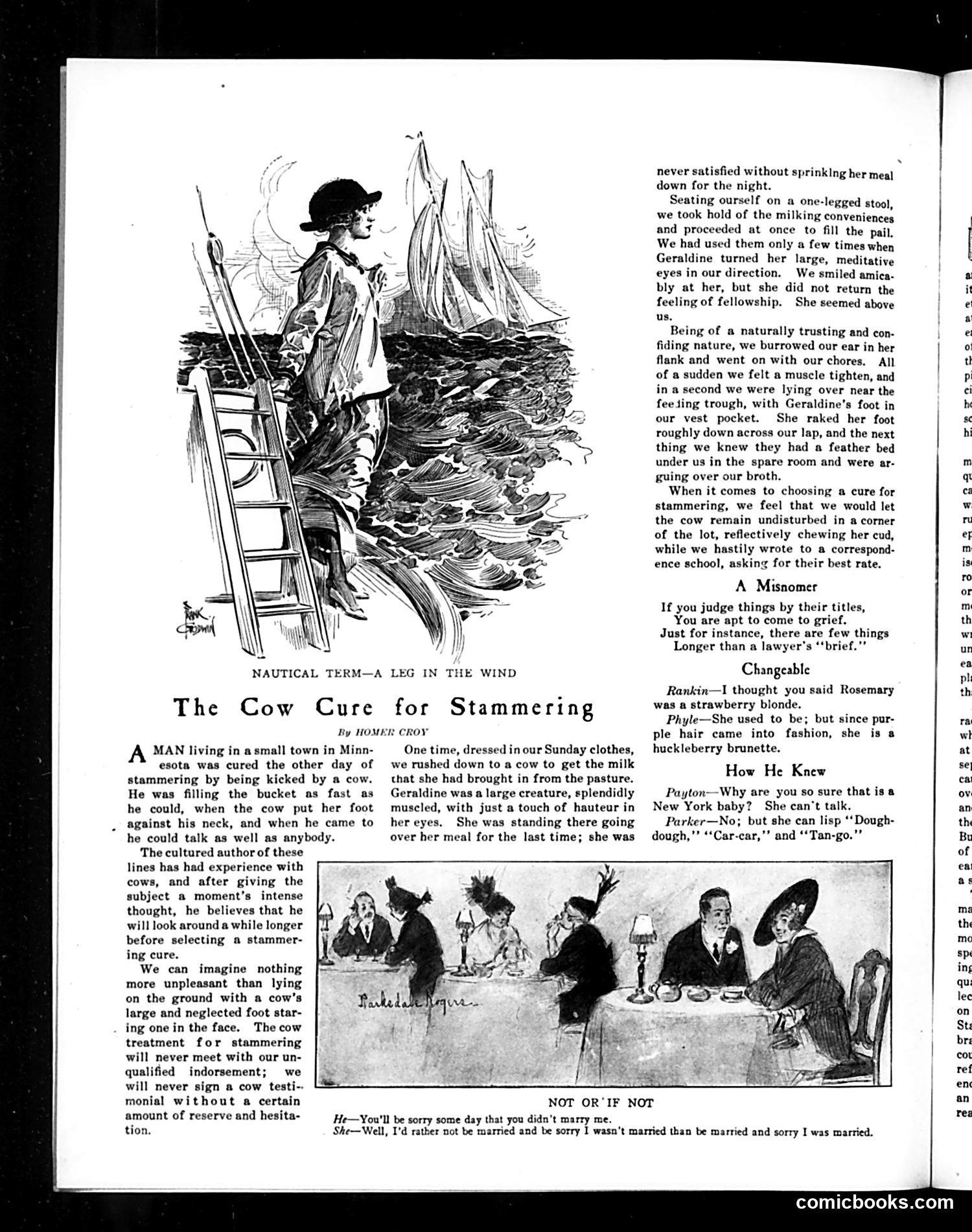
This humorous article by Homer Croy satirizes folk remedies and quack cures popular in early 20th-century rural America. The piece presents a tongue-in-cheek narrative about a Minnesota man supposedly "cured" of stammering after being kicked by a cow named Geraldine. The satire targets two things: (1) the gullibility of rural communities who embraced dubious medical treatments, and (2) the absurdity of attributing miraculous recoveries to violent accidents. The author's deadpan delivery—describing in mock-serious detail getting kicked into a feeding trough—emphasizes how ridiculous such "cures" actually are. His concluding refusal to endorse cow-kicking as legitimate treatment confirms the joke. The accompanying illustrations and shorter humorous pieces ("A Misnomer," "How He Knew," "Not or If Not") maintain the magazine's satirical tone throughout, poking fun at contemporary social observations and wordplay.
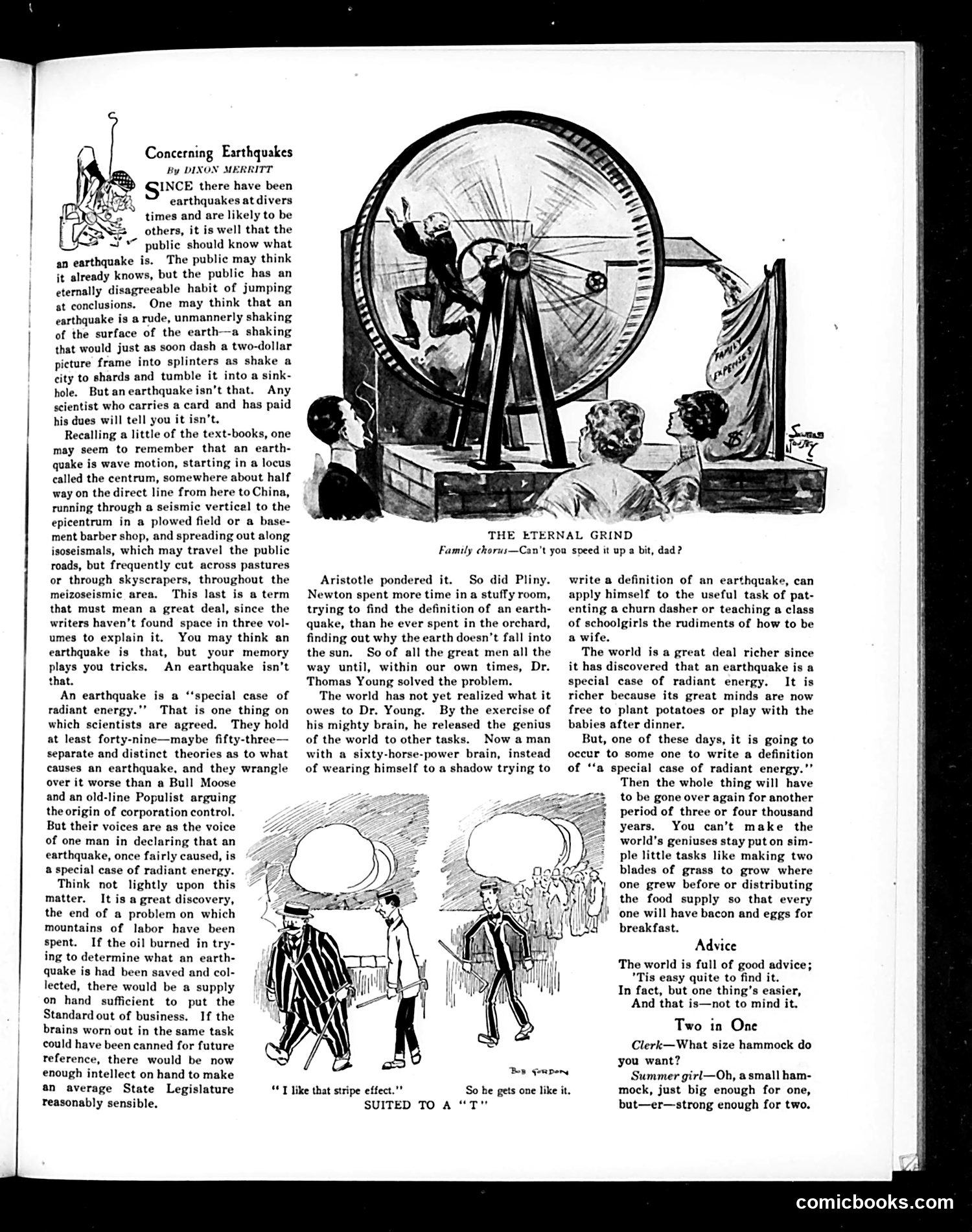
Dixon Merritt's satirical essay mocks the gap between scientific jargon and actual understanding. He argues that while scientists have spent enormous intellectual resources debating earthquake causes—producing "forty-nine, maybe fifty-three separate theories"—they've finally agreed on one useless definition: earthquakes are "a special case of radiant energy." Merritt's joke: this grand discovery accomplishes nothing. The real value came when Dr. Thomas Young solved the problem, freeing brilliant minds from pointless definitional debate to do useful work—"patenting a churn dasher or teaching schoolgirls" how to be wives. The cartoons show scholars trapped in intellectual wheel-spinning, and a frustrated family asking dad to "speed it up"—representing how over-specialization and abstract theorizing waste human potential. The satire critiques academic pretension and the absurdity of elaborate technical language that obscures rather than clarifies. The final joke suggests this cycle will repeat when someone writes a definition of "a special case of radiant energy."
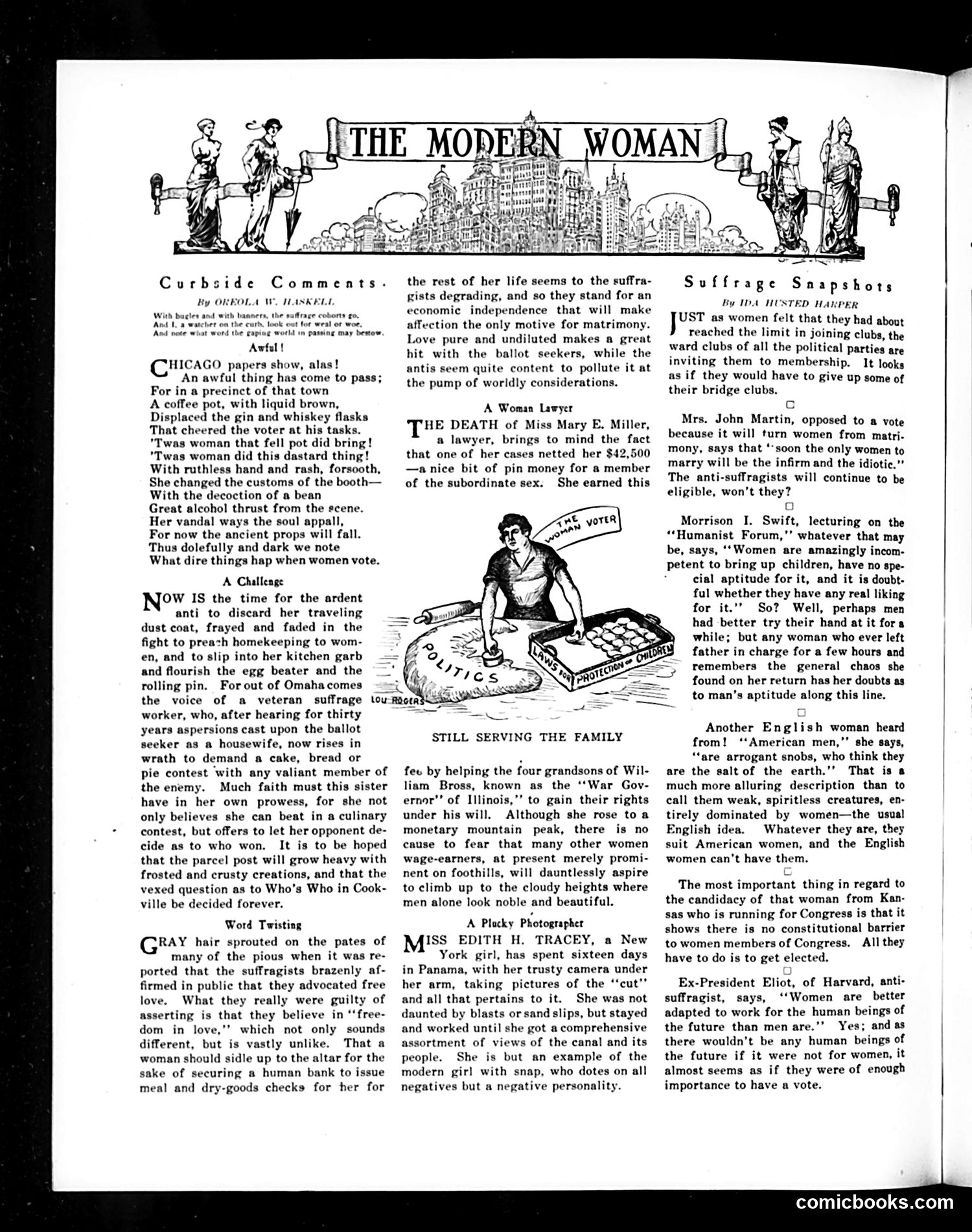
This anti-suffrage page from Judge uses multiple satirical pieces to mock women's voting rights and independence. **"Curbside Comments"** attacks women voters in Chicago who replaced alcohol with coffee at polling places—presented as horrifying disruption of tradition. The satire suggests women are recklessly "vandalizing" male customs. **"A Challenge"** sarcastically dares anti-suffrage activists to prove women belong in kitchens by competing in baking contests against suffragists, implying the real debate is whether women should vote or cook. **"Word Twisting"** criticizes suffragists for distinguishing "freedom in love" from "free love," portraying them as dishonest while actually describing their position: women should marry for affection, not financial security—a radical idea the magazine presents as absurd. Scattered anecdotes celebrate women succeeding professionally (lawyer earning $42,500, photographer) but frame these as rare exceptions, not arguments for equality. The overall message: women's independence threatens domestic order and is fundamentally unnatural.
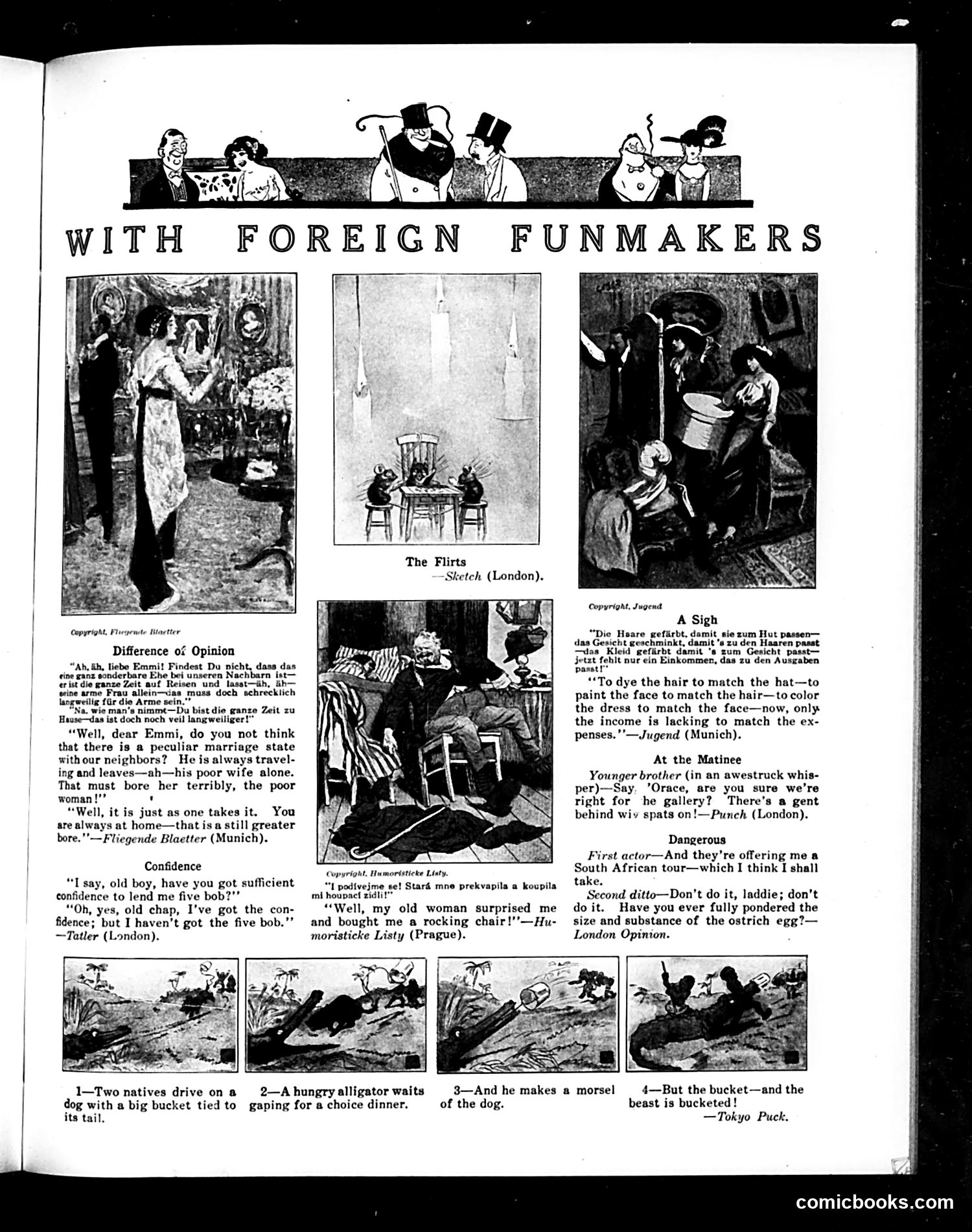
This page collects humorous jokes and cartoons from European and international publications, presenting them to American readers. The content includes domestic comedy sketches (German couple debating whose marriage is more boring; London theater-goers worried about dress codes) alongside visual gags. A Munich publication satirizes women's fashion obsession: dyeing hair to match hats, painting faces to match hair, coloring dresses to match faces—yet lacking income to afford it all. This critiques the absurdity of women prioritizing appearance coordination over practical finances. The four-panel "Tokyo Puck" cartoon shows slapstick humor: natives use a dog with a bucket to catch an alligator, but the alligator eats the dog and gets trapped by the bucket instead. The page demonstrates early 20th-century international humor exchange, featuring class-based comedy and gender stereotypes typical of the period's satirical magazines.
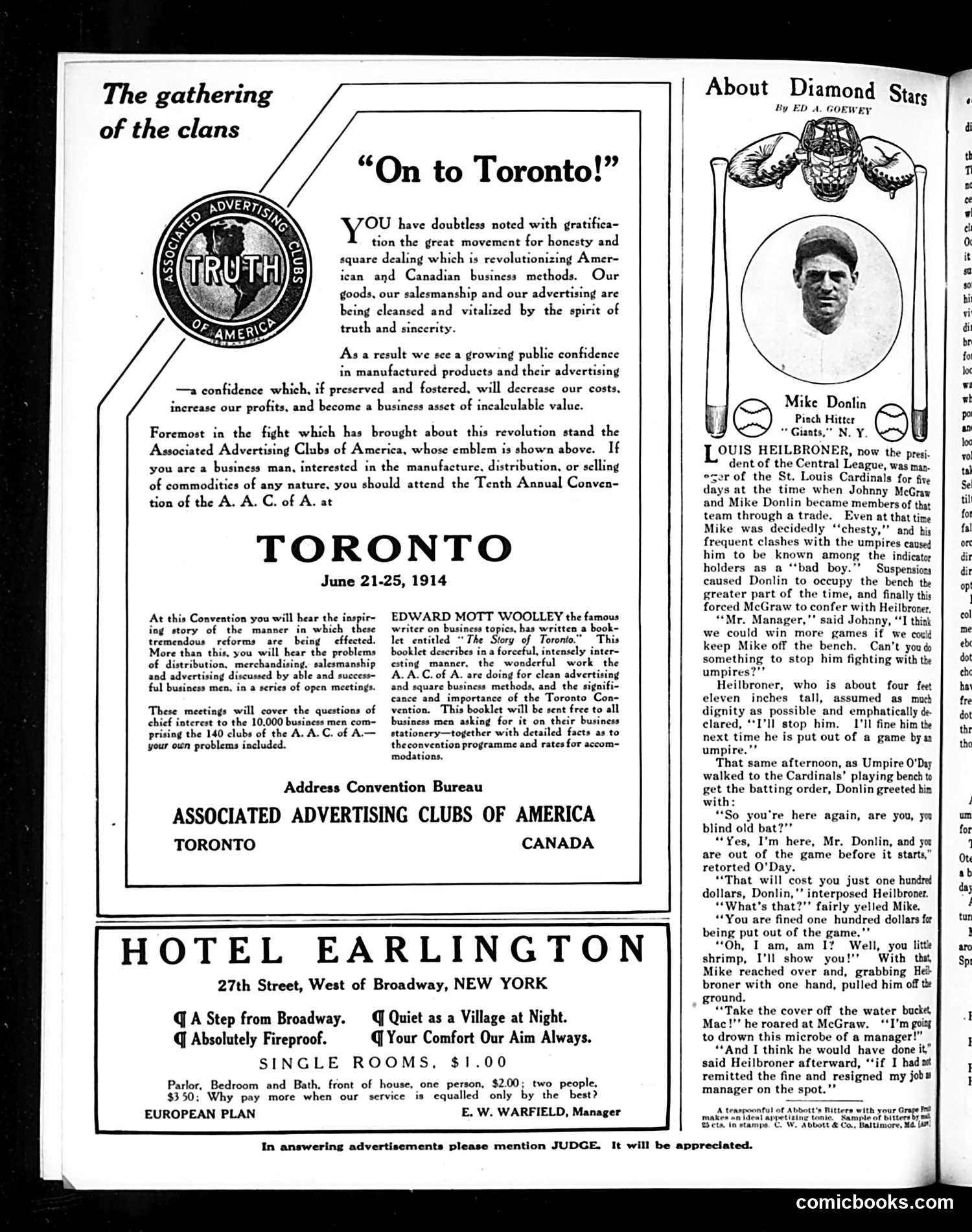
This page is primarily **advertising and convention promotion**, not political satire. The main content announces the Tenth Annual Convention of the Associated Advertising Clubs of America in Toronto (June 21-25, 1914), promoting the industry's movement toward "honesty and square dealing" in business and advertising. The right-hand column contains a baseball anecdote titled "About Diamond Stars," featuring **Mike Donlin**, a real pinch hitter for the New York Giants known for his combative temperament. The story illustrates Donlin's notorious conflicts with umpires—he was famously called a "bad boy" for frequent ejections. Manager Johnny McGraw allegedly asked St. Louis Cardinals manager Louis Heilbroner to control Donlin's behavior. The narrative humorously depicts Donlin greeting an umpire with "So you're here again, are you, you blind old bat?"—showing his characteristic insubordination. The page reflects early 1900s baseball culture where player discipline and umpire authority were contested.
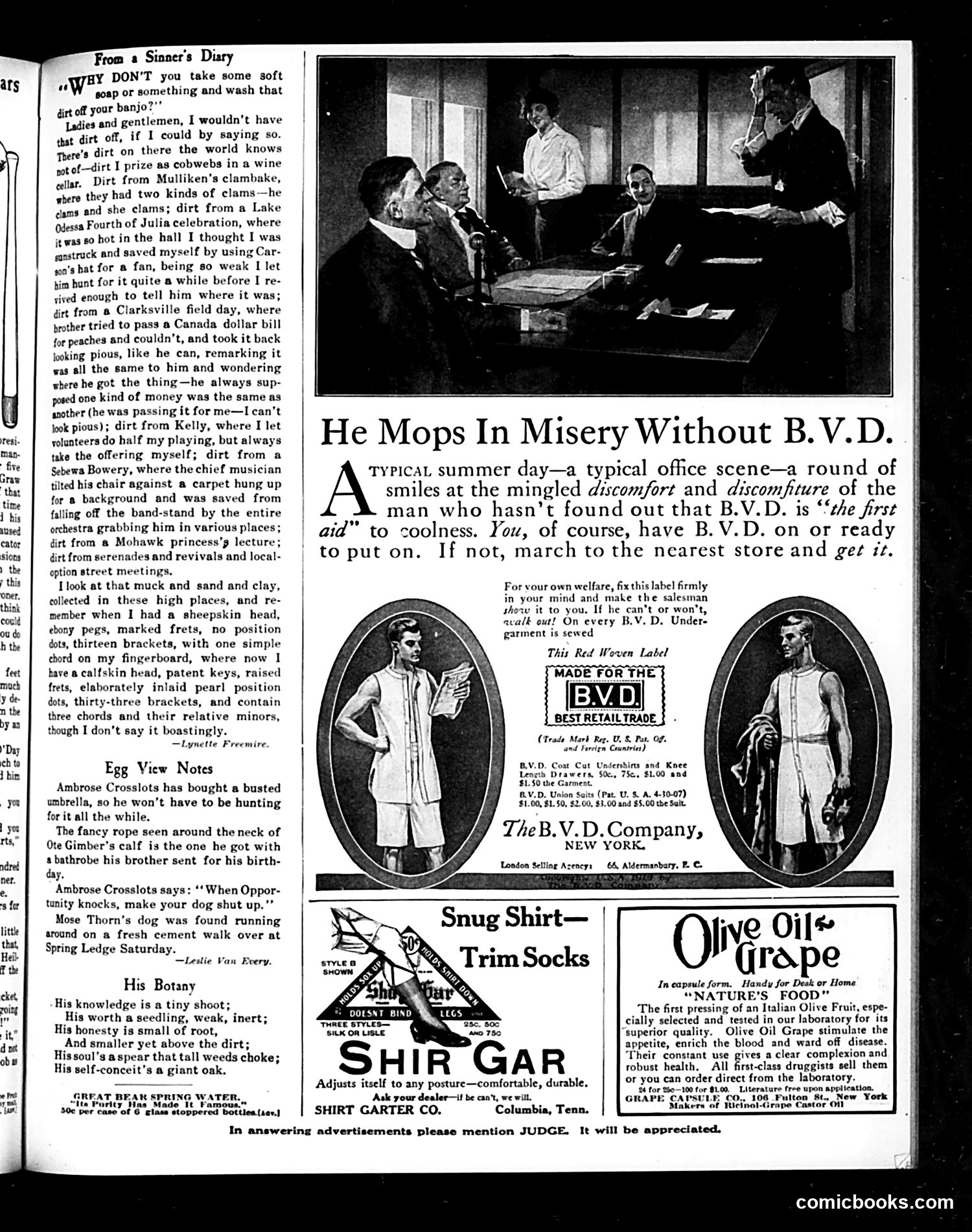
This page contains **primarily advertising and humor columns** rather than political satire. The main feature is a **B.V.D. underwear advertisement** (center), depicting an overheated office worker suffering through summer without the advertised product. The headline "He Mops In Misery Without B.V.D." uses humor to sell undergarments as essential for comfort—a common early 20th-century advertising strategy playing on male anxieties about appearance and bodily comfort. The surrounding text includes: - **"From a Sinner's Diary"**: A humorous first-person column about a banjo player's accumulated dirt from various small-town events (clambakes, celebrations, revivals), written in folksy, rural Americana style. - **"Egg View Notes"** and **"His Botany"**: Brief, lighthearted local gossip and satirical poetry about rural characters. The page reflects Judge magazine's mix of gentle social humor and advertising aimed at middle-class readers interested in consumer goods and small-town Americana.
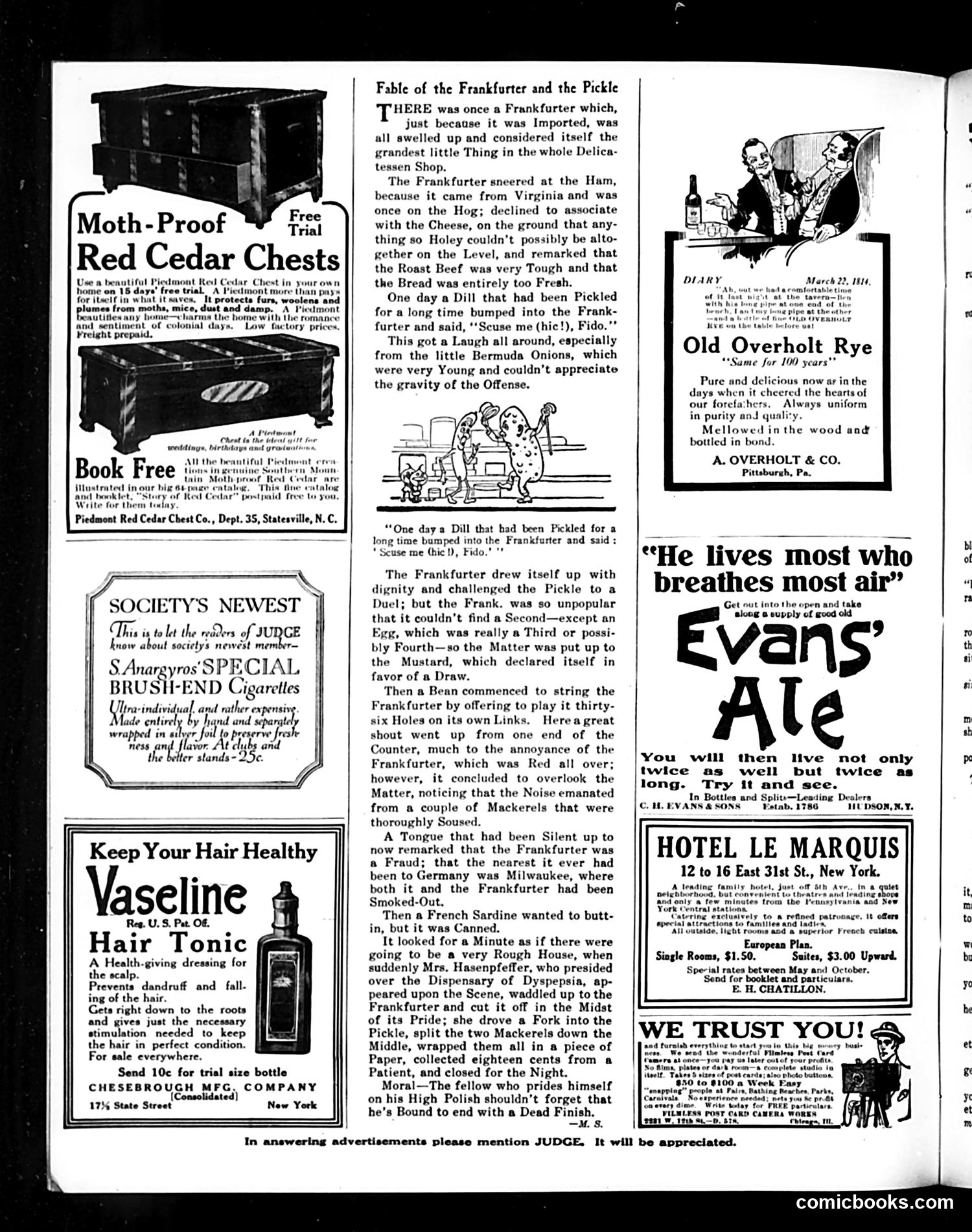
This is primarily a **humorous fable using food items as characters**, not a political cartoon. The main content is a satirical moral tale about class pretension. **The Story's Point:** An imported frankfurter—snobbish and self-important due to its foreign origin—insults various foods (ham from Virginia, cheap cheese, tough roast beef, fresh bread). When a pickled dill casually disrespects it, the frankfurter takes offense and nearly starts a fight, but no one supports it. **The Satire:** The joke mocks people (represented by the pretentious frankfurter) who adopt airs of superiority based solely on foreign origin while being fundamentally ordinary. The moral explicitly warns: "The fellow who prides himself on his High Polish shouldn't forget that he's Bound to end with a Dead Finish"—meaning such arrogance leads to humiliation. The fable ends with everything (frankfurter, pickle, mackerels) getting consumed by a doctor's patient, reducing all to the same fate. **Historical Context:** This likely reflects early 20th-century American attitudes toward German immigrants and imported goods, gently satirizing immigrant pretension. The page is otherwise filled with period **advertisements** (cedar chests, hair tonic, ale, hotels).
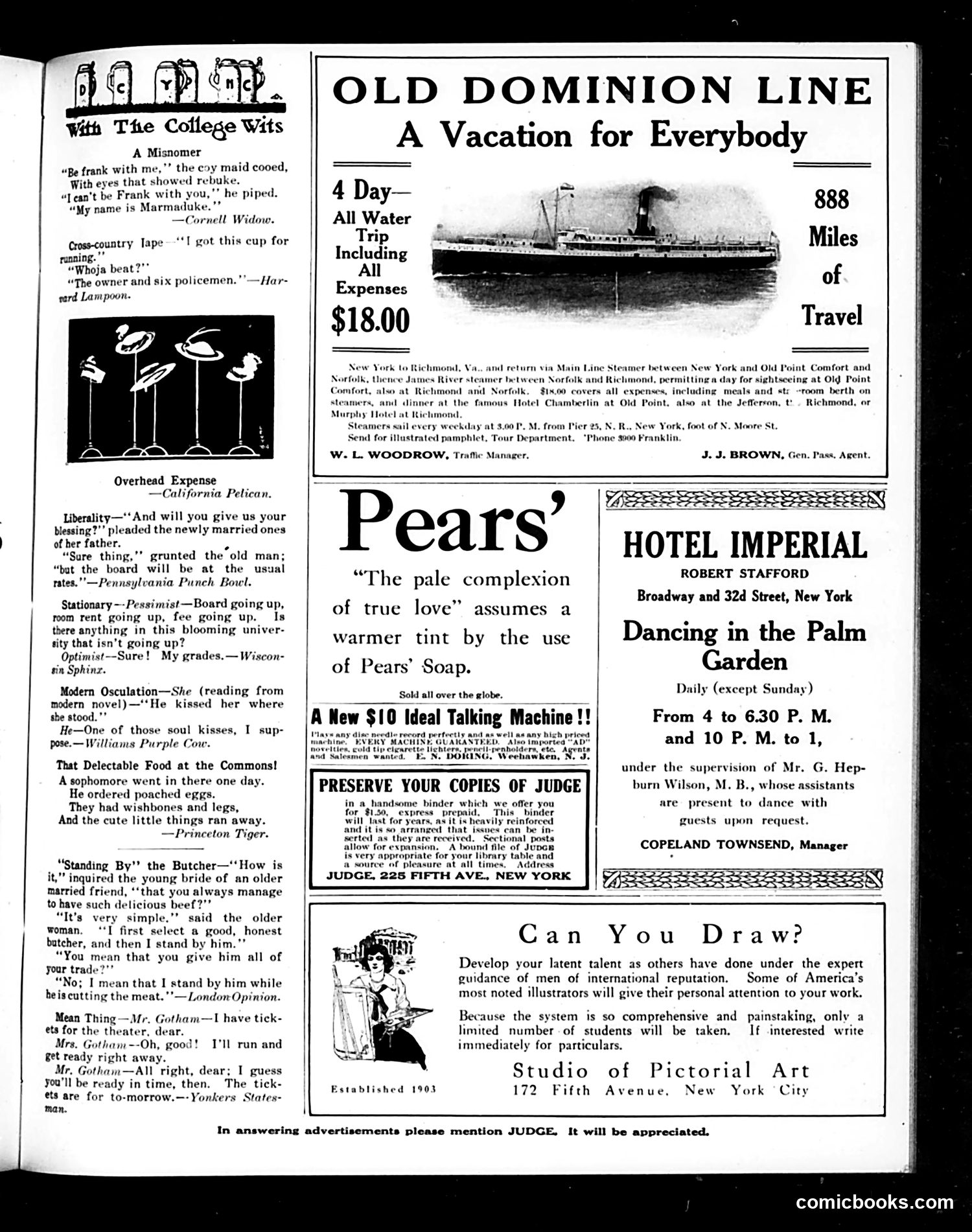
This page consists primarily of **advertisements and reprinted college humor** rather than original political cartoons. **The College Humor Section** collects jokes from university publications (Cornell Widow, Harvard Lampoon, Wisconsin Sphinx, etc.). These are lighthearted quips about college life—a young man named Marmaduke, grade inflation, rising board costs, poached eggs with wishbones that "run away," and marital dynamics. The humor is gentle and relies on wordplay and domestic situations rather than political satire. **The Advertisements** promote period-appropriate services: an Old Dominion Line steamship vacation ($18 for 4 days), the Hotel Imperial's Palm Garden dancing venue, Pears' Soap, a talking machine, a Judge magazine binder, and a Studio of Pictorial Art for aspiring illustrators. There are no identifiable caricatures of political figures or contemporary events on this page. It functions as a typical interior page of a humor magazine mixing student-contributed jokes with commercial advertising, rather than showcasing Judge's satirical editorial content.
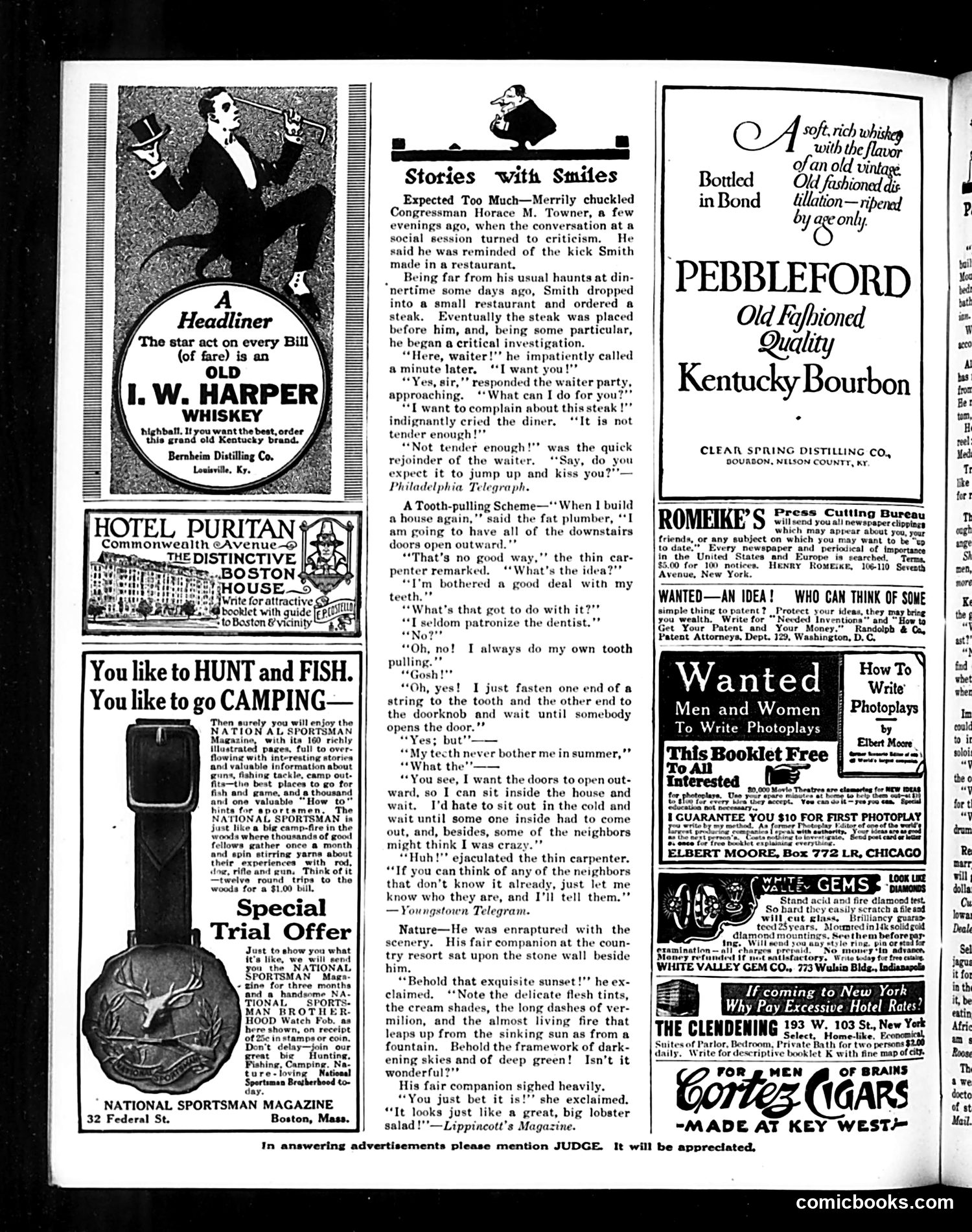
This is primarily a **advertisements and humor anecdotes page**, not a political cartoon page. The page features three brief humorous stories under "Stories with Smiles": 1. **Congressman Horace M. Towner's anecdote** about a man named Smith who complains a restaurant steak isn't tender enough—the joke being his unreasonable expectations. 2. **The plumber's tooth-pulling scheme**—a absurdist joke where a fat plumber describes rigging a doorknob to extract his teeth, with the carpenter sarcastically noting his neighbors already know he's crazy. 3. **Nature appreciation story**—a romantic man waxes poetic about a sunset's artistic qualities while his female companion prosaically compares it to a lobster salad, deflating his sentimentality. The bulk of the page consists of period **advertisements** for bourbon, hotels, hunting magazines, and other products typical of 1920s Judge magazine. The humor is gentle and domestic rather than political or satirical.
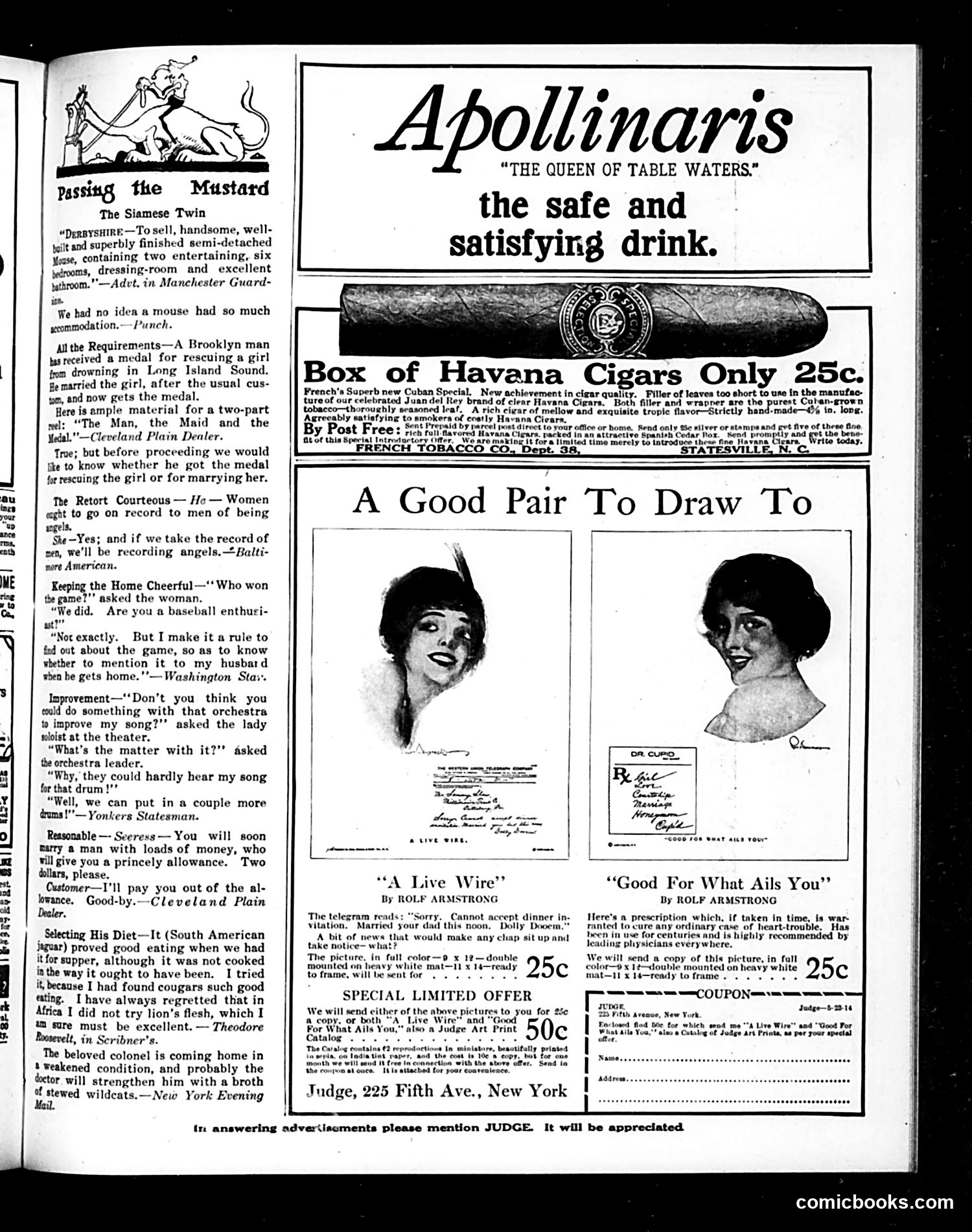
This page is predominantly **advertising and entertainment content** rather than political satire. The top portion contains brief humorous anecdotes—short jokes about real estate terminology, medal-earning, baseball, and theodore Roosevelt's exotic diet preferences. These are lighthearted social commentary typical of Judge's humor section. The bulk of the page consists of period advertisements: Apollinaris mineral water ("the safe and satisfying drink"), Havana cigars for 25¢, and two romantic illustration prints by artist Rolf Armstrong titled "A Live Wire" and "Good For What Ails You." These prints feature stylized portraits of young women and could be ordered for 25¢ each. The Roosevelt anecdote—mocking his well-publicized adventures eating wild animals—represents the page's closest approach to satire, poking fun at the former president's famous rugged exploits. However, this occupies minimal space among the commercial offerings and gentle domestic humor dominating the publication.
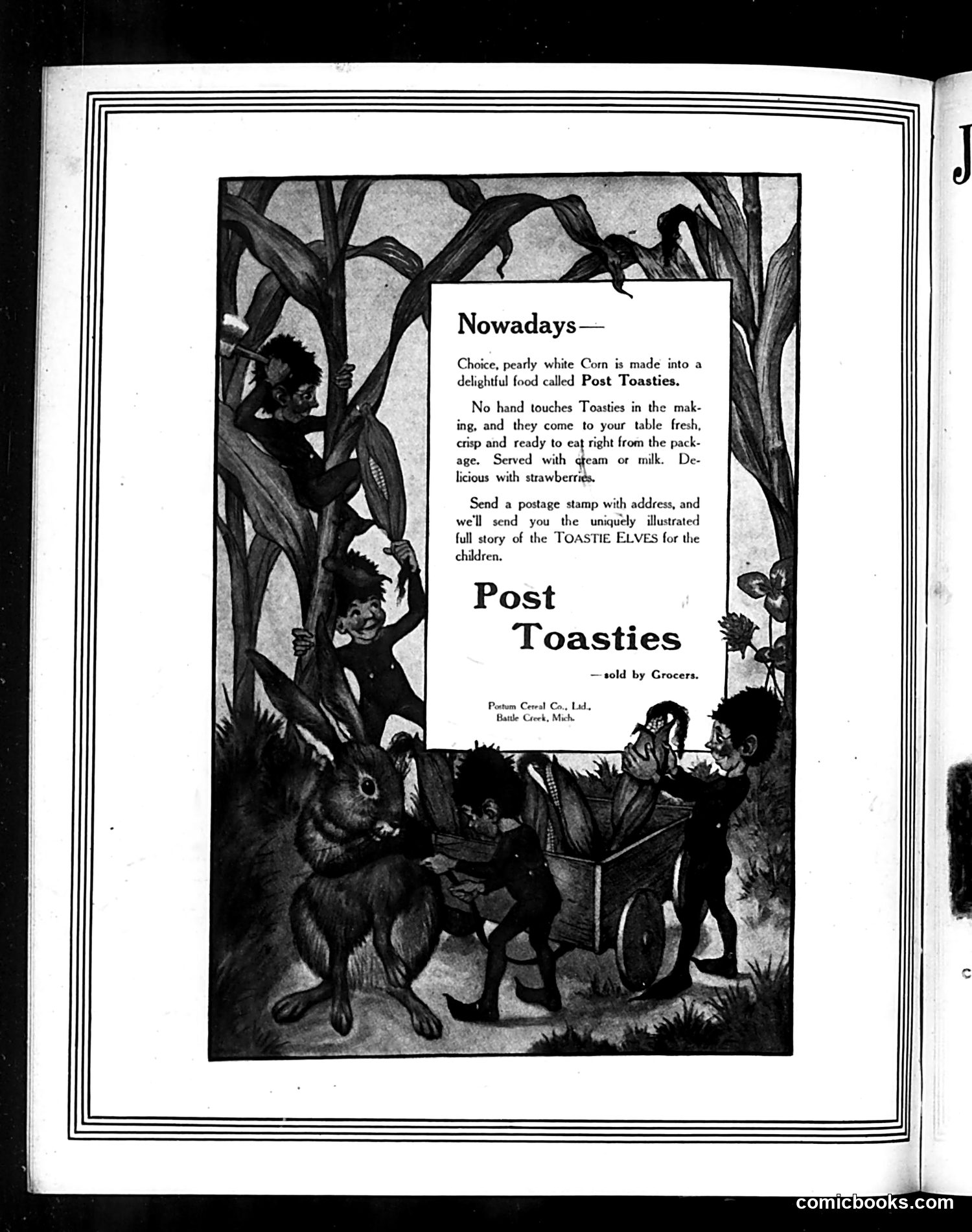
This page is primarily a **cereal advertisement**, not political satire. It promotes Post Toasties, a corn cereal made by Postum Cereal Co. of Battle Creek, Michigan. The illustrated scene depicts whimsical "Toastie Elves" in a forest setting—fantasy characters designed to appeal to children. The ad emphasizes the product's purity ("no hand touches Toasties") and convenience (ready-to-eat from the package), selling points common to early 20th-century processed foods. The promotion offers children an illustrated story about the Toastie Elves for a postage stamp, a typical marketing tactic of the era to build brand loyalty among young consumers. The fantastical imagery and emphasis on cleanliness reflect early advertising's focus on the novelty and safety of mass-produced, packaged foods.