
Judge, 1914-05-23 · page 6 of 24
Judge — May 23, 1914 — page 6: what you’re looking at
What you’re looking at
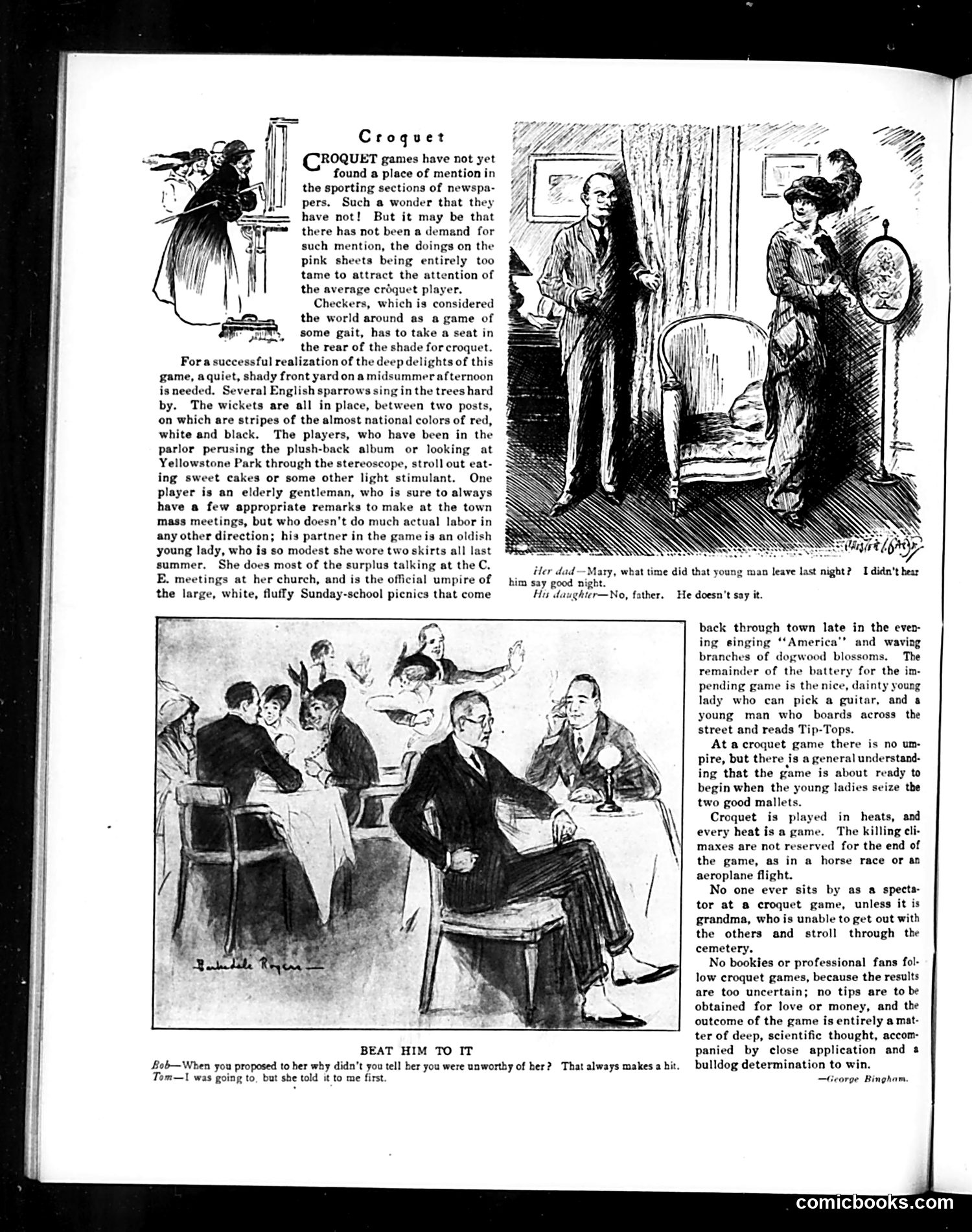
This piece satirizes the genteel social ritual of croquet among the American middle class. The author mocks how croquet players—described as idle elderly men who pontificate at town meetings, pious churchwomen, and loafing young men—treat this leisurely lawn game with exaggerated seriousness, calling it a matter of "deep, scientific thought" and "bulldog determination." The satire targets the pretension of Victorian leisure culture: players dress formally, consume "sweet cakes," and approach a simple game with absurd gravity. The accompanying cartoons illustrate these social types—elderly gentlemen, modest spinsters, guitar-playing young ladies. A secondary joke ("Beat Him to It") mocks courtship conventions: a man fails to propose because the woman preached self-deprecation first. The piece gently ridicules how the respectable classes invested trivial pursuits with false importance while avoiding genuine labor.
📄 Transcribed text from this page (OCR, searchable)
Machine-transcribed from the original scan — historical spelling and the odd misread are preserved.
| Croquet H (CROQUET games have not yet found a place of mention in the sporting sections of newspa- pers. Such a wonder that they have not! But it may be that there has not been a demand for such mention, the doings on the pink sheets being entirely too tame to attract the attention of the average croquet player. Checkers, which is considered the world around as a game of some gait, has to take a seat in the rear of the shade for croquet. For a successful realization of the deep delights of this game, aquiet, shady front yardon a midsummer afternoon isneeded. Several English sparrows sing in the trees hard by. The wickets are all in place, between two posts, on which are stripes of the almost national colors of red, white and black. The players, who have been in the parlor perusing the plush-back album or looking at Yellowstone Park through the stereoscope, stroll out eat- ing sweet cakes or some other light stimulant. One player is an elderly gentleman, who is sure to always have a few appropriate remarks to make at the town mass meetings, but who doesn’t do much actual labor in any other direction; his partner in the game is an oldish young lady, who is so modest she wore two skirts all last summer. She does most of the surplus talking at the C. E. meetings at her church, and is the official umpire of the large, white, fluffy Sunday-school picnics that come iter dad—Mary, what time did that young man leave last night? I didn’t hear him say good night. Hts do ghter—No, father. 1 BEAT HIM TO IT Tom—I was going to, but she told it to me first Bob—When you proposed to her why didn’t you tell her you were unworthy of her? That always makes a hit. He doesn't say it. back through town late in the even- ing singing ‘America’ and waving branches of dogwood ble ms. The remainder of the battery for the im- pending game is the nice, dainty young lady who can pick a guitar, and a young man who boards across the street and reads Tip-Tops. At acroquet game there is no um- pire, but there is a general understand- ing that the game is about ready to begin when the young ladies seize the two good mallets. Croquet is played in heats, and every heat is a game. The killing cli- maxes are not reserved for the end of the game, as in a horse race or an aeroplane flight. No one ever sits by as a specta- tor at a croquet game, unless it is grandma, who is unable to get out with the others and stroll through the cemetery. No bookies or professional fans fol- low croquet games, because the results are too uncertain; no tips are to be obtained for love or money, and the outcome of the game is entirely a mat- ter of deep, scientific thought, accom- panied by close application and bulldog determination to win. George Bingham. comicbooks.com