
Judge, 1914-05-23 · page 15 of 24
Judge — May 23, 1914 — page 15: what you’re looking at
What you’re looking at
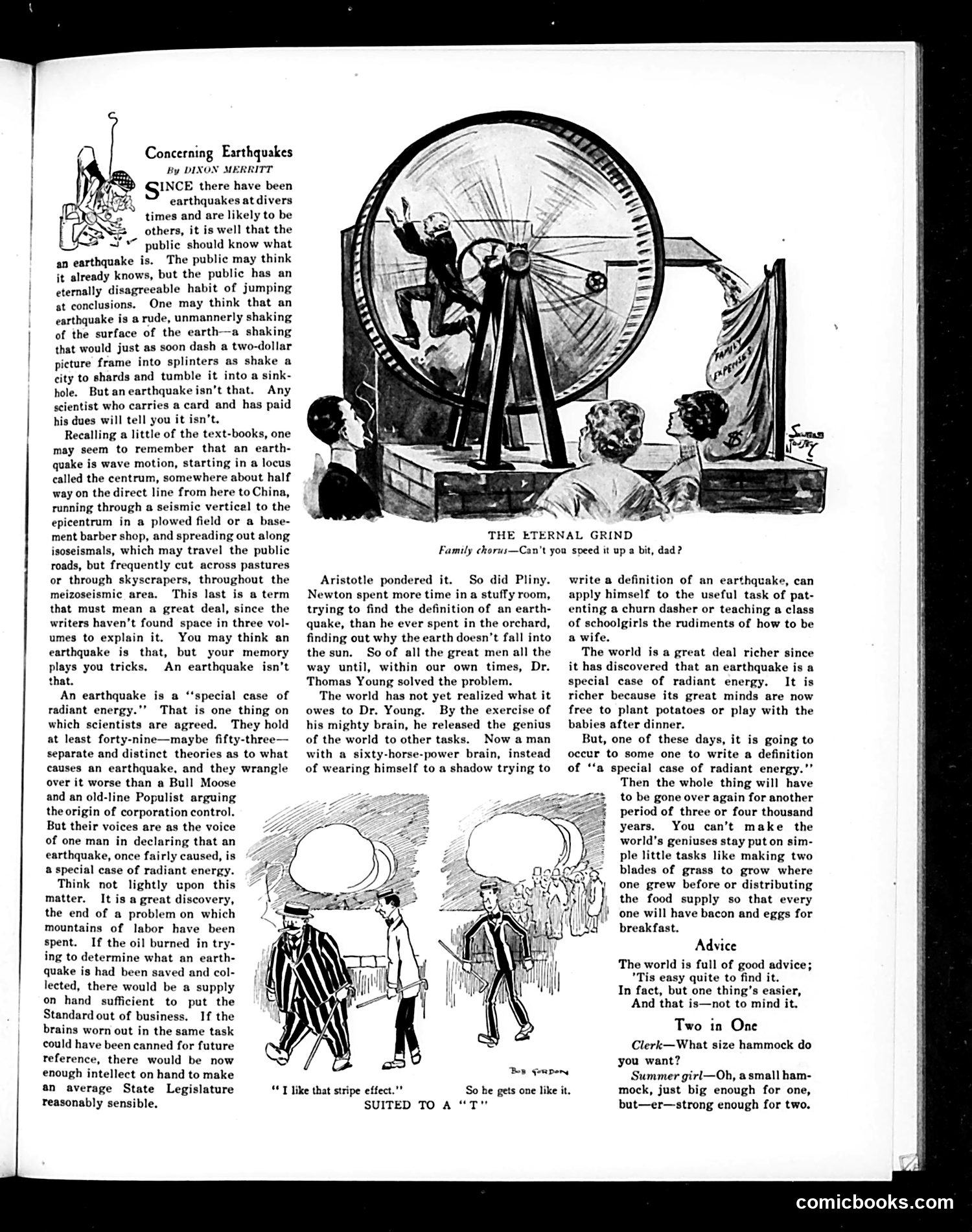
Dixon Merritt's satirical essay mocks the gap between scientific jargon and actual understanding. He argues that while scientists have spent enormous intellectual resources debating earthquake causes—producing "forty-nine, maybe fifty-three separate theories"—they've finally agreed on one useless definition: earthquakes are "a special case of radiant energy." Merritt's joke: this grand discovery accomplishes nothing. The real value came when Dr. Thomas Young solved the problem, freeing brilliant minds from pointless definitional debate to do useful work—"patenting a churn dasher or teaching schoolgirls" how to be wives. The cartoons show scholars trapped in intellectual wheel-spinning, and a frustrated family asking dad to "speed it up"—representing how over-specialization and abstract theorizing waste human potential. The satire critiques academic pretension and the absurdity of elaborate technical language that obscures rather than clarifies. The final joke suggests this cycle will repeat when someone writes a definition of "a special case of radiant energy."
📄 Transcribed text from this page (OCR, searchable)
Machine-transcribed from the original scan — historical spelling and the odd misread are preserved.
Concerning Earthquakes By DIXON MERRITT q INCE there have been LOA Ss earthquakes at divers times and are likely to be xy =3 others, it is well that the 3° =! public should know what an earthquake is. The public may think it already knows, but the public has an eternally disagreeable habit of jumping at conclusions. One may think that an earthquake is a rude, unmannerly shaking of the surface of the earth—a shaking that would just as soon dash a two-dollar picture frame into splinters as shake a city to shards and tumble it into a sink- hole. But anearthquakeisn’t that. Any scientist who carries a card and has paid his dues will tell you it isn’t. Recalling a little of the text-books, one may seem to remember that an earth- quake is wave motion, starting in a locus called the centrum, somewhere about half way on the direct line from here to China, running through a seismic verticel to the epicentrum in a plowed field or a base- ment barber shop, and spreading out along isoseismals, which may travel the public roads, but frequently cut across pastures or through skyscrapers, throughout the meizoseismic area. This last is a term that must mean a great deal, since the writers haven’t found space in three vol- umes to explain it. You may think an earthquake is that, but your memory plays you tricks, An earthquake isn’t that. An earthquake is a ‘‘special case of radiant energy." That is one thing on which scientists are agreed. They hold at least forty-nine—maybe fifty-three— separate and distinct theories as to what causes an earthquake, and they wrangle over it worse than a Bull Moose and an old-line Populist arguing the origin of corporation control. But their voices are as the voice of one man in declaring that an earthquake, once fairly caused, is a special case of radiant energy. Think not lightly upon this matter. It is a great discovery, the end of a problem on which mountains of labor have been spent. If the oil burned in try- ing to determine what an earth- quake is had been saved and col- lected, there would be a supply on hand sufficient to put the Standard out of business. If the brains worn out in the same task could have been canned for future reference, there would be now enough intellect on hand to make an average State Legislature reasonably sensible. “*T like that stripe effect." THE ETERNAL GRIND Family chorus—Can't you speed it up a bit, dad? Aristotle pondered So did Pliny. Newton spent more time ina stuffy room, trying to find the definition of an earth- quake, than he ever spent in the orchard, finding out why the earth doesn’t fall into the sun. So of all the great men all the way until, within our own times, Dr. Thomas Young solved the problem. The world has not yet realized what it owes to Dr. Young. By the exercise of his mighty brain, he released the genius of the world to other tasks. Now a man with a sixty-horse-power brain, instead of wearing himself to a shadow trying to SUITED TO A “T" Bee qeupeny So he gets one like it. write a definition of an earthquake, can apply himself to the useful task of pat- enting a churn dasher or teaching a class of schoolgirls the rudiments of how to be a wife. The world is a great deal richer since it has discovered that an earthquake is a special case of radiant energy. It is richer because its great minds are now free to plant potatoes or play with the babies after dinner. But, one of these days, it is going to occur to some one to write a definition of ‘‘a special case of radiant energy.’’ Then the whole thing will have to be gone over again for another period of three or four thousand years. You can’t make the world’s geniuses stay put on sim- ple little tasks like making two blades of grass to grow where one grew before or distributing the food supply so that every one will have bacon and eggs for breakfast. Advice The world is full of good advice; 'Tis easy quite to find it. In fact, but one thing’s easier, And that is—not to mind it. Two in One Clerk—What size hammock do you want? Summer girl—Oh, a small ham- mock, just big enough for one, but—er—strong enough for two. comicbooks.com