
Judge, 1914-05-23 · page 16 of 24
Judge — May 23, 1914 — page 16: what you’re looking at
What you’re looking at
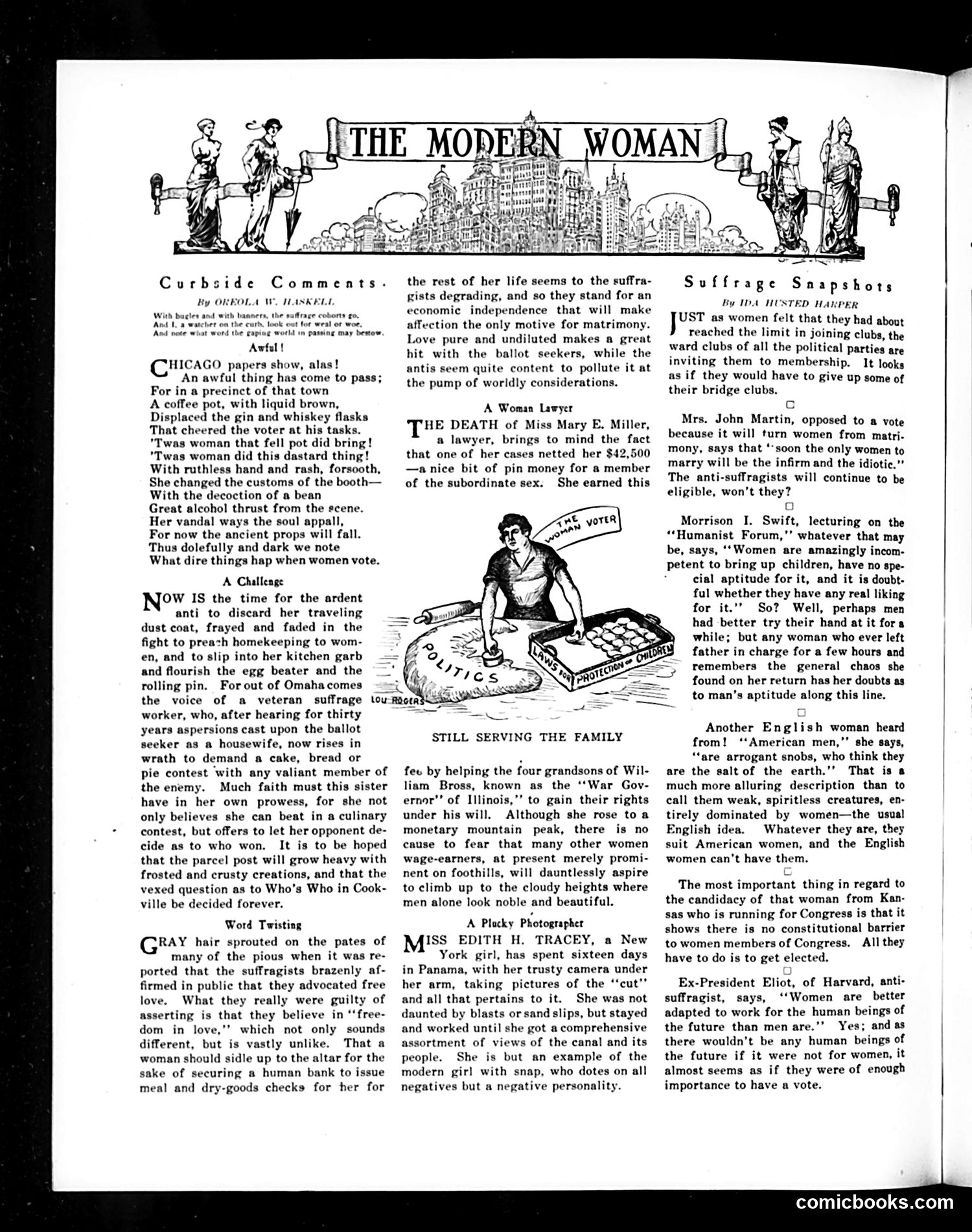
This anti-suffrage page from Judge uses multiple satirical pieces to mock women's voting rights and independence. **"Curbside Comments"** attacks women voters in Chicago who replaced alcohol with coffee at polling places—presented as horrifying disruption of tradition. The satire suggests women are recklessly "vandalizing" male customs. **"A Challenge"** sarcastically dares anti-suffrage activists to prove women belong in kitchens by competing in baking contests against suffragists, implying the real debate is whether women should vote or cook. **"Word Twisting"** criticizes suffragists for distinguishing "freedom in love" from "free love," portraying them as dishonest while actually describing their position: women should marry for affection, not financial security—a radical idea the magazine presents as absurd. Scattered anecdotes celebrate women succeeding professionally (lawyer earning $42,500, photographer) but frame these as rare exceptions, not arguments for equality. The overall message: women's independence threatens domestic order and is fundamentally unnatural.
📄 Transcribed text from this page (OCR, searchable)
Machine-transcribed from the original scan — historical spelling and the odd misread are preserved.
Curbside EOLA W. Comments. HASKE . anners. the wall 1et on the curb look out fo ord the gaping world in passing may bestow. Awful ! CHICAGO papers show, alas! An awful thing has come to pass; For in a precinct of that town A coffee pot, with liquid brown, Displaced the gin and whiskey flasks That cheered the voter at his tasks. 'Twas woman that fell pot did bring! 'Twas woman did this dastard thing! With ruthless hand and rash, forsooth, She changed the customs of the booth— With the decoction of a bean Great alcohol thrust from the scene. Her vandal ways the soul appall, For now the ancient props will fall. Thus dolefully and dark we note What dire things hap when women vote. A Challenge ‘OW IS the time for the ardent anti to discard her traveling dust coat, frayed and faded in the fight to preach homekeeping to wom- en, and to slip into her kitchen garb and flourish the egg beater and the rolling pin. For out of Omahacomes the voice of a veteran suffrage worker, who, after hearing for thirty years aspersions cast upon the ballot seeker as a housewife, now rises in wrath to demand a cake, bread or pie contest with any valiant member of the enemy. Much faith must this sister have in her own prowess, for she not only believes she can beat in a culinary contest, but offers to let her opponent de- cide as to who won. It is to be hoped that the parcel post will grow heavy with frosted and crusty creations, and that the vexed question as to Who’s Who in Cook- ville be decided forever. Word Twisting RAY hair sprouted on the pates of many of the pious when it was re- ported that the suffragists brazenly af- firmed in public that they advocated free love. What they really were guilty of asserting is that they believe in ‘‘free- dom in love,’’ which not only sounds different, but is vastly unlike. That a woman should sidle up to the altar for the sake of securing a human bank to issue meal and dry-goods checks for her for the rest of her life seems to the suffra- gists degrading, and so they stand for an economic independence that will make affection the only motive for matrimony. Love pure and undiluted makes a great hit with the ballot seekers, while the antis seem quite content to pollute it at the pump of worldly considerations. A Woman Lawyer HE DEATH of Miss Mary E. Miller, a lawyer, brings to mind the fact that one of her cases netted her $42,500 —anice bit of pin money for a member of the subordinate sex. She earned this SE yortR ans wi if STILL SERVING THE FAMILY fee by helping the four grandsons of Wil- liam Bross, known as the ‘*War Gov- ernor”’ of Illin ’ to gain their rights under his will. Although she rose to a monetary mountain peak, there is no cause to fear that many other women wage-earners, at present merely promi- nent on foothills, will dauntlessly aspire to climb up to the cloudy heights where men alone look noble and beautiful. A Plocky Photographer ISS EDITH H. TRACEY, a New York girl, has spent sixteen days in Panama, with her trusty camera under her arm, taking pictures of the ‘‘cut’’ and all that pertains to it. She was not daunted by blasts or sand slips, but stayed and worked until she got a comprehensive assortment of views of the canal and its people. She is but an example of the modern girl with snap, who dotes on all negatives but a negative personality. Suffrage Snapshots By IDA HUSTED HAkPER UST as women felt that they had about reached the limit in joining clubs, the ward clubs of all the political parties are inviting them to membership. It looks as if they would have to give up some of their bridge clubs. Cc Mrs. John Martin, opposed to a vote because it will turn women from matri- mony, says that ‘soon the only women to marry will be the infirm and the idiotic.” The anti-suffragists will continue to be eligible, won't they? a Morrison I. Swift, lecturing on the “Humanist Forum,'’ whatever that may be, says, ‘Women are amazingly incom- petent to bring up children, have no spe- cial aptitude for it, and it is doubt- ful whether they have any real liking for it.’’ So? Well, perhaps men had better try their hand at it fora while; but any woman who ever left father in charge for a few hours and remembers the general chaos she found on her return has her doubts as to man’s aptitude along this line. Another English woman heard from! ‘American men,’’ she says, “fare arrogant snobs, who think they are the saltof the earth.’’ That is a much more alluring description than to call them weak, spiritless creatures, en- tirely dominated by women—the usual English idea. Whatever they are, they suit American women, and the English women can't have them. The most important thing in regard to the candidacy of that woman from Kan- sas who is running for Congress is that it shows there is no constitutional barrier to women members of Congress. All they have to do is to get elected. Ex-President Eliot, of Harvard, anti- suffragist, says, ‘‘Women are better adapted to work for the human beings of the future than men are.’’ Yes; and as there wouldn't be any human beings of the future if it were not for women, it almost seems as if they were of enough importance to have a vote. comicbooks.com