
A complete issue · 24 pages · 1914
Judge — April 4, 1914
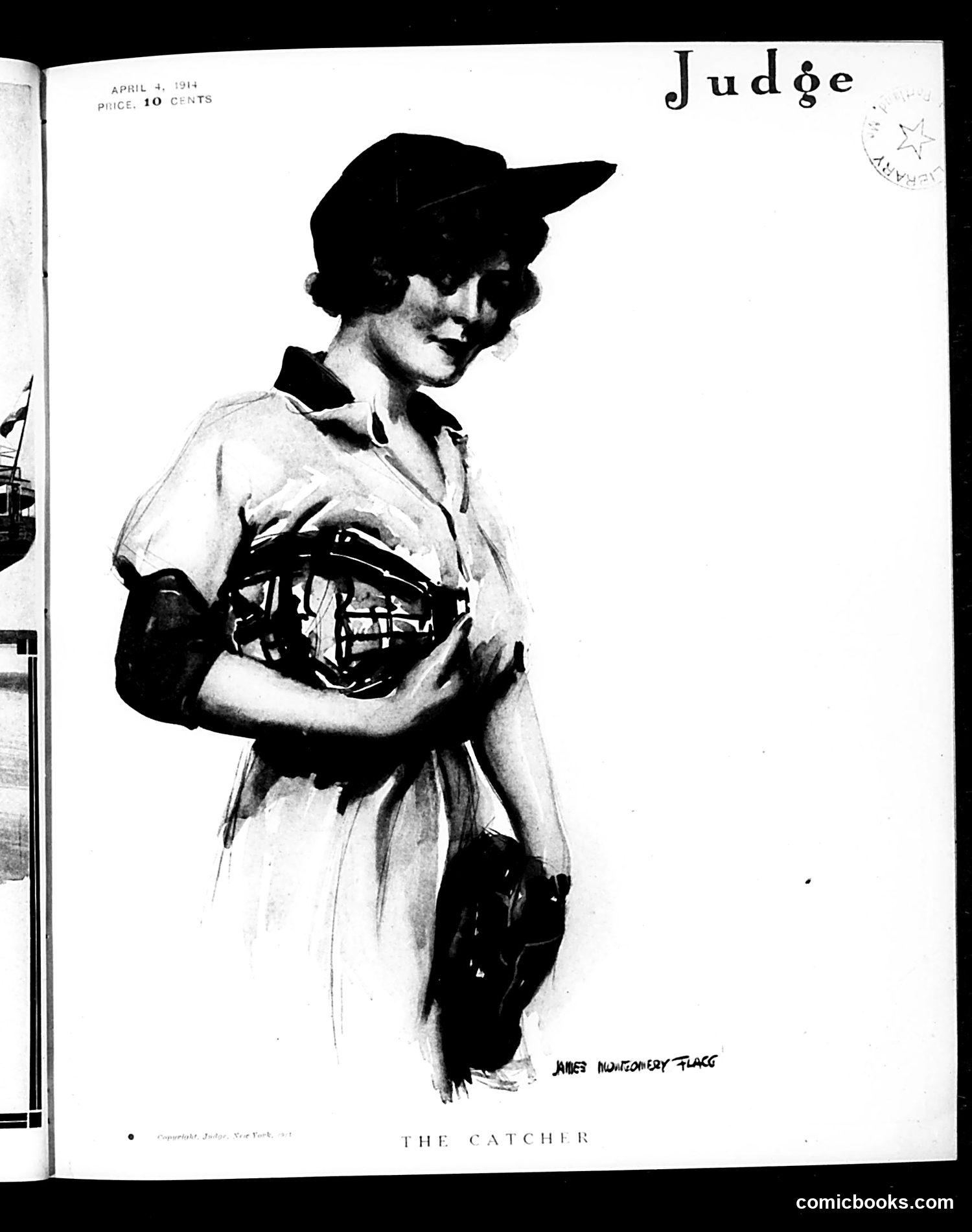
This illustration titled "The Catcher" appears to be a baseball-themed satirical image from Judge magazine's cover. The drawing by James Montgomery Flagg depicts a female figure in baseball attire—holding a catcher's mask and mitt, wearing a cap and uniform—posed in profile. In 1914, women's participation in baseball was unconventional and likely viewed as humorous or provocative by the magazine's audience. The satire likely mocks either the novelty of women entering traditionally male sports, or comments on contemporary debates about women's athletics and gender roles. Without additional context from the magazine's articles, the specific satirical target remains unclear, though the image clearly uses baseball as a vehicle for social commentary on gender and American culture.
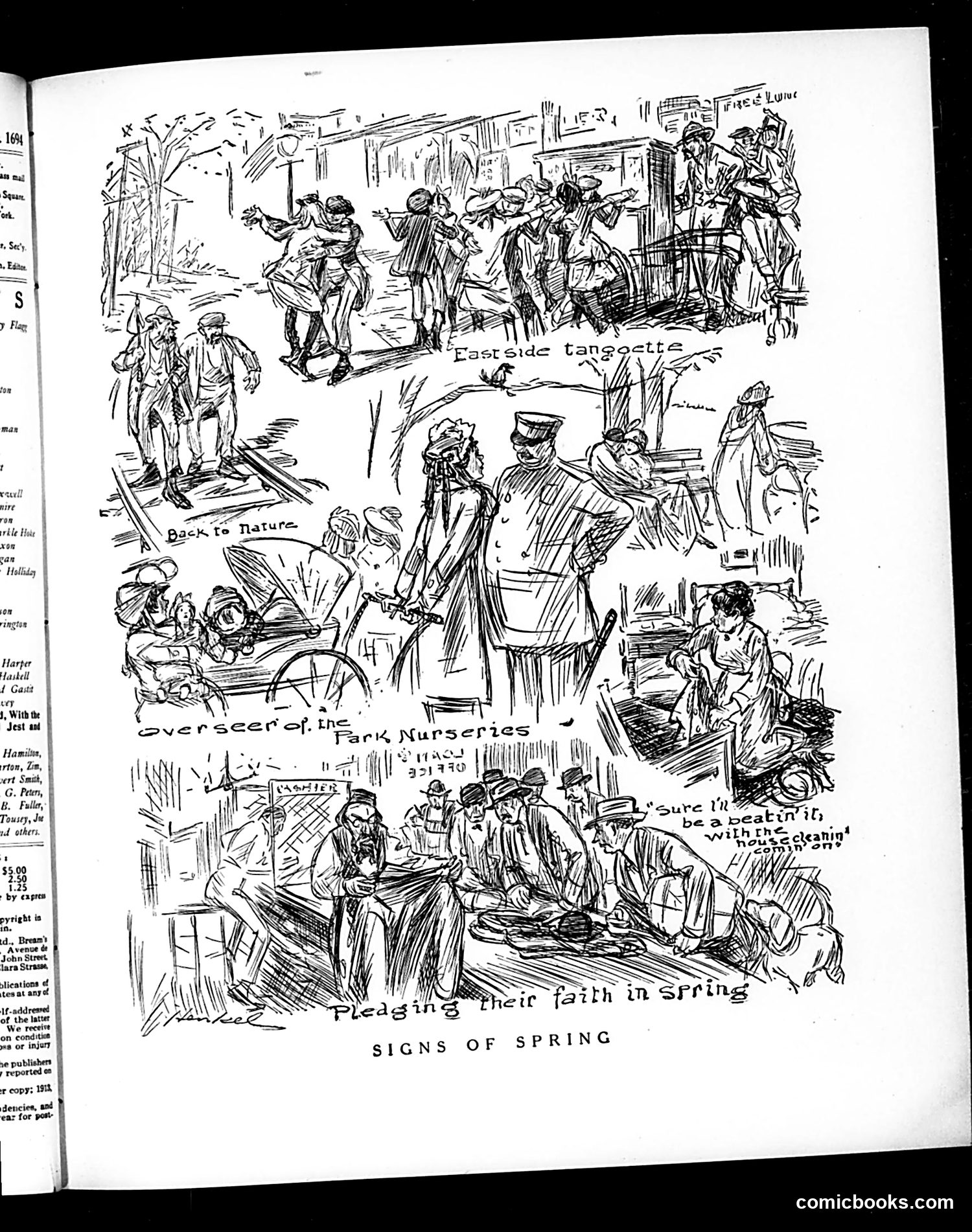
This page presents four seasonal sketches titled "Signs of Spring," each depicting urban working-class scenes with social commentary: 1. **"East Side Tangoette"** - Shows immigrants on the Lower East Side dancing the tango, a then-scandalous dance associated with working-class dance halls. 2. **"Back to Nature"** - Depicts laborers attempting leisure activities, seemingly mocking the upper-class "back to nature" movement among the wealthy. 3. **"Overseer of the Park Nurseries"** - Appears to satirize municipal park management or public works employment. 4. **"Pledging their Faith in Spring"** - Shows working people engaged in street activities, possibly referencing seasonal employment or labor patterns. The cartoons use immigrant and working-class subjects to satirize contemporary social trends and urban life during the early 20th century.
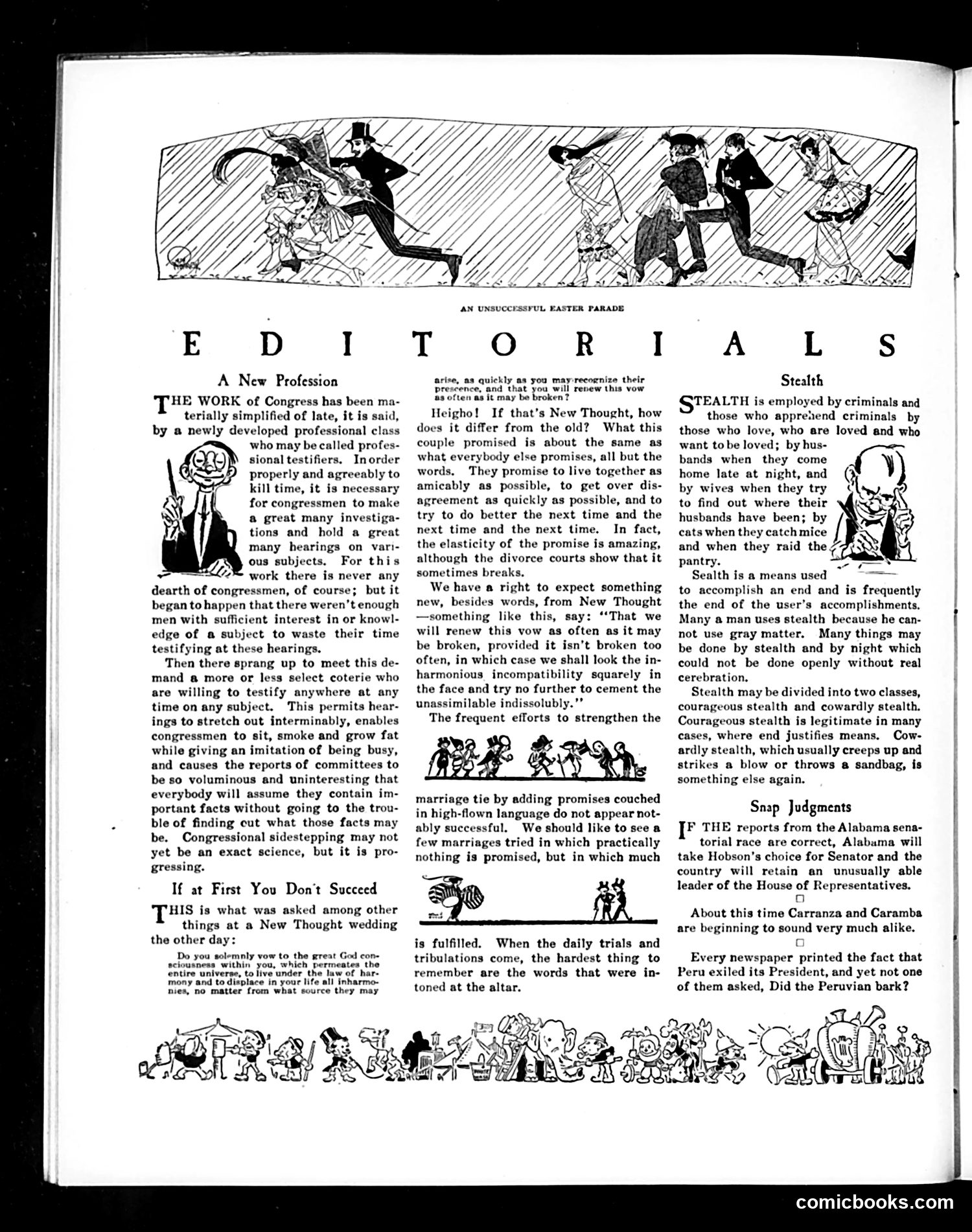
This page contains three satirical editorials mocking contemporary issues: **"A New Profession"** criticizes Congress's creation of a "professional listener" role—lawmakers hiring experts to testify on subjects they could research themselves. The satire attacks congressional laziness and frivolous spending. **"Stealth"** contrasts two types of theft: criminals stealing physically versus the cowardly striking "a blow or throws a sandbag, is something else again"—likely referencing anonymous attacks or backstabbing political tactics. **"Snap Judgments"** references Alabama senatorial politics, possibly the 1924 race where Senators Underwood and Heflin competed. The mention of "Carranza and Caramba sounding alike" suggests wordplay on Mexican political figures. The page employs cartoon illustrations to mock congressional incompetence and questionable political conduct typical of Judge's early 20th-century satirical style.
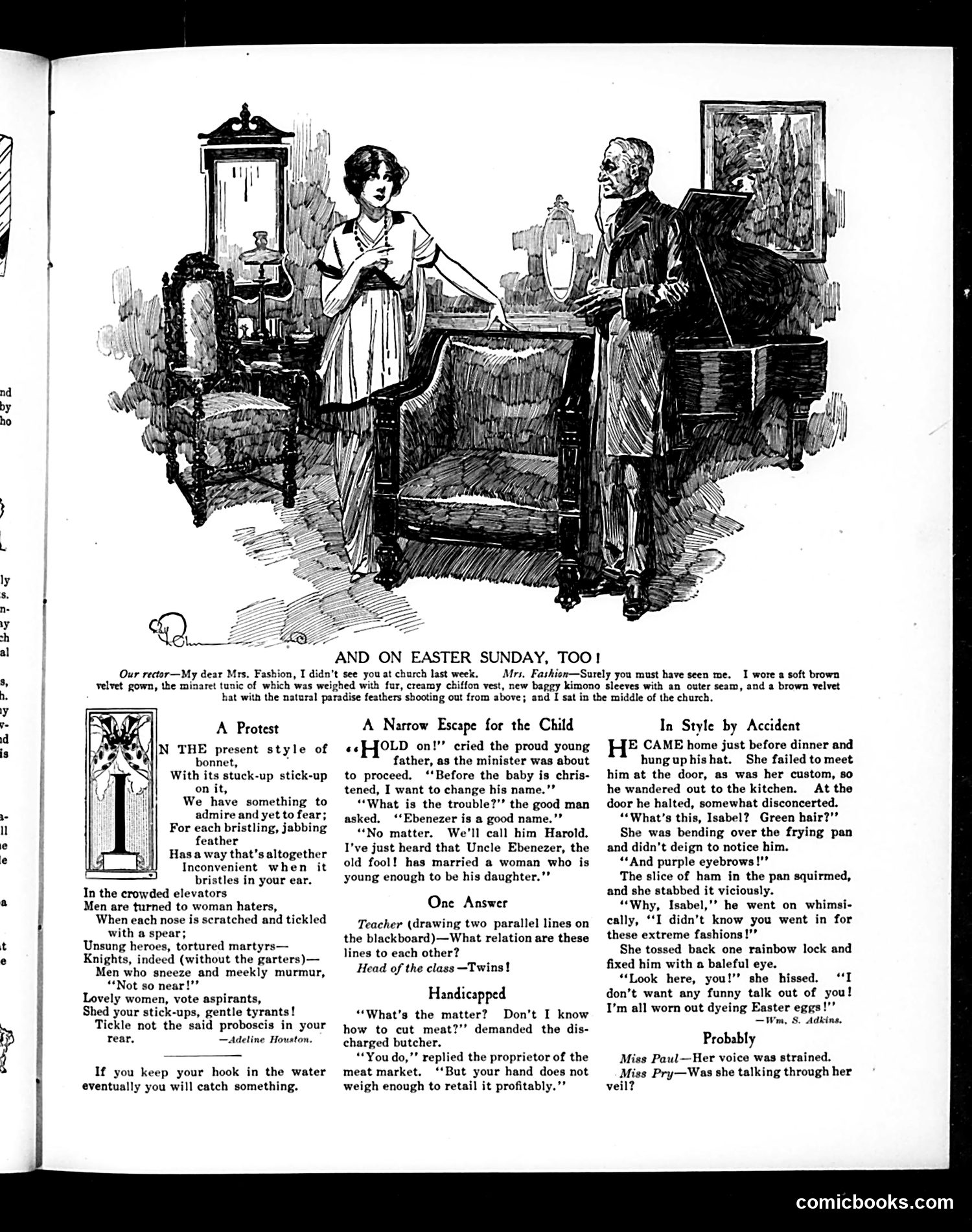
The top illustration shows a domestic scene with a woman in a white dress speaking to a well-dressed man, captioned "AND ON EASTER SUNDAY, TOO!" The accompanying dialogue reveals social commentary about women's fashion—specifically criticism of extravagant Easter bonnets and hats. Mrs. Fashion boasts of her expensive outfit while the man questions the excess. Below are several brief satirical items and jokes, including "A Protest" about christening names, "A Narrow Escape for the Child" about fashion mishaps, and "In Style by Accident" mocking unintentional fashion choices. The content appears to ridicule upper-class women's conspicuous consumption and obsession with fashionable dress, particularly elaborate Easter millinery—a recurring satirical target in early 20th-century American humor magazines.
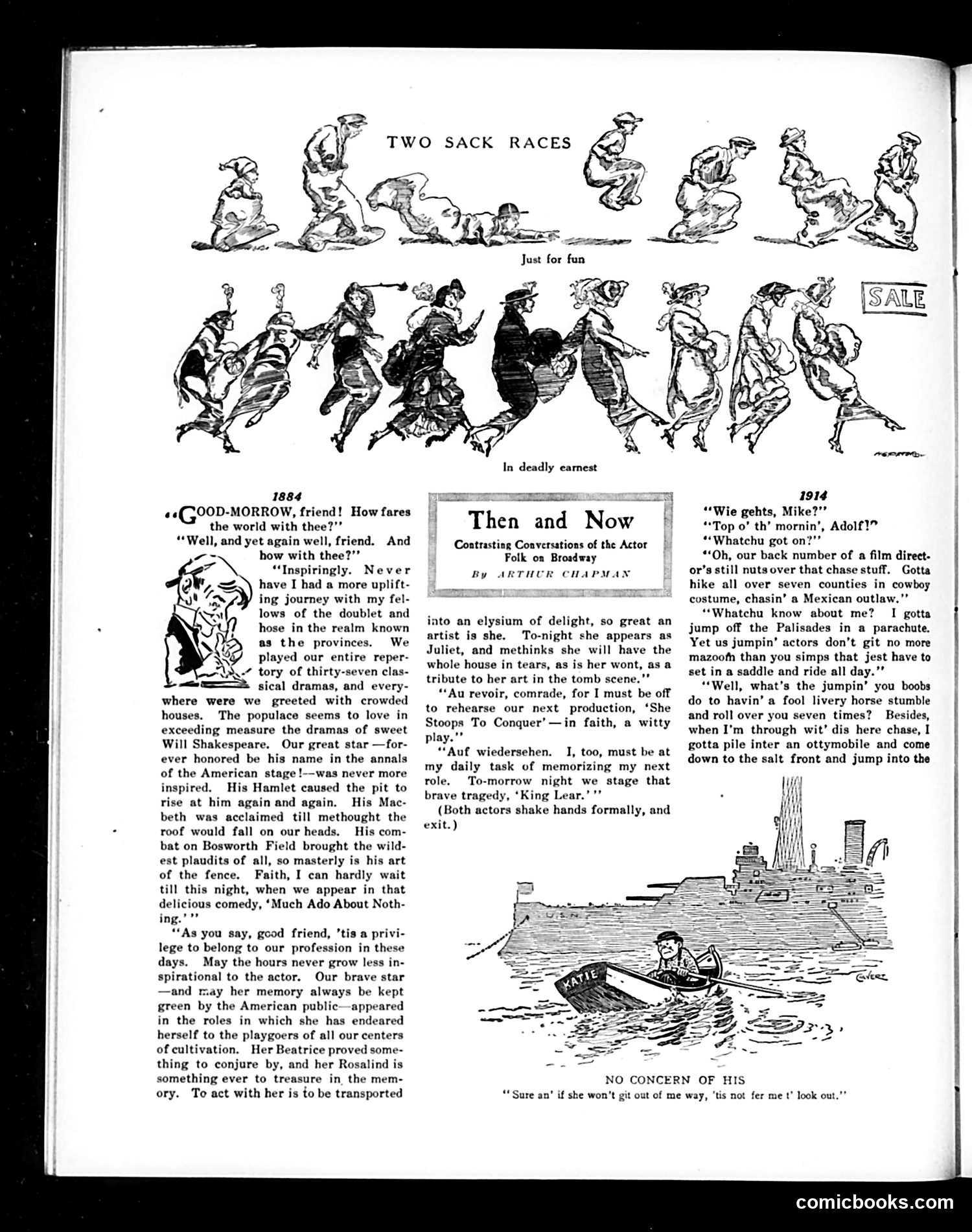
This satirical comparison contrasts theatrical actors' conversations from 1884 and 1914. The 1884 dialogue depicts classical actors speaking in Shakespearean language, earnestly discussing performances of *Hamlet*, *Macbeth*, and other canonical plays before appreciative, cultured audiences. The 1914 conversation mocks modern film actors using colloquial, broken English (mixing Irish, German, and American slang). They discuss dangerous, repetitive stunt work—chases, parachute jumps, horse falls—for what appears to be early silent Western films, with minimal artistic pretension. The satire criticizes how film has replaced legitimate theater: where 1884 offered artistic aspiration and classical literature, 1914 offers physical peril and commercial entertainment. The bottom cartoon reinforces this—a boatman indifferently rows past someone falling overboard, captioned "NO CONCERN OF HIS," suggesting the callous disregard for safety in film production. The piece reflects early concerns about cinema's artistic and cultural inferiority to traditional theater.
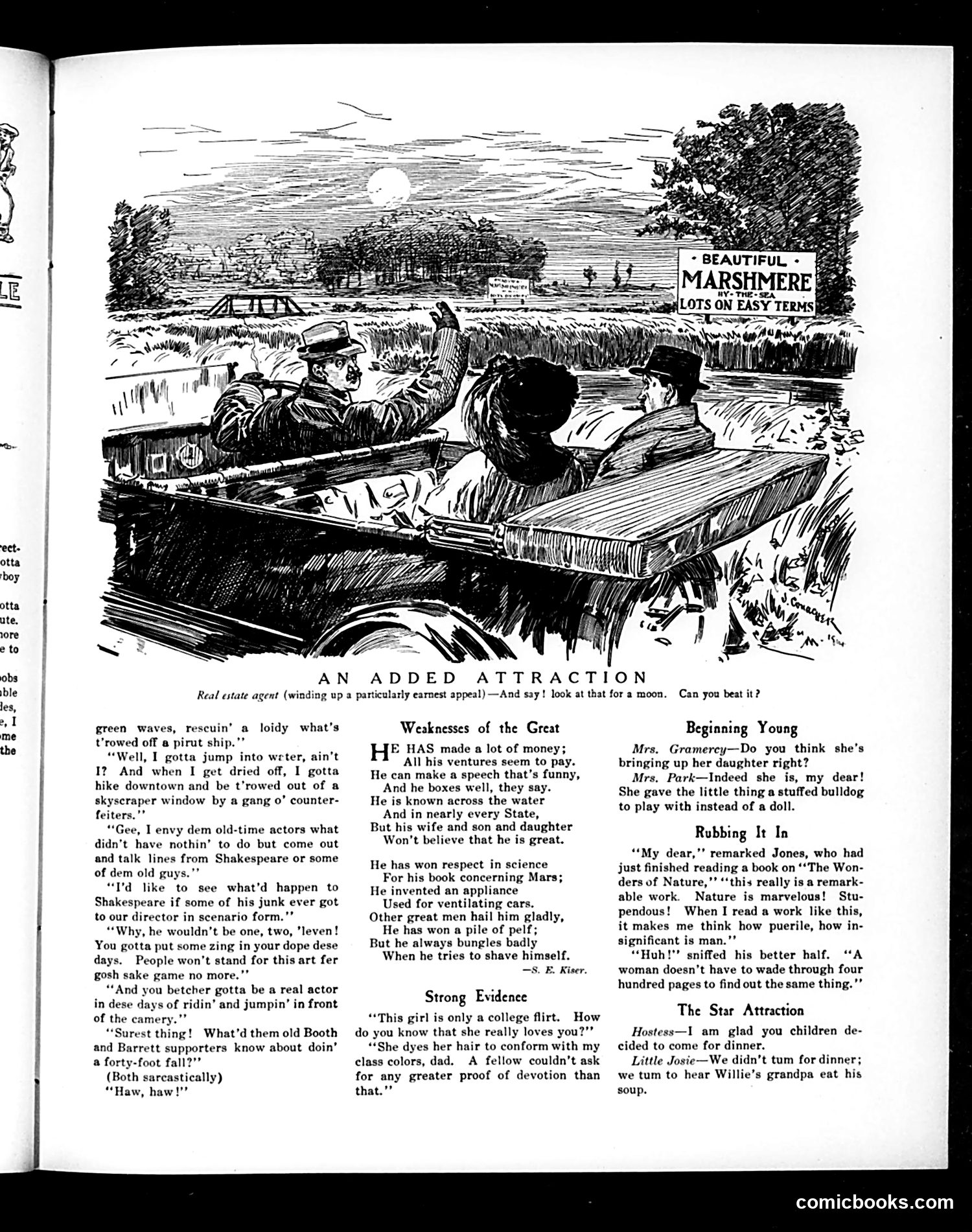
This page contains multiple brief comic sketches and jokes typical of early 20th-century Judge magazine humor, plus a real estate advertisement. **The main cartoon** depicts a real estate agent pitching property near marshland, with the sales pitch reduced to pointing out an attractive moon—satirizing how agents oversell mediocre land through distraction and false enthusiasm. **The text pieces** include: - **Actors' dialogue** mocking modern cinema's demands for stunts and "zing" versus classical theater's reliance on Shakespeare—reflecting 1920s anxiety about cinema replacing stage acting with spectacle. - **"Weaknesses of the Great"** targets an unnamed wealthy, successful man admired publicly but dismissed by his own family—likely satirizing celebrity worship and the gap between public image and private reality. - Other brief sketches joke about college romance, parenting trends (stuffed bulldogs replacing dolls), and marital dynamics. The humor reflects genteel early 20th-century sensibilities: gentle mockery of social pretension, gender relations, and changing entertainment media.
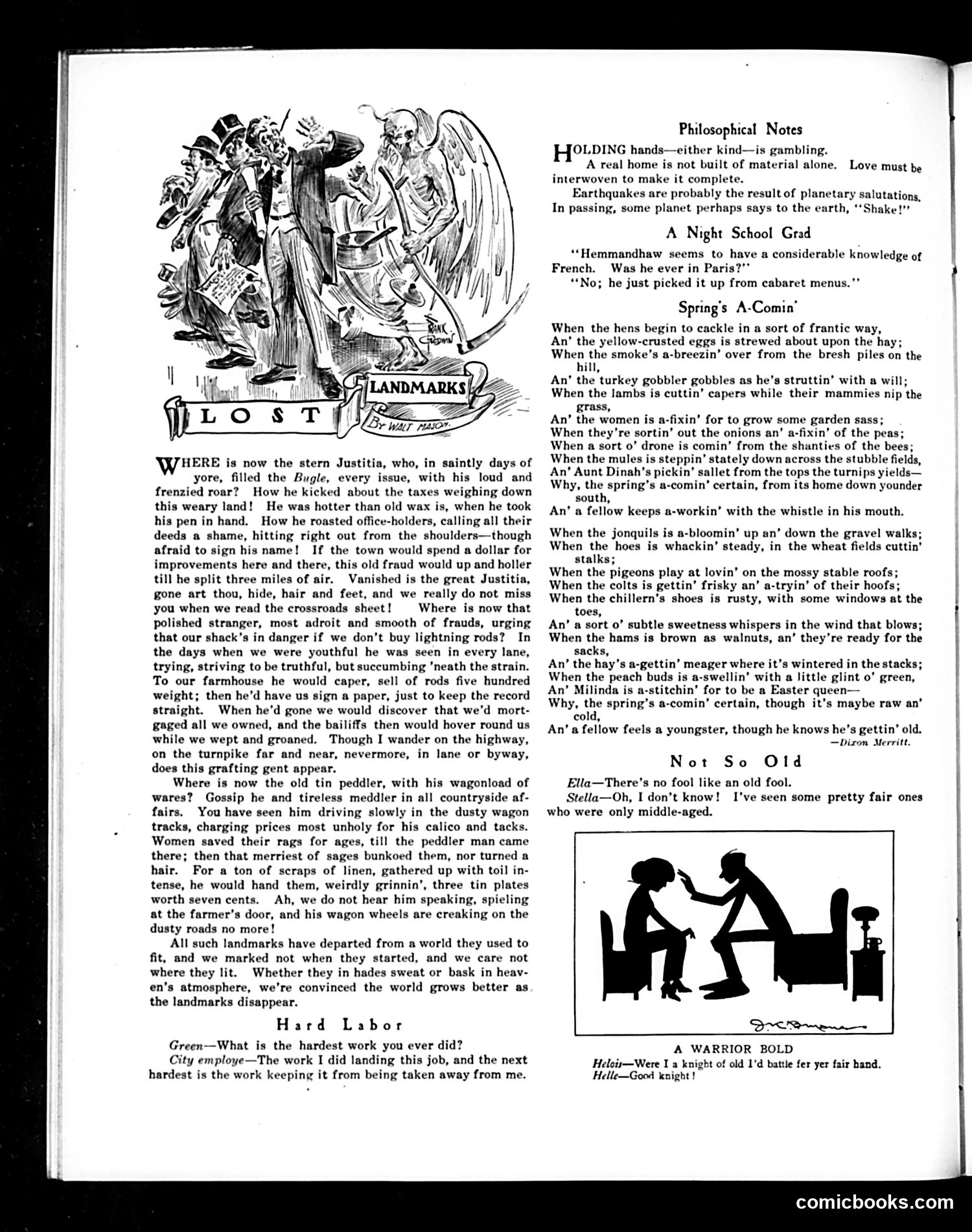
This page satirizes **vanished American archetypes**—con men and fraudsters who once plagued rural communities but have apparently disappeared. **"Lost Landmarks"** mocks "Justitia," a crusading newspaper editor who once railed against corruption and taxes but is now gone. The text reveals he was a hypocrite: he sold lightning rods door-to-door while feigning moral outrage, financially ruining farmers. The piece also laments the absent "tin peddler"—another traveling swindler who exploited farm women, trading worthless tin plates for valuable rags collected over years. The satirical point: these con men and fraudulent "reformers" have disappeared from the countryside, and society is *better for it*. The poem "Spring's A-Comin'" celebrates rural life freed from their schemes. Minor jokes include "Hard Labor" (a pun on government job-keeping) and "A Night School Grad" (mocking pretense via fake French). The overall message critiques rural exploitation and celebrates honest living.
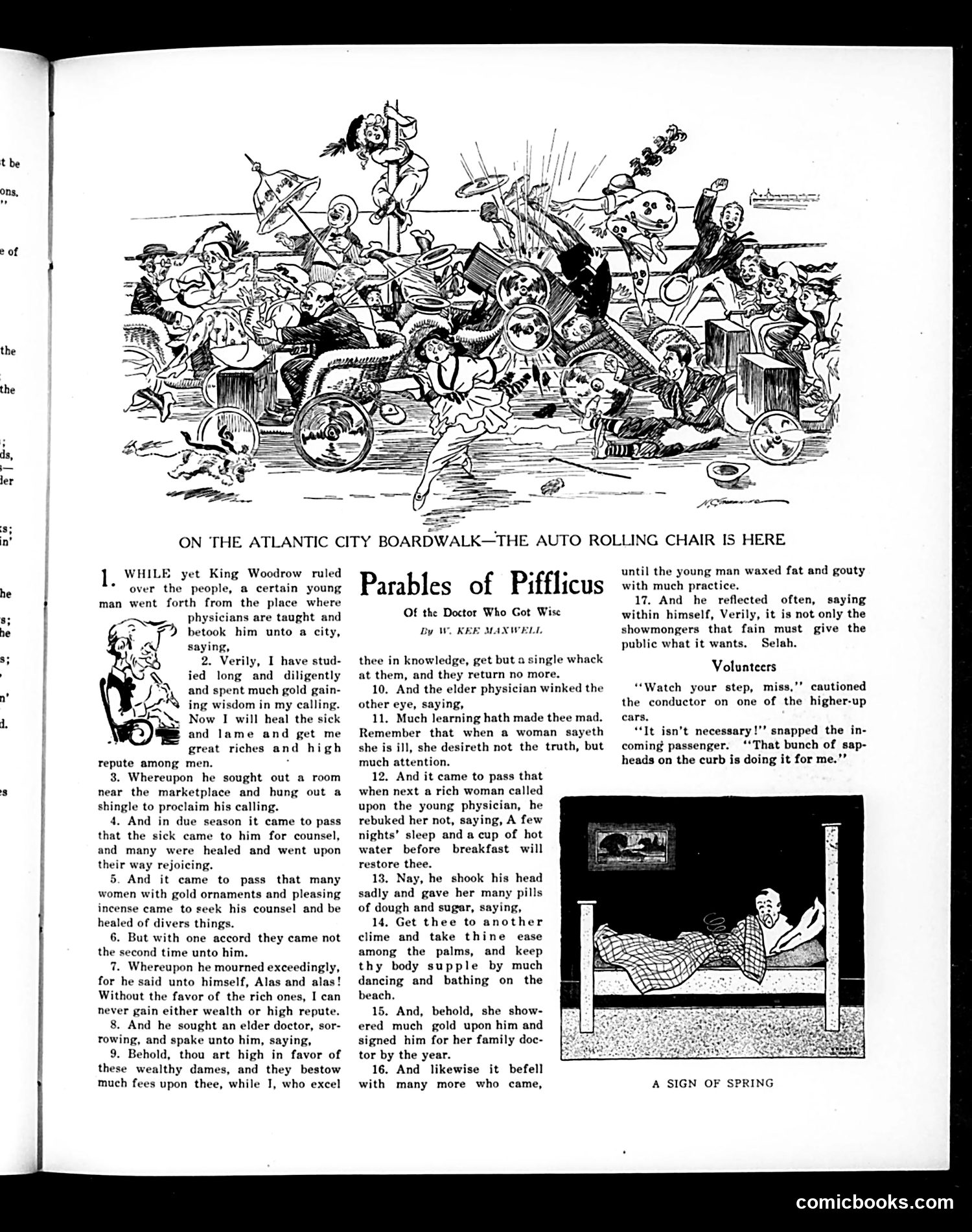
This page satirizes medical practice during the Wilson era ("King Woodrow"). The biblical-style parable mocks a young doctor who initially practices honest medicine but fails financially because wealthy female patients don't return for repeat visits. An older, successful physician reveals the secret: wealthy women seeking medical attention don't want truth—they want *attention*. The young doctor adopts this approach, prescribing expensive placebos (sugar pills) and recommending luxurious spa treatments instead of actual treatment. He becomes wealthy and corrupt. The satire targets two things: (1) doctors who exploit hypochondriac wealthy women by offering unnecessary expensive "treatments," and (2) patients' own complicity in preferring comforting lies to medical honesty. The moral ("the public gets what it wants") suggests both doctors and patients deserve each other. The top cartoon depicts Atlantic City's boardwalk scene unrelated to the main story.
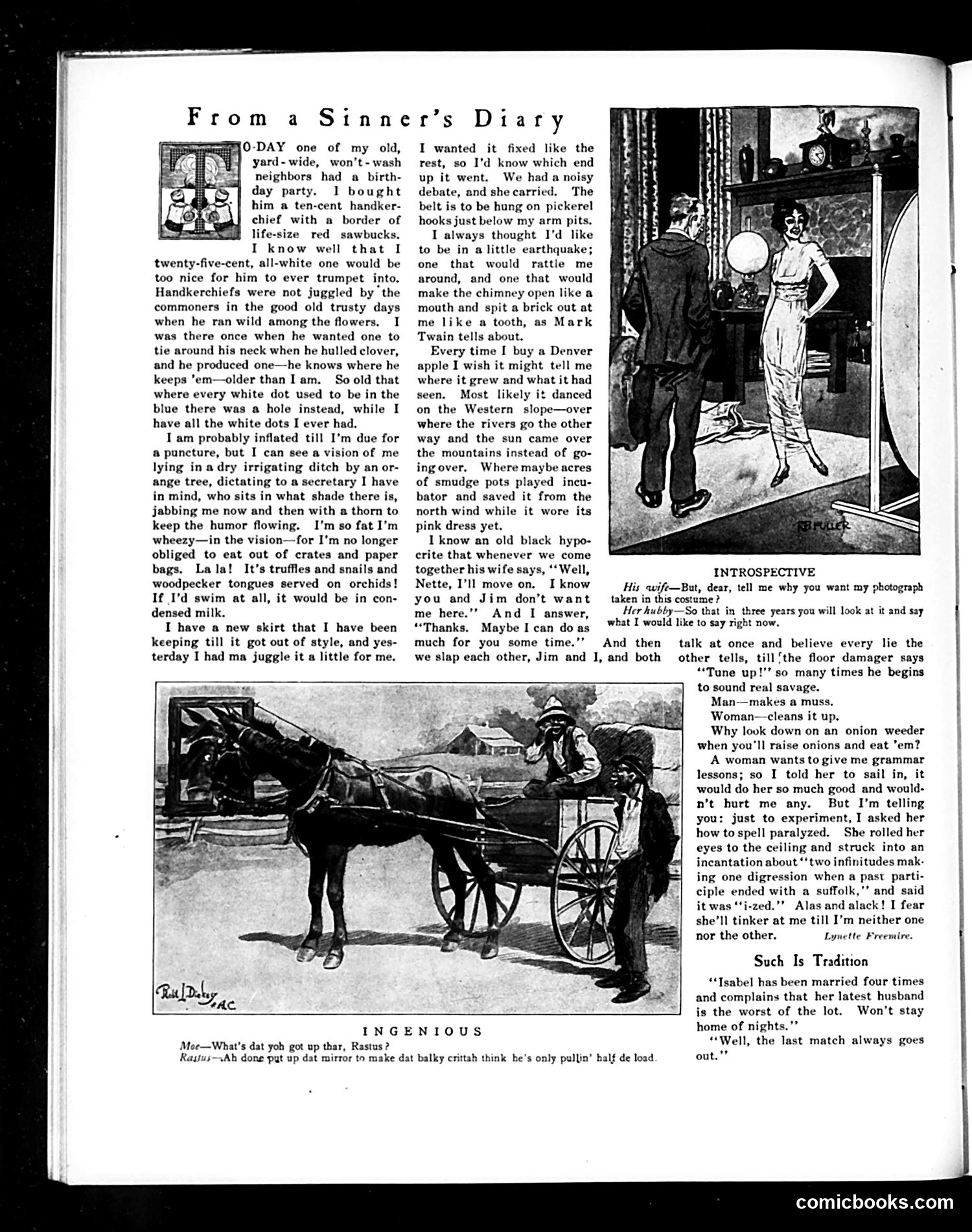
This page contains several satirical pieces typical of early 20th-century American humor: **"From a Sinner's Diary"** is a first-person monologue from a working-class woman reflecting on her poverty and humble neighbors, fantasizing about wealth (eating truffles, swimming in condensed milk). The satire mocks both her pretensions and class consciousness. **"Ingenious"** cartoon jokes about a Black man using a mirror to trick a stubborn mule into working harder, relying on a racist "dialect" stereotype. **"Introspective"** features a husband wanting his wife photographed so he can claim later she looked better years ago—a joke about marital criticism and aging. **"Such Is Tradition"** satirizes serial marriage, implying women accept bad husbands as inevitable. The remaining brief quips mock gender stereotypes: men create messes, women clean them; women give unsolicited grammar lessons, etc. The humor reflects early 20th-century attitudes about class, gender, and race typical of *Judge's* satirical approach.
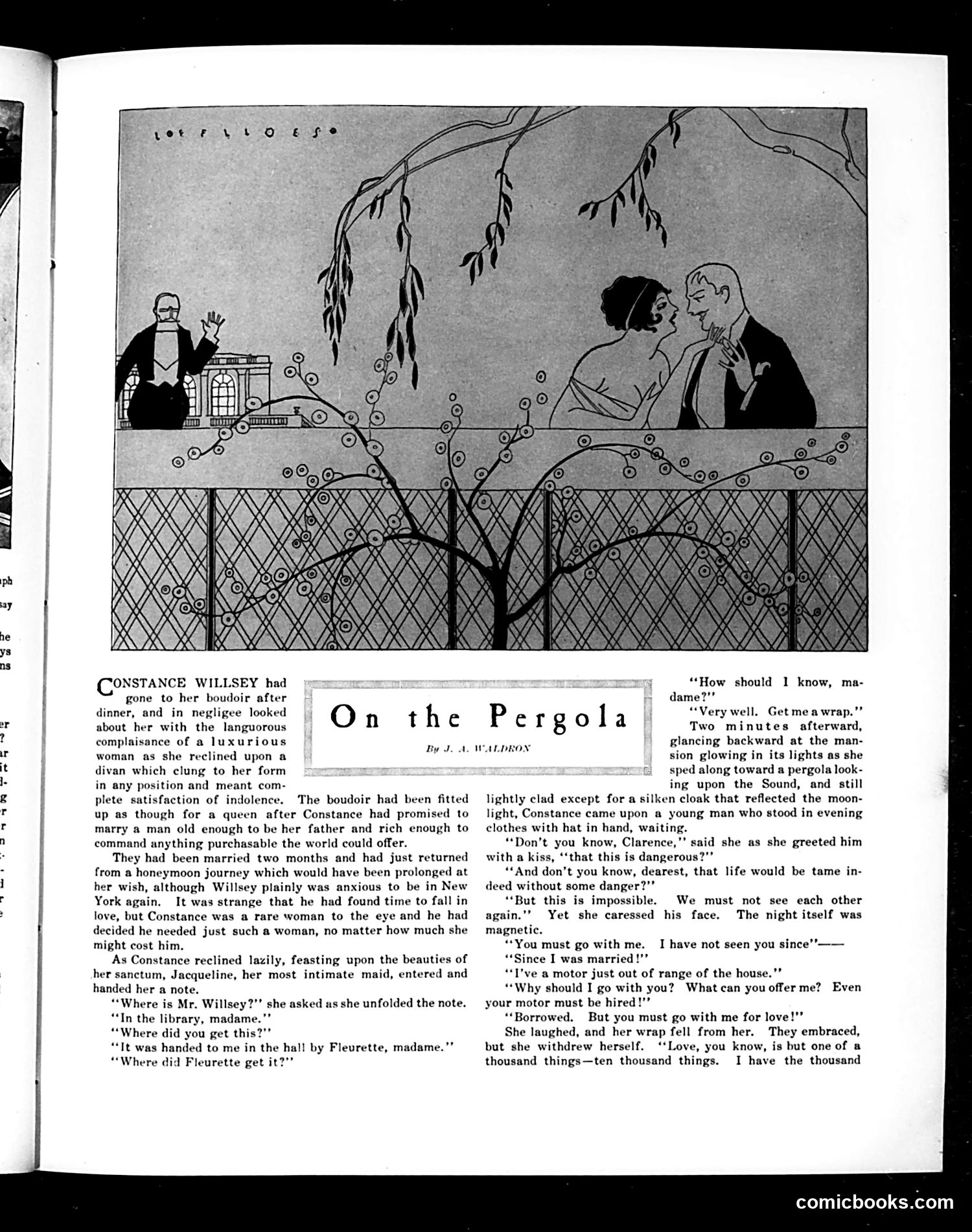
This is an illustrated short story depicting a wealthy woman's infidelity. Constance Willsey, a luxurious socialite married to an older, rich husband (Mr. Willsey), meets her former lover Clarence secretly in a pergola near her mansion. The story satirizes the moral hypocrisy of the wealthy elite: Constance enjoys the material comforts her marriage provides (the lavish boudoir, the mansion), yet simultaneously pursues romantic passion with a younger man. The cartoon above illustrates the scene—showing Constance with Clarence while a servant plays music indoors, unaware of the tryst. The satire targets the shallow values of high society: Constance dismisses Clarence's love as merely "one of a thousand things," suggesting that even romance is subordinate to material luxury and social standing. The story mocks both the protagonist's infidelity and the upper-class world that enables it.
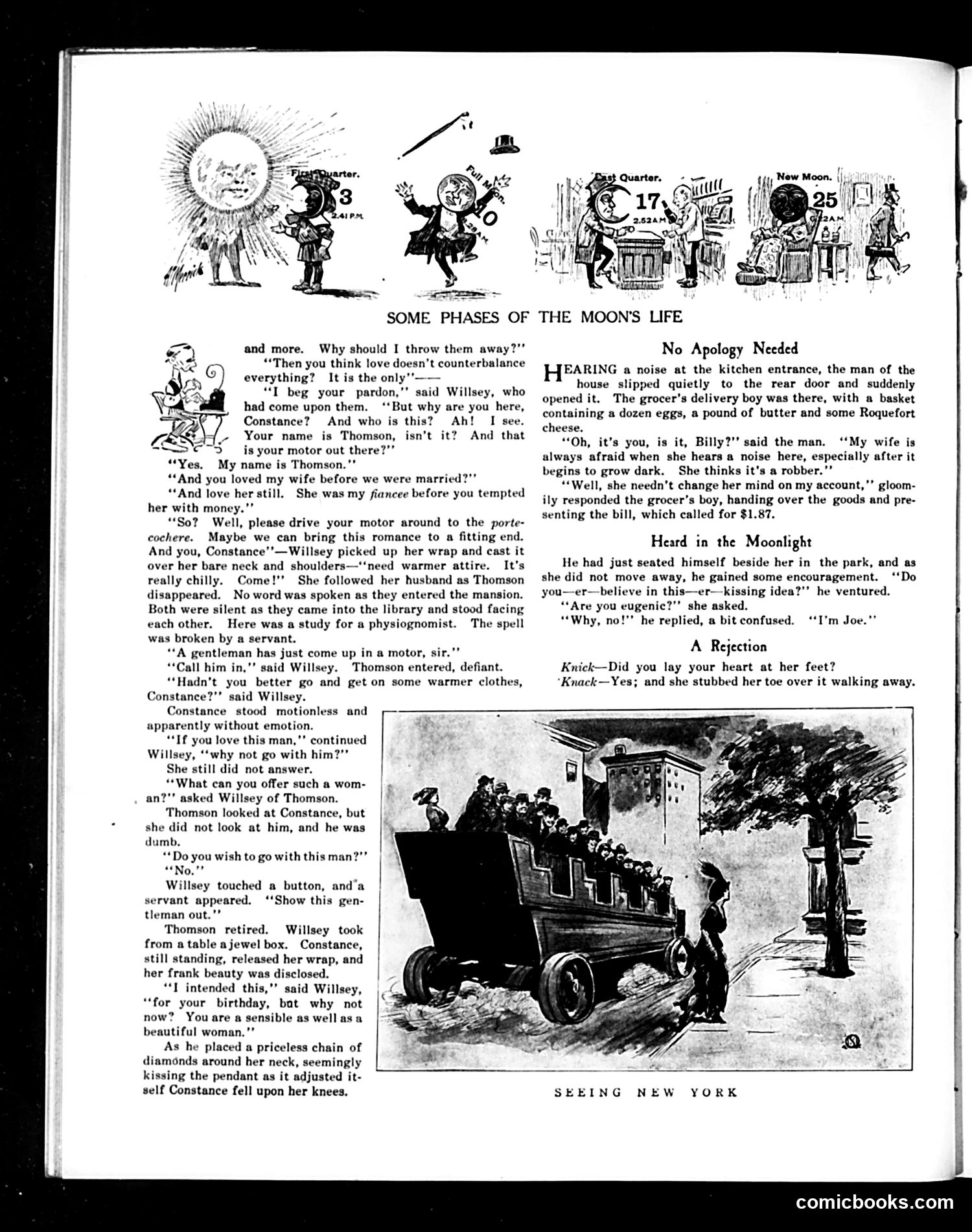
This Judge magazine page contains multiple humor pieces satirizing romantic and social situations of the era. **"Some Phases of the Moon's Life"** (main story): A love triangle where Constance's former fiancé Thomson reappears, claiming he still loves her and that Willsey (her wealthy husband) "tempted her with money." Willsey responds by inviting Thomson to the house, then suggesting Constance leave with him if she truly loves him. When she refuses, Willsey buys her forgiveness with an expensive diamond necklace. The satire mocks the transactional nature of marriage and suggests that women's loyalty can be purchased with luxury goods rather than love. The smaller comic pieces ("No Apology Needed," "Heard in the Moonlight," "A Rejection") are brief gags: one about a nervous wife mistaking a grocer's boy for a robber; another where a man named Joe awkwardly asks about "kissing" and the woman misunderstands "eugenic" for his name; and a punchline about a rejected suitor's heart being literally stubbed over. The humor relies on misunderstandings, gender stereotypes, and class commentary typical of early 20th-century satire.
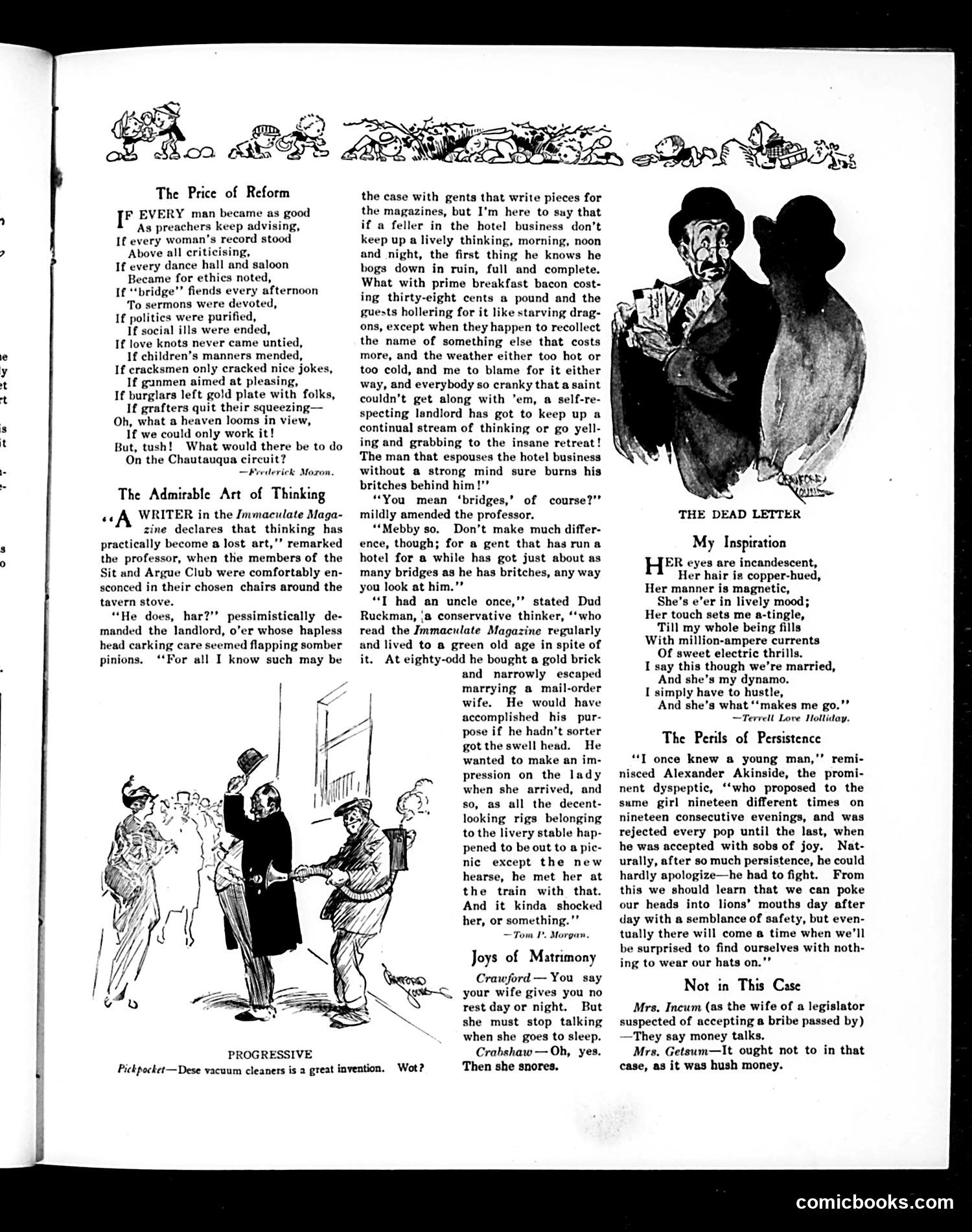
This page contains satirical humor typical of early 20th-century Judge magazine, targeting social hypocrisy and everyday frustrations. **"The Price of Reform"** mocks reform movements by listing idealistic improvements (moral behavior, virtuous living) while suggesting that if everything actually improved, reformers would lose their purpose—their livelihood depends on society's problems needing correction. **"The Admirable Art of Thinking"** presents a tavern discussion where a pragmatic hotel landlord argues that thinking hasn't disappeared; hotelkeepers must think constantly to survive rising costs and demanding guests. A professor's uncle bought a gold brick (a scam) despite reading an intellectual magazine, suggesting education doesn't prevent foolishness. **"Progressive" cartoon** depicts a pickpocket calling vacuum cleaners "a great invention"—dark humor about theft being "progress" for criminals. The remaining items—**"My Inspiration," "Joys of Matrimony,"** and **"The Perils of Persistence"**—are brief humorous poems and anecdotes about marriage, romantic attraction, and romantic persistence, using light sarcasm about domestic and romantic life.
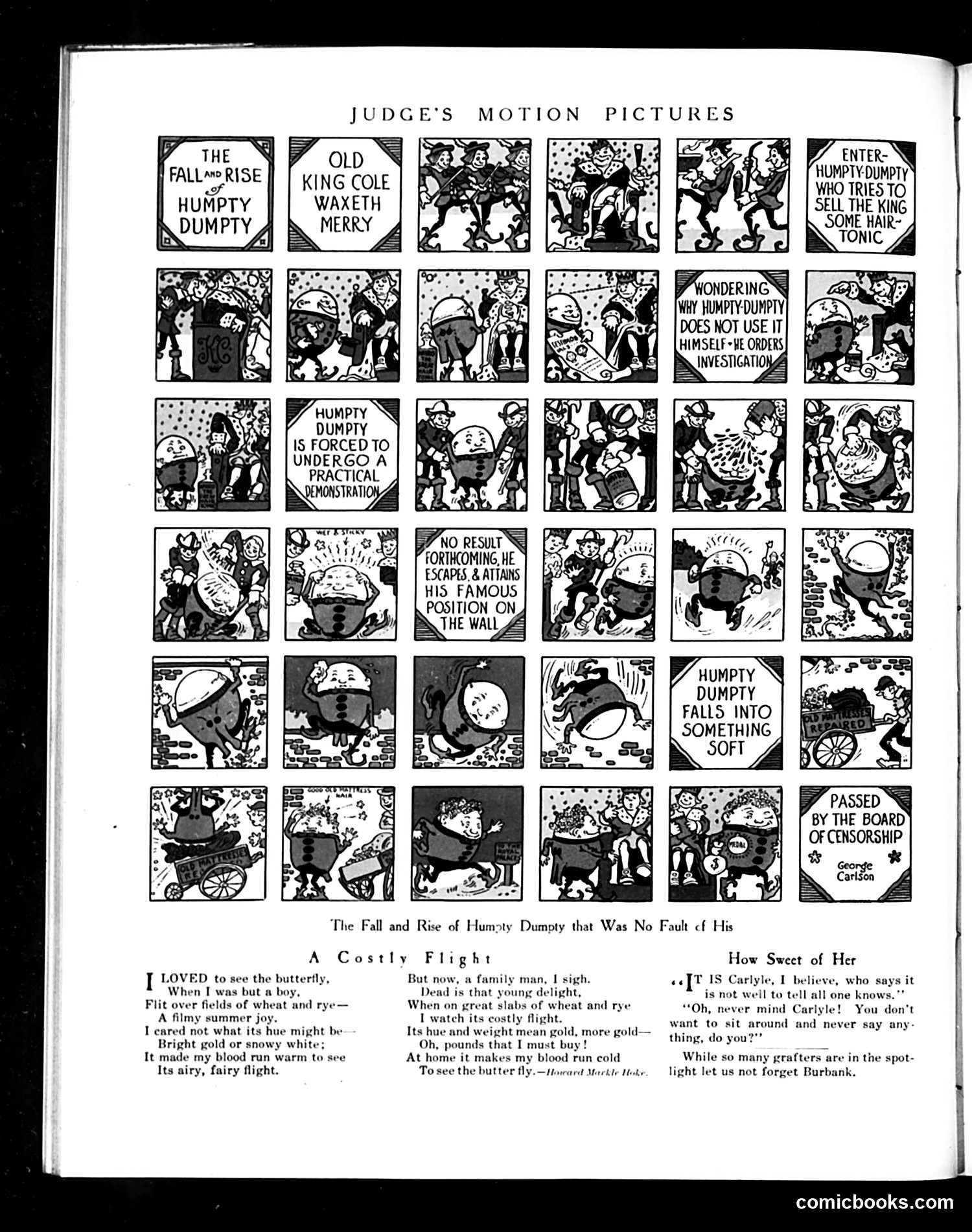
This is a sequential comic strip retelling of the nursery rhyme "Humpty Dumpty" with contemporary satirical twists. The narrative shows Humpty attempting to sell hair tonic to the King, undergoing a "practical demonstration" on the wall, and ultimately falling—but landing in something soft (likely manure or similar), thus surviving his famous fall. The satire mocks commercial fraud and dubious patent medicines popular in early 20th-century America. The "Humpty Dumpty" character represents a con artist or charlatan promoting a worthless product. The ironic title—"that Was No Fault of His"—suggests Humpty escapes consequences through luck rather than merit, satirizing how charlatans often evade accountability. The accompanying poems mock butterfly collecting and inflation/wealth obsession, unrelated to the main strip. The final note about "Board of Censorship" indicates this content faced regulatory scrutiny.
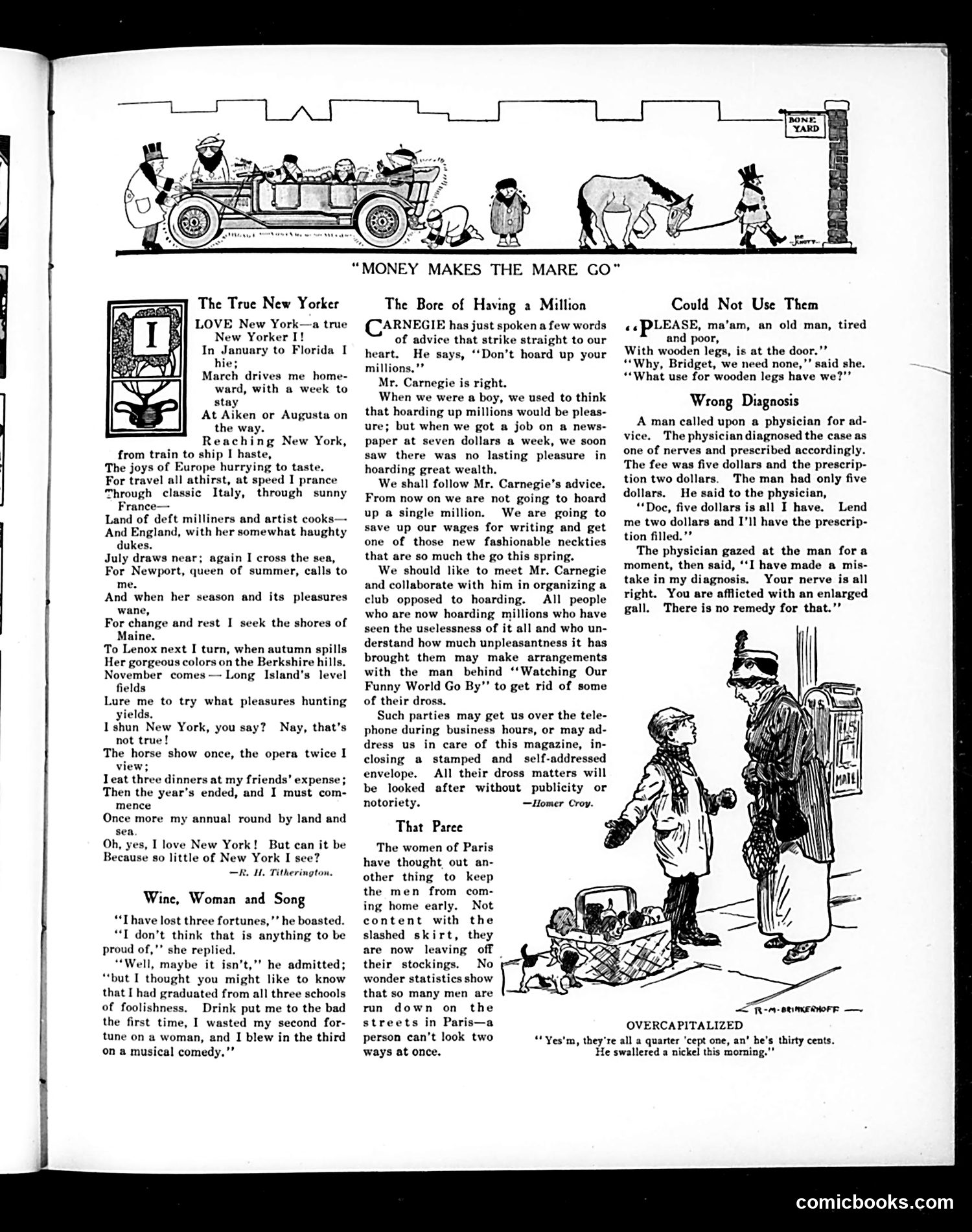
This page contains satirical commentary on wealthy American life and contemporary social issues. **"The True New Yorker"** mocks the paradox of wealthy New Yorkers who claim to love their city but spend most of the year traveling—to Florida, Europe, Newport, Maine, and the Berkshires. The poem's ironic conclusion asks: if they're barely in New York, can they truly love it? **"The Bore of Having a Million"** satirizes Andrew Carnegie's famous advice to wealthy industrialists not to hoard money. The author jokes they'll follow Carnegie's advice by saving for fashionable neckties instead of millions—a deadpan critique of how impractical such philosophy is for ordinary people. **"That Paree"** makes a risqué joke about Parisian women's fashion (removing stockings to expose legs), suggesting this deliberately distracts men and causes accidents. The other brief anecdotes—about a man losing three fortunes through drink, women, and theater; a beggar with wooden legs; and a patient's medical bill—offer typical period humor about human folly and irony. The illustration "Money Makes the Mare Go" uses the proverb about incentive and motivation.
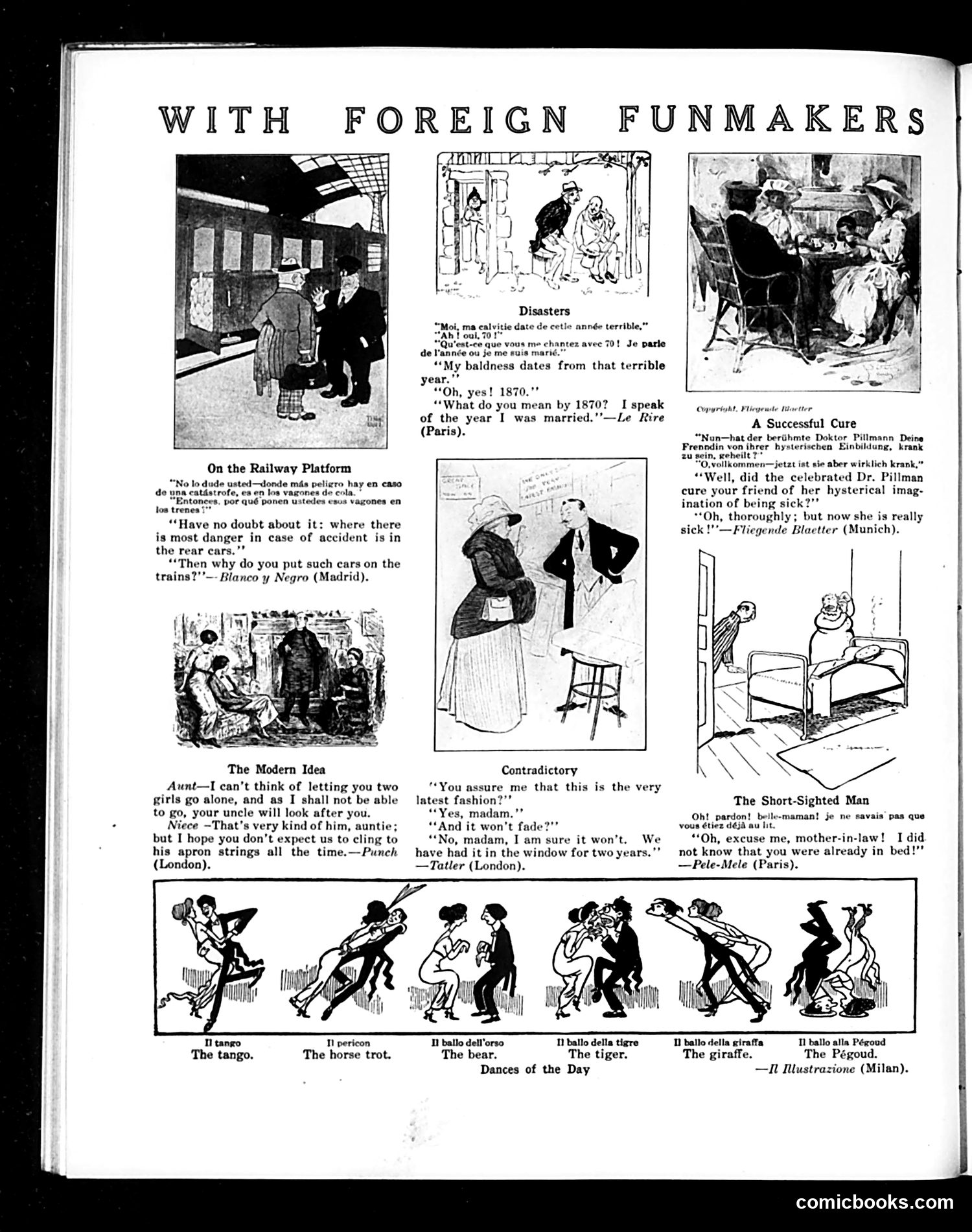
This page compiles short jokes and cartoons translated from European satirical publications (Spanish, French, German, Italian sources cited). The humor reflects early 20th-century sensibilities: **Key jokes include:** - A Spanish railroad safety paradox: dangerous rear cars are positioned at the train's back - A French marriage joke: a man's baldness stems from his wedding year (1870), implying marital stress caused hair loss - A London fashion contradiction: a dress is "latest fashion" yet has sat in a shop window two years - A German medical joke: a doctor "cured" a woman's imaginary illness, but she's now genuinely sick - A Paris mishap: a nearsighted man accidentally enters his mother-in-law's bedroom **The page's purpose:** *Judge* regularly featured foreign humor to amuse American readers with "continental" wit—emphasizing marriage troubles, fashion follies, and medical incompetence as universal comedic targets. The "Dances of the Day" section parodies contemporary crazes (tango, etc.) through animal metaphors.
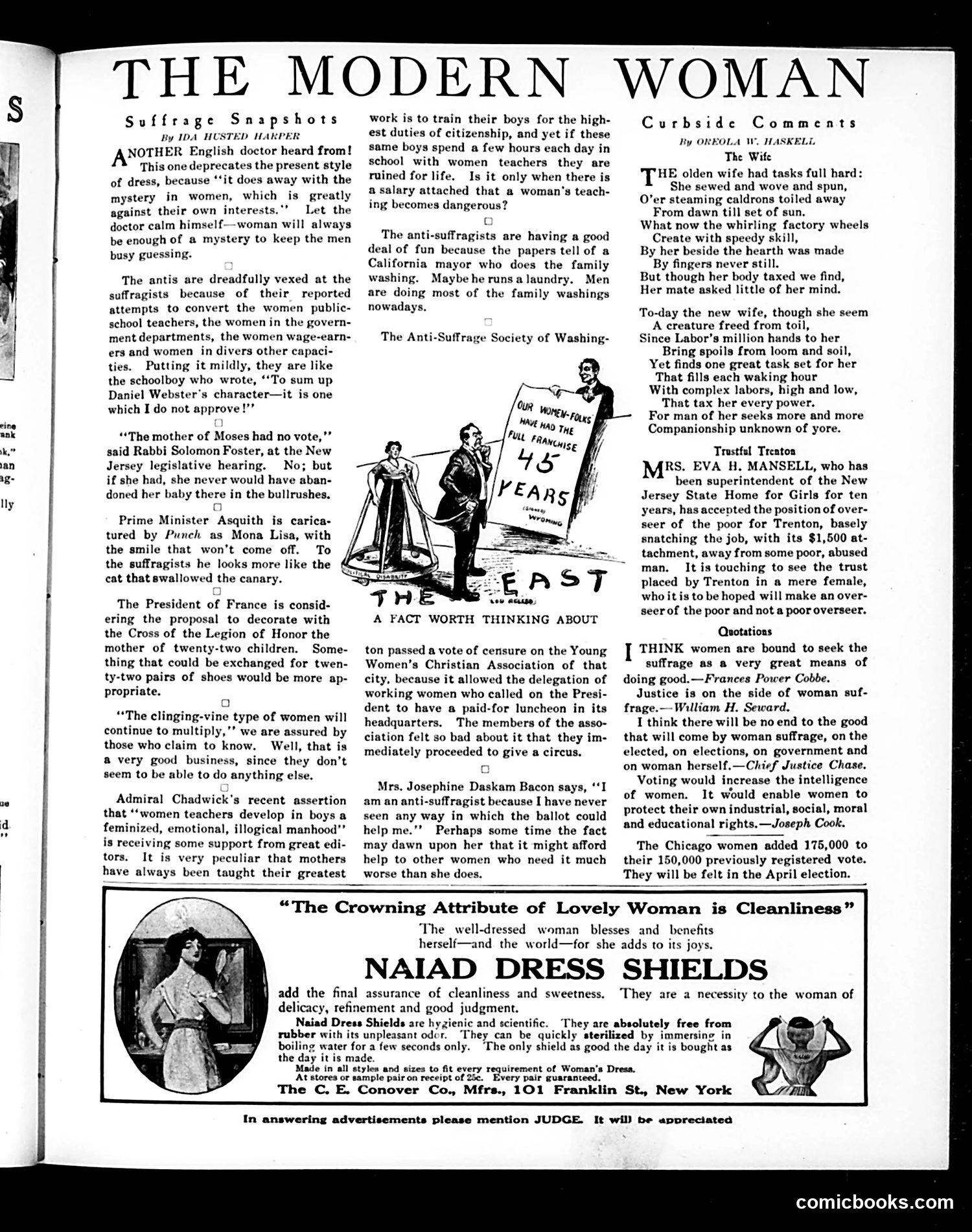
This page satirizes opposition to women's suffrage through columnist Ida Husted Harper's "Suffrage Snapshots." Harper mocks anti-suffragist arguments by exposing their logical inconsistencies: - She ridicules an English doctor claiming women's modern dress removes "mystery," noting women will remain mysterious regardless - She highlights the hypocrisy of anti-suffragists opposing efforts to educate women voters, using a schoolboy analogy - She skewers the argument that mothers "didn't need" votes (Moses's mother reference), noting mothers are trusted to raise citizens but not vote - She points out that women teachers are praised for citizenship training but condemned as "feminizing" when paid to teach the same boys The cartoon "A Fact Worth Thinking About" depicts suffragists (with a 45-years banner) confronting anti-suffrage opposition. The accompanying poem contrasts the old wife's physical labor with the modern wife's mental/emotional demands, suggesting progress creates new challenges rather than leisure. The overall message: anti-suffragist reasoning is illogical and self-defeating.
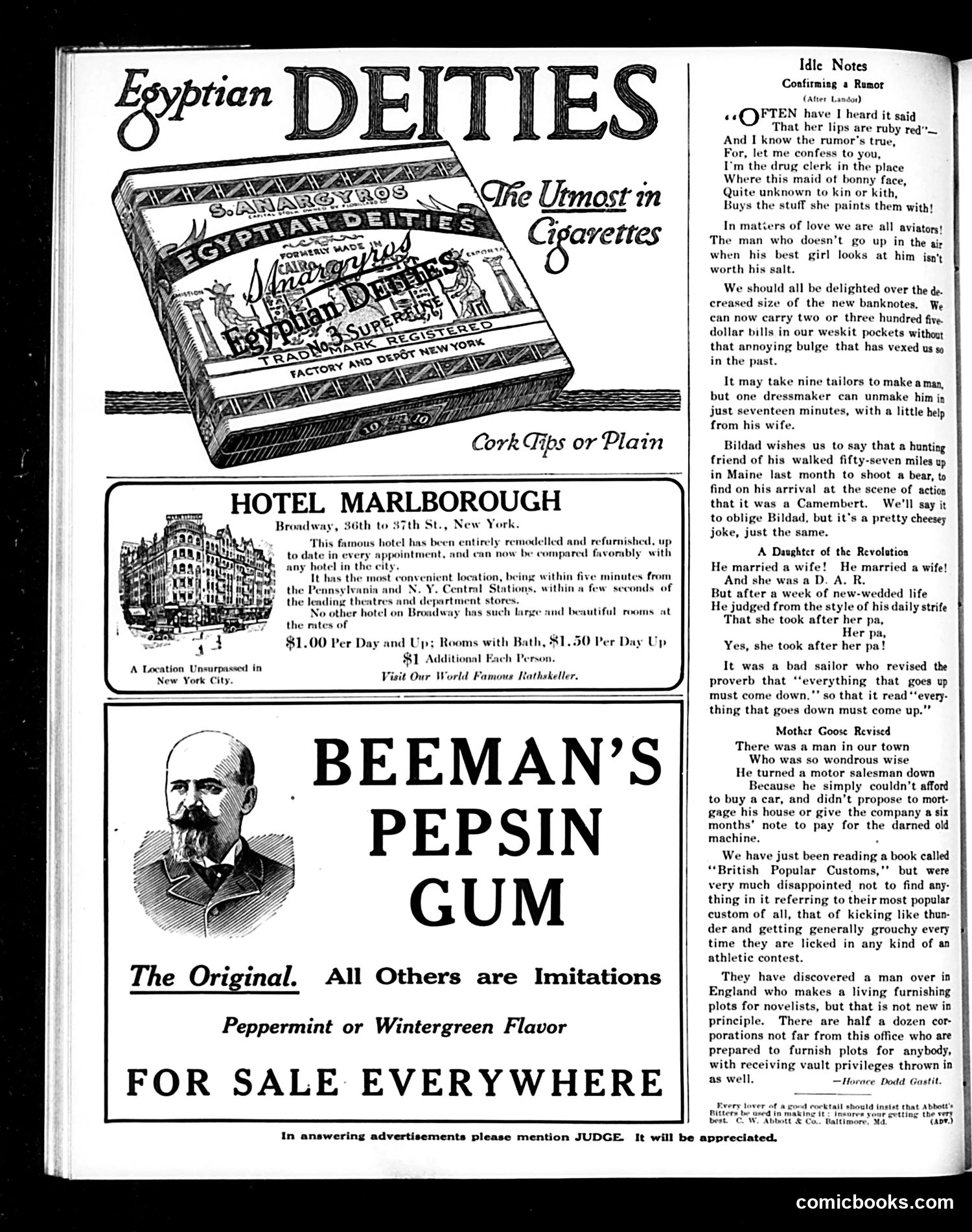
This page is primarily **advertising**, not political satire. It contains three main advertisements: 1. **Egyptian Deities Cigarettes** - promoting a cigarette brand with Egyptian theming, claiming to be "The Utmost in Cigarettes" 2. **Hotel Marlborough** - a New York hotel advertisement highlighting its renovation, convenient location near train stations, and famous Rathskeller restaurant 3. **Beeman's Pepsin Gum** - advertising "The Original" pepsin gum, emphasizing it's the authentic product and "All Others are Imitations" The right column contains **"Idle Notes"** — a humor section with light satirical verses and observations on contemporary life (women's cosmetics use, courtship, new banknote sizes, a motor salesman joke, and British sports behavior). These are general social commentary rather than focused political satire. The page reflects early 20th-century consumer culture and Judge's role as an advertising vehicle alongside humor content.
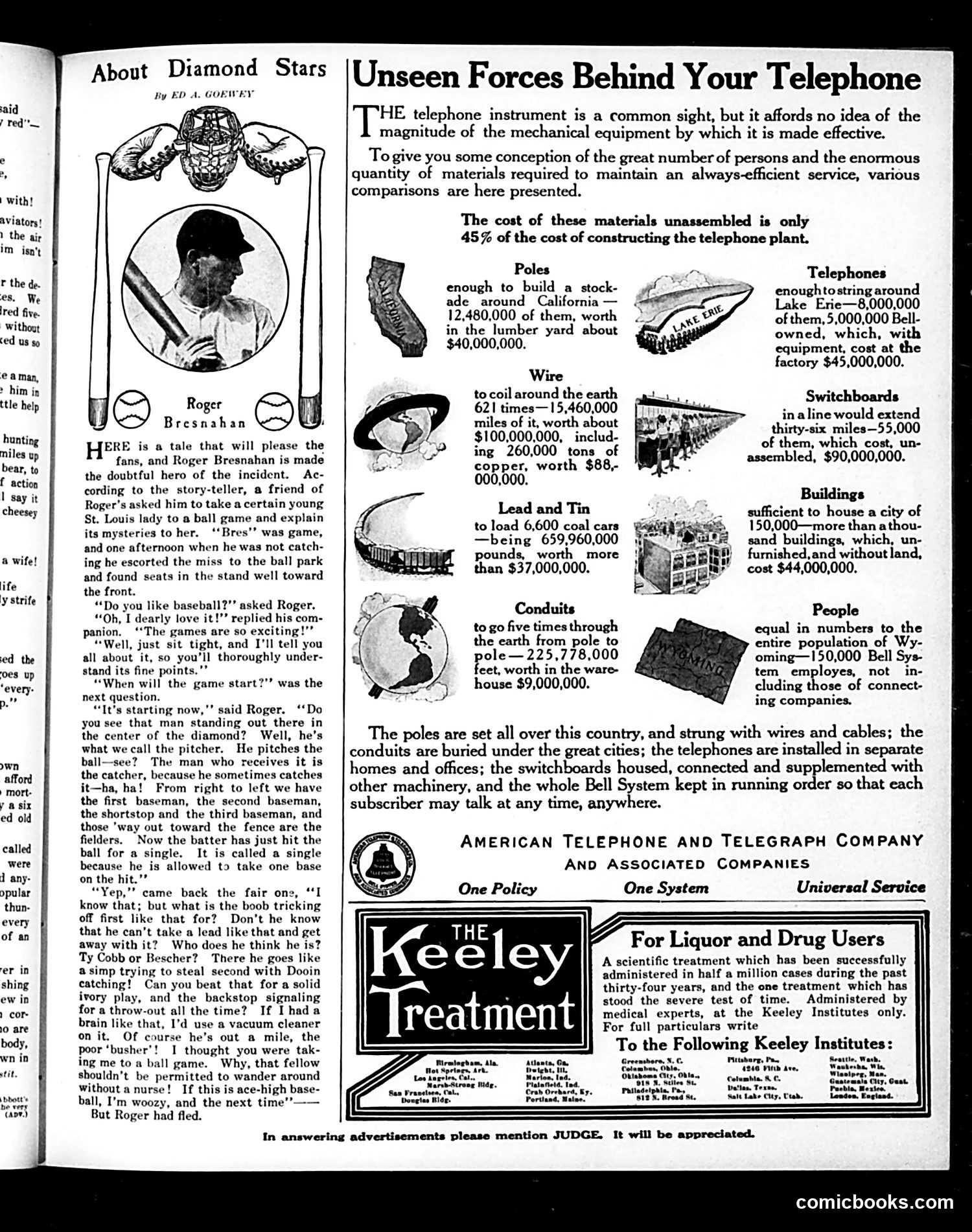
This page contains two distinct pieces: **Left side: "About Diamond Stars"** — A humorous anecdote about baseball player Roger Bresnahan taking a young woman to a St. Louis baseball game. The joke hinges on her unexpectedly sophisticated baseball knowledge; she immediately grasps strategy and criticizes players' mistakes despite claiming ignorance. Bresnahan, unable to explain basics to someone who already understands the game, flees in embarrassment. The satire mocks mansplaining and deflates masculine authority. **Right side: Advertisement** — The American Telephone and Telegraph Company presents statistics about telephone infrastructure using comparative metrics (poles could encircle California, wire could wrap Earth 621 times, etc.). This is corporate public relations, not satire—designed to impress readers with the Bell System's massive scale and sophistication during the early telephone era. It's essentially infrastructure marketing. The page juxtaposes lighthearted entertainment with corporate propaganda, typical of *Judge* magazine's mix of humor and advertising.
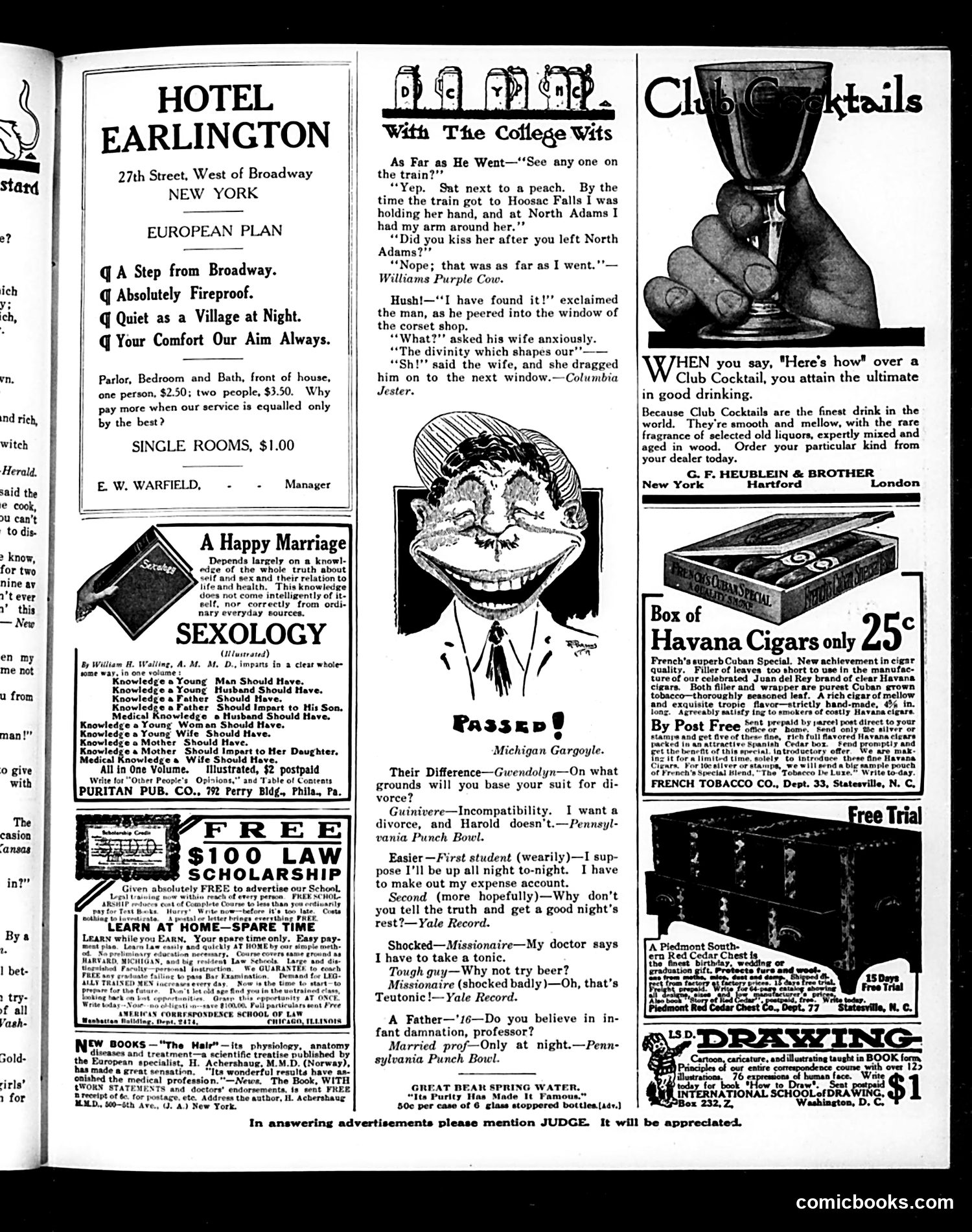
This appears to be primarily a **commercial advertising page** from Judge magazine, with minimal political satire. The small "College Wits" section contains mild **campus humor** jokes from various university publications (Williams Purple Cow, Columbia Jester, Yale Record, etc.). These brief anecdotes satirize college student behavior—a young man's romantic progress on a train, absent-minded professors, and students' creative excuses. The humor is gentle and domestic rather than political. The page is dominated by **advertisements** for hotels, books on sexuality and law, cocktails, cigars, and spring water—typical early 20th-century commercial content. A notable ad promotes "Sexology," an illustrated guide about marriage and reproduction, presented as scientific education. There are **no identifiable political figures or events** referenced. The satire, such as it exists, targets general social types (overeager students, hypochondriac millionaires, distracted husbands) rather than specific political issues or individuals. This is essentially a **commercial page with light collegiate humor**—not substantive political cartooning.
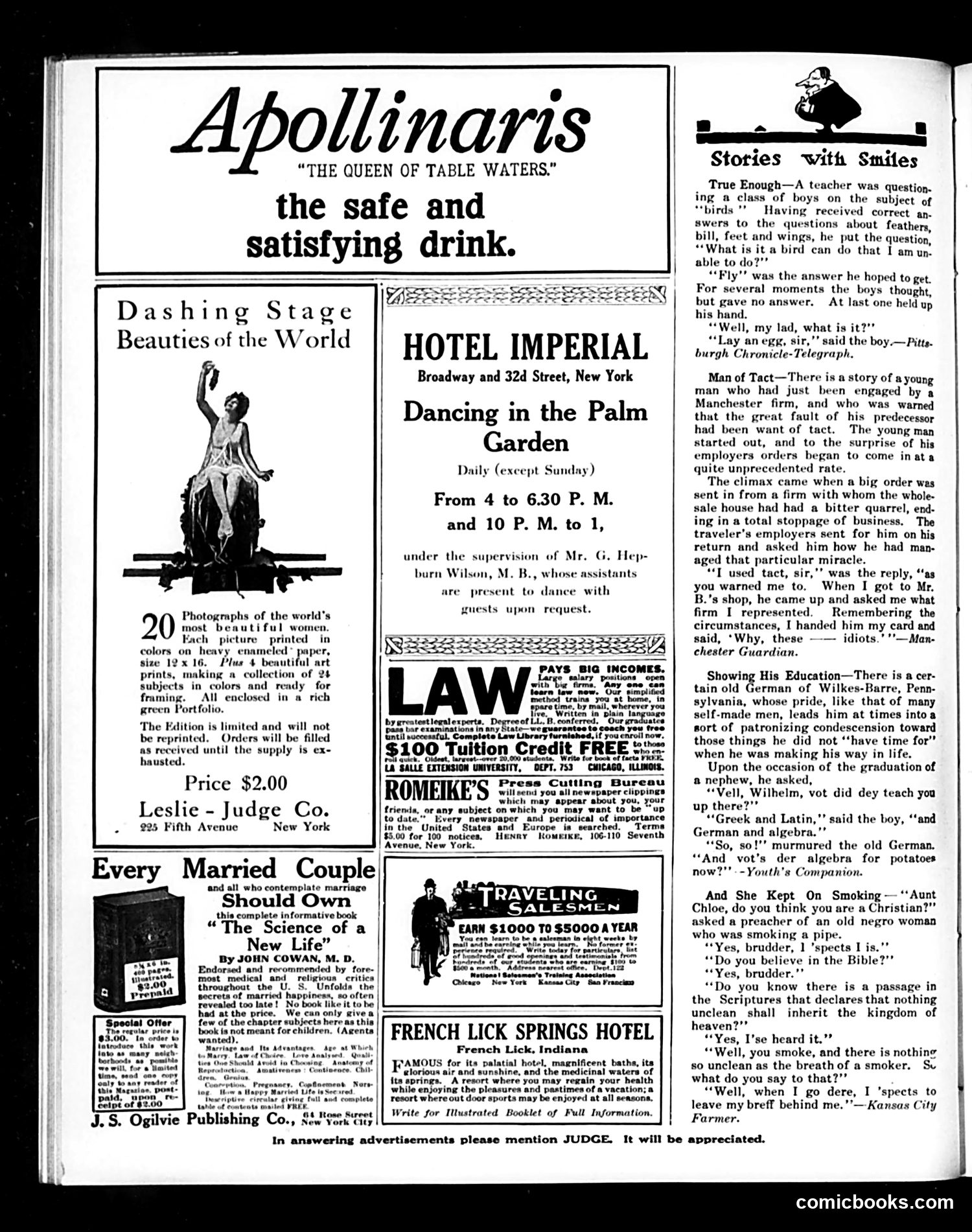
This page is primarily **advertisements and filler content** rather than satirical cartoons. The main elements are: **Advertisement focus:** Luxury goods and services targeting upper-class readers—spring water (Apollinaris), a hotel with dancing (Hotel Imperial), a photography collection of "beautiful women," marriage advice books, and a resort spa. **"Stories with Smiles" section:** Three brief humorous anecdotes with gentle, non-political humor: - A boy's cheeky answer about birds laying eggs - A traveling salesman's crude tact in securing a business order - (Incomplete) story about a German immigrant and his education **Notable context:** The ads reflect early-1900s leisure culture and consumer aspirations. The "Beautiful Women" photography collection and marriage/sexuality advice books indicate Judge's male readership. The humor is wholesome domestic comedy, not sharp political satire. **Missing satirical content:** No clear political cartoons or social commentary visible on this page.
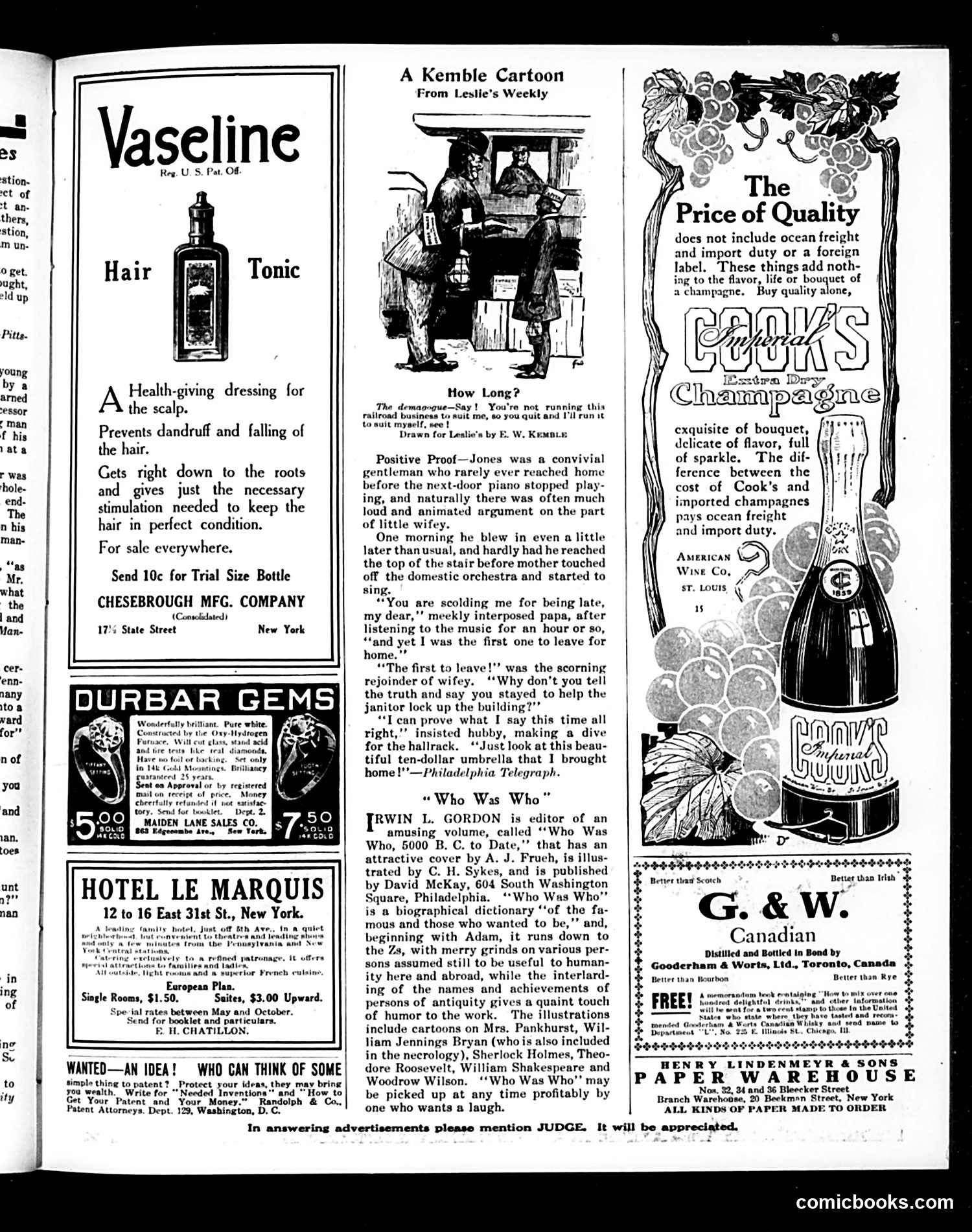
This page mixes advertisements with editorial content typical of Judge magazine. The main cartoon, by E. W. Kemble, depicts a demagogue demanding control of a railroad operation—a topical reference to early 20th-century labor unrest and populist political agitation against big business. The "demagogue" character represents inflammatory political rhetoric threatening established industry. The secondary humor piece concerns a husband caught coming home late, using a purchased umbrella as implausible "proof" he just arrived—satirizing domestic disputes and male evasiveness. The text discusses a new biographical dictionary "Who Was Who," which humorously catalogs famous historical figures alongside contemporary celebrities and politicians (Bryan, Roosevelt, Holmes, Pankhurst), poking fun at vanity publishing and celebrity culture. The remaining content is primarily product advertising for Vaseline hair tonic, gems, hotels, and champagne—standard Judge magazine fare mixing satire with commercial sponsorship.
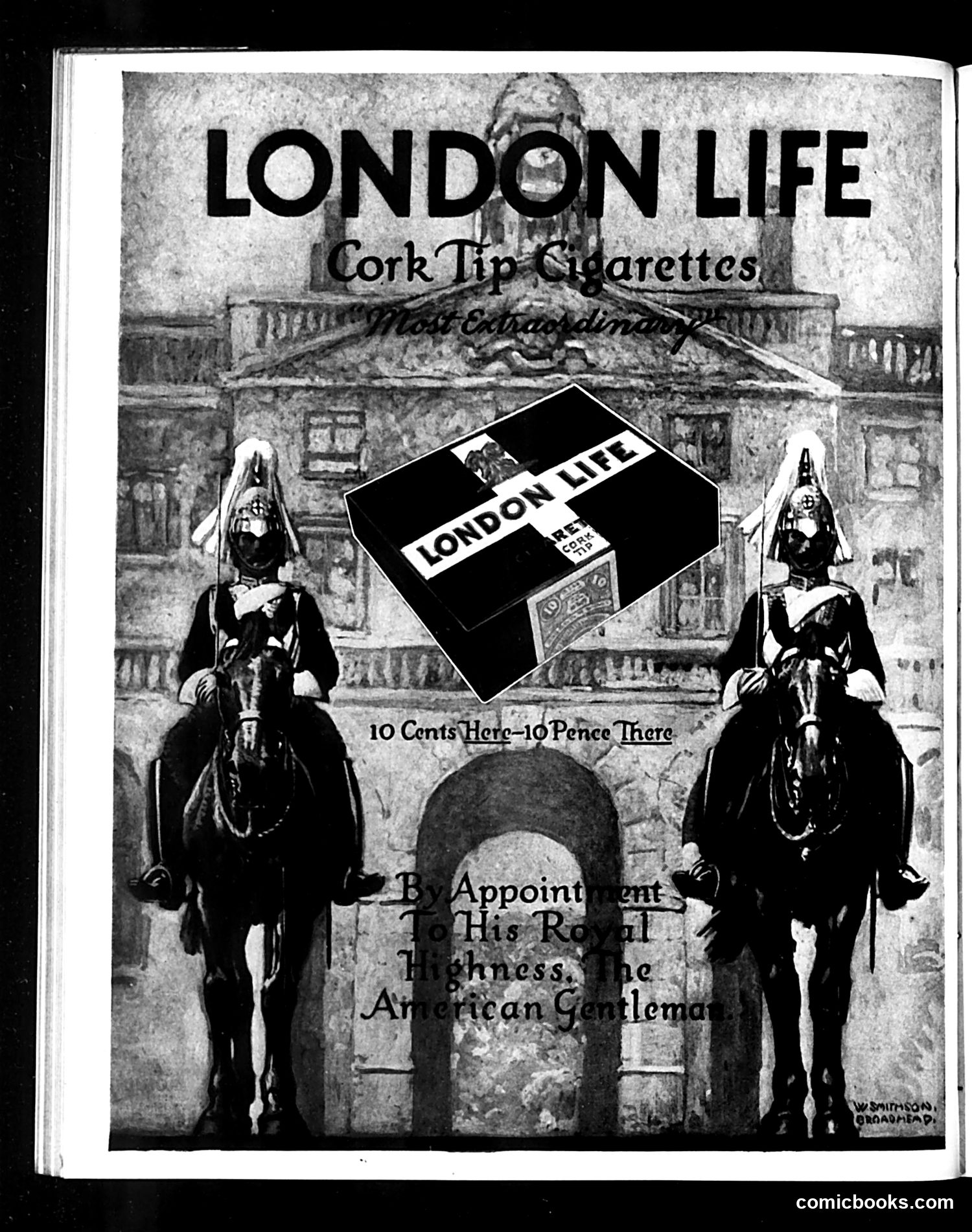
This is a **cigarette advertisement**, not political satire. It promotes "London Life" brand cork-tip cigarettes, emphasizing their price advantage: "10 Cents Here–10 Pence There" (appealing to Americans by comparing U.S. and British pricing). The imagery features two mounted **Royal Horse Guards** flanking the Whitehall building in London, establishing British prestige and sophistication. The phrase "By Appointment to His Royal Highness, the American Gentleman" cleverly conflates British royal endorsement with American consumers, suggesting these cigarettes carry aristocratic status. The central product image and architectural backdrop create an association between the cigarettes and English elegance, a common marketing strategy of the era. This is straightforward commercial promotion rather than editorial commentary.