
Judge, 1914-04-04 · page 8 of 24
Judge — April 4, 1914 — page 8: what you’re looking at
What you’re looking at
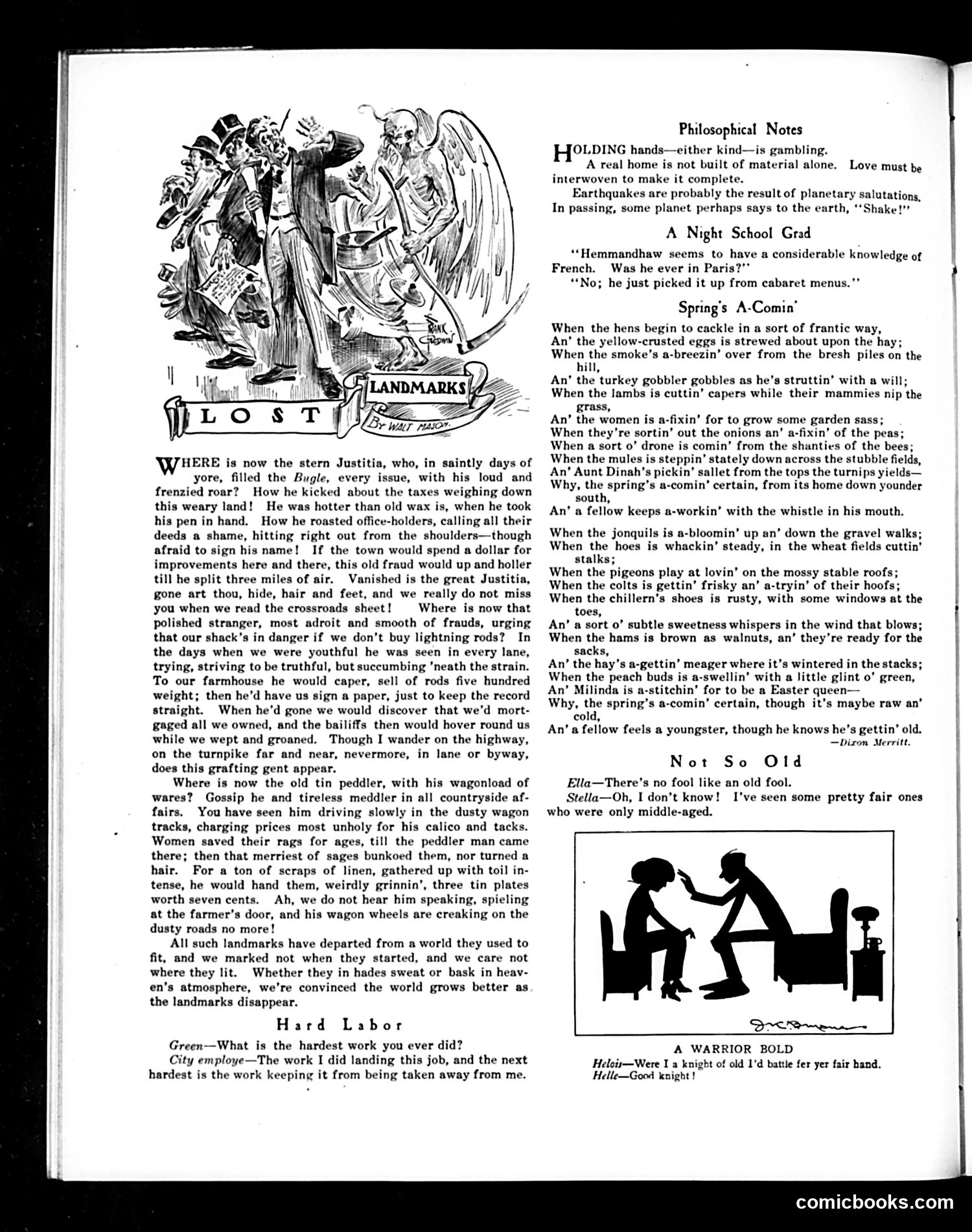
This page satirizes **vanished American archetypes**—con men and fraudsters who once plagued rural communities but have apparently disappeared. **"Lost Landmarks"** mocks "Justitia," a crusading newspaper editor who once railed against corruption and taxes but is now gone. The text reveals he was a hypocrite: he sold lightning rods door-to-door while feigning moral outrage, financially ruining farmers. The piece also laments the absent "tin peddler"—another traveling swindler who exploited farm women, trading worthless tin plates for valuable rags collected over years. The satirical point: these con men and fraudulent "reformers" have disappeared from the countryside, and society is *better for it*. The poem "Spring's A-Comin'" celebrates rural life freed from their schemes. Minor jokes include "Hard Labor" (a pun on government job-keeping) and "A Night School Grad" (mocking pretense via fake French). The overall message critiques rural exploitation and celebrates honest living.
📄 Transcribed text from this page (OCR, searchable)
Machine-transcribed from the original scan — historical spelling and the odd misread are preserved.
HERE is now the stern Justitia, who, in saintly days of yore, filled the Bugle, every issue, with his loud and frenzied roar? How he kicked about the taxes weighing down this weary land! He was hotter than old wax is, when he took his pen in hand. How he roasted office-holders, calling all their deeds a shame, hitting right out from the shoulders—though afraid to sign his name! If the town would spend a dollar for improvements here and there, this old fraud would up and holler till he split three miles of air. Vanished is the great Justitia, gone art thou, hide, hair and feet, and we really do not miss you when we read the crossroads sheet! Where is now that polished stranger, most adroit and smooth of frauds, urging that our shack’s in danger if we don’t buy lightning rods? In the days when we were youthful he was seen in every lane, trying, striving to be truthful, but succumbing 'neath the strain. To our farmhouse he would caper, sell of rods five hundred weight; then he'd have us sign a paper, just to keep the record straight. When he'd gone we would discover that we'd mort- gaged all we owned, and the bailiffs then would hover round us while we wept and groaned. Though I wander on the highway, on the turnpike far and near, nevermore, in lane or byway, does this grafting gent appear. Where is now the old tin peddler, with his wagonload of wares? Gossip he and tireless meddler in all countryside af- fairs. You have seen him driving slowly in the dusty wagon tracks, charging prices most unholy for his calico and tacks. Women saved their rags for ages, till the peddler man came there; then that merriest of sages bunkoed them, nor turned a hair. For a ton of scraps of linen, gathered up with toil in- tense, he would hand them, weirdly grinnin’, three tin plates worth seven cents. Ah, we do not hear him speaking, spieling at the farmer’s door, and his wagon wheels are creaking on the dusty roads no more! All such landmarks have departed from a world they used to fit, and we marked not when they started, and we care not where they lit. Whether they in hades sweat or bask in heav- en’s atmosphere, we’re convinced the world grows better as the landmarks disappear. Hard Labor Green—What is the hardest work you ever did? City employe—The work I did landing this job, and the next hardest is the work keeping it from being taken away from me. Philosophical Notes HeLDING hands—either kind—is gambling. A real home is not built of material alone. interwoven to make it complete. Earthquakes are probably the result of planetary salutations, In passing, some planet perhaps says to the earth, “Shake!"" A Night School Grad ‘*Hemmandhaw seems to have a considerable knowledge of French. Was he ever in Paris?" “No; he just picked it up from cabaret menus.’’ Love must be Spring's A-Comin’ When the hens begin to cackle in a sort of frantic way, An’ the yellow-crusted eggs is strewed about upon the hay; When the smoke's a-breezin’ over from the bresh piles on the hill, An’ the turkey gobbler gobbles as he’s struttin’ with a will; When the lambs is cuttin’ capers while their mammies nip the grass, An’ the women is a-fixin’ for to grow some garden sass; When they're sortin’ out the onions an’ a-fixin’ of the peas; When a sort 0’ drone is comin’ from the shanties of the bees; When the mules is steppin’ stately down across the stubble fields, An’ Aunt Dinah’s pickin’ sallet from the tops the turnips yields— Why, the spring's a-comin’ certain, from its home down younder south, An’ a fellow keeps a-workin’ with the whistle in his mouth. When the jonquils is a-bloomin’ up an’ down the gravel walks; When the hoes is whackin’ steady, in the wheat fields cuttin’ stalks; When the pigeons play at lovin’ on the mossy stable roofs; When the colts is gettin’ frisky an’ a-tryin’ of their hoofs; When the chillern’s shoes is rusty, with some windows at the toes, An’ a sort o’ subtle sweetness whispers in the wind that blows; When the hams is brown as walnuts, an’ they're ready for the sacks, An’ the hay’s a-gettin’ meager where it’s wintered in the stacks; When the peach buds is a-swellin’ with a little glint o’ green, An’ Milinda is a-stitchin’ for to be a Easter queen— Why, the spring’s a-comin’ certain, though it’s maybe raw an’ cold, An’ a fellow feels a youngster, though he knows he’s gettin’ old. —Dizon Merritt. Not So Old Ella—There’s no fool like an old fool. Stella—Oh, I don’t know! I've seen some pretty fair ones who were only middle-aged. Doo Re A WARRIOR BOLD Helois—Were 1 a knight of old I'd battle fer yer fair hand. Helle—Good knight! comicbooks.com