
Judge, 1914-04-04 · page 16 of 24
Judge — April 4, 1914 — page 16: what you’re looking at
What you’re looking at
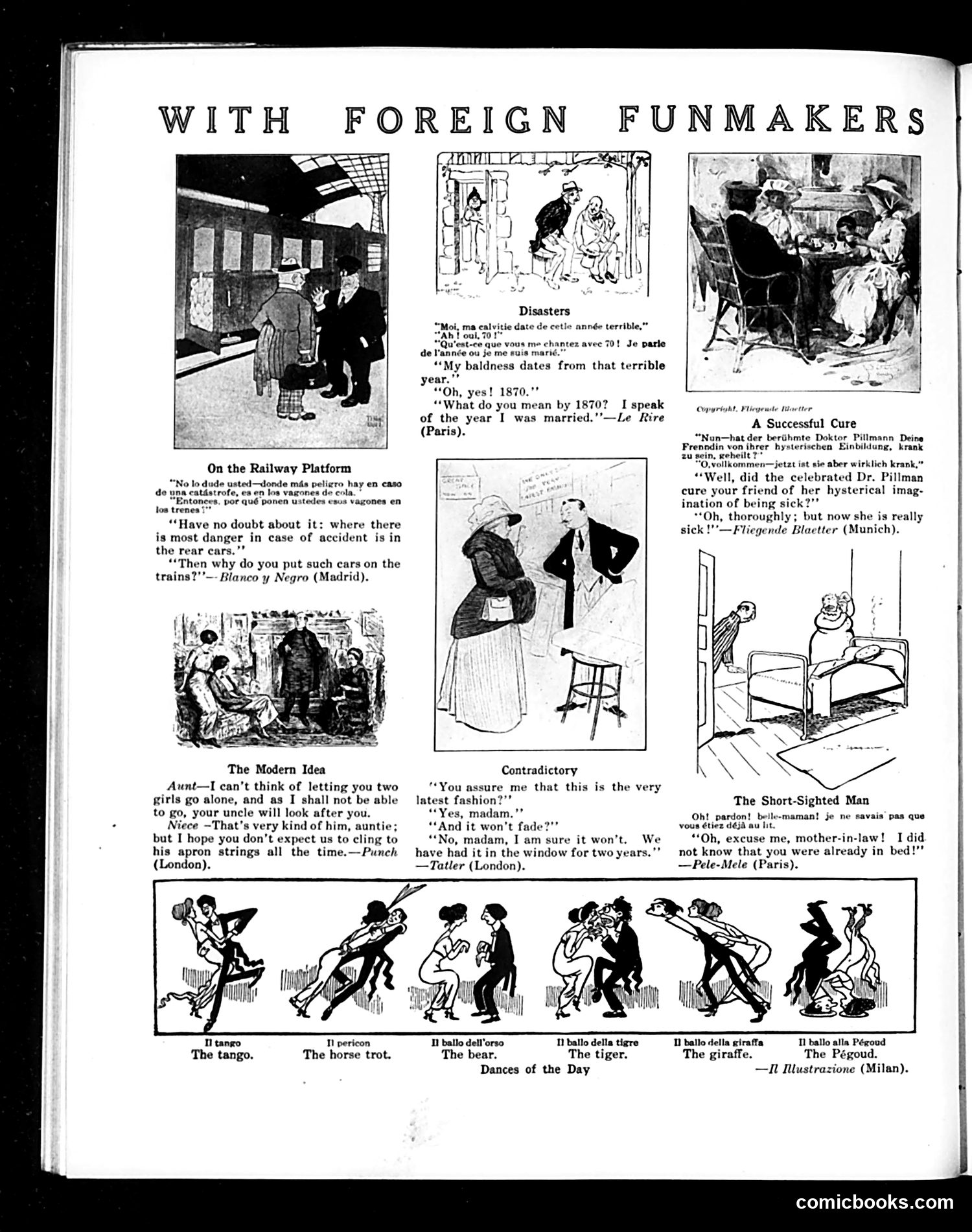
This page compiles short jokes and cartoons translated from European satirical publications (Spanish, French, German, Italian sources cited). The humor reflects early 20th-century sensibilities: **Key jokes include:** - A Spanish railroad safety paradox: dangerous rear cars are positioned at the train's back - A French marriage joke: a man's baldness stems from his wedding year (1870), implying marital stress caused hair loss - A London fashion contradiction: a dress is "latest fashion" yet has sat in a shop window two years - A German medical joke: a doctor "cured" a woman's imaginary illness, but she's now genuinely sick - A Paris mishap: a nearsighted man accidentally enters his mother-in-law's bedroom **The page's purpose:** *Judge* regularly featured foreign humor to amuse American readers with "continental" wit—emphasizing marriage troubles, fashion follies, and medical incompetence as universal comedic targets. The "Dances of the Day" section parodies contemporary crazes (tango, etc.) through animal metaphors.
📄 Transcribed text from this page (OCR, searchable)
Machine-transcribed from the original scan — historical spelling and the odd misread are preserved.
WITH FOREIGN FUNMAKERS On the Railway Platform oto dude usted donde més peligro hay en easo atdstrofe, es en los vagones tor ‘por qué-ponen ustedes cus vagones en Jos trenes “Have no doubt about it: where there is most danger in case of accident is in the rear cars."” “Then why do you put such cars on the trains?""—- Blanco y Negro (Madrid). The Modern Idea Aunt—I can't think of letting you two girls go alone, and as I shall not be able to go, your uncle will look after you. Niece —That's very kind of him, auntie; but I hope you don’t expect us to cling to his apron strings all the time.—Punch (London). 1! pericon The horse trot. Disasters “Mol, ma ealvitie date de cette année terrible,” stab t oui, 70 ‘Qu’est-co ‘que vous me chantez ave de année ou je me suis marié. “My baldness dates from that terrible year."’ “Oh, yes! 1870." “What do you mean by 1870? I speak of the year I was married.’’—Le Rire (Paris). Contradictory “You assure me that this is the very latest fashion?’’ “Yes, madam.” “And it won't fade?" “*No, madam, I am sure it won't. We have had it in the window for two years."’ —Tatler (London). sh It ballo delt'orso Ii ballo della tigre The bear. The tiger. Dances of the Day II ballo della giraffe Copartaht, Pliegenste Riwetter A Successful Cure “Nun—hat der berGhmte Doktor Pillmann Deine Frenndin von ihrer hysterisehen Einbildung, krank zu sein, geheilt ? Vollkommen—jetzt ist sie aber wirklich krank,”* “Well, did the celebrated Dr. Pillman cure your friend of her hysterical imag- ination of being sick?” “Oh, thoroughly; but now she is really sick !’’"—Fliegende Blaetter (Munich). The Short-Sighted Man Ob! pardon! belle-maman! je ne savais’ pas que vous étiez déja au lit. Idid “Oh, excuse me, mother-in-law! not know that you were already in bed!"" —Pele-Mele (Paris). ik Tey Il ballo alla Pézoud The Pégoud. —Il Mlustrazione (Milan). The giraffe. comicbooks.com