
Judge, 1914-04-04 · page 15 of 24
Judge — April 4, 1914 — page 15: what you’re looking at
What you’re looking at
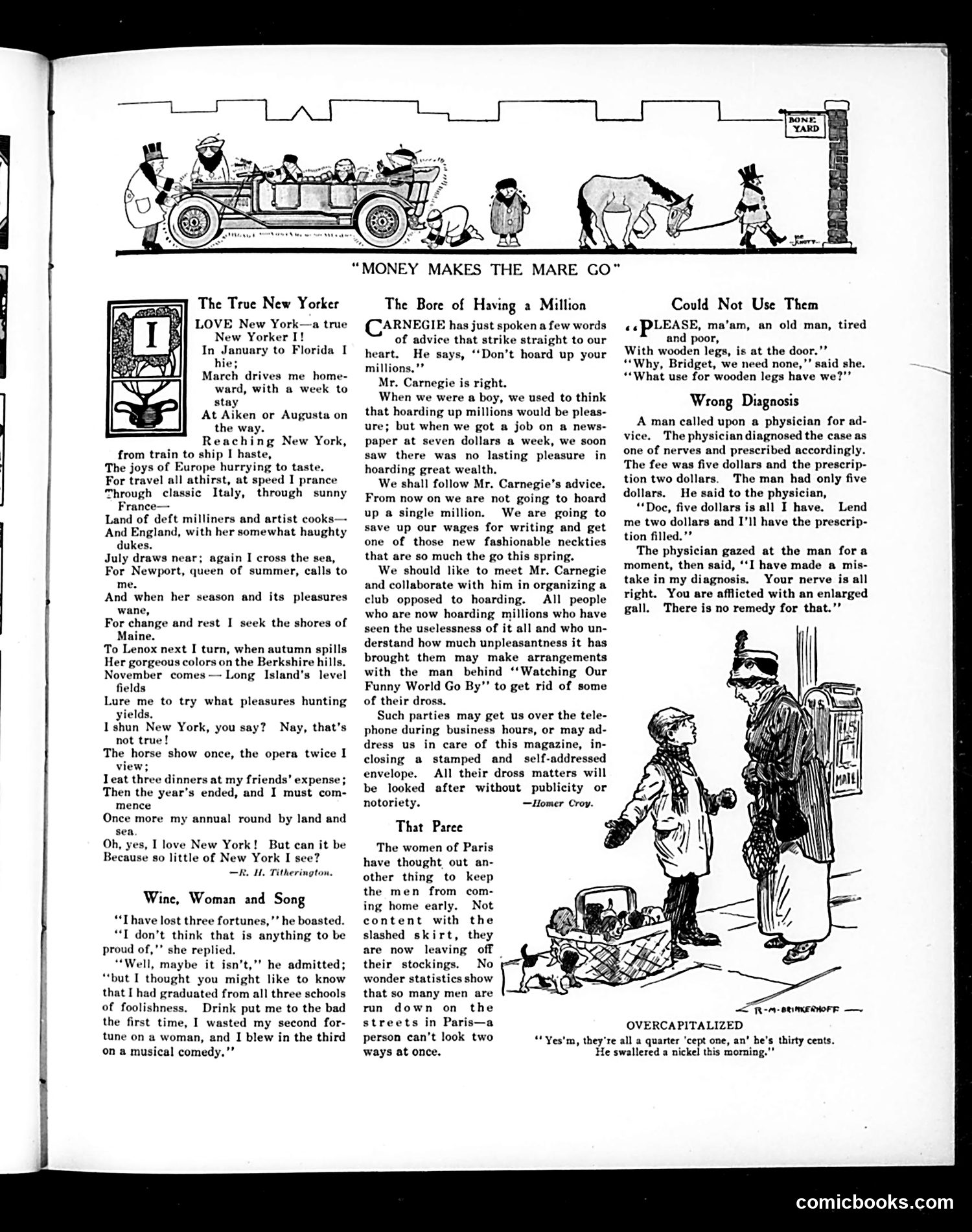
This page contains satirical commentary on wealthy American life and contemporary social issues. **"The True New Yorker"** mocks the paradox of wealthy New Yorkers who claim to love their city but spend most of the year traveling—to Florida, Europe, Newport, Maine, and the Berkshires. The poem's ironic conclusion asks: if they're barely in New York, can they truly love it? **"The Bore of Having a Million"** satirizes Andrew Carnegie's famous advice to wealthy industrialists not to hoard money. The author jokes they'll follow Carnegie's advice by saving for fashionable neckties instead of millions—a deadpan critique of how impractical such philosophy is for ordinary people. **"That Paree"** makes a risqué joke about Parisian women's fashion (removing stockings to expose legs), suggesting this deliberately distracts men and causes accidents. The other brief anecdotes—about a man losing three fortunes through drink, women, and theater; a beggar with wooden legs; and a patient's medical bill—offer typical period humor about human folly and irony. The illustration "Money Makes the Mare Go" uses the proverb about incentive and motivation.
📄 Transcribed text from this page (OCR, searchable)
Machine-transcribed from the original scan — historical spelling and the odd misread are preserved.
The True New Yorker |] LOVE New York—a true y New Yorker I! In January to Florida I hie; March drives me home- ward, with a week to stay At Aiken or Augusta on the way. Reaching New York, from train to ship I haste, The joys of Europe hurrying to taste. For travel all athirst, at speed I prance Through classic Italy, through sunny France— Land of deft milliners and artist cooks— And England, with her somewhat haughty dukes. July draws near; again I cross the sea, For Newport, queen of summer, calls to me. And when her season and its pleasures wane, For change and rest I seek the shores of Maine. To Lenox next I turn, when autumn spills Her gorgeous colors on the Berkshire hills. November comes — Long Island's level fields Lure me to try what pleasures hunting yields. I shun New York, you say? not true! The horse show once, the opera twice I view; leat three dinners at my friends’ expense; Then the year’s ended, and I must com- mence Once more my annual round by land and sea, Oh, yes, I love New York! But can it be Because so little of New York I see? —R. H. Titherington. Nay, that’s Wine, Woman and Song “Thave lost three fortunes,’’ he boasted. “I don’t think that is anything to be proud of,"* she replied. ‘Well, maybe it isn’t,” he admitted; “but I thought you might like to know that I had graduated from all three schools of foolishness. Drink put me to the bad the first time, I wasted my second for- tune on a woman, and I blew in the third on a musical comedy.’’ “MONEY MAKES THE MARE GO” The Bore of Having a Million CARNEGIE has just spoken a few words of advice that strike straight to our heart. He says, ‘Don’t hoard up your millions.’” Mr. Carnegie is right. When we were a boy, we used to think that hoarding up millions would be pleas- ure; but when we got a job on a news- paper at seven dollars a week, we soon saw there was no lasting pleasure in hoarding great wealth, We shall follow Mr. Carnegie’s advice. From now on we are not going to hoard up a single million. We are going to save up our wages for writing and get one of those new fashionable neckties that are so much the go this spring. We should like to meet Mr. Carnegie and collaborate with him in organizing a club opposed to hoarding. All people who are now hoarding millions who have seen the uselessness of it all and who un- derstand how much unpleasantness it has brought them may make arrangements with the man behind ‘Watching Our Funny World Go By”’ to get rid of some of their dross, Such parties may get us over the tele- phone during business hours, or may ad- dress us in care of this magazine, in- closing a stamped and_ self-addressed envelope. All their dross matters will be looked after without publicity or notoriety. —Homer Croy. That Paree The women of Paris have thought out an- other thing to keep the men from com- ing home early. Not content with the slashed skirt, they are now leaving off their stockings. No ¢ wonder statistics show that so many men are run down on the streets in Paris—a person can’t look two ways at once. Could Not Use Them ‘ «PLEASE, ma’am, an old man, tired and poor, With wooden legs, is at the door.’’ “Why, Bridget, we need none,’’ said she. “‘What use for wooden legs have we?’’ Wrong Diagnosis A man called upon a physician for ad- vice. The physician diagnosed the case as one of nerves and prescribed accordingly. The fee was five dollars and the prescrip- tion two dollars. The man had only five dollars. He said to the physician, “Doe, five dollars is all I have. Lend me two dollars and I'll have the prescrip- tion filled.’” The physician gazed at the man fora moment, then said, ‘‘I have made a mis- take in my diagnosis. Your nerve is all right. You are afflicted with an enl: gall. There is no remedy for that.”’ << TR-n- OtIMKERHOFF — OVERCAPITALIZED “'Yes'm, they're all a quarter ‘cept one, an’ he's thirty cents. He swallered a nickel this morning." comicbooks.com