
Judge, 1914-04-04 · page 11 of 24
Judge — April 4, 1914 — page 11: what you’re looking at
What you’re looking at
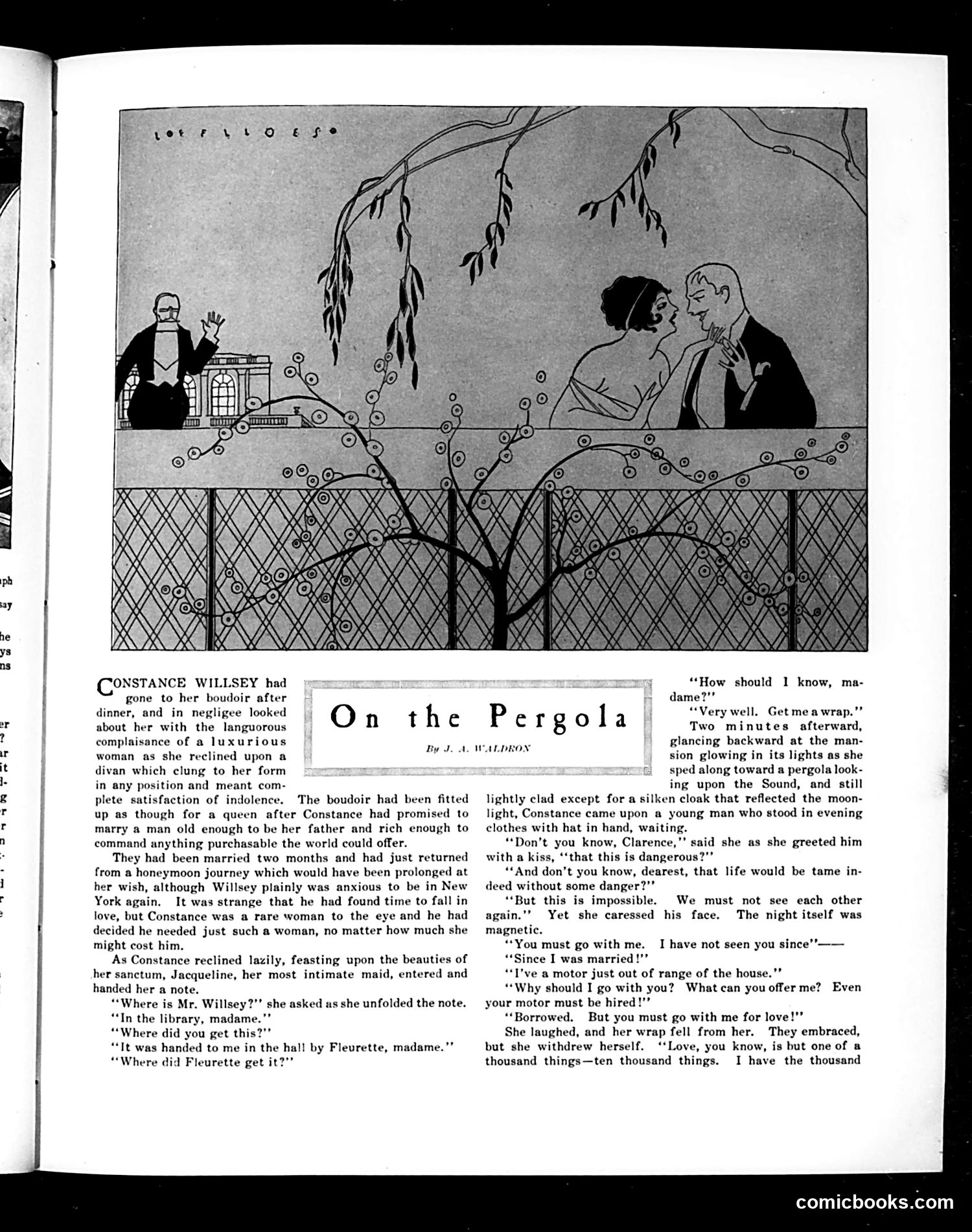
This is an illustrated short story depicting a wealthy woman's infidelity. Constance Willsey, a luxurious socialite married to an older, rich husband (Mr. Willsey), meets her former lover Clarence secretly in a pergola near her mansion. The story satirizes the moral hypocrisy of the wealthy elite: Constance enjoys the material comforts her marriage provides (the lavish boudoir, the mansion), yet simultaneously pursues romantic passion with a younger man. The cartoon above illustrates the scene—showing Constance with Clarence while a servant plays music indoors, unaware of the tryst. The satire targets the shallow values of high society: Constance dismisses Clarence's love as merely "one of a thousand things," suggesting that even romance is subordinate to material luxury and social standing. The story mocks both the protagonist's infidelity and the upper-class world that enables it.
📄 Transcribed text from this page (OCR, searchable)
Machine-transcribed from the original scan — historical spelling and the odd misread are preserved.
> VAY, g5 UK i/ ¢, OX , O x) Ny } 1} DW pe. ONSTANCE WILLSEY had = = gone to her boudoir after On dinner, and in negligee looked about her with the languorous complaisance of a luxurious woman as she reclined upon a divan which clung to her form in any position and meant com- plete satisfaction of indolence. The boudoir had been fitted up as though for a queen after Constance had promised to marry a man old enough to be her father and rich enough to command anything purchasable the world could offer. They had been married two months and had just returned from a honeymoon journey which would have been prolonged at her wish, although Willsey plainly was anxious to be in New York again. It was strange that he had found time to fall in love, but Constance was a rare woman to the eye and he had decided he needed just such a woman, no matter how much she might cost him. As Constance reclined lazily, feasting upon the beauties of her sanctum, Jacqueline, her most intimate maid, entered and handed her a note. “Where is Mr. Willsey?’’ she asked as she unfolded the note. “In the library, madame."’ “Where did you get this? “It was handed to me in the hal! by Flevrette, madame."’ “Where did Fleurette get it?” the By J. Ae r ase he AES “‘How should 1 know, ma- = dame?" \ “Very well. Get me awrap.”” F er 8 fe} 1 a Two minutes afterward, anpRox glancing backward at the man- Ane sion glowing in its lights as she © sped along toward a pergola look- ing upon the Sound, and still lightly clad except for a silken cloak that reflected the moon- light, Constance came upon a young man who stood in evening clothes with hat in hand, waiting. “Don’t you know, Clarence,"’ said she as she greeted him with a kiss, “that this is dangerous?” “And don’t you know, dearest, that life would be tame in- deed without some danger?"" “But this is impossible. We must not see each other again.'’ Yet she caressed his face. The night itself was magnetic. “You must go with me. I have not seen you since’’—— “Since I was married !’" “I've a motor just out of range of the house.’” “Why should I go with you? What can you offer me? Even your motor must be hired !’” “Borrowed. But you must go with me for love!"’ She laughed, and her wrap fell from her. They embraced, but she withdrew herself. ‘Love, you know, is but one of a thousand things—ten thousand things. I have the thousand comicbooks.com