
A complete issue · 24 pages · 1914
Judge — January 10, 1914
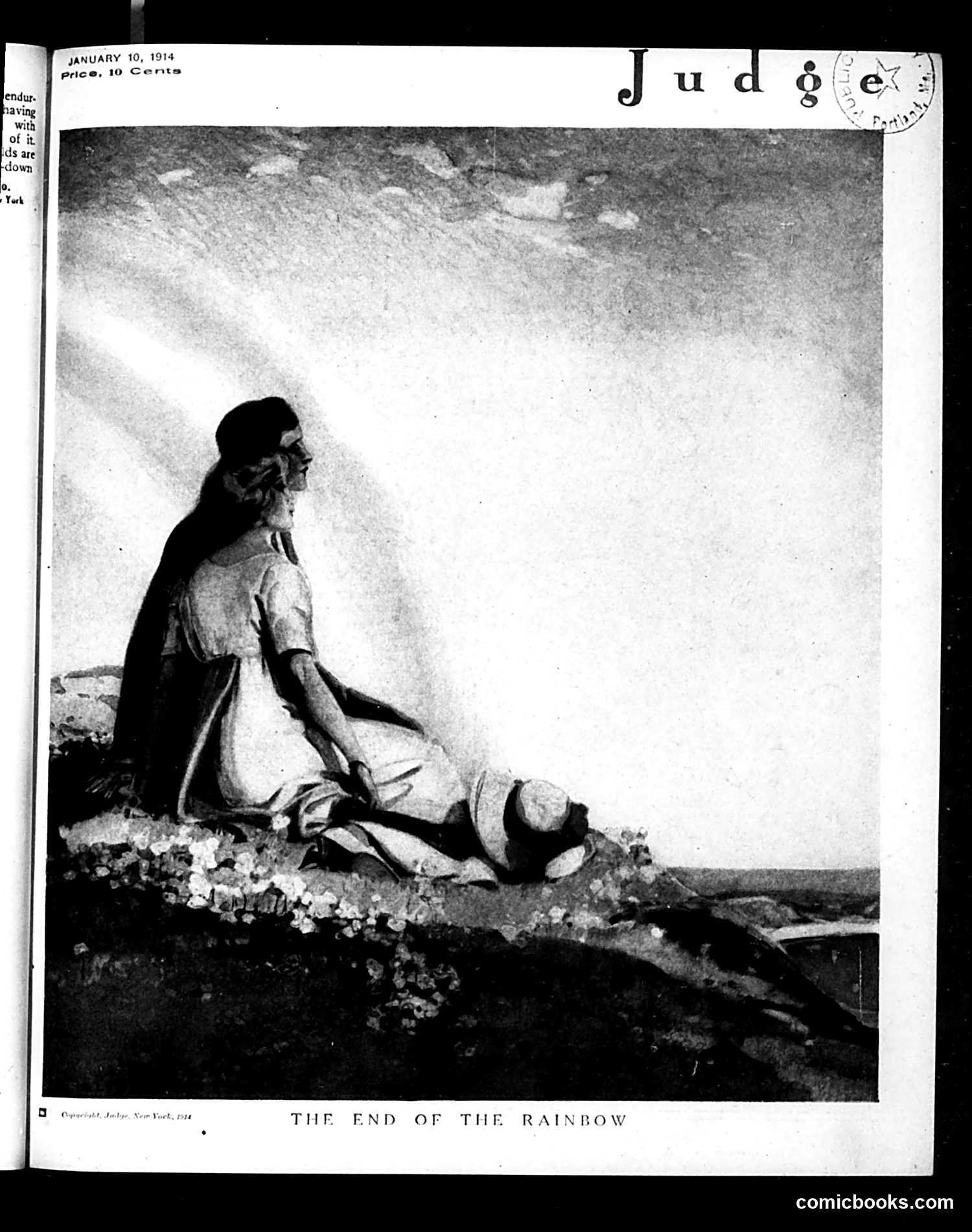
This illustration from *Judge* magazine (January 10, 1914) depicts a figure sitting on rocky terrain gazing toward the horizon, titled "The End of the Rainbow." The image appears to be a philosophical or allegorical commentary rather than direct political satire. The figure represents someone pursuing an elusive goal—"the end of the rainbow"—a metaphor for an unreachable dream or promise. The composition suggests disappointment or futility: the person has journeyed to where they believed the rainbow's end lay, only to find barren ground. Without additional context from the magazine's original articles, the specific reference remains unclear. It may critique unrealistic aspirations, false promises in business or politics, or general human folly in chasing unattainable dreams. The melancholic tone suggests disillusionment rather than humor.
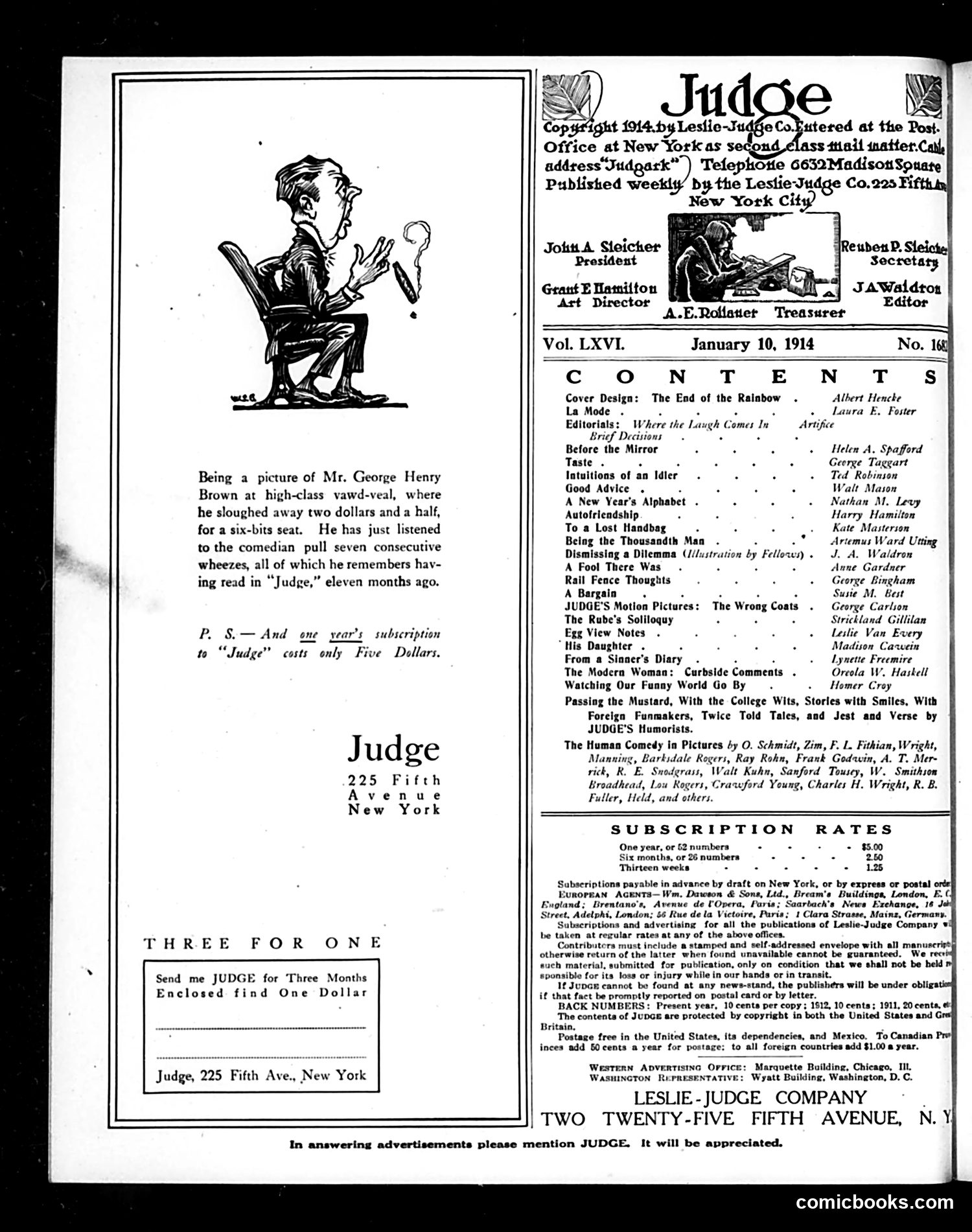
The main cartoon depicts **George Henry Brown**, a high-class swindler who "sloughed away two dollars and a half, for a six-bits seat." The joke references Brown's recent conviction—he had spent money on a theater ticket, then listened to a common streetcar conductor's spiel about consecutive "wheeze" jokes, all of which he'd previously read in Judge magazine eleven months prior. The satire mocks both Brown's pretensions to wealth and sophistication (spending money on expensive seats) and the repetitive, recycled nature of popular entertainment and jokes circulating in the era. It's a meta-joke about predictable humor and social climbing that backfires when supposedly "new" entertainment proves painfully familiar.
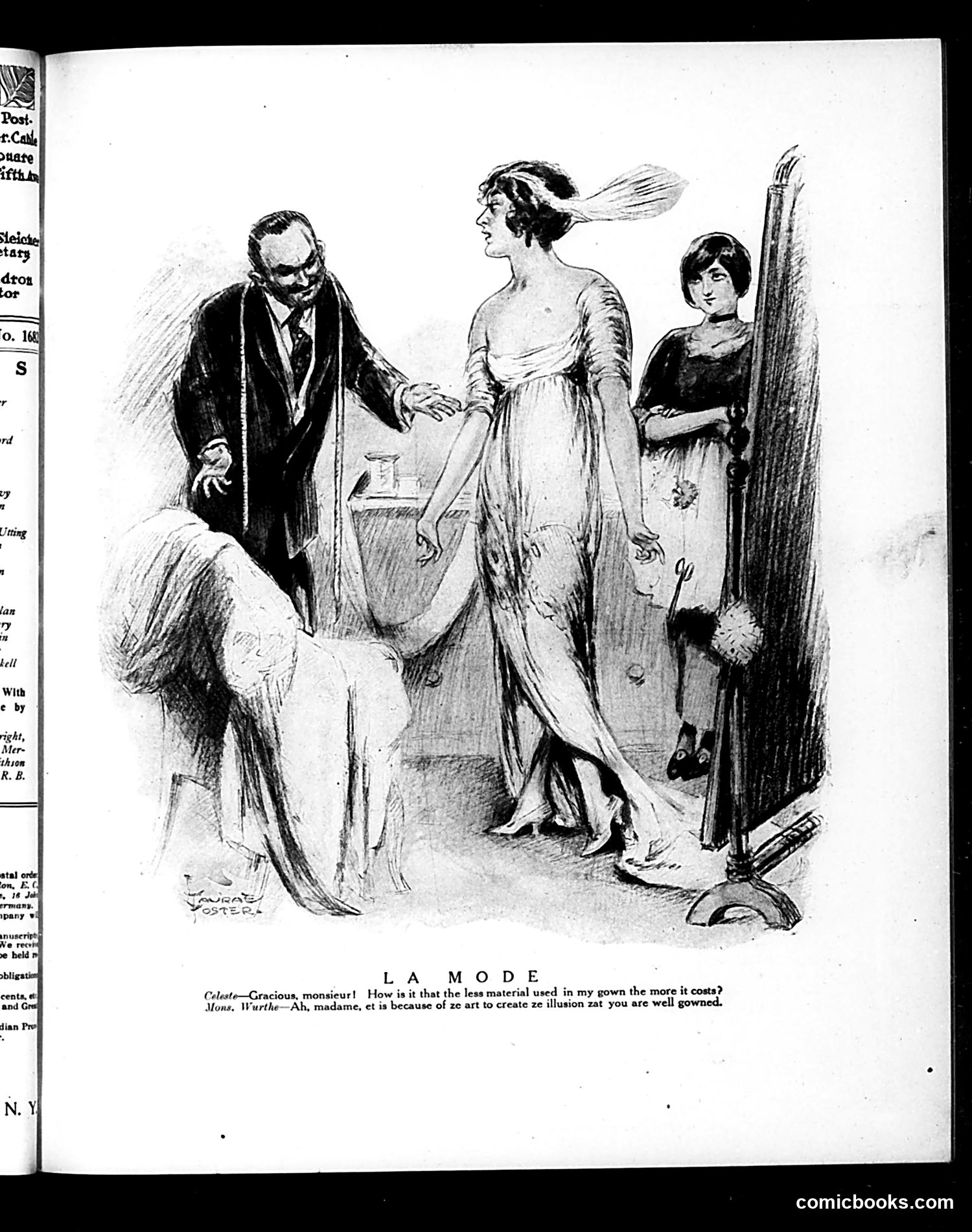
This cartoon satirizes the cost and impracticality of fashionable women's clothing. The dialogue reveals the joke: a well-dressed woman claims her gown costs little because "the less material used in my gown the more it costs," while her companion responds that expensive illusion justifies the price. The sketch mocks the fashion industry's paradox—haute couture charges premium prices for minimal fabric, creating an "illusion" of luxury rather than substance. The figures show the contrast between elaborate, expensive gowns and simpler dress, critiquing how fashion consumers pay inflated prices for designs that use fewer materials. This reflects early 20th-century anxieties about conspicuous consumption and the absurdity of high fashion economics.
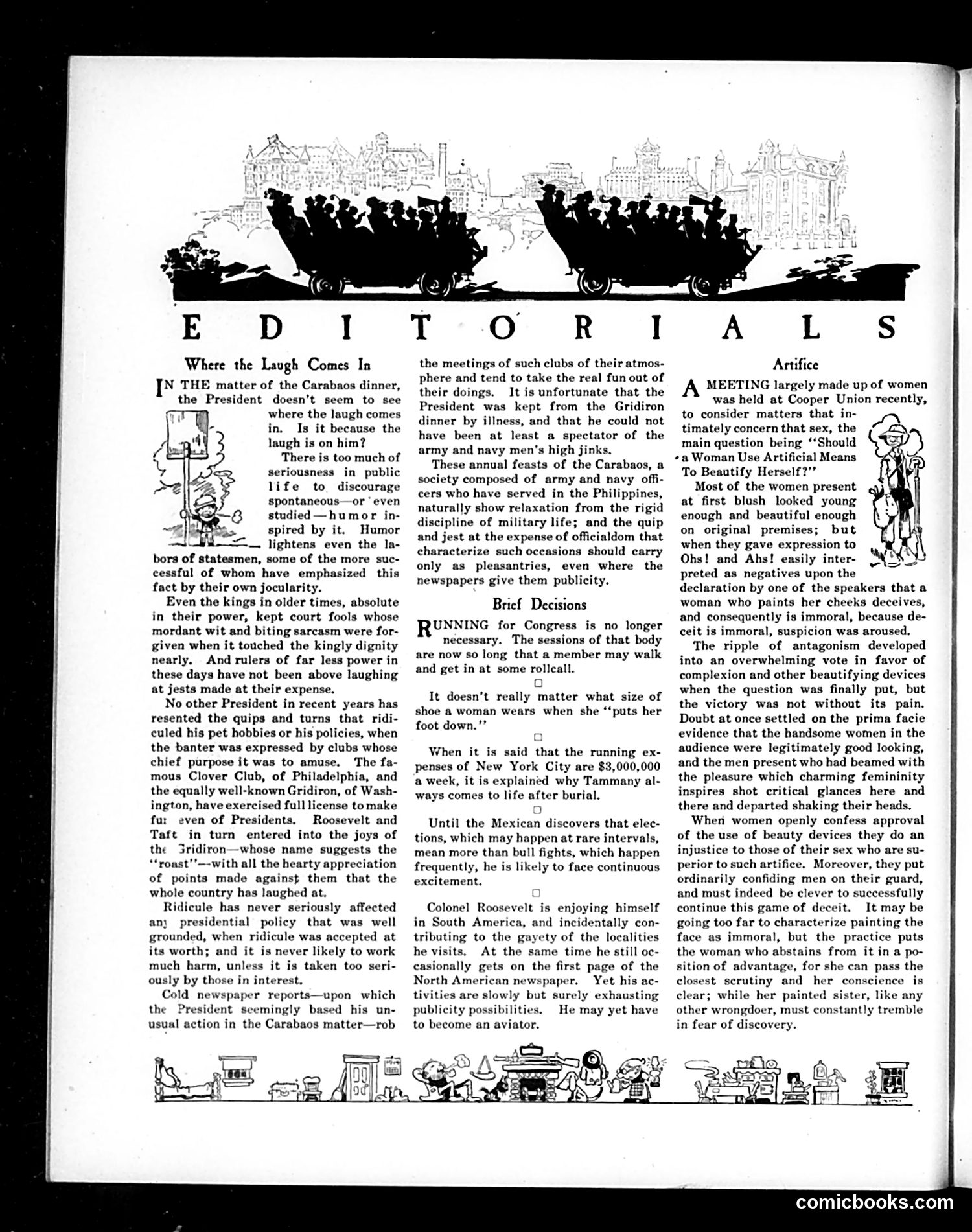
This page satirizes President Theodore Roosevelt's social activities and public persona. The header cartoon depicts two overflowing carriages of people heading toward a cityscape, illustrating Roosevelt's active social calendar. The main editorial "Where the Laugh Comes In" criticizes Roosevelt for attending the Gridiron Club dinner—a prestigious gathering of journalists and military officers. The piece argues the President's presence inhibits genuine humor and relaxation, as officials become overly formal and dignified around him. "Brief Decisions" section mocks various contemporary issues: women's use of beauty aids (deemed immoral by some), congressional candidates' campaign expenses ($3,000,000 for New York City races), and Roosevelt's South American travels, suggesting his publicity-seeking extends even abroad. The satire targets both Roosevelt's omnipresence in social life and era-specific controversies about propriety and gender.
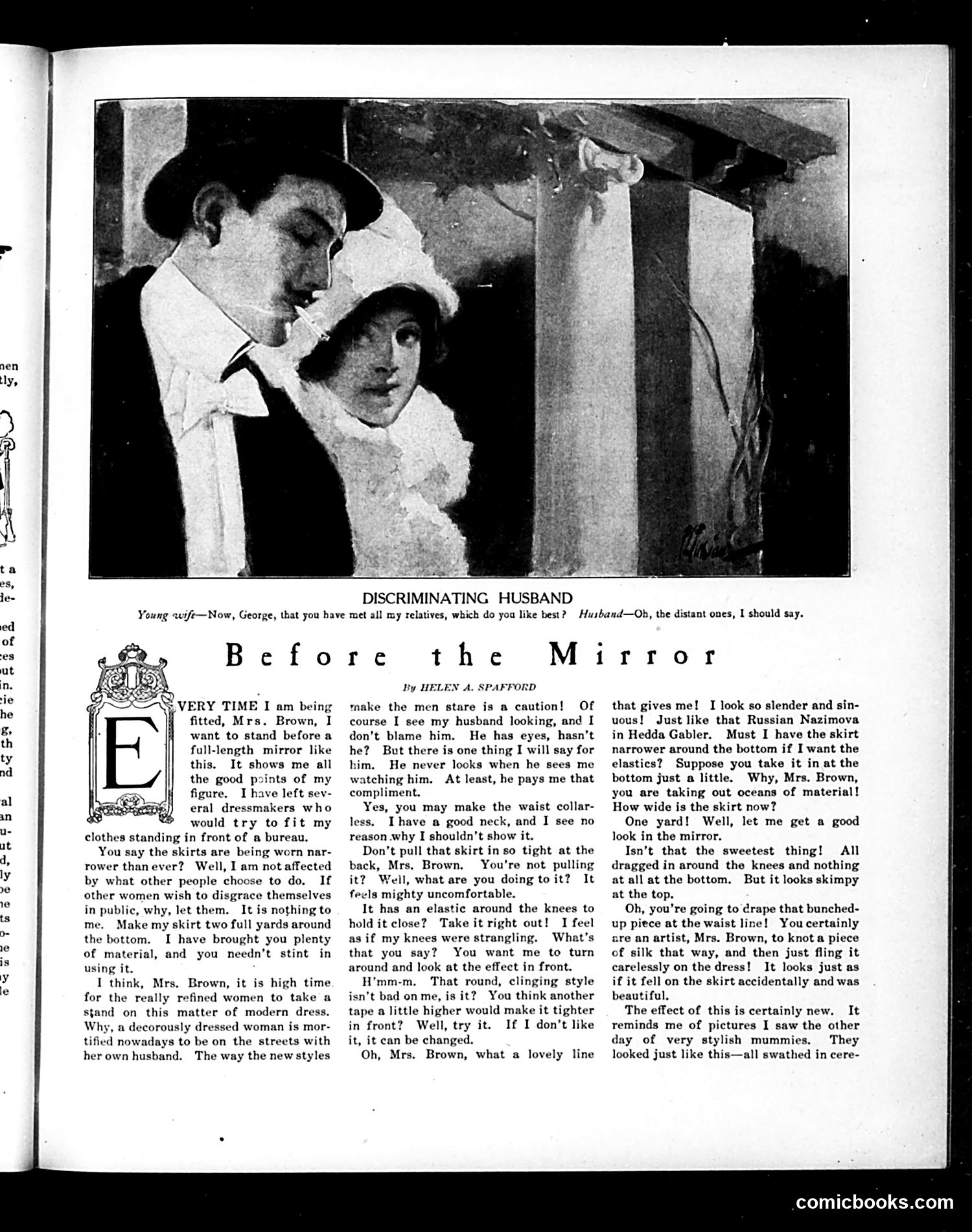
This page from *Judge* magazine contains a short story titled "Before the Mirror" by Helen A. Spafford, not a political cartoon. The illustration shows a couple examining themselves in a mirror, captioned "Discriminating Husband." The story satirizes early 20th-century fashion debates and marital dynamics around women's clothing. The husband criticizes his wife's dress as unfashionable—her skirt is too tight and lacks proper draping at the waist. The narrative presents the husband as pedantically correcting her appearance while she defends her choices. The satire targets both the era's strict fashion standards and husbands who presumed to dictate women's dress. It reflects contemporary anxieties about changing women's fashion and gender roles in this period.
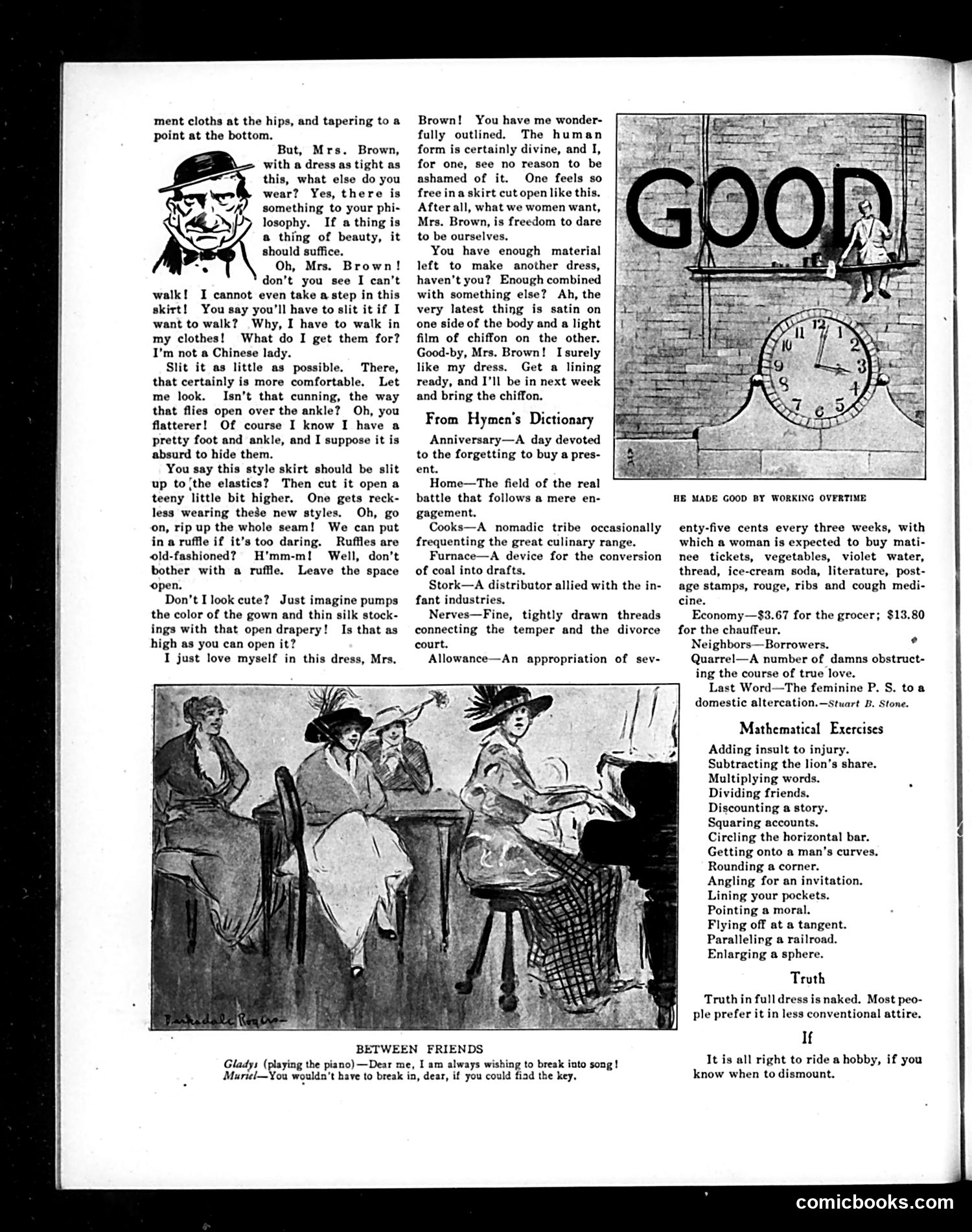
This page satirizes early 20th-century women's fashion and gender roles through multiple pieces: **Main Cartoon**: A dressmaker and client ("Mrs. Brown") discuss an extremely tight, high-slit skirt. The satire mocks the impracticality of fashionable dress—the client cannot walk, requiring progressive slits up the skirt. The joke turns on female vanity: despite discomfort, she loves the outfit for its revealing design and how it displays her figure. This criticizes both restrictive fashion and the contradictory demand that women prioritize appearance over function. **"Between Friends"**: A mild joke about piano playing and finding "the key"—a pun on musical incompetence. **Dictionary/Aphorisms Section**: Cynical definitions of marriage and domesticity ("Allowance" gets $3.67 weekly; "Home" is a "battle"), satirizing women's limited economic power and marital discord. The overall message critiques both the fashion industry's impractical demands on women and women's complicity in prioritizing appearance—framed through Judge's characteristic male-perspective humor.
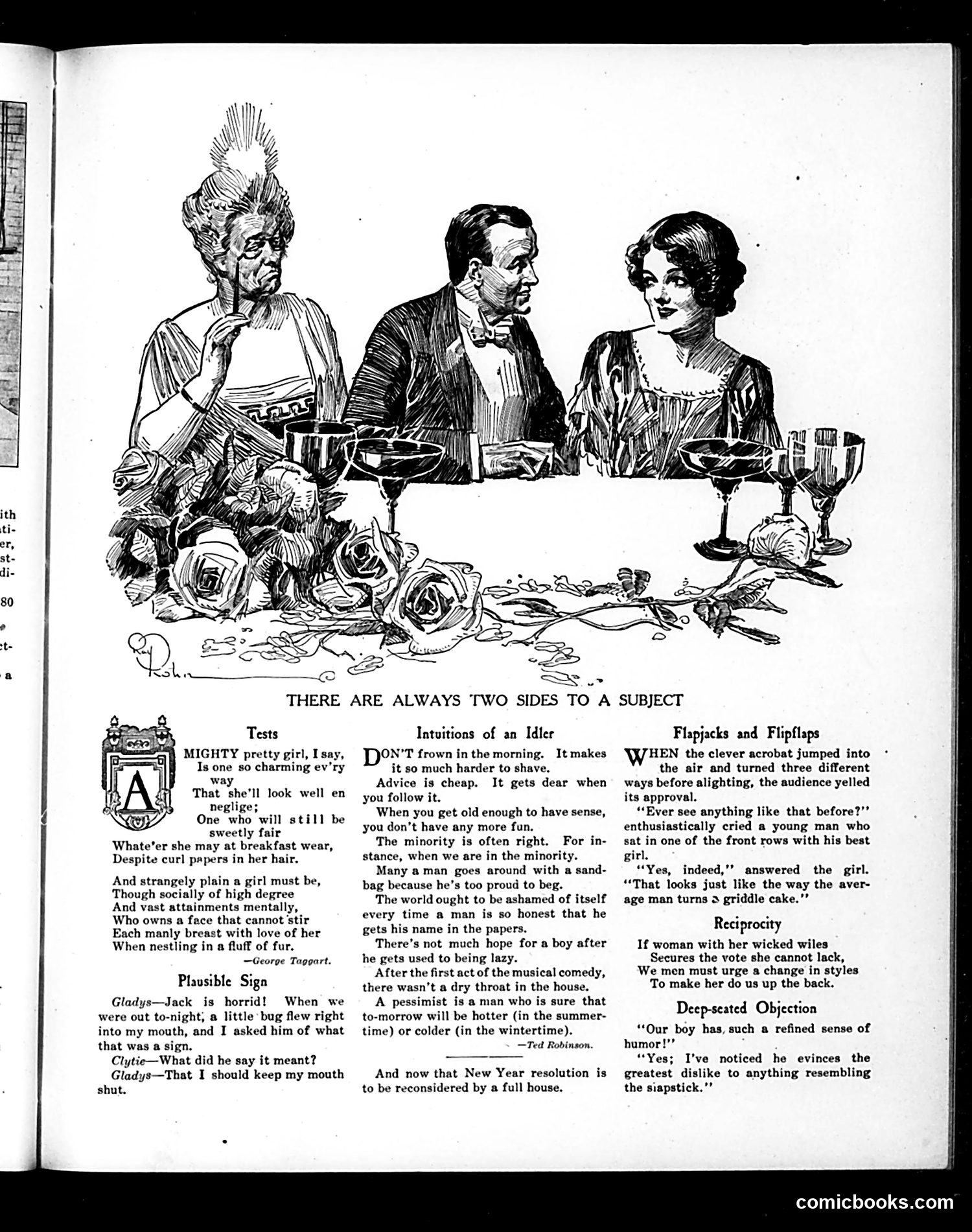
This page presents multiple satirical pieces typical of early 20th-century humor magazines. The main cartoon depicts three well-dressed figures at a dinner table with flowers, illustrating "There Are Always Two Sides to a Subject"—a commentary on social hypocrisy or conflicting perspectives. The surrounding text contains brief humorous observations and anecdotes: - "Tests" and "Plausible Sign" are short joke exchanges mocking social pretension and romance - "Intuitions of an Idler" offers sardonic life observations (on shaving, advice, honesty, pessimism) - "Flapjacks and Flipflaps" jokes about acrobats and pancake-flipping - The remaining pieces satirize gender relations, women's suffrage ("Reciprocity"), and modern parenting The humor relies on wordplay, irony, and gentle social criticism rather than political commentary. References to "New Year resolutions" and "the vote" suggest early 20th-century context, likely 1920s given the "flapper" references.
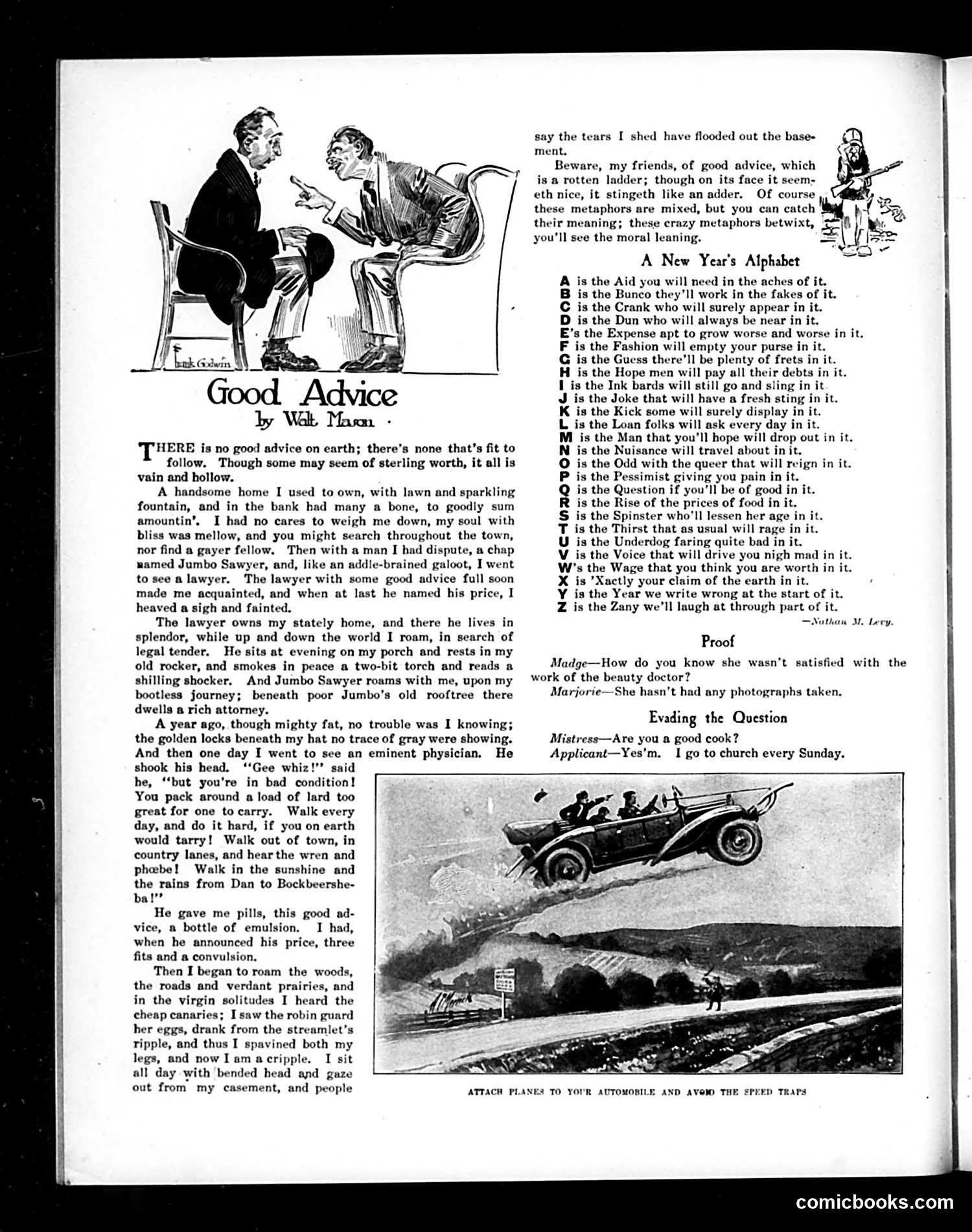
This comic verse satirizes the unintended consequences of seeking professional advice. A prosperous man consults a lawyer about a dispute with "Jumbo Sawyer." The lawyer's fee is so exorbitant that the narrator loses his home, which the lawyer now occupies in splendor, while the narrator roams poor and desperate. The moral: well-meaning advice from professionals (here, lawyers and doctors) often enriches *them* while impoverishing the client. The physician's prescription to walk leads only to exhaustion and despair. The accompanying "New Year's Alphabet" continues this cynical theme, predicting the year will bring only expense, nuisance, debt-collection, and disappointment—a dark forecast masquerading as lighthearted verse. The page mocks the reliability and ethics of 20th-century professionals who profited from clients' misfortunes.
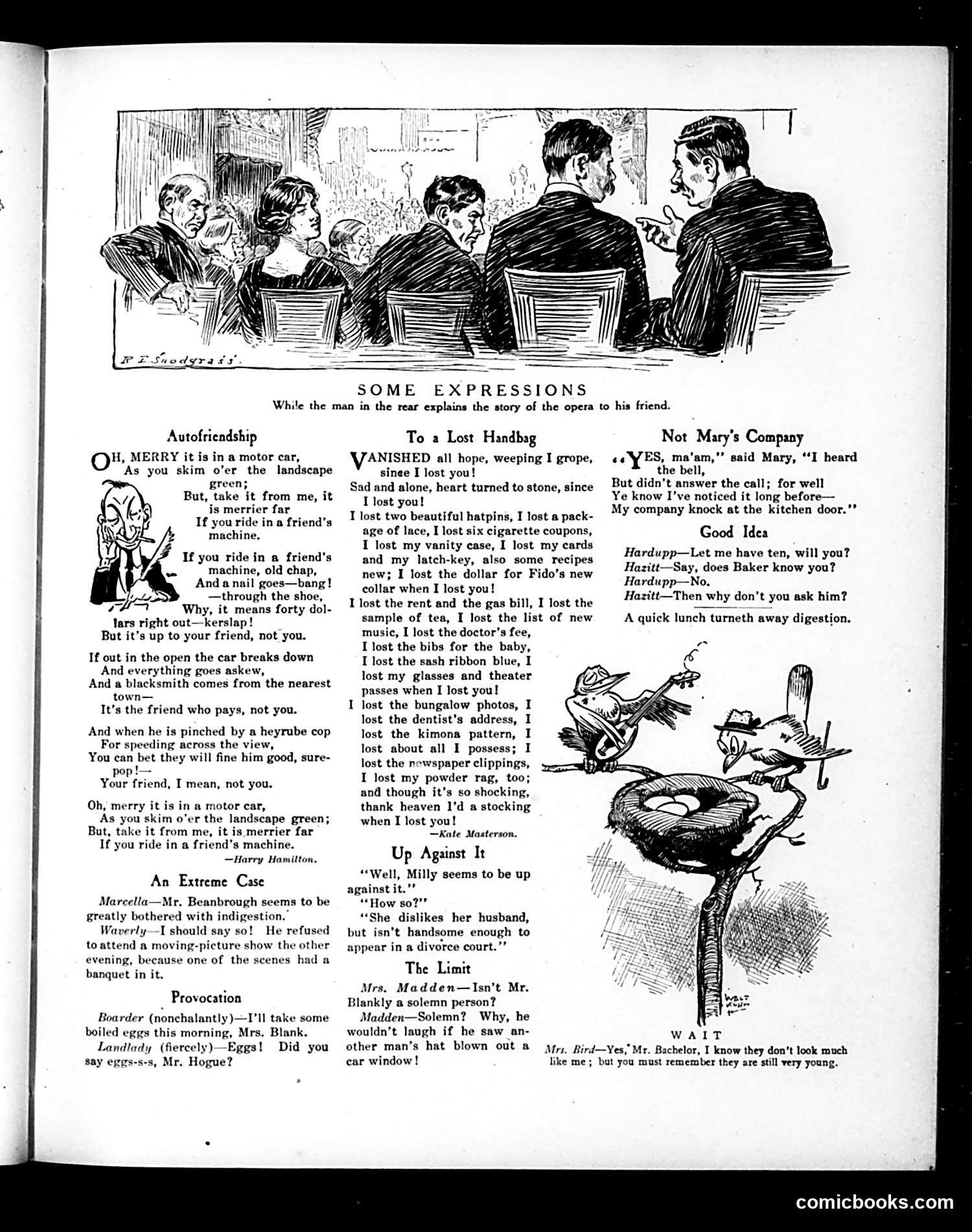
This page contains light satirical humor pieces typical of early 20th-century American comic magazines. The content includes: **"Autofriendship"** mocks the false economy of accepting rides in friends' automobiles—while the ride is free, the friend bears all costs (repairs, fines, breakdowns). The joke exploits the then-novel expense of owning a motorcar. **"To a Lost Handbag"** parodies sentimental lost-love songs by applying the dramatic style to a missing purse and its contents, satirizing overwrought emotional expression. **"Not Mary's Company"** jokes about a servant answering the door only for callers she considers socially inferior, using her kitchen as the proper entrance. **Other brief pieces** mock indigestion, landlady irritability, unhappy marriage, and stoic husbands through short comedic dialogues. The accompanying illustration shows men at what appears to be an opera, explaining the plot—common satire of both opera's complexity and tedious social commentary. Overall, the page targets automobile culture, pretension, and domestic/social awkwardness.
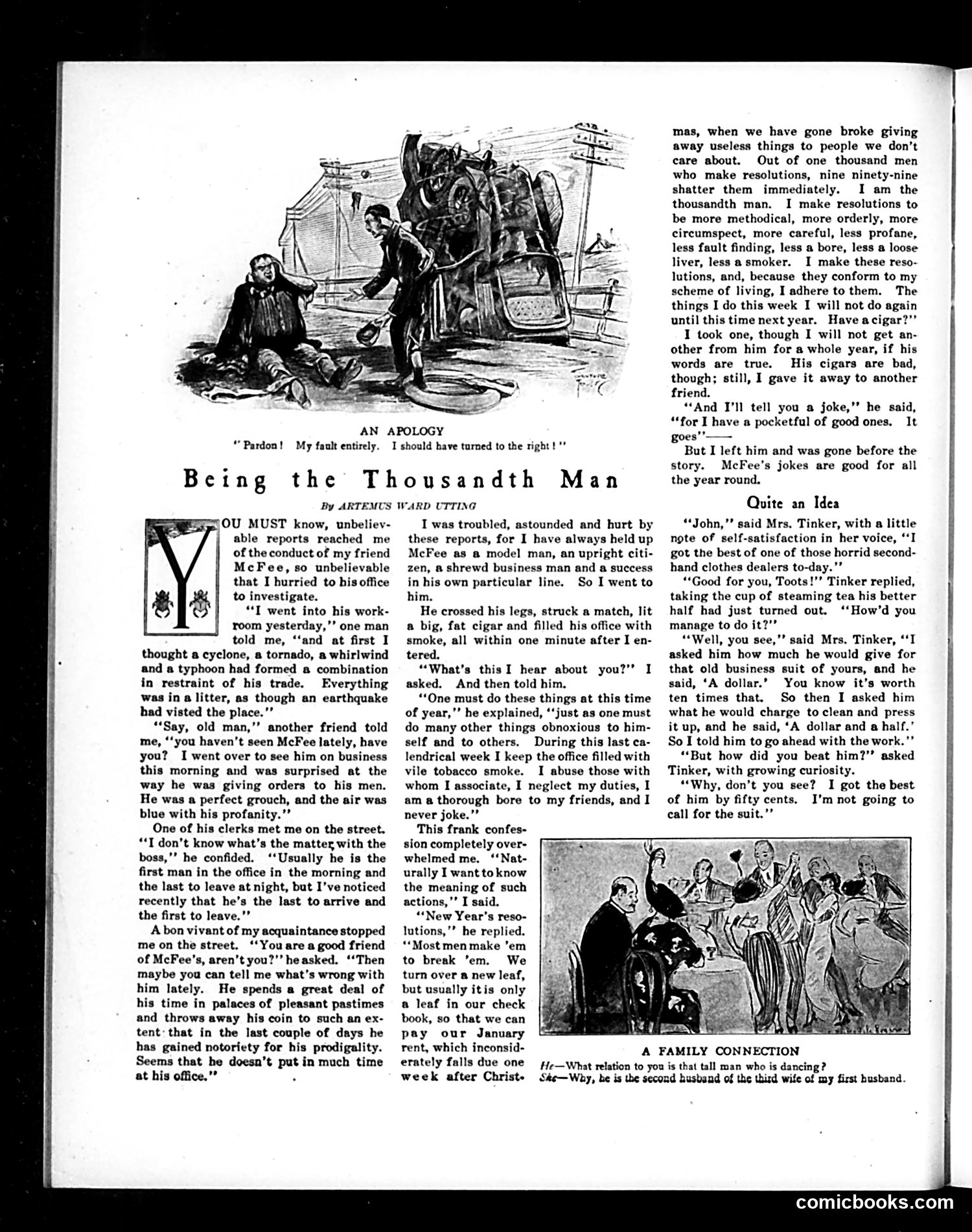
This page satirizes New Year's resolutions and hypocrisy. The main story, "Being the Thousandth Man," presents McFee, a businessman whose conduct has reportedly deteriorated—he's become slovenly, profane, negligent, and dissolute. When confronted, McFee reveals he's deliberately behaving badly *because* it's the week before New Year's. He explains that he makes resolutions annually and actually keeps them, so he indulges all his vices beforehand as a kind of "system." The satire's point: while 999 of 1,000 men break their resolutions immediately, McFee is "the thousandth man" who follows through—but this requires him to compartmentalize his bad behavior into one specific week. The cartoon illustrates the absurdity of this rationalization: his meticulous adherence to resolutions is enabled only by pre-planned moral collapse. The secondary anecdote about Mrs. Tinker similarly mocks self-satisfaction over minor victories. The humor targets self-deception and the ritualistic emptiness of New Year's resolutions.
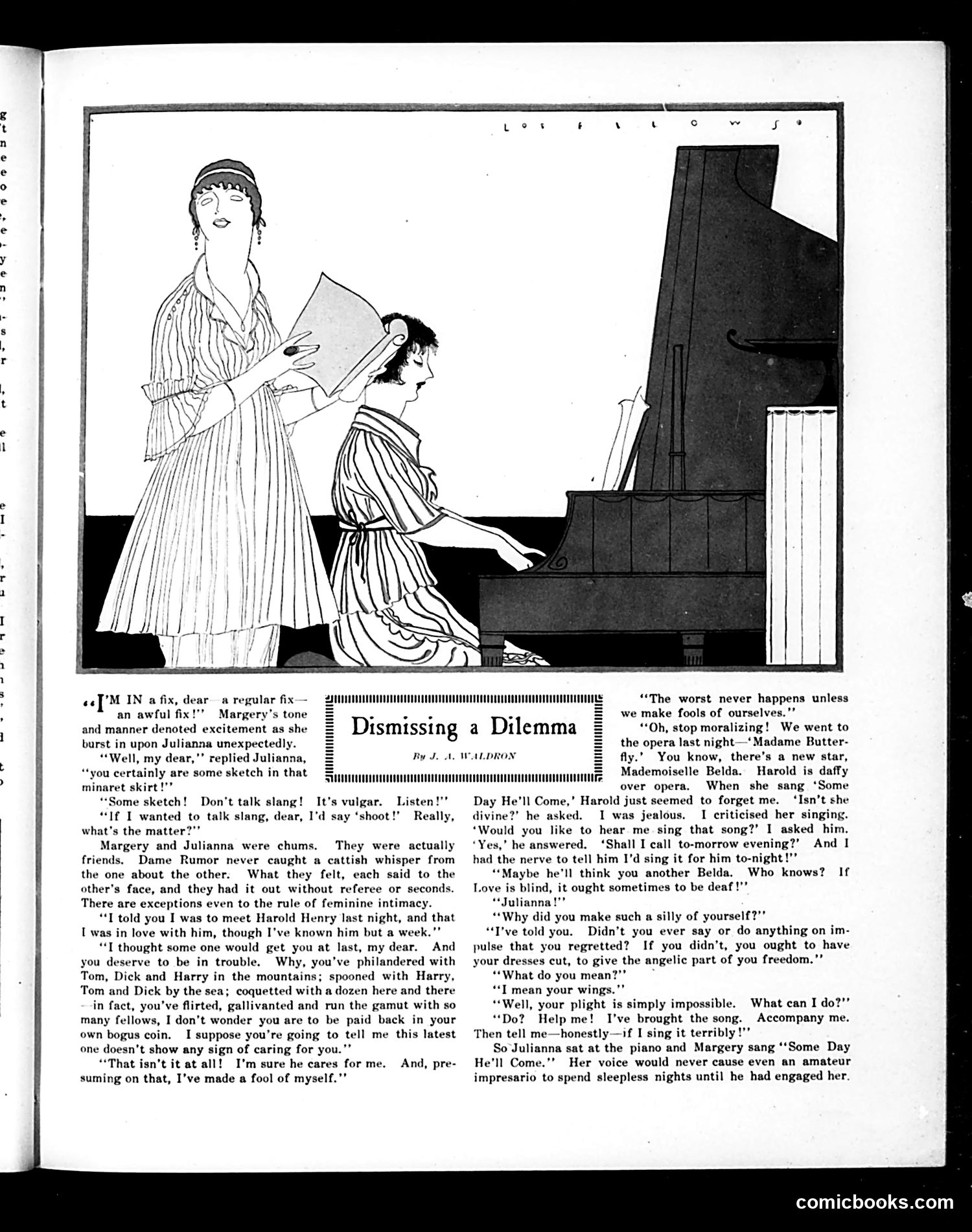
This is a romantic comedy story illustrated in the Art Deco style typical of 1920s Judge magazine. Two wealthy young women—Margery and Julianna—are friends who discuss romantic troubles frankly. Margery has impulsively challenged her new suitor, Harold, by offering to sing the opera aria "Some Day He'll Come" (from Puccini's *Madame Butterfly*) after he praised another soprano. Now she fears she's ruined the relationship. The satire targets early 20th-century attitudes toward women: Julianna mock-lectures Margery about her past flirtations ("philandered with Tom, Dick and Harry"), implying women deserve romantic disappointment for coquetry. The joke hinges on female vanity and impulsiveness—Margery's jealous challenge being portrayed as foolish rather than understandable. The final punchline suggests Margery's singing is terrible, making her anxiety about the audition humorous.
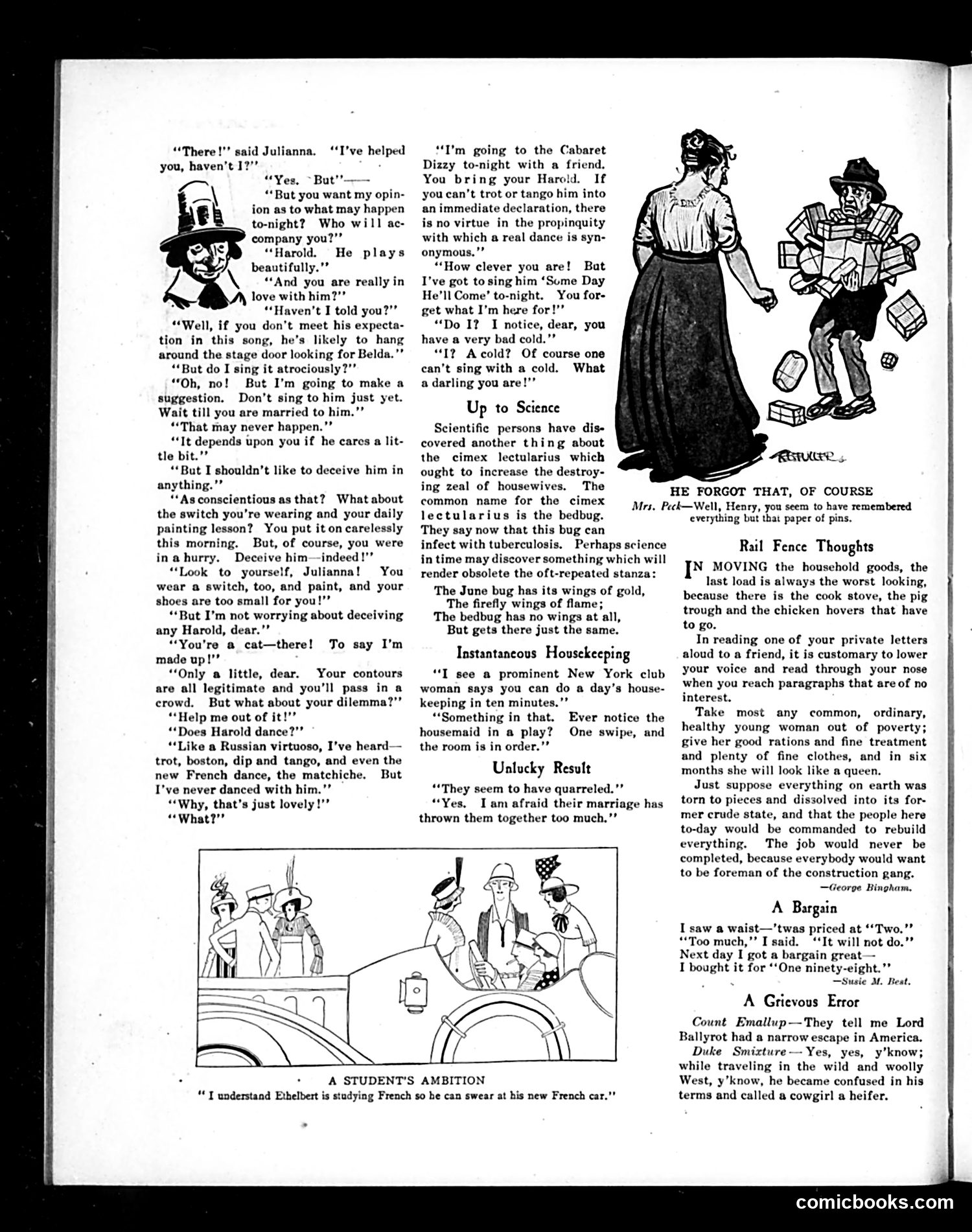
This page contains multiple satirical pieces targeting early 20th-century social conventions: **Main narrative dialogue**: Two women discuss romantic deception. Julianna advises her friend to withhold singing until after marriage to avoid disappointing her suitor Harold, then hypocritically defends her own use of fake hair ("switch") and makeup—exposing Victorian-era female artifice and the gap between moral preaching and practice. **Scientific humor**: A piece mocking bedbugs (cimex lectularius) sardonically suggests tuberculosis research might finally make them "obsolete," poking fun at both scientific pretension and persistent household pests. **Other items**: Brief jokes about instant housekeeping, a student learning French to curse at his car, and a husband forgetting pins—all gentle domestic satire. The cartoons and text collectively mock Edwardian courtship rituals, female vanity, and the contradictions between professed propriety and actual behavior. The tone is lighthearted social commentary typical of Judge's satirical approach to middle-class life.
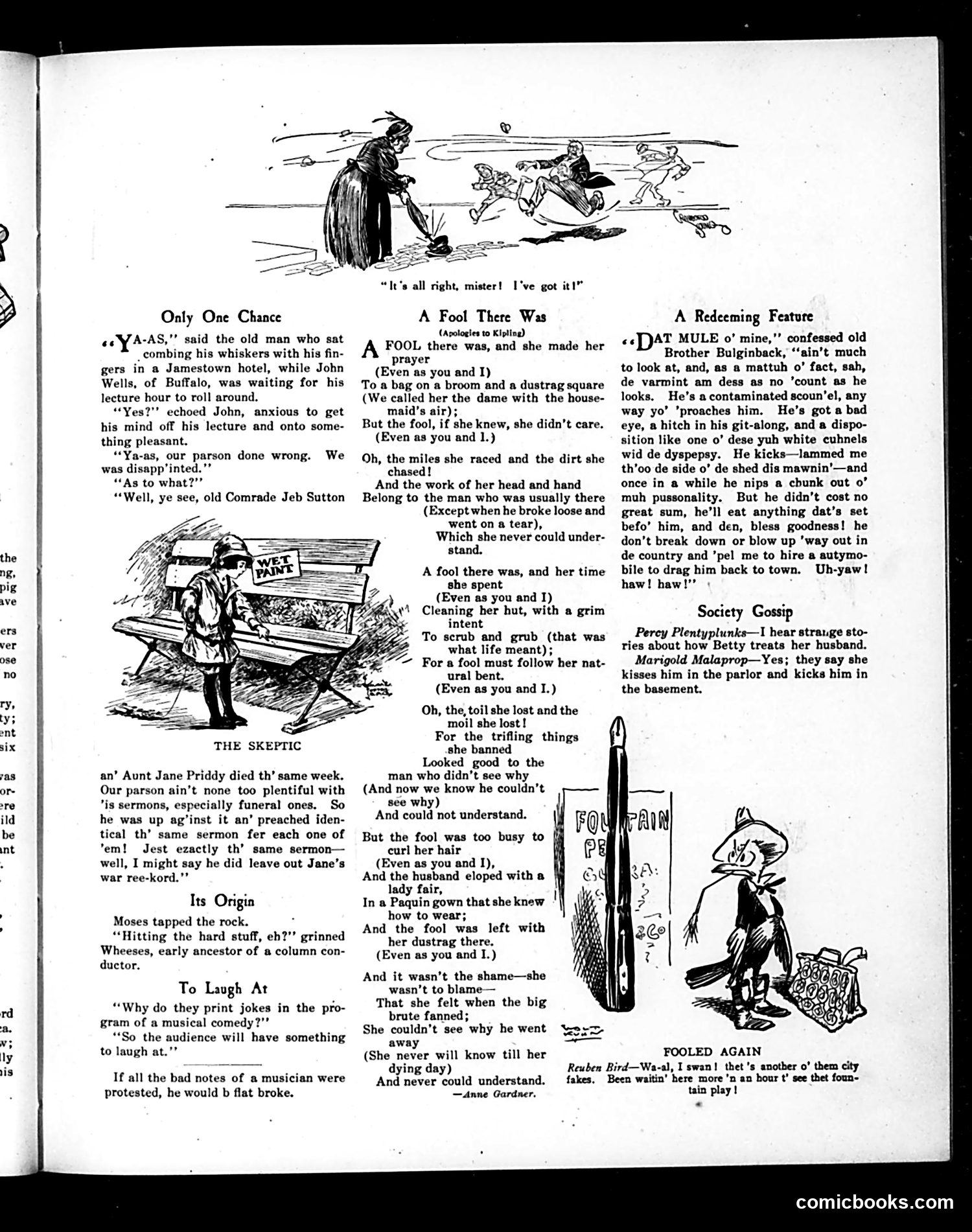
This page contains several distinct humor pieces typical of early 20th-century American satire: **"Only One Chance"** presents rural dialect humor: a country man complains that his pastor recycled the same funeral sermon for two different deceased parishioners, omitting only the deceased woman's "war record"—implying she had a scandalous past. **"A Fool There Was"** is a narrative poem satirizing a devoted housewife whose industrious nature (cleaning, scrubbing) goes unappreciated. Her inattentive husband abandons her for a fashionable woman in a "Paquin gown," leaving the dutiful wife bewildered and unable to understand why he left. **"Society Gossip"** jokes about a wife who kisses her husband in the parlor but kicks him in the basement—contrasting public propriety with private contempt. **"Fooled Again"** depicts a city person spending over an hour watching a fountain, suggesting gullibility or misplaced priorities. The page reflects period attitudes toward rural simplicity, marital dynamics, and class distinctions between city and country folk.
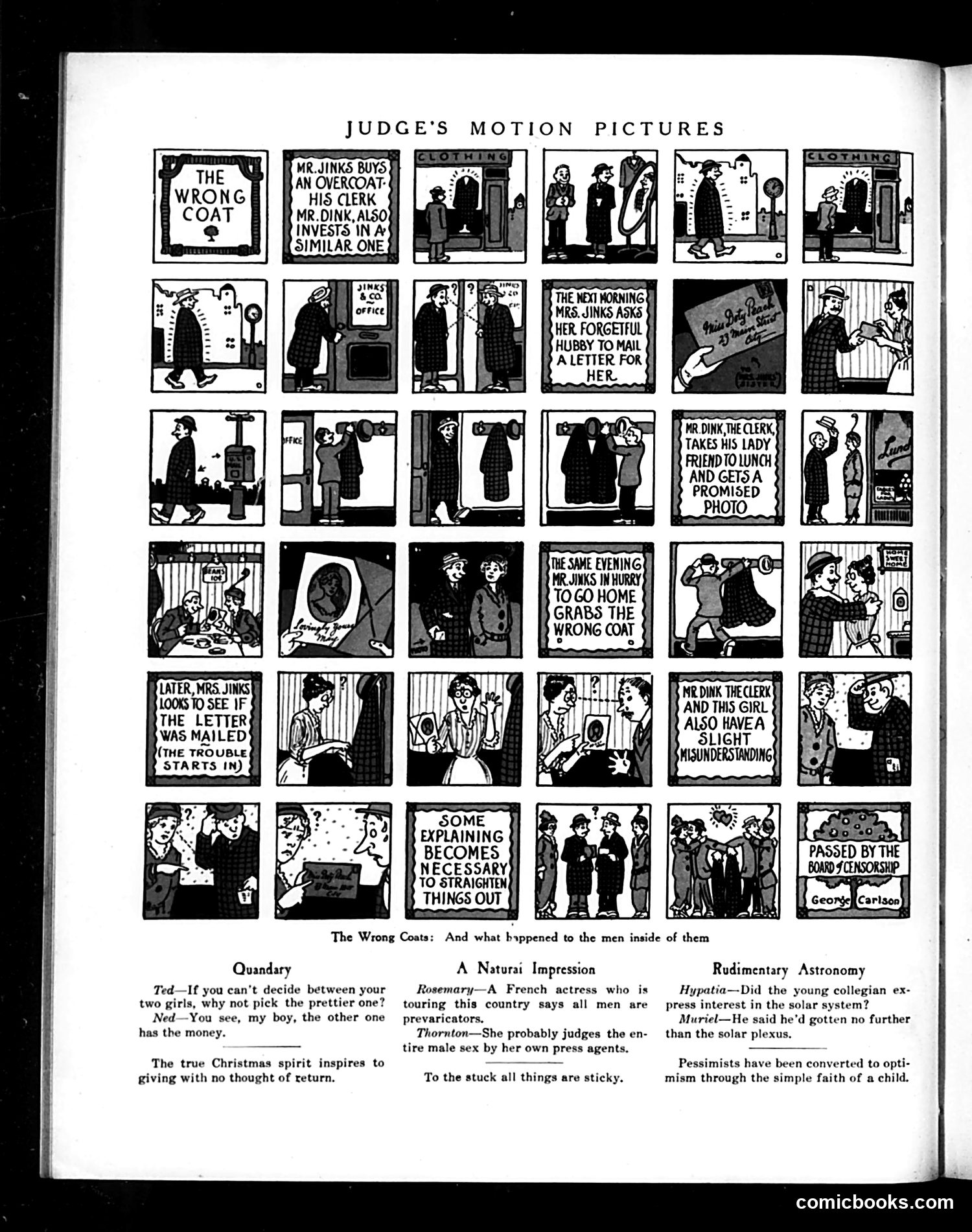
This is a multi-panel silent comic strip following a case of mistaken identity. Mr. Jinks accidentally takes home the wrong overcoat from his office, which belongs to another man. The narrative unfolds through the panels: Jinks's wife discovers the error, he attempts to return it, a letter goes missing, confusion ensues, and ultimately Jinks grabs the wrong coat again that evening—perpetuating the mix-up. The satire lampoons everyday urban mishaps and domestic complications arising from simple mistakes. The recurring "wrong coat" device symbolizes how minor errors cascade into absurd consequences. The humor relies on slapstick visual storytelling typical of early 20th-century Judge magazine comics. Below the strip are brief satirical quips about male-female relationships, French actresses, and philosophy—unrelated to the main narrative but characteristic of Judge's format mixing longer stories with short joke columns.
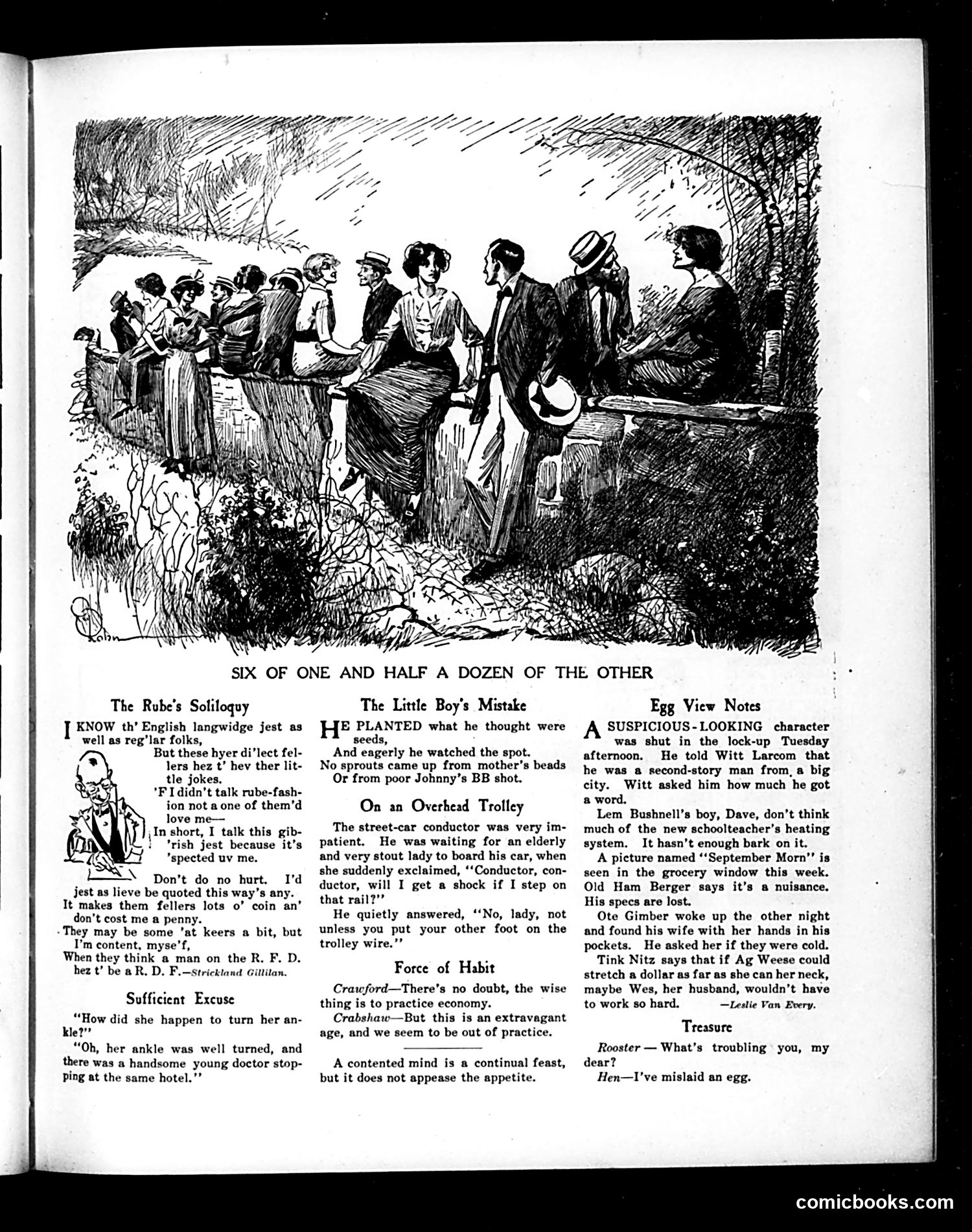
This Judge magazine page contains multiple humorous short pieces typical of early 20th-century American humor magazines: **The Rube's Soliloquy** satirizes a rural character who deliberately speaks in exaggerated dialect ("rube fashion") despite understanding proper English, because audiences expect and enjoy it. The joke critiques both the performer's cynicism and readers' appetite for stereotyped rural characters—he profits from playing a caricature. **Other brief pieces** include: a doctor-seduction joke about a sprained ankle; a child planting beads expecting crops; a fat woman asking a trolley conductor about electric shock (his reply implies she's so heavy she'd conduct electricity); and rural gossip anecdotes. The **title phrase** "Six of One and Half a Dozen of the Other" suggests these sketches offer similar humor from different angles—all playing with audience expectations and social stereotypes common to the era.
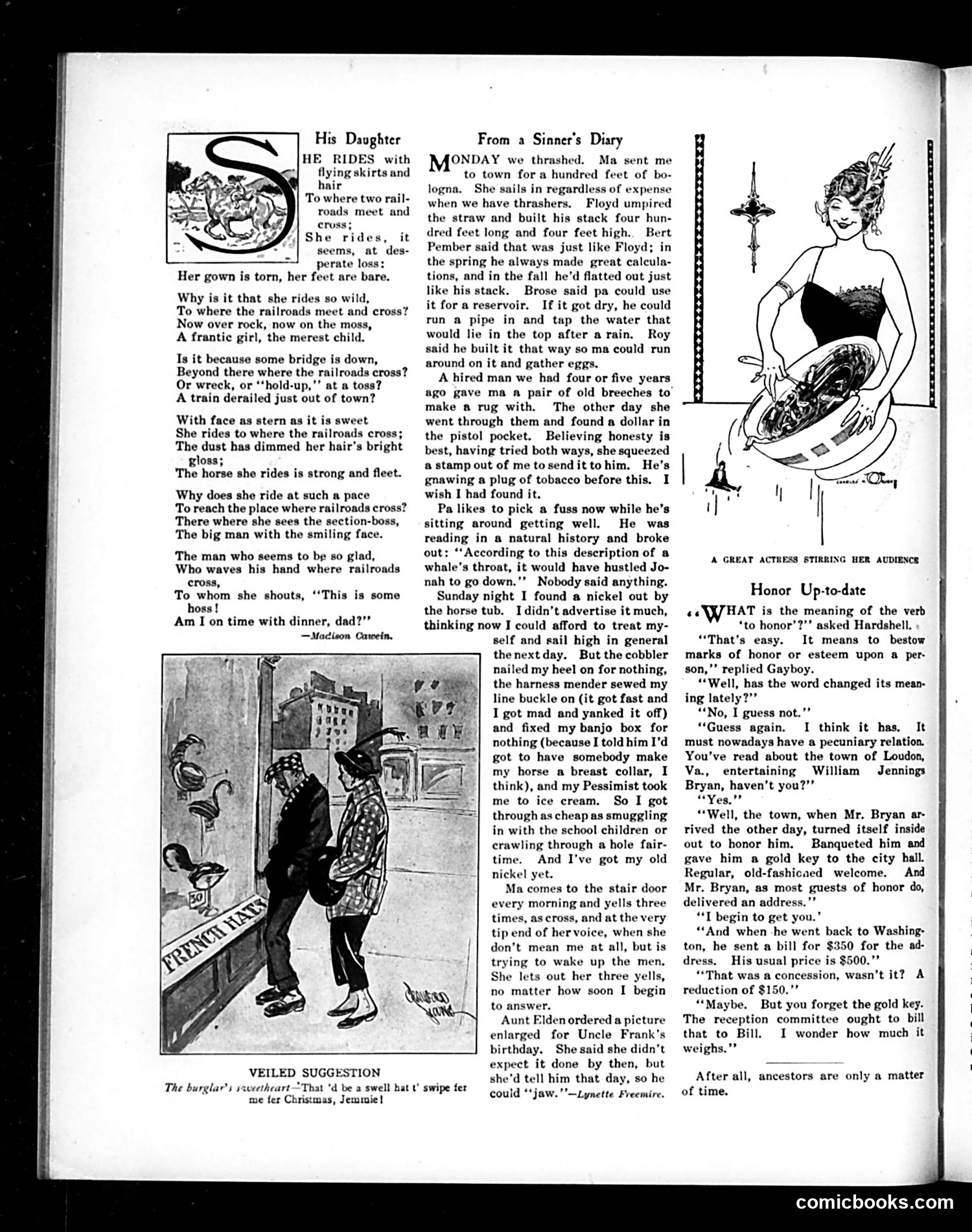
This page contains three distinct pieces of early 20th-century American humor: **"His Daughter"** (poem with illustration): A romantic narrative poem about a young woman riding frantically to meet her father—a railroad section boss—to deliver his dinner. The satire appears gentle, celebrating rural/working-class life while gently mocking the "desperate" appearance of an unladylike woman in torn clothes riding wildly. The point seems to be affectionate irony about duty and family obligation. **"From a Sinner's Diary"** (prose): A humorous rural narrative about farm life during threshing season, featuring working-class characters and their small economies (finding lost coins, bartering repairs). The humor derives from practical rural problem-solving and modest fortune. **"Veiled Suggestion"** (cartoon): Shows a burglar and his girlfriend discussing stealing a woman's hat as a Christmas gift—satirizing both petty crime and consumer materialism. **"Honor Up-to-date"** (dialogue): A brief satirical exchange playing on the word "honor" and its changing meaning in modern society. Overall, the page reflects Judge's mix of rural Americana, gentle social satire, and wordplay humor typical of early 1900s American magazines.
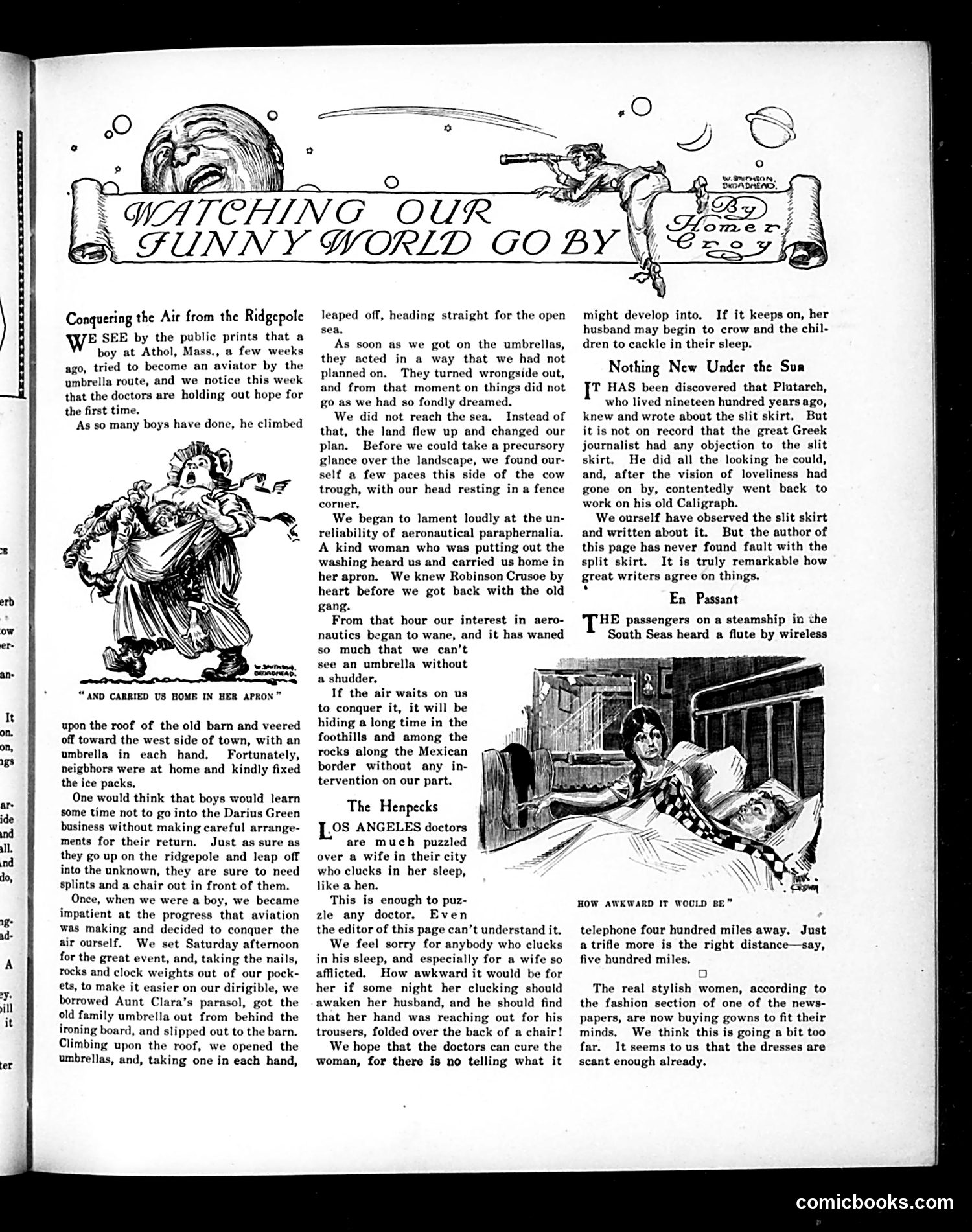
This page contains three humorous essays mocking early aviation and contemporary social trends: **"Conquering the Air from the Ridgepole"** satirizes boys imitating early aviators by jumping off barns with umbrellas—a reference to the actual Darius Green story and real accidents. The author recounts his own childhood attempt, ending comically in a cow trough, carried home in a woman's apron. The joke: aviation enthusiasm among the general public is dangerously premature and foolish. **"The Henpecks"** ridicules a Los Angeles woman who clucks in her sleep, extrapolating absurdly that her husband might crow and children cackle—mocking both medical puzzlement and gender dynamics of the era. **"Nothing New Under the Sun"** defends the fashionable "slit skirt" by noting even ancient Plutarch found it acceptable, while claiming the author himself has "observed" it without complaint—playful commentary on contemporary fashion debates and male hypocrisy about women's clothing. All three pieces use exaggeration and self-deprecating humor typical of early 20th-century satirical magazines.
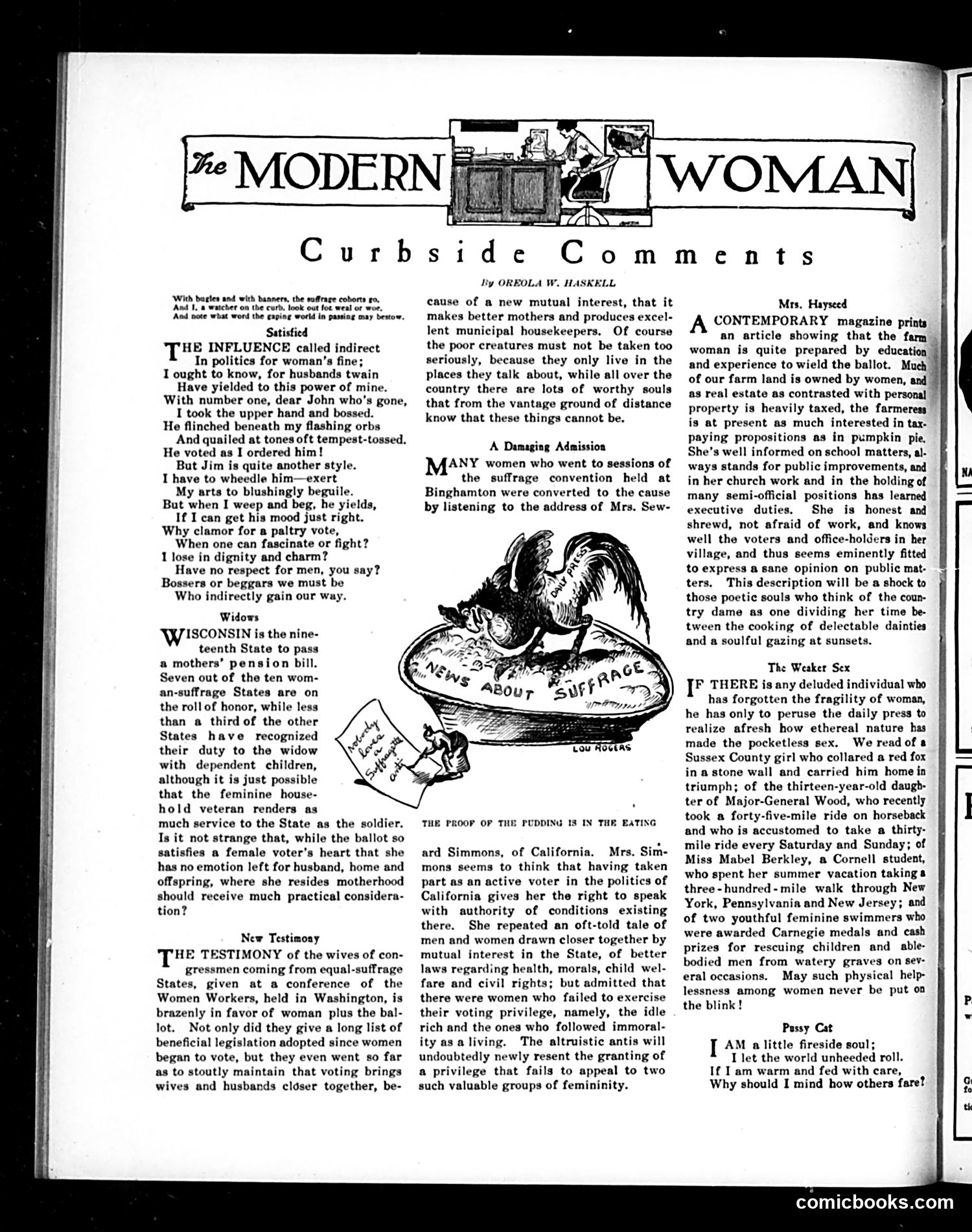
This page satirizes women's suffrage advocates through multiple angles: **Main Cartoon**: The bird labeled "News About Suffrage" sits in a nest containing competing claims—likely representing how suffrage arguments contradict each other. **Poems/Essays**: Written by "Oreola W. Haskell," these mock pro-suffrage arguments: 1. **"Satisfied"**: A woman boasts she already controls men through manipulation (wheedling, weeping, "fascination") rather than voting, arguing formal suffrage is unnecessary. 2. **"Widows"**: Sarcastically notes Wisconsin passed mothers' pensions while questioning whether women voters actually care about family welfare if they're so satisfied with the ballot. 3. **"Curbside Comments"**: Attacks testimonies from suffragists' wives claiming voting strengthens marriages and improves legislation. The author dismissively calls them "poor creatures" and suggests distance-observers know better. **The satire's point**: Anti-suffrage conservatives argue women already possess informal power over men and shouldn't need formal voting rights—and that female voters aren't delivering promised social benefits. The tone is condescending, treating suffragists as deluded or hypocritical.
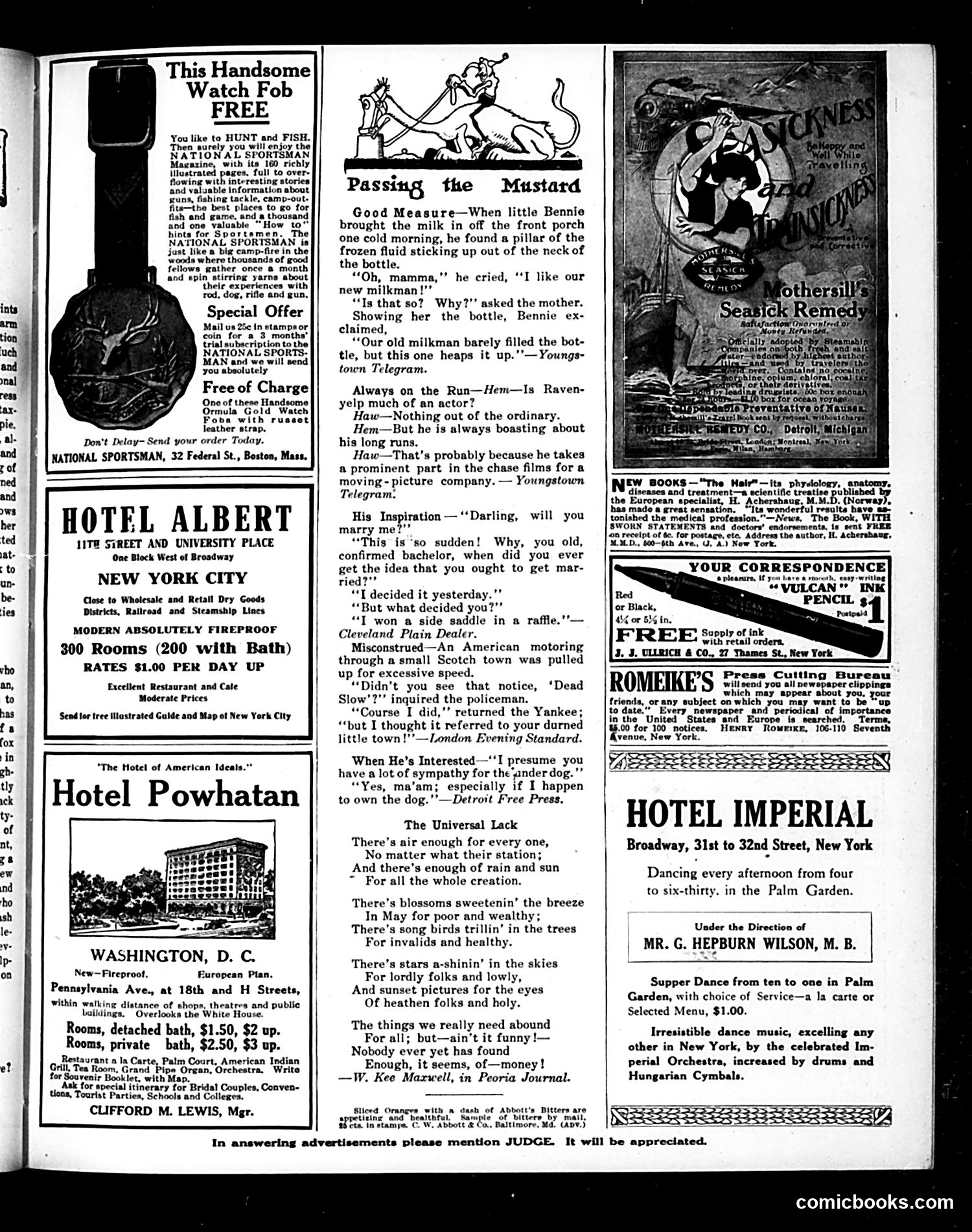
This page is primarily **advertising with humor content**, typical of early 20th-century Judge magazine. The visual cartoon at top ("Passing the Mustard") depicts a child discovering frozen milk protruding from a bottle—a joke about a new milkman's generosity compared to the previous one who "barely filled the bottle." The page contains **six short humorous anecdotes** playing on wordplay and misunderstandings: - An actor's "long runs" (stage vs. film chase scenes) - A bachelor's sudden marriage proposal motivation (winning a saddle in a raffle) - A reckless American driver misinterpreting a "Dead Slow" street sign as referring to the town itself - A man's sympathy for underdogs correlating to dog ownership The final poem, "The Universal Lack," employs populist humor—nature provides abundance for rich and poor alike, yet **nobody can find enough money**—a likely commentary on economic inequality during this period. The remainder consists of hotel and product advertisements typical of the era.
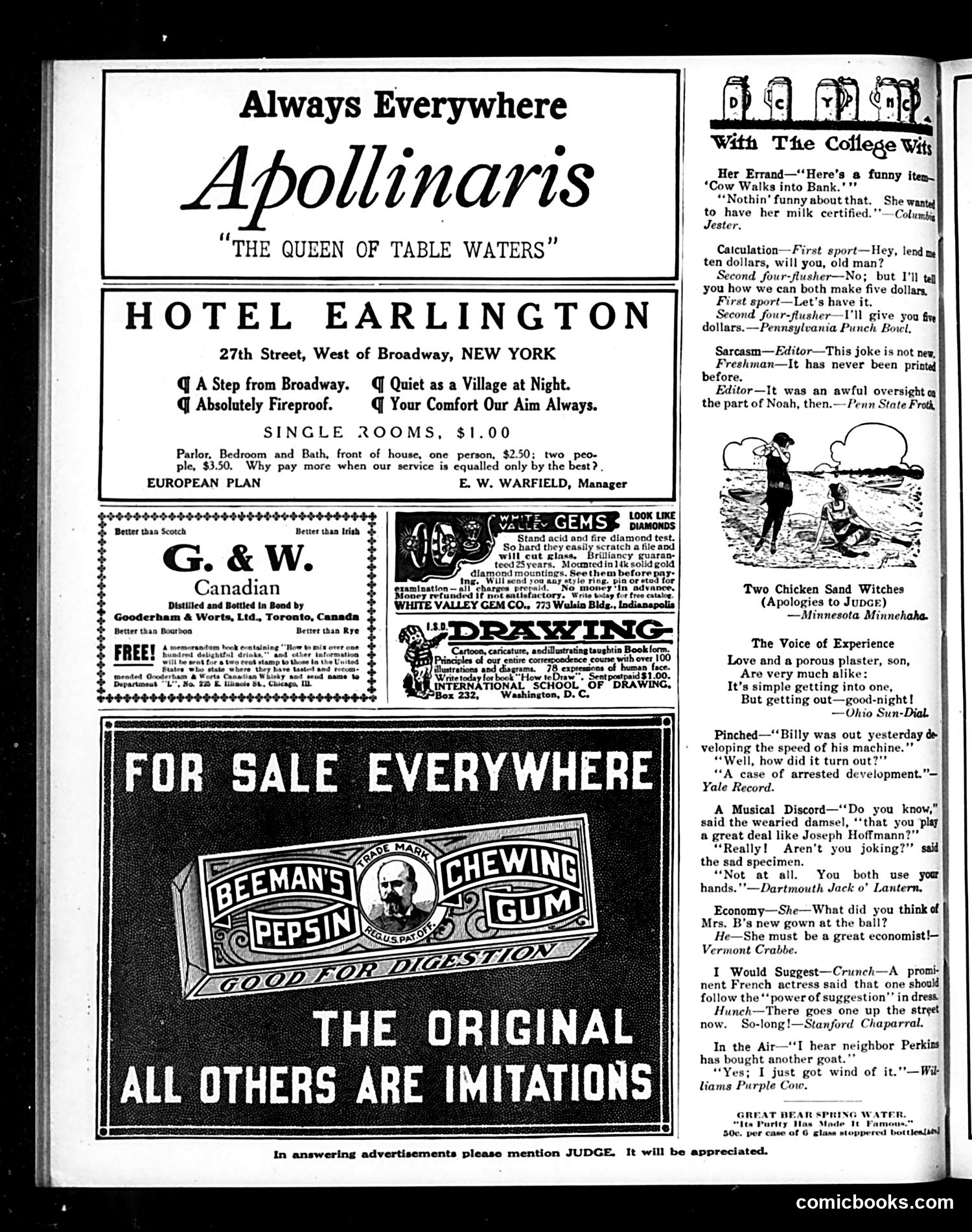
This is primarily a **commercial advertising page** rather than editorial content. The page features multiple product advertisements (hotel, spirits, jewelry, drawing school) alongside brief humorous snippets from various college publications. The cartoons and jokes are lightweight campus humor typical of the era: - **"Cow Walks into Bank"**: A play on words—the joke's humor relies on the unexpected literalism (the cow actually needs milk certification, not the setup suggesting something absurd). - **"Two Chicken Sand Witches"**: An obvious pun on "sandwiches," credited to college humor magazines. - Other brief jokes exploit wordplay and double-meanings common to early 20th-century collegiate humor. The page reflects **Judge magazine's format**: mixing advertising revenue with reprinted jokes from college publications, creating a compilation of mild, pun-based humor. There are no identifiable political figures or sophisticated satire—this appears to be filler content designed to fill space while generating advertising income.
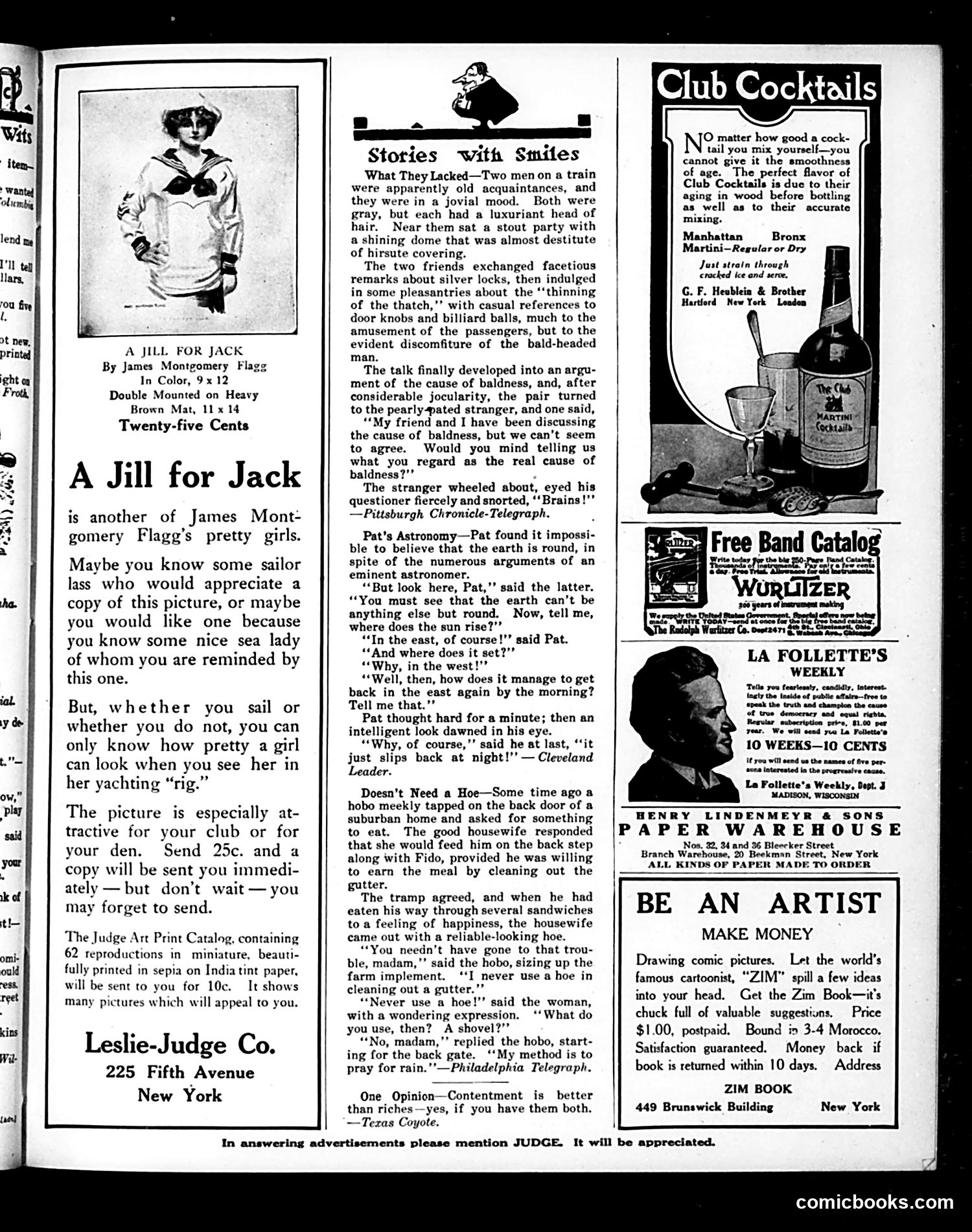
This page is primarily **advertising and product promotion**, not political satire. It features: **Main Content:** James Montgomery Flagg's illustration of an attractive woman in yachting attire, offered as a 25-cent art print. The accompanying text appeals to male readers (sailors, club members) as a decorative picture for their spaces. **Humor Section:** "Stories with Smites" contains three brief jokes: - Two men mock a bald stranger about hair loss; he replies the cause is "brains" - An Irishman ("Pat") struggles with the concept of a round Earth, theorizing the sun "slips back at night" - A hobo avoids gutter-cleaning by claiming his method is "to pray for rain" These are generic period humor—playing on stereotypes of Irish immigrants as simple-minded and tramps as lazy—with no specific political reference. The page reflects early 20th-century popular comedy conventions rather than satirical commentary.
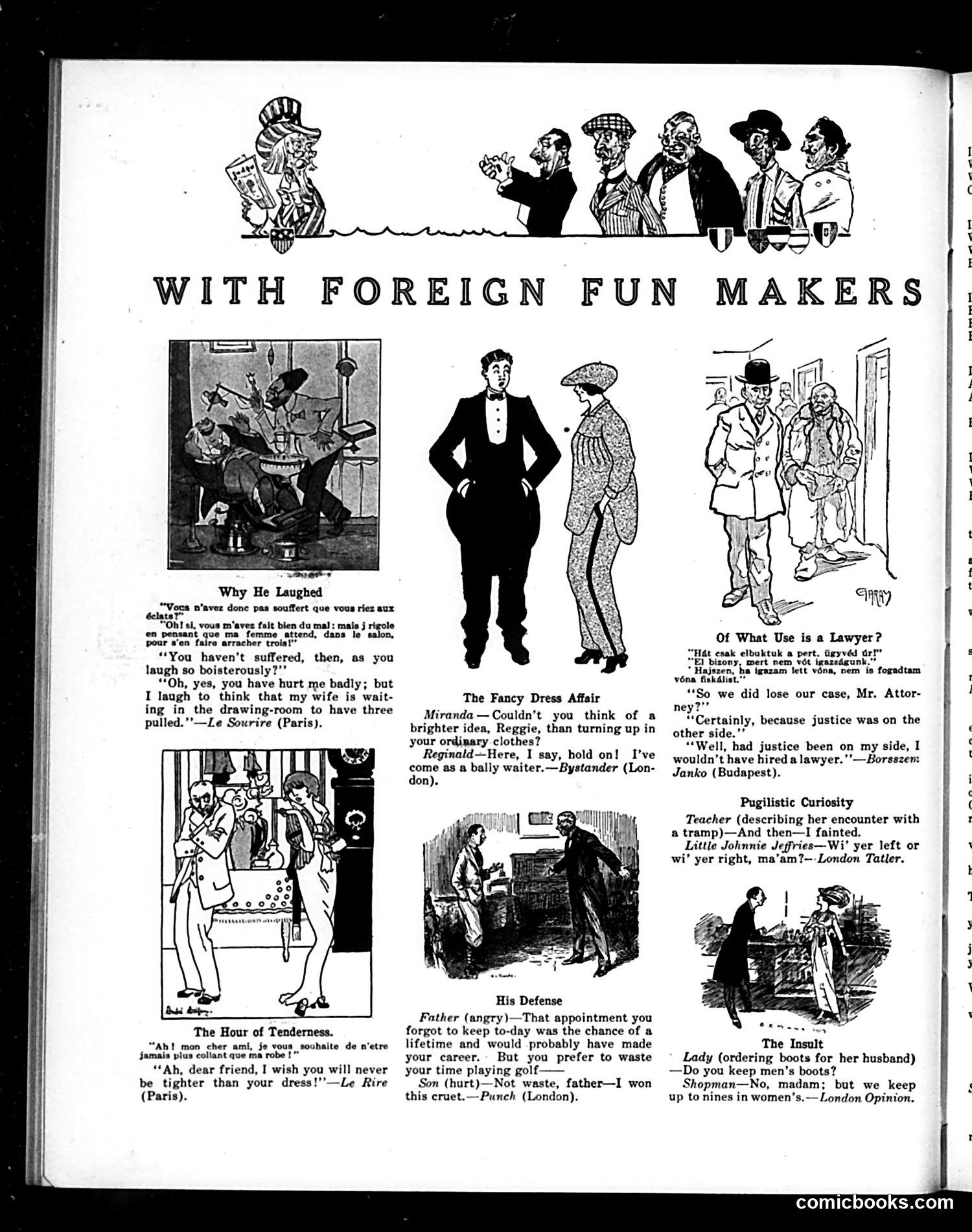
This page collects humorous anecdotes translated from European satirical publications (Le Sourire, Le Rire, Bystander, Punch, and Hungarian Borsszen). The cartoons illustrate jokes about marital discord, social awkwardness, and legal/professional incompetence. Key examples: A man laughs about dental extractions his waiting wife faces; a woman wishes her suitor weren't as clingy as her dress; a son defends golfing by claiming he won a cruet; a Hungarian lawyer admits he lost because justice favored the other side (implying clients only hire lawyers when they lack justice). The final jokes play on gender expectations: a teacher "fainting" with her left or right hand, and a shopman keeping women's shoe sizes but not men's—suggesting women are the primary boot purchasers. The page demonstrates early 20th-century transatlantic humor-sharing and period attitudes toward marriage, incompetent professionals, and gender roles.
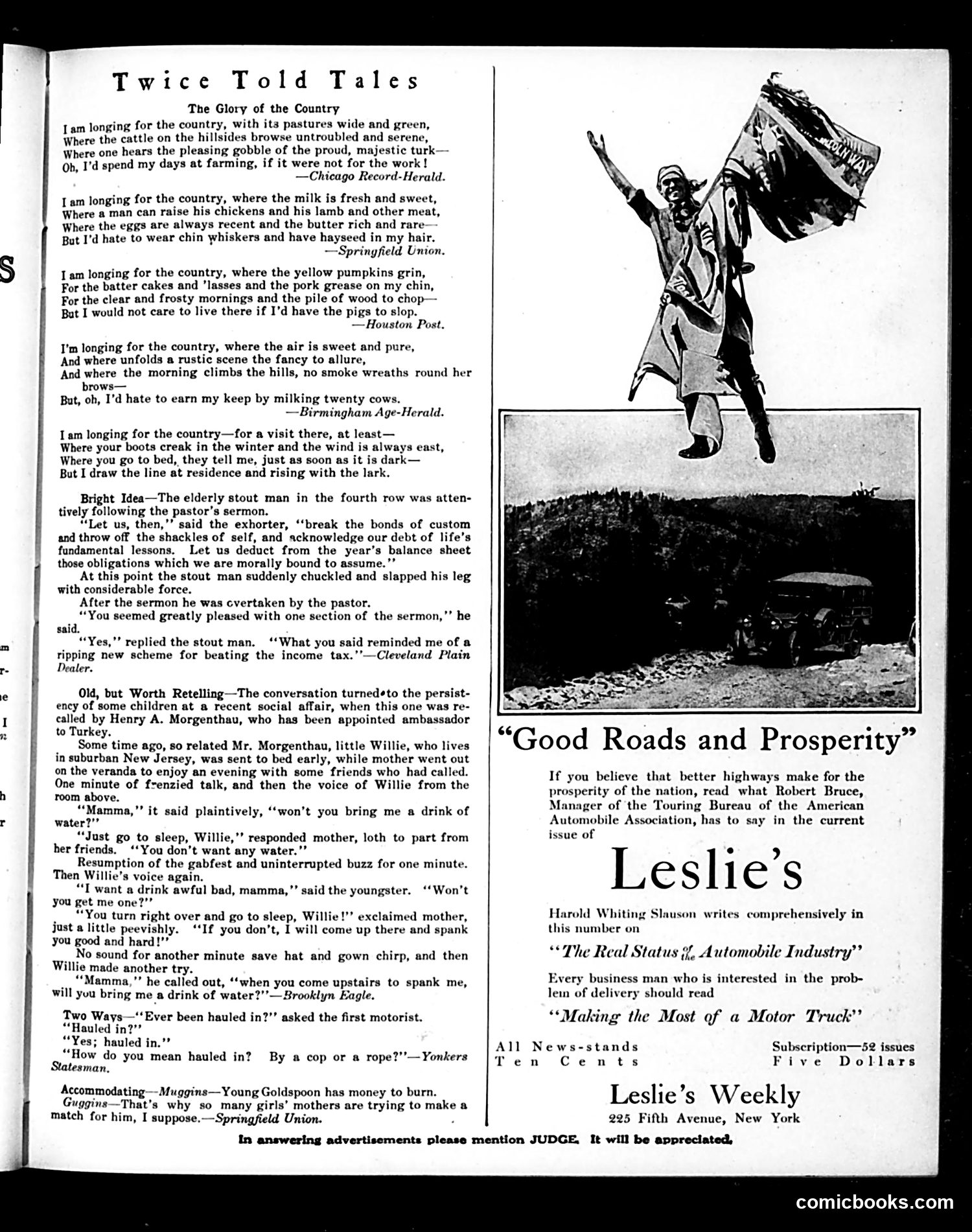
This page contains humorous "twice-told tales"—reprinted jokes and anecdotes from various newspapers. The main satirical content consists of five interconnected rural fantasy pieces mocking urbanites' romanticized notions of country life. **The "Glory of the Country" series** presents a recurring joke: city dwellers fantasize about pastoral farming but acknowledge they'd never endure actual farm labor—milking cows, wearing "hayseed," sloping pigs, or rising at dawn. Each attributed quote (Chicago Record-Herald, Springfield Union, etc.) undercuts romantic agrarianism with pragmatic complaints, satirizing middle-class nostalgia disconnected from reality. Secondary anecdotes include a minister's sermon about moral obligations inadvertently inspiring tax-evasion schemes, a persistent child using clever negotiation to extract water, and motorist slang ("hauled in"). The accompanying advertisement promotes Leslie's Weekly magazine, featuring an automobile-themed illustration emphasizing "Good Roads and Prosperity." The satire targets educated Americans' sentimental fantasies about rural life while remaining fundamentally city-bound—a timeless critique of escapism without commitment.
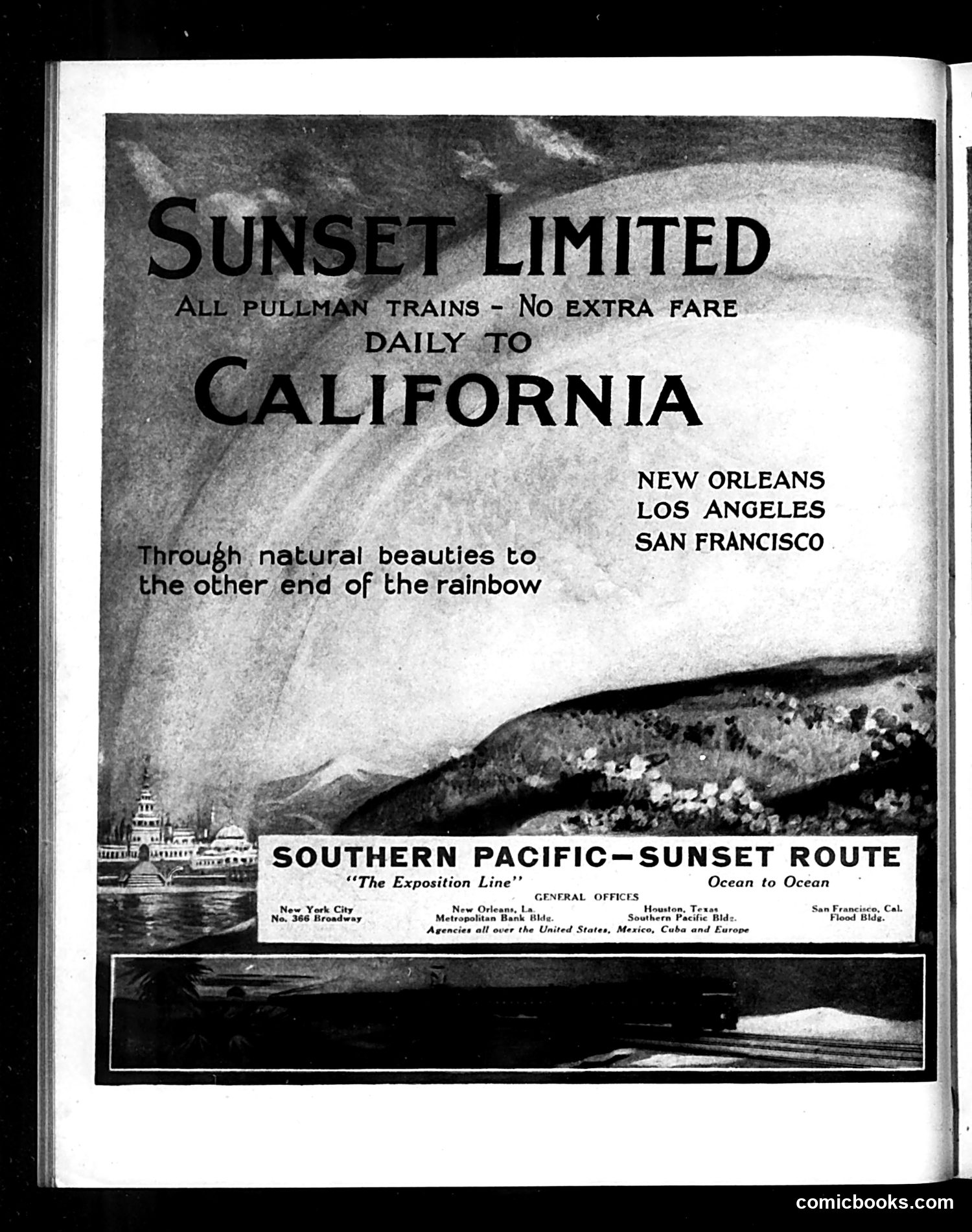
This page is not a cartoon or satire—it's a full-page advertisement for the Southern Pacific Railroad's "Sunset Limited" train service. The ad promotes daily Pullman train service from New Orleans, Los Angeles, and San Francisco, marketing the route as traveling "through natural beauties to the other end of the rainbow." The phrase "The Exposition Line" and "Ocean to Ocean" emphasize cross-country connectivity. The dramatic landscape imagery (appearing to show a desert or canyon vista) reinforces the scenic appeal. General offices are listed in three cities. This is vintage railroad advertising designed to attract affluent travelers during the early-to-mid 20th century, not satirical content.