
Judge, 1914-01-10 · page 4 of 24
Judge — January 10, 1914 — page 4: what you’re looking at
What you’re looking at
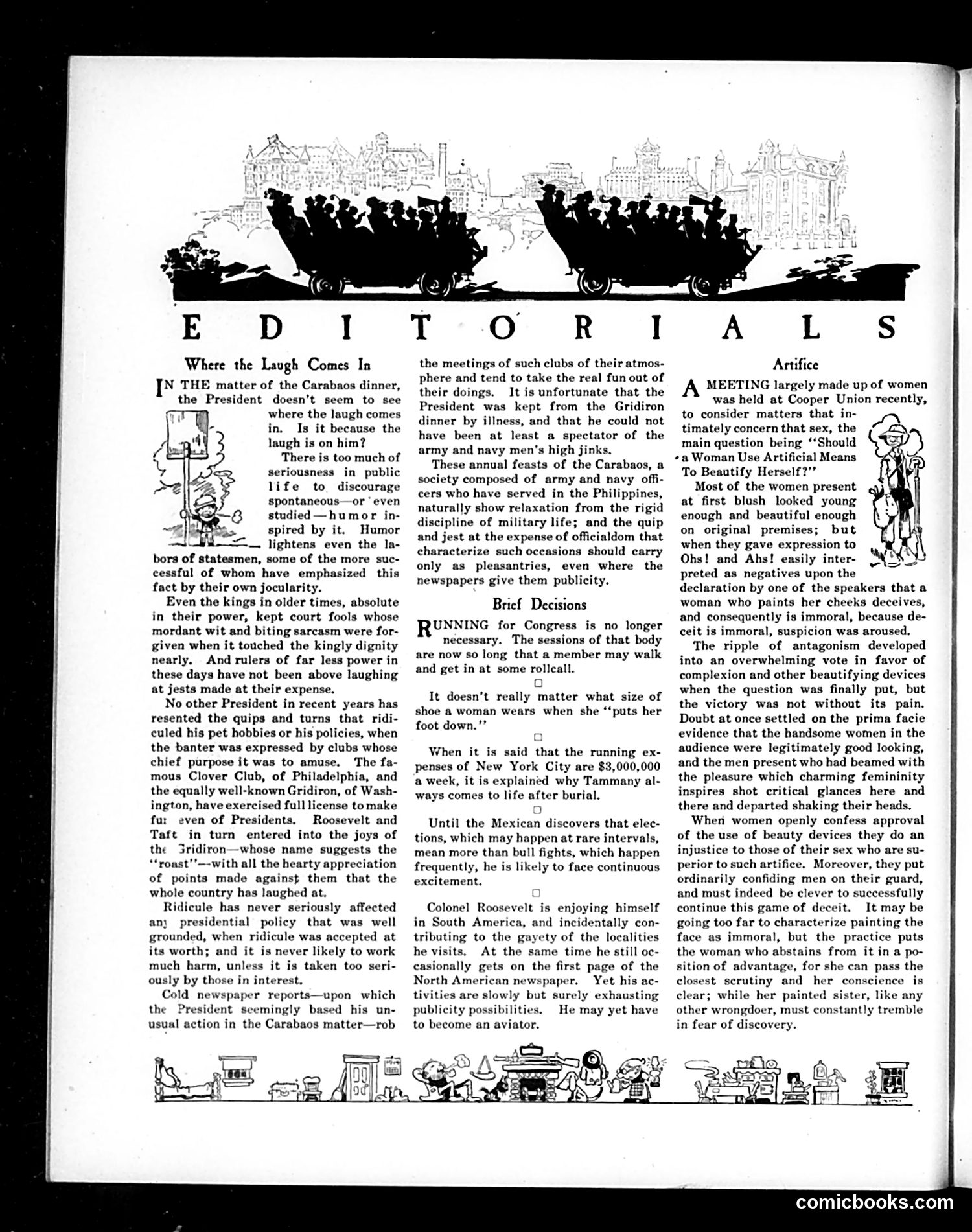
This page satirizes President Theodore Roosevelt's social activities and public persona. The header cartoon depicts two overflowing carriages of people heading toward a cityscape, illustrating Roosevelt's active social calendar. The main editorial "Where the Laugh Comes In" criticizes Roosevelt for attending the Gridiron Club dinner—a prestigious gathering of journalists and military officers. The piece argues the President's presence inhibits genuine humor and relaxation, as officials become overly formal and dignified around him. "Brief Decisions" section mocks various contemporary issues: women's use of beauty aids (deemed immoral by some), congressional candidates' campaign expenses ($3,000,000 for New York City races), and Roosevelt's South American travels, suggesting his publicity-seeking extends even abroad. The satire targets both Roosevelt's omnipresence in social life and era-specific controversies about propriety and gender.
📄 Transcribed text from this page (OCR, searchable)
Machine-transcribed from the original scan — historical spelling and the odd misread are preserved.
Where the Laugh Comes In N THE matter of the Carabaos dinner, the President doesn’t seem to see where the laugh comes in. Is it because the laugh is on him? There is too much of seriousness in public life to discourage spontaneous—or ‘even studied —humor in- a> spired by it. Humor =. lightens even the la- bors of statesmen, some of the more suc- cessful of whom have emphasized this fact by their own jocularity. Even the kings in older times, absolute in their power, kept court fools whose mordant wit and biting sarcasm were for- given when it touched the kingly dignity nearly. And rulers of far less power in these days have not been above laughing at jests made at their expense. No other President in recent years has resented the quips and turns that ridi- culed his pet hobbies or his policies, when the banter was expressed by clubs whose chief purpose it was to amuse. The fa- mous Clover Club, of Philadelphia, and the equally well-known Gridiron, of Wash- ington, have exercised full license tomake fur even of Presidents. Roosevelt and Taft in turn entered into the joys of Sridiron—whose name suggests the -with all the hearty appreciation of points made against them that the whole country has laughed at. Ridicule has never seriously affected an} presidential policy that was well grounded, when ridicule was accepted at its worth; and it is never likely to work much harm, unless it is taken too seri- ously by those in interest. Cold newspaper reports—upon which the President seemingly based his un- usual action in the Carabaos matter—rob the meetings of such clubs of their atmos- phere and tend to take the real fun out of their doings. It is unfortunate that the President was kept from the Gridiron dinner by illness, and that he could not have been at least a spectator of the army and navy men’s high jinks. These annual feasts of the Carabaos, a society composed of army and navy offi- cers who have served in the Philippines, naturally show relaxation from the rigid discipline of military life; and the quip and jest at the expense of officialdom that characterize such occasions should carry only as pleasantries, even where the newspapers give them publicity. Brief Decisions UNNING for Congress is no longer necessary. The sessions of that body are now so long that a member may walk and get in at some rolleall. is) It doesn’t really matter what size of shoe a woman wears when she ‘‘puts her foot down."” When it is said that the running ex- penses of New York City are $3,000,000 ‘a week, it is explained why Tammany al- ways comes to life after burial. } Until the Mexican discovers that elec- tions, which may happen at rare intervals, mean more than bull fights, which happen frequently, he is likely to face continuous excitement. Colonel Roosevelt is enjoying himself in South America, and incidentally con- tributing to the gayety of the localities he visits. At the same time he still oc- casionally gets on the first page of the North American newspaper. Yet his ac- tivities are slowly but surely exhausting publicity possibilities. He may yet have to become an aviator. Artifice A MEETING largely made up of women was held at Cooper Union recently, to consider matters that in- timately concern that sex, the main question being ‘‘Should +a Woman Use Artificial Means To Beautify Herself?’’ Most of the women present at first blush looked young enough and beautiful enough on original premises; but when they gave expression to Ohs! and Ahs! easily inter- preted as negatives upon the declaration by one of the speakers that a woman who paints her cheeks deceives, and consequently is immoral, because de- ceit is immoral, suspicion was aroused. The ripple of antagonism developed into an overwhelming vote in favor of complexion and other beautifying devices when the question was finally put, but the victory was not without its pain. Doubt at once settled on the prima facie evidence that the handsome women in the audience were legitimately good looking, and the men present who had beamed with the pleasure which charming femininity inspires shot critical glances here and there and departed shaking their heads, When women openly confess approval of the use of beauty devices they do an injustice to those of their sex who are su- perior to such artifice. Moreover, they put ordinarily confiding men on their guard, and must indeed be clever to successfully continue this game of di It may be going too far to characterize painting the face as immoral, but the practice puts the woman who abstains from it in a po- on of advantage, for she can pass the closest scrutiny and her conscience is Ci ; while her painted sister, like any other wrongdoer, must constantly tremble in fear of discovery. =, comicbooks.com