
Judge, 1914-01-10 · page 10 of 24
Judge — January 10, 1914 — page 10: what you’re looking at
What you’re looking at
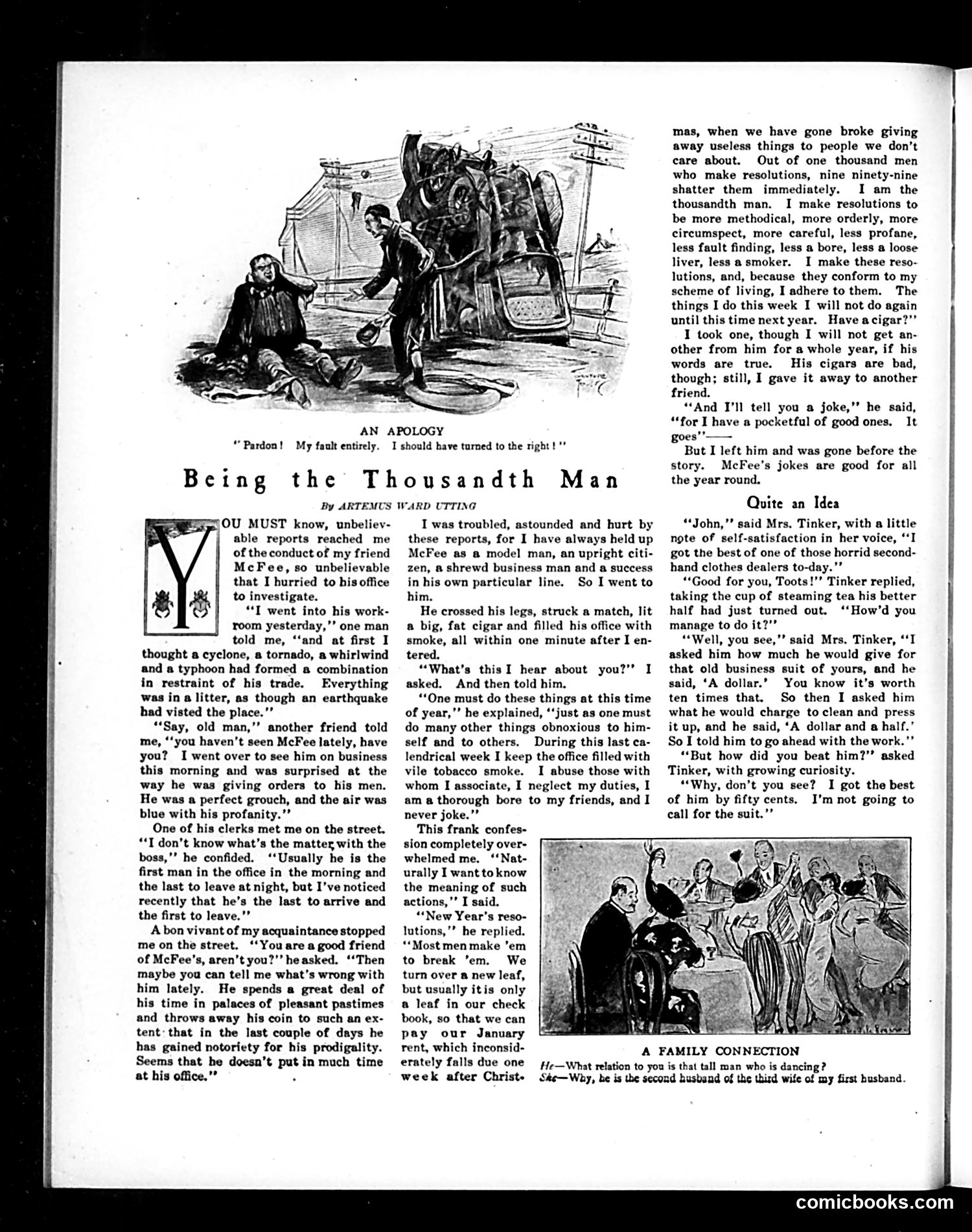
This page satirizes New Year's resolutions and hypocrisy. The main story, "Being the Thousandth Man," presents McFee, a businessman whose conduct has reportedly deteriorated—he's become slovenly, profane, negligent, and dissolute. When confronted, McFee reveals he's deliberately behaving badly *because* it's the week before New Year's. He explains that he makes resolutions annually and actually keeps them, so he indulges all his vices beforehand as a kind of "system." The satire's point: while 999 of 1,000 men break their resolutions immediately, McFee is "the thousandth man" who follows through—but this requires him to compartmentalize his bad behavior into one specific week. The cartoon illustrates the absurdity of this rationalization: his meticulous adherence to resolutions is enabled only by pre-planned moral collapse. The secondary anecdote about Mrs. Tinker similarly mocks self-satisfaction over minor victories. The humor targets self-deception and the ritualistic emptiness of New Year's resolutions.
📄 Transcribed text from this page (OCR, searchable)
Machine-transcribed from the original scan — historical spelling and the odd misread are preserved.
AN APOLOGY “Pardon! My fault entirely. the By ARTEMUS OU MUST know, unbeliev- able reports reached me of the conduct of my friend McFee, so unbelievable that I hurried to bis office to investigate. “I went into his work- room yesterday,’’ one man told me, ‘‘and at first I thought a cyclone, a tornado, a whirlwind and a typhoon had formed a combination in restraint of his trade. Everything was in a litter, as though an earthquake had visted the plac “Say, old man,’’ another friend told ie, ‘‘you haven't seen McFee lately, have you? I went over to see him on business this morning and was surprised at the way he was giving orders to his men. He was a perfect grouch, and the air was blue with his profanity.’’ One of his clerks met me on the street. “I don’t know what’s the matter with the boss,’’ he confided. ‘‘Usually he is the first man in the office in the morning and the last to leave at night, but I’ve noticed recently that he’s the last to arrive and the first to leave.’” A bon vivant of my acquaintance stopped me on the street. ‘‘You are a good friend of McFee’s, aren't you?”’ heasked. ‘‘Then maybe you can tell me what’s wrong with him lately. He spends a great deal of his time in palaces of pleasant pastimes and throws away his coin to such an ex- tent: that in the last couple of days he has gained notoriety for his prodigality. Seems that he doesn’t ae in much time at his office.” Being BS T should have turned to the right !"" Thousandth Man WARD UTTING I was troubled, astounded and hurt by these reports, for I have always held up McFee as a model man, an upright citi- zen, a shrewd business man and a success in his own particular line. So I went to him. He crossed his legs, struck a match, lit a big, fat cigar and filled his office with smoke, all within one minute after I en- tered. “What’s thisI hear about you?” I asked. And then told him. “‘One must do these things at this time of year,”’ he explained, ‘‘just as one must do many other things obnoxious to him- self and to others. During this last ca- lendrical week I keep the office filled with vile tobacco smoke. I abuse those with whom I associate, I neglect my duties, I am a thorough bore to my friends, and I never joke.” This frank confes- mas, when we have gone broke giving away useless things to people we don’t care about. Out of one thousand men who make resolutions, nine ninety-nine shatter them immediately. I am the thousandth man. I make resolutions to be more methodical, more orderly, more circumspect, more careful, less profane, less fault finding, less a bore, less a loose liver, less a smoker. I make these reso- lutions, and, because they conform to my scheme of living, I adhere tothem. The things I do this week I will not do again until this time next year. Have acigar?”’ I took one, though I will not get an- other from him for a whole year, if his words are true. His cigars are bad, though; still, I gave it away to another friend. “And I'll tell you a joke,” he said, “for I have a pocketful of good ones. It goes’’—— But I left him and was gone before the story. McFee’s jokes are good for all the year round, Quite an Idea “John,’’ said Mrs. Tinker, with a little note of self-satisfaction in her voice, ‘‘I got the best of one of those horrid second- hand clothes dealers to-day.”” “Good for you, Toots!’’ Tinker replied, taking the cup of steaming tea his better half had just turned out. ‘How'd you manage to do it?’”” “Well, you see,’’ said Mrs. Tinker, ‘‘I asked him how much he would give for that old business suit of yours, and he said, ‘A dollar.’ You know it’s worth ten times that. So then I asked him what he would charge to clean and press it up, and he said, ‘A dollar and a half.’ So I told him to go ahead with the work.”” “But how did you beat him?’’ asked Tinker, with growing curiosity. “Why, don’t you see? I got the best of him by fifty cents, I’m not going to call for the suit.’”’ sion completely over- whelmed me. ‘‘Nat- urally I want toknow the meaning of such actions,"’ I said. “New Year's reso- lutions,”” he replied. “*Most men make ’em to break ’em. We turn over a new leaf, but usually itis only a leaf in our check book, so that we can pay our January rent, which inconsid- erately falls due one week after Christ. A FAMILY CONNECTION He—What relation to you is that tall man who is dancing? She—Why, he is the second husband of the thisd wife of my first husband. comicbooks.com