
Judge, 1914-01-10 · page 23 of 24
Judge — January 10, 1914 — page 23: what you’re looking at
What you’re looking at
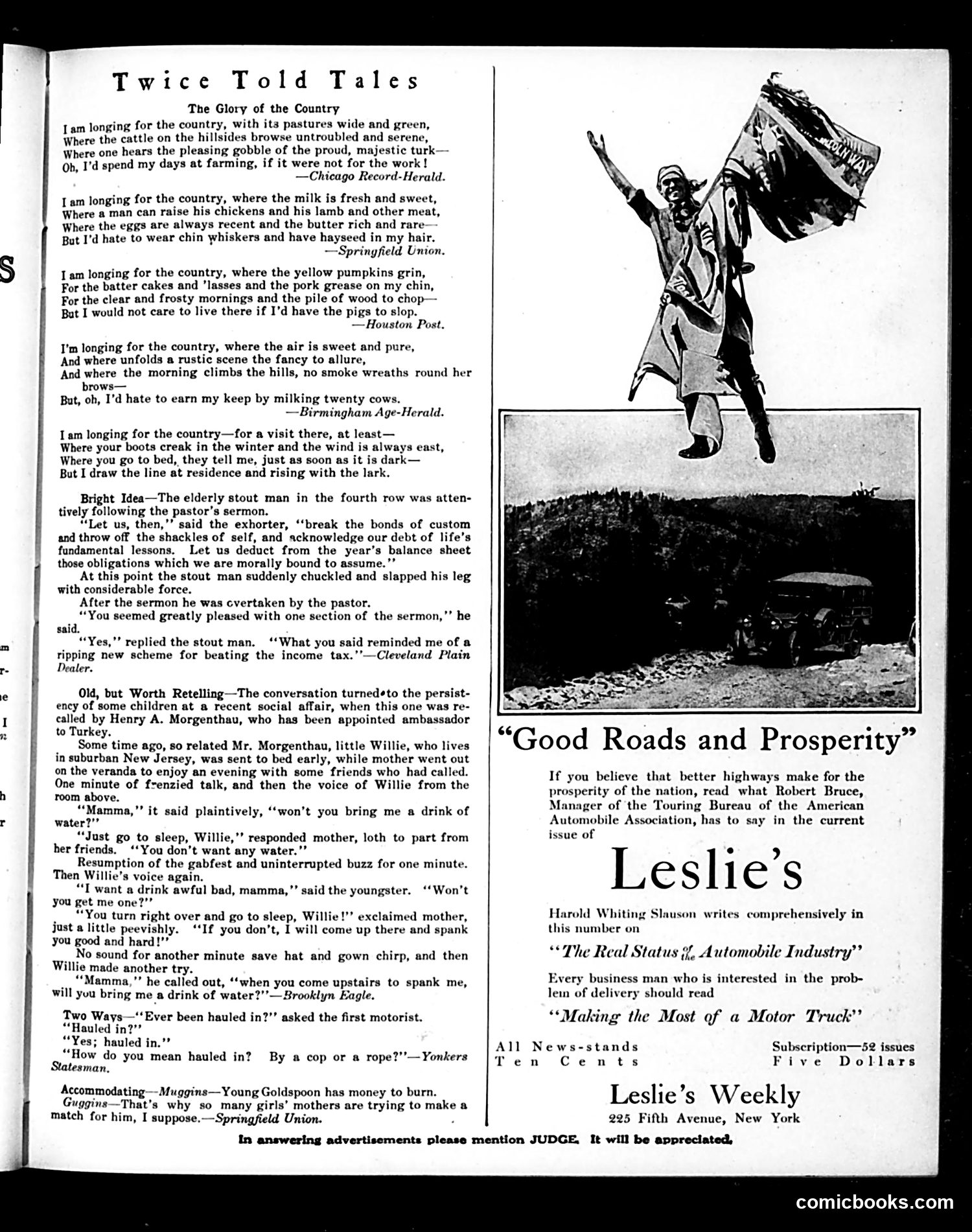
This page contains humorous "twice-told tales"—reprinted jokes and anecdotes from various newspapers. The main satirical content consists of five interconnected rural fantasy pieces mocking urbanites' romanticized notions of country life. **The "Glory of the Country" series** presents a recurring joke: city dwellers fantasize about pastoral farming but acknowledge they'd never endure actual farm labor—milking cows, wearing "hayseed," sloping pigs, or rising at dawn. Each attributed quote (Chicago Record-Herald, Springfield Union, etc.) undercuts romantic agrarianism with pragmatic complaints, satirizing middle-class nostalgia disconnected from reality. Secondary anecdotes include a minister's sermon about moral obligations inadvertently inspiring tax-evasion schemes, a persistent child using clever negotiation to extract water, and motorist slang ("hauled in"). The accompanying advertisement promotes Leslie's Weekly magazine, featuring an automobile-themed illustration emphasizing "Good Roads and Prosperity." The satire targets educated Americans' sentimental fantasies about rural life while remaining fundamentally city-bound—a timeless critique of escapism without commitment.
📄 Transcribed text from this page (OCR, searchable)
Machine-transcribed from the original scan — historical spelling and the odd misread are preserved.
Twice Told Tales The Glory of the Country [am longing for the country, with its pastures wide and green, Where the cattle on the hillsides browse untroubled and serene, Where one hears the pleasing gobble of the proud, majestic turk— Oh, I'd spend my days at farming, if it were not for the work ! —Chicago Record-Herald. I am longing for the country, where the milk is fresh and sweet, Where a man can raise his chickens and his lamb and other meat, Where the eggs are always recent and the butter rich and rare But I'd hate to wear chin whiskers and have hayseed in my hair. —Springfield Union. J am longing for the country, where the yellow pumpkins grin, For the batter cakes and ’lasses and the pork grease on my chin, For the clear and frosty mornings and the pile of wood to chop— But I would not care to live there if I’d have the pigs to slop. —Houston Post. I’m longing for the country, where the air is sweet and pure, And where unfolds a rustic scene the fancy to allure, And where the morning climbs the hills, no smoke wreaths round her brows— But, oh, I'd hate to earn my keep by milking twenty cows. —Birmingham Age-Herald. Lam longing for the country—for a visit there, at least— Where your boots creak in the winter and the wind is always east, Where you go to bed, they tell me, just as soon as it is dark— But I draw the line at residence and rising with the lark. Bright Idea—The elderly stout man in the fourth row was atten- tively following the pastor’s sermon. “Let us, then,’’ said the exhorter, ‘‘break the bonds of custom and throw off the shackles of self, and acknowledge our debt of life’s fundamental lessons. Let us deduct from the year’s balance sheet those obligations which we are morally bound to assume.’’ At this point the stout man suddenly chuckled and slapped his leg with considerable force. After the sermon he was cvertaken by the pastor. i You seemed greatly pleased with one section of the sermon,’’ he said. “Yes,”’ replied the stout man. “‘What you said reminded me of a = ripping new scheme for beating the income tax.’’—Cleveland Plain " Dealer. e Old, but Worth Retelling—The conversation turnedeto the persist- ency of some children at a recent social affair, when this one was re- I called by Henry A. Morgenthau, who has been appointed ambassador n to Turkey. Some time ago, so related Mr. Morgenthau, little Willie, who lives in suburban New Jersey, was sent to bed early, while mother went out on the veranda to enjoy an evening with some friends who had called. One minute of frenzied talk, and then the voice of Willie from the h room above. “Mamma,” it said plaintively, “‘won’t you bring me a drink of r water?” “Just go to sleep, Willie,’ responded mother, loth to part from her friends. ‘You don’t want any water.”” Resumption of the gabfest and uninterrupted buzz for one minute. Then Willie’s voice again. “T want a drink awful bad, mamma,”’ said the youngster. ‘‘Won’t you get me one?” _ _ “You turn right over and go to sleep, Willi xclaimed mother, Just a little peevishly. ‘‘If you don’t, I will come up there and spank you good and hard!’’ No sound for another minute save hat and gown chirp, and then made another try. _, ‘Mamma,’’ he called out, ‘‘when you come upstairs to spank me, will you bring me a drink of water?”"—Brooklyn Eagle. Two Ways—‘‘Ever been hauled in?’ asked the first motorist. “‘Hauled in?” “Yes; hauled in.’’ “How do you mean hauled in? Statesman, By a cop or a rope?’’— Yonkers Accommodating—Muggins—Young Goldspoon has money to burn. Guggins—That’s why so many girls’ mothers are trying to make a match for him, I suppose.—Springfield Union. : In answering advertisements please mention JUDGE, It will be appreciated, “Good Roads and Prosperity” If you believe that better highways make for the prosperity of the nation, read what Robert Bruce, Manager of the Touring Bureau of the American Automobile Association, has to say in the current Leslie’s Harold Whiti this number on “The Real Status § Every business man who is interested in the prob- lein of delivery should read “Making the Most of a Motor Truck’ wz Slauson writes comprehensively in Automobile Industry” Subscription—52 issues Five Dollars All News-stands Ten Cents Leslie’s Weekly 225 Fifth Avenue, New York comicbooks.com