
Judge, 1914-01-10 · page 11 of 24
Judge — January 10, 1914 — page 11: what you’re looking at
What you’re looking at
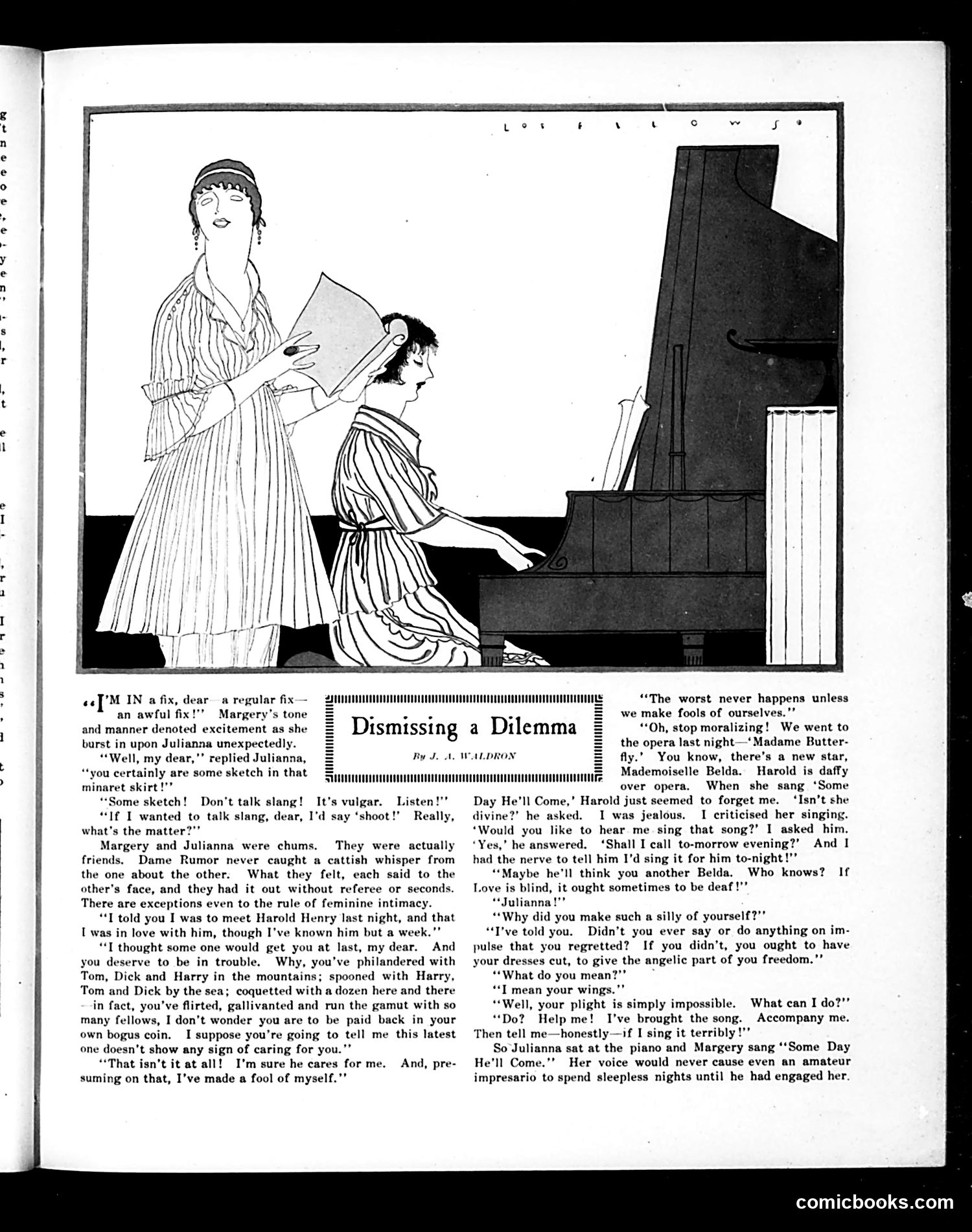
This is a romantic comedy story illustrated in the Art Deco style typical of 1920s Judge magazine. Two wealthy young women—Margery and Julianna—are friends who discuss romantic troubles frankly. Margery has impulsively challenged her new suitor, Harold, by offering to sing the opera aria "Some Day He'll Come" (from Puccini's *Madame Butterfly*) after he praised another soprano. Now she fears she's ruined the relationship. The satire targets early 20th-century attitudes toward women: Julianna mock-lectures Margery about her past flirtations ("philandered with Tom, Dick and Harry"), implying women deserve romantic disappointment for coquetry. The joke hinges on female vanity and impulsiveness—Margery's jealous challenge being portrayed as foolish rather than understandable. The final punchline suggests Margery's singing is terrible, making her anxiety about the audition humorous.
📄 Transcribed text from this page (OCR, searchable)
Machine-transcribed from the original scan — historical spelling and the odd misread are preserved.
ee] IN a fix, dear a regular fix— an awful fix!’ Margery’s tone and manner denoted excitement as she burst in upon Julianna unexpectedly. “Well, my dear,”’ replied Julianna, “you certainly are some sketch in that minaret skirt !"" “Some sketch! Don’t talk slang! “If I wanted to talk slang, dear, what's the matter?”’ Margery and Julianna were chums. They were actually friends. Dame Rumor never caught a cattish whisper from the one about the other. What they felt, each said to the other's face, and they had it out without referee or seconds. There are exceptions even to the rule of feminine intimacy. “I told you I was to meet Harold Henry last night, and that I was in love with him, though I’ve known him but a week.”” “I thought some one would get you at last, my dear. And you deserve to be in trouble. Why, you’ve philandered with Tom, Dick and Harry in the mountains; spooned with Harry, Tom and Dick by the sea; coquetted with a dozen here and there in fact, you've flirted, gallivanted and run the gamut with so many fellows, I don’t wonder you are to be paid back in your own bogus coin. I suppose you’re going to tell me this latest one doesn’t show any sign of caring for you.”” “That isn’t it at all! I’m sure he cares for me. suming on that, I’ve made a fool of myself.”” It’s vulgar. Listen!’’ I'd say ‘shoot!’ Really, And, pre- SAUATALAEAEA ATLANTA Dismissing a Dilemma Ru J. A, WALDRON ETM “‘The worst never happens unless we make fools of ourselves.’” “Oh, stop moralizing! We went to the opera last night—‘ Madame Butter- fly.’ You know, there’s a new star, Mademoiselle Belda. Harold is daffy over opera. When she sang ‘Some Day He'll Come,’ Harold just seemed to forget me. ‘Isn’t she divine?’ he asked. 1 was jealous. I criticised her singing. ‘Would you like to hear me sing that song?’ I asked him. ‘Yes,’ he answered. ‘Shall I call to-morrow evening?’ And I had the nerve to tell him I'd sing it for him to-night!" ‘‘Maybe he'll think you another Belda, Who knows? If Love is blind, it ought sometimes to be deaf!’ “Julianna!"" “Why did you make such a silly of yourself?’" “I’ve told you. Didn’t you ever say or do anything on im- pulse that you regretted? If you didn’t, you ought to have your dresses cut, to give the angelic part of you freedom.’’ “What do you mean?” “I mean your wings." “Well, your plight is simply impossible. What can I do?’’ “Do? Help me! I’ve brought the song. Accompany me. Then tell me—honestly—if I sing it terribly !"" So Julianna sat at the piano and Margery sang ‘‘Some Day He'll Come.’’ Her voice would never cause even an amateur impresario to spend sleepless nights until he had engaged her. comicbooks.com