
A complete issue · 24 pages · 1913
Judge — December 13, 1913
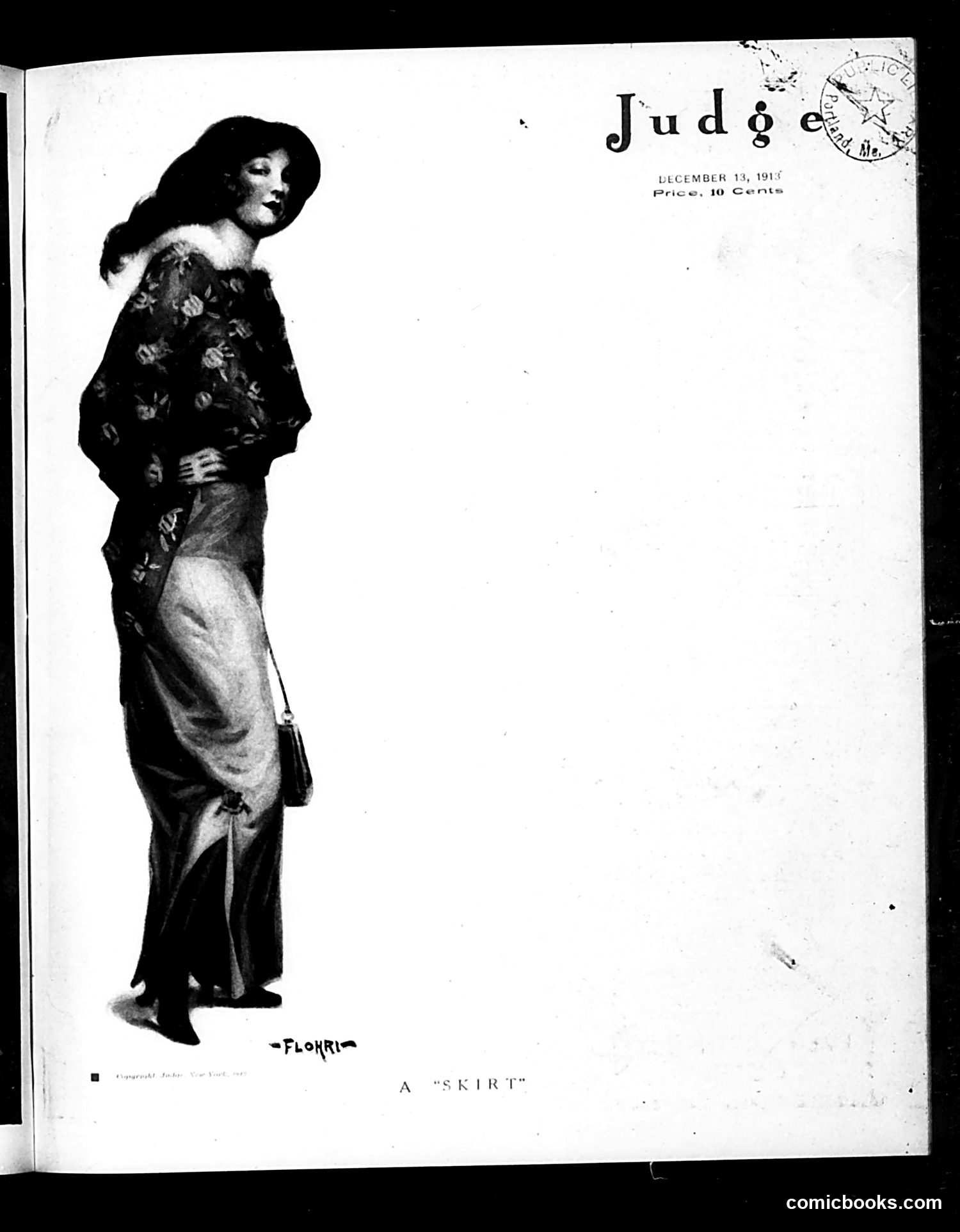
This page features a fashion illustration titled "A 'Skirt'" credited to artist Florri. It depicts a woman in early 1910s attire wearing a long skirt with decorative patterned overlay or coat, a fur collar, and a small hat with feathers. Rather than political satire, this appears to be a fashion commentary typical of Judge's society pages. The quotation marks around "Skirt" suggest irony—likely mocking the era's increasingly restrictive and voluminous skirt designs that were being debated as impractical or absurd by some commentators. This aligns with early 20th-century discussions about women's fashion constraints versus emerging calls for more functional clothing.
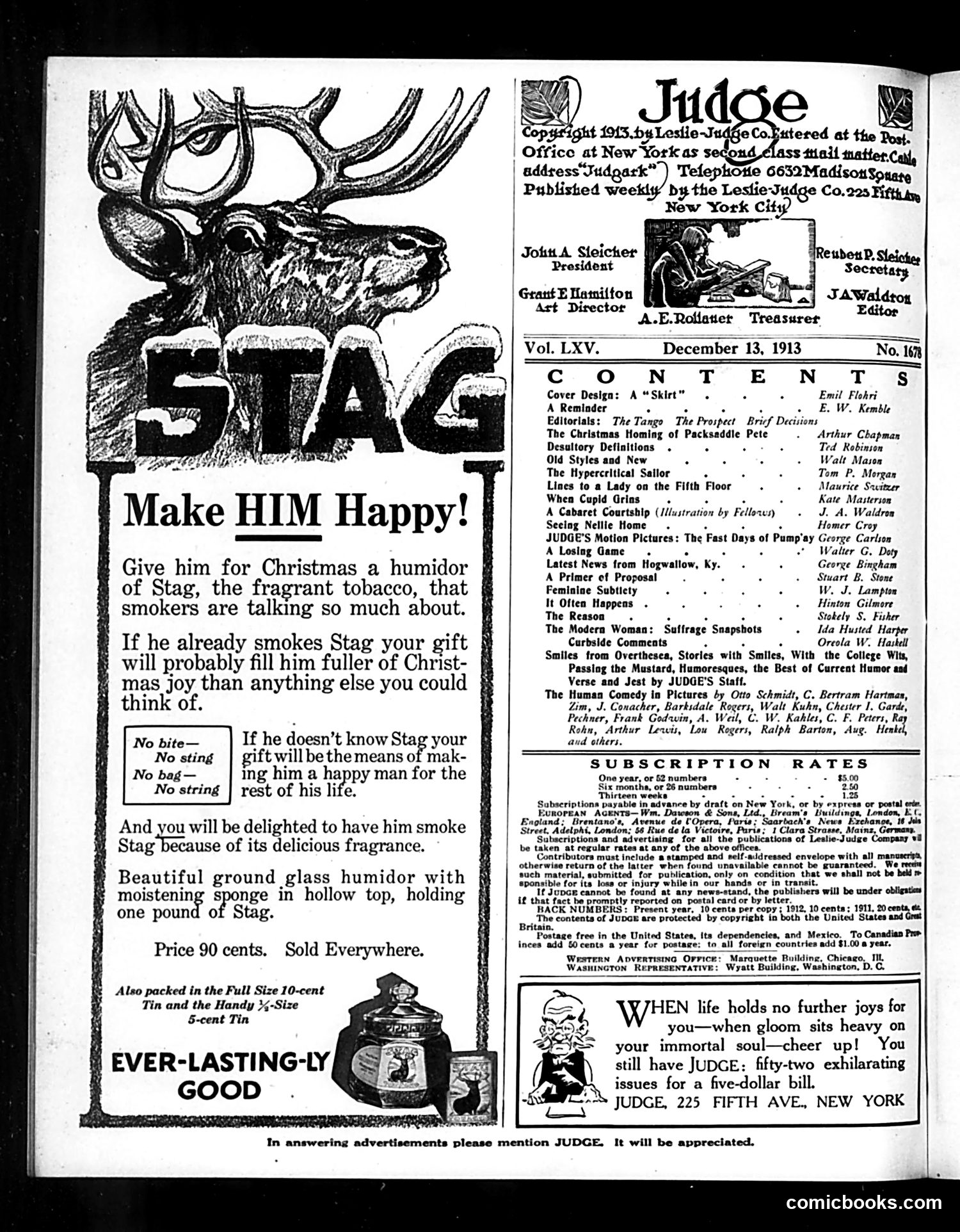
This page is dominated by a **Stag tobacco advertisement** rather than political satire. The ad features a stag's head and promotes Stag brand tobacco as a Christmas gift, emphasizing its "delicious fragrance" and claiming it will make the recipient happy. The advertisement plays on the product name (Stag) with the animal imagery and promises the tobacco is free of harsh properties ("No bite—No sting—No bag—No string"). It highlights a glass humidor as the premium packaging option priced at 90 cents. The right side shows the magazine's masthead, table of contents, and subscription information. **No significant political or social satire appears on this particular page**—it's primarily commercial advertising material typical of period magazines.
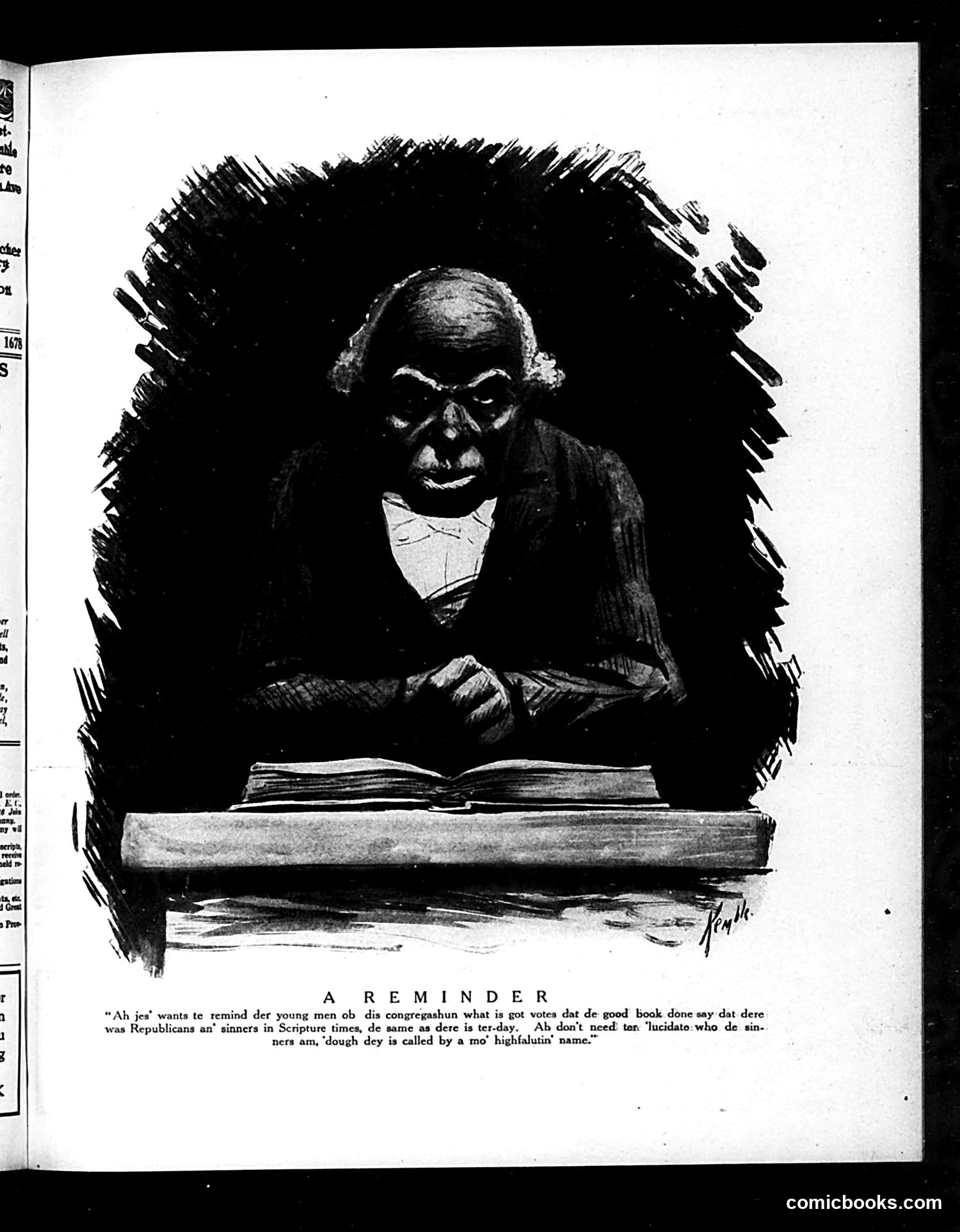
This cartoon satirizes Republican hypocrisy regarding moral authority. The exaggerated caricature depicts an elderly man (likely representing Republican leadership or ideology) reading Scripture, with text below mocking Republicans who cite Biblical values while conducting themselves unethically. The quote references Republicans who quoted Scripture in "Congress times" yet behaved like "sinners," suggesting they invoked religious authority selectively. The phrase about "good book" versus actual conduct appears to criticize the gap between stated principles and actions. The heavy, shadowy background and grotesque facial features emphasize the sardonic tone—presenting the figure as hypocritical and darkly comedic rather than genuinely pious. This reflects Judge magazine's Democratic-leaning satirical stance toward Republican moral positioning.
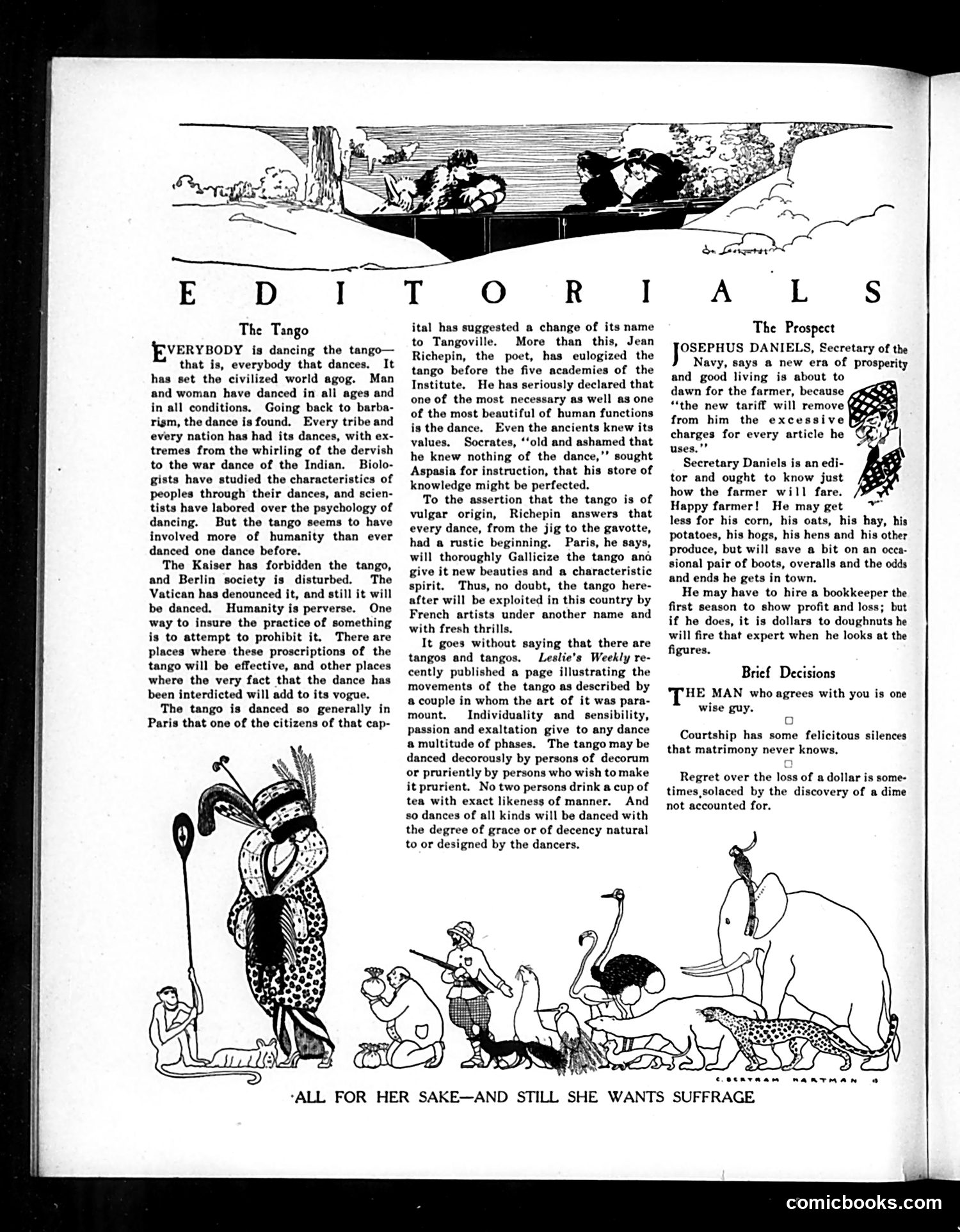
This page contains three distinct sections: **"The Tango"** (left editorial): Discusses the tango dance's origins and social controversy. It notes the Kaiser and Pope have condemned it, and that French artists are adopting it under different names to circumvent bans. **"The Prospect"** (right editorial): Commentary by Secretary of the Navy Josephus Daniels on agricultural prosperity, suggesting farmers hire bookkeepers to track their improved finances. **Bottom cartoon**: Depicts a woman controlling various figures (appearing to represent different social groups) like puppets. The caption "ALL FOR HER SAKE—AND STILL SHE WANTS SUFFRAGE" satirizes women's suffrage advocates, suggesting women already wield considerable power over society despite lacking voting rights—a common anti-suffrage argument of the era.
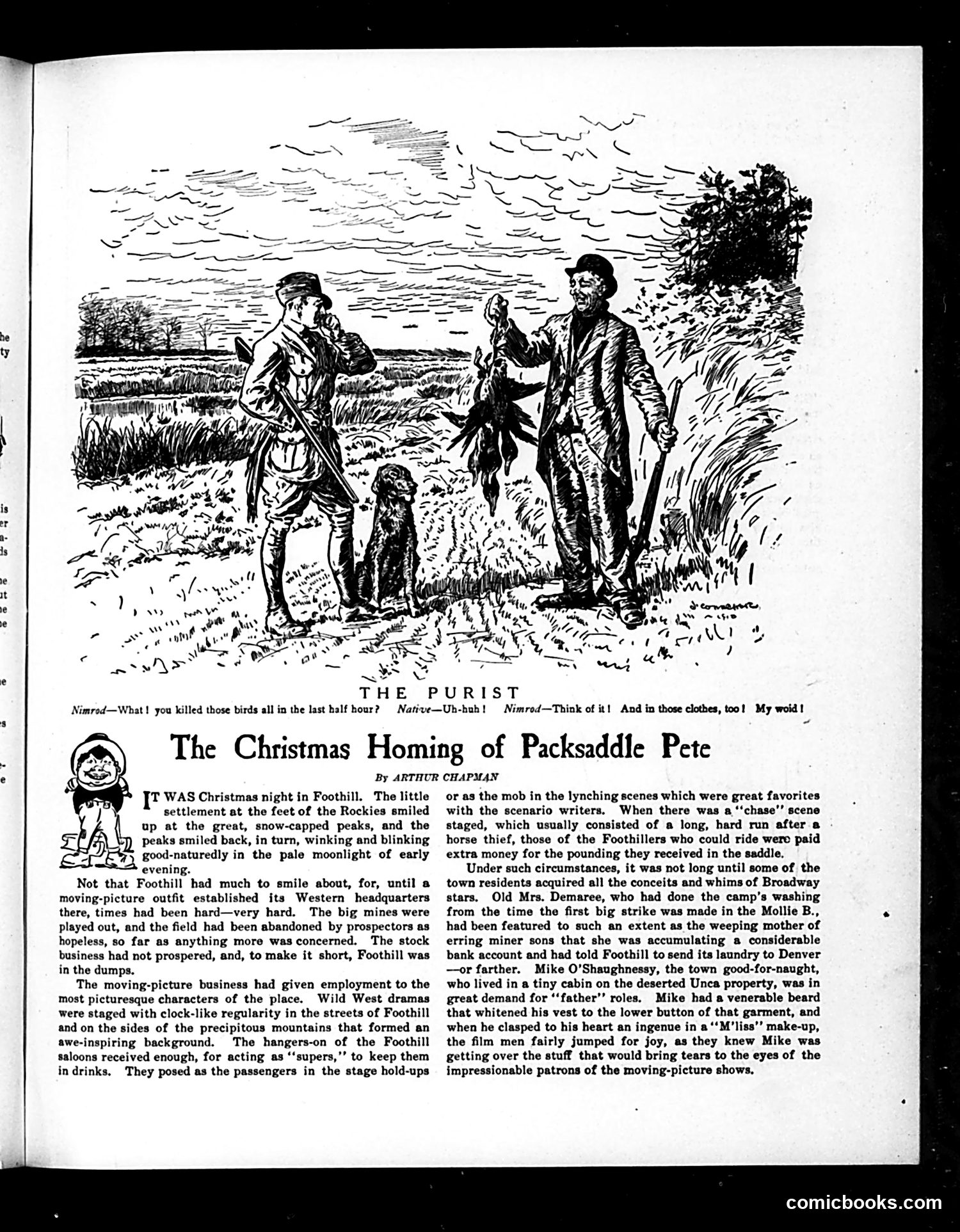
**"The Purist" (top cartoon):** Two men confront a third about killing birds. The dialogue suggests hypocrisy—one accuses the other of killing birds while wearing clothes made from them ("those clothes, too!"). This satirizes people who claim moral principles while ignoring their own complicity in similar practices. It's a straightforward joke about inconsistent ethics. **"The Christmas Homing of Packsaddle Pete" (story below):** This appears to be a Western fiction piece set in early Foothill, Colorado, describing a film production company's operations there. The narrative details how film companies employed locals as extras and incorporated Western scenery. The story seems to celebrate the industry's economic impact and entertainment value rather than offering satire.
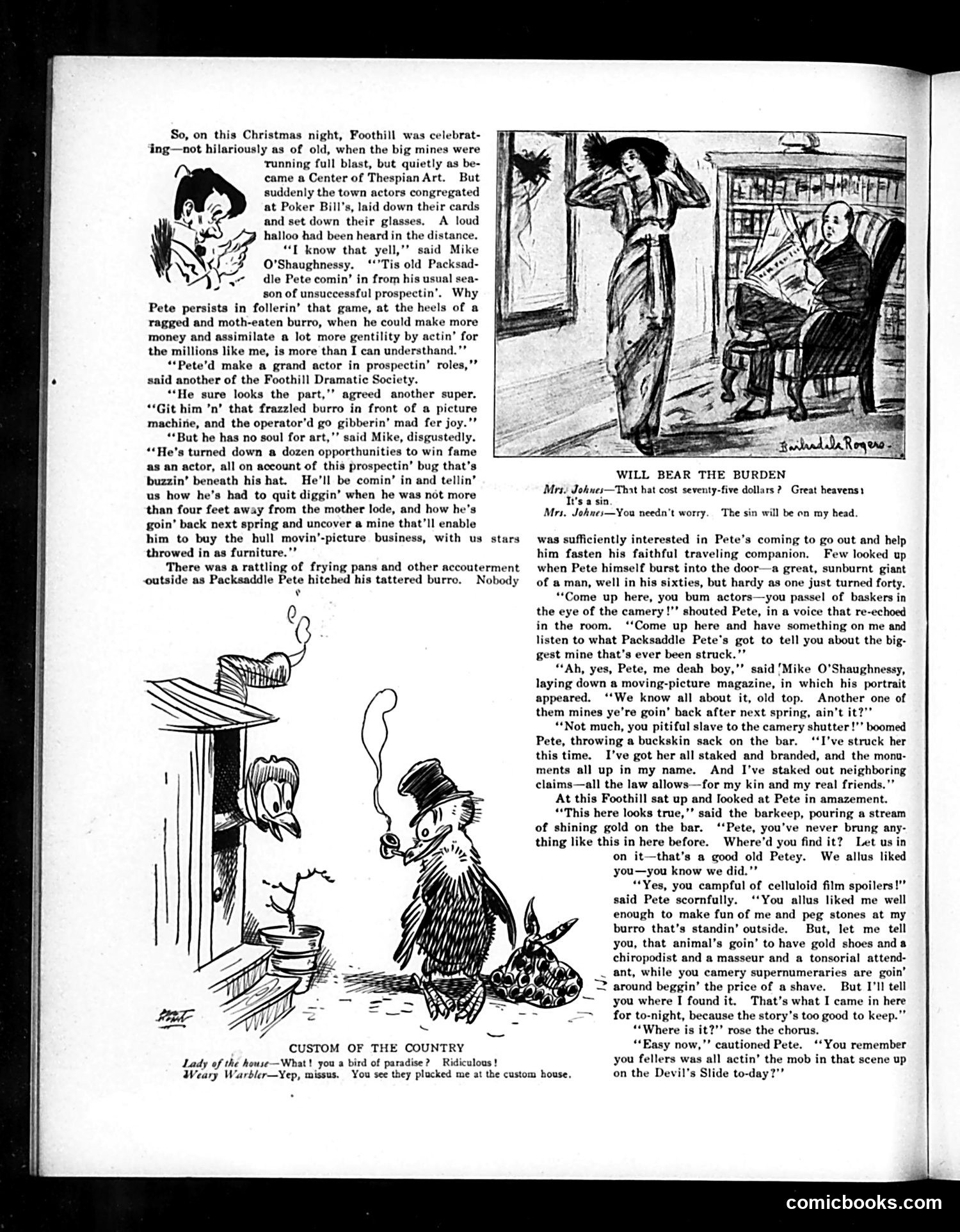
This story satirizes the tension between **old-fashioned prospecting and the new motion picture industry**. The setting is "Foothill," a former mining town that has transformed into a theatrical center. Local actors mock Packsaddle Pete, an aging prospector, for pursuing a dying dream (finding gold) instead of joining their lucrative film business. The joke's irony: Pete's prospecting is dismissed as futile until he actually strikes gold—vindicating his old-economy ways over the actors' modern "camery" (camera) work. The actors had mocked him repeatedly; now they want a cut. The accompanying "Custom of the Country" cartoon makes a separate joke about import tariffs—a "weary warbler" (vagrant/tramp) claims to be a "bird of paradise" until customs officials strip his feathers. The "Will Bear the Burden" cartoon is a brief society joke about a wife accepting guilt for an expensive hat purchase.
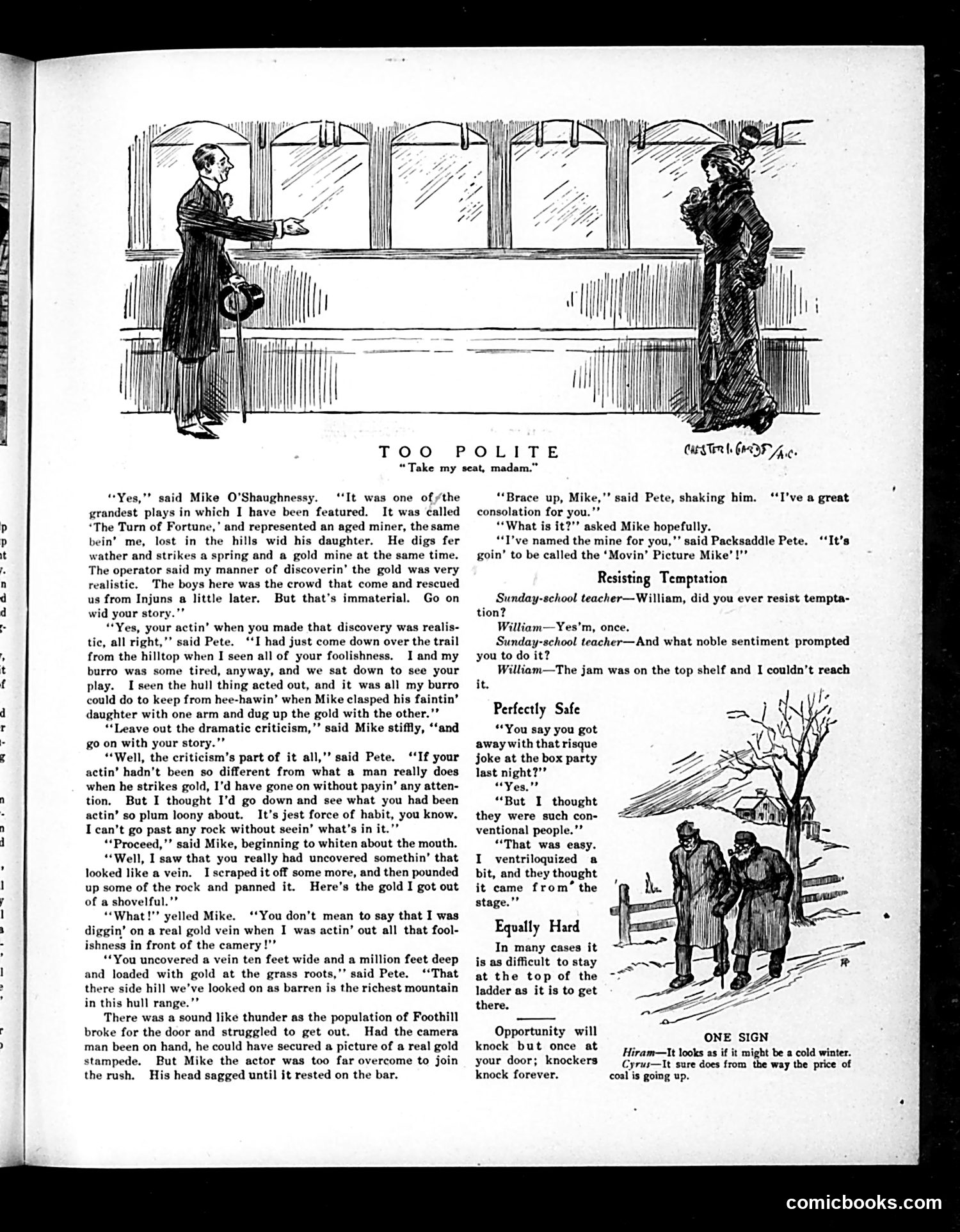
This page contains a humorous story about an actor named Mike O'Shaughnessy who performs in a play called "The Turn of Fortune," portraying a prospector discovering gold. The joke is situational irony: while Mike dramatically *acts out* finding gold and a spring, his realistic performance accidentally occurs on an actual gold vein. A genuine prospector named Pete witnesses Mike's theatrical gestures, investigates, and confirms a massive gold deposit beneath the site. The satire targets theatrical pretension—Mike's exaggerated "realistic" acting unintentionally becomes real, then he's devastated to learn Pete will name the mine "The Movin' Picture Mike," reducing his genuine fortune to a joke about his failed acting career. The page also includes three brief humorous anecdotes about temptation, ventriloquism, and opportunity—typical filler humor for the magazine. These appear unrelated to the main cartoon.
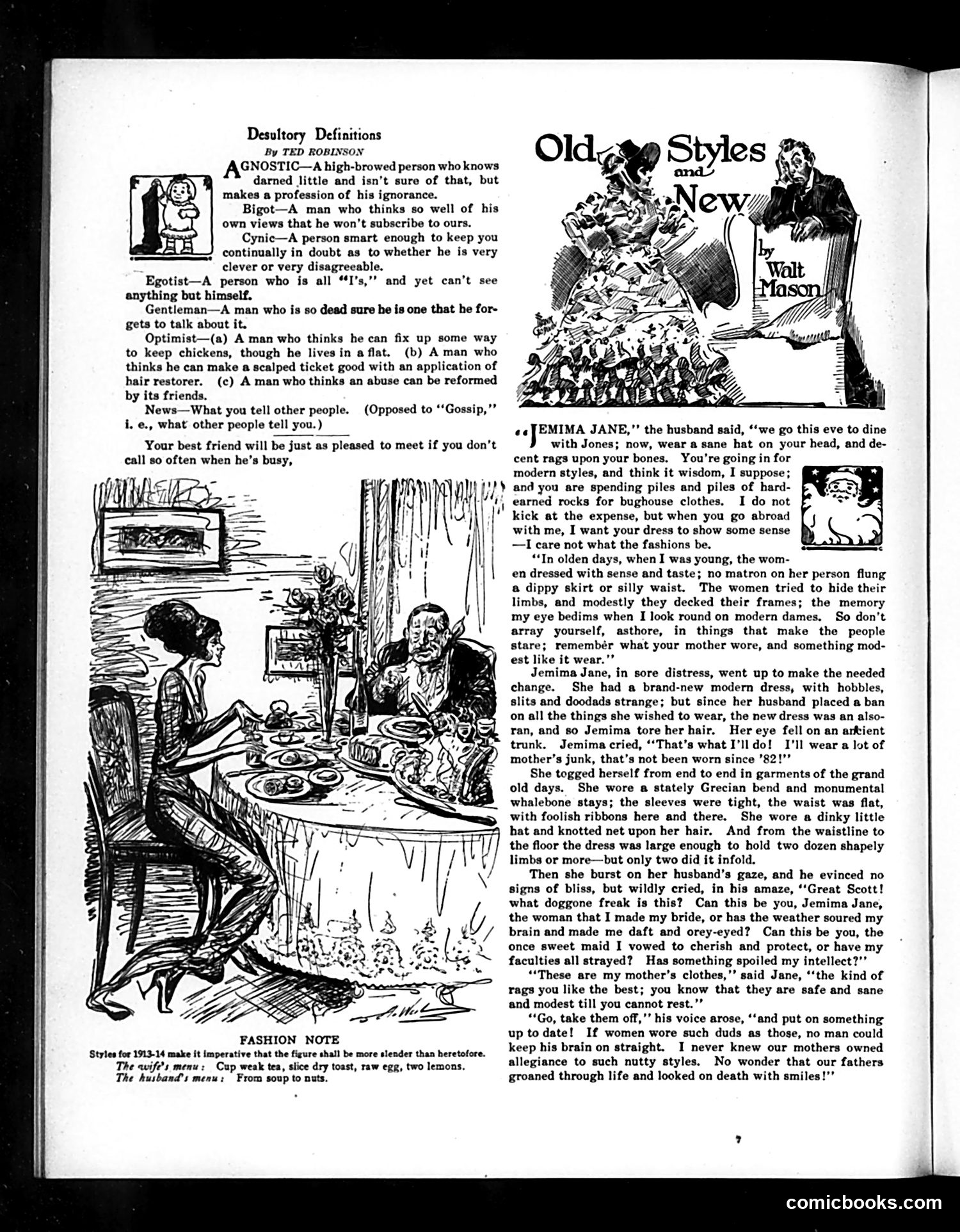
This page contains two satirical pieces about fashion and social attitudes circa 1913-14. **"Desultory Definitions"** offers tongue-in-cheek definitions of character types (agnostic, cynic, egotist, etc.), typical of satirical magazines' commentary on human nature. **The main story, "Jemima Jane,"** satirizes conflicting attitudes toward women's fashion. A husband demands his wife dress modestly, rejecting modern 1913-14 styles (hobble skirts, loose waists) as immodest. He insists she wear old-fashioned clothing "like your mother." When Jemima complies by wearing actual 1880s garments—complete with whalebone stays, a "Grecian bend," and voluminous skirts—he's appalled, calling them absurd. The joke critiques male hypocrisy: he claims to want "modest" dress but actually objects to *any* style—old or new. The accompanying fashion note mocks that 1913-14 fashion demands extreme slenderness, while the husband's menu contrast (wife: weak tea and lemon; husband: full meals) suggests gendered inequality.
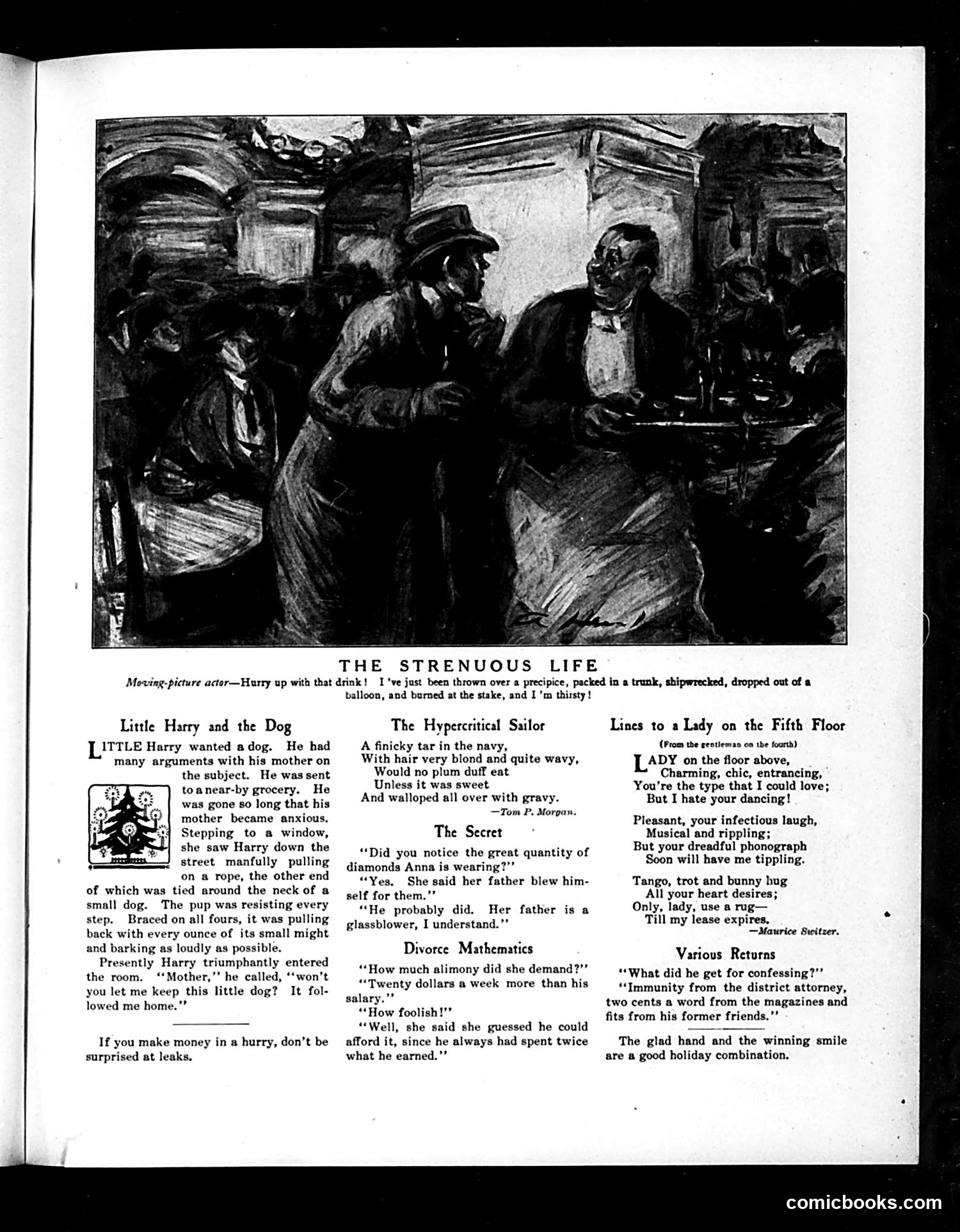
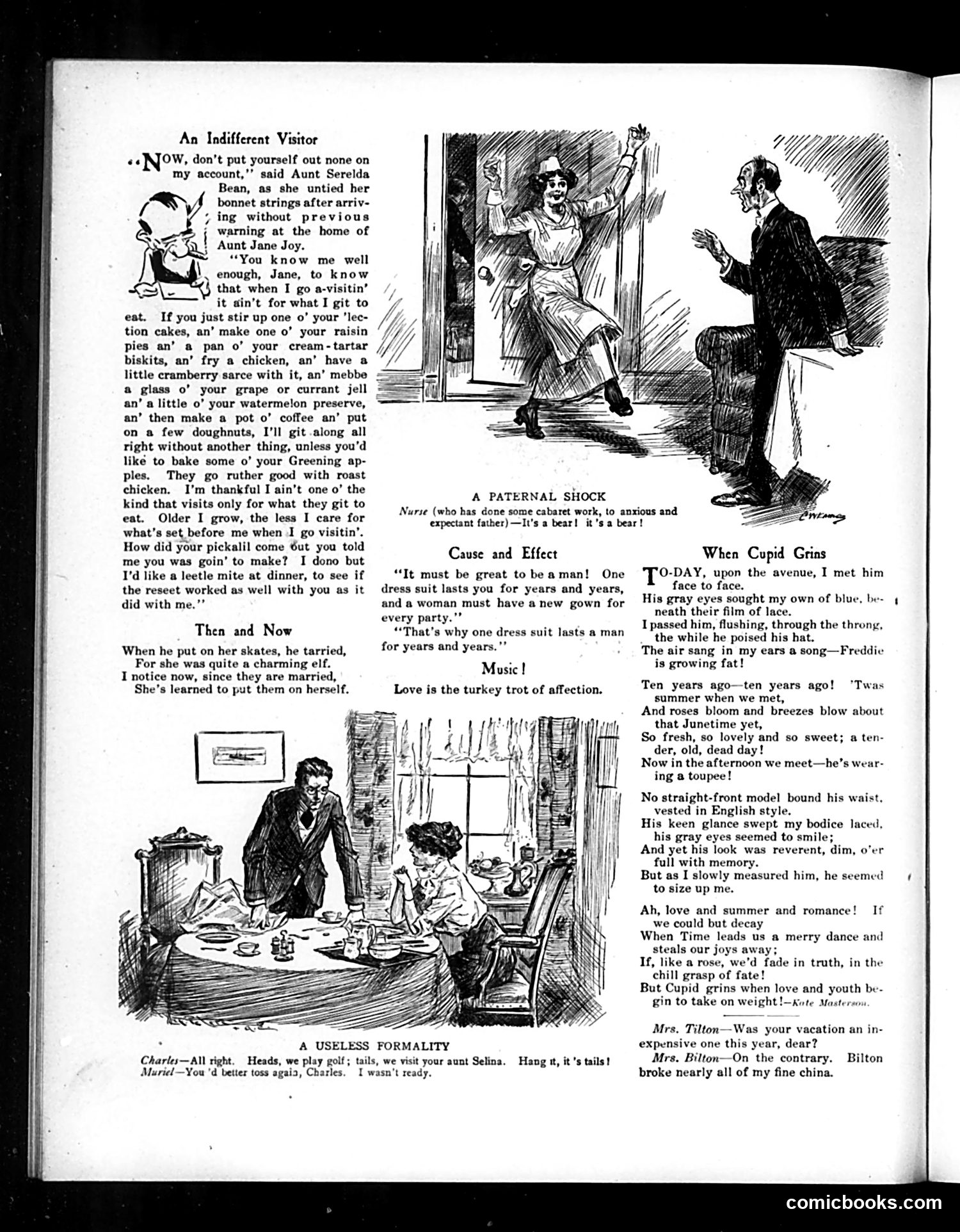
This page contains several satirical pieces mocking domestic life and romance around the early 1900s. **"An Indifferent Visitor"** depicts Aunt Serelda Bean arriving unannounced, claiming she visits "not for what I git to eat"—then immediately demands an elaborate meal (election cakes, raisin biscuits, fried chicken, cranberry sauce, jellies, coffee, doughnuts, and apple pie). The satire targets hypocritical guests who deny their true motivations while making excessive demands on their hosts. **"Then and Now"** jokes about post-marriage role reversals: a husband once helped his wife with skates; now married, she puts them on herself, implying lost romance. **"A Paternal Shock"** and related pieces satirize gender and marriage dynamics—women needing new gowns constantly versus men's single dress suit, and the physical decay of romance ("Cupid grins when love and youth begin to take on weight"). **"When Cupid Grins"** contrasts youthful romance with aging: a woman once loved now sees her old flame wearing a toupee, deflating the nostalgia. The overall theme: marriage and aging dissolve romance into domestic mundanity.
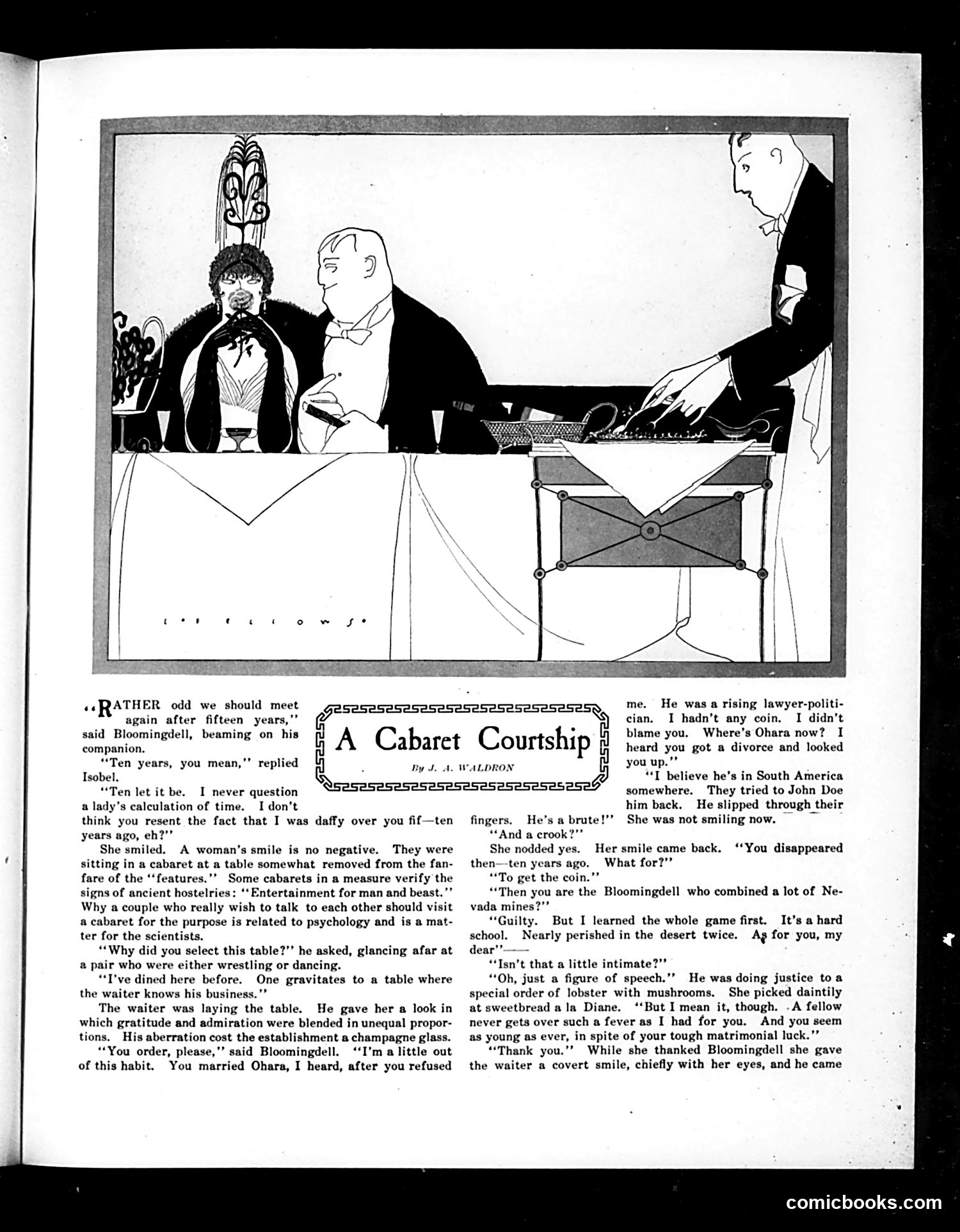
This is a romantic/comedic short story illustrated with a single panel showing two well-dressed patrons dining at a cabaret while a waiter serves them. **The Setup:** Two former lovers, Bloomingdell and Isobel, reunite after years apart. They're catching up at a cabaret—a nightclub featuring entertainment and dining. **The Plot Points:** - Bloomingdell had been "daffy" (in love) with Isobel years ago, but she married someone else (Ohara) for money when Bloomingdell was broke - Bloomingdell later struck it rich in Nevada mining - Ohara proved to be a criminal who fled to South America - Now they're rekindling their connection **The Satire:** The humor lies in the social awkwardness—two former lovers subtly flirting in a public cabaret while the attentive waiter notices their charged interaction (costing the restaurant a champagne glass through his distraction). It's commentary on how cabarets serve as venues for romantic intrigue and how social pretense masks genuine emotion.
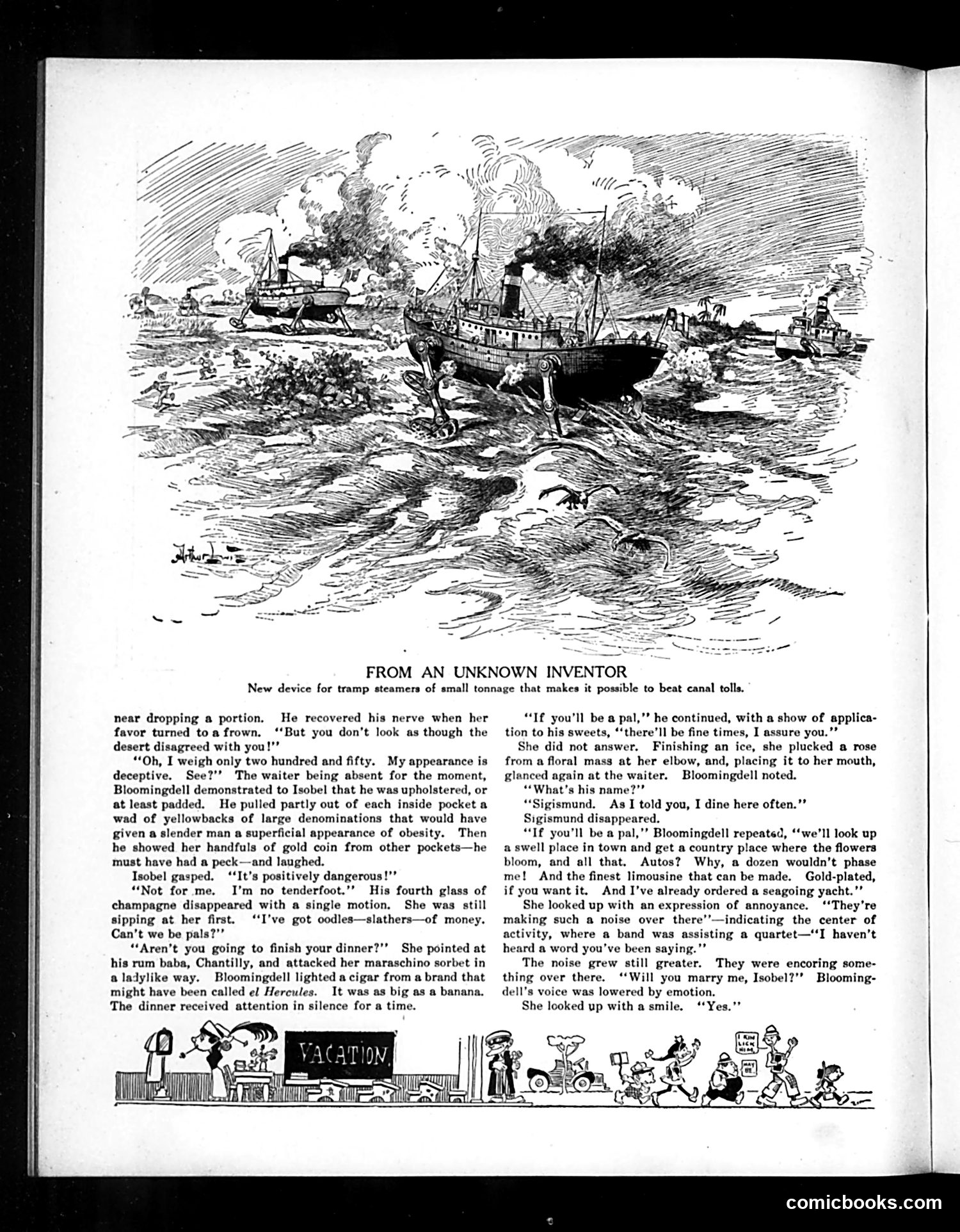
The main illustration shows **steamships and small boats in water**, captioned "FROM AN UNKNOWN INVENTOR—New device for tramp steamers of small tonnage that makes it possible to beat canal tolls." This is satirical commentary on shipping economics: the cartoon depicts an absurdly impractical or humorous scheme (unclear exactly what) for avoiding canal fees—a real concern for small commercial vessels. The accompanying story is a romantic comedy about a wealthy but socially awkward man named **Bloomingdell** courting a woman named **Isobel**. The satire mocks nouveau-riche behavior: he ostentatiously displays wads of cash and gold from his pockets, brags constantly about money and possessions (yachts, automobiles, limousines), yet remains so oblivious to social cues that he doesn't notice she's completely unimpressed—she only accepts his marriage proposal because the restaurant noise prevents her from hearing his boastful speech. The joke targets **gilded-age wealth without refinement**—money cannot buy taste, manners, or genuine romantic connection.
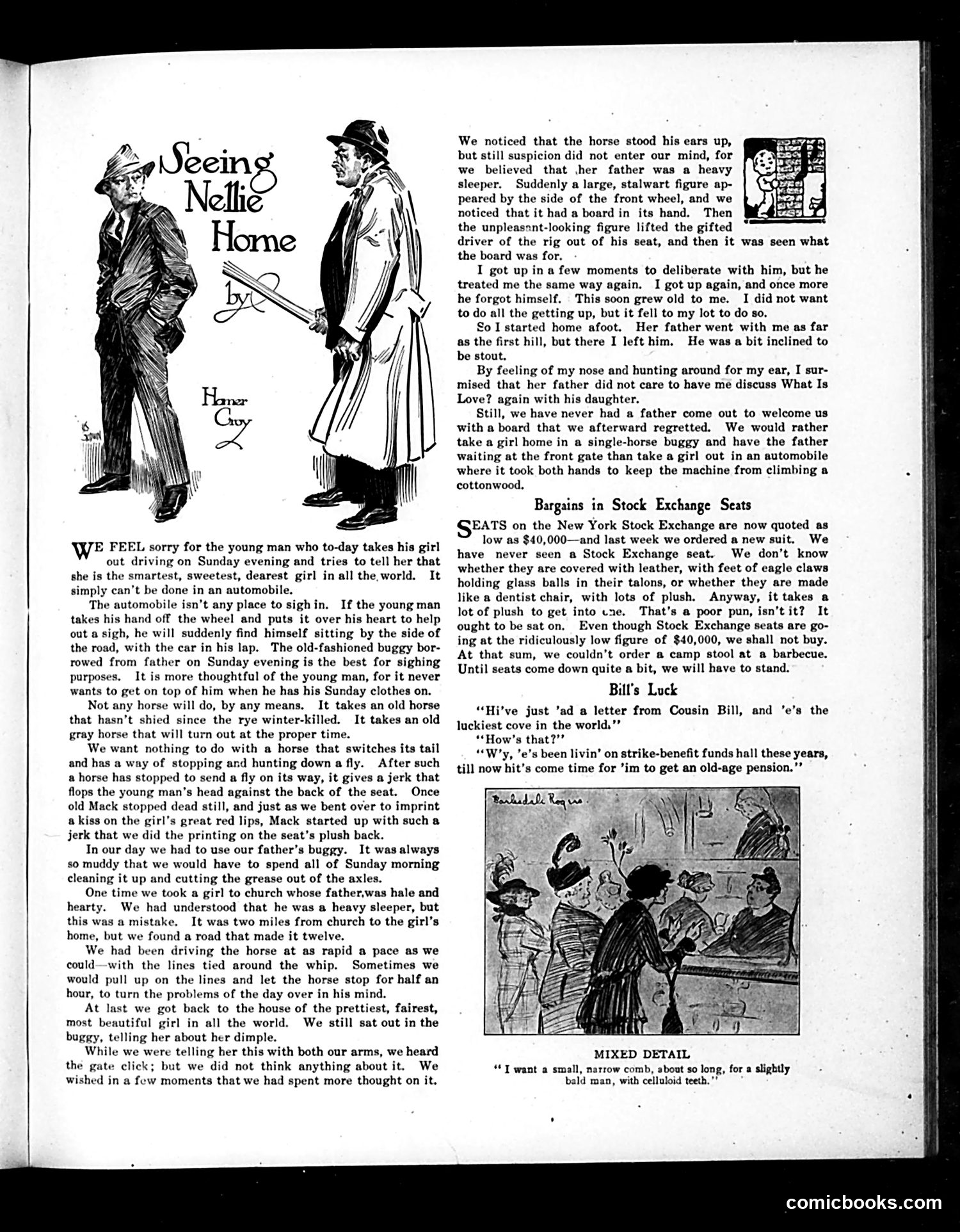
This is a humorous personal essay mocking early 1900s courtship customs. The author contrasts automobiles unfavorably with horse-drawn buggies for romantic purposes. **The main joke:** A young man takes his date driving in a car, but can't properly court her because operating the vehicle requires both hands. The story climaxes when her father emerges with a board and literally beats the narrator out of the buggy seat—a darkly comic punishment for improper behavior. **The satire targets:** - The impracticality of automobiles for romance (you need both hands to drive) - The dangers of unsupervised young couples - Overprotective fathers who enforce strict courtship rules - The narrator's self-mocking incompetence with his date The essay nostalgically advocates for old horse buggies, which require less attention and allow proper romantic gestures—though even these offered hazards (horses stopping abruptly mid-kiss). This reflects genuine 1900s anxieties about automobiles enabling unchaperoned dating and moral dangers to young women.
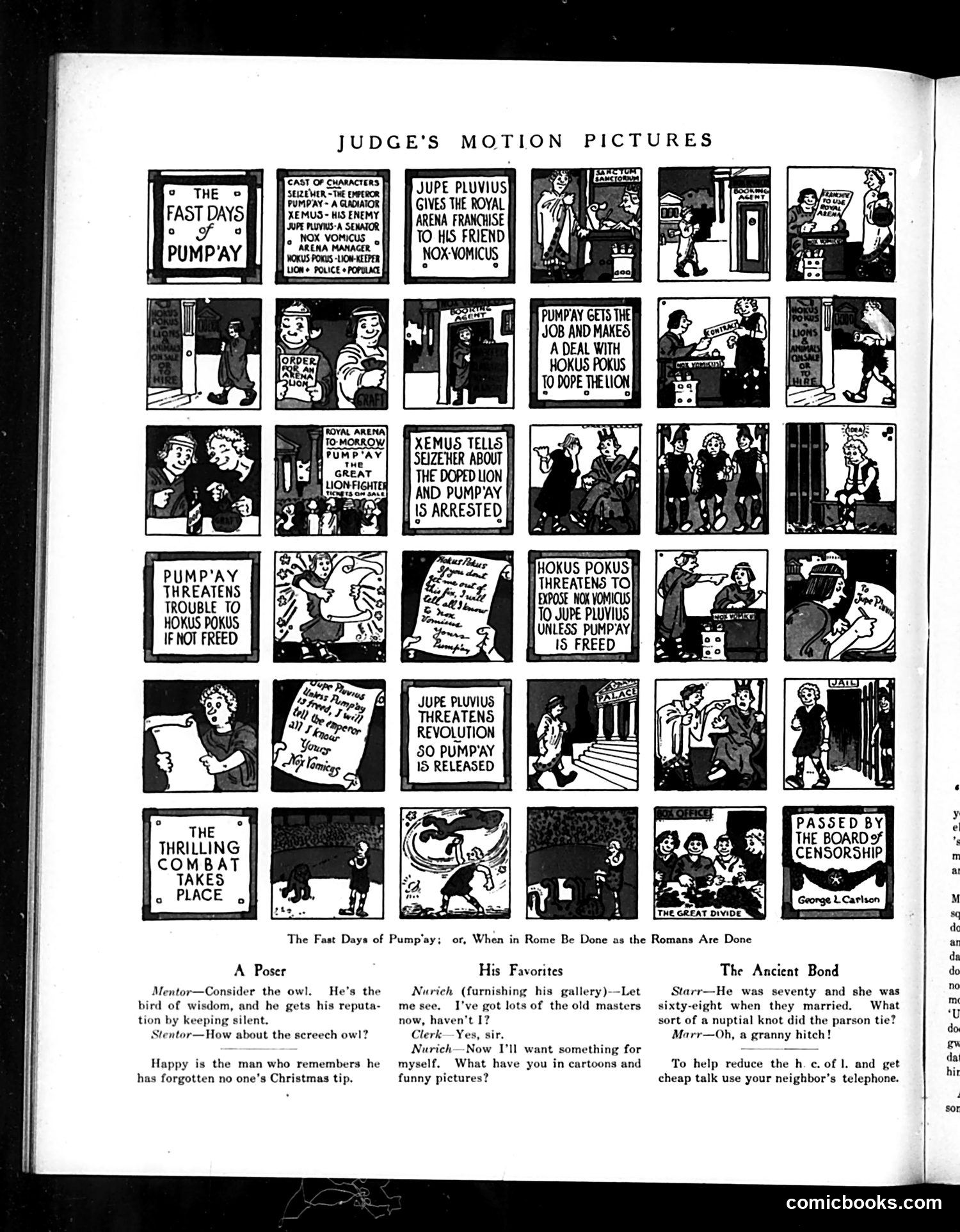
This is a **silent film parody page** from Judge magazine. The top section presents "The Fast Days of Pump'ay"—a mock film serial showing characters named Pump'ay, Hokus Pokus, Jupe Pluvius, and Xemius Seizher in melodramatic scenarios involving threats, arrests, and rescues. The plot appears nonsensical, a satire of overwrought silent-film narratives common in the 1920s. Below are three brief comic exchanges mocking different character types: a mentor offering clichéd wisdom about owls, a gallery owner seeking "funny pictures," and an elderly couple's marriage described with the pun "granny hitch." The final line is a practical joke: suggesting readers use their neighbor's telephone to reduce costs—satirizing post-WWI economic hardship and penny-pinching behavior. The overall tone ridicules both silent cinema melodrama and contemporary social pretension, with the "Pump'ay" serial as the primary comedic vehicle through absurdist plot synopsis.
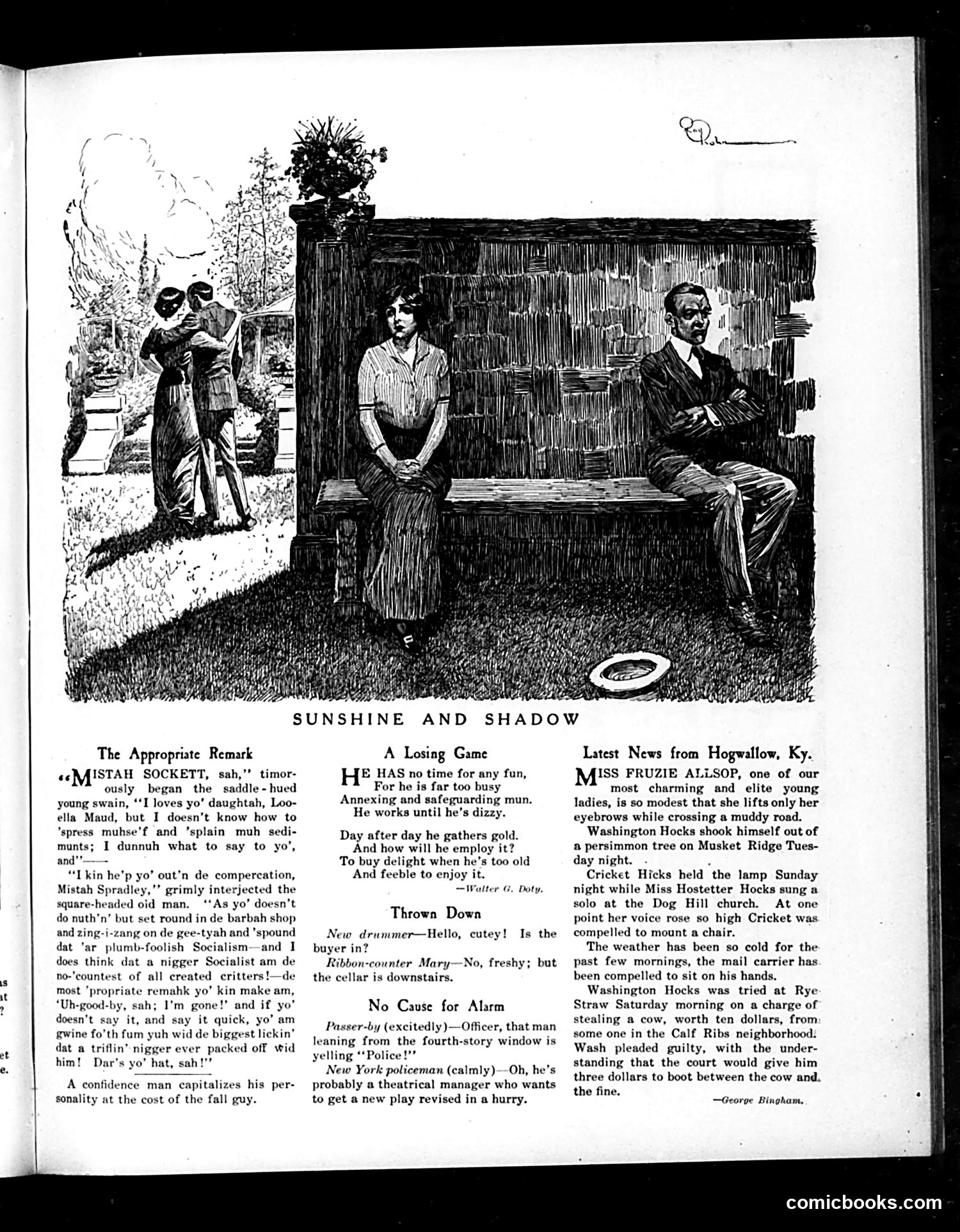
The main cartoon, "Sunshine and Shadow," depicts a racial stereotype scenario: a young Black man seeking permission to court his employer's daughter is rebuffed by the father, who insults him as a "Socialist" and threatens violence. The satire targets not the Black characters but rather the father's hypocrisy—he uses political name-calling ("nigger Socialist") as cover for crude prejudice, while the cartoon's ironic title suggests the contrast between outward respectability and inner cruelty. The surrounding short humorous pieces are unrelated: one mocks wealthy men who accumulate money they're too old to enjoy; another makes a joke about aggressive salesmen; a third plays on police indifference to theatrical emergencies. The "Hogwallow, Ky." section is rural humor focused on poor Southern characters and their modest circumstances. The page reflects Judge's typical mix of social satire, though the racial content reflects its era's problematic attitudes.
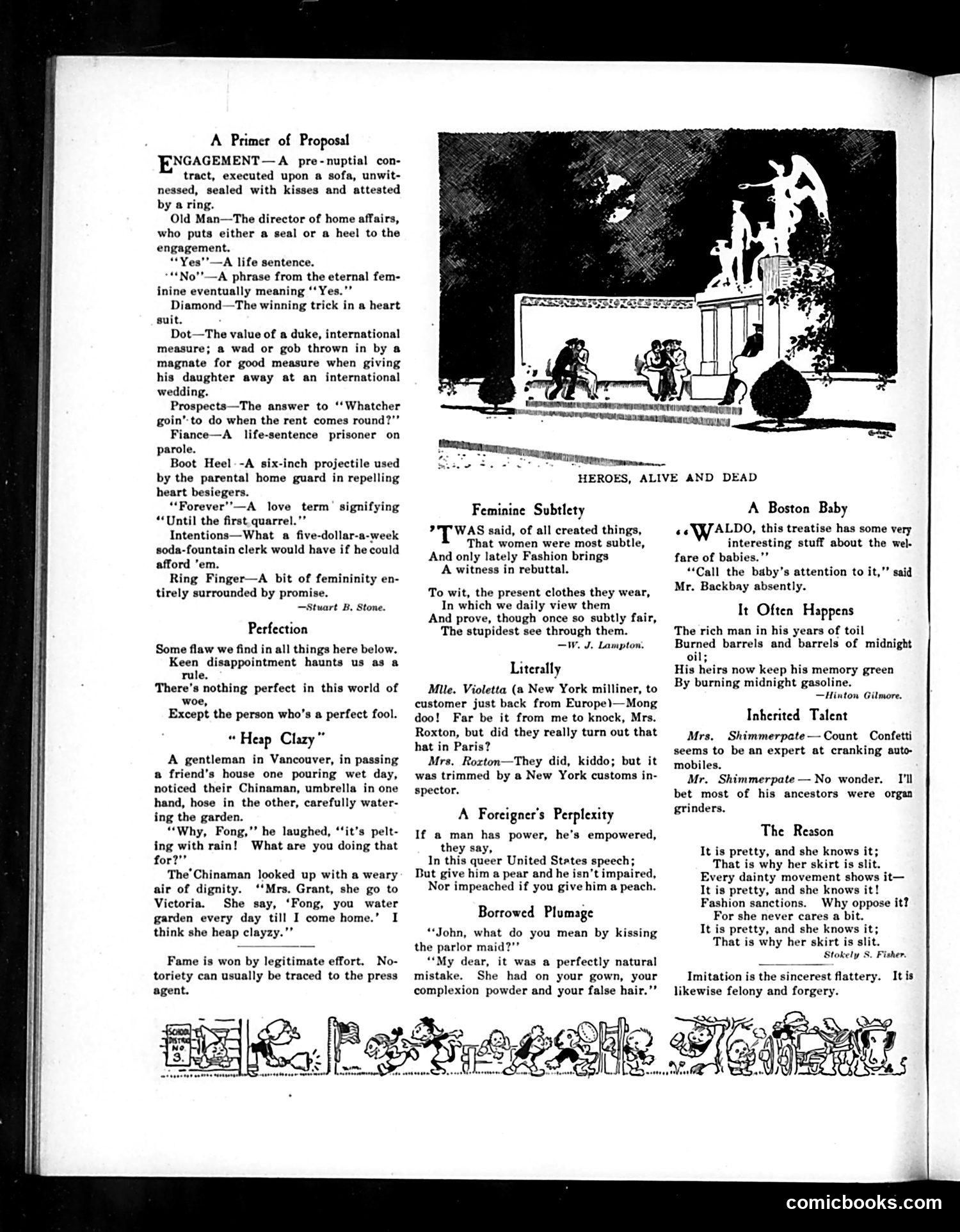
This page from *Judge* (a satirical weekly) contains humorous definitions and short comedic pieces satirizing early 20th-century American courtship, gender relations, and social pretension. **"A Primer of Proposal"** mockingly defines engagement-related terms—treating marriage proposals as cynical transactions. A "diamond" is the "winning trick," rent-paying is uncertain, and a fiancé is a "life-sentence prisoner on parole." The satire suggests engagements were mercenary arrangements, with fathers ("Old Man") controlling outcomes through financial incentive ("Dot"—a dowry). **Other pieces mock contemporary attitudes**: "Feminine Subtlety" suggests women's fashions are transparently revealing rather than subtle. "A Foreigner's Perplexity" jokes about American English grammar quirks. The "Boston Baby" piece satirizes wealthy parental indifference. "Inherited Talent" uses ethnic stereotyping (organ-grinder ancestors becoming automobile-cranking "Counts"). The "Heap Crazy" anecdote caricatures a Chinese servant's obedience despite absurdity—reflecting period-typical racial attitudes. Overall, the page targets marriage economics, female fashion choices, nouveau-riche pretension, and immigrant stereotypes typical of early 1900s American humor.
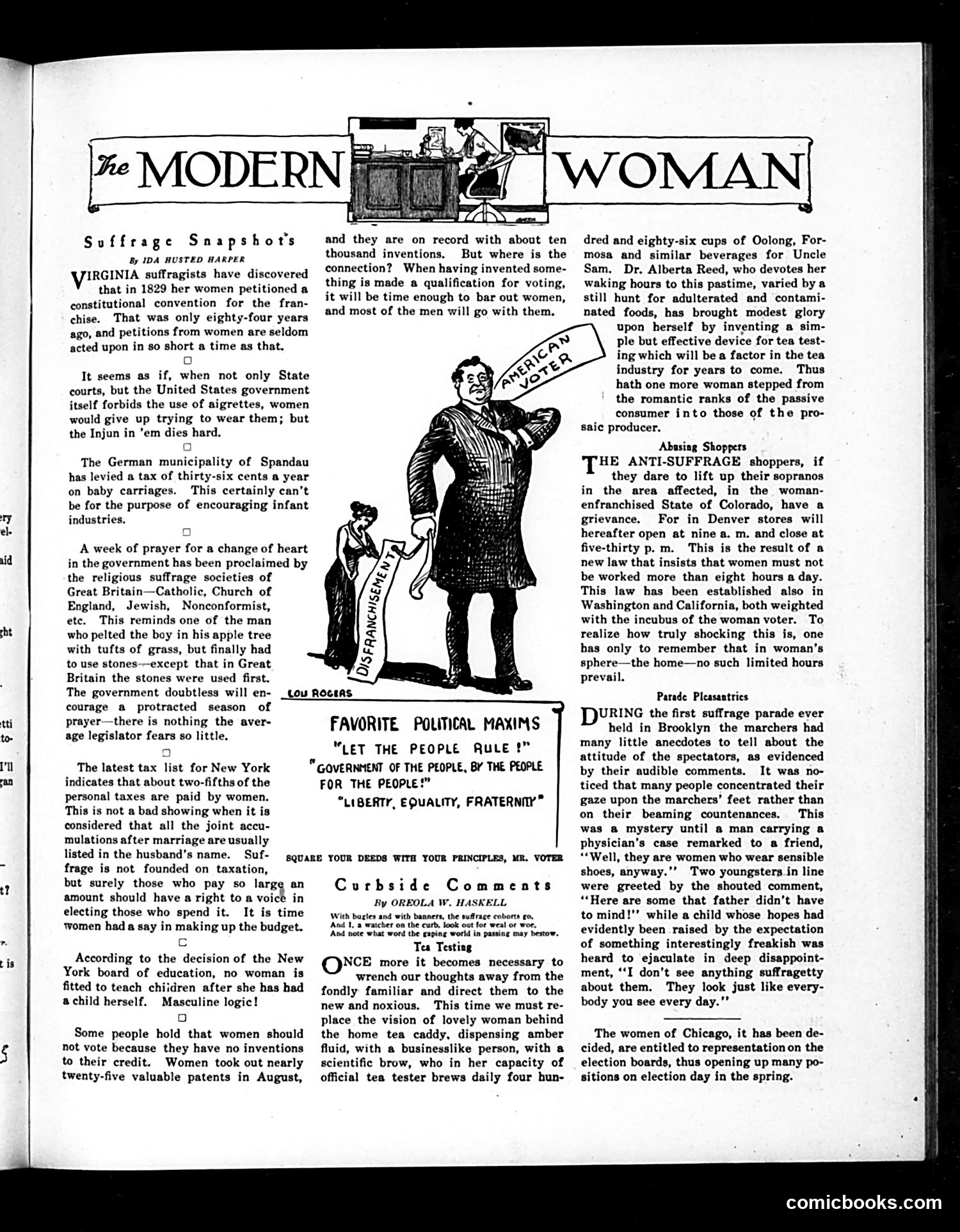
This page from Judge magazine contains pro-suffrage commentary by Ida Husted Harper. The central cartoon depicts a large woman labeled "AMERICAN VOTER" carrying a small man labeled "ANTI-SUFFRAGE SHOPPER," satirizing anti-suffrage women who oppose voting rights for their own sex. The "Suffrage Snapshots" column uses humor to counter arguments against women's suffrage: women have invented thousands of devices (refuting claims they lack capability), they pay substantial taxes (demanding "no taxation without representation"), and they're capable workers (like the tea-testing official Dr. Alberta Reed). The highlighted "Favorite Political Maxims" section mockingly juxtaposes democratic ideals ("government of the people, by the people, for the people") with the reality that women—excluded from voting—cannot participate in this system, suggesting hypocrisy in American democracy. The overall message: women deserve suffrage based on taxation, competence, and fundamental democratic principles.
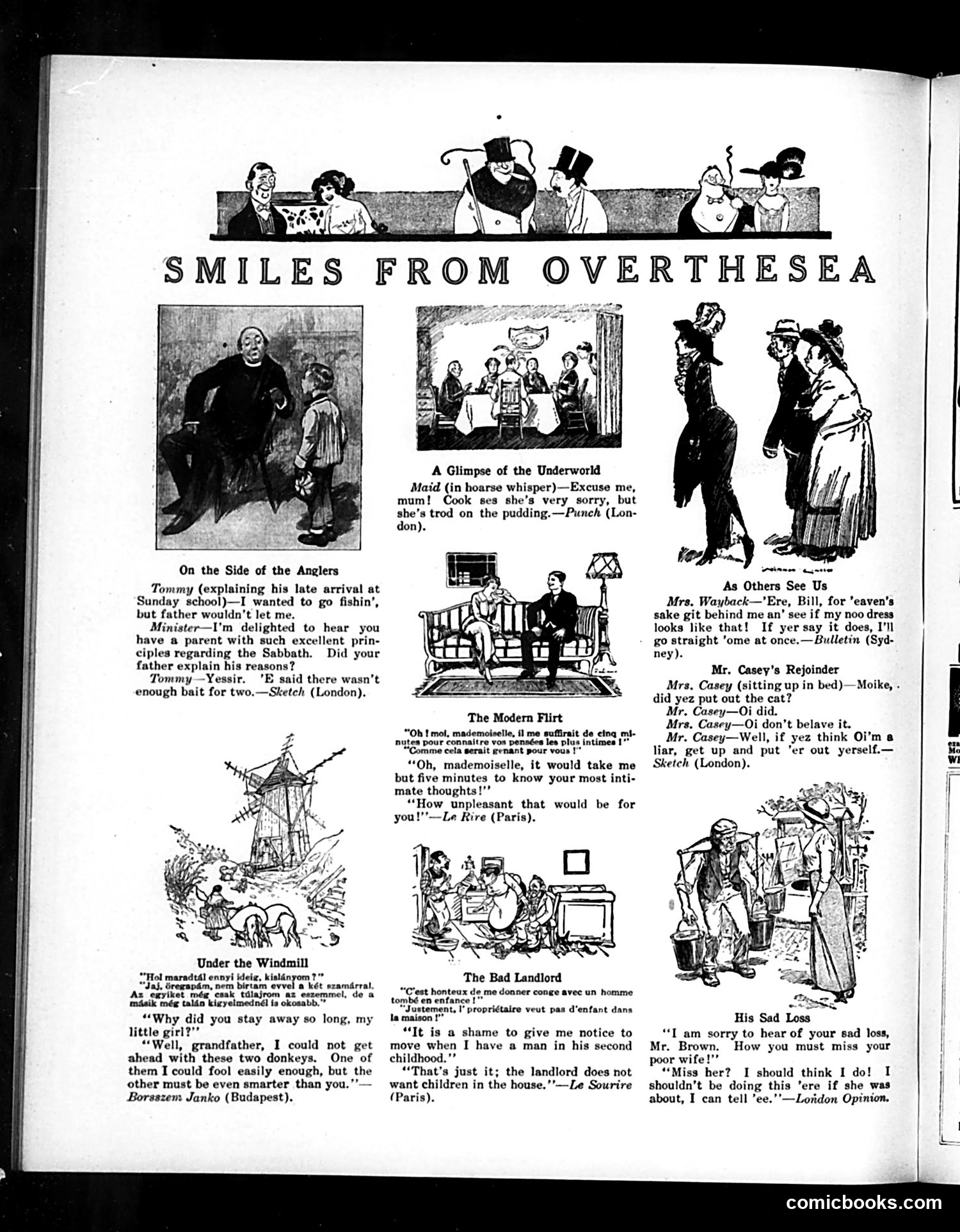
This page collects humorous anecdotes from foreign publications, translated for American readers. The cartoons illustrate working-class and domestic humor from British, French, Hungarian, and Australian sources. The jokes rely on character types and situations: a boy's excuse about fishing (Sabbath observance humor), a girl struggling with stubborn donkeys (rural incompetence), a maid's accident with pudding (servant mishaps), flirtation gone wrong (gender dynamics), a landlord's child-aversion (housing disputes), and marital exchanges about dress and household chores. The recurring themes are *class-based humor*—servants, working families, and rural folk—and *domestic comedy* depicting wives, husbands, and children in everyday conflicts. The "His Sad Loss" cartoon's punchline (a widower relieved of responsibility) exemplifies the period's cynical marital humor. These are primarily *observational gags* rather than political satire, showcasing how different English-language publications mined domestic life for comedy.
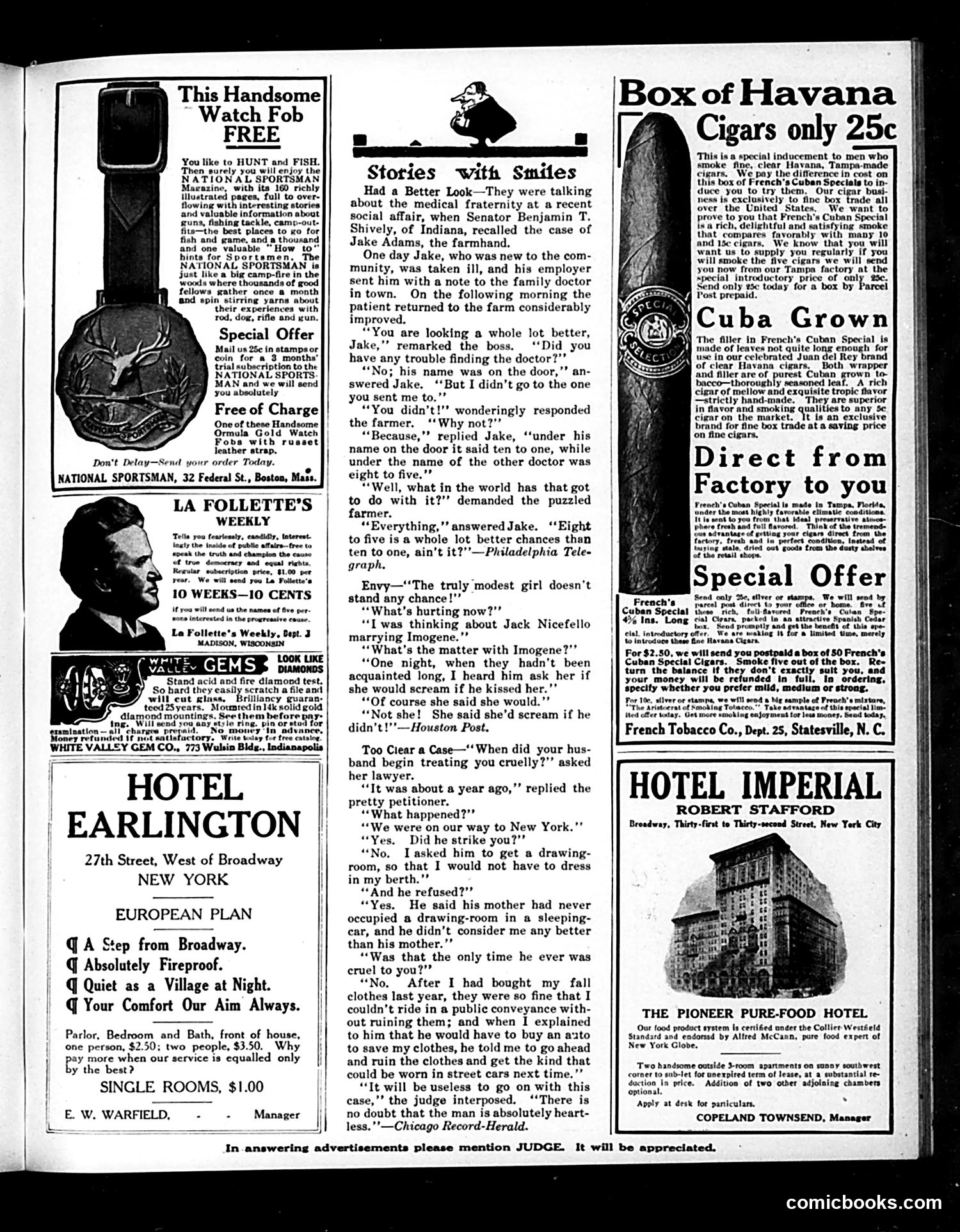
This page is primarily **advertising and light humor** rather than political satire. The main content includes: **"Stories with Smiles"** section: Three short, gentle jokes typical of early 20th-century humor magazines. The first involves Jake Adams, a farmhand who chooses a doctor based on betting odds listed on office doors ("eight to five" versus "ten to one"), misunderstanding medical confidence ratings as gambling odds. The jokes are wholesome, apolitical anecdotes. **Advertisements** dominate the page: watch fobs, Cuban cigars, hotel rooms, gemstones, and La Follette's Weekly magazine (a progressive publication). These ads reflect contemporary consumer goods and services. **Notable**: One ad references "Senator Benjamin T. Shively, of Indiana," a real historical figure, lending credibility to the anecdote, though the story itself has no political content. The page contains **no clear political cartoons or satire**—it's primarily a mixture of advertising revenue and light entertainment content typical of Judge magazine's commercial function.
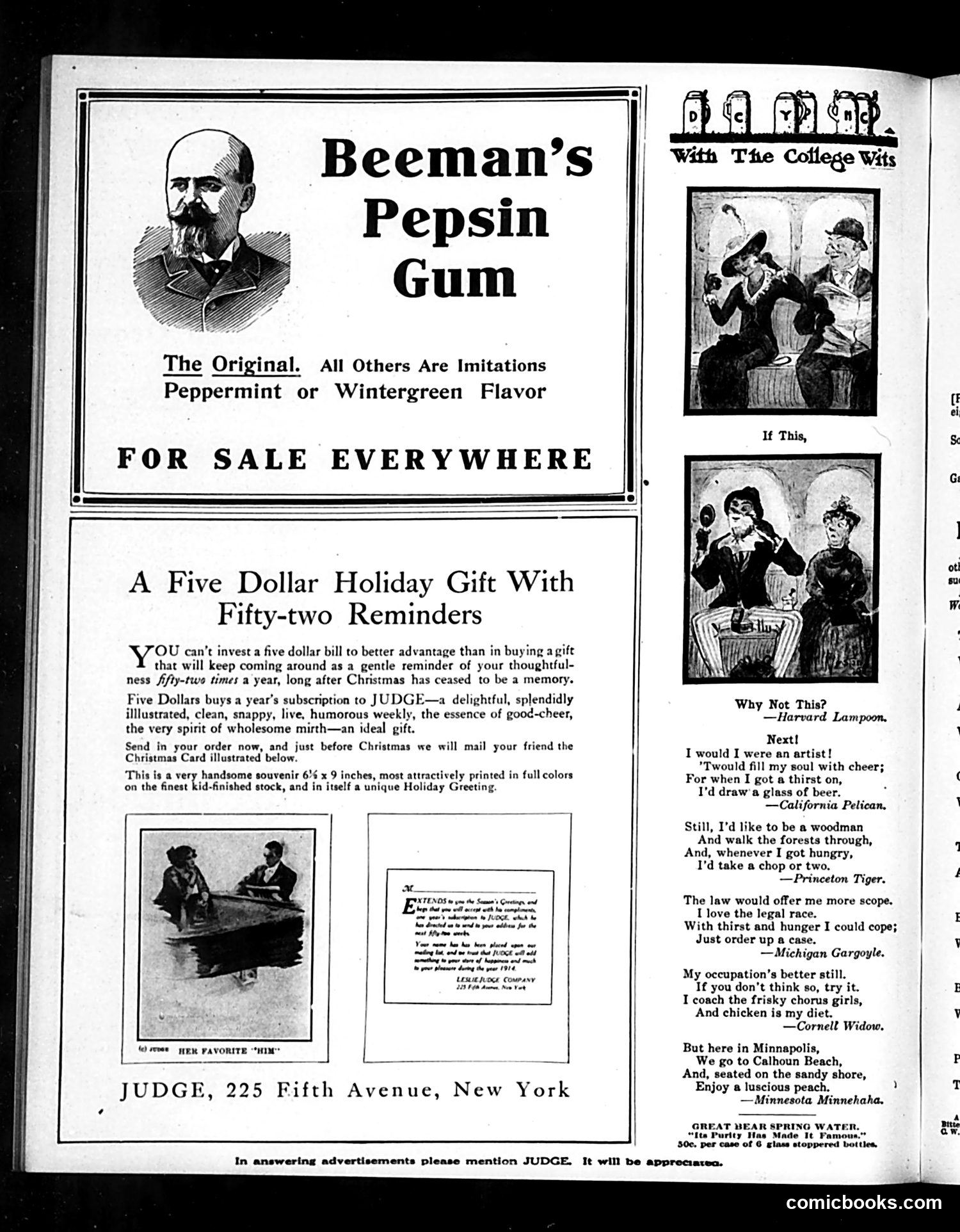
This page is primarily **advertising**, not political satire. The left side promotes **Beeman's Pepsin Gum** and a **Judge magazine subscription** as a five-dollar holiday gift—pitched as providing "fifty-two reminders" of the giver's thoughtfulness through weekly issues. The right side features college humor verses from various university publications (Harvard Lampoon, Princeton Tiger, Michigan Gargoyle, Cornell Widow, Minnesota Minnehaha). These are lighthearted student-written poems about fantasy occupations—artist, woodman, lawyer, chorus coach, peach-eater—mostly with humorous twists involving alcohol or food. **Historical context**: This reflects early 20th-century collegiate culture and humor magazines' popularity. The poems are mildly irreverent but conventional for the era. The page contains no identifiable political figures or significant satire—it's a commercial pitch padded with entertainment content typical of Judge's format.
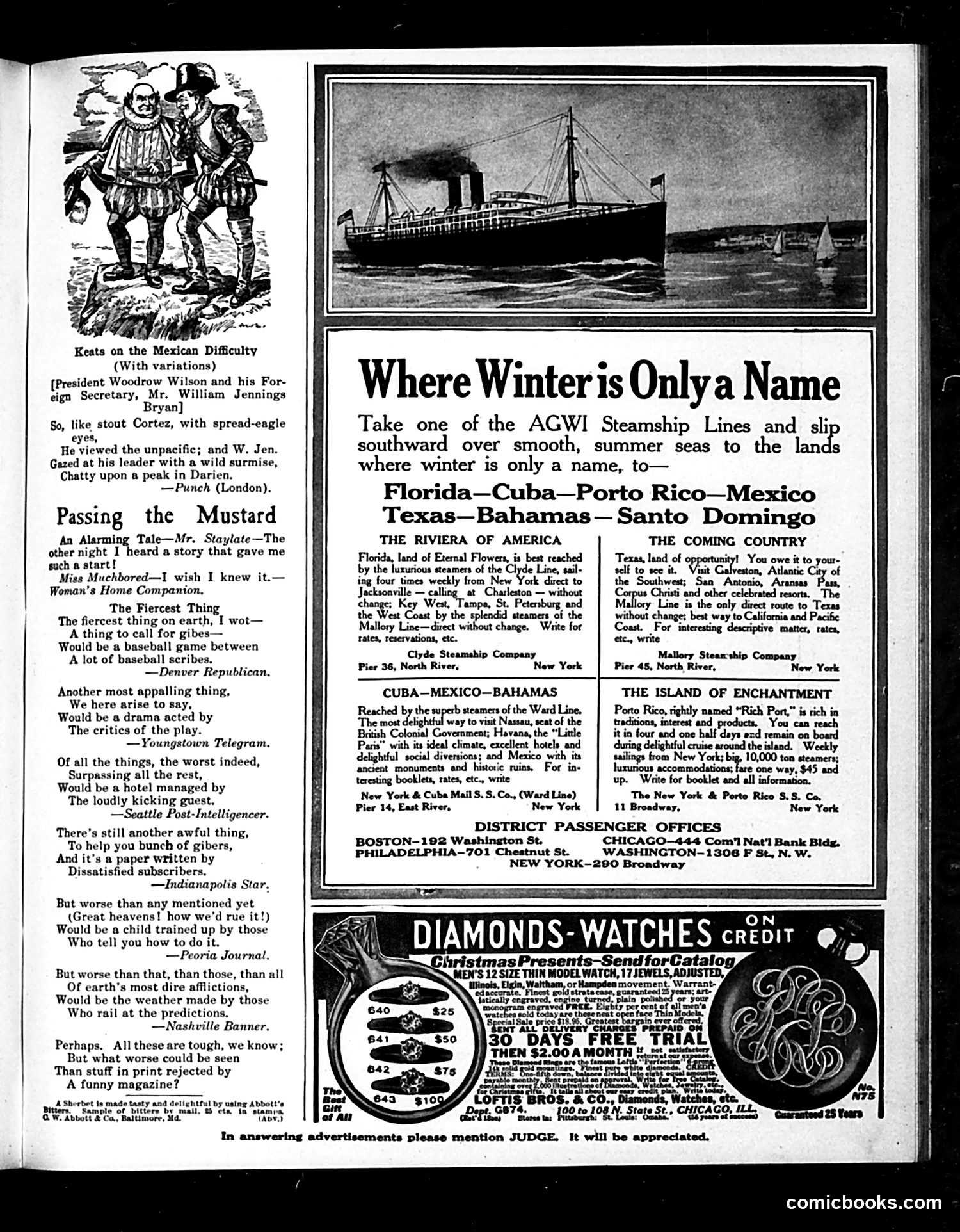
This page contains two unrelated elements: political satire and travel advertising. **The Cartoon/Satire:** The top section mocks President Woodrow Wilson and Secretary of State William Jennings Bryan regarding the "Mexican Difficulty"—likely referring to U.S. intervention in Mexico during the Mexican Revolution. The satire compares Wilson to Cortez (the Spanish conquistador) with "spread-eagle eyes," suggesting aggressive imperialism, while Bryan "gazes" in bewildered wonder. This references Keats' famous poem about Cortez discovering the Pacific, ironically titled "Keats on the Mexican Difficulty." The page then collects humorous newspaper quotes about society's "most appalling things"—baseball writers, drama critics, and complaining hotel guests—culminating in the joke that being rejected by a humor magazine is worse than all earthly afflictions. **The Advertising:** The bulk of the page promotes steamship cruises to warm winter destinations (Florida, Cuba, Mexico, Puerto Rico) via various shipping lines—typical leisure travel advertising for wealthy Americans.
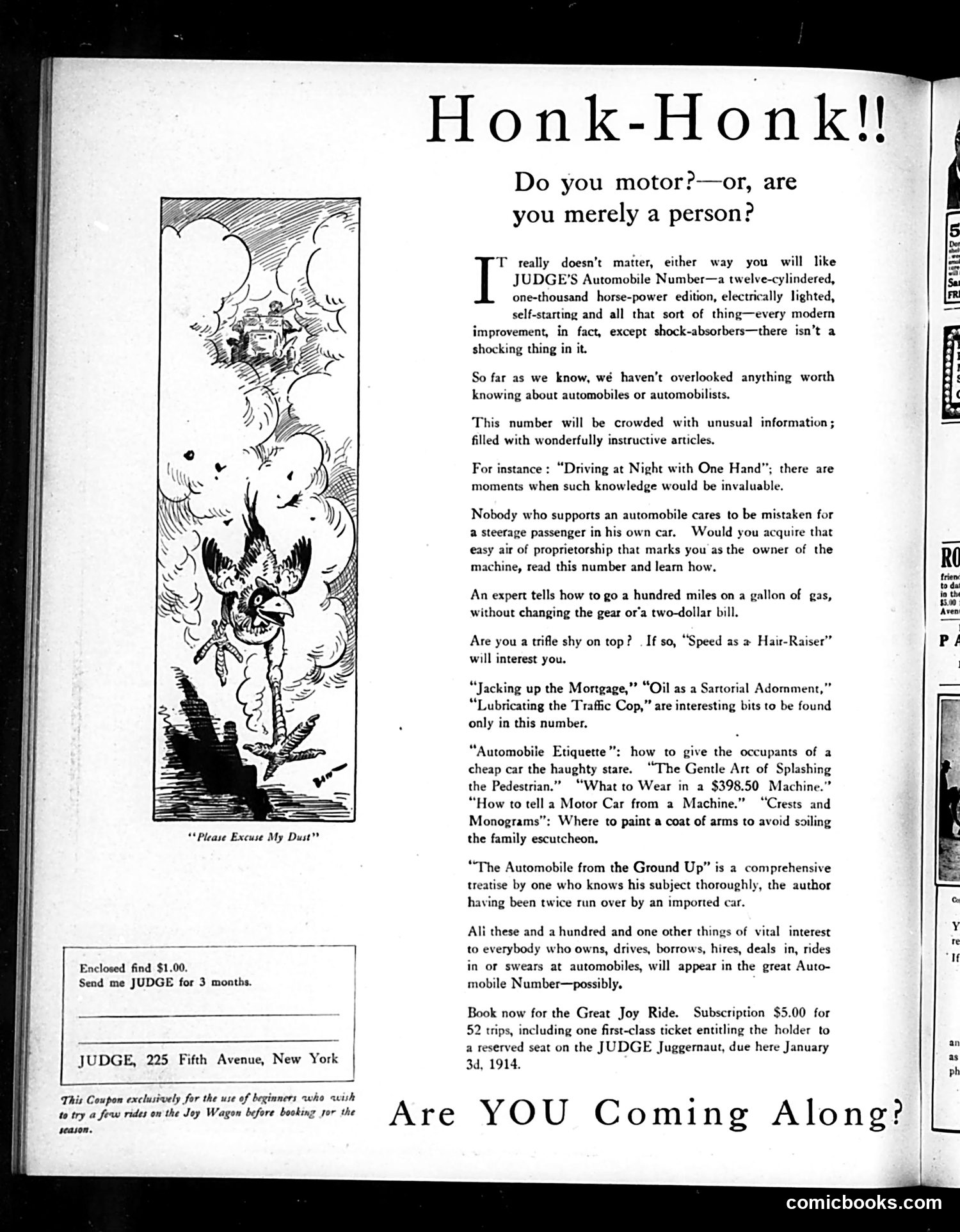
This is a **promotional advertisement** for Judge magazine's special automobile issue, not a political cartoon. The small illustration ("Please Excuse My Dust") shows a dust cloud—a visual pun on the era's notorious road hazards from early motorcar travel. The satire targets the **emerging automobile culture** of the early 1900s, mocking how car ownership had become a status symbol and source of social anxiety. The text humorously catalogs trivial concerns: acquiring the "easy air of proprietorship," maintaining appearances ("What to Wear in a $398.50 Machine"), and one-upping others ("give the haughty stare" to cheap car owners). Key jokes include articles on "Lubricating the Traffic Cop" (bribing police), bald men using speed as a "Hair-Raiser," and an author who'd been "twice run over by an imported car"—poking fun at automobiles' danger and America's emerging car-culture pretensions during the dawn of mass motoring.
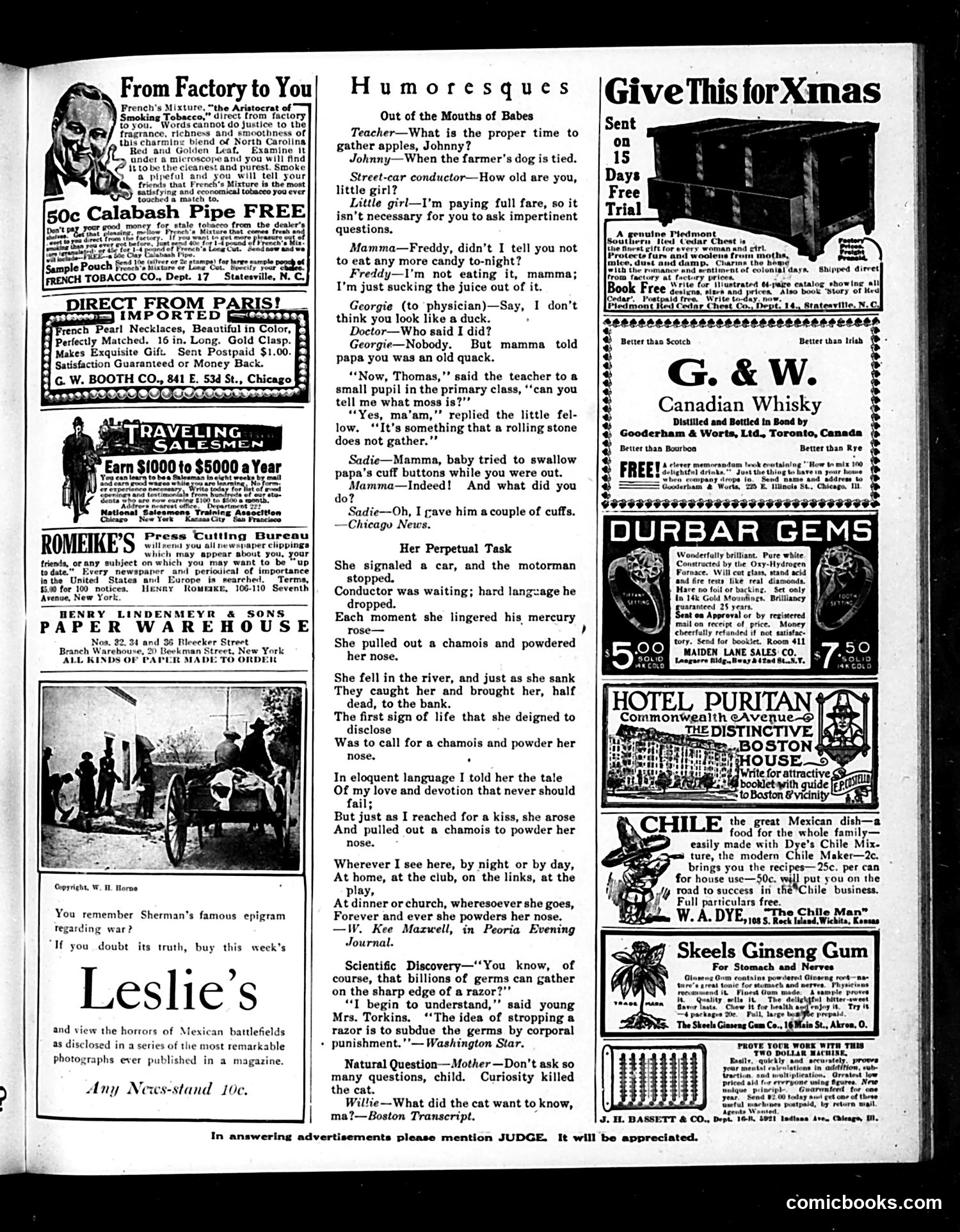
This page from *Judge* (a satirical American magazine) consists primarily of **advertising and humor columns** rather than political cartoons. The "Humoresques" section contains **brief, gentle jokes** about children's innocent misunderstandings and adults' quirks—typical turn-of-century humor. Examples include a child paying full streetcar fare so the conductor won't ask her age, and a running gag about a woman obsessively powdering her nose (the poem "Her Perpetual Task") even in absurd situations like nearly drowning. The advertisements promote **consumer goods**: tobacco, jewelry, whiskey, gems, and patent medicines—reflecting early 1900s marketing. The top-left "From Factory to You" ad emphasizes direct distribution as a selling point. The humor is **non-political and domestic** in focus, aimed at middle-class readers. There are no caricatures of political figures or commentary on current events visible here. This is a lifestyle/consumer-oriented magazine page typical of the era's popular humor magazines.
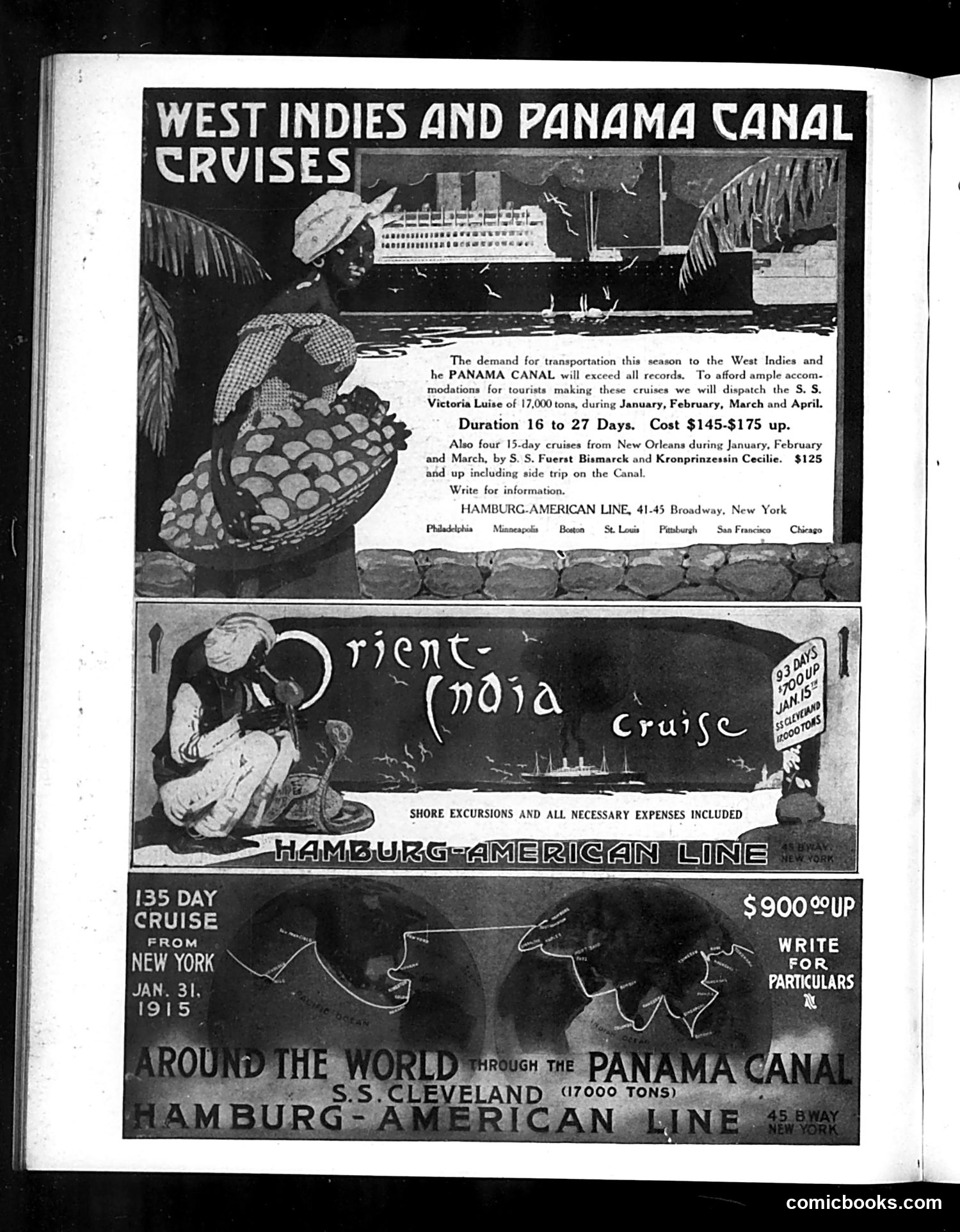
This page is **primarily advertising**, not political satire. It features three cruise advertisements from the Hamburg-American Line promoting voyages to the West Indies and Panama Canal. The ads use **exotic imagery** — figures in tropical dress and headwear — to market luxury travel. This reflects early-20th-century tourism marketing that exoticized distant destinations for wealthy American travelers. **Historical context**: The Panama Canal opened in 1914, making it a newly fashionable tourist attraction. The ads emphasize the novelty and accessibility of this engineering marvel. **Notable detail**: The German steamships (Victoria Luise, Fuerst Bismarck, Kronprinzessin Cecilie) are prominently featured. This is significant because this *appears* to be from early 1915, just months into World War I — when German-American relations were deteriorating. Such advertisements would become increasingly rare as the U.S. moved toward entry into the war in 1917. The page demonstrates how consumer advertising reflected both tourism trends and pre-war international commerce.