
Judge, 1913-12-13 · page 5 of 24
Judge — December 13, 1913 — page 5: what you’re looking at
What you’re looking at
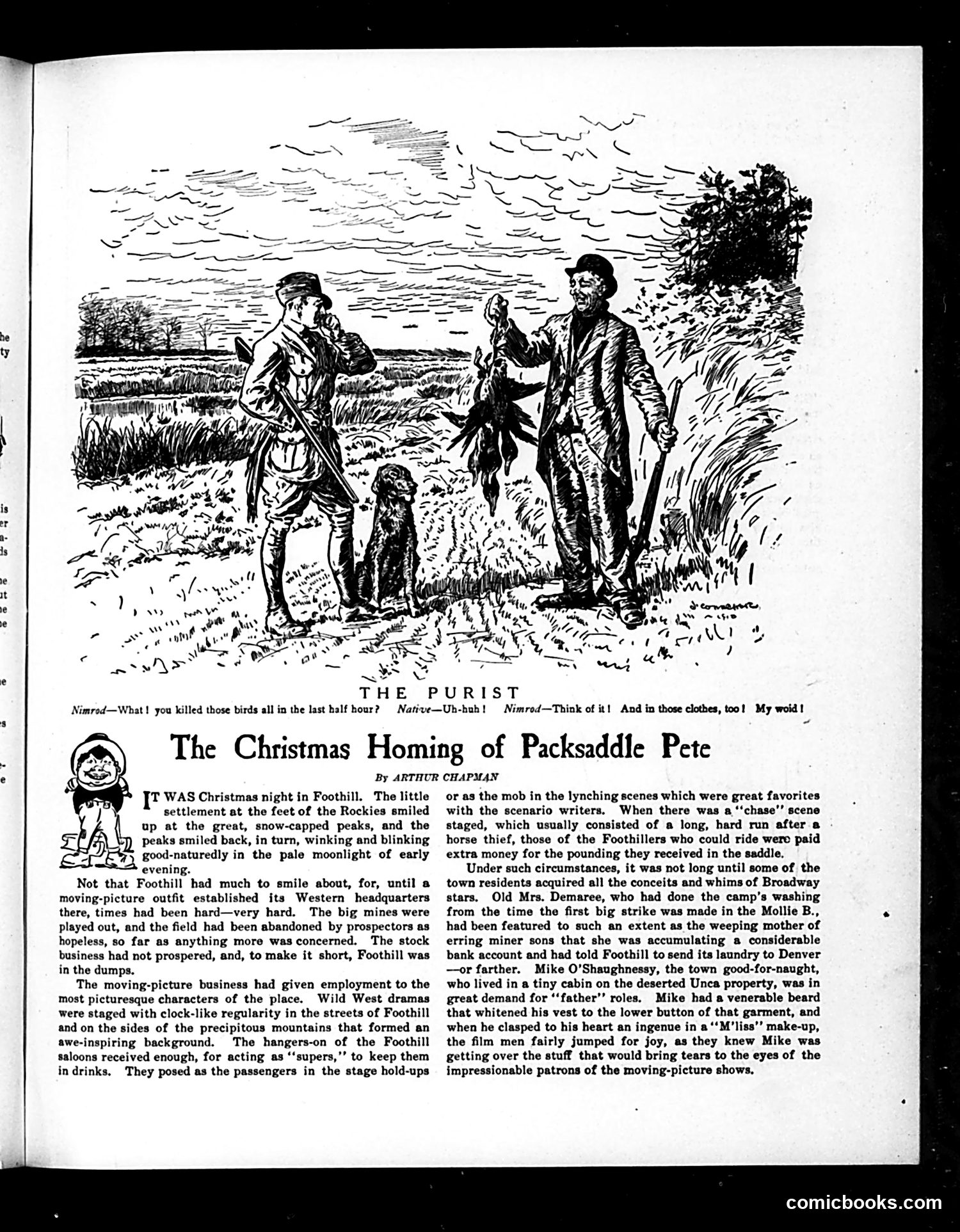
**"The Purist" (top cartoon):** Two men confront a third about killing birds. The dialogue suggests hypocrisy—one accuses the other of killing birds while wearing clothes made from them ("those clothes, too!"). This satirizes people who claim moral principles while ignoring their own complicity in similar practices. It's a straightforward joke about inconsistent ethics. **"The Christmas Homing of Packsaddle Pete" (story below):** This appears to be a Western fiction piece set in early Foothill, Colorado, describing a film production company's operations there. The narrative details how film companies employed locals as extras and incorporated Western scenery. The story seems to celebrate the industry's economic impact and entertainment value rather than offering satire.
📄 Transcribed text from this page (OCR, searchable)
Machine-transcribed from the original scan — historical spelling and the odd misread are preserved.
~* THE Nimrod—What! you killed those birds all in the last half hour? Native—Ub-bub ! o fam Se 2 j a oe cr % PURIST Nimrod—Think of it! And in those clothes, too! My woid! The Christmas Homing of Packsaddle Pete By ARTHUR CHAPMAN I‘ WAS Christmas night in Foothill. The little settlement at the feet of the Rockies smiled up at the great, snow-capped peaks, and the peaks smiled back, in turn, winking and blinking E% good-naturedly in the pale moonlight of early evening. Not that Foothill had much to smile about, for, until a moving-picture outfit established its Western headquarters there, times had been hard—very hard. The big mines were played out, and the field had been abandoned by prospectors as hopeless, so far as anything more was concerned. The stock business had not prospered, and, to make it short, Foothill was in the dumps. The moving-picture business had given employment to the most picturesque characters of the place. Wild West dramas were staged with clock-like regularity in the streets of Foothill and on the sides of the precipitous mountains that formed an awe-inspiring background. The hangers-on of the Foothill saloons received enough, for acting as ‘‘supers,’’ to keep them in drinks, They posed as the passengers in the stage hold-ups or as the mob in the lynching scenes which were great favorites with the scenario writers. When there was a ‘‘chase’’ scene staged, which usually consisted of a long, hard run after a horse thief, those of the Foothillers who could ride were paid extra money for the pounding they received in the saddle. Under such circumstances, it was not long until some of the town residents acquired all the conceits and whims of Broadway stars. Old Mrs. Demaree, who had done the camp’s washing from the time the first big strike was made in the Mollie B., had been featured to such an extent as the weeping mother of erring miner sons that she was accumulating a considerable bank account and had told Foothill to send its laundry to Denver —or farther. Mike O'Shaughnessy, the town good-for-naught, who lived in a tiny cabin on the deserted Unca property, was in great demand for ‘‘father’’ roles. Mike had a venerable beard that whitened his vest to the lower button of that garment, and when he clasped to his heart an ingenue in a ‘‘M’liss’’ make-up, the film men fairly jumped for joy, as they knew Mike was getting over the stuff that would bring tears to the eyes of the impressionable patrons of the moving-picture shows. comicbooks.com