
Judge, 1913-12-13 · page 13 of 24
Judge — December 13, 1913 — page 13: what you’re looking at
What you’re looking at
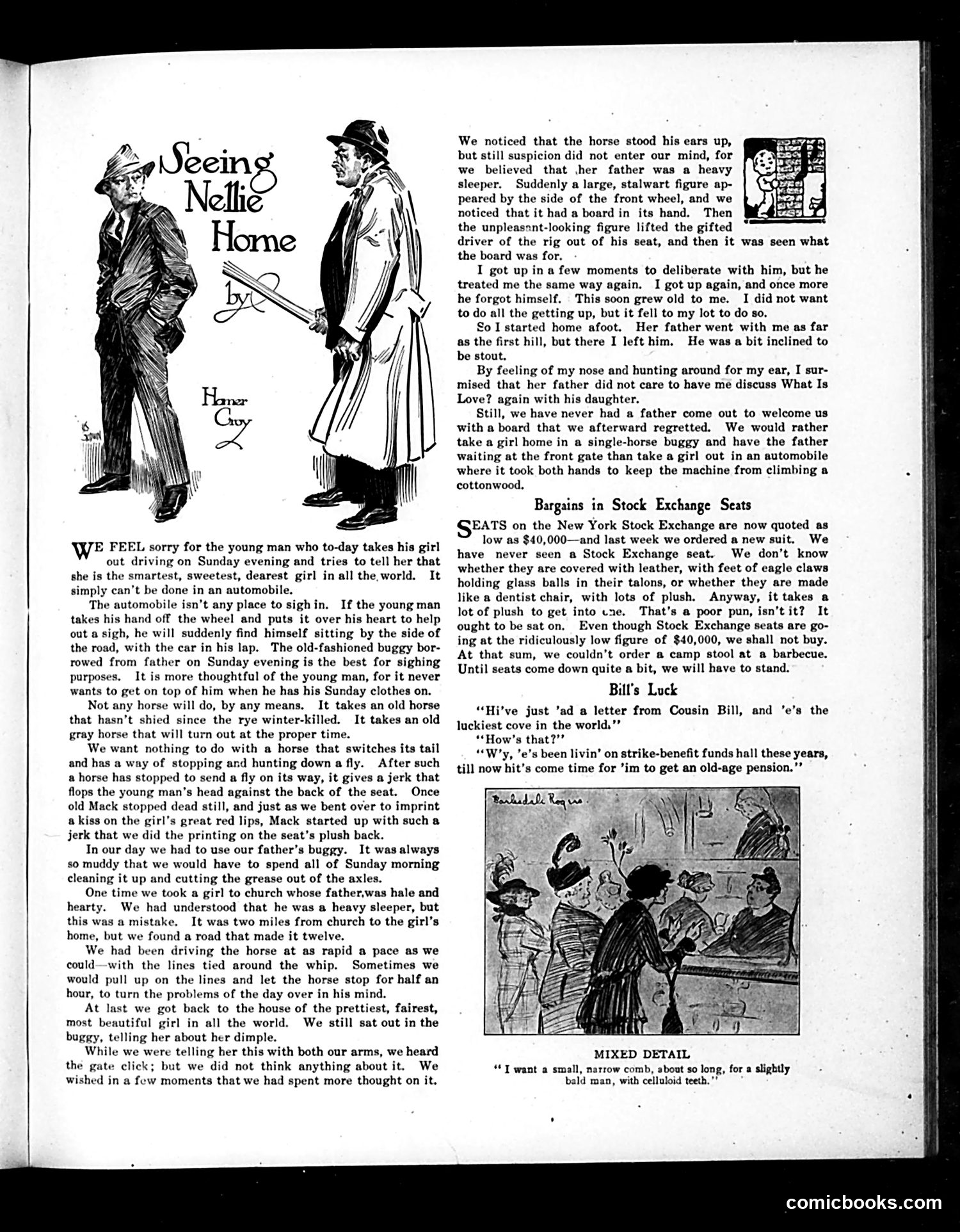
This is a humorous personal essay mocking early 1900s courtship customs. The author contrasts automobiles unfavorably with horse-drawn buggies for romantic purposes. **The main joke:** A young man takes his date driving in a car, but can't properly court her because operating the vehicle requires both hands. The story climaxes when her father emerges with a board and literally beats the narrator out of the buggy seat—a darkly comic punishment for improper behavior. **The satire targets:** - The impracticality of automobiles for romance (you need both hands to drive) - The dangers of unsupervised young couples - Overprotective fathers who enforce strict courtship rules - The narrator's self-mocking incompetence with his date The essay nostalgically advocates for old horse buggies, which require less attention and allow proper romantic gestures—though even these offered hazards (horses stopping abruptly mid-kiss). This reflects genuine 1900s anxieties about automobiles enabling unchaperoned dating and moral dangers to young women.
📄 Transcribed text from this page (OCR, searchable)
Machine-transcribed from the original scan — historical spelling and the odd misread are preserved.
WE FEEL sorry for the young man who to-day takes his girl out driving on Sunday evening and tries to tell her that she is the smartest, sweetest, dearest girl in all the.world. It simply can’t be done in an automobile. The automobile isn’t any place to sighin. If the young man takes his hand off the wheel and puts it over his heart to help out a sigh, he will suddenly find himself sitting by the side of the road, with the car in his lap. The old-fashioned buggy bor- rowed from father on Sunday evening is the best for sighing purposes, It is more thoughtful of the young man, for it never wants to get on top of him when he has his Sunday clothes on. Not any horse will do, by any means, It takes an old horse that hasn’t shied since the rye winter-killed. It takes an old gray horse that will turn out at the proper time. We want nothing to do with a horse that switches its tail and has a way of stopping and hunting down a fly. After such a horse has stopped to send a fly on its way, it gives a jerk that flops the young man’s head against the back of the seat. Once old Mack stopped dead still, and just as we bent over to imprint a kiss on the girl's great red lips, Mack started up with such a jerk that we did the printing on the seat’s plush back. In our day we had to use our father’s buggy. It was always so muddy that we would have to spend all of Sunday morning cleaning it up and cutting the grease out of the axles. One e we took a girl to church whose father,was hale and hearty. We had understood that he was a heavy sleeper, but this was a mistake. It was two miles from church to the girl’s home, but we found a road that made it twelve. We had been driving the horse at as rapid a pace as we could—with the lines tied around the whip. Sometimes we would pull up on the lines and let the horse stop for half an hour, to turn the problems of the day over in his mind. At last we got back to the house of the prettiest, fairest, most beautiful girl in all the world. We still sat out in the buggy, telling her about her dimple. While we were telling her this with both our arms, we heard the gate click; but we did not think anything about it. We wished in a few moments that we had spent more thought on it. We noticed that the horse stood his ears up, but still suspicion did not enter our mind, for we believed that .her father was a heavy sleeper. Suddenly a large, stalwart figure ap- peared by the side of the front wheel, and we noticed that it had a board in its hand. Then the unpleasent-looking figure lifted the gifted driver of the rig out of his seat, and then it was seen what the board was for. I got up in a few moments to deliberate with him, but he treated me the same way again. I got up again, and once more he forgot himself. This soon grew old to me. I did not want to do all the getting up, but it fell to my lot to do so, £o I started home afoot. Her father went with me as far as the first hill, but there I left him. He was a bit inclined to be stout. By feeling of my nose and hunting around for my ear, I sur- mised that her father did not care to have me discuss What Is Love? again with his daughter. Still, we have never had a father come out to welcome us with a board that we afterward regretted. We would rather take a girl home in a single-horse buggy and have the father waiting at the front gate than take a girl out in an automobile where it took both hands to keep the machine from climbing a cottonwood. Bargains in Stock Exchange Seats SFATS on the New York Stock Exchange are now quoted as low as $40,000—and last week we ordered a new suit. We have never seen a Stock Exchange seat. We don’t know whether they are covered with leather, with feet of eagle claws holding glass balls in their talons, or whether they are made like a dentist chair, with lots of plush, Anyway, it takes a lot of plush to get into ene. That’s a poor pun, isn’t it? It ought to be saton, Even though Stock Exchange seats are go- ing at the ridiculously low figure of $40,000, we shall not buy. At that sum, we couldn't order a camp stool at a barbecue. Until seats come down quite a bit, we will have to stand. Bill’s Luck “Hi’ve just ’ad a letter from Cousin Bill, and 'e’s the luckiest cove in the world.’’ “*How’s that?’” “«W’y, ’e’s been livin’ on strike-benefit funds hall these years, till now hit’s come time for ’im to get an old-age pension.” MIXED DETAIL “Twant a small, narrow comb, about so long, for a slightly bald man, with celluloid teeth.” comicbooks.com