
Judge, 1913-12-13 · page 8 of 24
Judge — December 13, 1913 — page 8: what you’re looking at
What you’re looking at
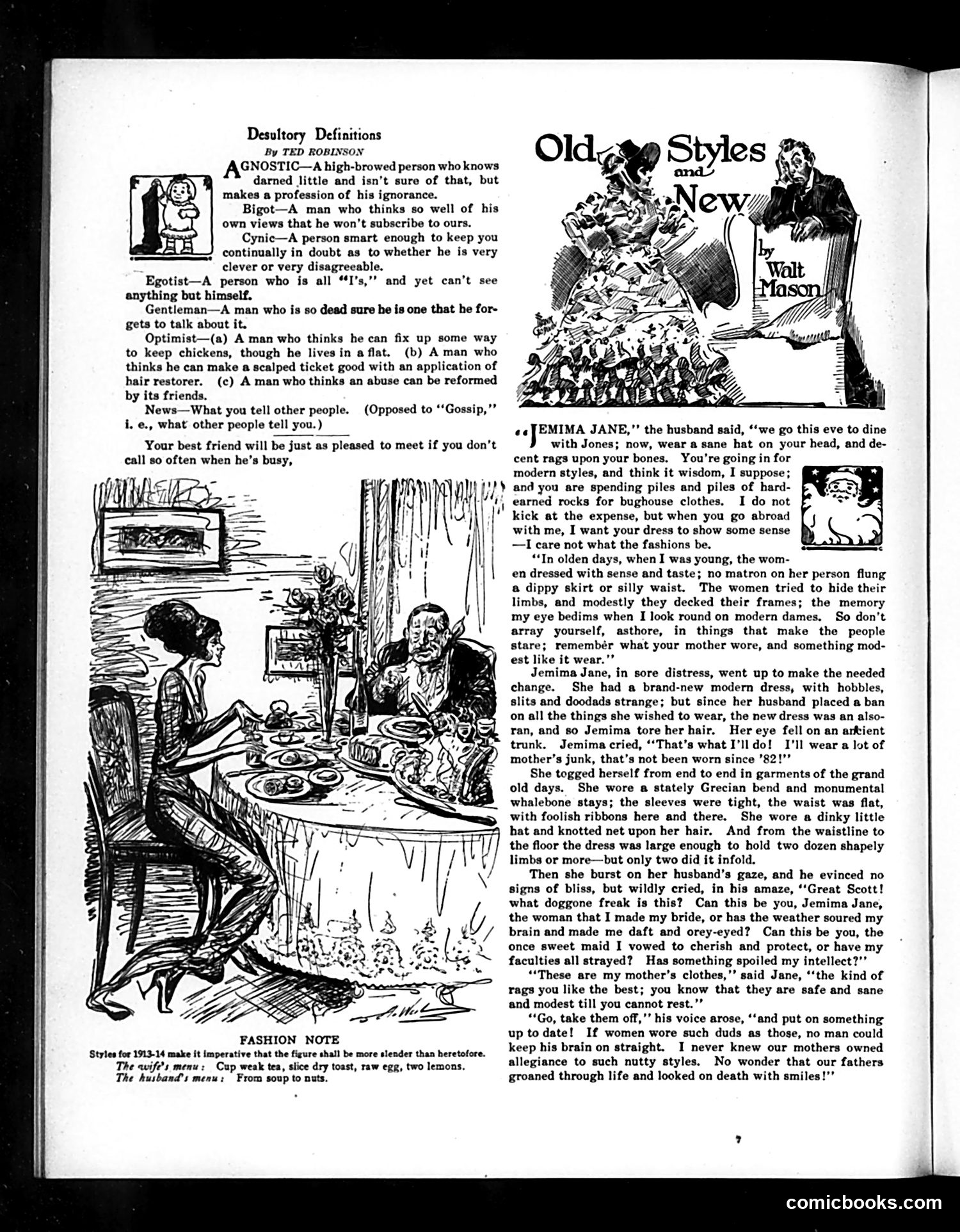
This page contains two satirical pieces about fashion and social attitudes circa 1913-14. **"Desultory Definitions"** offers tongue-in-cheek definitions of character types (agnostic, cynic, egotist, etc.), typical of satirical magazines' commentary on human nature. **The main story, "Jemima Jane,"** satirizes conflicting attitudes toward women's fashion. A husband demands his wife dress modestly, rejecting modern 1913-14 styles (hobble skirts, loose waists) as immodest. He insists she wear old-fashioned clothing "like your mother." When Jemima complies by wearing actual 1880s garments—complete with whalebone stays, a "Grecian bend," and voluminous skirts—he's appalled, calling them absurd. The joke critiques male hypocrisy: he claims to want "modest" dress but actually objects to *any* style—old or new. The accompanying fashion note mocks that 1913-14 fashion demands extreme slenderness, while the husband's menu contrast (wife: weak tea and lemon; husband: full meals) suggests gendered inequality.
📄 Transcribed text from this page (OCR, searchable)
Machine-transcribed from the original scan — historical spelling and the odd misread are preserved.
Desultory Definitions By TED ROBINSON ASNOSTIC—A high-browed person who knows darned little and isn’t sure of that, but makes a profession of his ignorance. Bigot—A man who thinks so well of his own views that he won’t subscribe to ours. Cynic—A person smart enough to keep you continually in doubt as to whether he is very clever or very disagreeable. Egotist—A person who is all “I's,” anything but himself. Gentleman—A man who is so dead sure he is one that he for- gets to talk about it. Optimist—(a) A man who thinks he can fix up some way to keep chickens, though he lives in a flat. (b) A man who and yet can’t see thinks he can make a scalped ticket good with an application of hair restorer. by its friends. News—What you tell other people. i. e., what other people tell you.) Your best friend will be just as pleased to meet if you don’t (c) A man who thinks an abuse can be reformed (Opposed to “Gossip,” call so often when he’s busy, FASHION NOTE Styles for 1913-14 make it imperative that the figure shall be more slender than heretofore. The wife's menu: Cup weak tea, slice dry toast, raw egg, two lemons. The husband's menu: From soup to nuts. | earned rocks for bughouse clothes, e«]EMIMA JANE,” the husband said, ‘‘we go this eve to dine with Jones; now, wear a sane hat on your head, and de- cent rags upon your bones. You're going in for modern styles, and think it wisdom, I suppose; and you are spending piles and piles of hard- I do not kick at the expense, but when you go abroad with me, I want your dress to show some sense —I care not what the fashions be. “In olden days, when I was young, the wom- en dressed with sense and taste; no matron on her person flung a dippy skirt or silly waist. The women tried to hide their limbs, and modestly they decked their frames; the memory my eye bedims when I look round on modern dames. So don't array yourself, asthore, in things that make the people stare; remembér what your mother wore, and something mod- est like it wear.” Jemima Jane, in sore distress, went up to make the needed change. She had a brand-new modern dress, with hobbles, slits and doodads strange; but since her husband placed a ban on all the things she wished to wear, the new dress was an also- ran, and so Jemima tore her hair. Her eye fell on an arkient trunk. Jemima cried, ‘‘That’s what I'll do! I'll wear a lot of mother’s junk, that’s not been worn since ’82!"" She togged herself from end to end in garments of the grand old days. She wore a stately Grecian bend and monumental whalebone stays; the sleeves were tight, the waist was flat, with foolish ribbons here and there. She wore a dinky little hat and knotted net upon her hair. And from the waistline to the floor the dress was large enough to hold two dozen shapely limbs or more—but only two did it infold. Then she burst on her husband’s gaze, and he evinced no signs of bliss, but wildly cried, in his amaze, ‘‘Great Scott! what doggone freak is this? Can this be you, Jemima Jane, the woman that I made my bride, or has the weather soured my brain and made me daft and orey-eyed? Can this be you, the once sweet maid I vowed to cherish and protect, or have my faculties all strayed? Has something spoiled my intellect?’’ “These are my mother’s clothes,’’ said Jane, ‘‘the kind of rags you like the best; you know that they are safe and sane and modest till you cannot rest.’” “Go, take them off,” his voice arose, ‘‘and put on something up todate! If women wore such duds as those, no man could keep his brain on straight. I never knew our mothers owned allegiance to such nutty styles. No wonder that our fathers groaned through life and looked on death with smiles!’ comicbooks.com