
Judge, 1913-12-13 · page 12 of 24
Judge — December 13, 1913 — page 12: what you’re looking at
What you’re looking at
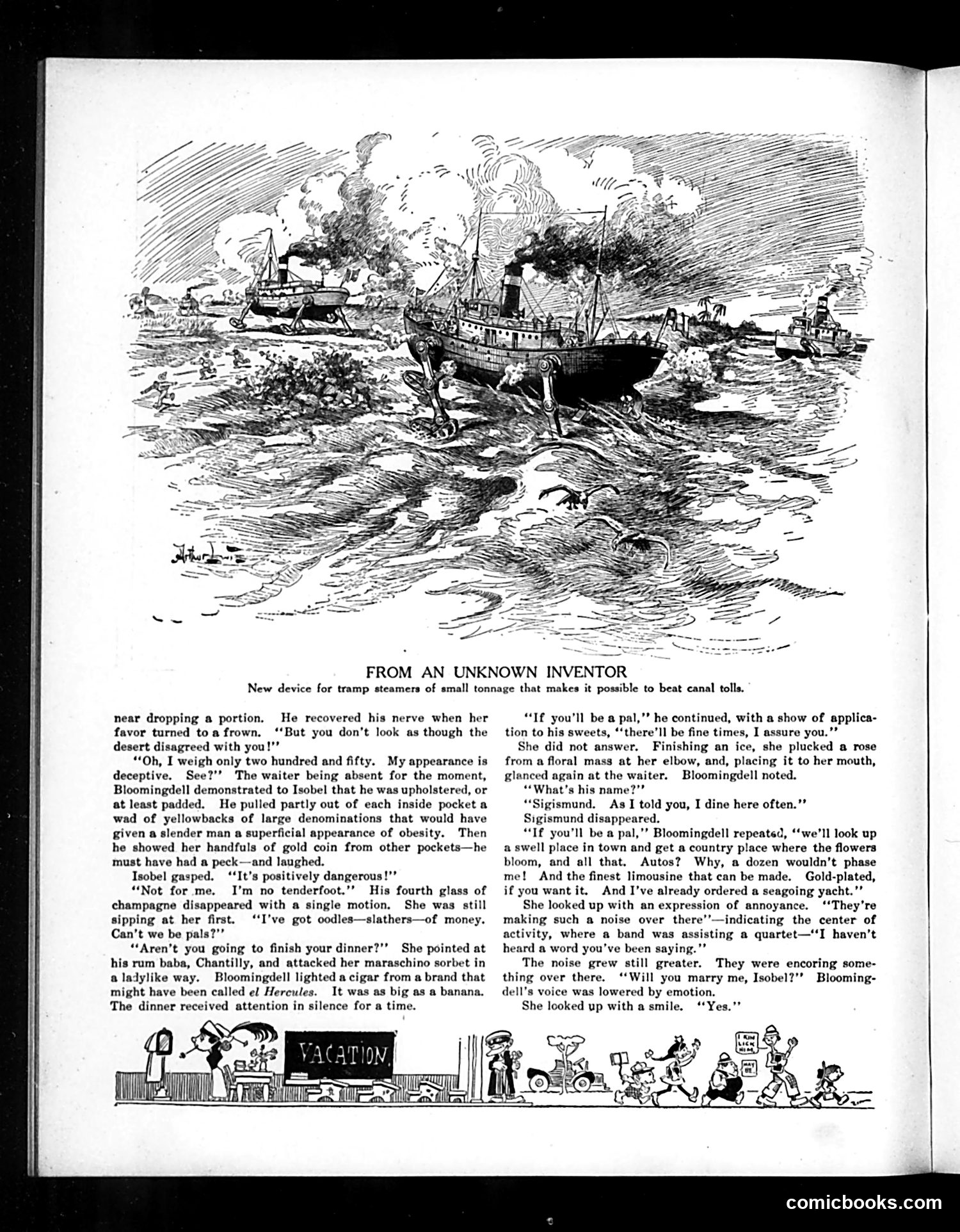
The main illustration shows **steamships and small boats in water**, captioned "FROM AN UNKNOWN INVENTOR—New device for tramp steamers of small tonnage that makes it possible to beat canal tolls." This is satirical commentary on shipping economics: the cartoon depicts an absurdly impractical or humorous scheme (unclear exactly what) for avoiding canal fees—a real concern for small commercial vessels. The accompanying story is a romantic comedy about a wealthy but socially awkward man named **Bloomingdell** courting a woman named **Isobel**. The satire mocks nouveau-riche behavior: he ostentatiously displays wads of cash and gold from his pockets, brags constantly about money and possessions (yachts, automobiles, limousines), yet remains so oblivious to social cues that he doesn't notice she's completely unimpressed—she only accepts his marriage proposal because the restaurant noise prevents her from hearing his boastful speech. The joke targets **gilded-age wealth without refinement**—money cannot buy taste, manners, or genuine romantic connection.
📄 Transcribed text from this page (OCR, searchable)
Machine-transcribed from the original scan — historical spelling and the odd misread are preserved.
FROM AN UNKNOWN INVENTOR New device for tramp steamers of small tonnage that makes it possible to beat canal tolls. near dropping a portion. He recovered his nerve when her favor turned toa frown. ‘But you don’t look as though the desert disagreed with you!” “Oh, I weigh only two hundred and fifty. My appearance is deceptive. See?’’ The waiter being absent for the moment, Bloomingdell demonstrated to Isobel that he was upholstered, or at least padded. He pulled partly out of each inside pocket a wad of yellowbacks of large denominations that would have given a slender man a superficial appearance of obesity. Then he showed her handfuls of gold coin from other pockets—he must have had a peck—and laughed. Isobel gasped. ‘‘It’s positively dangerous!’* “Not for me. I’m no tenderfoot.’’ His fourth glass of champagne disappeared with a single motion. She was still sipping at her first. ‘‘I’'ve got oodles—slathers—of money. Can't we be pals?’’ “Aren’t you going to finish your dinner?’ She pointed at his rum baba, Chantilly, and attacked her maraschino sorbet in a ladylike way. Bloomingdell lighted a cigar from a brand that might have been called el Hercules. It was as big as a banana. The dinner received attention in silence for a time. “If you'll be a pal,’’ he continued, with a show of applica- tion to his sweets, ‘‘there'll be fine times, I assure you.”” She did not answer. Finishing an ice, she plucked a rose from a floral mass at her elbow, and, placing it to her mouth, glanced again at the waiter. Bloomingdell noted. “What's his name?"” “Sigismund. As I told you, I dine here often.” Sigismund disappeared. “If you'll be a pal,’’ Bloomingdell repeated, ‘‘we’ll look up a swell place in town and get a country place where the flowers bloom, and all that. Autos? Why, a dozen wouldn’t phase e! And the finest limousine that can be made. Gold-plated, if you want it. And I’ve already ordered a seagoing yacht.’”” She looked up with an expression of annoyance. ‘They're making such a noise over there’’—indicating the center of activity, where a band was assisting a quartet—‘‘I haven't heard a word you've been saying.’” The noise grew still greater. thing over there. ‘Will you marry me, Isobel?” dell’s voice was lowered by emotion. She looked up with a smile. ‘‘Yes.’’ They were encoring some- Blooming- comicbooks.com