
Judge, 1913-12-13 · page 17 of 24
Judge — December 13, 1913 — page 17: what you’re looking at
What you’re looking at
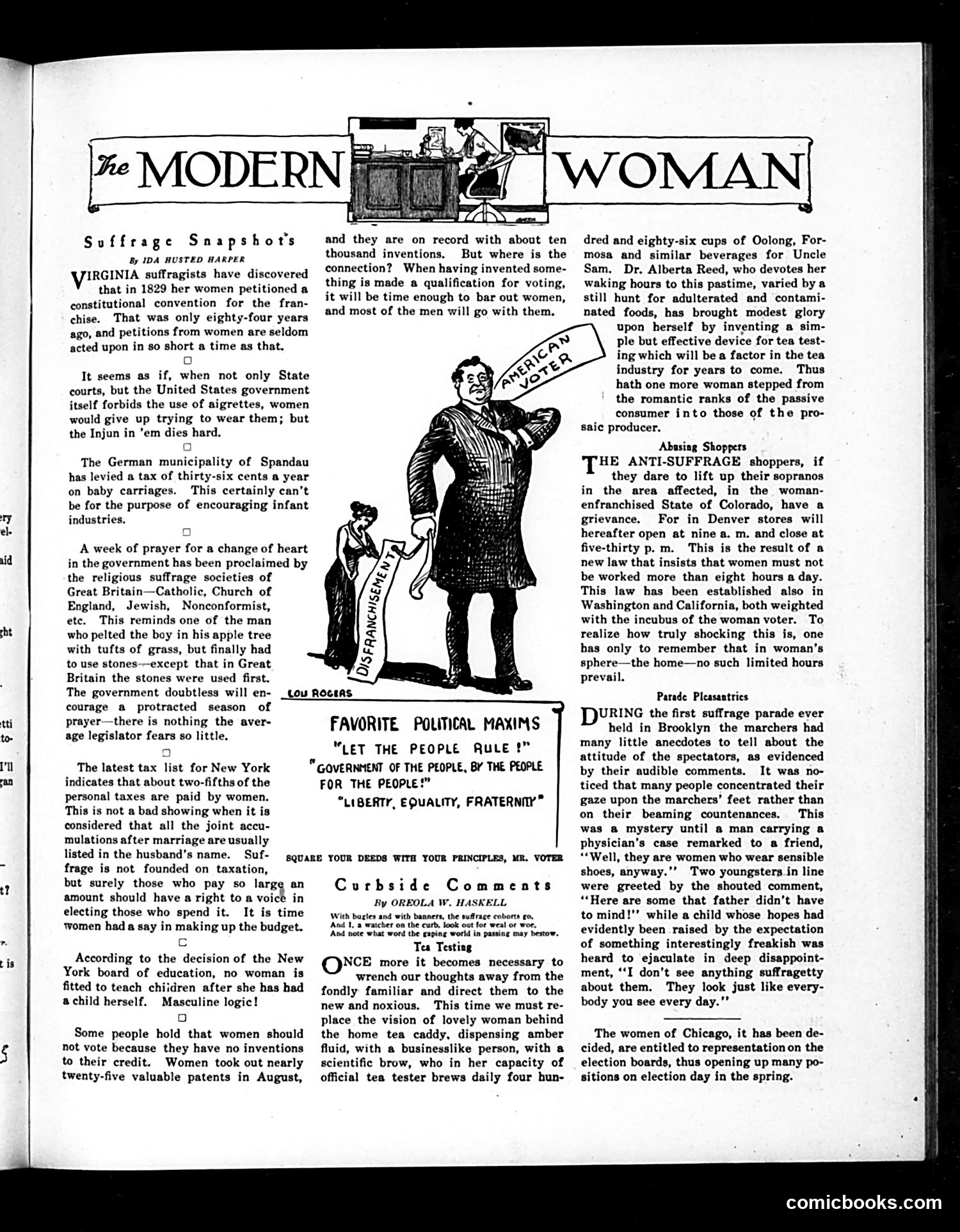
This page from Judge magazine contains pro-suffrage commentary by Ida Husted Harper. The central cartoon depicts a large woman labeled "AMERICAN VOTER" carrying a small man labeled "ANTI-SUFFRAGE SHOPPER," satirizing anti-suffrage women who oppose voting rights for their own sex. The "Suffrage Snapshots" column uses humor to counter arguments against women's suffrage: women have invented thousands of devices (refuting claims they lack capability), they pay substantial taxes (demanding "no taxation without representation"), and they're capable workers (like the tea-testing official Dr. Alberta Reed). The highlighted "Favorite Political Maxims" section mockingly juxtaposes democratic ideals ("government of the people, by the people, for the people") with the reality that women—excluded from voting—cannot participate in this system, suggesting hypocrisy in American democracy. The overall message: women deserve suffrage based on taxation, competence, and fundamental democratic principles.
📄 Transcribed text from this page (OCR, searchable)
Machine-transcribed from the original scan — historical spelling and the odd misread are preserved.
Suffrage Snapshort's By IDA HUSTED HARPER VIRGINIA suffragists have discovered that in 1829 her women petitioned a constitutional convention for the fran- chise. That was only eighty-four years ago, and petitions from women are seldom acted upon in so short a time as that. o It seems as if, when not only State courts, but the United States government itself forbids the use of aigrettes, women would give up trying to wear them; but the Injun in ’em dies hard. The German municipality of Spandau has levied a tax of thirty-six cents a year on baby carriages. This certainly can’t be for the purpose of encouraging infant industries. ‘A week of prayer for a change of heart in the government has been proclaimed by the religious suffrage societies of Great Britain—Catholic, Church of England, Jewish, Nonconformist, etc. This reminds one of the man who pelted the boy in his apple tree with tufts of grass, but finally had to use stones-—except that in Great Britain the stones were used first. The government doubtless will en- courage a protracted season of prayer—there is nothing the aver- age legislator fears so little. oO The latest tax list for New York indicates that about two-fifths of the personal taxes are paid by women. This is not a bad showing when it is considered that all the joint accu- mulations after marriage are usually listed in the husband’s name. Suf- frage is not founded on taxation, but surely those who pay so large an amount should have a right to a voice in electing those who spend it. It is time women hada say in making up the budget. c According to the decision of the New York board of education, no woman is fitted to teach chiidren after she has had achild herself. Masculine logic! a Some people hold that women should not vote because they have no inventions to their credit. Women took out nearly twenty-five valuable patents in August, and they are on record with about ten thousand inventions. But where is the connection? When having invented some- thing is made a qualification for voting, it will be time enough to bar out women, and most of the men will go with them. FAVORITE POLITICAL MAXIMS “LET THE PEOPLE RULE !” "GOVERNMENT OF THE PEOPLE, BY THE PEOPLE FOR THE PEOPLE!” “LIBERTY, EQUALITY, FRATERNITY” SQUARE YOUR DEEDS WITH YOUR PRINCIPLES, MR. VOTER Curbside Comments By OREOLA W. HASKELL With bagtes and with banners, the suffrage coborts £0. And 1, a waicher on the curb, look ost for weal or woe, And note what word the gaping world in pasting may bestow. Tea Testing ONCE more it becomes necessary to wrench our thoughts away from the fondly familiar and direct them to the new and noxious. This time we must re- place the vision of lovely woman behind the home tea caddy, dispensing amber fluid, with a businesslike person, with a scientific brow, who in her capacity of official tea tester brews daily four hun- dred and eighty-six cups of Oolong, For- mosa and similar beverages for Uncle Sam. Dr. Alberta Reed, who devotes her waking hours to this pastime, varied by a still hunt for adulterated and contami- nated foods, has brought modest glory upon herself by inventing a sim- ple but effective device for tea test- ing which will be a factor in the tea industry for years to come. Thus hath one more woman stepped from the romantic ranks of the passive consumer into those of the pro- saic producer. Abusing Shoppers THE ANTI-SUFFRAGE shoppers, if they dare to lift up their sopranos in the area affected, in the woman- enfranchised State of Colorado, have a grievance. For in Denver stores will hereafter open at nine a. m. and close at five-thirty p.m. This is the result of a new law that insists that women must not be worked more than eight hours a day. This law has been established also in Washington and California, both weighted with the incubus of the woman voter. To realize how truly shocking this is, one has only to remember that in woman’s sphere—the home—no such limited hours prevail. Parade Pleasantries DvuRING the first suffrage parade ever held in Brooklyn the marchers had many little anecdotes to tell about the attitude of the spectators, as evidenced by their audible comments. It was no- ticed that many people concentrated their gaze upon the marchers’ feet rather than on their beaming countenances. This was a mystery until a man carrying a physician’s case remarked to a friend, ‘Well, they are women who wear sensible shoes, anyway.’’ Two youngsters in line were greeted by the shouted comment, “‘Here are some that father didn’t have to mind!’’ while a child whose hopes had evidently been raised by the expectation of something interestingly freakish was heard to ejaculate in deep disappoint- ment, ‘‘I don’t see anything suffragetty about them. They look just like every- body you see every day.’’ The women of Chicago, it has been de- cided, are entitled to representation on the election boards, thus opening up many po- sitions on election day in the spring. comicbooks.com