
A complete issue · 24 pages · 1913
Judge — November 29, 1913
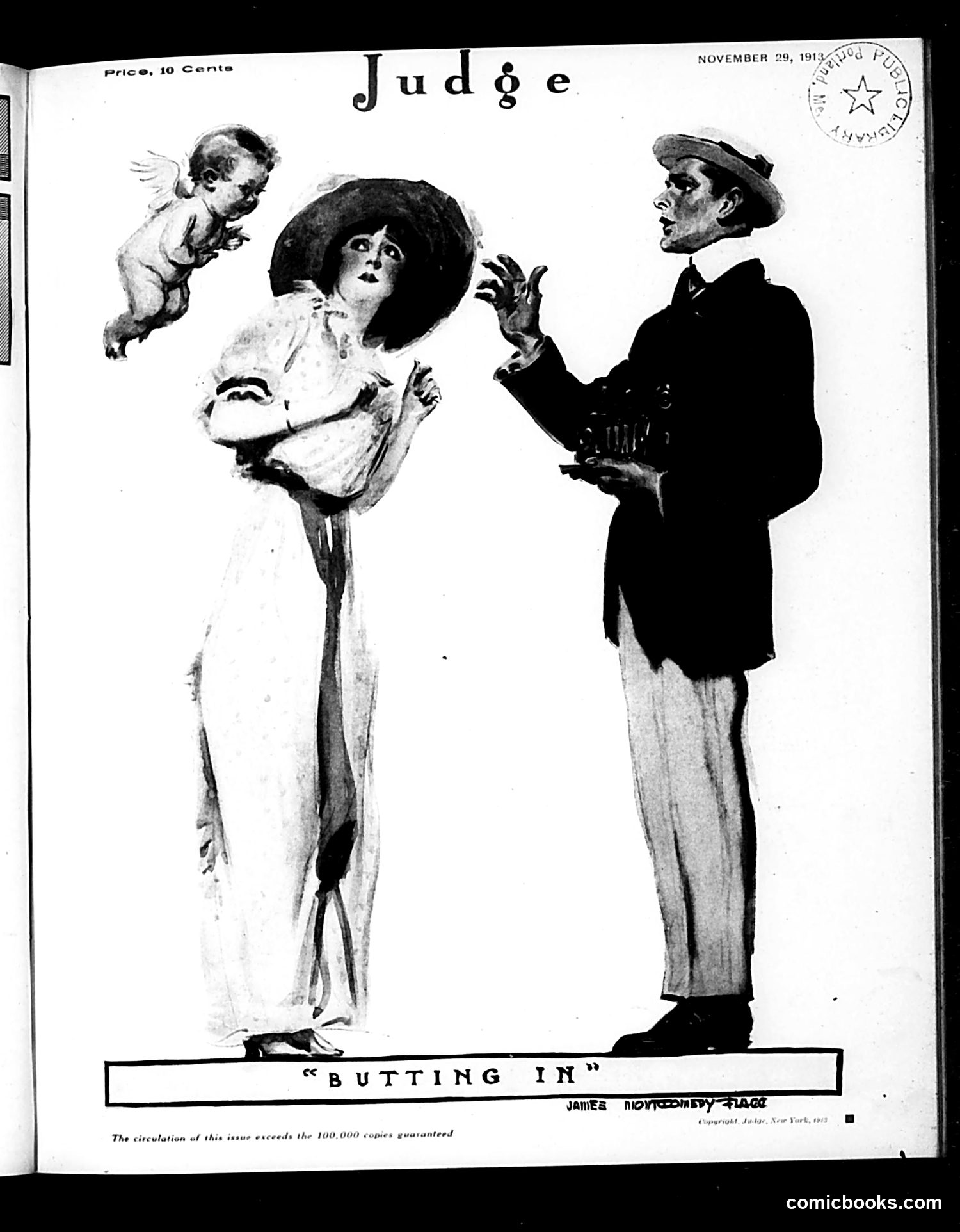
This cartoon, titled "Butting In," depicts a domestic scene satirizing unwanted interference in marriage or courtship. A woman holding a baby looks distressed while a man in formal dress gestures toward her, apparently intruding on an intimate moment. A cherub or cupid figure floats above, suggesting romantic or familial matters. The cartoon's humor targets the social problem of third-party meddling—a common satirical theme in early 20th-century humor magazines. The "butting in" refers to someone inserting themselves uninvited into others' private affairs, likely reflecting period anxieties about privacy and proper social boundaries. The artist is credited as James Montgomery Flagg, a prominent illustrator of the era. The specific individuals being satirized remain unclear without additional context.
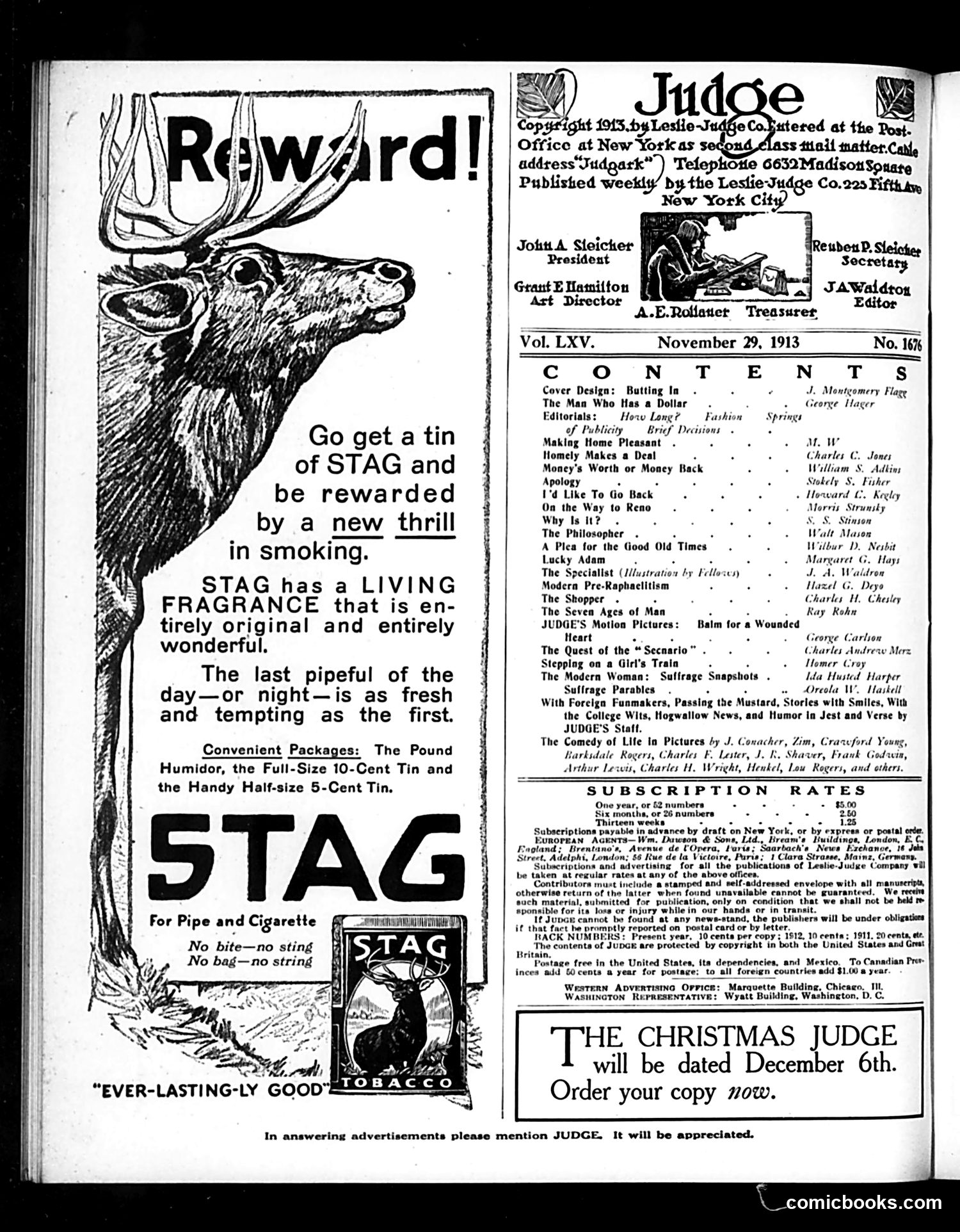
This page is primarily a **tobacco advertisement** for STAG brand pipe and cigarette tobacco, occupying the left side. The ad features a stag's head with prominent antlers and uses the word "Reward" as its central concept—promising smokers a "new thrill in smoking" from STAG's "living fragrance." The right side contains the **table of contents and masthead** for *Judge* magazine (November 29, 1913), listing articles, stories, and illustrations by various authors. There is **no political cartoon or satire visible** on this page. The imagery is purely commercial—the stag illustration serves as a brand mascot and logo rather than social commentary. This appears to be a standard magazine cover/contents page with advertising integrated into the layout.
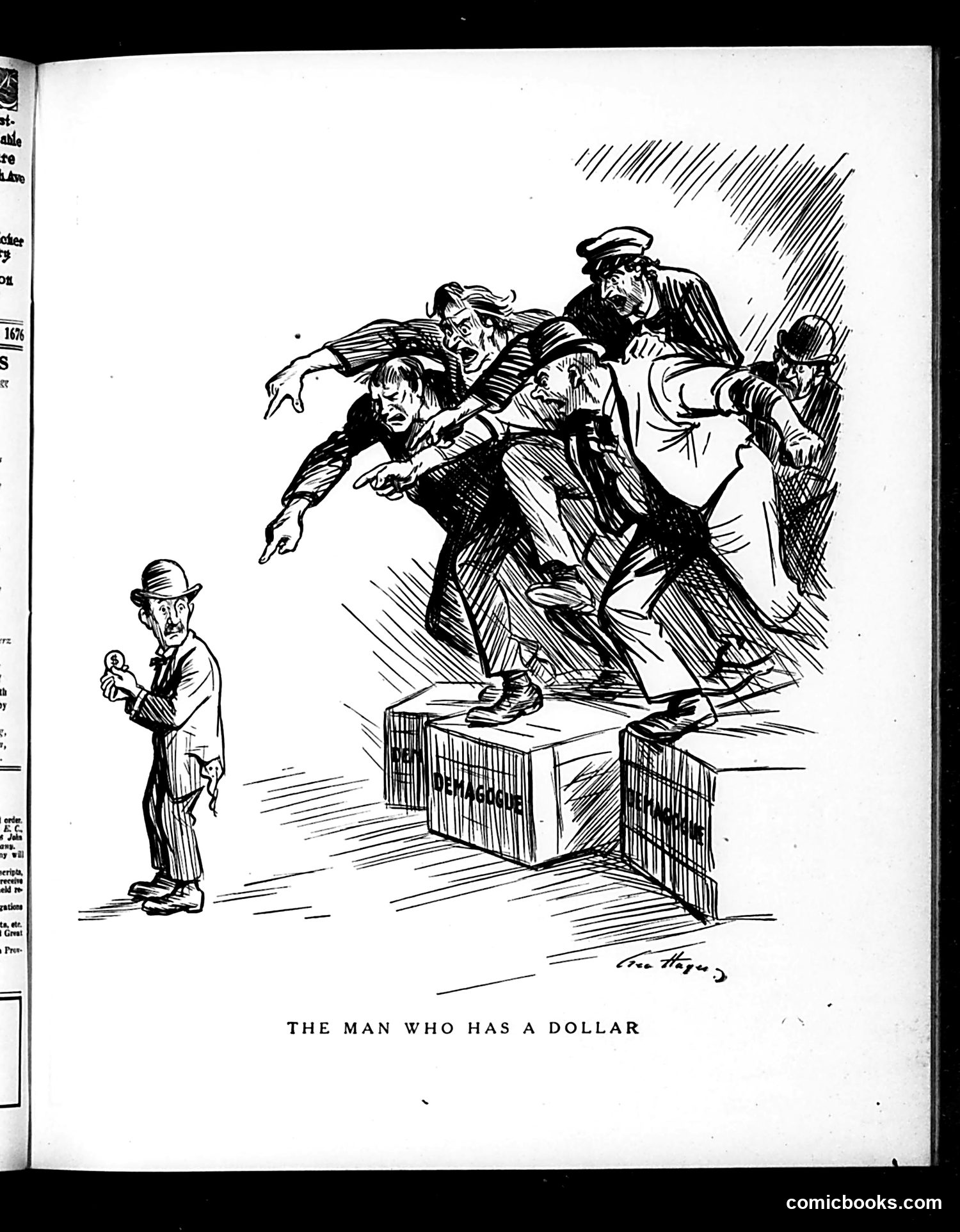
This political cartoon depicts economic class conflict, likely from the early 20th century. On the left stands a solitary, well-dressed man holding a dollar—depicted as small and vulnerable. On the right, a group of larger figures (appearing to represent various commercial or political interests—possibly businessmen, politicians, or corrupt officials) are aggressively pursuing him from behind crates labeled "MERCHANDISE." The satire illustrates the precarious position of an ordinary person with modest wealth in a system dominated by powerful economic forces. The cartoon suggests that even possessing a single dollar makes one a target for exploitation by larger, more powerful interests seeking to extract or control that wealth. It critiques economic inequality and predatory capitalism of the era.
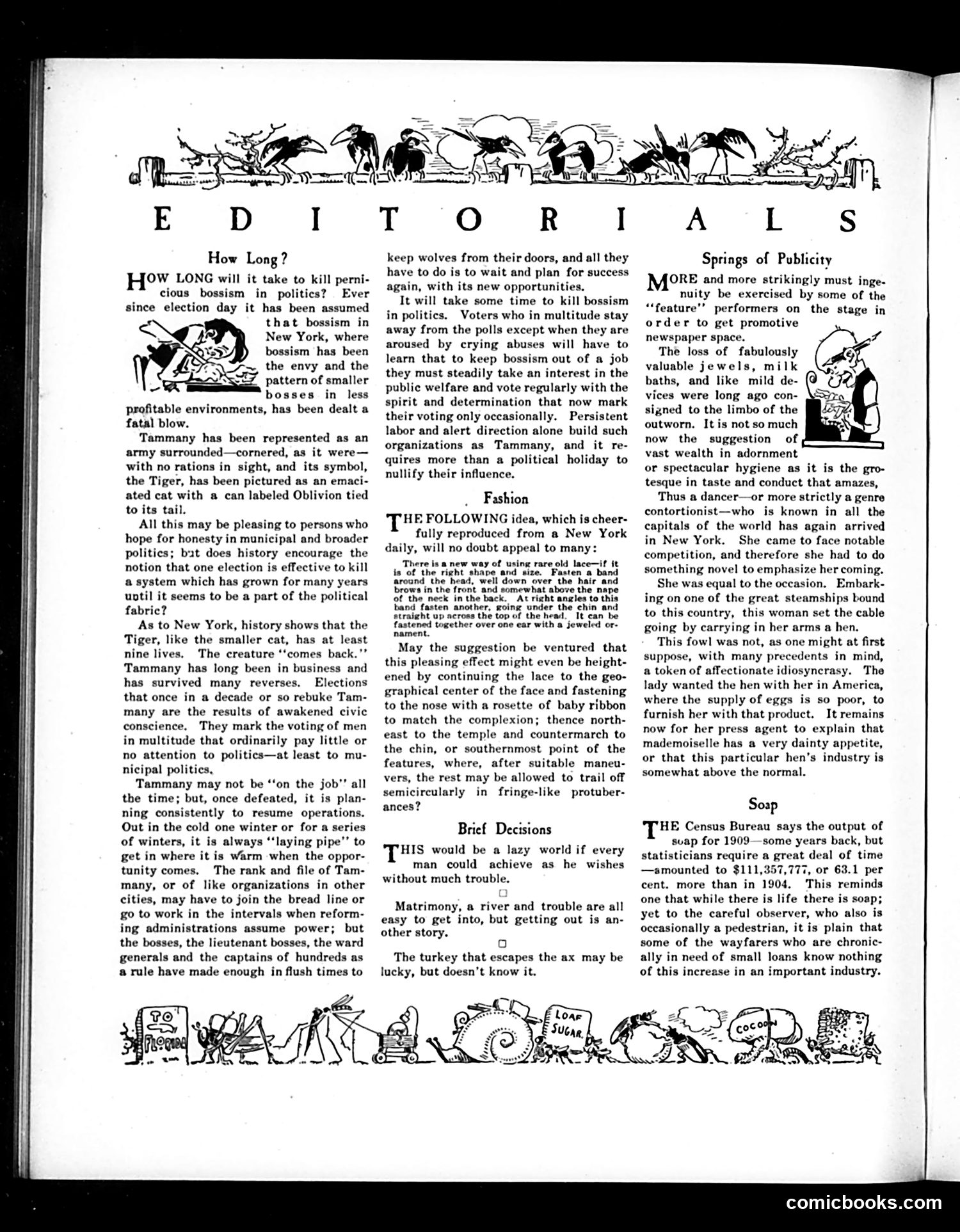
This is an editorials/opinion page from *Judge* magazine featuring three satirical pieces: 1. **"How Long?"** - Criticizes Tammany Hall (New York's Democratic political machine) for its persistence despite repeated defeats. The piece argues voters must remain vigilant to keep the corrupt organization out of power, comparing Tammany to a tiger with "nine lives." 2. **"Fashion"** - Satirizes a New York newspaper's suggestion to use old lace to create a fashionable facial feature by attaching it to women's faces with ribbon. The author mocks this impractical idea. 3. **"Brief Decisions"** - Contains short witticisms, including observations about matrimony and the Census Bureau's soap production statistics. The cartoons feature whimsical animal illustrations typical of *Judge*'s decorative style.
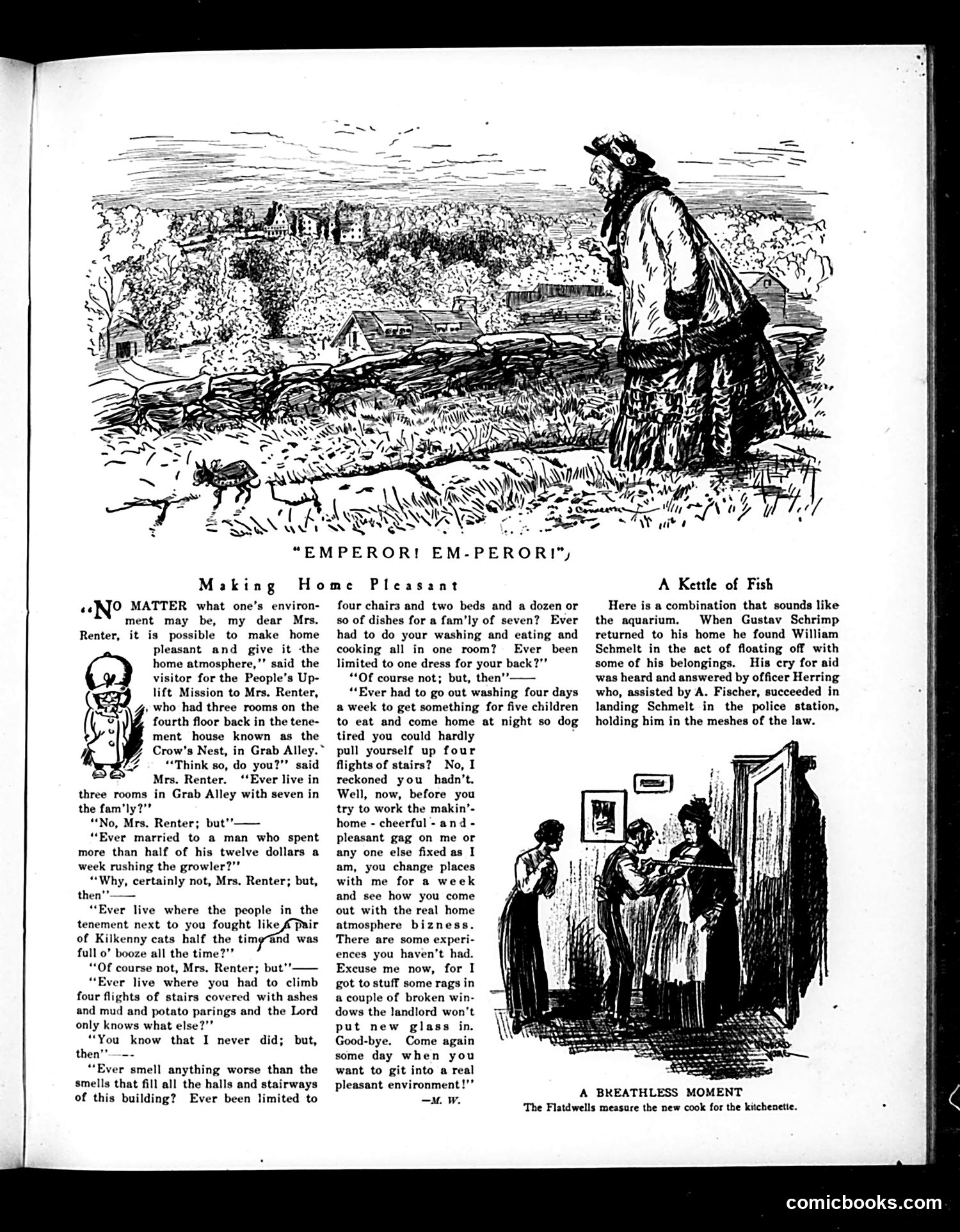
This page contains two distinct pieces of satirical commentary on tenement housing conditions in early 20th-century America. **"Making Home Pleasant"** (left) depicts a conversation between Mrs. Renter and a landlord about living conditions in a tenement. The satire mocks the landlord's obliviousness to squalid, overcrowded housing—stairs covered in filth, persistent odors, vermin—while he suggests the tenant simply relocate to improve her situation. The dialogue highlights the gap between landlords' indifference and tenants' difficult circumstances. **"A Kettle of Fish"** (right) describes a case where tenant Gustav Schrimp was arrested for floating off with belongings, caught by Officer Herring. The story appears to satirize both tenant desperation and police enforcement of housing disputes. Both pieces critique inadequate housing and the powerlessness of poor urban residents.
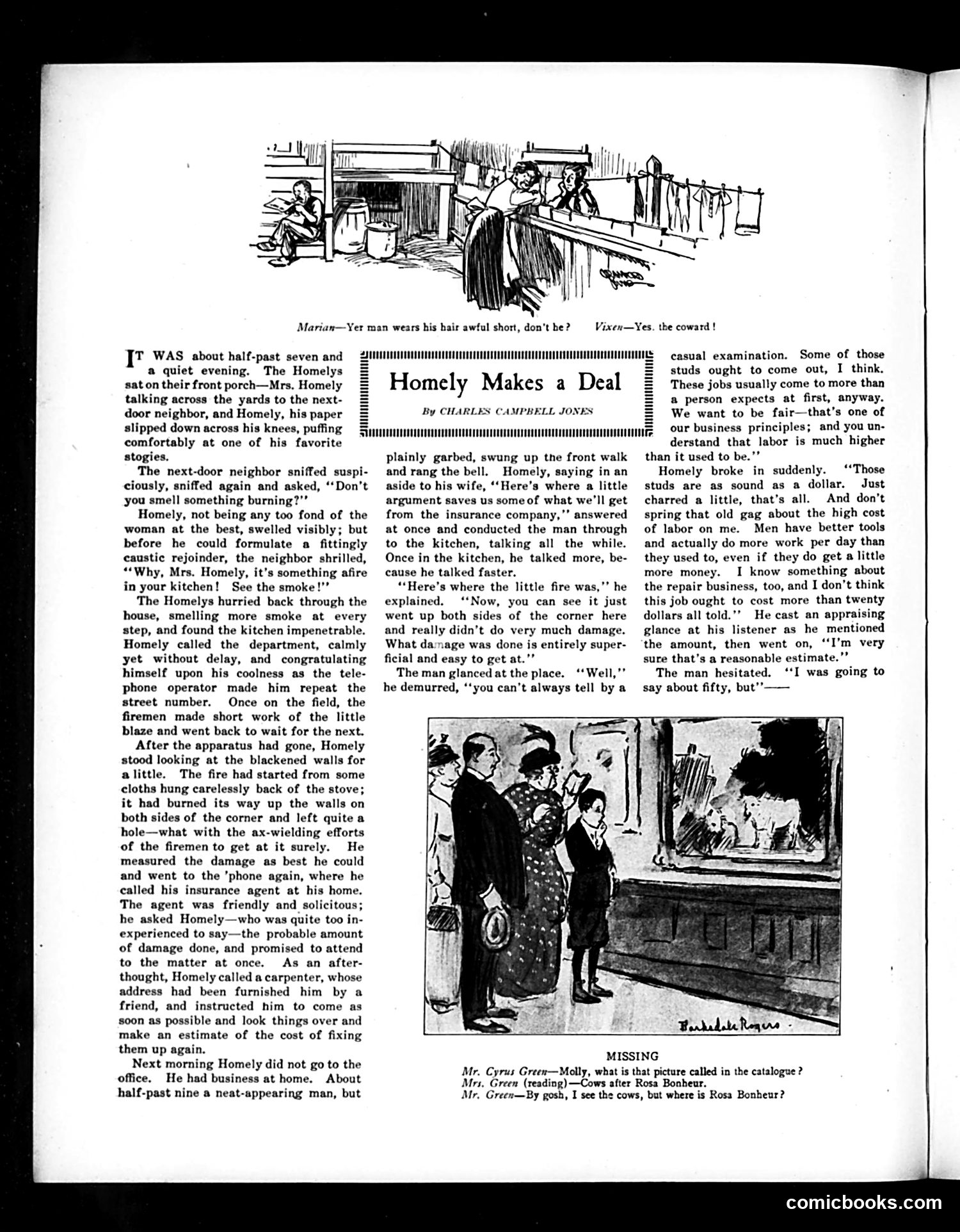
This story satirizes the dishonesty of homeowners dealing with insurance adjusters and repair contractors. When Homely's kitchen catches fire, he deliberately downplays the damage to his insurance adjuster, claiming it's "superficial and easy to get at." He then attempts to lowball a carpenter's estimate at twenty dollars. The satire targets Homely's hypocrisy: he manipulates the insurance company while simultaneously resisting the carpenter's reasonable explanations about labor costs and necessary structural inspection. The humor lies in Homely's self-interested negotiating tactics—he expects fairness from the insurance company but refuses to grant it to the tradesman. The story critiques how ordinary people exploit the insurance system while grudging fair compensation to workers. The running gag about the neighbor's gossiping provides comic relief to this commentary on insurance fraud and penny-pinching dishonesty.
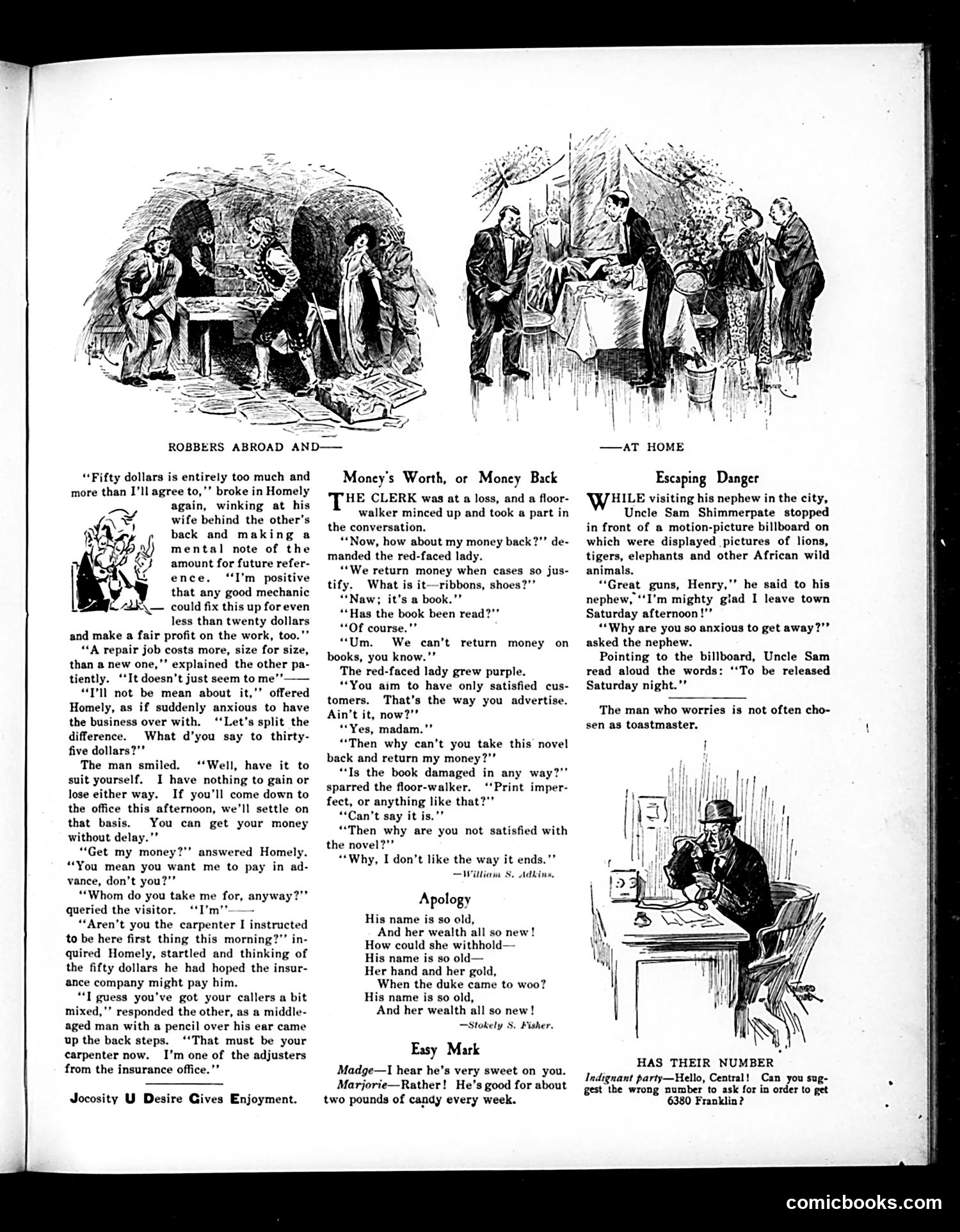
This page contains several unrelated humorous sketches satirizing everyday American life and commerce, likely from the early 20th century. **"Money's Worth, or Money Back"** mocks retail customer service standards. A department store refuses to refund a customer's money for an unread novel simply because she dislikes the ending—despite advertising "satisfied customers." The satire targets the gap between advertised customer service policies and actual practice. **"Robbers Abroad and at Home"** contrasts con artists operating overseas versus domestic insurance fraud. A man attempts to collect repair costs from what he assumes is an insurance adjuster, confusing him with a carpenter. **Other brief sketches** mock: a gullible romantic boyfriend ("Easy Mark"), a rural visitor misreading a movie theater sign about wild animals ("Escaping Danger"), and telephone misuse. The common thread: ordinary people attempting deception, misunderstanding, or exploiting commercial systems—reflecting Judge's satirical stance toward middle-class American behavior and institutions.
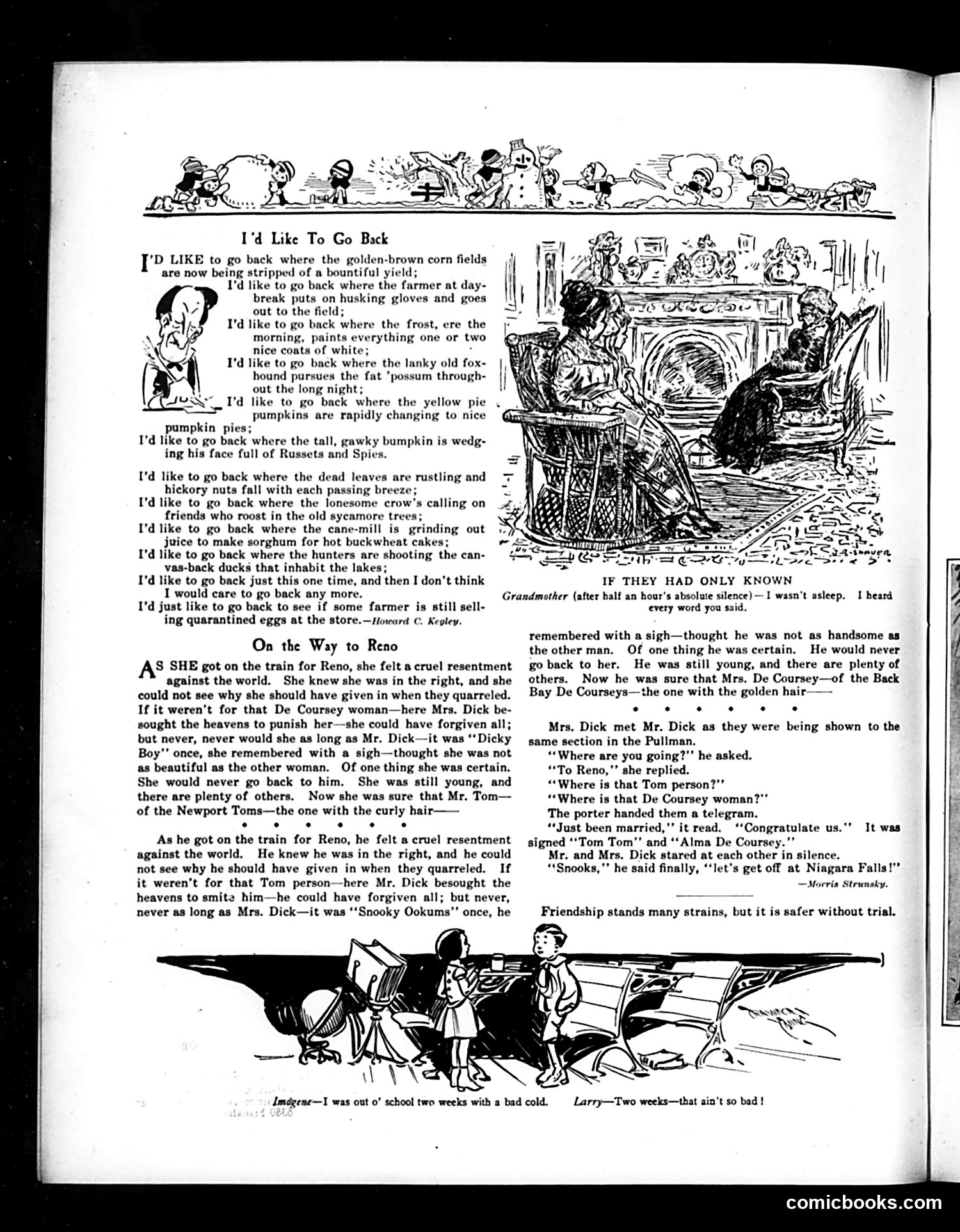
This page contains two satirical stories mocking romantic entanglements and nostalgia. **"I'd Like To Go Back"** is a nostalgic poem by Howard C. Kegley about yearning for rural farm life—corn fields, frost, foxhounds, pumpkins, hunting. The joke's twist appears at the end: the narrator would gladly return to those simple times "just...to see if some farmer is still selling quarantined eggs at the store"—undercutting the sentimental vision with petty contemporary concern. **"On the Way to Reno"** by Morris Strunsky satirizes infidelity and self-deception. Both Mr. and Mrs. Dick board a train to Reno (then famous for quick divorces) separately, each blaming the other's romantic rival (a "De Coursey woman" and "Tom person"). The punchline: those rivals—"Tom Tom" and "Alma De Coursey"—have eloped together, leaving the Dicks stranded. They reconcile at Niagara Falls (a honeymoon destination), implying they'll stay married despite their quarrels. Both pieces satirize human nature—nostalgia and marital discord.
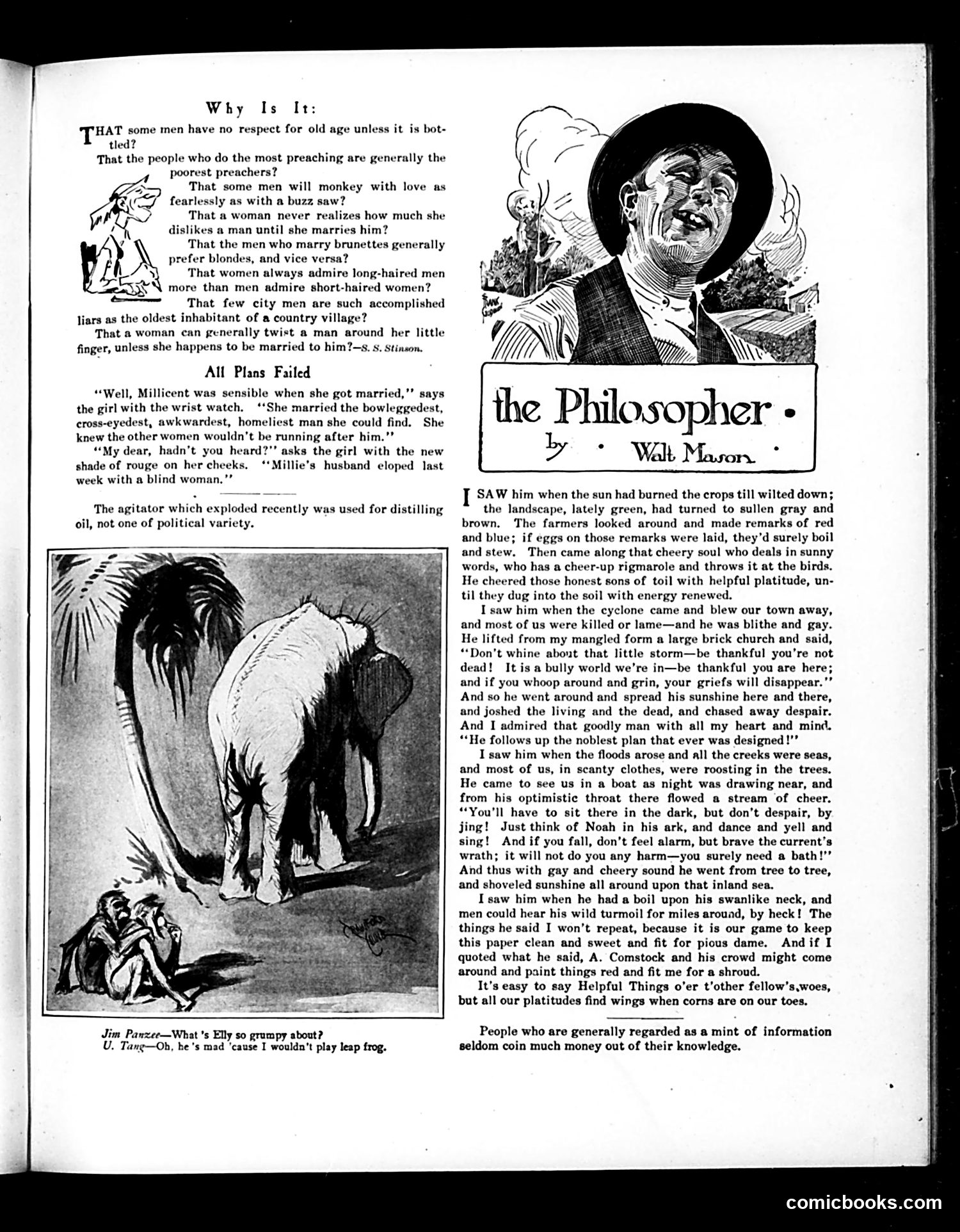
**"Why Is It"** is a humorous advice column listing absurd social observations about human nature and relationships. It mocks hypocrisy (preachers who don't practice what they preach), romantic foolishness, and gender stereotypes common in the era—assumptions about women's fickleness, preferences for certain hair lengths, and manipulative abilities. **"The Philosopher"** by Walt Mason is a satirical poem about an aggressively optimistic man who dispenses platitudes during genuine disasters: crop failures, cyclones, floods, deaths. The poem mocks false cheerfulness and empty positive advice, showing how "the Philosopher" callously trivializes real suffering with hollow encouragement. The final lines drive the satire home: it's easy to offer uplifting platitudes about *others'* troubles, but we lose perspective when faced with our own pain (represented by corns on one's feet). Both pieces critique shallow social attitudes and performative wisdom common to early 20th-century American culture.
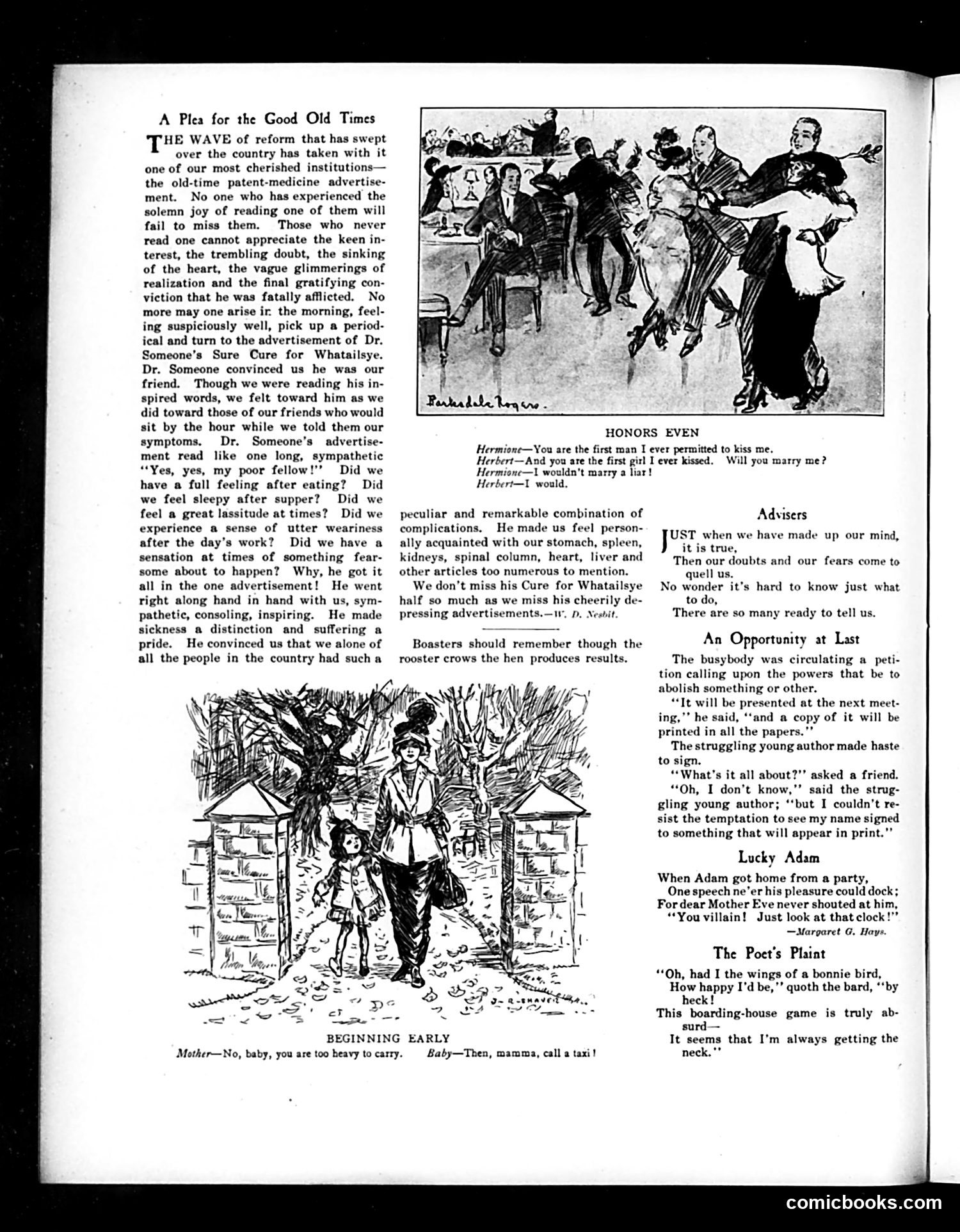
**Main Article: "A Plea for the Good Old Times"** This is nostalgic satire lamenting the decline of patent-medicine advertisements due to reform efforts (likely referencing early 20th-century regulatory crackdowns like the Pure Food and Drug Act of 1906). The author humorously praises these ads for their emotional manipulation—how they convinced readers they had obscure ailments by listing vague symptoms (fatigue, poor digestion, etc.). The satire mocks both the quack medicines and the gullible public who found comfort in self-diagnosis through advertising. "Dr. Someone's Sure Cure for Whatailsye" is a fictional example representing countless real patent-medicine hucksters. **Cartoons and Humor Items** The page includes several unrelated comedic pieces: "Honors Even" (a flirtation joke about mutual dishonesty), "Beginning Early" (child asking mother to call a taxi), "Lucky Adam" (poem about Adam escaping spousal nagging), and brief satirical items about busybodies and struggling authors. These represent typical Judge magazine filler content—light social commentary and domestic humor.
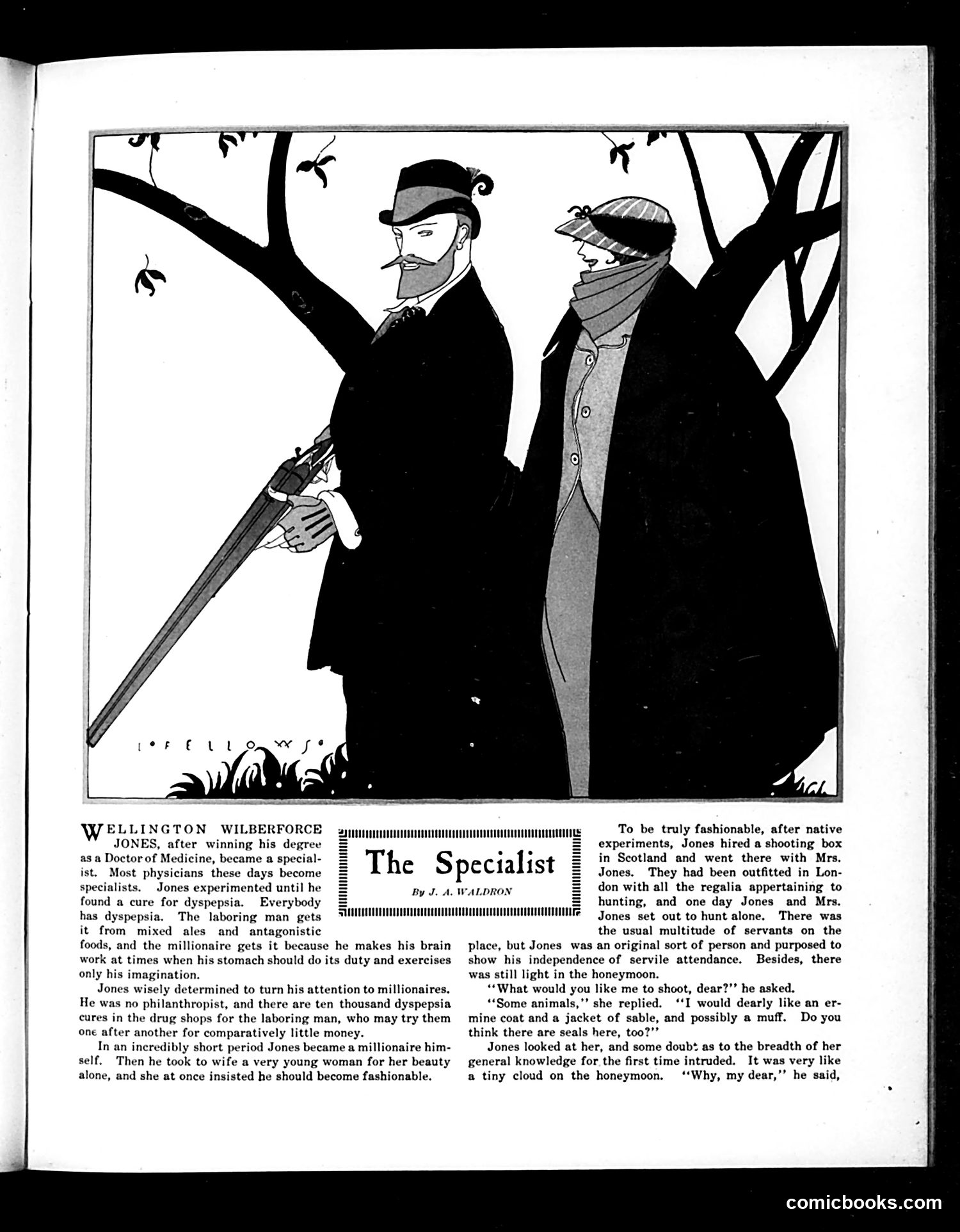
This story-cartoon satirizes the nouveau riche and the absurdity of marrying for beauty alone. Dr. Wellington Jones, a successful specialist who made his fortune treating dyspepsia (indigestion) in wealthy men, marries a young, beautiful woman—then must pretend to be fashionable to satisfy her social ambitions. The joke: On their honeymoon in Scotland, hunting to appear aristocratic, Jones asks his wife what she'd like him to shoot. She requests animals for furs (ermine, sable) and then naively asks if there are seals present—revealing her complete ignorance of geography and wildlife. The "tiny cloud on the honeymoon" is their intellectual incompatibility. The satire targets both Jones's social climbing and the emptiness of marrying purely for looks. The illustration shows them in hunting attire under bare trees, already suggesting disillusionment despite the honeymoon setting.
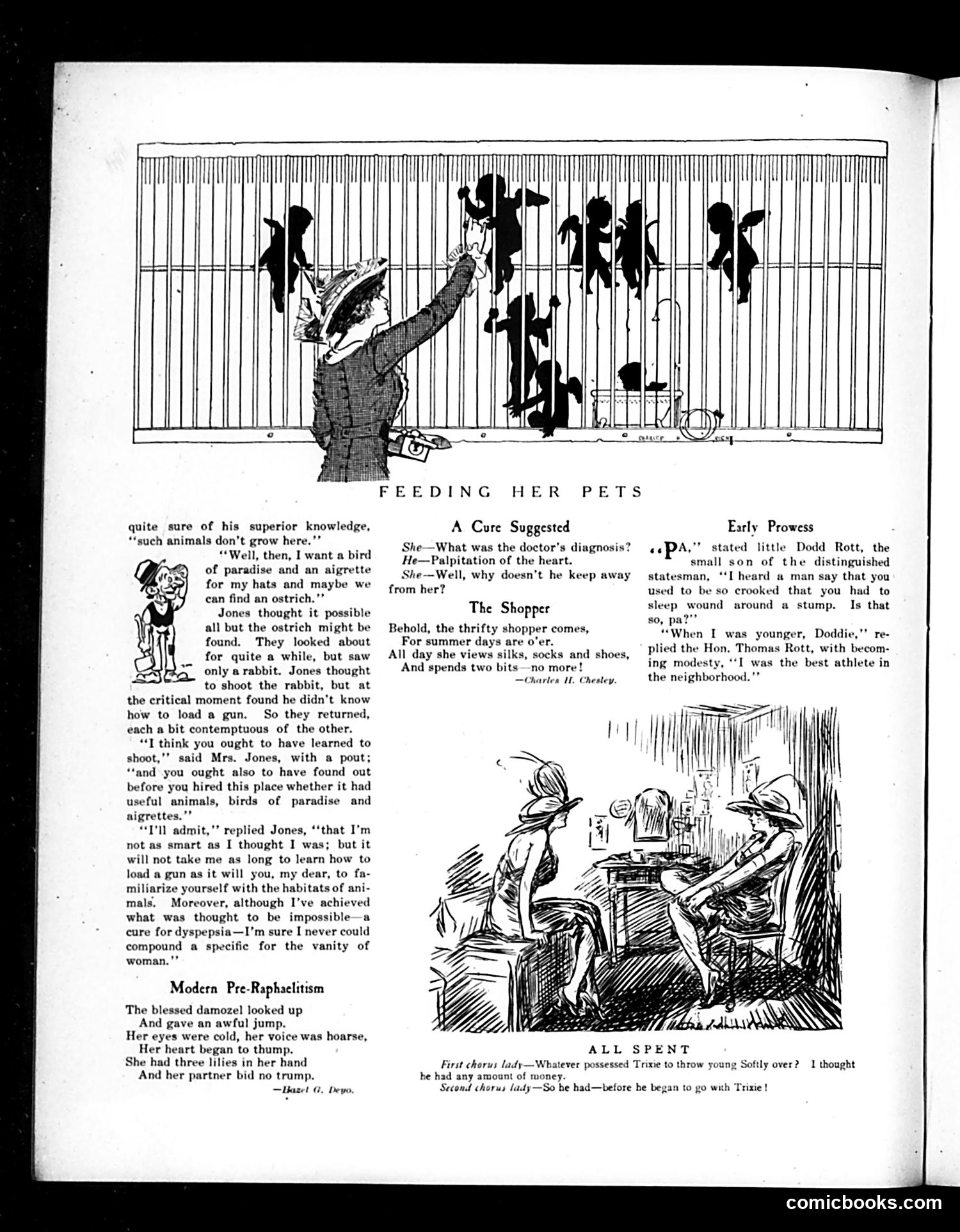
**Top cartoon "Feeding Her Pets":** A woman feeds birds in a large cage while a man watches. The satire targets women's frivolous spending on fashion accessories—specifically feathered hats. The woman wants exotic birds (birds of paradise, aigrettes) for millinery purposes. When only a rabbit is found, the incompetent man can't shoot it because he doesn't know how to load a gun. The couple trades barbs: she criticizes his incompetence; he mocks women's vanity, claiming he cured his dyspepsia but could never cure "the vanity of woman." **Bottom cartoon "All Spent":** Two chorus girls discuss why Trixie left her wealthy boyfriend—he only *had* money before dating Trixie, implying she spent it all. **Overall theme:** Women as spendthrifts and vain consumers, men as incompetent but morally superior. These sketches reflect early 20th-century gender stereotypes common in American humor.
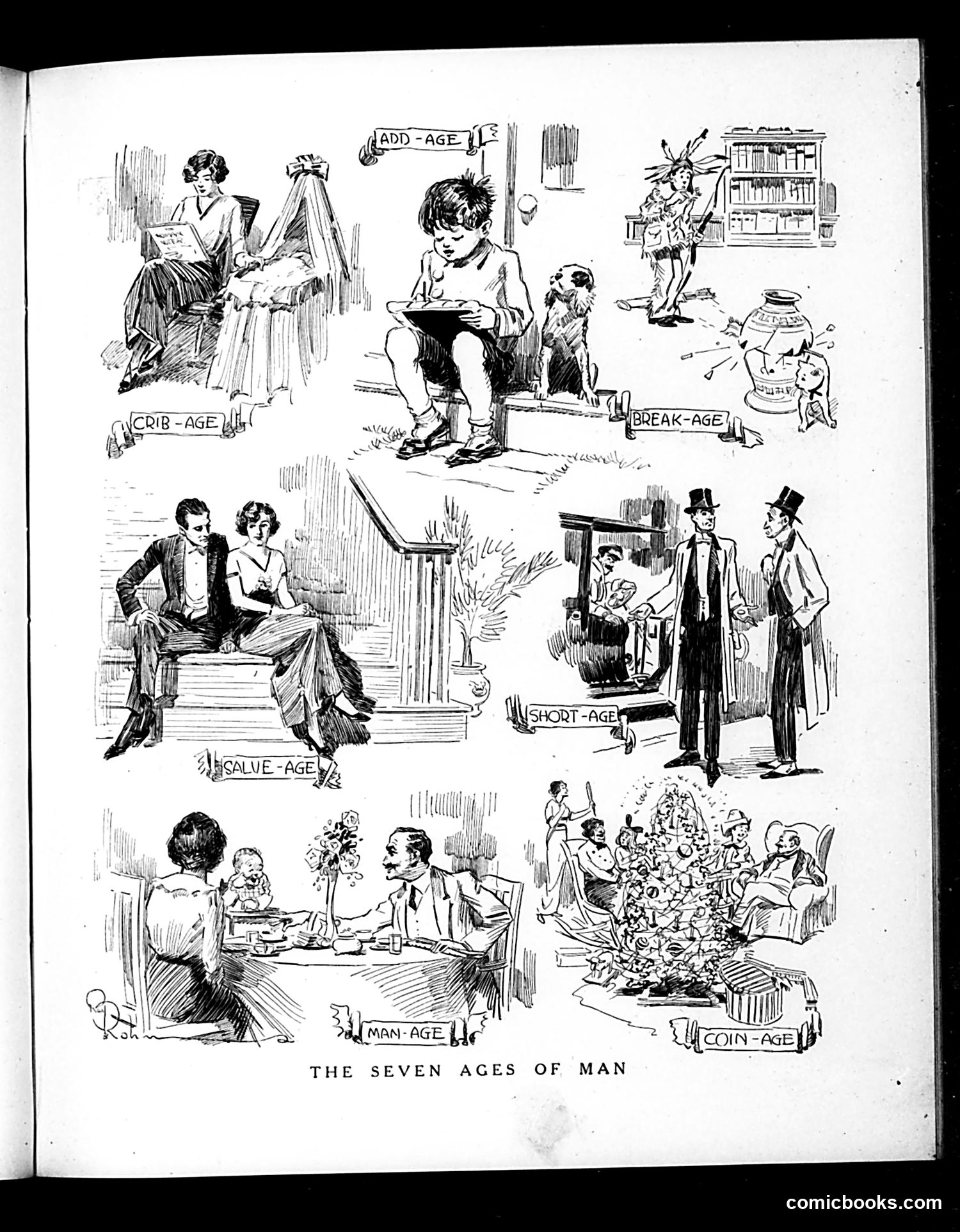
This cartoon adapts Shakespeare's famous "seven ages of man" concept but replaces the traditional life stages with satirical versions based on money and social status: - **CRIB-AGE**: Infancy (mother with baby) - **ADD-AGE**: Childhood (boy reading) - **BREAK-AGE**: Youth (boy with dog, breaking things) - **CALVE-AGE**: Young adulthood (couple courting) - **SHORT-AGE**: Middle age (two men in formal dress—possibly depicting financial shortage or scarcity) - **MAN-AGE**: Mature adulthood (man with wife and infant) - **COIN-AGE**: Old age (elderly couple by Christmas tree, surrounded by wealth) The joke appears to be a pun-laden commentary on how life progresses from helplessness through various stages ultimately toward accumulating money and property. The wordplay on "age" suggests that financial status—not wisdom or virtue—defines life's chapters in American society.
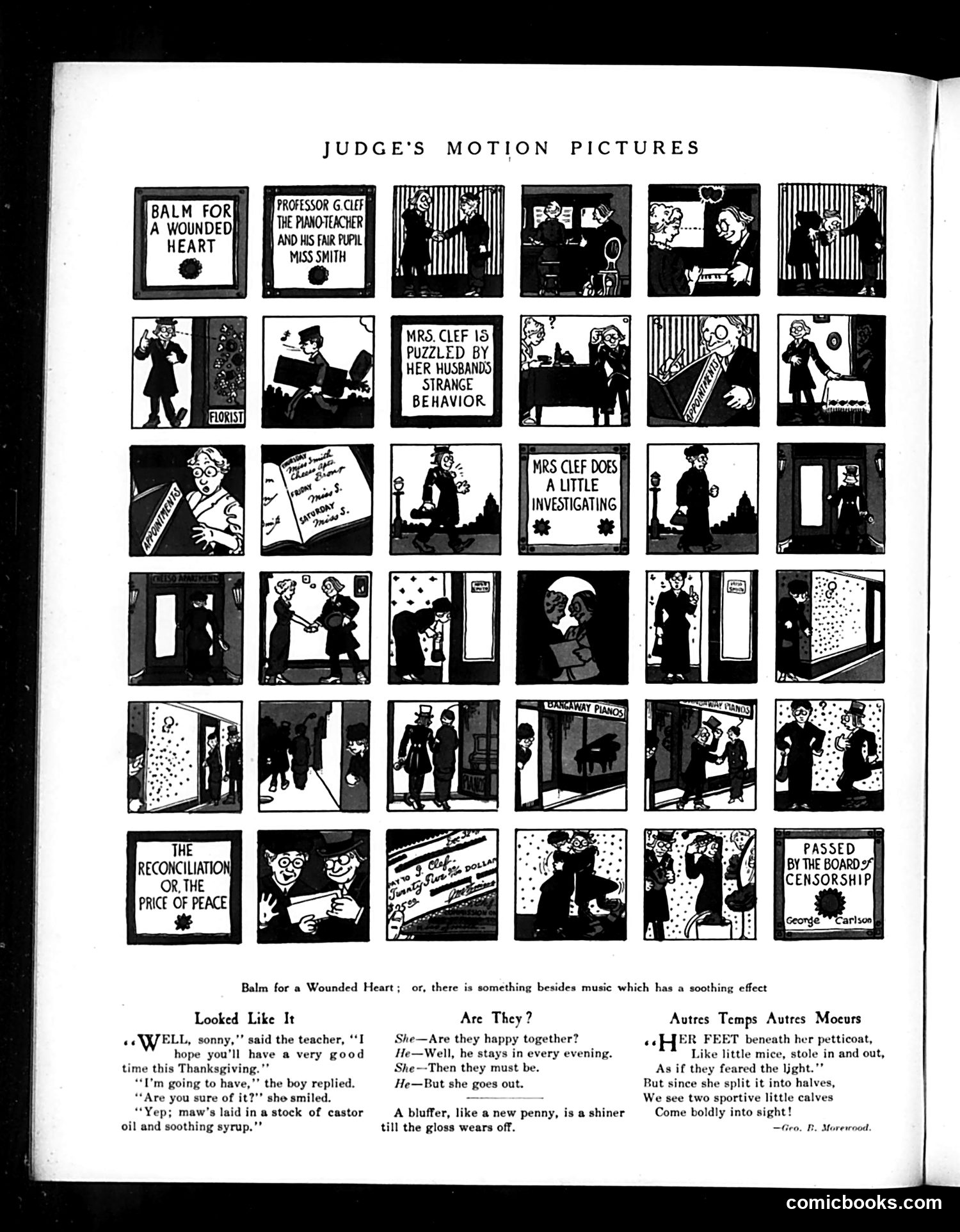
This page from *Judge* magazine presents a series of silent-film-style motion picture vignettes satirizing contemporary social situations. The "motion pictures" format was a popular Judge feature, using sequential panels to tell humorous stories. The content includes domestic comedy sketches: a teacher-student interaction about Thanksgiving (the boy's joke about castor oil and syrup reflects early-20th-century folk remedies), marital puzzles about a husband's changed behavior, and observations about courtship and women's fashion. The bottom section includes three brief prose comedies: "Looked Like It" plays on misunderstandings; "Are They?" offers cynical commentary on marriage (staying home ≠ happiness); and "Autres Temps Autres Moeurs" (French: "Other Times, Other Customs") jokes about women's fashion changes, specifically how women's ankles became more visible as skirts shortened—a significant social controversy of the 1910s-1920s. The humor relies on wordplay, domestic situations, and mild social commentary typical of Judge's target middle-class readership.
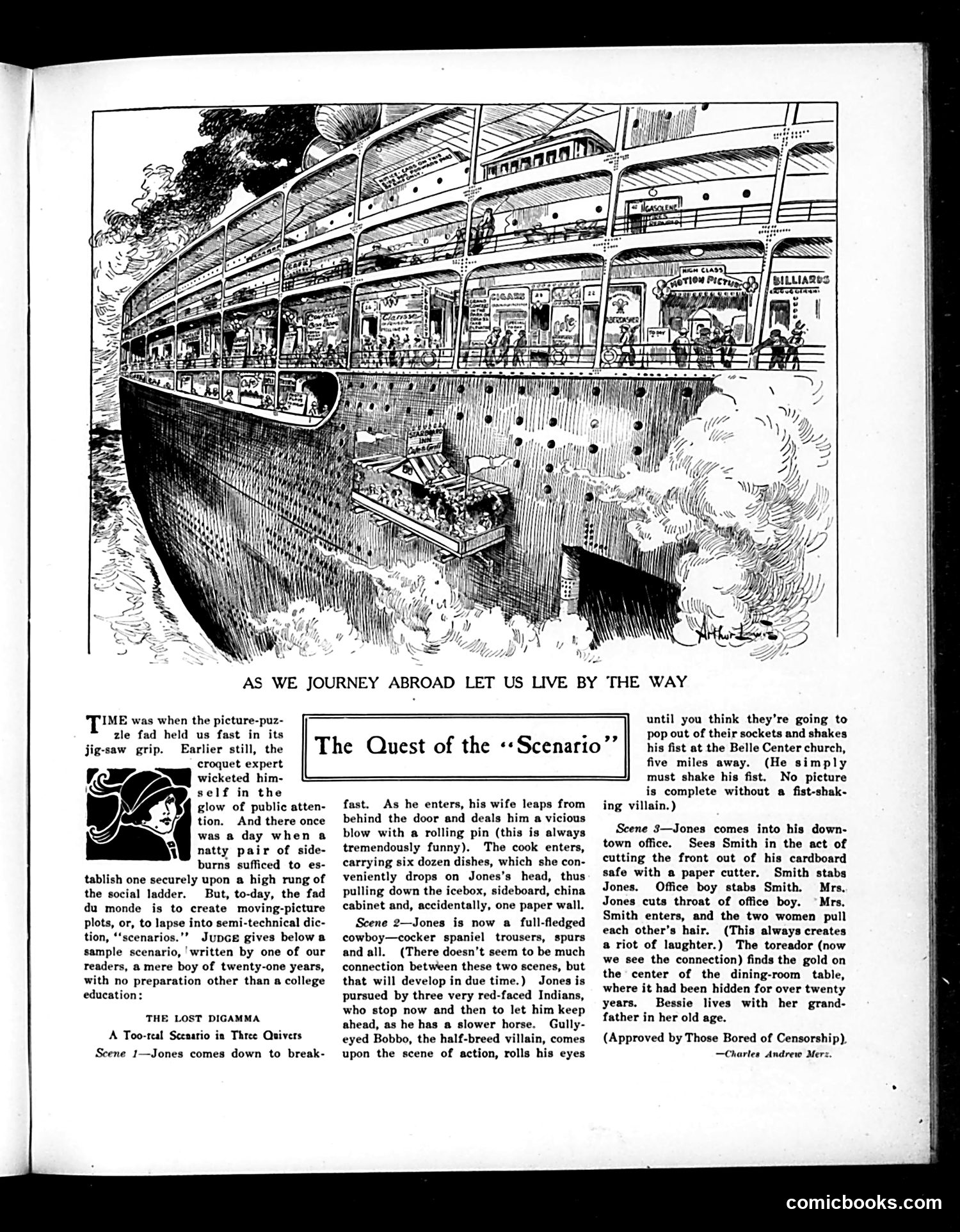
This is a satirical piece mocking the early film industry's scenario (screenplay) writing fad around the 1910s. Judge criticizes how amateur writers—here, a 21-year-old college student—churn out absurd movie plots with no coherent logic. The cartoon illustrates the problem: "The Lost Digamma" deliberately strings together three nonsensical scenes (domestic violence, a cowboy-Indian chase, office stabbing) with zero narrative connection. The humor lies in exposing the ridiculous conventions audiences supposedly loved: slapstick violence, melodramatic villains required to "shake their fists," and arbitrary plot elements ("we see the connection") inserted retroactively. The byline credits Charles Andrew Merz, likely the author, and includes mock censorship approval—further satirizing film industry self-regulation. The joke is that anyone could write these scenarios, and audiences would accept their incoherence. It's social commentary on both lowbrow entertainment and the chaotic early days of cinema.
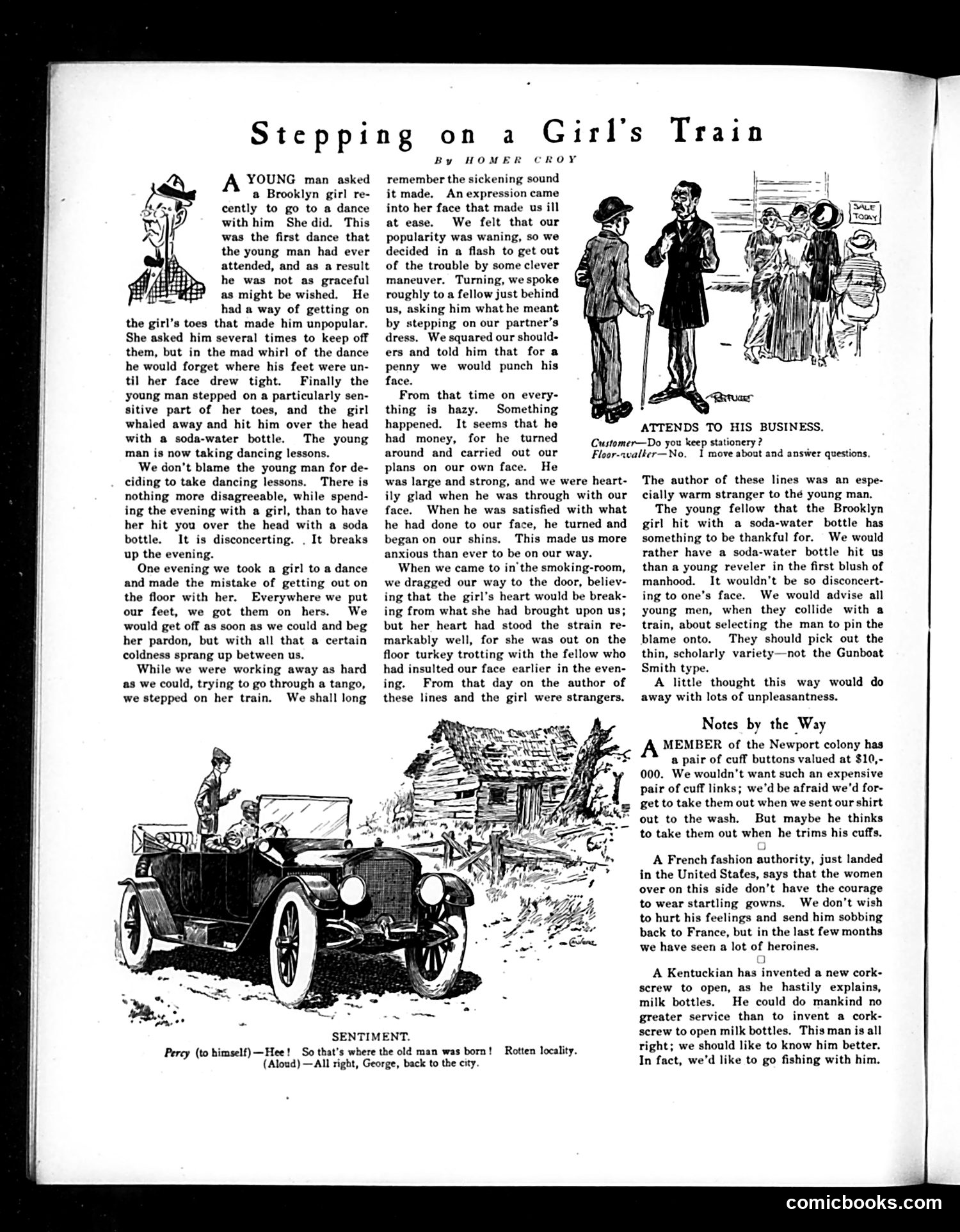
This humorous article by Homer Croy satirizes the awkwardness of young men attempting to dance with women, particularly regarding their clumsiness on the dance floor. The main joke involves stepping on a girl's dress train—a common hazard when women wore long gowns with trailing fabric. The author recounts two scenarios: a young Brooklyn man who hits his dance partner with a soda bottle after repeatedly stepping on her feet, and the author's own experience stepping on a woman's train at a dance. When the author tries to deflect blame by angrily confronting an innocent bystander, he gets beaten up instead—while his dance partner immediately moves on to dance with the aggressor, suggesting his efforts to save face were entirely unsuccessful. The satire mocks male vanity, social incompetence, and the gap between men's self-perception and reality. The "Notes by the Way" sidebar continues this theme with unrelated social commentary about fashion and inventions.
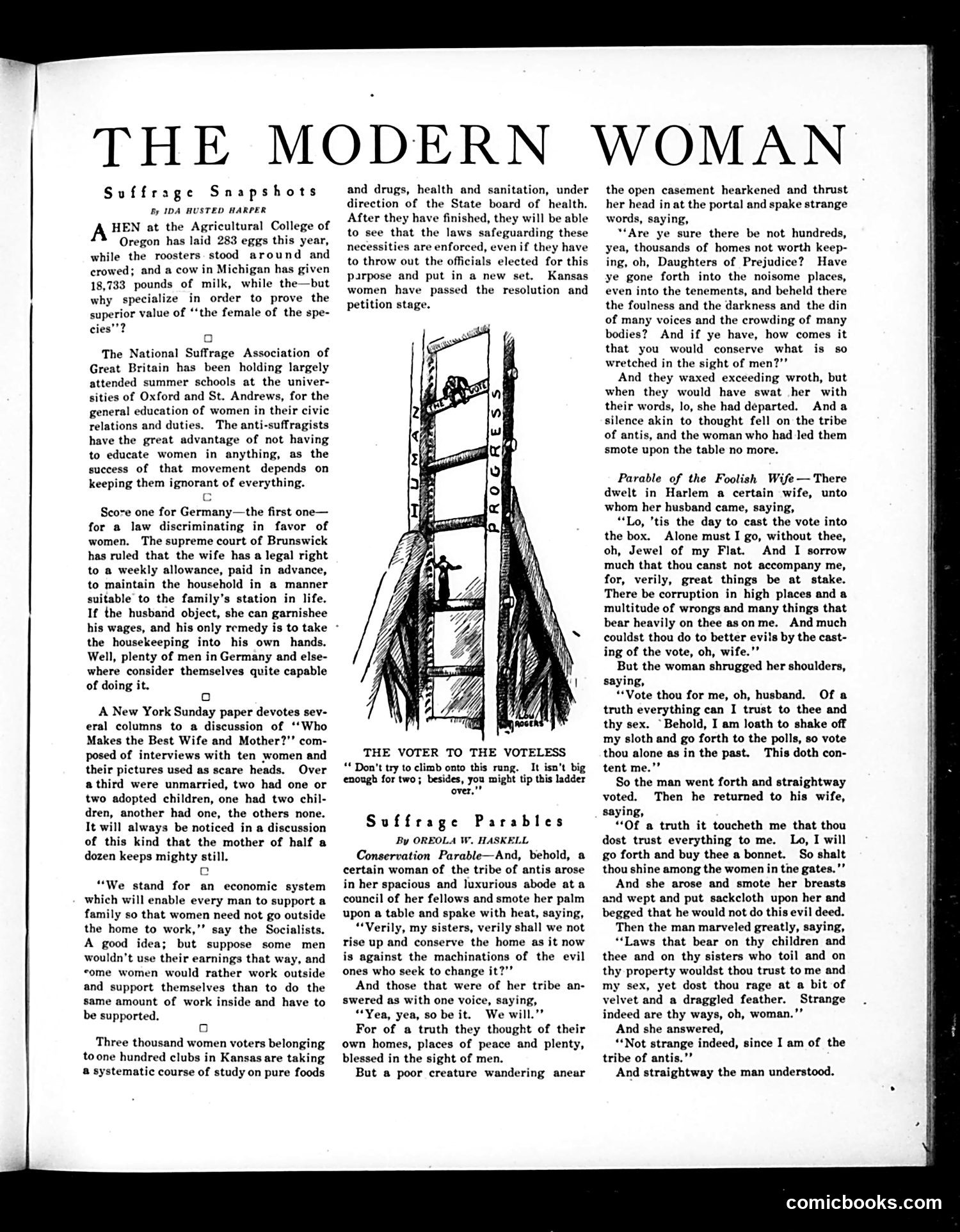
This page satirizes the **women's suffrage debate** of the early 20th century through commentary and parables. The main cartoon ("The Voter to the Voteless") depicts a woman on a ladder telling another woman below not to climb—a metaphor for enfranchised women blocking those without voting rights, suggesting suffragists are selfish rather than inclusive. The "Suffrage Parables" section mocks **anti-suffrage arguments**. The "Conservation Parable" features wealthy anti-suffrage women claiming they want to "conserve the home," but a poor woman interrupts, pointing out they ignore the harsh realities of working-class homes. This exposes the hypocrisy: anti-suffragists romanticize domestic life while ignoring women's actual hardships. The snapshots above celebrate women's **civic engagement and economic contributions**—from suffrage education programs to food safety advocacy—to counter claims that women shouldn't participate in public life. The piece argues anti-suffragists succeed only by keeping women "ignorant."
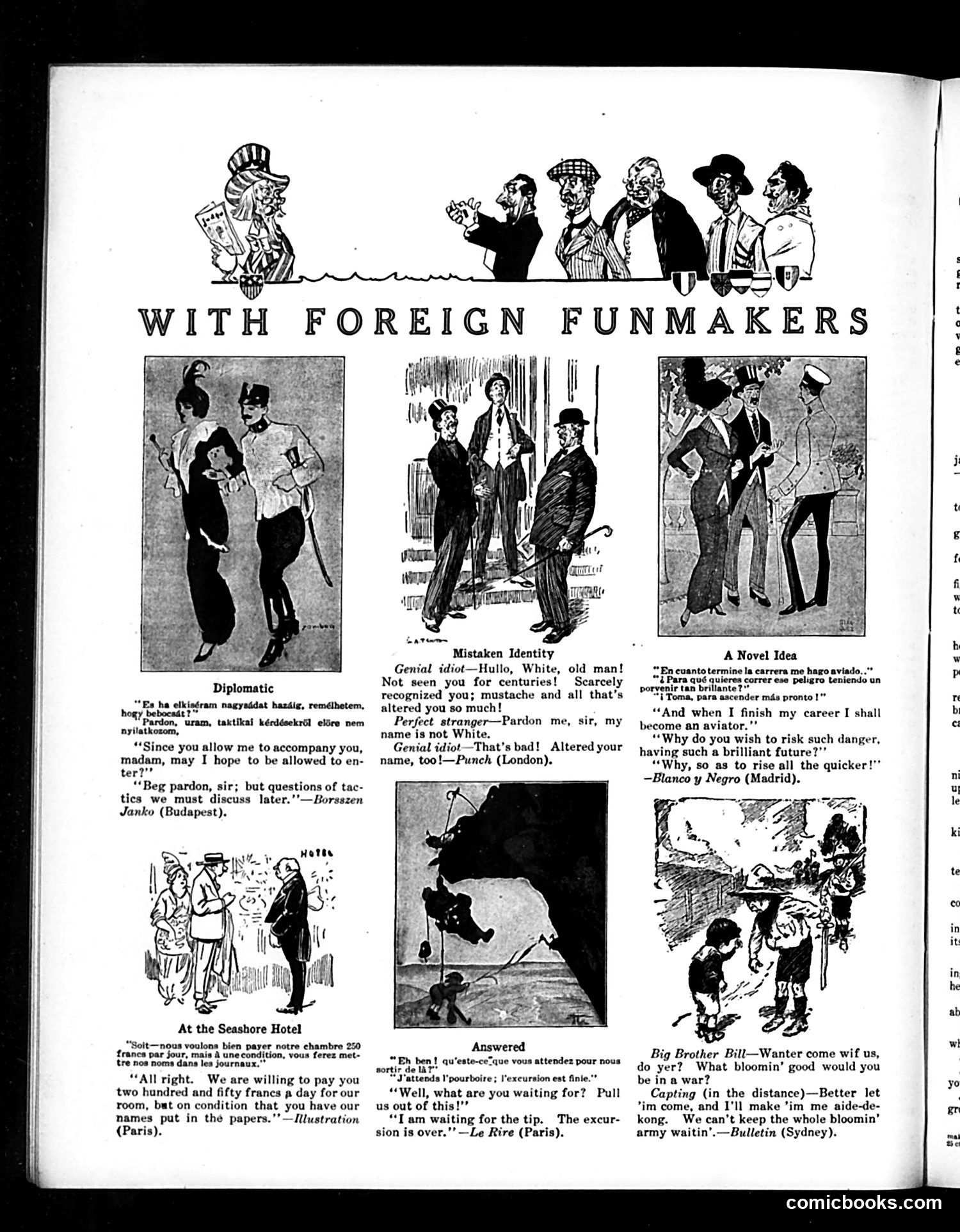
This page compiles humorous cartoons from international publications, satirizing various social situations across Europe and beyond. The jokes target pompous or foolish behavior: a diplomat speaks nonsense in Hungarian; tourists demand their names published in papers; a man confuses a stranger's identity after the stranger changes his mustache (the absurdity being he assumes the name also changed); a boatman extorts a tip by refusing to leave tourists stranded; and a young man plans to become an aviator to "rise quicker" in his military career—darkly joking that aviation (then extremely dangerous) promises faster advancement, presumably through death. The page's title frames these as specimens of humor from "foreign" sources—Budapest, Paris, London, Madrid, Sydney—presenting international comedy for American readers. The satire targets greed, vanity, bureaucratic pretension, and the casual absurdity of everyday life across cultures, unified by a cynical worldview typical of Judge's satirical tradition.
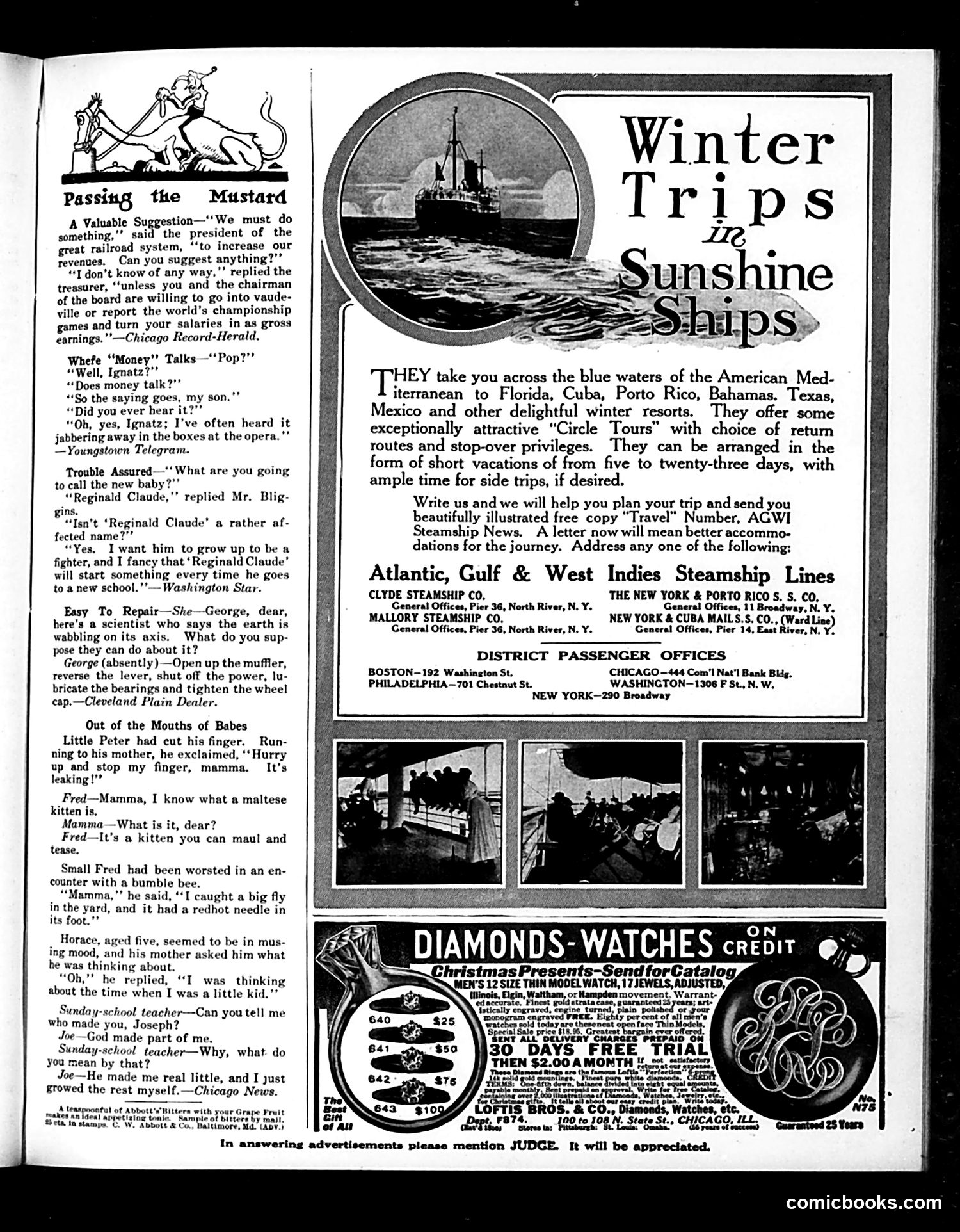
This page from *Judge* magazine consists of light satirical humor and advertising, typical of early-20th-century American magazines. The **cartoons and jokes** on the left side mock everyday life: railroad executives unable to boost profits; a father's confusion about whether money literally speaks; parents naming their children "Reginald Claude" to provoke schoolyard fights; and children's innocent misunderstandings (a leak as "leaking," a bumblebee as a "fly with a redhot needle"). The **right side is primarily advertising** for Sunshine Ships—steamship cruises to Caribbean and Gulf destinations—plus ads for diamonds and watches sold on credit. These jokes require no specific historical context beyond understanding early-1900s middle-class attitudes: they satirize business inefficiency, parental psychology, child logic, and wordplay. The page exemplifies *Judge*'s formula of gentle domestic humor accessible to general audiences, paired with consumer advertisements.
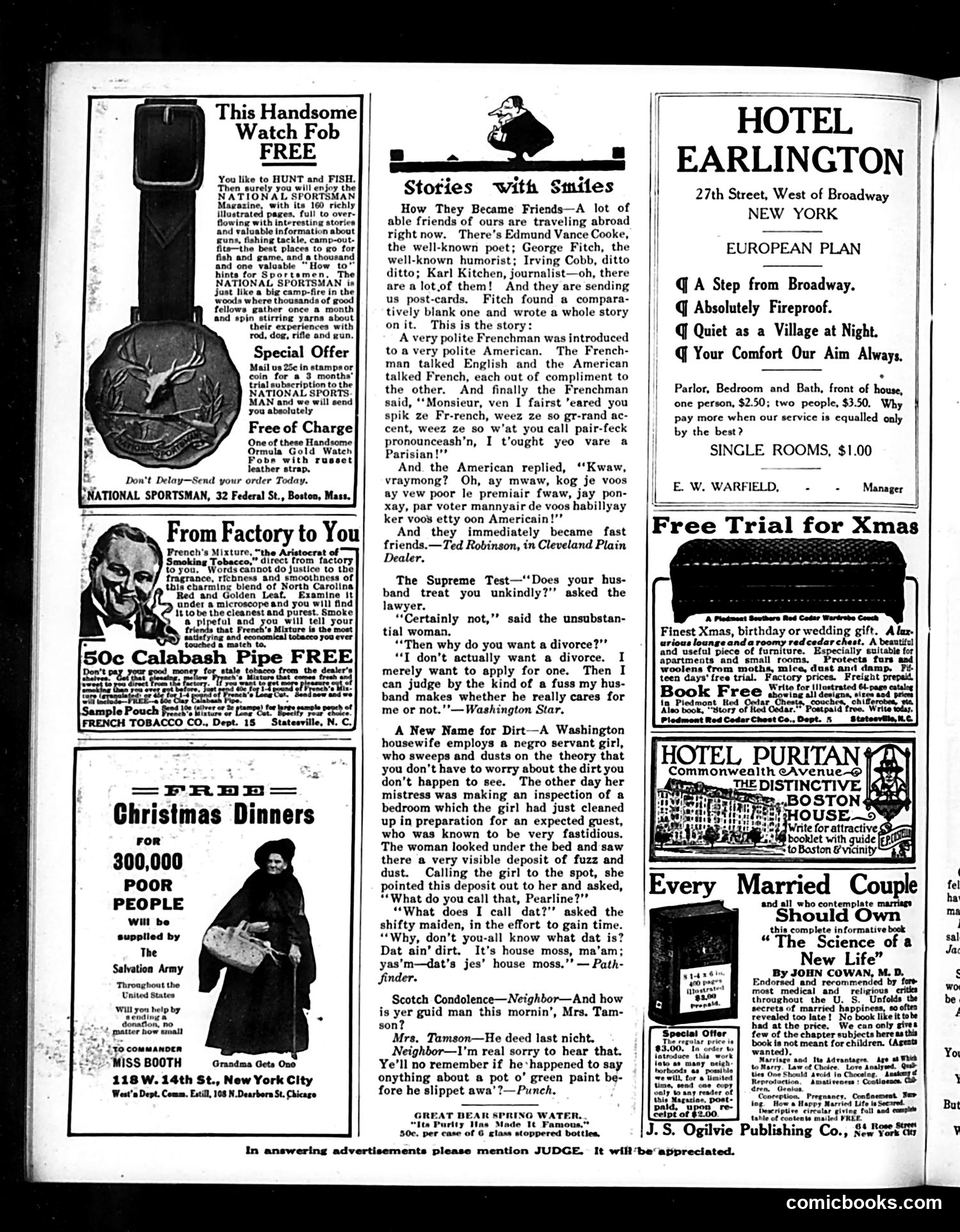
This is primarily an **advertising page** with scattered **humorous anecdotes** rather than political cartoons. The main content includes: **Advertisements** for sporting goods (National Sportsman magazine, calabash pipes), the Salvation Army's Christmas dinner program for 300,000 poor people, and NYC hotels (Earlington, Puritan). **Humor columns** titled "Stories with Smiles," featuring brief jokes: - A story about a Frenchman and American becoming friends through mutual flattery of each other's language skills - A wife seeking divorce merely to test her husband's devotion - A Black servant girl euphemistically calling dust under a bed "house moss" - A Scottish widow asking about her dead husband's paint pot The satirical edge is **mild social commentary**: mocking politeness, marital games, racial stereotypes (the "house moss" anecdote), and Scottish thriftiness. Nothing appears directly political. This reflects early-20th-century magazine humor—often relying on ethnic jokes and gender-based domestic comedy that would be considered offensive today.
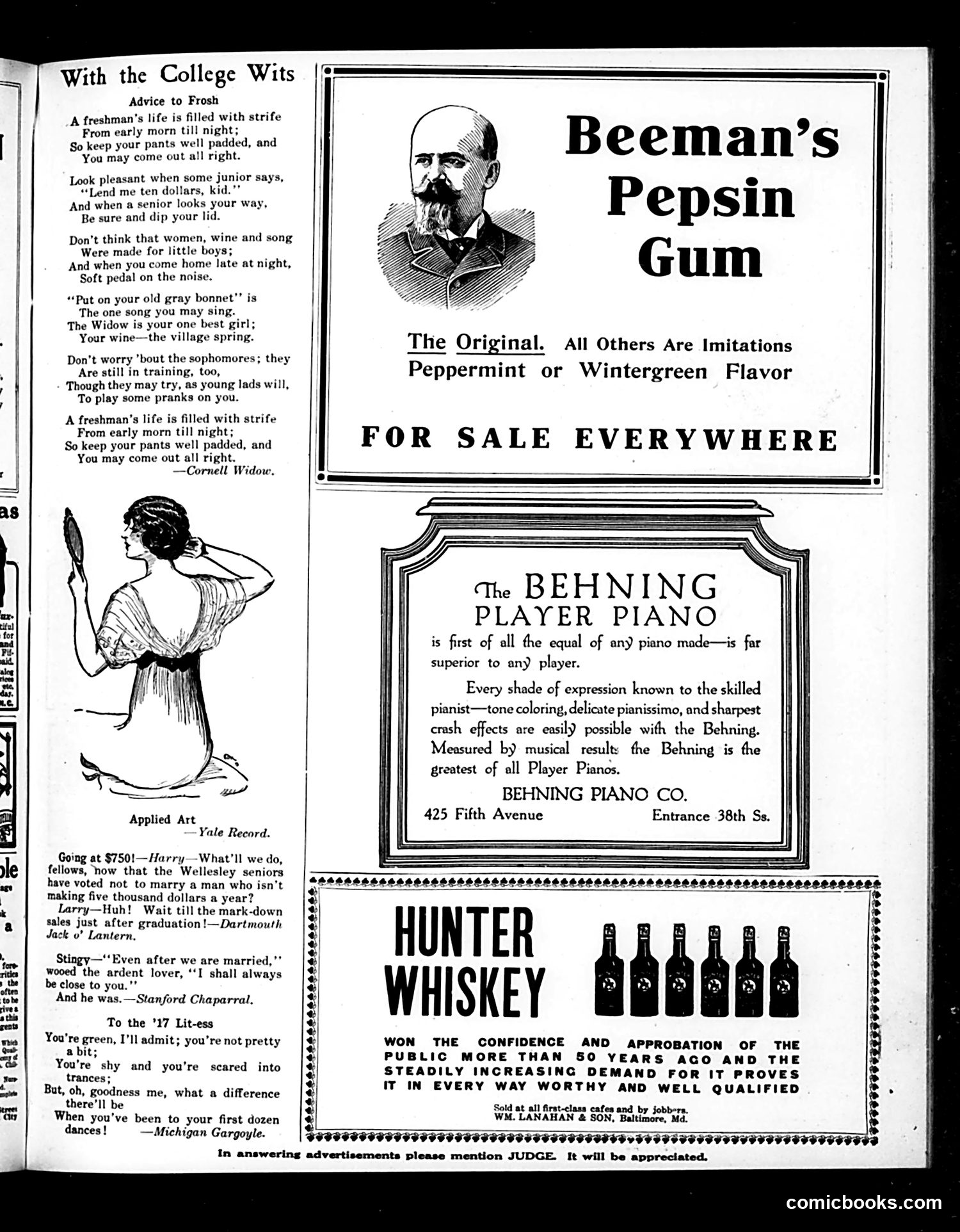
This page from *Judge* magazine is primarily **advertising with some humorous college content**. The main feature, "With the College Wits," reprints humorous advice to freshmen from various college publications (Cornell Widow, Yale Record, Stanford Chaparral, Dartmouth Jack o' Lantern). The jokes reference hazing rituals and freshman vulnerability—warnings about seniors demanding money ("Lend me ten dollars, kid") and sophomores playing pranks. The repeated emphasis on keeping "your pants well padded" suggests physical initiation abuse was an expected college experience. The page also contains period product advertisements: Beeman's Pepsin Gum, Behning Player Piano, and Hunter Whiskey. These ads reflect early 20th-century consumer culture aimed at affluent college-educated readers. The "Applied Art" cartoon is a simple decorative figure study, likely filler content. The smaller jokes ("Going at $750," "Stingy") are typical collegiate humor mocking marriage prospects and romantic situations among the wealthy young men who read *Judge*.
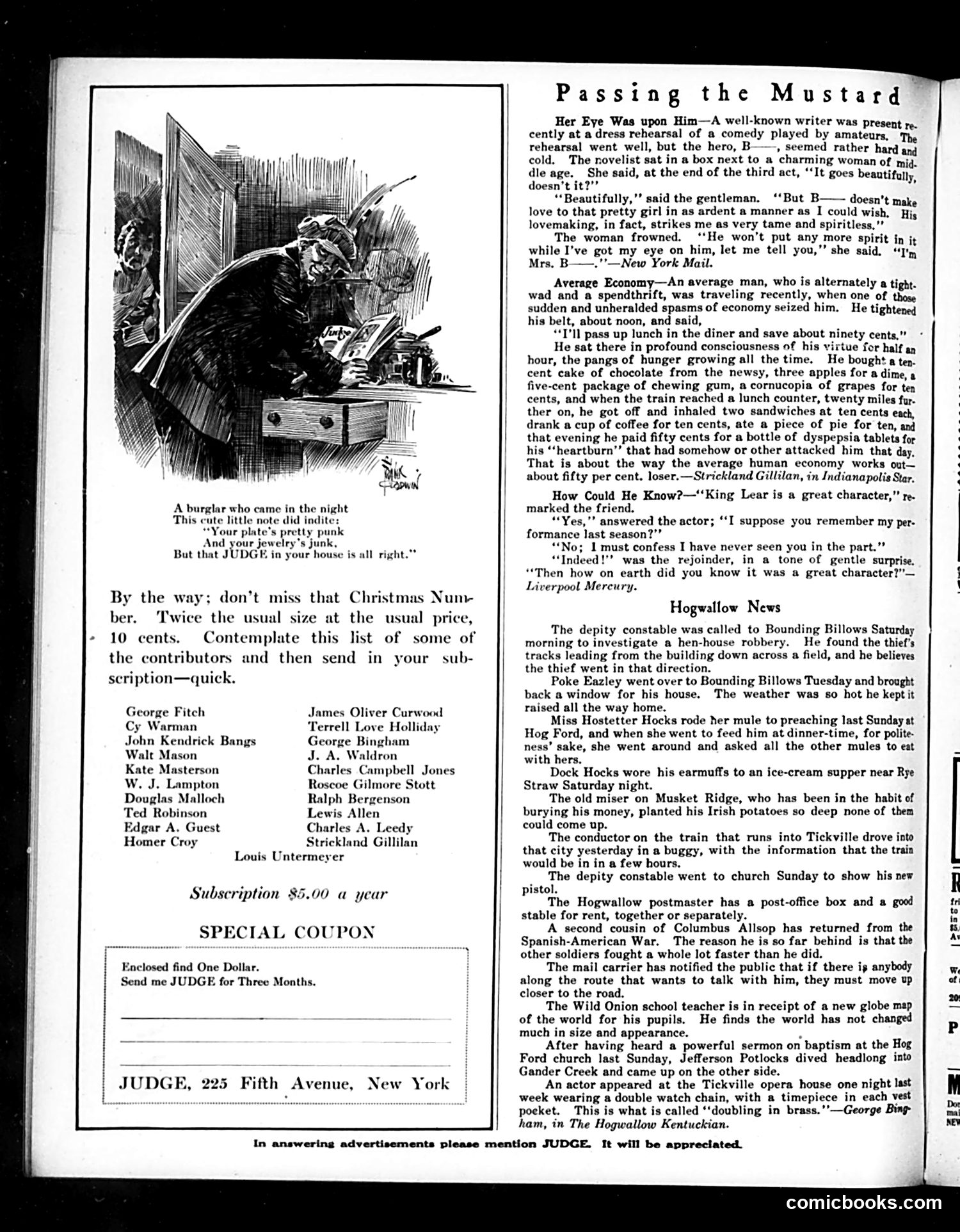
This page contains **advertisements and humor columns** rather than political cartoons. The small illustration shows a burglar, accompanying a humorous anecdote about crime and justice. The main content consists of three separate joke pieces: 1. **"Her Eye Was upon Him"** — a witty anecdote about an amateur theatrical performance where a woman hints she could inspire the male lead's romantic acting. 2. **"Average Economy"** — satire on human contradictions, showing a man who skips lunch to save money but then spends far more on snacks and antacids, ironically losing money through his attempted frugality. 3. **"Hogwallow News"** — rural humor depicting absurd small-town incidents (a constable following obvious tracks, a man keeping a window raised in heat, someone asking mules to dinner politely). The page primarily promotes Judge's Christmas issue and subscription offer, listing celebrity contributors like Edgar A. Guest and Walt Mason. The humor targets everyday human foolishness and rural simplicity rather than political figures or events.
This page is primarily **advertising**, not political satire. It contains product advertisements (diamonds, whiskey, cigars, ginseng gum, pipes, cameras) typical of early 20th-century magazines. However, it includes one **poem by Edgar A. Guest** titled "The Vote of Thanks," which offers social commentary. The poem satirizes workplace dynamics: it critiques how idle people avoid labor while industrious workers carry the burden, then receive only hollow "votes of thanks" as reward. Guest contrasts the many who rest in comfort against the few who toil, suggesting this pattern continues even into the afterlife ("at the heavenly banks"). The satire targets **lazy colleagues and passive management**—those who benefit from others' work while offering only perfunctory gratitude. It's not political satire but rather social commentary on workplace fairness and the disconnect between actual labor and symbolic recognition. The page otherwise serves as a time capsule of early-1900s consumer culture and advertising practices.
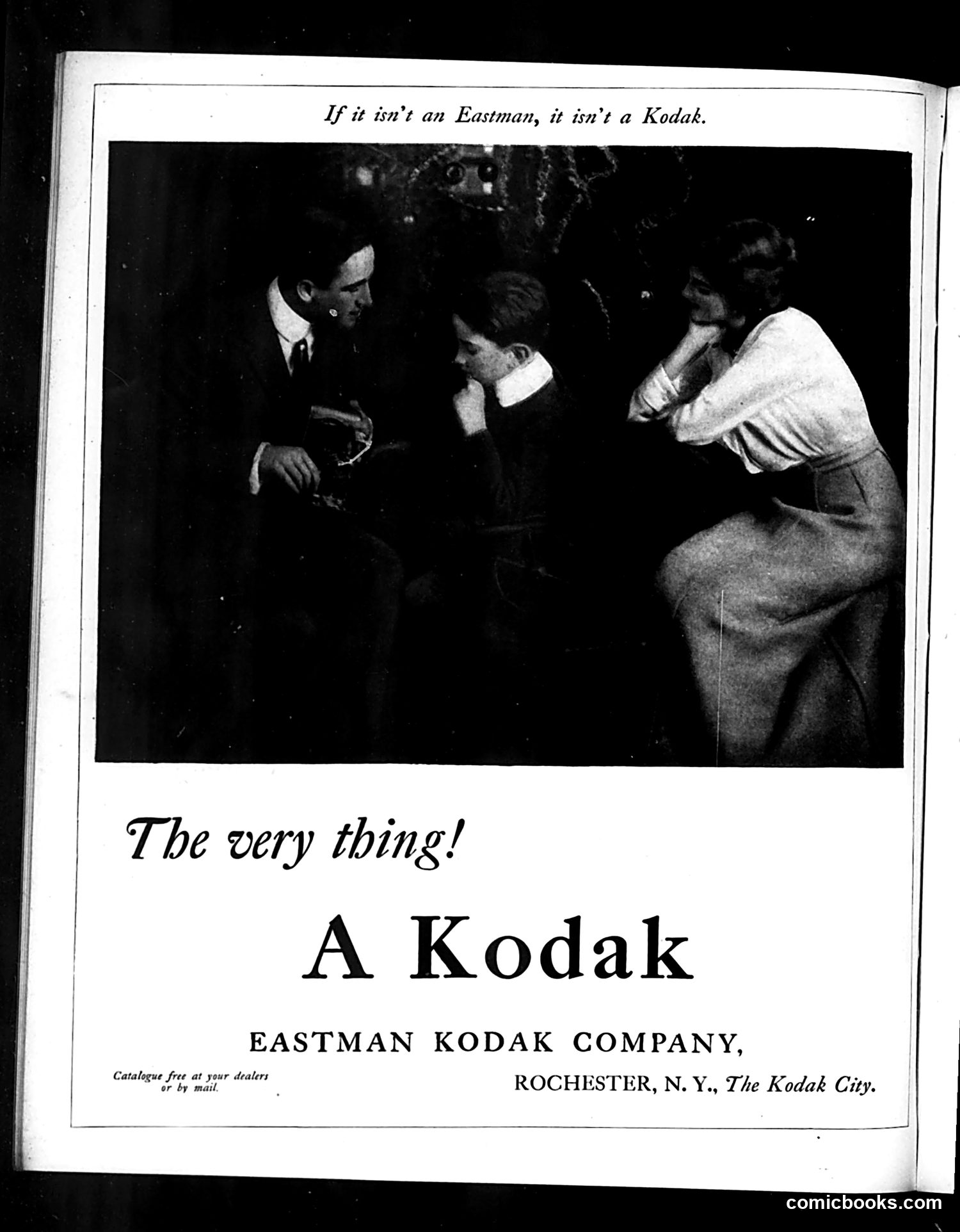
This is a **Kodak advertisement**, not political satire. The page shows four people in what appears to be a social gathering or party scene. The tagline "If it isn't an Eastman, it isn't a Kodak" (top) establishes brand exclusivity, while "The very thing!" suggests the camera is the perfect gift or accessory for such occasions. The advertisement's humor relies on the notion that capturing social moments—presumably with a Kodak camera—is essential to enjoying them. The dressed figures and intimate grouping imply this is aspirational advertising targeting middle-class consumers interested in documenting their social lives. The ad emphasizes Kodak's dominance: the company name itself had become synonymous with photography. Rochester, New York, is identified as "The Kodak City," underscoring the company's local importance.