
Judge, 1913-11-29 · page 17 of 24
Judge — November 29, 1913 — page 17: what you’re looking at
What you’re looking at
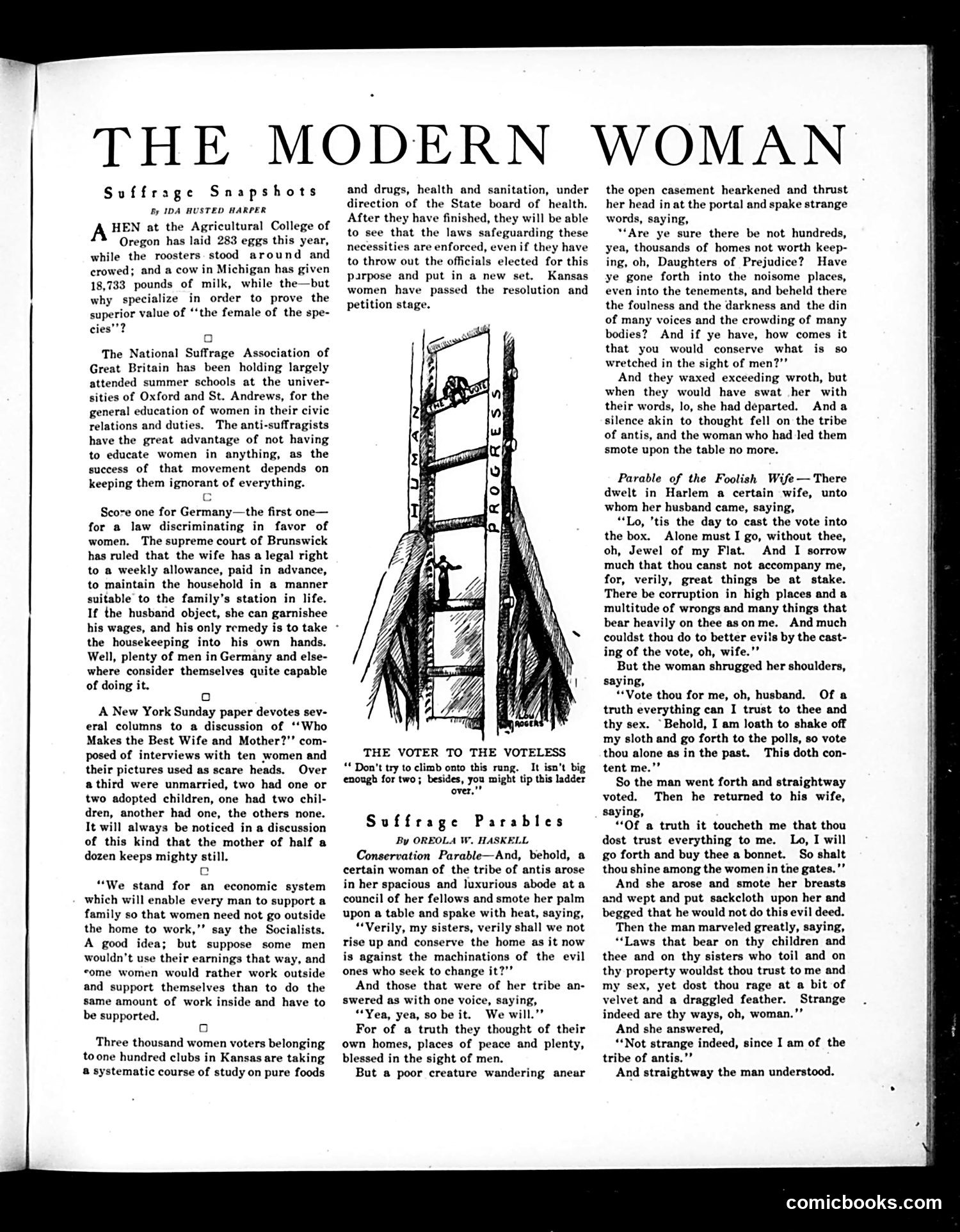
This page satirizes the **women's suffrage debate** of the early 20th century through commentary and parables. The main cartoon ("The Voter to the Voteless") depicts a woman on a ladder telling another woman below not to climb—a metaphor for enfranchised women blocking those without voting rights, suggesting suffragists are selfish rather than inclusive. The "Suffrage Parables" section mocks **anti-suffrage arguments**. The "Conservation Parable" features wealthy anti-suffrage women claiming they want to "conserve the home," but a poor woman interrupts, pointing out they ignore the harsh realities of working-class homes. This exposes the hypocrisy: anti-suffragists romanticize domestic life while ignoring women's actual hardships. The snapshots above celebrate women's **civic engagement and economic contributions**—from suffrage education programs to food safety advocacy—to counter claims that women shouldn't participate in public life. The piece argues anti-suffragists succeed only by keeping women "ignorant."
📄 Transcribed text from this page (OCR, searchable)
Machine-transcribed from the original scan — historical spelling and the odd misread are preserved.
Suffrage Snapshots By IDA HUSTED HARPER A HEN at the Agricultural College of Oregon has laid 283 eggs this year, while the roosters stood around and crowed; and a cow in Michigan has given 18,733 pounds of milk, while the—but why specialize in order to prove the superior value of ‘the female of the spe- cies’? The National Suffrage Association of Great Britain has been holding largely attended summer schools at the univer- sities of Oxford and St. Andrews, for the general education of women in their civic relations and duties. The anti-suffragists have the great advantage of not having to educate women in anything, as the success of that movement depends on keeping them ignorant of everything. Cc Score one for Germany—the first one— for a law discriminating in favor of women. The supreme court of Brunswick has ruled that the wife has a legal right to a weekly allowance, paid in advance, to maintain the household in a manner suitable to the family’s station in life. If the husband object, she can garnishee his wages, and his only remedy is to take - the housekeeping into his own hands. Well, plenty of men in Germany and else- where consider themselves quite capable of doing it. [s) A New York Sunday paper devotes sev- eral columns to a discussion of ‘*Who Makes the Best Wife and Mother?"’ com- posed of interviews with ten women and their pictures used as scare heads. Over athird were unmarried, two had one or two adopted children, one had two chil- dren, another had one, the others none. It will always be noticed in a discussion of this kind that the mother of half a dozen keeps mighty still. Go “We stand for an economic system which will enable every man to support a family so that women need not go outside the home to work,’’ say the Socialists. A good idea; but suppose some men wouldn't use their earnings that way, and some women would rather work outside and support themselves than to do the same amount of work inside and have to be supported. G Three thousand women voters belonging toone hundred clubs in Kansas are taking a systematic course of study on pure foods THE MODERN WOMAN and drugs, health and sanitation, under direction of the State board of health. After they have finished, they will be able to see that the laws safeguarding these necessities are enforced, evenif they have to throw out the officials elected for this Parpose and put in a new set. Kansas women have passed the resolution and petition stage. THE VOTER TO THE VOTELESS “* Don't try to climb onto this rung. It isn’t big enough for two; besides, you might tip this ladder ‘over,"* Suffrage Parables By OREOLA W. HASKELL Conservation Parable—And, behold, a certain woman of the tribe of antis arose in her spacious and luxurious abode at a council of her fellows and smote her palm upon a table and spake with heat, saying, “Verily, my sisters, verily shall we not rise up and conserve the home as it now is against the machinations of the evil ones who seek to change it?’’ And those that were of her tribe an- swered as with one voice, saying, “Yea, yea, so be it. We will.”” For of a truth they thought of their own homes, places of peace and plenty, blessed in the sight of men. But a poor creature wandering anear the open casement hearkened and thrust her head in at the portal and spake strange words, saying, **Are ye sure there be not hundreds, yea, thousands of homes not worth keep- ing, oh, Daughters of Prejudice? Have ye gone forth into the noisome places, even into the tenements, and beheld there the foulness and the darkness and the din of many voices and the crowding of many bodies? And if ye have, how comes it that you would conserve what is so wretched in the sight of men?” And they waxed exceeding wroth, but when they would have swat her with their words, lo, she had departed. Anda silence akin to thought fell on the tribe of antis, and the woman who had led them smote upon the table no more. Parable of the Foolish Wife— There dwelt in Harlem a certain wife, unto whom her husband came, saying, “Lo, 'tis the day to cast the vote into the box. Alone must I go, without thee, oh, Jewel of my Flat. And I sorrow much that thou canst not accompany me, for, verily, great things be at stake. There be corruption in high places and a multitude of wrongs and many things that bear heavily on thee asonme. And much couldst thou do to better evils by the cast- ing of the vote, oh, wife.’” But the woman shrugged her shoulders, saying, “Vote thou for me, oh, husband. Of a truth everything can I trust to thee and thy sex. “Behold, I am loath to shake off my sloth and go forth to the polls, so vote thou alone as in the past. This doth con- tent me.’’ So the man went forth and straightway voted. Then he returned to his wife, saying, “Of a truth it toucheth me that thou dost trust everything to me. Lo, I will go forth and buy thee a bonnet. So shalt thou shine among the women in tne gates.”” And she arose and smote her breasts and wept and put sackcloth upon her and begged that he would not do this evil deed. Then the man marveled greatly, saying, “Laws that bear on thy children and thee and on thy sisters who toil and on thy property wouldst thou trust to me and my sex, yet dost thou rage at a bit of velvet and a draggled feather. Strange indeed are thy ways, oh, woman.’’ And she answered, “Not strange indeed, since I am of the tribe of antis.”’ And straightway the man understood. comicbooks.com