
Judge, 1913-11-29 · page 9 of 24
Judge — November 29, 1913 — page 9: what you’re looking at
What you’re looking at
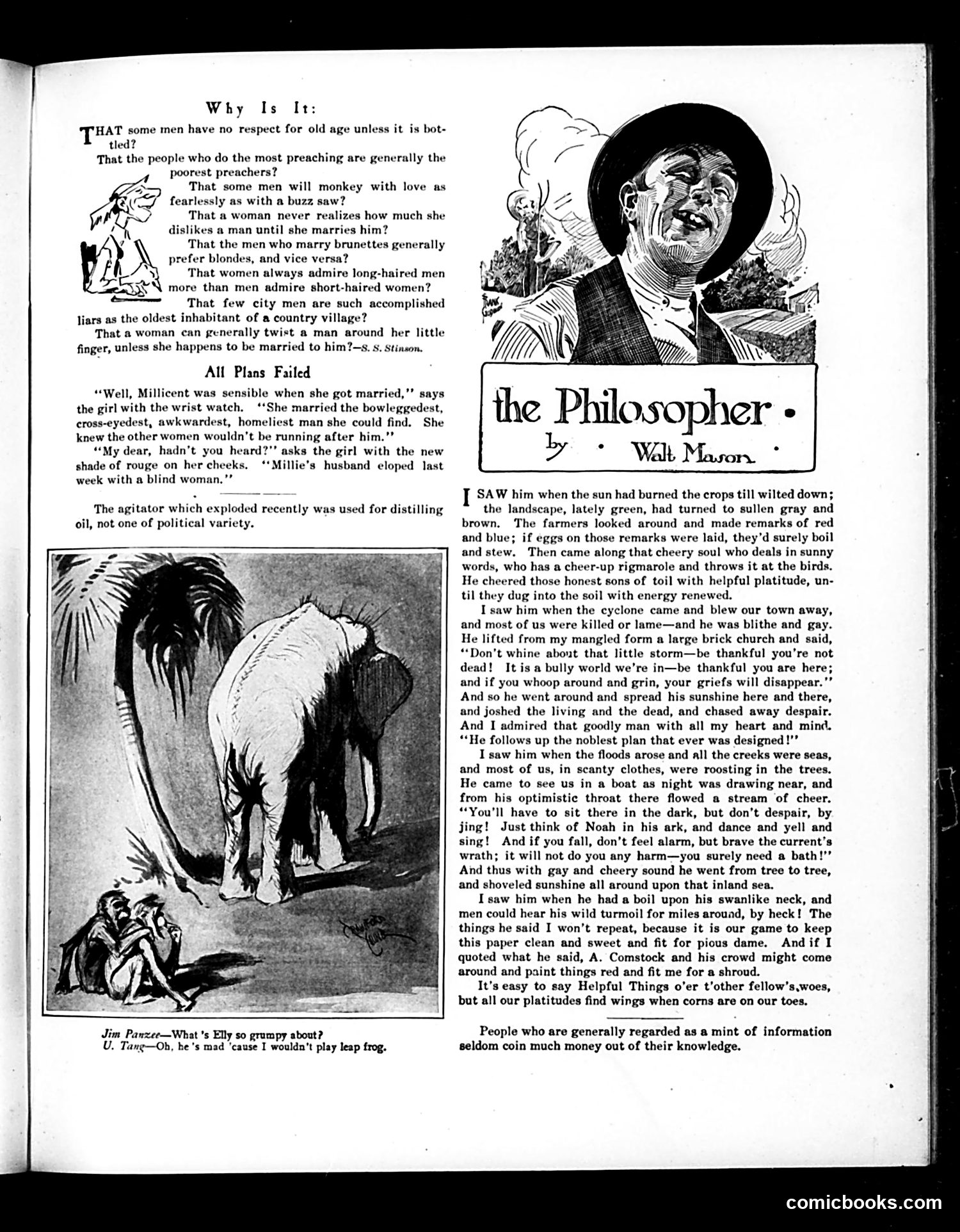
**"Why Is It"** is a humorous advice column listing absurd social observations about human nature and relationships. It mocks hypocrisy (preachers who don't practice what they preach), romantic foolishness, and gender stereotypes common in the era—assumptions about women's fickleness, preferences for certain hair lengths, and manipulative abilities. **"The Philosopher"** by Walt Mason is a satirical poem about an aggressively optimistic man who dispenses platitudes during genuine disasters: crop failures, cyclones, floods, deaths. The poem mocks false cheerfulness and empty positive advice, showing how "the Philosopher" callously trivializes real suffering with hollow encouragement. The final lines drive the satire home: it's easy to offer uplifting platitudes about *others'* troubles, but we lose perspective when faced with our own pain (represented by corns on one's feet). Both pieces critique shallow social attitudes and performative wisdom common to early 20th-century American culture.
📄 Transcribed text from this page (OCR, searchable)
Machine-transcribed from the original scan — historical spelling and the odd misread are preserved.
Why Is It: HAT some men have no respect for old age unless it is bot- tled? That the people who do the most preaching are generally the poorest preachers? ZA That some men will monkey with love as ten if es Qe fearlessly as with a buzz saw? That a woman never reali how much she Q dislikes a man until she marries him? a That the men who marry brunettes generally \ prefer blondes, and vice versa? f Lf y That women always admire long-haired men SeN more than men admire short-haired women? —— That few city men are such accomplished liars as the oldest inhabitant of a country village? That a woman can generally twist a man around her little finger, unless she happens to be married to him?— All Plans Failed “Well, Millicent was sensible when she got married,”” says the girl with the wrist watch. ‘She married the bowleggedest, cross-eyedest, awkwardest, homeliest man she could find. She knew the other women wouldn't be running after him.”” “My dear, hadn't you heard?"’ asks the girl with the new shade of rouge on her cheeks. ‘‘Millie’s husband eloped last week with a blind woman,’” ‘The agitator which exploded recently was used for distilling oil, not one of political variety. Jim Panzzee—What 's Elly so grampy about? U. Tang—Oh, he's mad ‘cause I wouldn't play leap frog. the Philosopher - De. © NE Mitncees SAW him when the sun had burned the crops till wilted down; the landscape, lately green, had turned to sullen gray and brown. The farmers looked around and made remarks of red and blue; if eggs on those remarks were laid, they’d surely boil and stew. Then came along that cheery soul who deals in sunny words, who has a cheer-up rigmarole and throws it at the birds. He cheered those honest sons of toil with helpful platitude, un- til they dug into the soil with energy renewed. I saw him when the cyclone came and blew our town away, and most of us were killed or lame—and he was blithe and gay. He lifted from my mangled form a large brick church and said, “Don't whine about that little storm—be thankful you're not dead! It is a bully world we’re in—be thankful you are here; and if you whoop around and grin, your griefs will disappear.’ And so he went around and spread his sunshine here and there, and joshed the living and the dead, and chased away despair. And I admired that goodly man with all my heart and mind. “He follows up the noblest plan that ever was designed !’” I saw him when the floods arose and all the creeks were seas, and most of us, in scanty clothes, were roosting in the trees. He came to see us in a boat as night was drawing near, and from his optimistic throat there flowed a stream of cheer. “You'll have to sit there in the dark, but don’t despair, by jing! Just think of Noah in his ark, and dance and yell and sing! And if you fall, don’t feel alarm, but brave the current’s wrath; it will not do you any harm—you surely need a bath!’’ And thus with gay and cheery sound he went from tree to tree, and shoveled sunshine all around upon that inland sea. I saw him when he had a boil upon his swanlike neck, and men could hear his wild turmoil for miles arouad, by heck! The things he said I won’t repeat, because it is our game to keep this paper clean and sweet and fit for pious dame. And if I quoted what he said, A. Comstock and his crowd might come around and paint things red and fit me for a shroud. It’s easy to say Helpful Things o’er t’other fellow’s,woes, but all our platitudes find wings when corns are on our toes. People who are generally regarded as a mint of information seldom coin much money out of their knowledge. comicbooks.com