
Judge, 1913-11-29 · page 10 of 24
Judge — November 29, 1913 — page 10: what you’re looking at
What you’re looking at
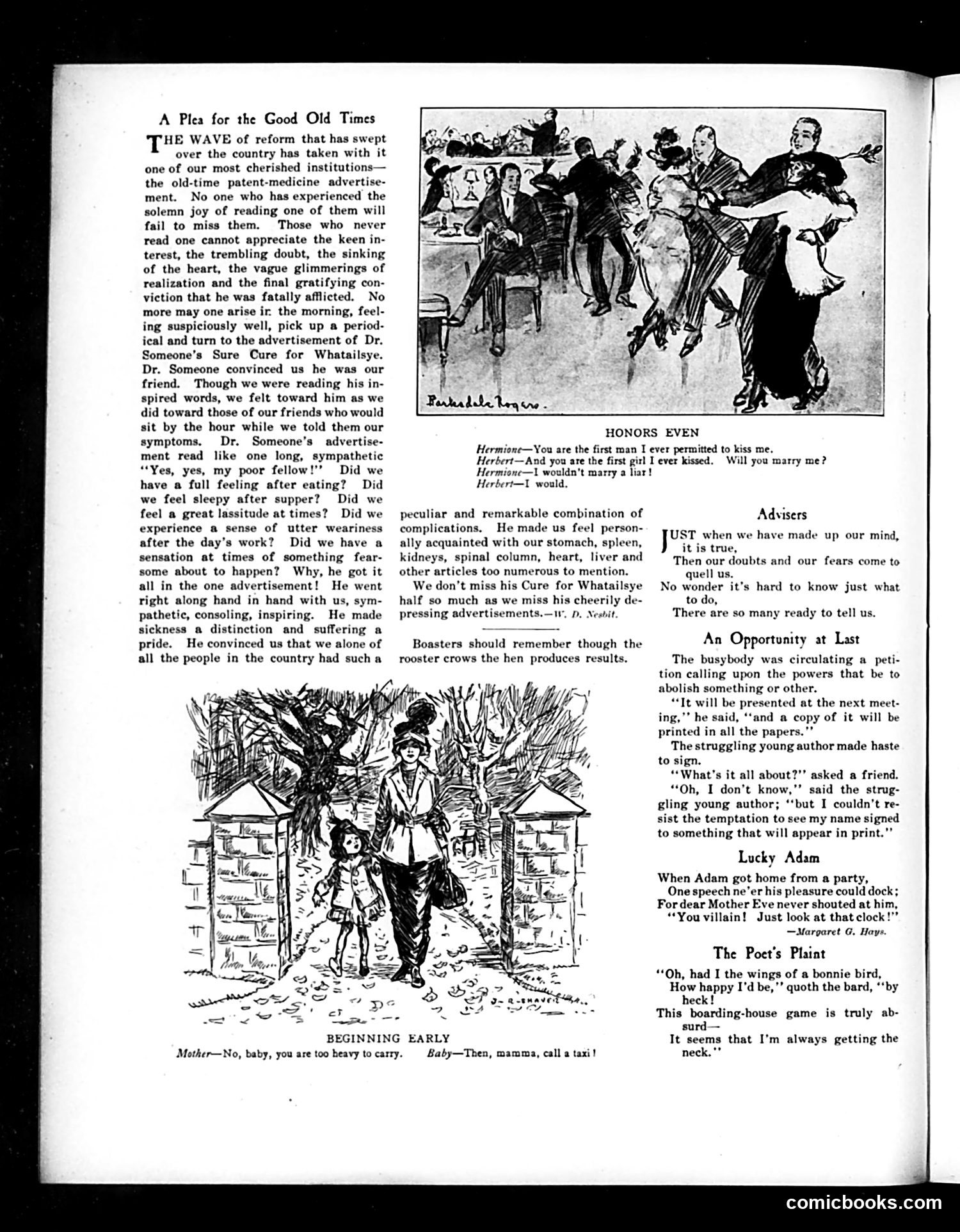
**Main Article: "A Plea for the Good Old Times"** This is nostalgic satire lamenting the decline of patent-medicine advertisements due to reform efforts (likely referencing early 20th-century regulatory crackdowns like the Pure Food and Drug Act of 1906). The author humorously praises these ads for their emotional manipulation—how they convinced readers they had obscure ailments by listing vague symptoms (fatigue, poor digestion, etc.). The satire mocks both the quack medicines and the gullible public who found comfort in self-diagnosis through advertising. "Dr. Someone's Sure Cure for Whatailsye" is a fictional example representing countless real patent-medicine hucksters. **Cartoons and Humor Items** The page includes several unrelated comedic pieces: "Honors Even" (a flirtation joke about mutual dishonesty), "Beginning Early" (child asking mother to call a taxi), "Lucky Adam" (poem about Adam escaping spousal nagging), and brief satirical items about busybodies and struggling authors. These represent typical Judge magazine filler content—light social commentary and domestic humor.
📄 Transcribed text from this page (OCR, searchable)
Machine-transcribed from the original scan — historical spelling and the odd misread are preserved.
A Plea for the Good Old Times HE WAVE of reform that has swept over the country has taken with it one of our most cherished institutions— the old-time patent-medicine advertise- ment. No one who has experienced the solemn joy of reading one of them will fail to miss them. Those who never read one cannot appreciate the keen in- terest, the trembling doubt, the sinking of the heart, the vague glimmerings of realization and the final gratifying con- viction that he was fatally afflicted. No more may one arise ir. the morning, feel- ing suspiciously well, pick up a period- ical and turn to the advertisement of Dr. Someone’s Sure Cure for Whatailsye. Dr. Someone convinced us he was our friend. Though we were reading his in- spired words, we felt toward him as we did toward those of our friends who would sit by the hour while we told them our symptoms. Dr. Someone's advertise- ment read like one long, sympathetic “Yes, yes, my poor fellow!’ Did we have a full feeling after eating? Did we feel sleepy after supper? Did we feel a great lassitude at times? Did we experience a sense of utter weariness after the day’s work? Did we have a sensation at times of something fear- some about to happen? all in the one advertisement! Why, he got it He went right along hand in hand with us, sym- pathetic, consoling, inspiring. He made sickness a distinction and suffering a pride. He convinced us that we alone of all the people in the country had such a HONORS EVEN Hermione—Nou are the first man I ever permitted to kiss me. Herbert—And you are the first girl I ever kissed. Will you marry me? Hermione—1 wouldn't marry a liar! Herbert—1 would, peculiar and remarkable combination of complications. He made us feel person- ally acquainted with our stomach, spleen, kidneys, spinal column, heart, liver and other articles too numerous to mention. We don’t miss his Cure for Whatailsye half so much as we miss his chi pressing advertisements.—w-, Boasters should remember though the rooster crows the hen produces results. BEGINNING EARLY Mother—No, baby, you are too heavy to carry. Baby—Then, mamma, call a taxi! Advisers UST when we have made up our mind, it is true, Then our doubts and our fears come to quell us. No wonder it’s hard to know just what to do, There are so many ready to tell us. An Opportunity at Last The busybody was circulating a peti- tion calling upon the powers that be to abolish something or other. “It will be presented at the next meet- ing,’’ he said, ‘tand a copy of it will be printed in all the papers.”” The struggling young author made haste to sign. “What's it all about?"’ asked a friend. “Oh, I don’t know,” said the strug- gling young author; ‘but I couldn't re- sist the temptation to see my name signed to something that will appear in print.” Lucky Adam When Adam got home from a party, One speech ne'er his pleasure could dock; For dear Mother Eve never shouted at him, “You villain! Just look at that clock!” Margaret G. Hays. The Poet's Plaint “Oh, had I the wings of a bonnie bird, How happy I'd be,’’ quoth the bard, ‘‘by heck! This boarding-house game is truly ab- surd— It seems that I'm always getting the neck."’ comicbooks.com