
Judge, 1913-11-29 · page 6 of 24
Judge — November 29, 1913 — page 6: what you’re looking at
What you’re looking at
This story satirizes the dishonesty of homeowners dealing with insurance adjusters and repair contractors. When Homely's kitchen catches fire, he deliberately downplays the damage to his insurance adjuster, claiming it's "superficial and easy to get at." He then attempts to lowball a carpenter's estimate at twenty dollars. The satire targets Homely's hypocrisy: he manipulates the insurance company while simultaneously resisting the carpenter's reasonable explanations about labor costs and necessary structural inspection. The humor lies in Homely's self-interested negotiating tactics—he expects fairness from the insurance company but refuses to grant it to the tradesman. The story critiques how ordinary people exploit the insurance system while grudging fair compensation to workers. The running gag about the neighbor's gossiping provides comic relief to this commentary on insurance fraud and penny-pinching dishonesty.
📄 Transcribed text from this page (OCR, searchable)
Machine-transcribed from the original scan — historical spelling and the odd misread are preserved.
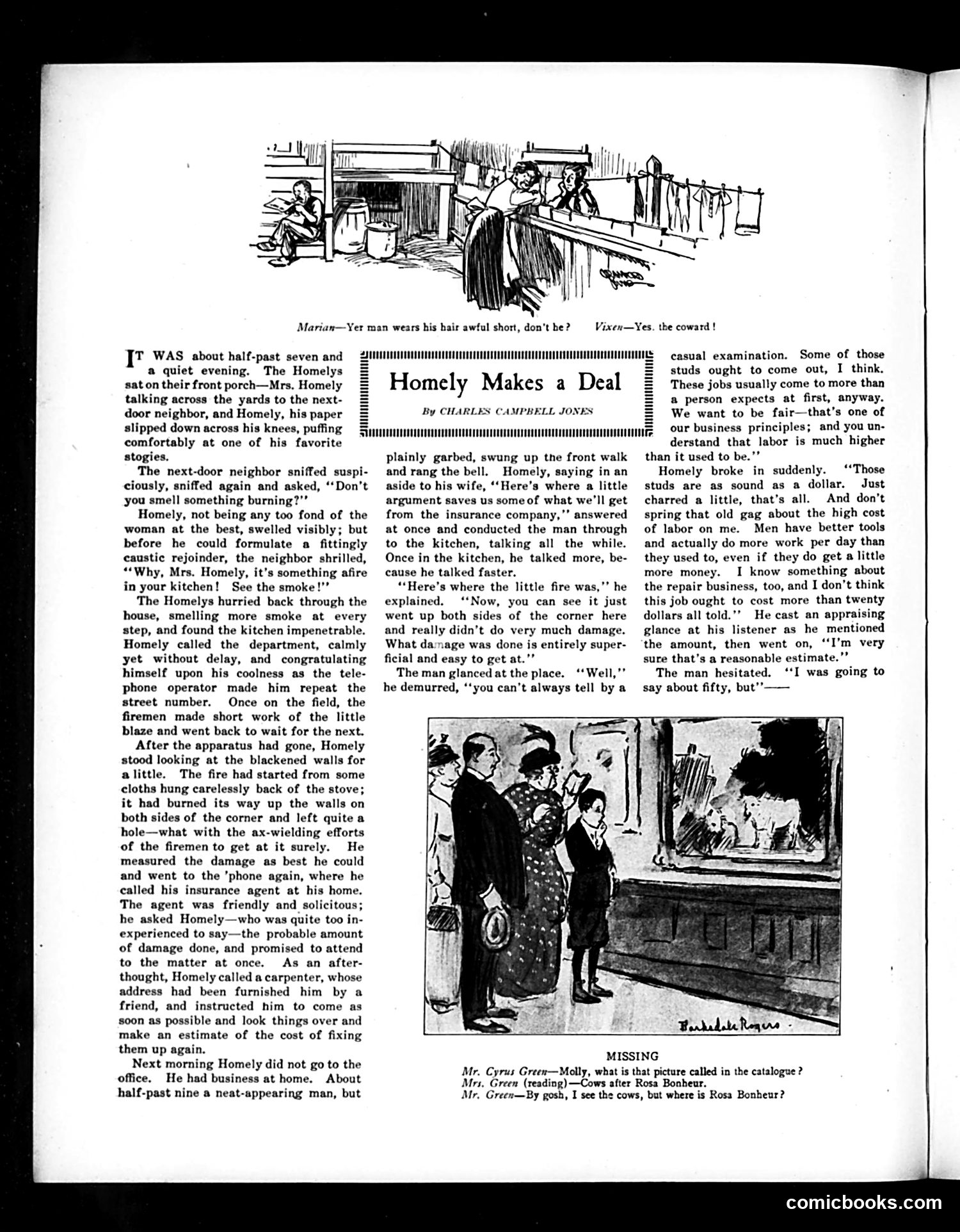
Marian—Yer man wears his hair awful short, don't be? [oy T WAS about half-past seven and a quiet evening. The Homelys saton their front porch—Mrs,. Homely talking across the yards to the next- door neighbor, and Homely, his paper slipped down across his knees, puffing comfortably at one of his favorite stogies. The next-door neighbor sniffed suspi- ciously, sniffed again and asked, ‘‘Don’t you smell something burning?"’ Homely, not being any too fond of the woman at the best, swelled visibly; but before he could formulate a fittingly caustic rejoinder, the neighbor shrilled, “Why, Mrs. Homely, it’s something afire in your kitchen! See the smoke!’’ The Homelys hurried back through the house, smelling more smoke at every step, and found the kitchen impenetrable. Homely called the department, calmly yet without delay, and congratulating himself upon his coolness as the tele- phone operator made him repeat the street number. Once on the field, the firemen made short work of the little blaze and went back to wait for the next. After the apparatus had gone, Homely stood looking at the blackened walls for alittle. The fire had started from some cloths hung carelessly back of the stove; it had burned its way up the walls on both sides of the corner and left quite a hole—what with the ax-wielding efforts of the firemen to get at it surely. He measured the damage as best he could and went to the phone again, where he called his insurance agent at his home. The agent was friendly and solicitous; he asked Homely—who was quite too in- experienced to say—the probable amount of damage done, and promised to attend to the matter at once. As an after- thought, Homely called a carpenter, whose address had been furnished him by a friend, and instructed him to come as soon as possible and look things over and make an estimate of the cost of fixing them up again. Next morning Homely did not go to the office. He had business at home. About half-past nine a neat-appearing man, but EF ET UT Homely Makes a Deal By CHARLES CAMPBELL JONES plainly garbed, swung up the front walk and rang the bell. Homely, saying in an aside to his wife, ‘‘Here’s where a little argument saves us some of what we'll get from the insurance company,” answered at once and conducted the man through to the kitchen, talking all the while. Once in the kitchen, he talked more, be- cause he talked faster. “‘Here’s where the little fire was,’ he explained. ‘*Now, you can see it just went up both sides of the corner here and really didn’t do very much damage. What damage was done js entirely super- ficial and easy to get at."” The man glanced at the place. ‘*Well,’’ he demurred, ‘‘you can’t always tell by a Vixen—Yes. the coward ! casual examination. Some of those studs ought to come out, I think. These jobs usually come to more than = a person expects at first, anyway. = We want to be fair—that’s one of = our business principles; and you un- derstand that labor is much higher than it used to be.’” Homely broke in suddenly. ‘Those studs are as sound as a dollar. Just charred a little, that’s all. And don’t spring that old gag about the high cost of labor on me. Men have better tools and actually do more work per day than they used to, even if they do get a little more money. I know something about the repair business, too, and I don’t think this job ought to cost more than twenty dollars all told.’’ He cast an appraising glance at his listener as he mentioned the amount, then went on, ‘‘I’m very sure that’s a reasonable estimate.” The man hesitated. ‘‘I was going to say about fifty, but’’—— MISSING Mr. Cyrus Green—Molly, what is that picture called in the catalogue ? Mrs, Green (reading) —Cows after Rosa Bonheur. Mr, Green—By gosh, I see the cows, but where is Rosa Bonheur? comicbooks.com