
Judge, 1913-11-29 · page 15 of 24
Judge — November 29, 1913 — page 15: what you’re looking at
What you’re looking at
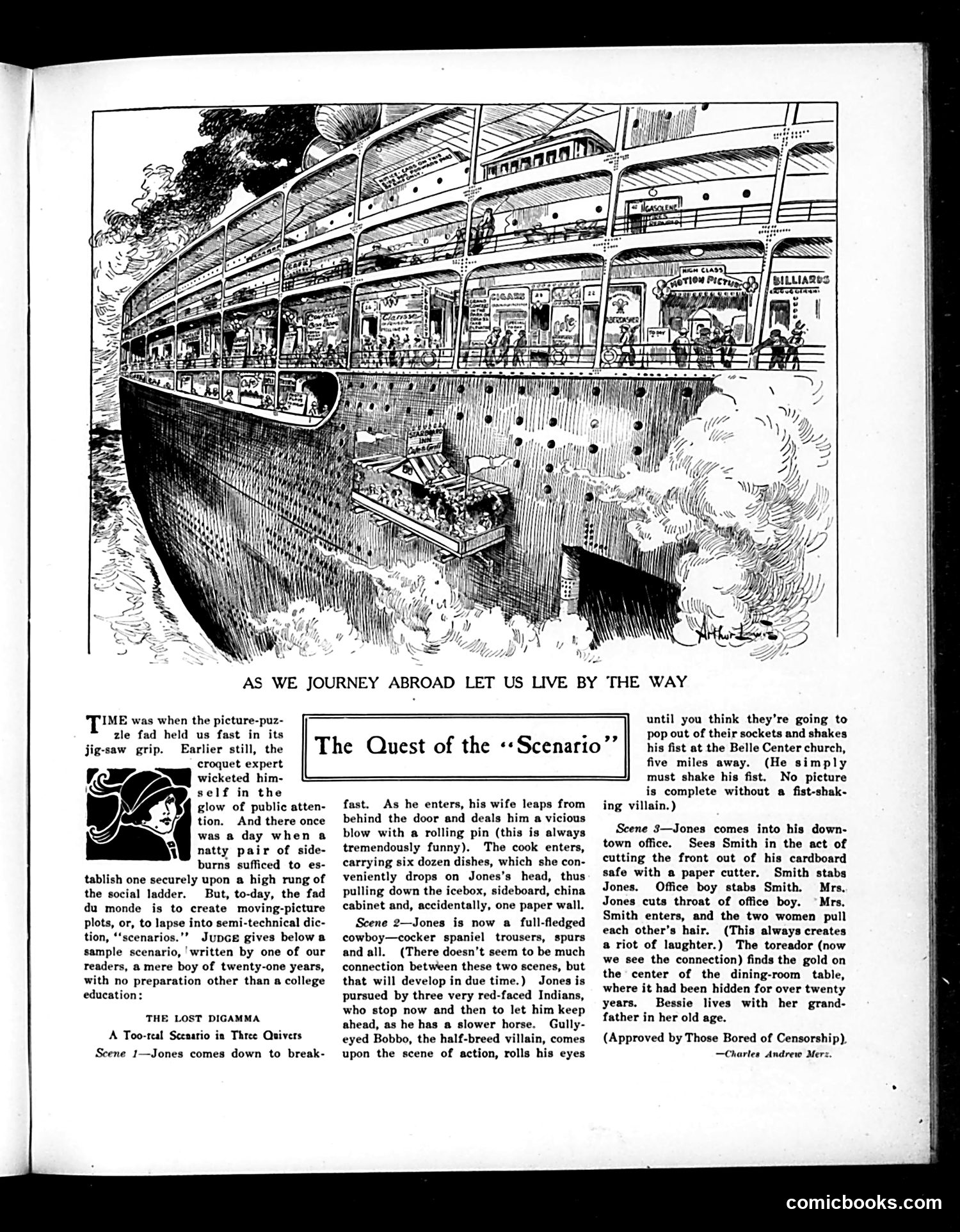
This is a satirical piece mocking the early film industry's scenario (screenplay) writing fad around the 1910s. Judge criticizes how amateur writers—here, a 21-year-old college student—churn out absurd movie plots with no coherent logic. The cartoon illustrates the problem: "The Lost Digamma" deliberately strings together three nonsensical scenes (domestic violence, a cowboy-Indian chase, office stabbing) with zero narrative connection. The humor lies in exposing the ridiculous conventions audiences supposedly loved: slapstick violence, melodramatic villains required to "shake their fists," and arbitrary plot elements ("we see the connection") inserted retroactively. The byline credits Charles Andrew Merz, likely the author, and includes mock censorship approval—further satirizing film industry self-regulation. The joke is that anyone could write these scenarios, and audiences would accept their incoherence. It's social commentary on both lowbrow entertainment and the chaotic early days of cinema.
📄 Transcribed text from this page (OCR, searchable)
Machine-transcribed from the original scan — historical spelling and the odd misread are preserved.
AS WE JOURNEY ABROAD LET US LIVE BY THE WAY {TIME was when the picture-puz- zle fad held us fast in its jig-saw grip. Earlier still, the croquet expert wicketed him- self in the glow of public atten- tion. And there once was a day when a natty pair of side- burns sufficed to es- tablish one securely upon a high rung of the social ladder. But, to-day, the fad du monde is to create moving-picture plots, or, to lapse into semi-technical dic- tion, ‘‘scenarios."’ Jupce gives belowa sample scenario, ‘written by one of our readers, a mere boy of twenty-one years, with no preparation other than a college education: THE LOST DIGAMMA A Too-teal Scenario in Three Quivers Scene 1—Jones comes down to break- The Quest of the ««Scenario”’ fast. As he enters, his wife leaps from behind the door and deals him a vicious blow with a rolling pin (this is always tremendously funny). The cook enters, carrying six dozen dishes, which she con- veniently drops on Jones’s head, thus pulling down the icebox, sideboard, china cabinet and, accidentally, one paper wall. Scene 2—Jones is now a full-fledged cowboy—cocker spaniel trousers, spurs and all. (There doesn’t seem to be much connection between these two scenes, but that will develop in due time.) Jones is pursued by three very red-faced Indians, who stop now and then to let him keep ahead, as he has a slower horse. Gully- eyed Bobbo, the half-breed villain, comes upon the scene of action, rolls his eyes until you think they’re going to pop out of their sockets and shakes his fist at the Belle Center church, five miles away. (He simply must shake his fist. No picture is complete without a fist-shak- ing villain.) Scene 3—Jones comes into his down- town office. Sees Smith in the act of cutting the front out of his cardboard safe with a paper cutter. Smith stabs Jones. Office boy stabs Smith. Mrs. Jones cuts throat of office boy. ~Mrs. Smith enters, and the two women pull each other’s hair. (This always creates a riot of laughter.) The toreador (now we see the connection) finds the gold on the center of the dining-room table, where it had been hidden for over twenty years. Bessie lives with her grand- father in her old age. (Approved by Those Bored of Censorship). —Charles Andrew Merz. comicbooks.com