
A complete issue · 24 pages · 1913
Judge — November 15, 1913
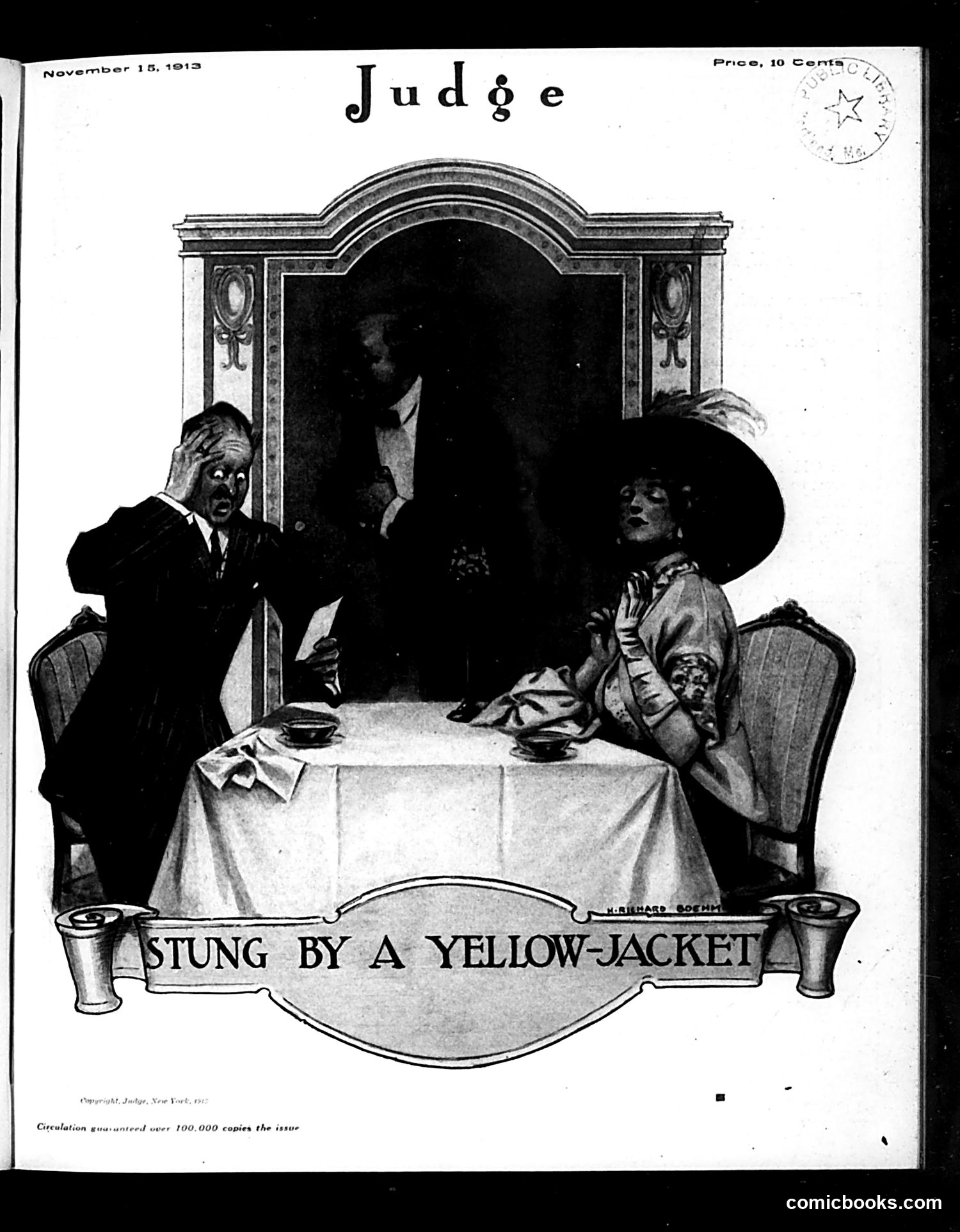
This satirical cartoon depicts a dining scene where two well-dressed figures (a man on the left appearing distressed, and a woman on the right) sit at a table with a shadowy figure looming above them in a doorway. The title "Stung by a Yellow-Jacket" is the key to understanding the joke. "Yellow-jacket" likely refers to *Judge* magazine itself, which had a yellow cover. The cartoon satirizes how the magazine's recent articles or exposés have metaphorically "stung" (criticized or embarrassed) these social figures during their private meal. The shadowy, threatening silhouette suggests an intrusive or accusatory presence disrupting their comfort—typical of muckraking journalism's impact on public figures in the Progressive Era.
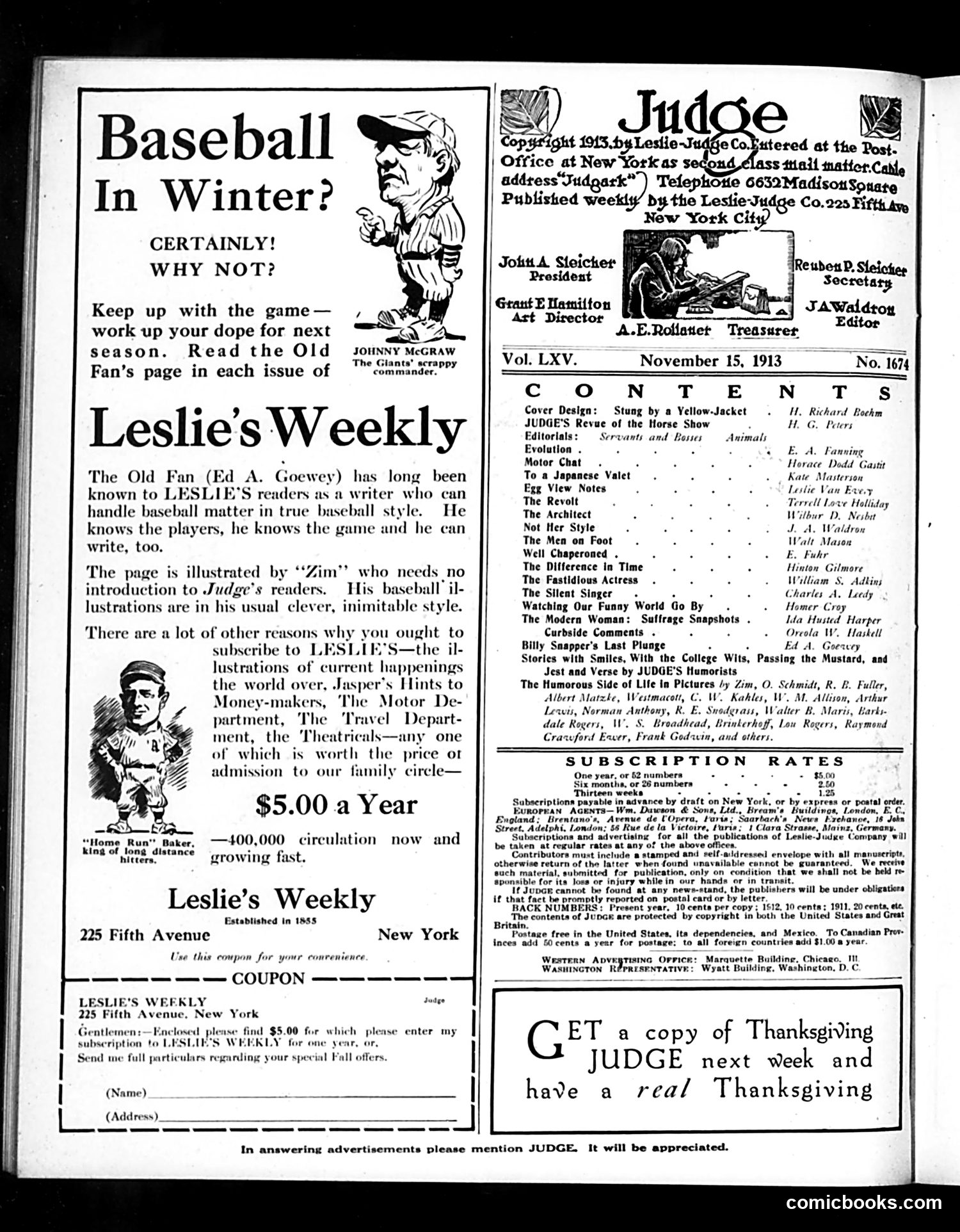
This page is primarily **advertising and masthead content** rather than political satire. The left side promotes Leslie's Weekly magazine with a subscription advertisement featuring "Home Run" Baker, identified as "king of long distance" hitters. The cartoon shows a baseball player in batting stance, appealing to sports enthusiasts to subscribe for $5 yearly. The right side contains the Judge magazine masthead and contents listing for Vol. LXV, No. 1674. A Thanksgiving advertisement at bottom promotes getting next week's special holiday issue. The baseball imagery reflects early 1910s American popular culture enthusiasm for the sport. No significant political satire or commentary is evident on this particular page—it functions primarily as a commercial and editorial information page.
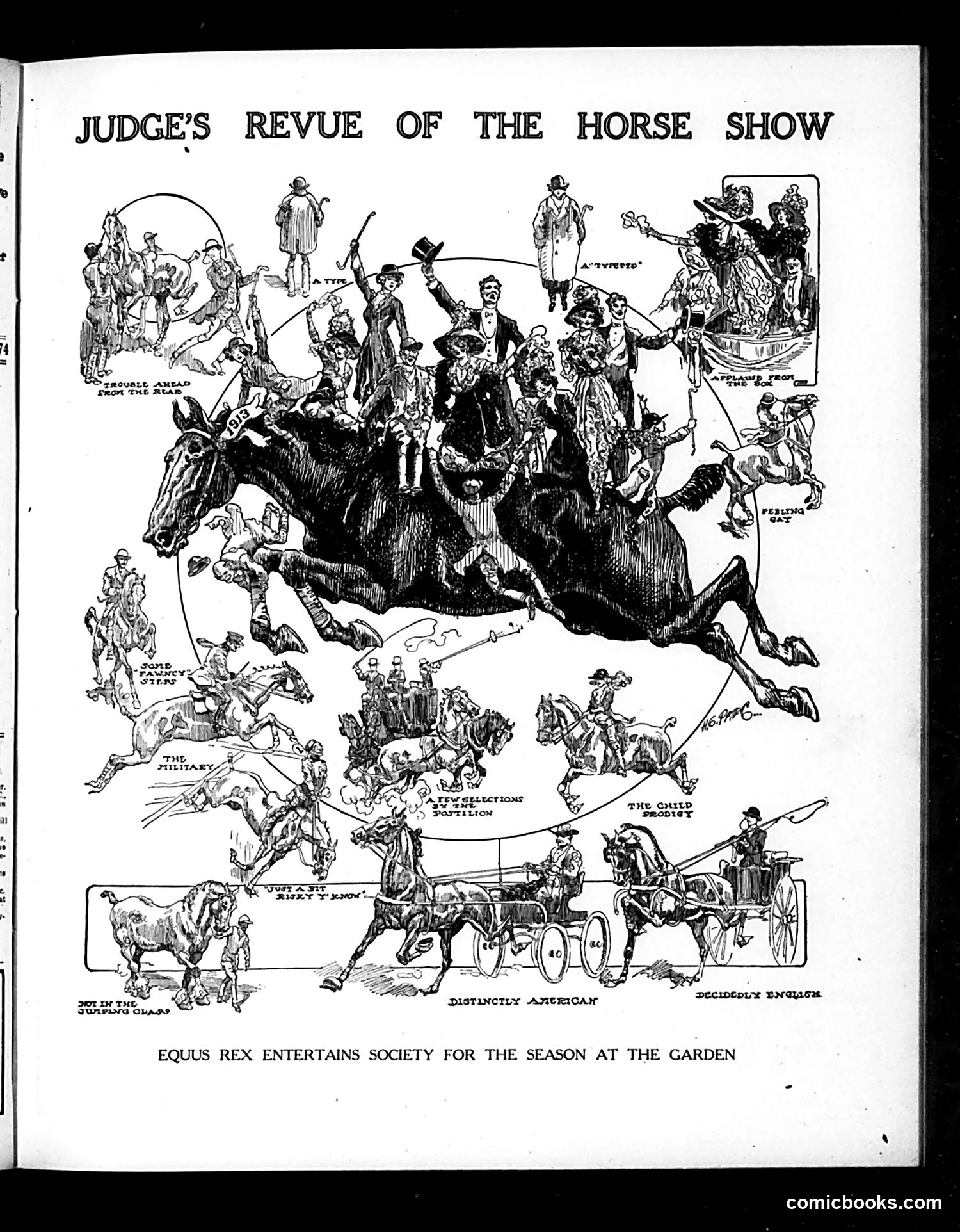
This is a satirical commentary on New York's prestigious horse show (likely the National Horse Show), a major society event. The cartoon depicts various horse-related activities and social types arranged around two large horses as the central focus. Labels reference different competition categories: "The Therapy," "Pony Selections Petition," "The Child Prodigy," and descriptions like "Distinctly American" and "Decidedly English." The arrangement suggests Judge magazine is gently mocking both the pretensions of high society attendees and the obsessive focus on horse breeding and training that characterized wealthy New Yorkers of the era. The subtitle indicates "Equus Rex Entertains Society for the Season at the Garden," positioning the event as a showcase of social hierarchies and fashionable display.
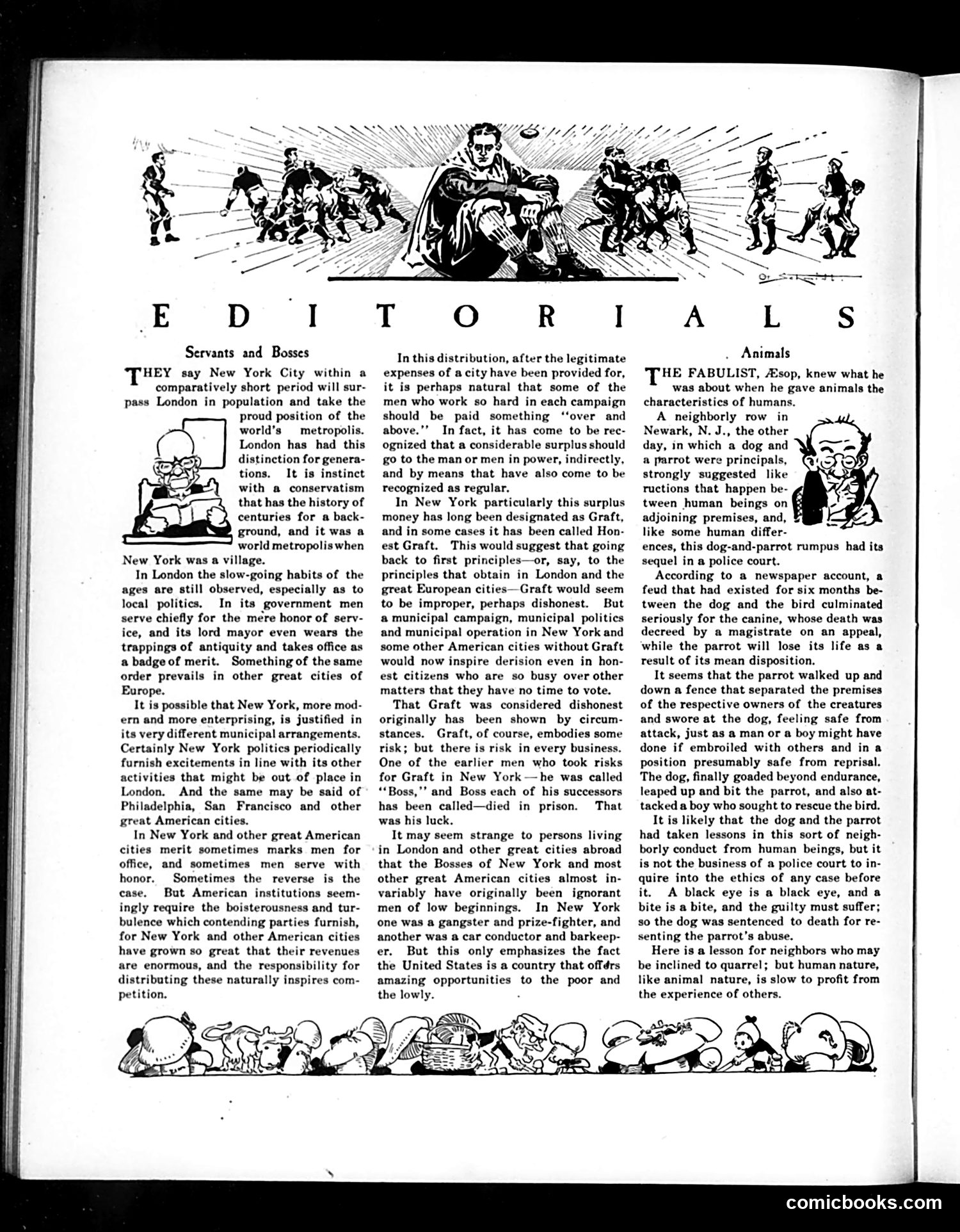
This page contains two editorial pieces satirizing New York City politics and governance. **"Servants and Bosses"** criticizes how New York politicians, particularly those in "Graft" positions, distribute city money to political workers rather than providing honest municipal services. The text compares New York unfavorably to London, suggesting the city operates through corrupt patronage networks where political loyalty is rewarded over merit. The cartoon illustrates a central authority figure distributing resources to subordinates. **"Animals"** is a fable by Aesop discussing a dog-and-parrot court case, used metaphorically to critique New York's moral standards. The satire suggests that while a dog was executed for attacking a parrot, humans in power escape consequences for similar abuses—implying systemic corruption where the powerful operate outside justice. Both pieces attack municipal corruption and unequal application of law.
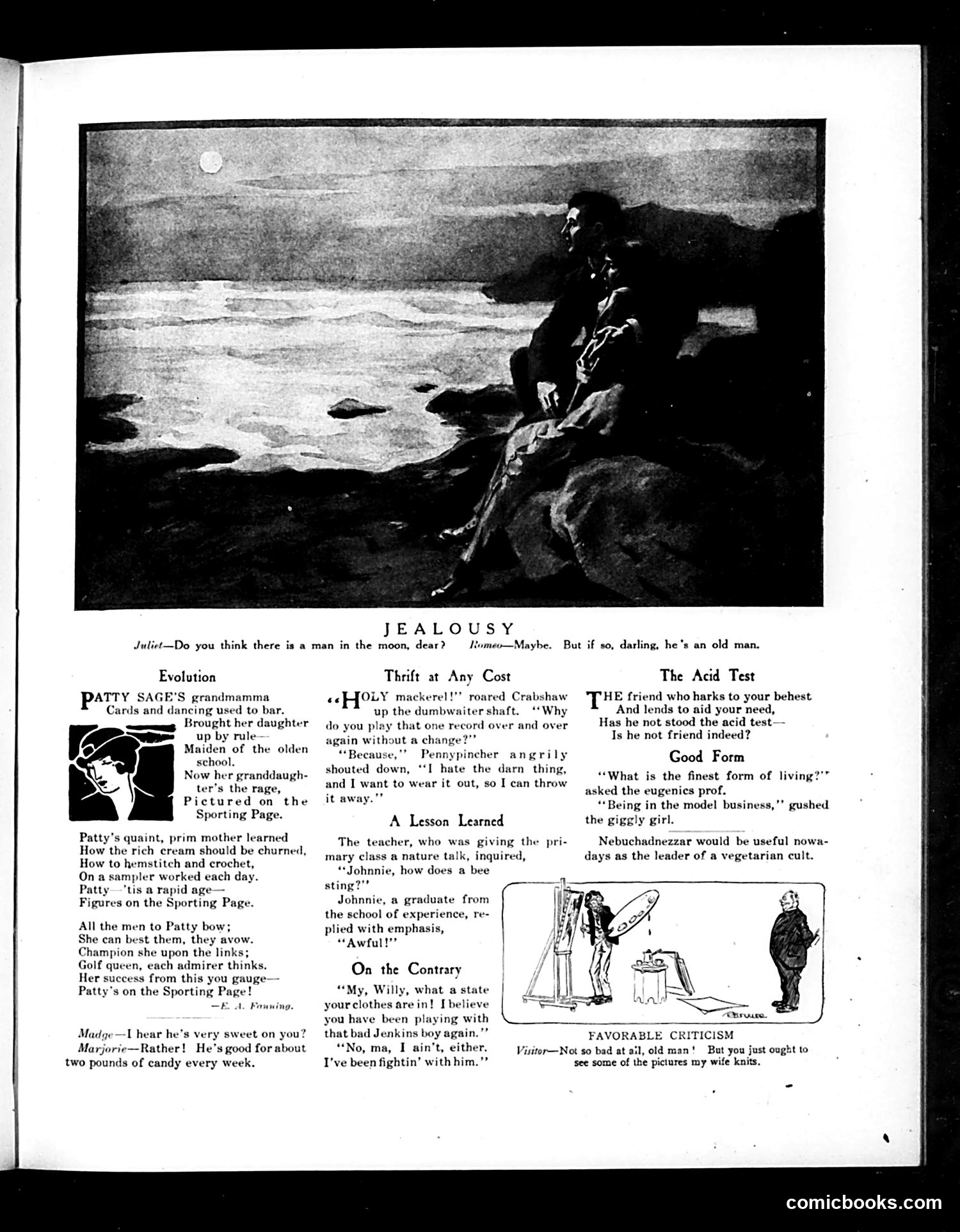
This page features multiple short humorous pieces rather than sustained political cartoons. The top image titled "Jealousy" depicts a couple by moonlight with dialogue about whether men exist on the moon—a reference to early 20th-century space speculation. The remaining content consists of brief jokes and satirical observations labeled "Evolution," "Thrift at Any Cost," "The Acid Test," "A Lesson Learned," "Good Form," "On the Contrary," and "Favorable Criticism." These touch on domestic situations, education, social etiquette, and gender relations typical of Judge's humor. The small cartoon illustrations accompanying these pieces mock contemporary social conventions—wealthy heirs, teachers, eugenics advocates, and marital dynamics. No specific political figures or major events appear to be targeted; rather, the satire aims at general social pretensions and behavioral oddities of the era.
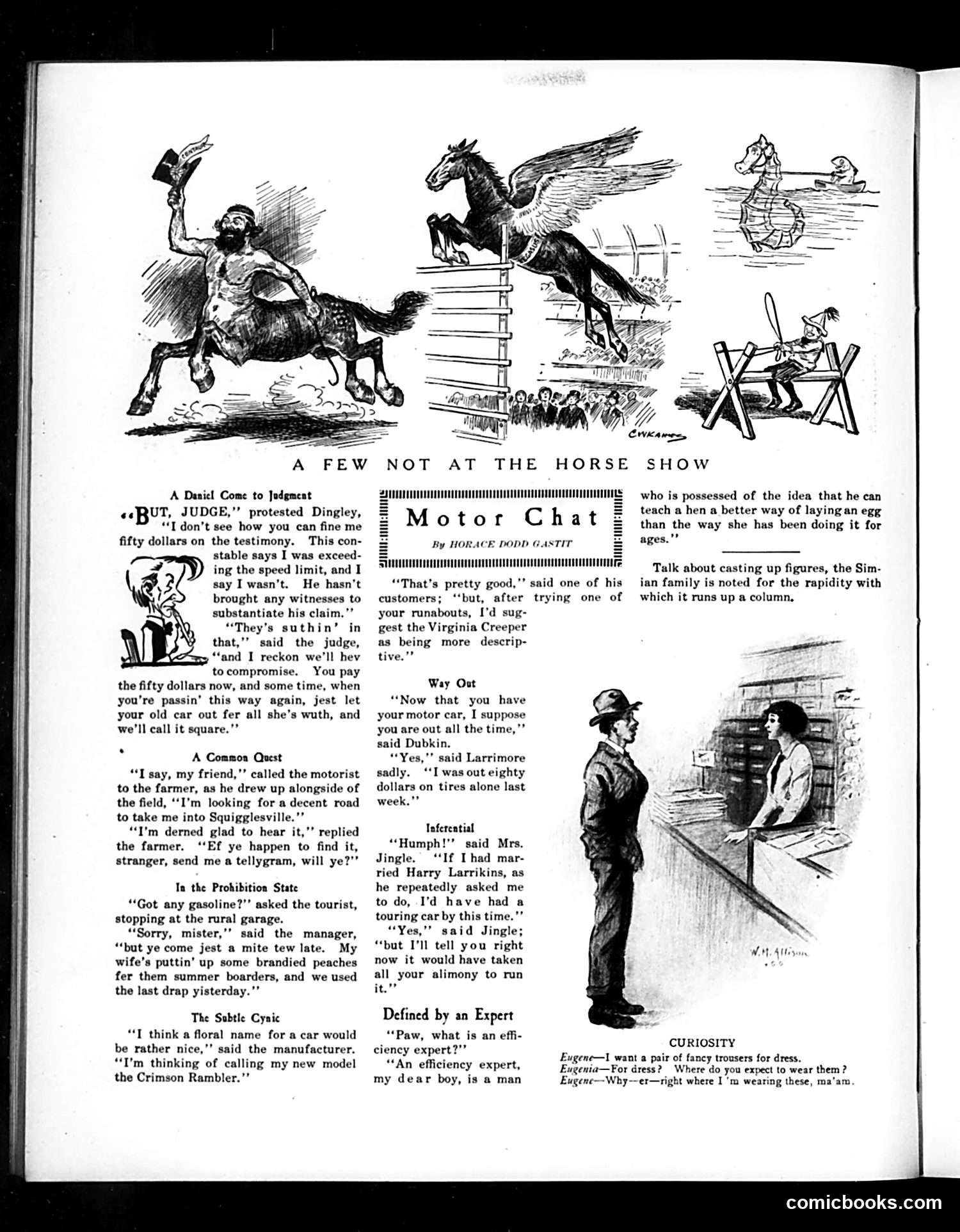
This page from *Judge* magazine contains several short humorous sketches satirizing early automobile culture (circa 1910s). Key themes: **Rural/Urban divide**: Sketches mock rural judges and farmers unfamiliar with cars—a corrupt judge offers to "square" a speeding fine if the motorist speeds again; a farmer has never seen a decent road; a garage manager used gasoline for canning peaches instead of selling it. **The "efficiency expert" joke** ridicules a trendy business concept of the era—consultants claiming to optimize everything, even nature itself (teaching hens to lay eggs differently). **"Motor Chat" section** contains puns about car names ("Virginia Creeper," "Crimson Rambler"—actual plant names), and expense jokes (a man spent eighty dollars on tires). **The cartoons at top** appear to depict circus or acrobatic acts—likely visual punchlines about horse shows versus modern motorized entertainment. The overall satire targets automobile adoption's disruption of traditional rural life and emerging consumer culture anxieties about unnecessary spending.
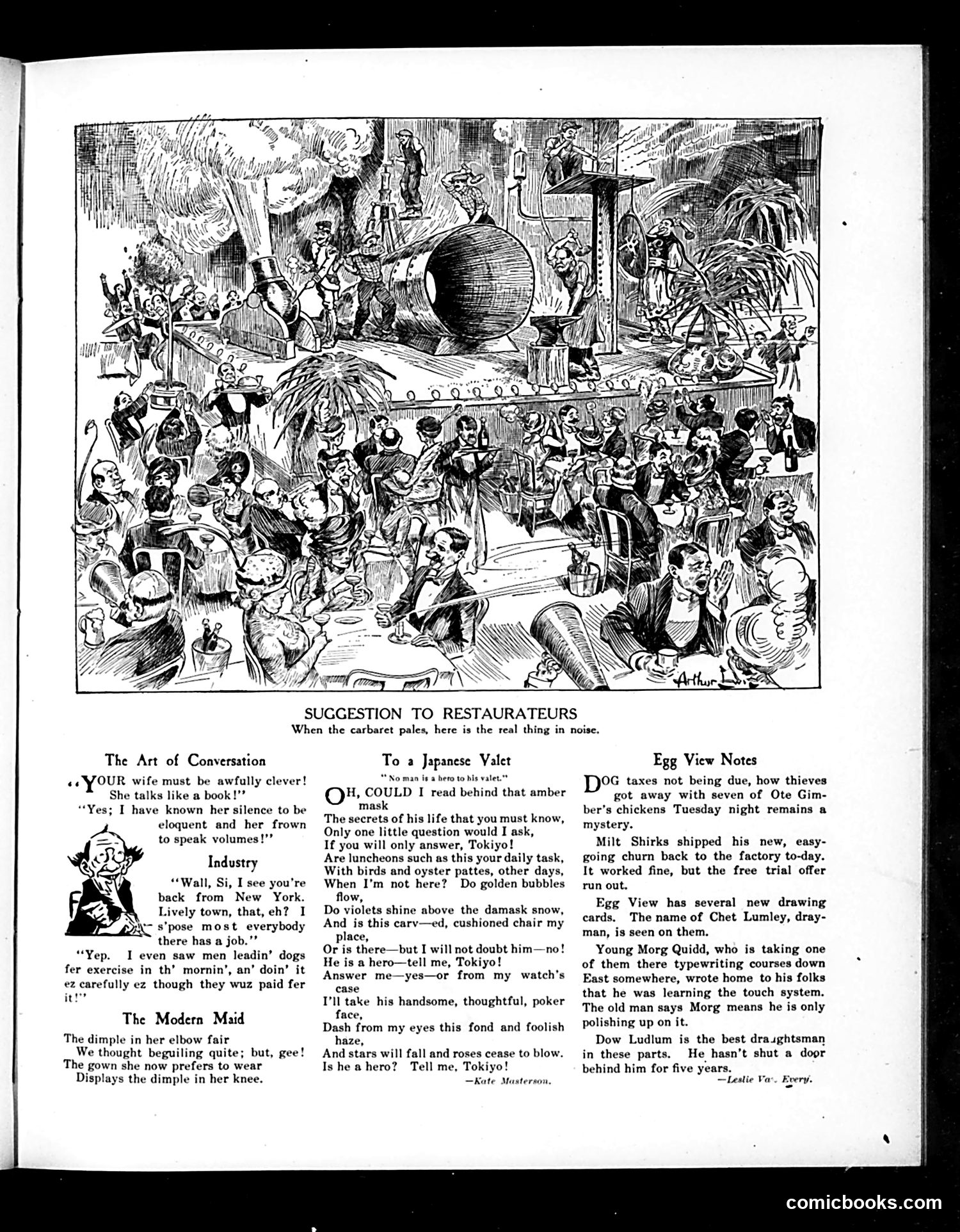
This Judge magazine page satirizes early 1900s American social life through humorous sketches and verse. The top illustration depicts a chaotic restaurant cabaret scene—the satire is that restaurateurs seeking "noise" and excitement should just seat talkative diners together instead. The text pieces mock contemporary manners and attitudes: "The Art of Conversation" jokes about wives who dominate talk; "Industry" satirizes New York's employment claims; "The Modern Maid" pokes fun at changing women's fashion (exposing the knee was scandalous); and "To a Japanese Valet" presents a woman questioning whether her lover is truly heroic or simply well-treated—a commentary on class, servant knowledge, and romantic delusion. "Egg View Notes" appears to be local gossip-style humor about small-town theft and mishaps. The overall tone reflects upper-middle-class preoccupations with propriety, modernization, and social climbing typical of early 20th-century American satire.
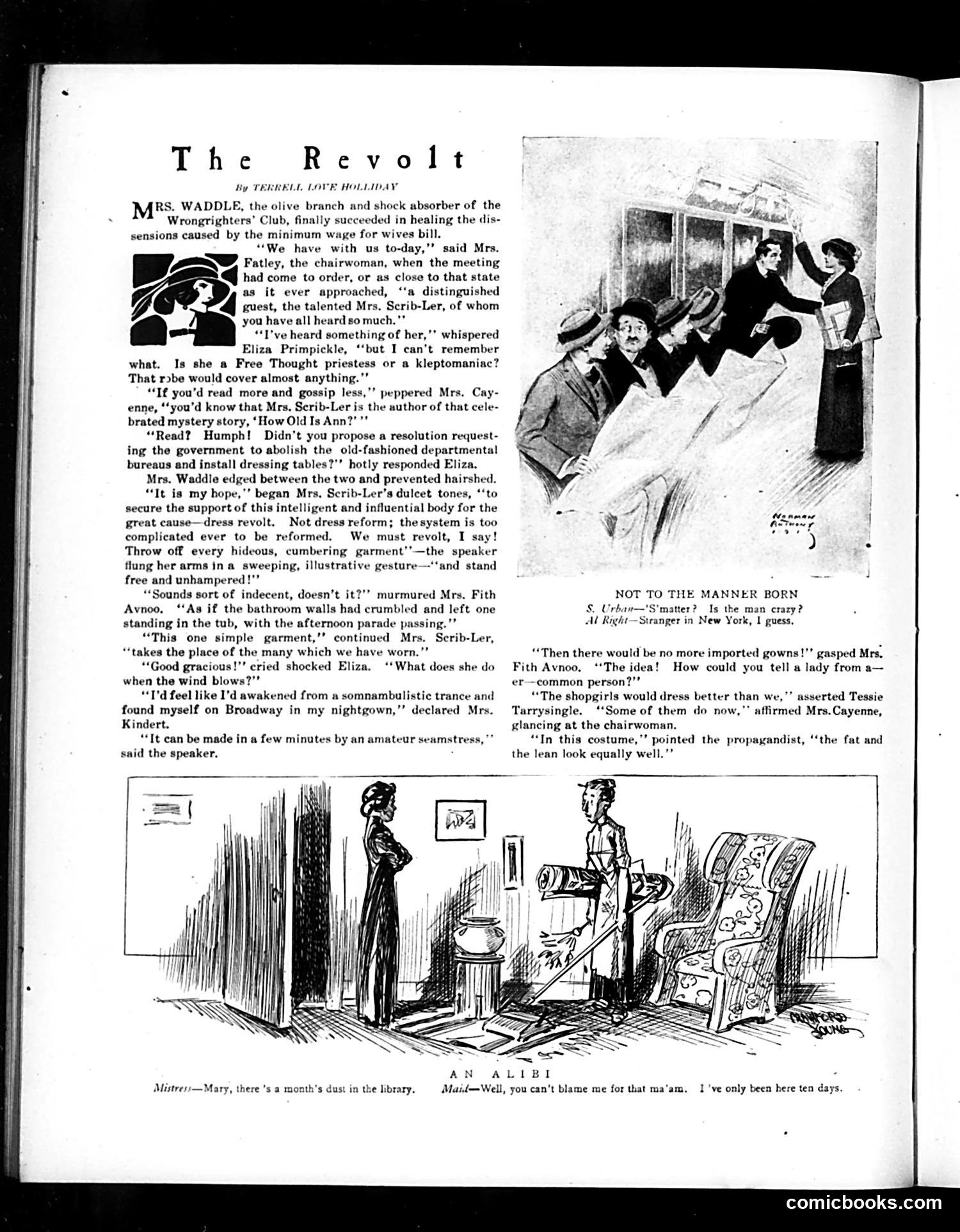
This satirical story mocks women's rights activists, specifically those advocating dress reform—a real early 20th-century movement promoting simpler, more practical clothing to replace restrictive corsets and elaborate layered garments. The "Wrongrighters' Club" discusses a speaker, Mrs. Scrib-Ler, who proposes a complete dress revolution: one simple garment replacing multiple pieces. The club members' shocked reactions reveal period anxieties: without ornate clothing, how would women signal social class? One character fears looking like she's in a nightgown on Broadway; another worries about being indistinguishable from working-class shopgirls. The cartoonist ridicules both the reformers' earnestness and the resisters' snobbery—their obsession with fashion as class marker and propriety. The bottom cartoon about a maid's alibi is a separate, unrelated joke.
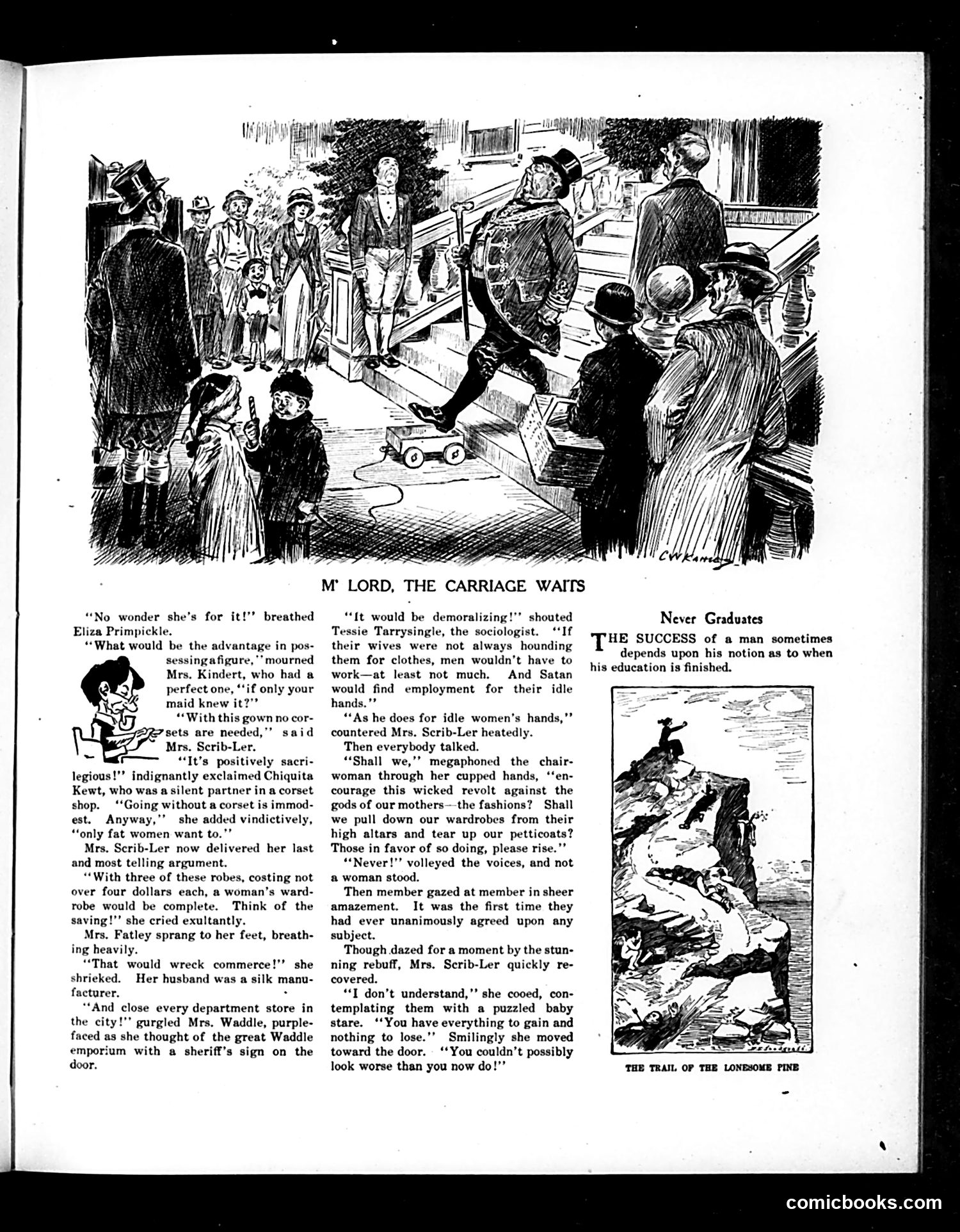
This Judge cartoon satirizes the hypocrisy of women claiming to oppose frivolous fashion while protecting their economic interests. Mrs. Scrib-Ler proposes affordable, practical three-dollar dresses requiring no corsets—a radical reformist idea. Various women object on moral grounds (corsets equal modesty), while others reveal the true motive: Mrs. Fatley's husband manufactures silk; Mrs. Waddle owns a department store. Both fear economic collapse. Even socialist Tessie Tarrysingle invokes pseudo-intellectual arguments about keeping men industrious through constant clothing demands. When asked to vote for reform, unanimously they refuse—exposing that their opposition stems entirely from financial self-preservation, not principle. Mrs. Scrib-Ler's parting jab ("You couldn't possibly look worse than you now do!") drives home the satire: women prioritize consumption and status over genuine improvement. The cartoon mocks both female consumerism and the rationalization of frivolous spending.
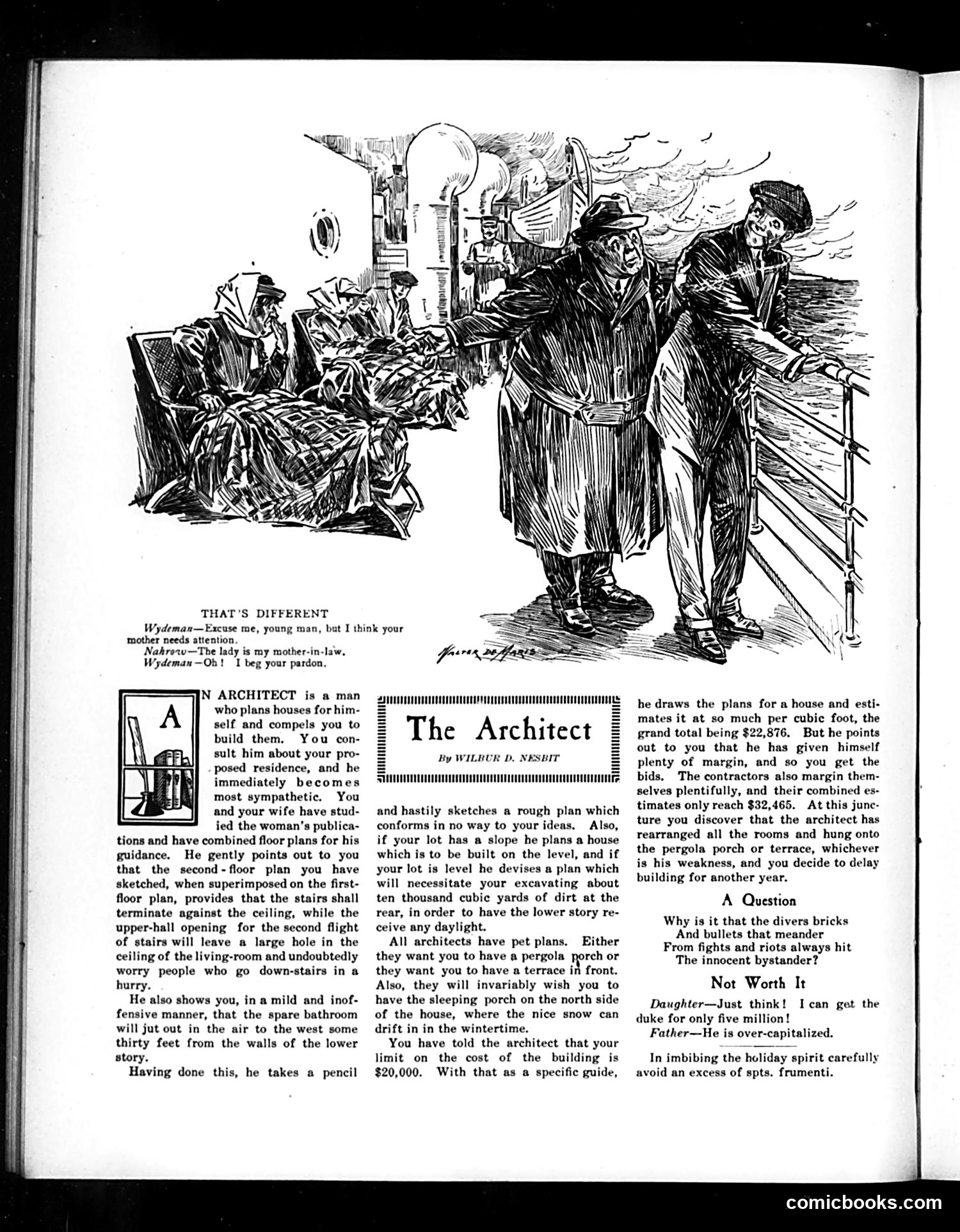
The top cartoon mocks social class attitudes: a man introduces his companion to a woman, and when told she's his mother-in-law rather than his mother, the first man immediately apologizes—implying mothers deserve respect while mothers-in-law do not. It's a joke about common family hierarchy prejudices of the era. The main article by Wilbur D. Nesbit satirizes architects as impractical visionaries who ignore clients' actual needs and budgets. The satire describes how architects listen sympathetically to homeowners' ideas, then disregard them entirely, imposing pet design features (pergolas, terraces, north-facing porches) regardless of practicality. They also systematically underestimate costs—quoting $22,876 when the budget is $20,000, then contractors' bids reach $32,465, forcing homeowners to postpone building. The piece mocks architects' disconnect between promises and reality.
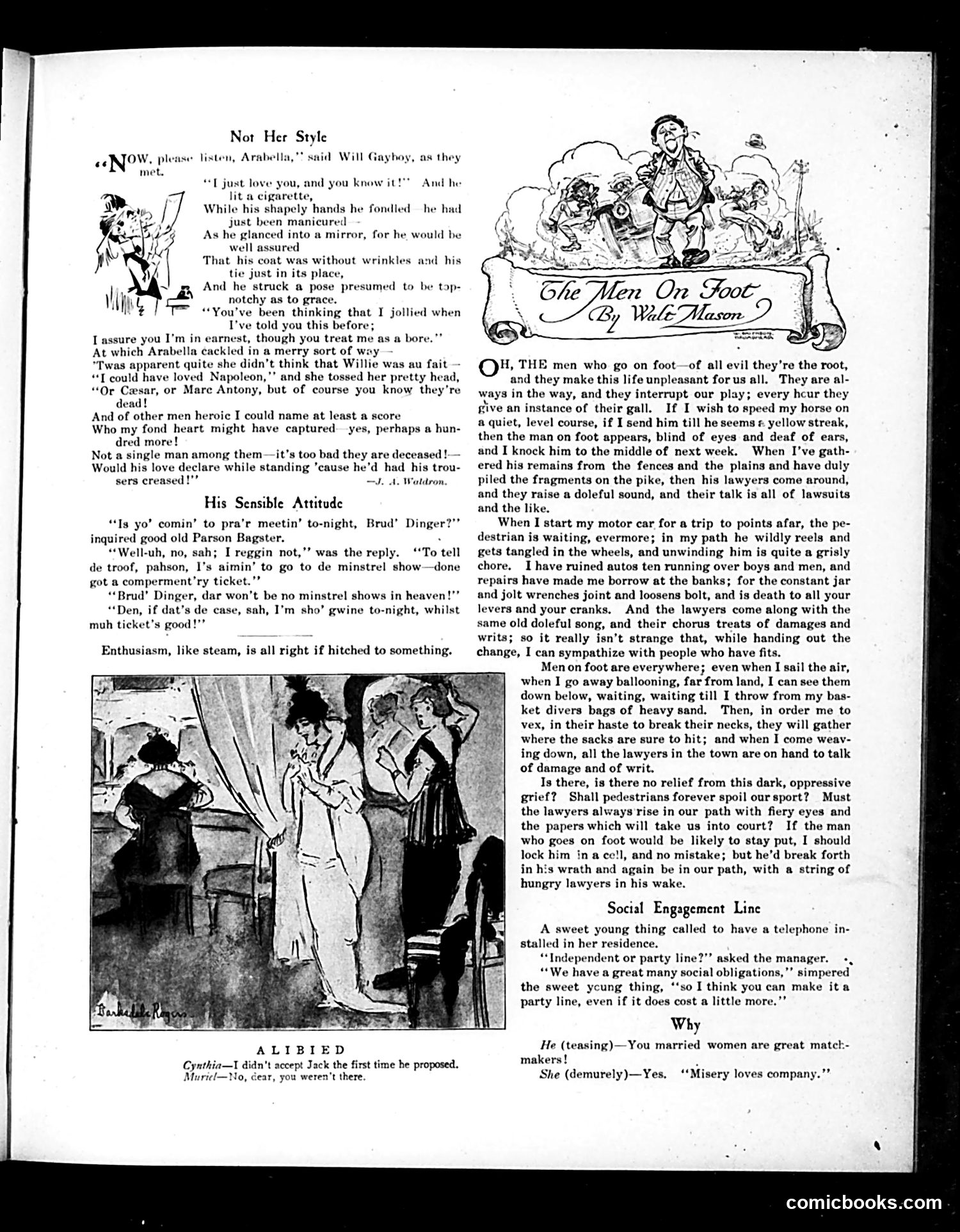
This page contains three satirical pieces from *Judge* magazine: **"Not Her Style"** mocks an excessively vain suitor named Willie Gayhoy who constantly admires his manicured hands, wrinkle-free coat, and perfectly positioned tie while declaring his love. Arabella rejects him by noting she could have loved historical military heroes like Napoleon or Caesar—but certainly not a man worried about having his trousers creased. The satire targets fin-de-siècle male vanity and the emerging "dandy" aesthetic. **"His Sensible Attitude"** is a dialect humor piece where a Black man chooses attending a minstrel show over prayer meeting, joking he'll attend church tonight to use his free ticket since "there won't be no minstrel shows in heaven." This relies on period racial stereotypes common in *Judge*. **"The Men on Foot"** (by Walt Mason) is a motorist's complaint about pedestrians constantly interfering with automobiles, presented as an absurdist grievance. It satirizes early automobile culture's contempt for foot traffic and the litigation that followed traffic accidents—a genuinely modern problem of the era.
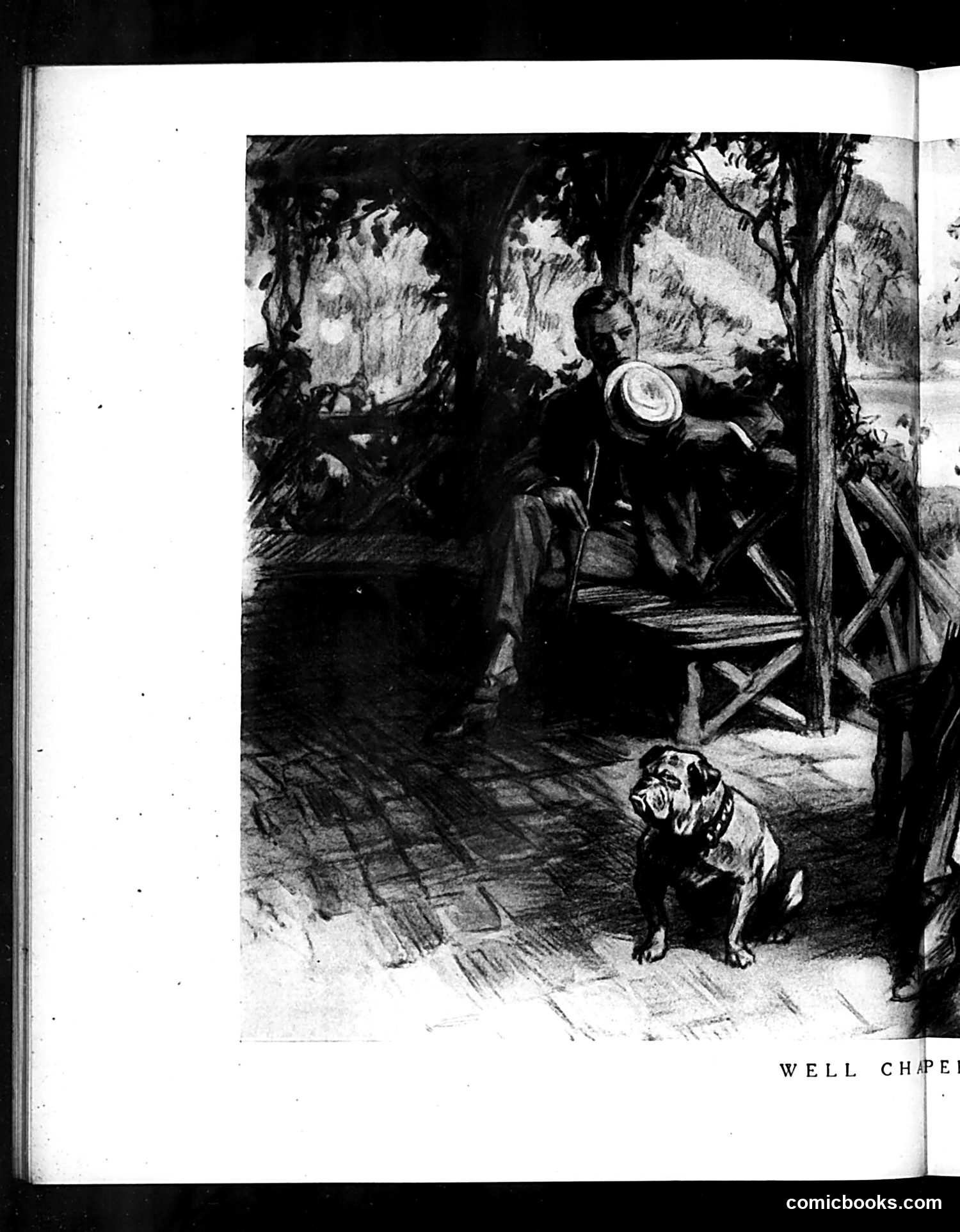
This page shows a black and white illustration from *Judge* magazine titled "Well Chapel" (the OCR is incomplete). The scene depicts people gathered in a shaded outdoor setting beneath trees, with a dog in the foreground. The composition suggests a casual social gathering or picnic scene. Without complete caption text visible, the specific satirical point is unclear. However, given *Judge*'s style, this likely mocks contemporary social customs, leisure activities, or public behavior. The dog's presence might add comedic commentary on human conduct. The formal dress visible suggests commentary on class or social pretension during supposedly relaxed gatherings. The full caption and context would clarify the intended satire.
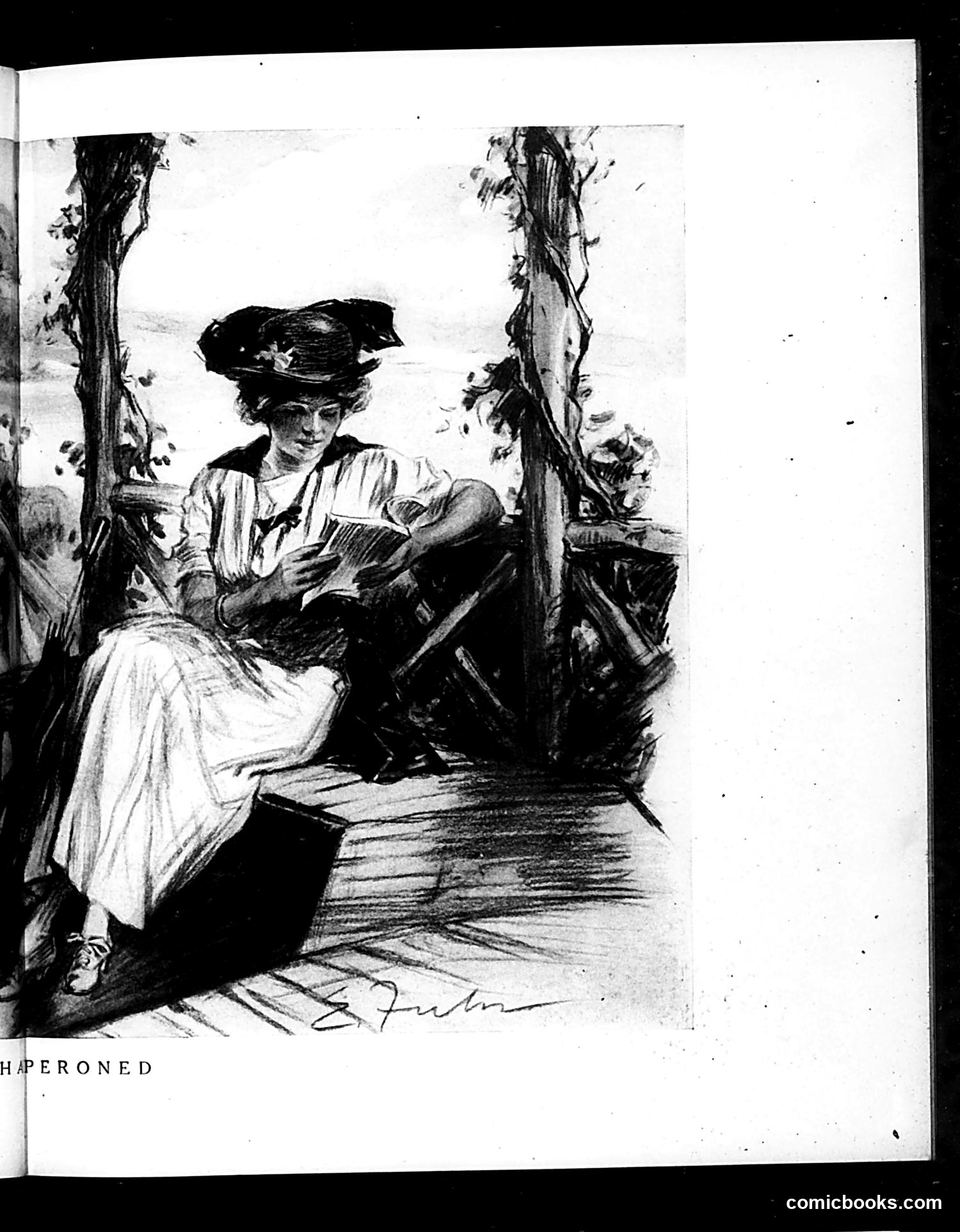
This appears to be a sketch titled "HIPERONED" (possibly "CHAPERONED," though the OCR is unclear). The image shows a woman in Edwardian-era dress sitting on what looks like a bench or seat outdoors, reading. She's wearing a large hat typical of the early 1900s, and ivy-covered posts frame the scene on either side. The satire likely comments on courtship customs of the era—specifically the practice of chaperoning unmarried women. The woman appears to be reading while chaperoned, suggesting commentary on restrictive social conventions that governed women's behavior and leisure activities during the period. The signature on the sketch is present but not clearly legible in this reproduction. Without the full magazine context or clearer text, the precise satirical point remains somewhat unclear.
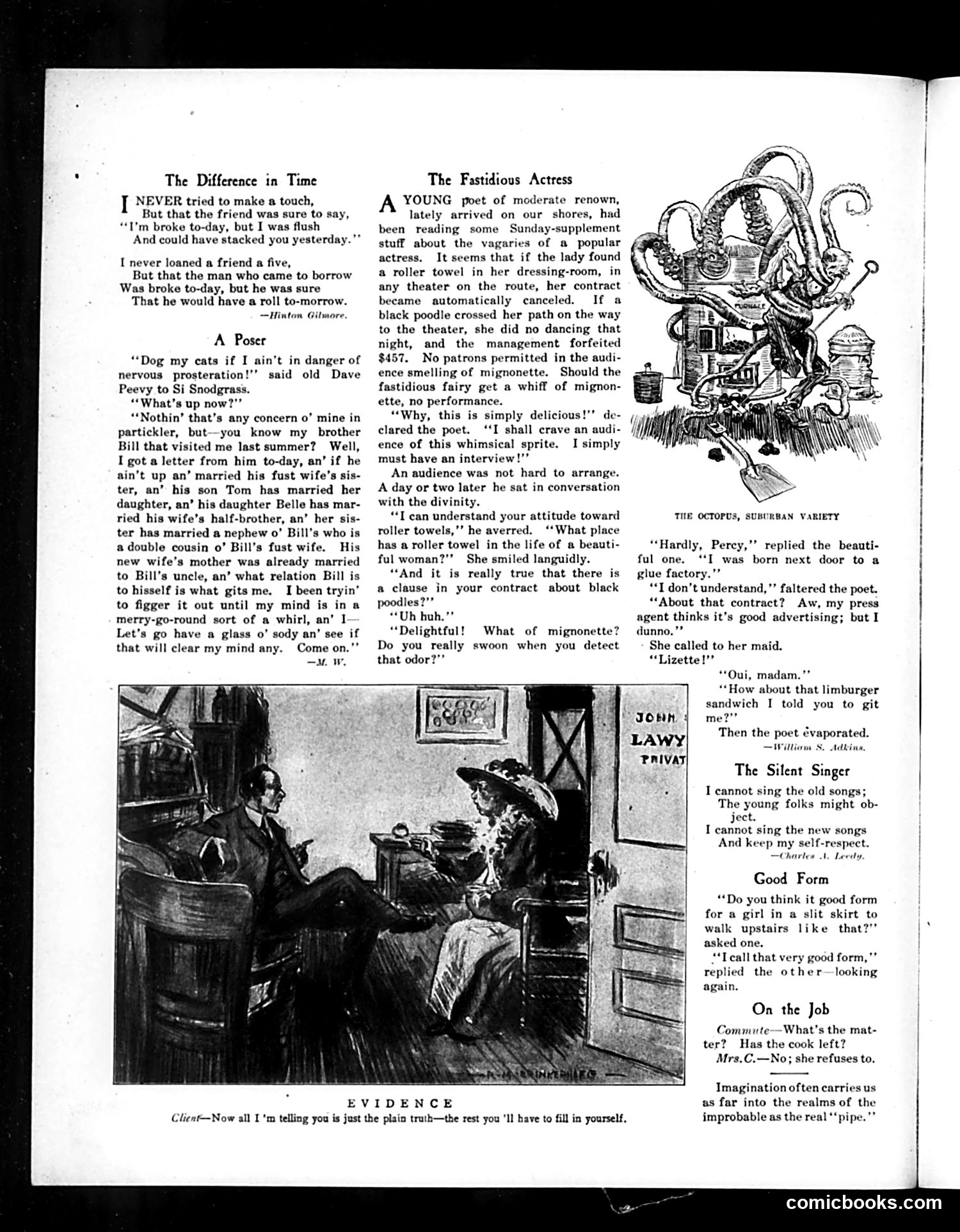
This page contains several humorous short pieces satirizing American social pretensions and absurdities circa early 20th century. **"The Fastidious Actress"** mocks theatrical diva behavior. A young poet seeks an interview with a famous actress known for extravagant superstitions—canceling performances over roller towels, black poodles, and the scent of mignonette. When he finally meets her, she deflates his romantic expectations by casually revealing she was born next door to a glue factory, and that her notorious "requirements" are merely her press agent's fabrications for publicity. The punch line: she's eating limburger (notoriously foul-smelling) cheese, driving him away—an ironic reversal of her supposed delicacy. **"The Poser"** satirizes tangled family relationships resulting from remarriage among poor/working-class relatives, where determining actual kinship becomes mathematically impossible. Other brief pieces mock workplace dynamics, propriety concerns about women's clothing, and the gap between truth and embellished storytelling. The satire targets celebrity mythology, cheap sensationalism, and social pretense generally.
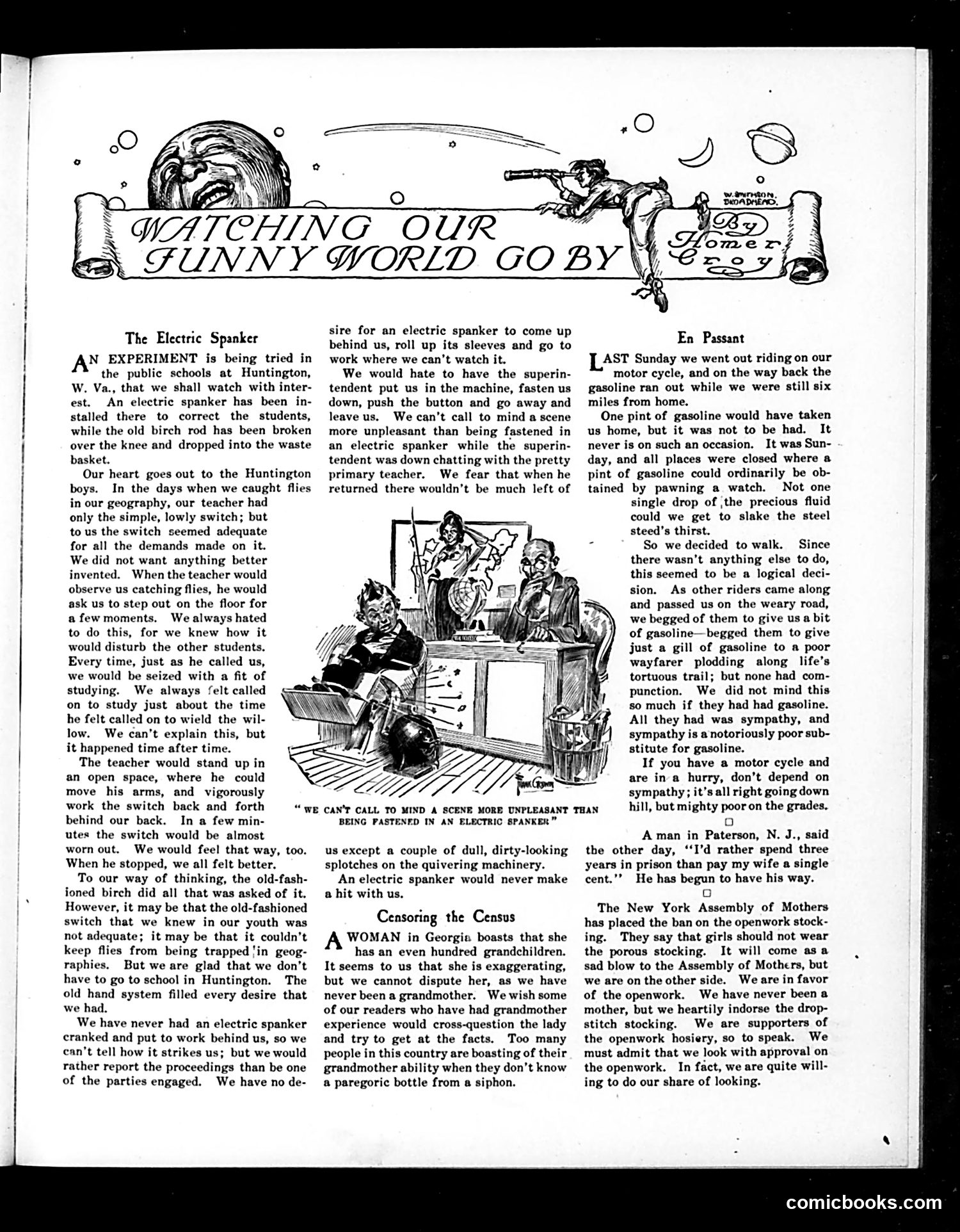
This page from Judge magazine contains three satirical pieces mocking American institutions and attitudes circa early 20th century. **"The Electric Spanker"** ridicules the adoption of mechanical punishment devices in schools. Huntington, West Virginia had installed an "electric spanker" to replace traditional corporal punishment (birch rods and switches). The author humorously expresses nostalgia for old-fashioned whipping while feigning horror at mechanized punishment—the real joke being that both systems are absurd. The satire critiques progressive educational "improvements" that are merely replacing one barbaric practice with another. **"Censoring the Census"** mocks exaggerated boasting, particularly a Georgian woman claiming 100 grandchildren. Judge sarcastically suggests readers fact-check her claim, implying widespread dishonesty about personal achievements. **"En Passant"** humorously describes running out of gasoline on a Sunday motorcycle ride when all gas stations were closed—a complaint about commercial inconvenience and poor planning. Overall, the page satirizes American social progress, education, commerce, and personal vanity through lighthearted mockery.
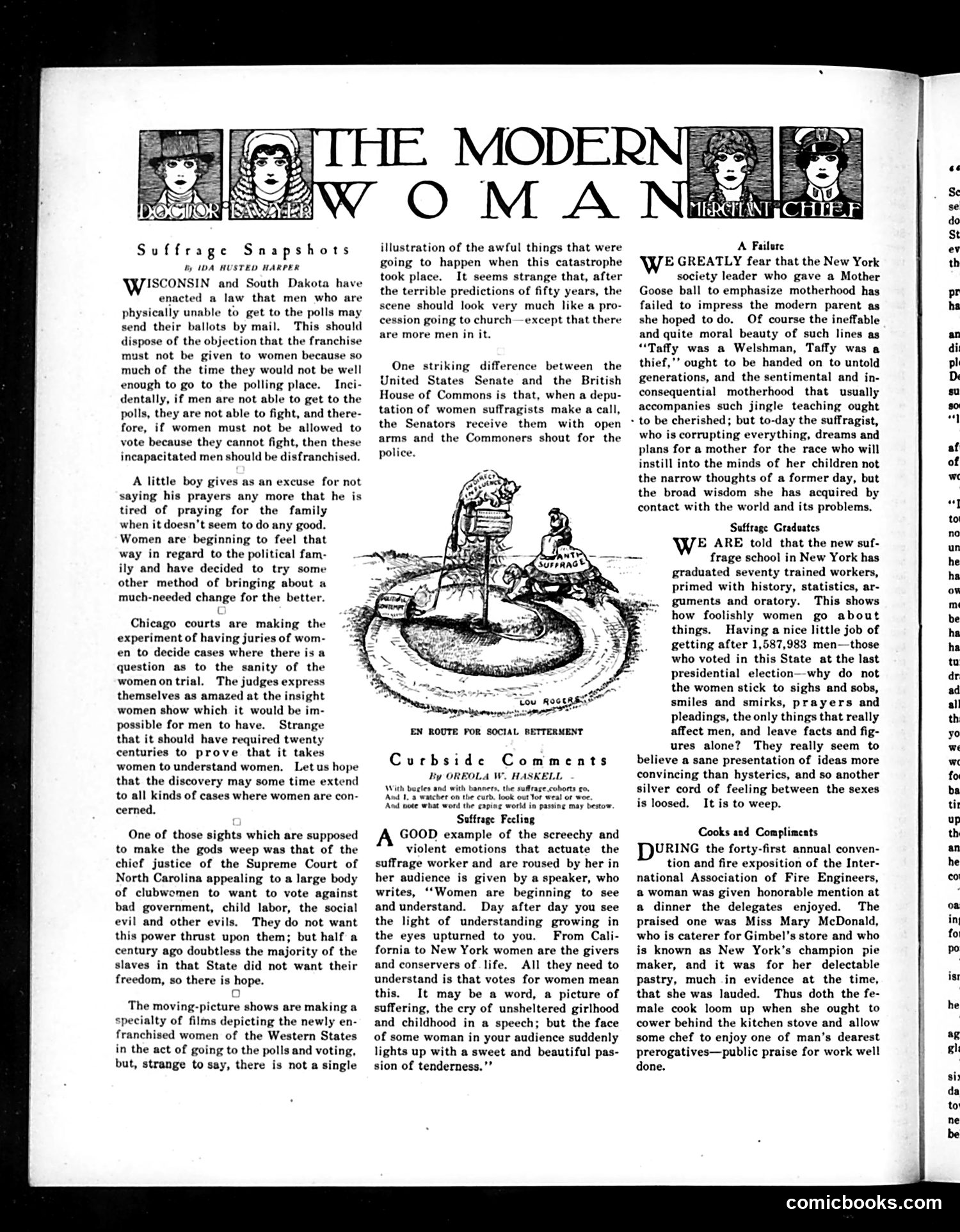
This page satirizes the women's suffrage movement of the early 20th century. The main cartoon depicts suffragists marching "en route for social betterment"—a procession the caption mockingly compares to a church service. The accompanying text by Ida Husted Harper argues *for* women's voting rights, using logical arguments: if men can vote by mail when unable to reach polls, the physical weakness objection to female suffrage collapses. She also notes that women jurors demonstrate superior judgment in cases involving women. The satire cuts both ways: while Harper's piece defends suffrage, other sections mock suffragists' emotional appeals and romanticized rhetoric about "the light of understanding" in women's eyes—suggesting overwrought sentimentality. The cartoon itself appears gently mocking, presenting the suffrage march as mundane rather than the social catastrophe opponents had predicted, with the dry observation that "there are more men in it."
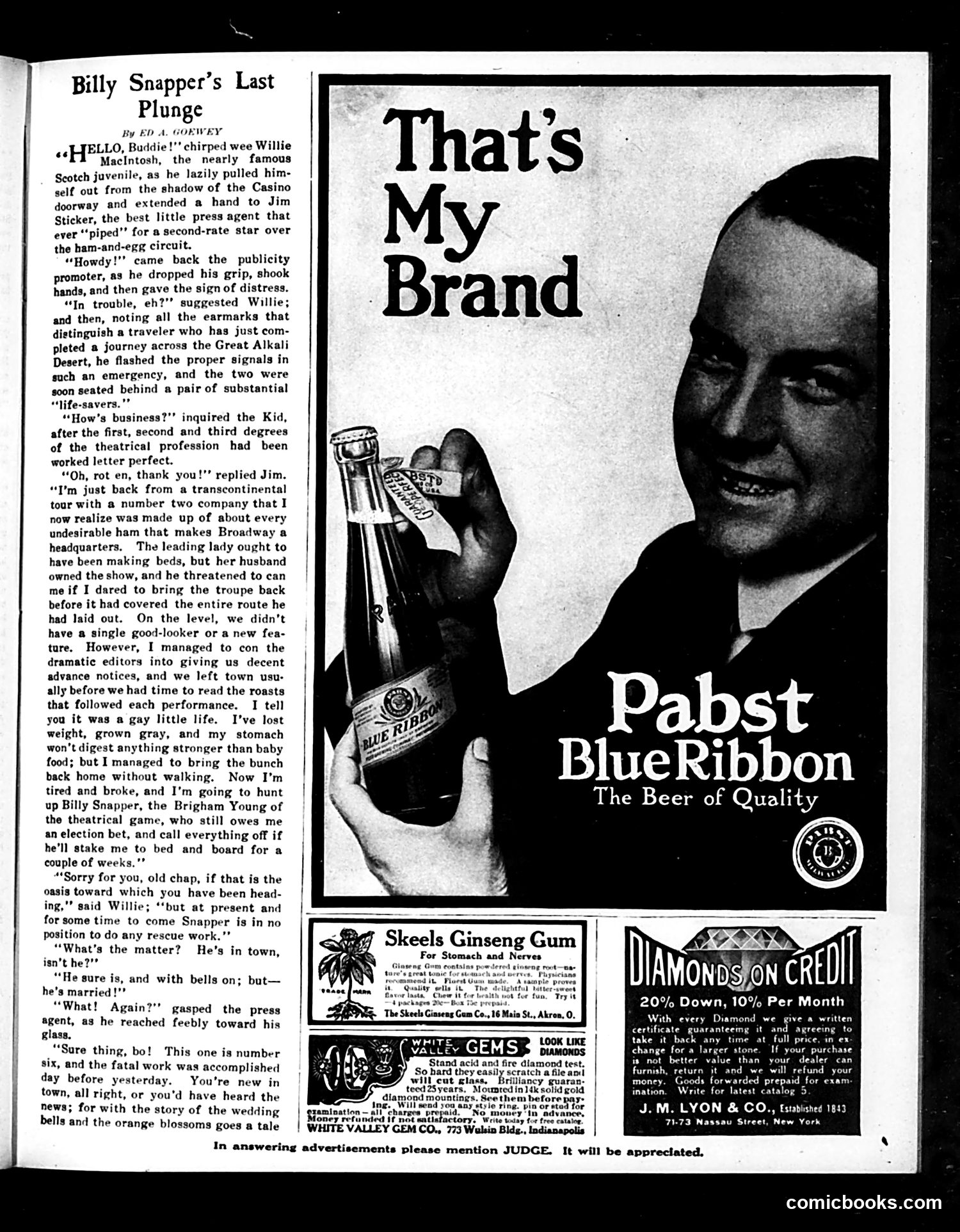
This page presents a short story by Ed A. Gorwey about theatrical life in early 20th-century America. Two men—Willie MacIntosh (a famous child actor) and Jim Sticker (a press agent)—meet and discuss the theater circuit's hardships. Jim describes managing a failing touring company with untalented performers, fabricating positive reviews to escape towns before negative ones appeared, and exhausting himself for meager pay. The story's apparent "point" involves Billy Snapper, a character who apparently makes serial marriages his business model—this is joke #6. The surrounding advertisements (Pabst Blue Ribbon beer, diamond rings, ginseng gum) are period typical. The satire targets theater's lower echelons: struggling press agents, mediocre performers, and the desperation of touring productions—suggesting the theatrical profession, despite glamorous mythology, often involved financial instability and moral compromises. Willie and Jim's relief-seeking through alcohol reflects this world's stresses.
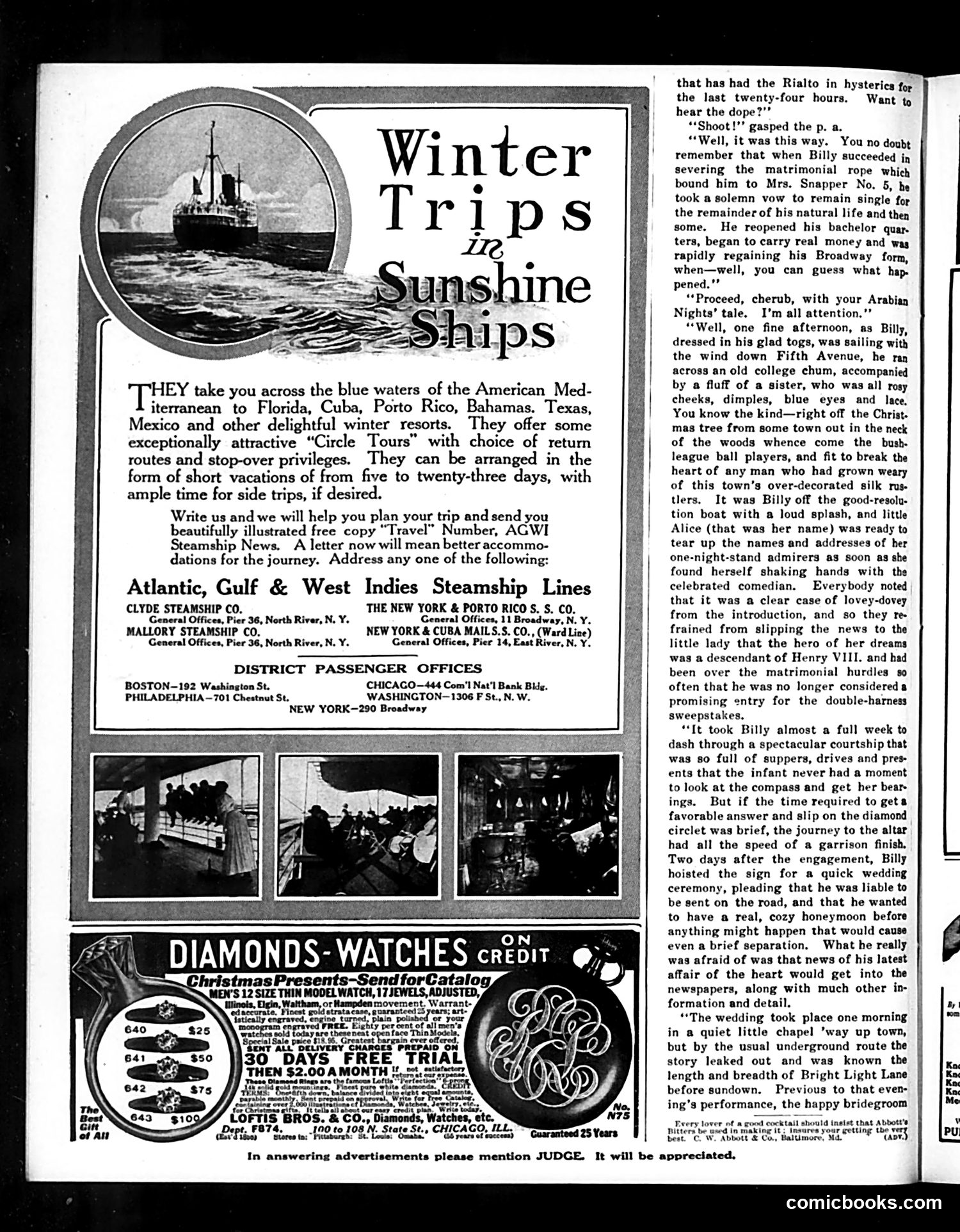
This page is primarily **advertising and serialized fiction**, not political satire. The upper half features a travel advertisement for steamship lines offering winter Caribbean cruises—a commercial pitch for vacation packages to Florida, Cuba, Puerto Rico, and Mexico. The right column contains a serialized romantic comedy story about a character named "Billy," a Broadway performer and serial divorcee ("Mrs. Snapper No. 5") who has sworn off marriage. He meets an innocent young woman from out of town and rapidly courts and engages her within days. The humor derives from the contrast between Billy's jaded, urbane character and the naive "Alice's" romantic expectations, with knowing observers amused that she doesn't realize she's marrying a notorious repeat bridegroom. This is light entertainment fiction typical of Judge's content—comedic rather than satirical of any particular political issue or current event.
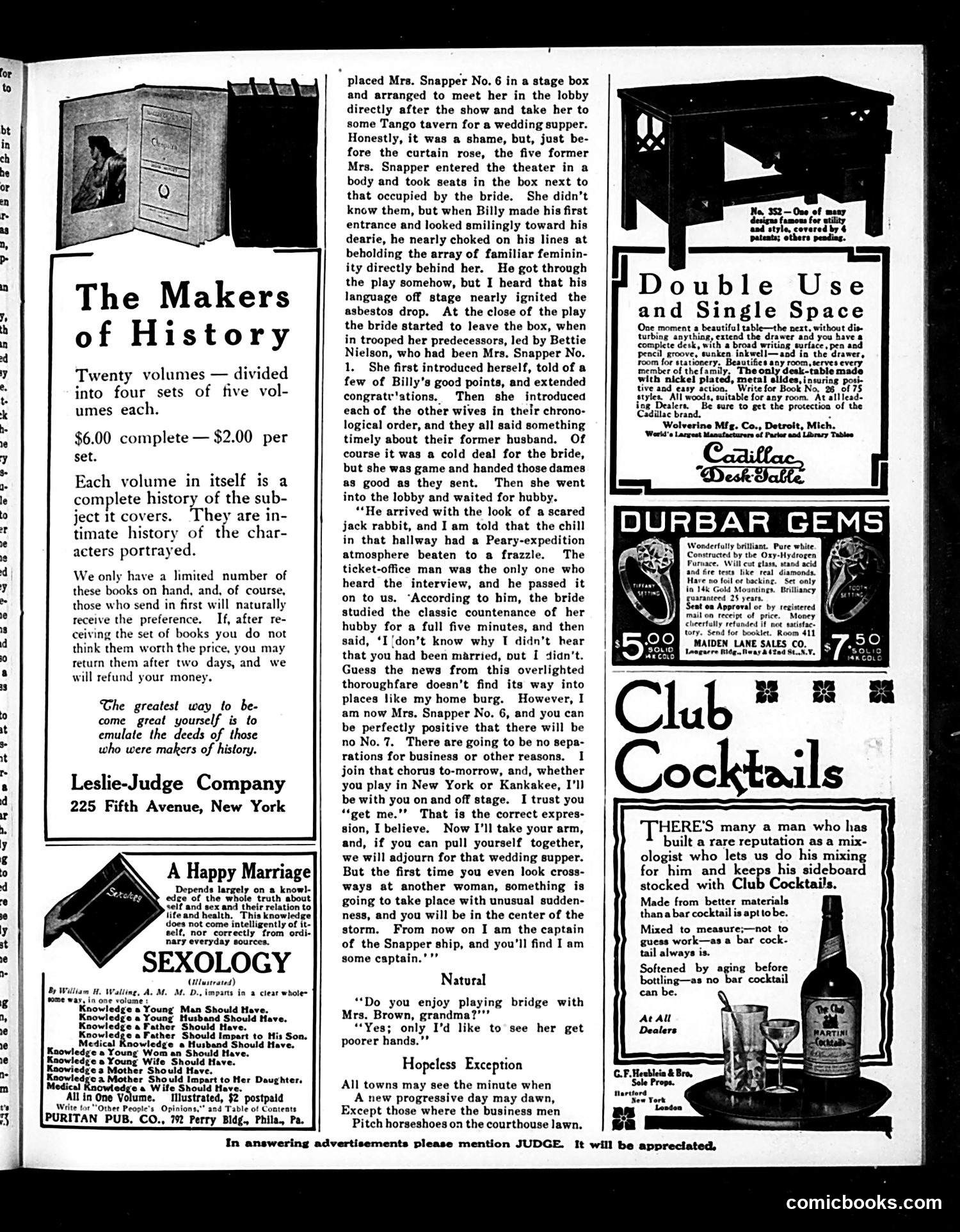
This page primarily contains **advertisements and a humorous anecdote** rather than a political cartoon. The main story mocks a man named Billy who has been married five times. His current bride (Wife No. 6) attends their wedding-night theater performance, only to be confronted by his five ex-wives sitting nearby in the audience. After the show, the ex-wives introduce themselves to the new bride in chronological order—a deliberately awkward social humiliation. The satire targets **serial marriage and male infidelity**. When the bride confronts Billy afterward, she delivers a sharp ultimatum: she will follow him everywhere (New York or Kansas) and there will be no divorce or separation. She essentially forces him into fidelity through constant surveillance and companionship. The joke exposes the social absurdity of repeated marriages and suggests that a woman's best recourse against a philandering husband is relentless vigilance and control rather than legal protection—a comment on women's limited options in marriage at the time.
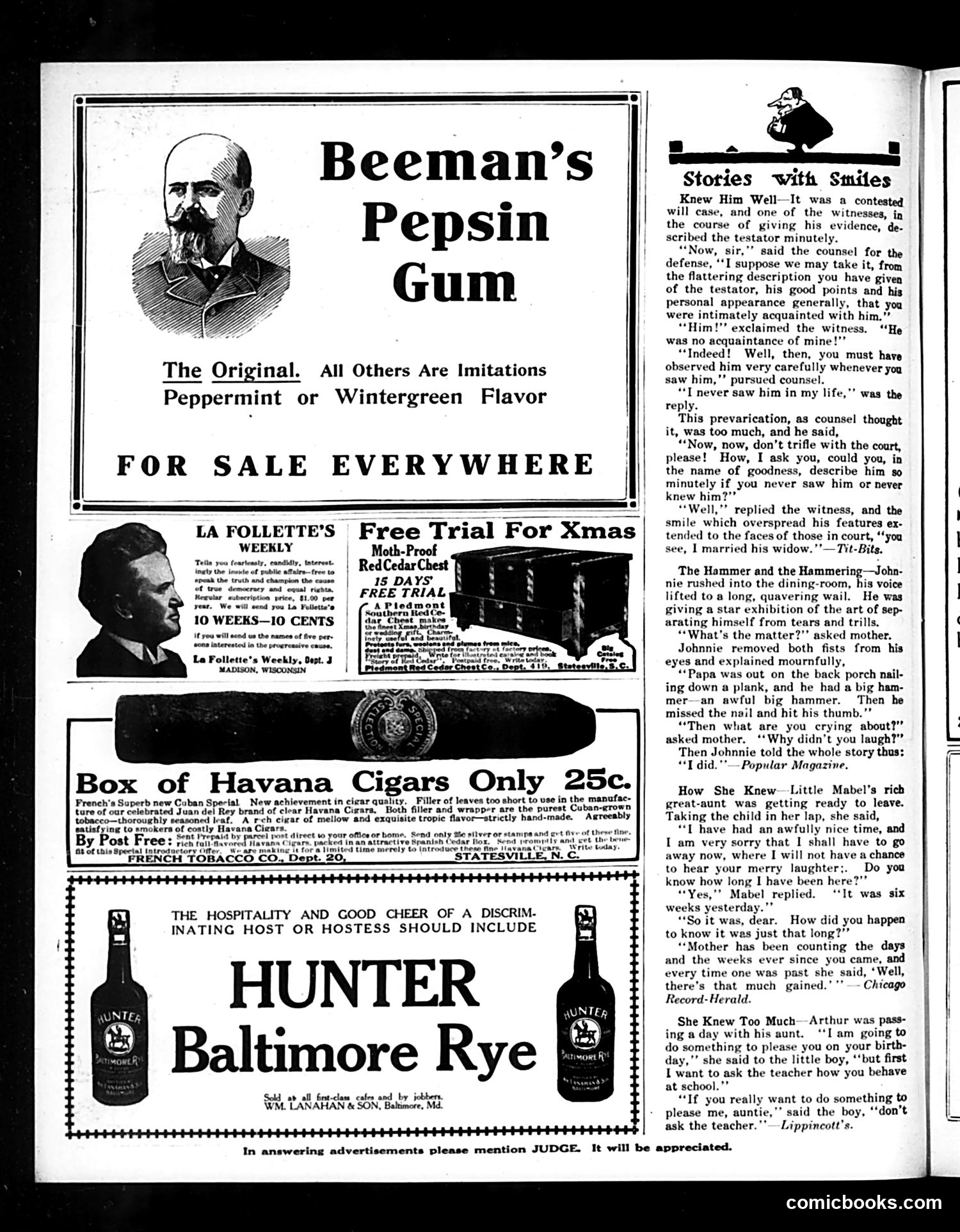
This page is primarily **advertisements** with a sidebar of short humorous anecdotes ("Stories with Smiles"). The main advertisements include Beeman's Pepsin Gum (claiming to be "the original"), La Follette's Weekly magazine, Havana cigars, and Hunter Baltimore Rye whiskey. The Beeman's ad features a bearded man's portrait. The humorous stories are brief jokes about everyday situations: a courtroom witness who knew the testator only through marrying his widow; a child crying after his father hits his thumb with a hammer; a child's aunt surprised that six weeks have passed during her visit; and a boy worried his teacher will report his misbehavior. These are gentle, domestic humor pieces typical of early 20th-century magazines—none contain significant political satire. The page reflects period advertising practices and middle-class American concerns rather than substantive commentary.
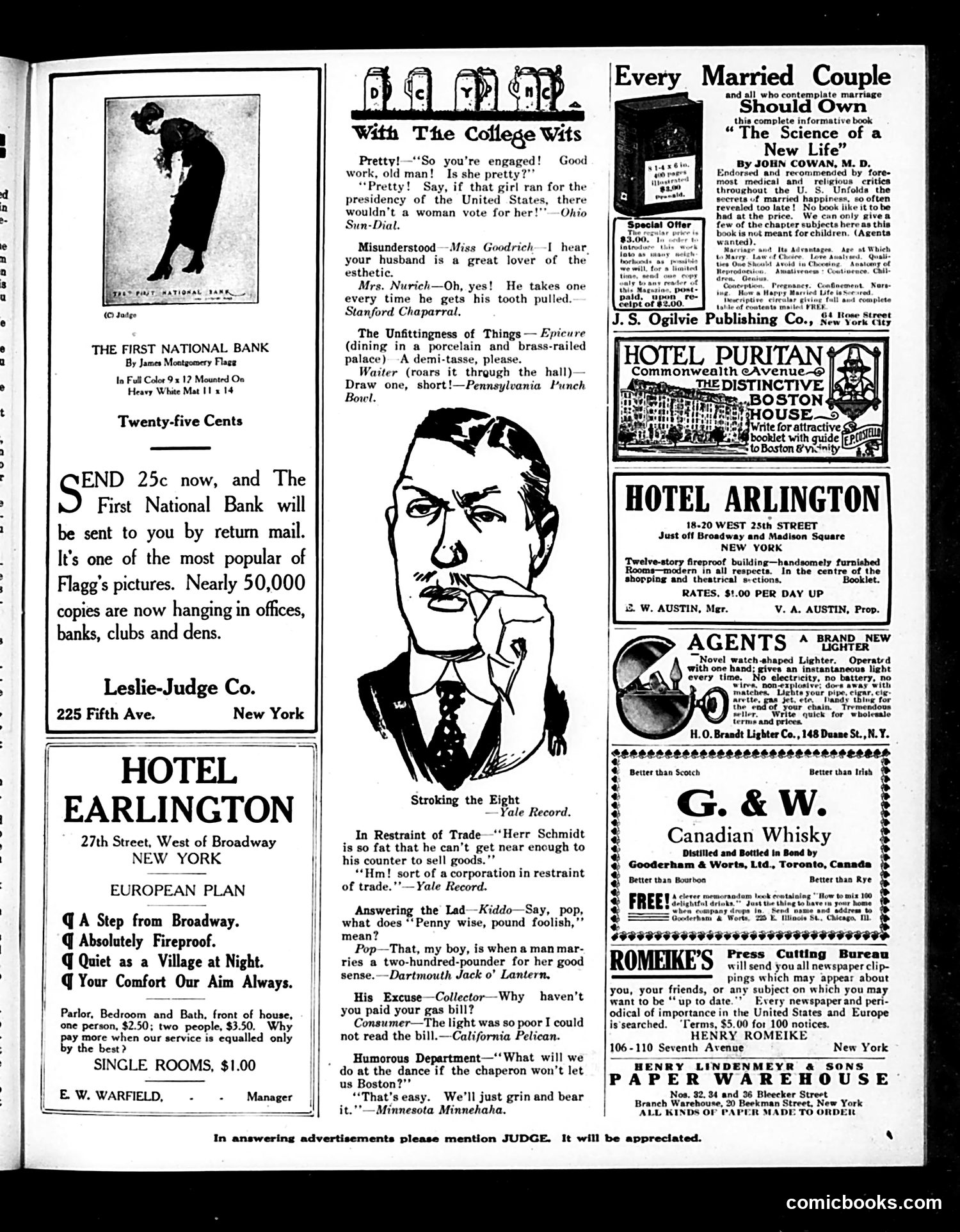
This is primarily a **humor and advertising page** from Judge magazine. The page contains several brief satirical jokes rather than a single focused political cartoon. The main visual element—a caricatured man with a mustache captioned "Stroking the Eight"—appears to be a Yale Record reference, likely depicting someone in a rowing context or making an expression. The humor is situational rather than politically charged. The jokes mock everyday social situations: a woman so unattractive she'd lose a presidential vote, men preferring aesthetics to dental pain, overeating, business inefficiency, and courtship. One prominent joke mocks the phrase "penny wise, pound foolish" by claiming it describes marrying a heavy woman. **Context for moderns:** These are gentle, misogynistic observations typical of 1910s college humor—mocking women's appearance and intelligence while depicting men as bumbling. The advertising (hotels, whisky, paper warehouses) reflects period leisure and business culture.
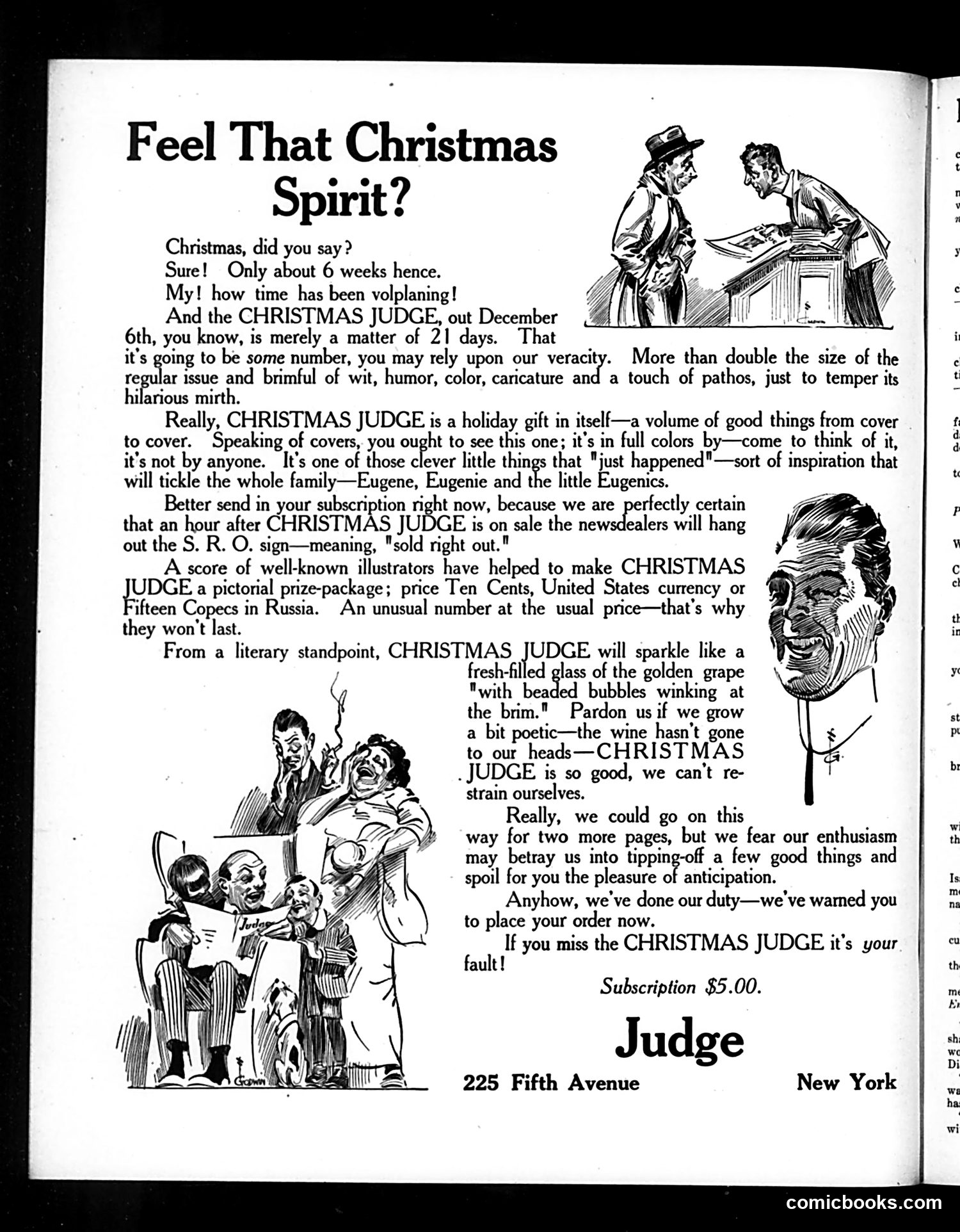
This is primarily a **subscription advertisement** for Judge magazine's special Christmas issue (dated December 6th), not a political cartoon. The page uses humorous promotional copy to sell subscriptions. The text employs self-aggrandizing satire typical of Judge's house style: it boasts the Christmas issue will be "more than double the size" and promises it will sell out immediately ("S.R.O. sign"). The reference to "Eugene, Eugenie and the little Eugenics" appears to be a playful family name pun, possibly alluding to early 20th-century eugenics debates, though this remains unclear. The accompanying illustrations show cartoonish figures in Judge's typical style—exaggerated facial features and caricature work—but serve mainly as decorative support for the ad copy rather than carrying specific political commentary. The subscription price of $5.00 and mention of "Fifteen Copecs in Russia" suggest this is an early 20th-century publication. The overall tone is lighthearted salesmanship rather than satirical commentary on current events.
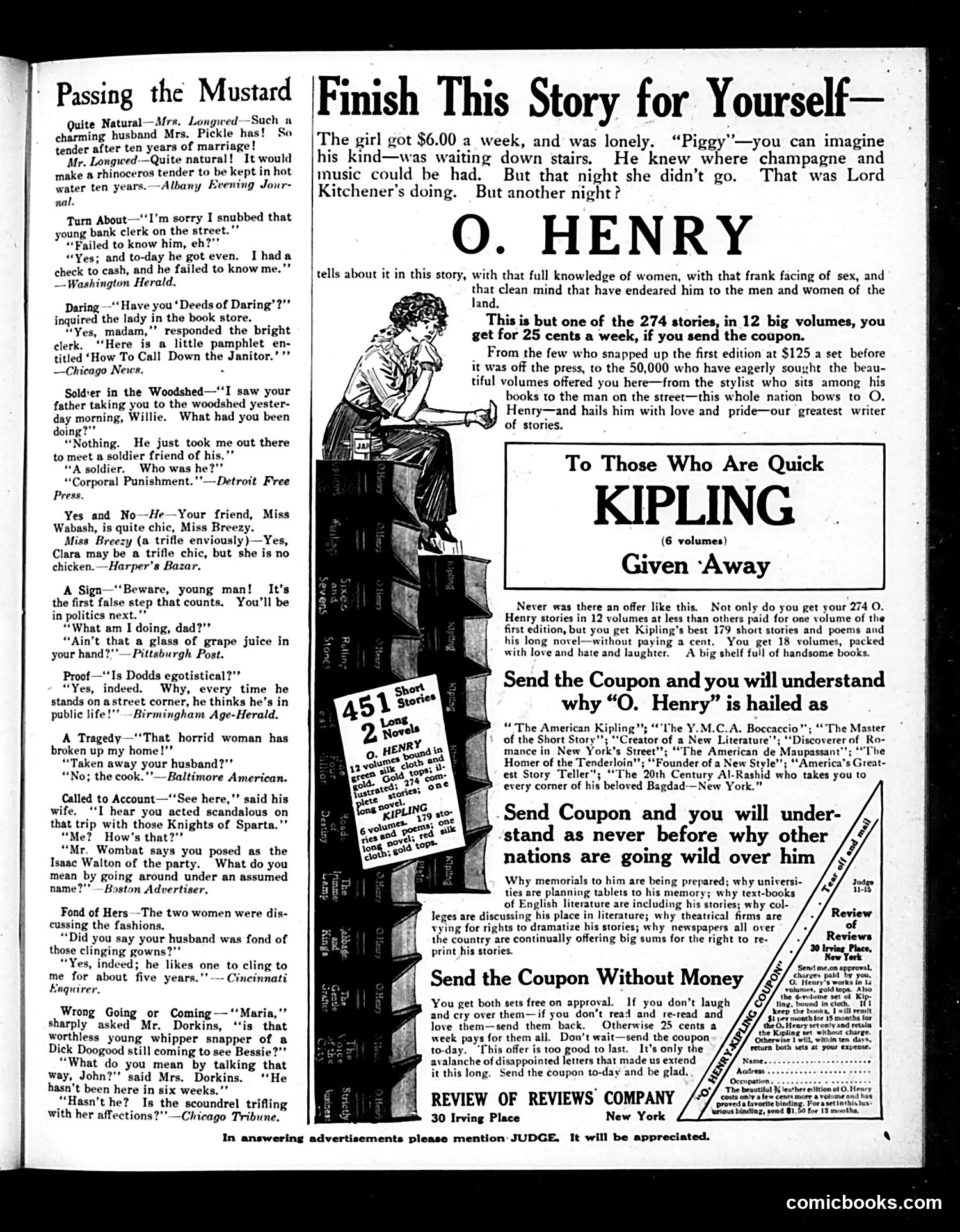
This page is primarily **advertising**, not political satire. The top section contains brief humorous anecdotes (typical Judge magazine filler), but the dominant content promotes discounted book collections. The main advertisement markets O. Henry's 274 stories in 12 volumes for 25 cents weekly—positioning him as "our greatest writer of stories" with universal appeal. A secondary offer gives away Kipling's 6-volume collection. The marketing emphasizes accessibility: these expensive first editions ($125) are now available to ordinary readers, from "the stylist" to "the man on the street." The "Finish This Story for Yourself" section teases an O. Henry tale about a lonely working girl earning $6/week, tempted by a gentleman offering champagne and music—suggesting O. Henry's sophisticated treatment of class and morality that made him popular. The satire here is commercial rather than political: the page celebrates mass-market democratization of "high" literature while the brief jokes above mock middle-class pretension and marital dynamics typical of early 20th-century humor magazines.
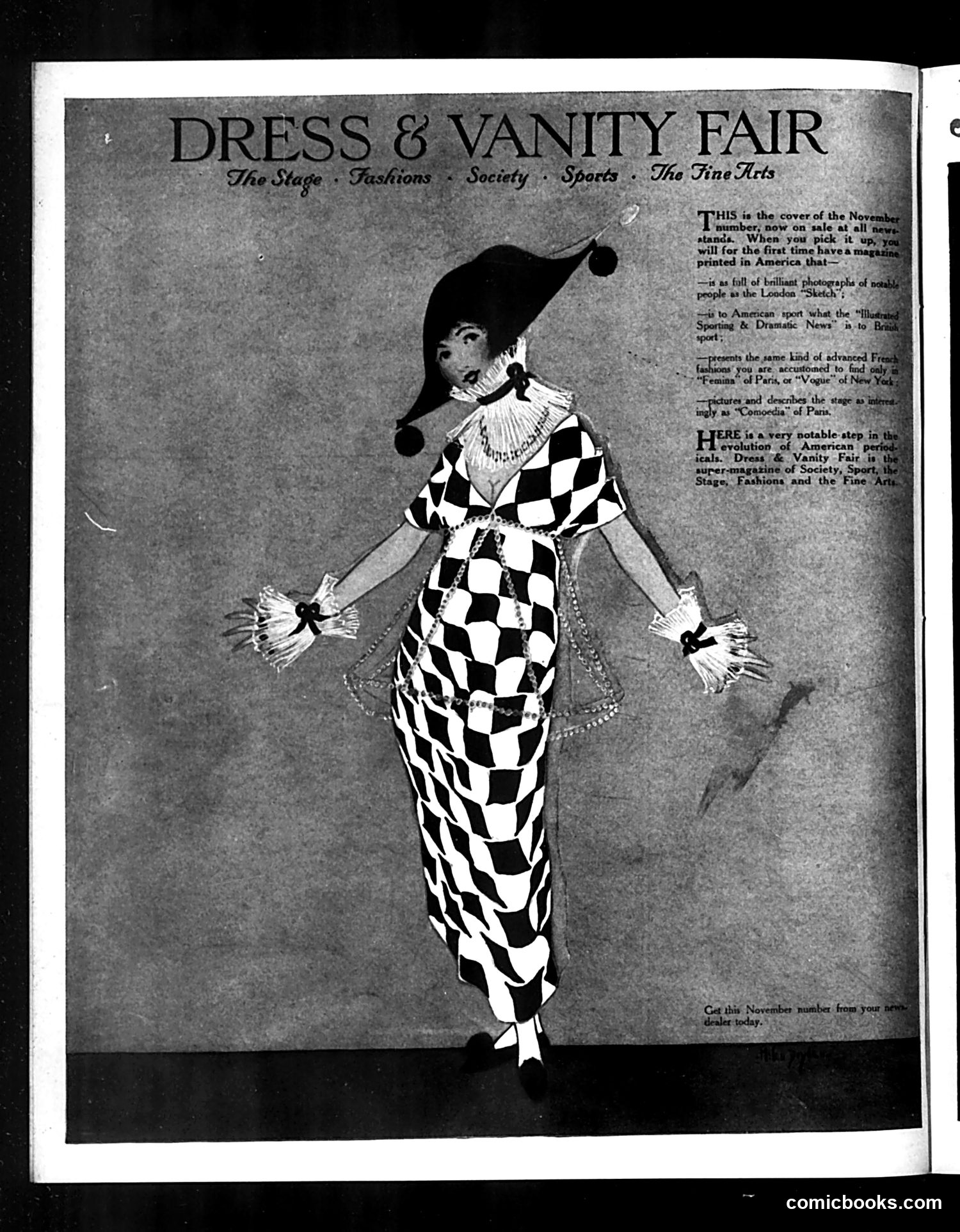
This is a title page/advertisement for the November issue of *Dress & Vanity Fair*, a new American magazine covering "The Stage · Fashions · Society · Sports · The Fine Arts." The illustration shows a fashionable figure in a striking black-and-white diamond-patterned dress with a jester-like pointed hat, ruffled collar, and decorative cuffs. The design is deliberately theatrical and avant-garde. The text announces this magazine represents "a very notable step in the history of publishing periodicals," positioning it as a sophisticated new entry into the magazine market. It emphasizes coverage of advanced French fashion alongside society, sports, theatrical, and fine arts content—targeting affluent, culturally-aware readers of the era. This appears to be a promotional cover rather than political satire, showcasing contemporary fashion aesthetics.