
Judge, 1913-11-15 · page 4 of 24
Judge — November 15, 1913 — page 4: what you’re looking at
What you’re looking at
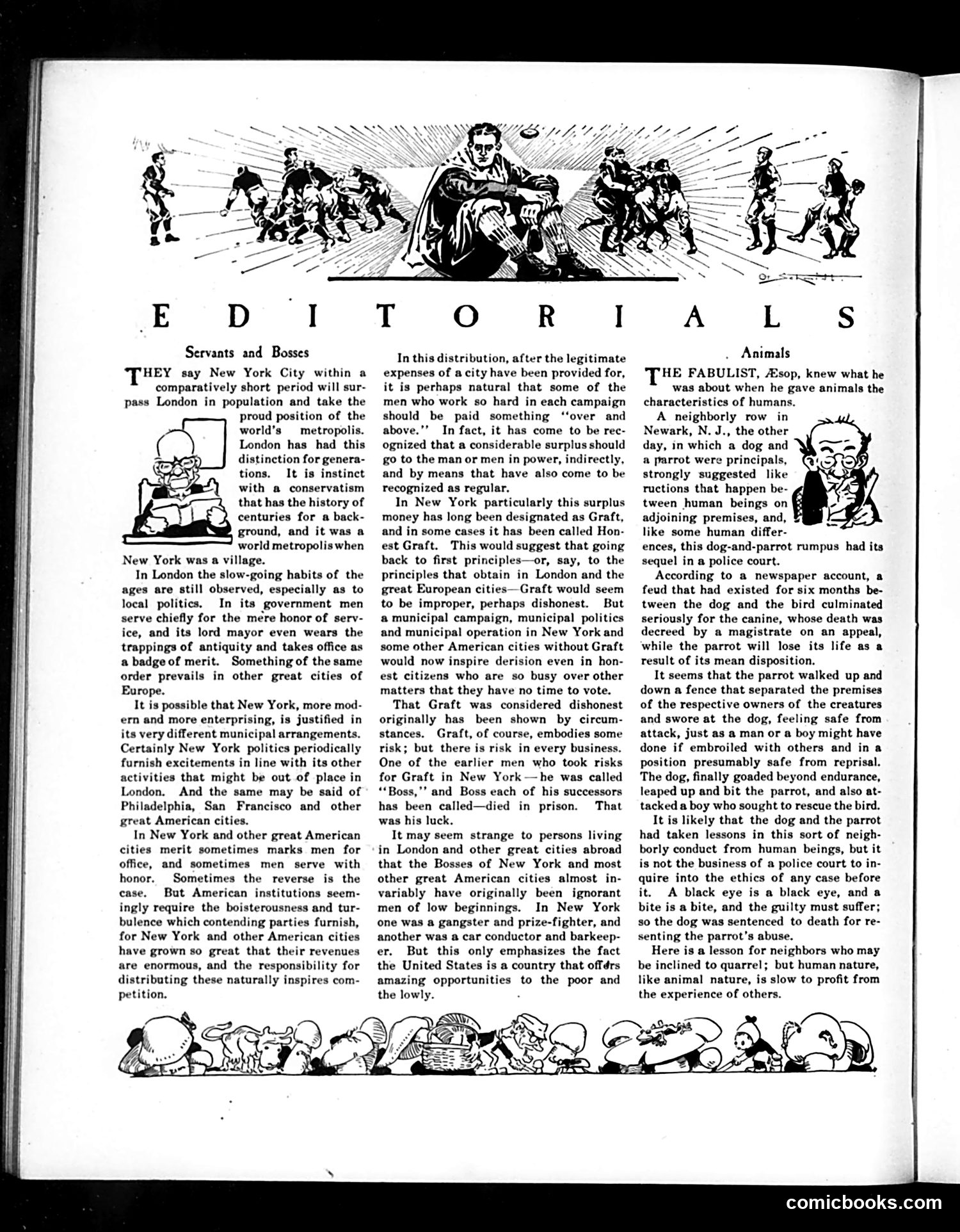
This page contains two editorial pieces satirizing New York City politics and governance. **"Servants and Bosses"** criticizes how New York politicians, particularly those in "Graft" positions, distribute city money to political workers rather than providing honest municipal services. The text compares New York unfavorably to London, suggesting the city operates through corrupt patronage networks where political loyalty is rewarded over merit. The cartoon illustrates a central authority figure distributing resources to subordinates. **"Animals"** is a fable by Aesop discussing a dog-and-parrot court case, used metaphorically to critique New York's moral standards. The satire suggests that while a dog was executed for attacking a parrot, humans in power escape consequences for similar abuses—implying systemic corruption where the powerful operate outside justice. Both pieces attack municipal corruption and unequal application of law.
📄 Transcribed text from this page (OCR, searchable)
Machine-transcribed from the original scan — historical spelling and the odd misread are preserved.
Servants and Bosses THEY say New York City within a comparatively short period will sur- pass London in population and take the proud position of the world’s metropolis. London has had this distinction for genera- tions. It is instinct with a conservatism that has the history of centuries for a back- ground, and it was a world metropolis when New York was a village. In London the slow-going habits of the ages are still observed, especially as to local politics. In its government men serve chiefly for the mere honor of serv- ice, and its lord mayor even wears the trappings of antiquity and takes office as a badge of merit. Something of the same order prevails in other great cities of Europe. It is possible that New York, more mod- ern and more enterprising, is justified in its very different municipal arrangements. Certainly New York politics periodically furnish excitements in line with its other activities that might be out of place in London. And the same may be said of Philadelphia, San Francisco and other great American cities. In New York and other great American cities merit sometimes marks men for office, and sometimes men serve with honor. Sometimes the reverse is the case. But American institutions seem- ingly require the boisterousness and tur- bulence which contending parties furnish, for New York and other American cities have grown so great that their revenues are enormous, and the responsibility for distributing these naturally inspires com- petition. VLD a ae ae - iyo? ie ne . In this distribution, after the legitimate expenses of a city have been provided for, it is perhaps natural that some of the men who work so hard in each campaign should be paid something ‘‘over and above.’’ In fact, it has come to be rec- ognized that a considerable surplus should go to the man or men in power, indirectly, and by means that have also come to be recognized as regular. In New York particularly this surplus money has long been designated as Graft, and in some cases it has been called Hon- est Graft. This would suggest that going back to first principles—or, say, to the principles that obtain in London and the great European cities—Graft would seem to be improper, perhaps dishonest. But a municipal campaign, municipal politics and municipal operation in New York and some other American cities without Graft would now inspire derision even in hon- est citizens who are so busy over other matters that they have no time to vote. That Graft was considered dishonest originally has been shown by circum- stances. Graft, of course, embodies some risk; but there is risk in every business. One of the earlier men who took risks for Graft in New York—he was called “‘Boss,”’ and Boss each of his successors has been called—died in prison. That was his luck. It may seem strange to persons living in London and other great cities abroad that the Bosses of New York and most other great American cities almost in- variably have originally been ignorant men of low beginnings. In New York one was a gangster and prize-fighter, and another was a car conductor and barkeep- er. But this only emphasizes the fact the United States is a country that offérs amazing opportunities to the poor and the lowly. . Animals THE FABULIST, sop, knew what he was about when he gave animals the characteristics of humans. A neighborly row in Newark, N. J., the other day, in which a dog and a parrot were principals, strongly suggested like ructions that happen be- tween human beings on adjoining premises, and, like some human differ- ences, this dog-and-parrot rumpus had its sequel in a police court. According to a newspaper account, a feud that had existed for six months be- tween the dog and the bird culminated seriously for the canine, whose death was decreed by a magistrate on an appeal, while the parrot will lose its life as a result of its mean disposition. It seems that the parrot walked up and down a fence that separated the premises of the respective owners of the creatures and swore at the dog, feeling safe from attack, just as a man or a boy might have done if embroiled with others and in a position presumably safe from reprisal. The dog, finally goaded beyond endurance, leaped up and bit the parrot, and also at- tacked a boy who sought to rescue the bird. It is likely that the dog and the parrot had taken lessons in this sort of neigh- borly conduct from human beings, but it is not the business of a police court to in- quire into the ethics of any case before it. A black eye is a black eye, and a bite is a bite, and the guilty must suffer; so the dog was sentenced to death for re- senting the parrot’s abuse. Here is a lesson for neighbors who may be inclined to quarrel; but human nature, like animal nature, is slow to profit from the experience of others. comicbooks.com