
Judge, 1913-11-15 · page 11 of 24
Judge — November 15, 1913 — page 11: what you’re looking at
What you’re looking at
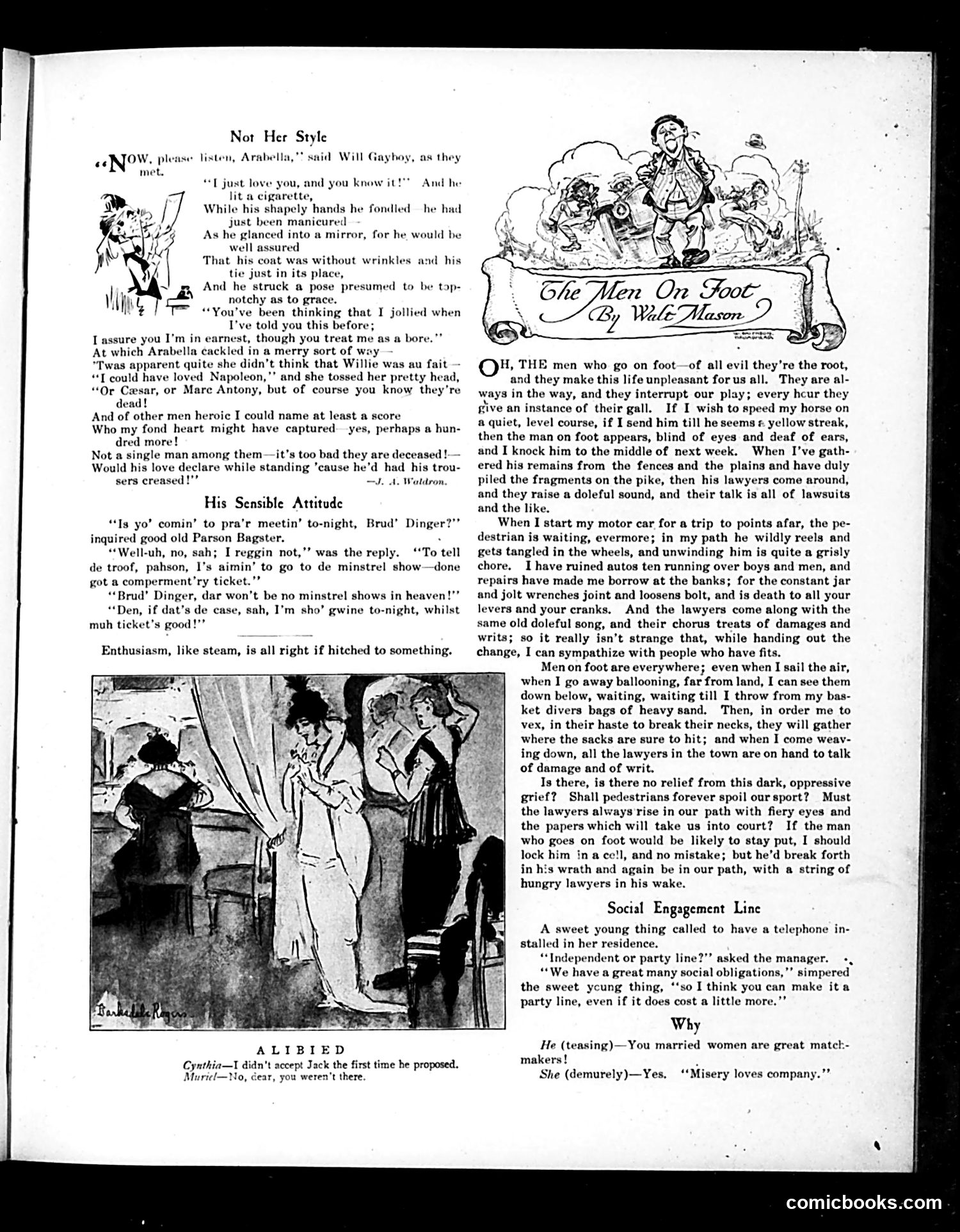
This page contains three satirical pieces from *Judge* magazine: **"Not Her Style"** mocks an excessively vain suitor named Willie Gayhoy who constantly admires his manicured hands, wrinkle-free coat, and perfectly positioned tie while declaring his love. Arabella rejects him by noting she could have loved historical military heroes like Napoleon or Caesar—but certainly not a man worried about having his trousers creased. The satire targets fin-de-siècle male vanity and the emerging "dandy" aesthetic. **"His Sensible Attitude"** is a dialect humor piece where a Black man chooses attending a minstrel show over prayer meeting, joking he'll attend church tonight to use his free ticket since "there won't be no minstrel shows in heaven." This relies on period racial stereotypes common in *Judge*. **"The Men on Foot"** (by Walt Mason) is a motorist's complaint about pedestrians constantly interfering with automobiles, presented as an absurdist grievance. It satirizes early automobile culture's contempt for foot traffic and the litigation that followed traffic accidents—a genuinely modern problem of the era.
📄 Transcribed text from this page (OCR, searchable)
Machine-transcribed from the original scan — historical spelling and the odd misread are preserved.
Not Her Style ce NOW, please listen, Arabella,” said Will Gayhoy, as they met. “T just love you, and you know it!" And he lit a cigarette, While his shapely hands he fondled just been manicured As he glanced into a mirror, for he would be well assured That his coat was without wrinkles and his ie just in its place, And he struck a pose presumed to be top- notchy as to grace. “You've been thinking that I jollied when I’ve told you this before; T assure you I’m in earnest, though you treat me as a bore."’ ‘At which Arabella cackled in a merry sort of way *Twas apparent quite she didn’t think that Willie was au fait “L could have loved Napoleon,’ and she tossed her pretty head, “Or Cwsar, or Mare Antony, but of course you know they're dead! And of other men heroic I could name at least a score Who my fond heart might have captured. yes, perhaps a hun- dred more! Not a single man among them— it's too bad they are deceased !— Would his love declare while standing ‘cause he'd had his trou- sers creased !'" 4. Waldron. he had His Sensible Attitude “Is yo’ comin’ to pra’r meetin’ to-night, Brud’ Dinger?"’ inquired good old Parson Bagster. “Well-uh, no, sah; I reggin not,’? was the reply. de troof, pahson, I's aimin’ to go to de minstrel show got a comperment’ry ticket.’” “Brud’ Dinger, dar won't be no minstrel shows in heaven!"’ “Den, if dat’s de case, sah, I’m sho’ gwine to-night, whilst muh ticket’s good!’" “To tell done Enthusiasm, like steam, is all right if hitched to something. O# THE men who go on foot—of all evil they’re the root, and they make this life unpleasant for us all. They are al- ways in the way, and they interrupt our play; every hcur they give an instance of their gall. If I wish to speed my horse on a quiet, level course, if I send him till he seems & yellow streak, then the man on foot appears, blind of eyes and deaf of ears, and I knock him to the middle of next week. When I’ve gath- ered his remains from the fences and the plains and have duly piled the fragments on the pike, then his lawyers come around, and they raise a doleful sound, and their talk is all of lawsuits and the like. When I start my motor car for a trip to points afar, the pe- destrian is waiting, evermore; in my path he wildly reels and gets tangled in the wheels, and unwinding him is quite a grisly chore. I have ruined autos ten running over boys and men, and repairs have made me borrow at the banks; for the constant jar and jolt wrenches joint and loosens bolt, and is death to all your levers and your cranks. And the lawyers come along with the same old doleful song, and their chorus treats of damages and writs; so it really isn’t strange that, while handing out the change, I can sympathize with people who have fits. Men on foot are everywhere; even when I sail the air, when I go away ballooning, far from land, I can see them down below, waiting, waiting till I throw from my bas- ket divers bags of heavy sand. Then, in order me to vex, in their haste to break their necks, they will gather where the sacks are sure to hit; and when I come weav- ing down, all the lawyers in the town are on hand to talk of damage and of writ. Is there, is there no relief from this dark, oppressive grief? Shall pedestrians forever spoil our sport? Must the lawyers always rise in our path with fiery eyes and the papers which will take us into court? If the man who goes on foot would be likely to stay put, I should lock him ina ce!l, and no mistake; but he’d break forth in his wrath and again be in our path, with a string of hungry lawyers in his wake. Social Engagement Line A sweet young thing called to have a telephone in- Stalled in her residence. “Independent or party line?’’ asked the manager. +, “We have a great many social obligations,” simpered the sweet ycung thing, ‘‘so I think you can make ita party line, even if it does cost a little more,”’ Why ALIBIED Cynthia—I didn't accept Jack the first time he proposed. Muriel—No, ear, you weren't there. He (teasing)—You married women are great matck- makers! ; She (demurely)—Yes. ‘Misery loves company.”” comicbooks.com