
Judge, 1913-11-15 · page 15 of 24
Judge — November 15, 1913 — page 15: what you’re looking at
What you’re looking at
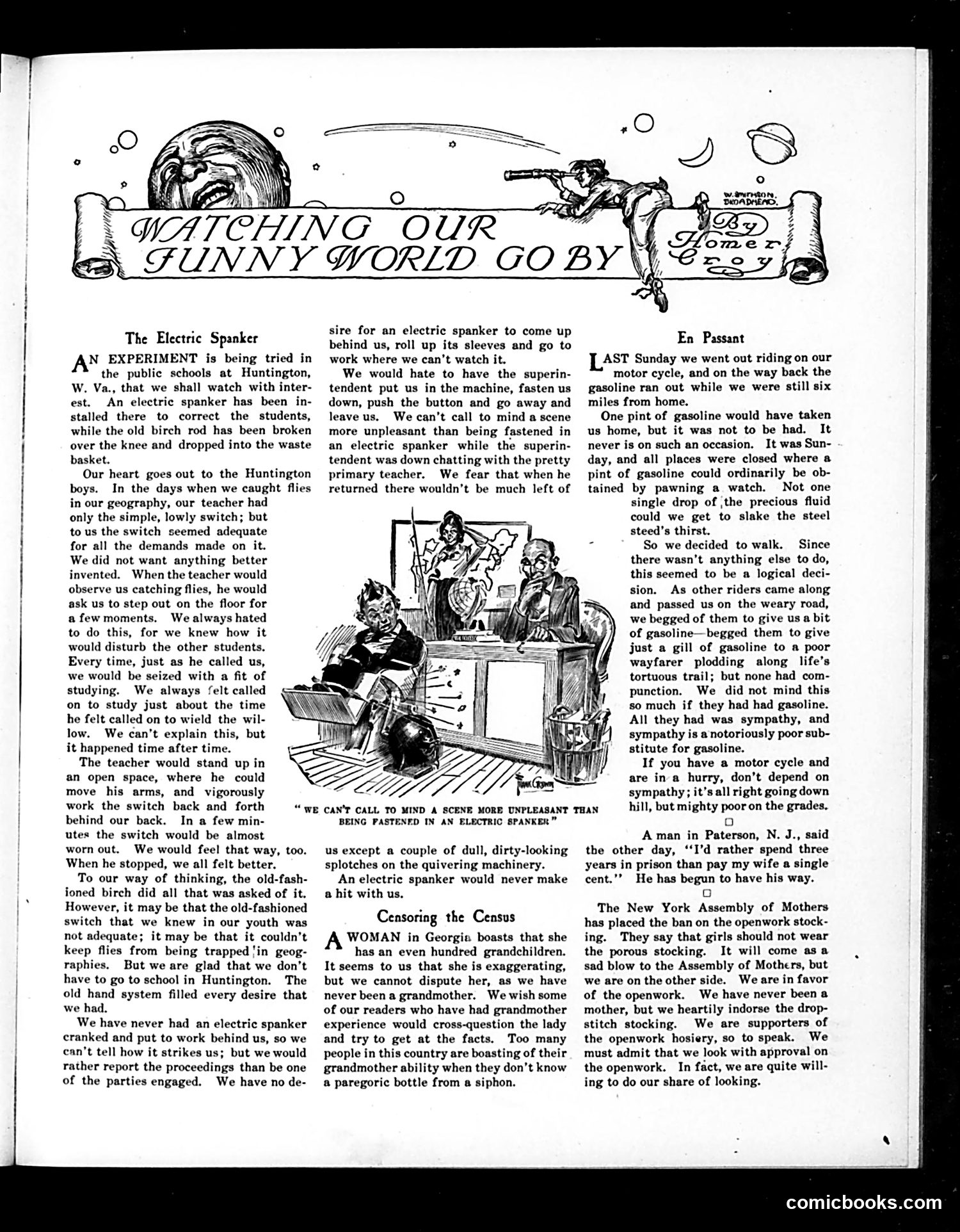
This page from Judge magazine contains three satirical pieces mocking American institutions and attitudes circa early 20th century. **"The Electric Spanker"** ridicules the adoption of mechanical punishment devices in schools. Huntington, West Virginia had installed an "electric spanker" to replace traditional corporal punishment (birch rods and switches). The author humorously expresses nostalgia for old-fashioned whipping while feigning horror at mechanized punishment—the real joke being that both systems are absurd. The satire critiques progressive educational "improvements" that are merely replacing one barbaric practice with another. **"Censoring the Census"** mocks exaggerated boasting, particularly a Georgian woman claiming 100 grandchildren. Judge sarcastically suggests readers fact-check her claim, implying widespread dishonesty about personal achievements. **"En Passant"** humorously describes running out of gasoline on a Sunday motorcycle ride when all gas stations were closed—a complaint about commercial inconvenience and poor planning. Overall, the page satirizes American social progress, education, commerce, and personal vanity through lighthearted mockery.
📄 Transcribed text from this page (OCR, searchable)
Machine-transcribed from the original scan — historical spelling and the odd misread are preserved.
The Electric Spanker AN EXPERIMENT is being tried in the public schools at Huntington, W. Va., that we shall watch with inter- est. An electric spanker has been in- stalled there to correct the students, while the old birch rod has been broken over the knee and dropped into the waste basket. Our heart goes out to the Huntington boys. In the days when we caught flies in our geography, our teacher had only the simple, lowly switch; but. to us the switch seemed adequate for all the demands made on it. We did not want anything better invented. When the teacher would observe us catching flies, he would ask us to step out on the floor for afew moments. We always hated to do this, for we knew how it would disturb the other students. Every time, just as he called us, we would be seized with a fit of studying. We always felt called on to study just about the time he felt called on to wield the wil- low. We can’t explain this, but it happened time after time. The teacher would stand up in an open space, where he could move his arms, and vigorously work the switch back and forth behind our back. In a few min- utes the switch would be almost worn out. We would feel that way, too. When he stopped, we all felt better. To our way of thinking, the old-fash- joned birch did all that was asked of it. However, it may be that the old-fashioned switch that we knew in our youth was not adequate; it may be that it couldn’t keep flies from being trapped !in geog- raphies. But we are glad that we don’t have to go to school in Huntington. The old hand system filled every desire that we had. We have never had an electric spanker cranked and put to work behind us, so we can’t tell how it strikes us; but we would rather report the proceedings than be one of the parties engaged. We have no de- “WE CAN'T CALL TO sire for an electric spanker to come up behind us, roll up its sleeves and go to work where we can’t watch it. We would hate to have the superin- tendent put us in the machine, fasten us down, push the button and go away and leave us. We can’t call to mind a scene more unpleasant than being fastened in an electric spanker while the superin- tendent was down chatting with the pretty primary teacher. We fear that when he returned there wouldn’t be much left of BEING PASTENED IN AN ELECTRIC SPANKER” us except a couple of dull, dirty-looking splotches on the quivering machinery. An electric spanker would never make a hit with us. Censoring the Census A WOMAN in Georgia boasts that she has an even hundred grandchildren. It seems to us that she is exaggerating, but we cannot dispute her, as we have never been a grandmother. We wish some of our readers who have had grandmother experience would cross-question the lady and try to get at the facts. Too many people in this country are boasting of their grandmother ability when they don’t know a paregoric bottle from a siphon. IND A SCENE MORE UNPLEASANT THAN En Passant LAST Sunday we went out riding on our motor cycle, and on the way back the gasoline ran out while we were still six miles from home. One pint of gasoline would have taken us home, but it was not to be had. It never is on such an occasion. It was Sun- day, and all places were closed where a pint of gasoline could ordinarily be ob- tained by pawning a watch. Not one single drop of ,the precious fluid could we get to slake the steel steed’s thirst. So we decided to walk. Since there wasn’t anything else to do, this seemed to be a logical deci- sion. As other riders came along and passed us on the weary road, we begged of them to give us a bit of gasoline—begged them to give just a gill of gasoline to a poor wayfarer plodding along life’s tortuous trail; but none had com- punction. We did not mind this so much if they had had gasoline. All they had was sympathy, and sympathy is a notoriously poor sub- stitute for gasoline. If you have a motor cycle and are ina hurry, don’t depend on sympathy; it’s all right going down hill, but mighty poor on the grades, Oo Aman in Paterson, N. J., said the other day, ‘‘I’d rather spend three years in prison than pay my wife a single cent.’”’ He has begun to have his way. o The New York Assembly of Mothers has placed the ban on the openwork stock- ing. They say that girls should not wear the porous stocking. It will come asa sad blow to the Assembly of Mothers, but we are on the other side. We are in favor of the openwork. We have never been a mother, but we heartily indorse the drop- stitch stocking. We are supporters of the openwork hosiery, so to speak. We must admit that we look with approval on the openwork. In fact, we are quite will- ing to do our share of looking. comicbooks.com