
Judge, 1913-11-15 · page 9 of 24
Judge — November 15, 1913 — page 9: what you’re looking at
What you’re looking at
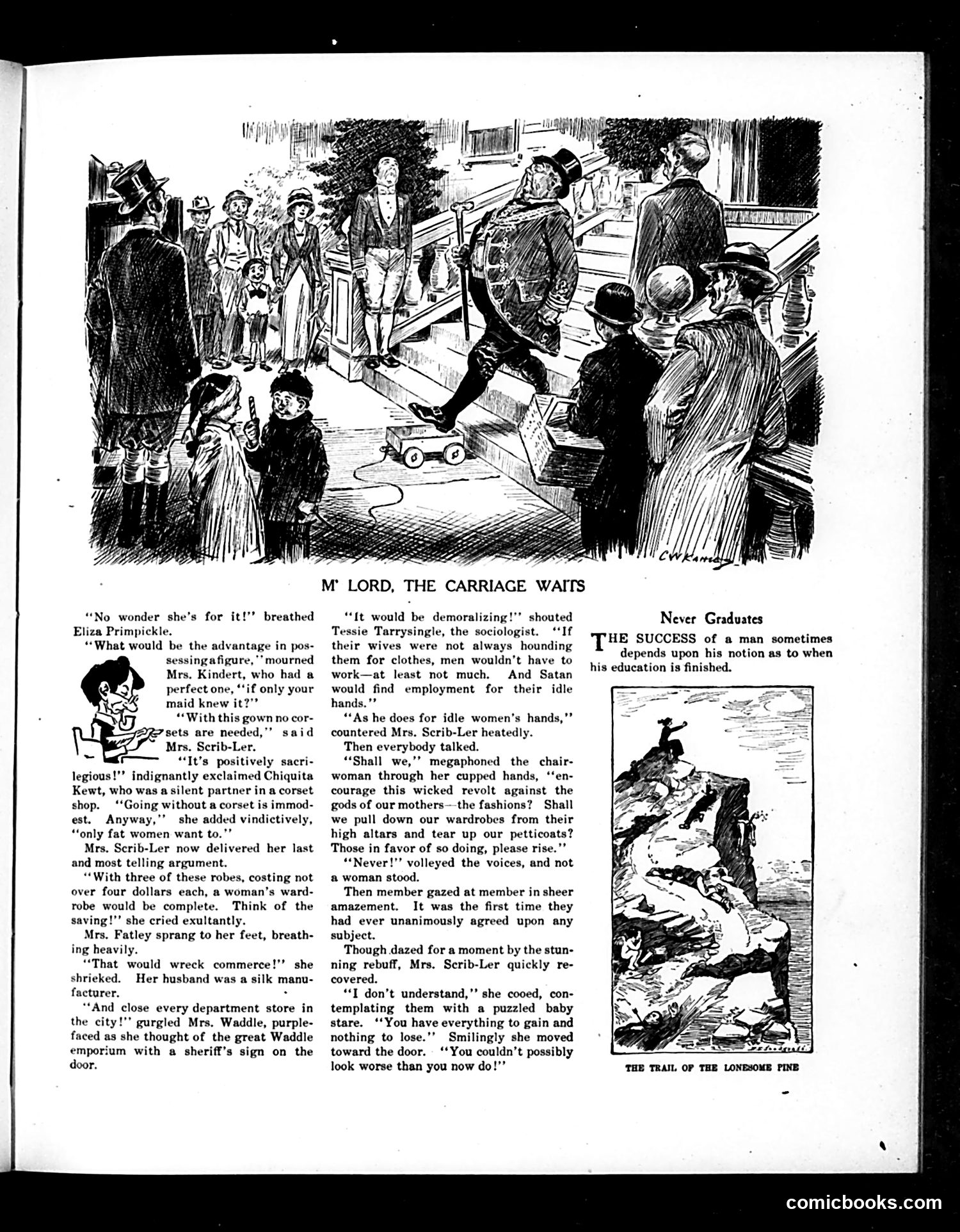
This Judge cartoon satirizes the hypocrisy of women claiming to oppose frivolous fashion while protecting their economic interests. Mrs. Scrib-Ler proposes affordable, practical three-dollar dresses requiring no corsets—a radical reformist idea. Various women object on moral grounds (corsets equal modesty), while others reveal the true motive: Mrs. Fatley's husband manufactures silk; Mrs. Waddle owns a department store. Both fear economic collapse. Even socialist Tessie Tarrysingle invokes pseudo-intellectual arguments about keeping men industrious through constant clothing demands. When asked to vote for reform, unanimously they refuse—exposing that their opposition stems entirely from financial self-preservation, not principle. Mrs. Scrib-Ler's parting jab ("You couldn't possibly look worse than you now do!") drives home the satire: women prioritize consumption and status over genuine improvement. The cartoon mocks both female consumerism and the rationalization of frivolous spending.
📄 Transcribed text from this page (OCR, searchable)
Machine-transcribed from the original scan — historical spelling and the odd misread are preserved.
“No wonder she’s for it!’’ breathed Eliza Primpickle. “What would be the advantage in pos- sessing afigure,*’ mourned Mrs. Kindert, who had a perfect one, “if only your maid knew it?” “With this gown no cor- sets are needed,”’ said Mrs. Scrib-Ler. f——— “It’s positively sacri- legious!’’ indignantly exclaimed Chiquita Kewt, who was a silent partner ina corset shop. ‘Going without a corset is immod- est. Anyway,’’ she added vindictively, “only fat women want to."” Mrs. Scrib-Ler now delivered her last and most telling argument. “‘With three of these robes, costing not over four dollars each, a woman’s ward- robe would be complete. Think of the saving!"’ she cried exultantly. Mrs. Fatley sprang to her feet, breath- ing heavily. “That would wreck commerce!’’ she shrieked. Her husband was a silk manu- facturer. : “‘And close every department store in the city!" gurgled Mrs. Waddle, purple- faced as she thought of the great Waddle emporium with a sheriff’s sign on the door. M’ LORD, THE CARRIAGE WAITS “ft would be demoralizing!’ shouted Tessie Tarrysingle, the sociologist. ‘‘If their wives were not always hounding them for clothes, men wouldn’t have to work—at least not much. And Satan would find employment for their idle hands.”” “‘As he does for idle women’s hands,”’ countered Mrs. Scrib-Ler heatedly. Then everybody talked. “Shall we,’’ megaphoned the chair- woman through her cupped hands, ‘‘en- courage this wicked revolt against the gods of our mothers—the fashions? Shall we pull down our wardrobes from their high altars and tear up our petticoats? Those in favor of so doing, please rise.”” “‘Never!"’ volleyed the voices, and not a woman stood. Then member gazed at member in sheer amazement. It was the first time they had ever unanimously agreed upon any subject. Though dazed for a moment by the stun- ning rebuff, Mrs. Scrib-Ler quickly re- covered. “I don’t understand,’’ she cooed, con- templating them with a puzzled baby stare. ‘You have everything to gain and nothing to lose.’’ Smilingly she moved toward the door. ‘‘You couldn’t possibly look worse than you now do!’’ Never Graduates HE SUCCESS of a man sometimes depends upon his notion as to when his education is finished. THE TRAIL OP THE LONESOME PINE comicbooks.com