
Judge, 1913-11-15 · page 16 of 24
Judge — November 15, 1913 — page 16: what you’re looking at
What you’re looking at
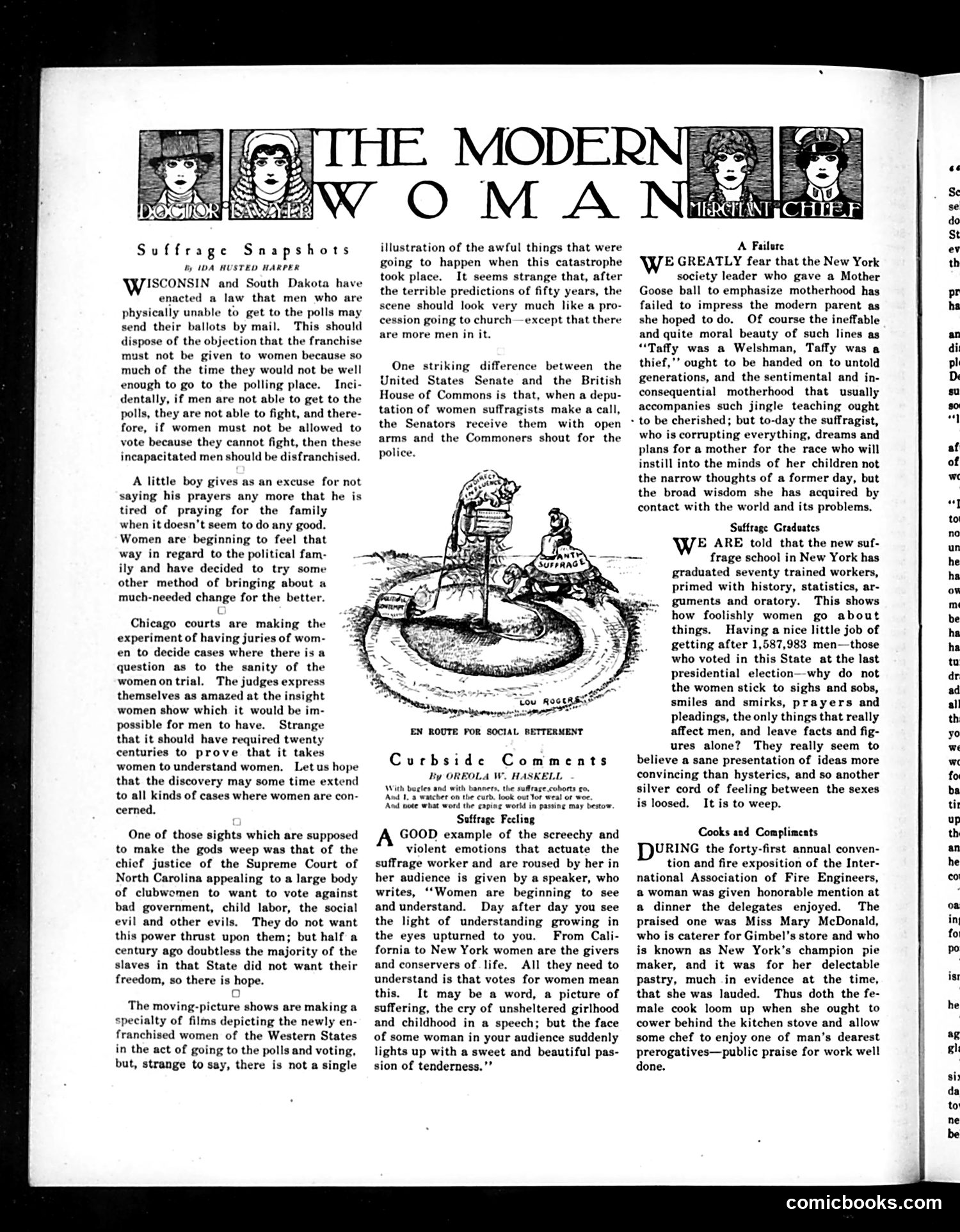
This page satirizes the women's suffrage movement of the early 20th century. The main cartoon depicts suffragists marching "en route for social betterment"—a procession the caption mockingly compares to a church service. The accompanying text by Ida Husted Harper argues *for* women's voting rights, using logical arguments: if men can vote by mail when unable to reach polls, the physical weakness objection to female suffrage collapses. She also notes that women jurors demonstrate superior judgment in cases involving women. The satire cuts both ways: while Harper's piece defends suffrage, other sections mock suffragists' emotional appeals and romanticized rhetoric about "the light of understanding" in women's eyes—suggesting overwrought sentimentality. The cartoon itself appears gently mocking, presenting the suffrage march as mundane rather than the social catastrophe opponents had predicted, with the dry observation that "there are more men in it."
📄 Transcribed text from this page (OCR, searchable)
Machine-transcribed from the original scan — historical spelling and the odd misread are preserved.
Suffrage Snapshots by IDA HUSTED HARPER WISCONSIN and South Dakota have enacted a law that men who are physically unable to get to the polls may send their ballots by mail. This should dispose of the objection that the franchise must not be given to women because so much of the time they would not be well enough to go to the polling place. Inci- dentally, if men are not able to get to the polls, they are not able to fight, and there- fore, if women must not be allowed to vote because they cannot fight, then these incapacitated men should be disfranchised. A little boy gives as an excuse for not saying his prayers any more that he is tired of praying for the family when it doesn’t seem to do any good. Women are beginning to feel that way in regard to the political fam- ily and have decided to try some other method of bringing about « much-needed change for the better. Chicago courts are making the experiment of having juries of wom- en to decide cases where there is a question as to the sanity of the women ontrial. The judges express themselves as amazed at the insight women show which it would be im- possible for men to have. Strange that it should have required twenty centuries to prove that it takes women to understand women. Letus hope that the discovery may some time extend to all kinds of cases where women are con- cerned, One of those sights which are supposed to make the gods weep was that of the chief justice of the Supreme Court of North Carolina appealing to a large body of clubwomen to want to vote against bad government, child labor, the social evil and other evils. They do not want this power thrust upon them; but half a century ago doubtless the majority of the slaves in that State did not want their freedom, so there is hope. oO The moving-picture shows are making a specialty of films depicting the newly en- franchised women of the Western States in the act of going to the polls and voting, but, strange to say, there is not a single illustration of the awful things that were going to happen when this catastrophe took place. It seems strange that, after the terrible predictions of fifty years, the scene should look very much like a pro- cession going to church —except that there are more men in it. One striking difference between the United States Senate and the British House of Commons is that, when a depu- tation of women suffragists make a call, the Senators receive them with open arms and the Commoners shout for the EN ROUTE POR SOCIAL BETTERMENT Curbside Comments Ry OREOLA W. HASKELL With bugles and with banners, the suffrage cohorts £0, And 1, a watcber on the curb. look out Yor weal of woe, And note what word the caping world in passing may bestow. Suffrage Feeling GOOD example of the screechy and violent emotions that actuate the suffrage worker and are roused by her in her audience is given by a speaker, who writes, ‘‘Women are beginning to see and understand. Day after day you see the light of understanding growing in the eyes upturned to you. From Cali- fornia to New York women are the givers and conservers of life. All they need to understand is that votes for women mean this. It may be a word, a picture of suffering, the cry of unsheltered girlhood and childhood in a speech; but the face of some woman in your audience suddenly lights up with a sweet and beautiful pas- sion of tenderness.’’ A Failure E GREATLY fear that the New York society leader who gave a Mother Goose ball to emphasize motherhood has failed to impress the modern parent as she hoped todo. Of course the ineffable and quite moral beauty of such lines as “Taffy was a Welshman, Taffy was a thief,’’ ought to be handed on to untold generations, and the sentimental and in- consequential motherhood that usually accompanies such jingle teaching ought - to be cherished; but to-day the suffragist, who is corrupting everything, dreams and plans for a mother for the race who will instill into the minds of her children not the narrow thoughts of a former day, but the broad wisdom she has acquired by contact with the world and its problems, Suffrage Graduates E ARE told that the new suf- frage school in New York has graduated seventy trained workers, primed with history, statistics, ar- guments and oratory. This shows how foolishly women go about things. Having a nice little job of getting after 1,587,983 men—those who voted in this State at the last presidential election—why do not the women stick to sighs and sobs, smiles and smirks, prayers and pleadings, the only things that really affect men, and leave facts and fig- ures alone? They really seem to believe a sane presentation of ideas more convincing than hysterics, and so another silver cord of feeling between the sexes is loosed. It is to weep. Cooks and Compliments DURING the forty-first annual conven- tion and fire exposition of the Inter- national Association of Fire Engineers, a woman was given honorable mention at a dinner the delegates enjoyed. The praised one was Miss Mary McDonald, who is caterer for Gimbel’s store and who is known as New York’s champion pie maker, and it was for her delectable pastry, much in evidence at the time, that she was lauded. Thus doth the fe- male cook loom up when she ought to cower behind the kitchen stove and allow some chef to enjoy one of man’s dearest prerogatives—public praise for work well done. comicbooks.com