
A complete issue · 24 pages · 1913
Judge — October 18, 1913
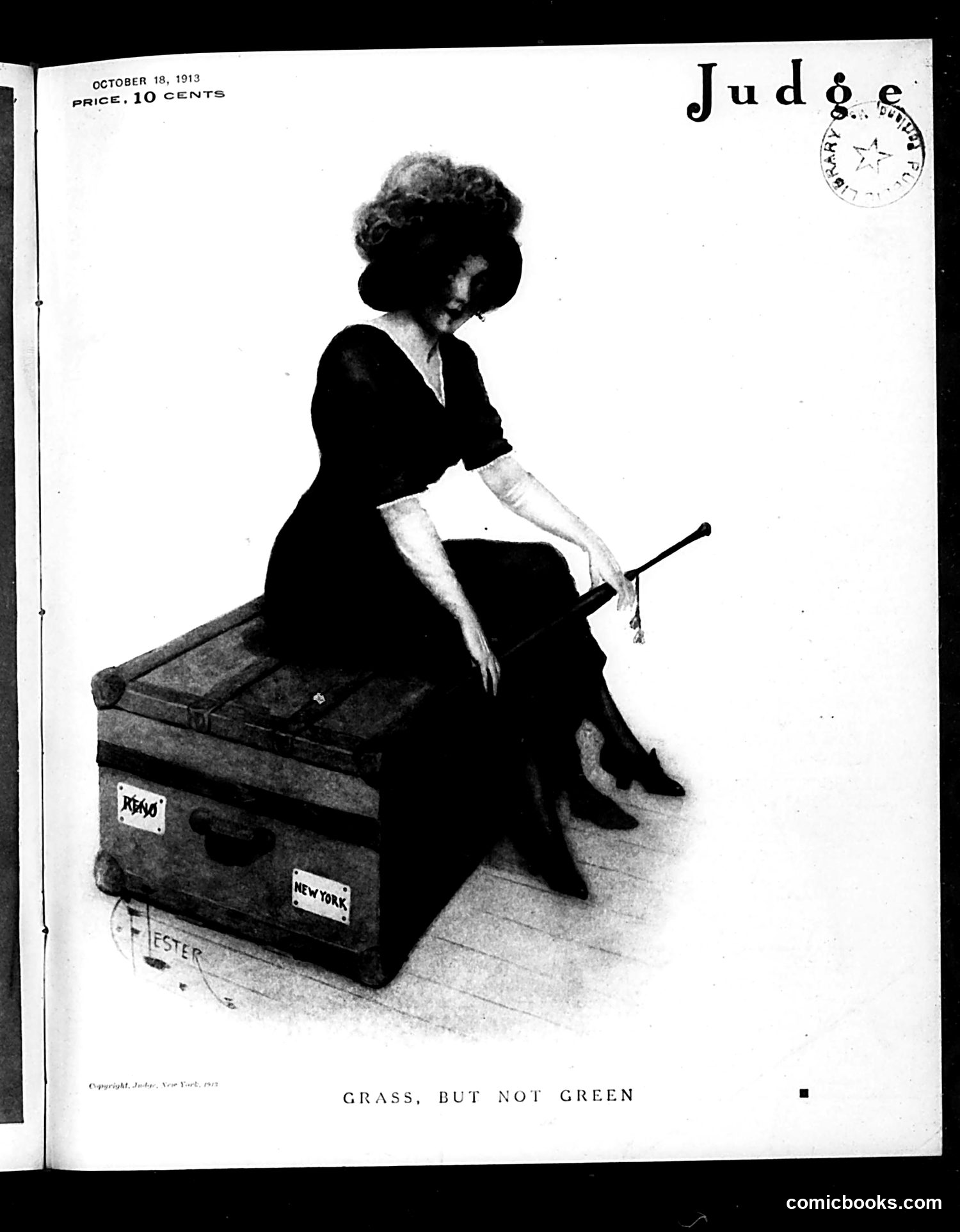
This October 1913 *Judge* cartoon satirizes a woman traveler sitting on a suitcase marked "NEW YORK," holding what appears to be a travel document or ticket. The caption "Grass, But Not Green" is a cryptic reference—likely a play on words about travel or expectations versus reality. The image appears to comment on either the travel industry, tourism, or possibly women's increasing independence in traveling alone during this era. The suitcase labels and her composed pose suggest commentary on modern travel experiences or the commercialization of tourism. Without additional context about specific 1913 events or figures, the exact satirical target remains unclear, though it likely critiques contemporary attitudes about travel or travelers.
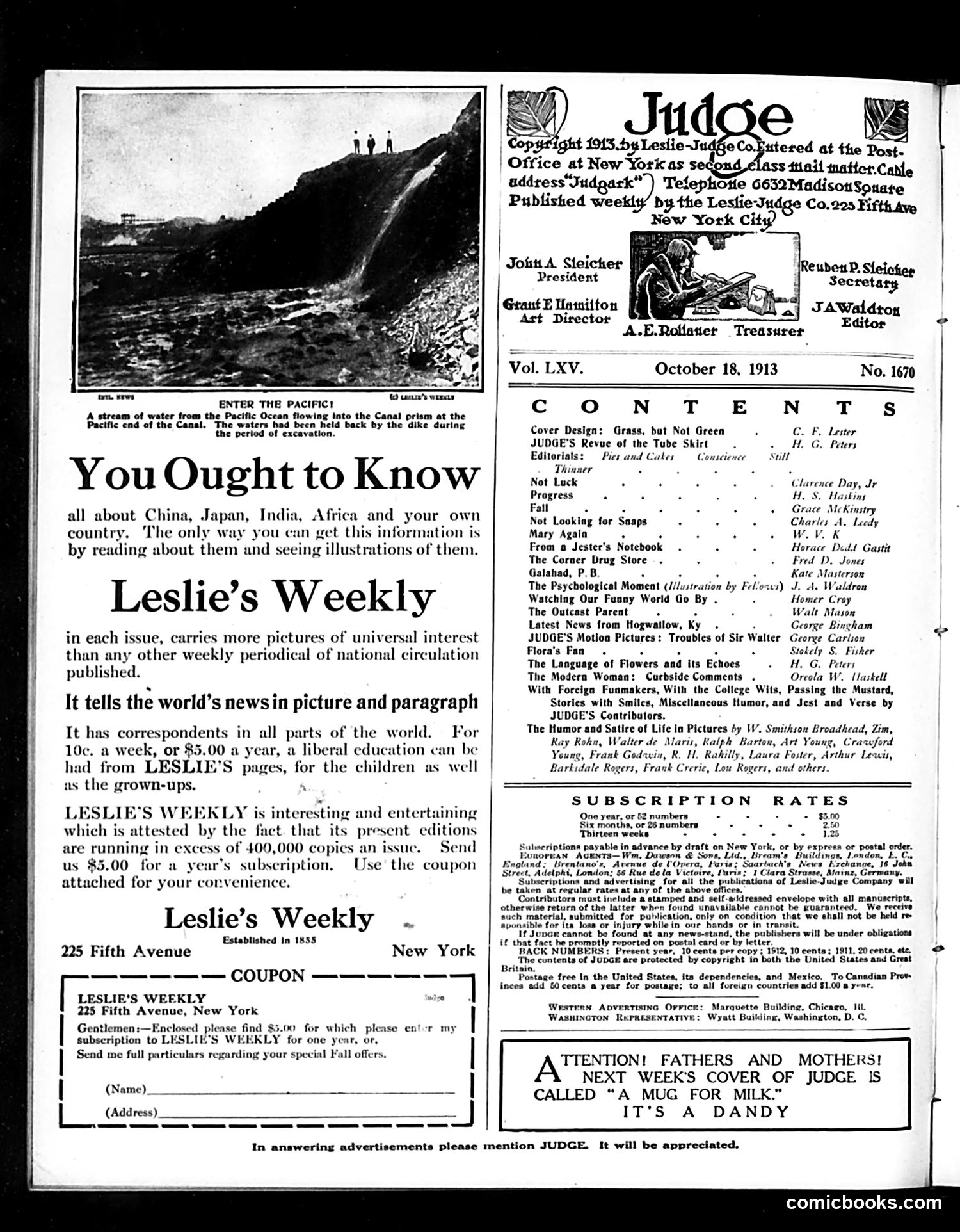
This page is primarily **advertising and masthead material** rather than political satire. The left side features a dramatic photograph labeled "ENTER THE PACIFIC!" showing water from the Pacific Ocean entering the Panama Canal—celebrating the canal's completion, a major 1913 American engineering achievement. Below this, extensive advertising promotes **Leslie's Weekly** magazine, emphasizing its global news coverage and pictorial journalism ("tells the world's news in picture and paragraph"). The subscription cost was $3.00 annually. The right side contains the Judge masthead, contents listing, and subscription rates. A small notice teases next week's cover: "A Mug for Milk," suggesting family-oriented humor content. No significant political cartoons or satirical commentary appear on this particular page—it's primarily a promotional issue designed to attract magazine subscriptions.
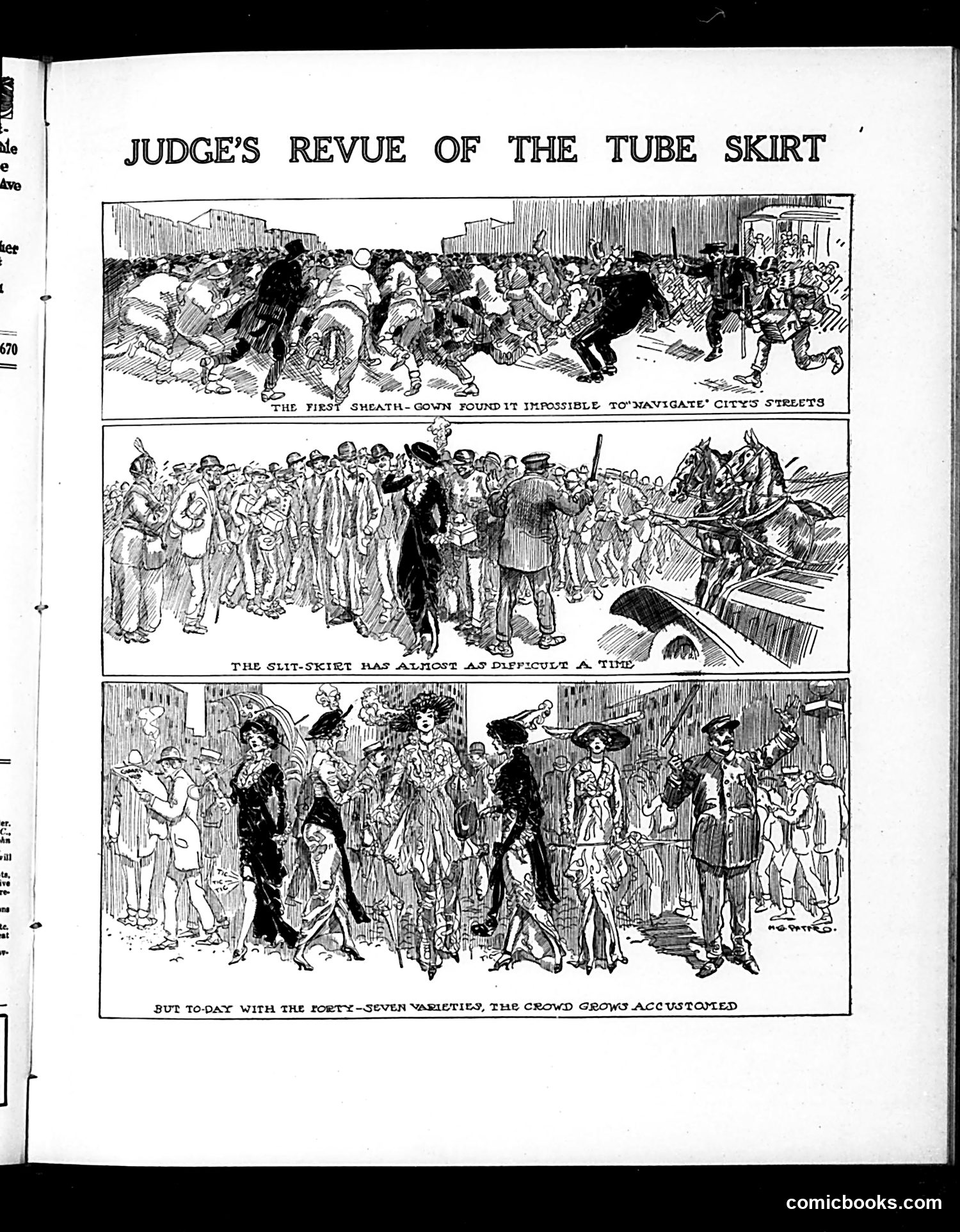
This satirical piece mocks the "tube skirt" — a narrow, straight fashion silhouette popular in the early 1910s. The three panels humorously depict the garment's impracticality: **Panel 1:** Women in tube skirts struggle to navigate city streets, their movement severely restricted by the tight fit. **Panel 2:** The slit-skirt (an attempted modification) creates new problems, proving nearly as difficult to manage. **Panel 3:** The caption suggests that with "forty-seven varieties" of variations available, the crowd has "grown accustomed" — implying fashion-conscious women will tolerate any impractical trend. The satire targets both the absurd garment design and women's willingness to endure fashion's demands, common themes in Judge's social commentary of the era.
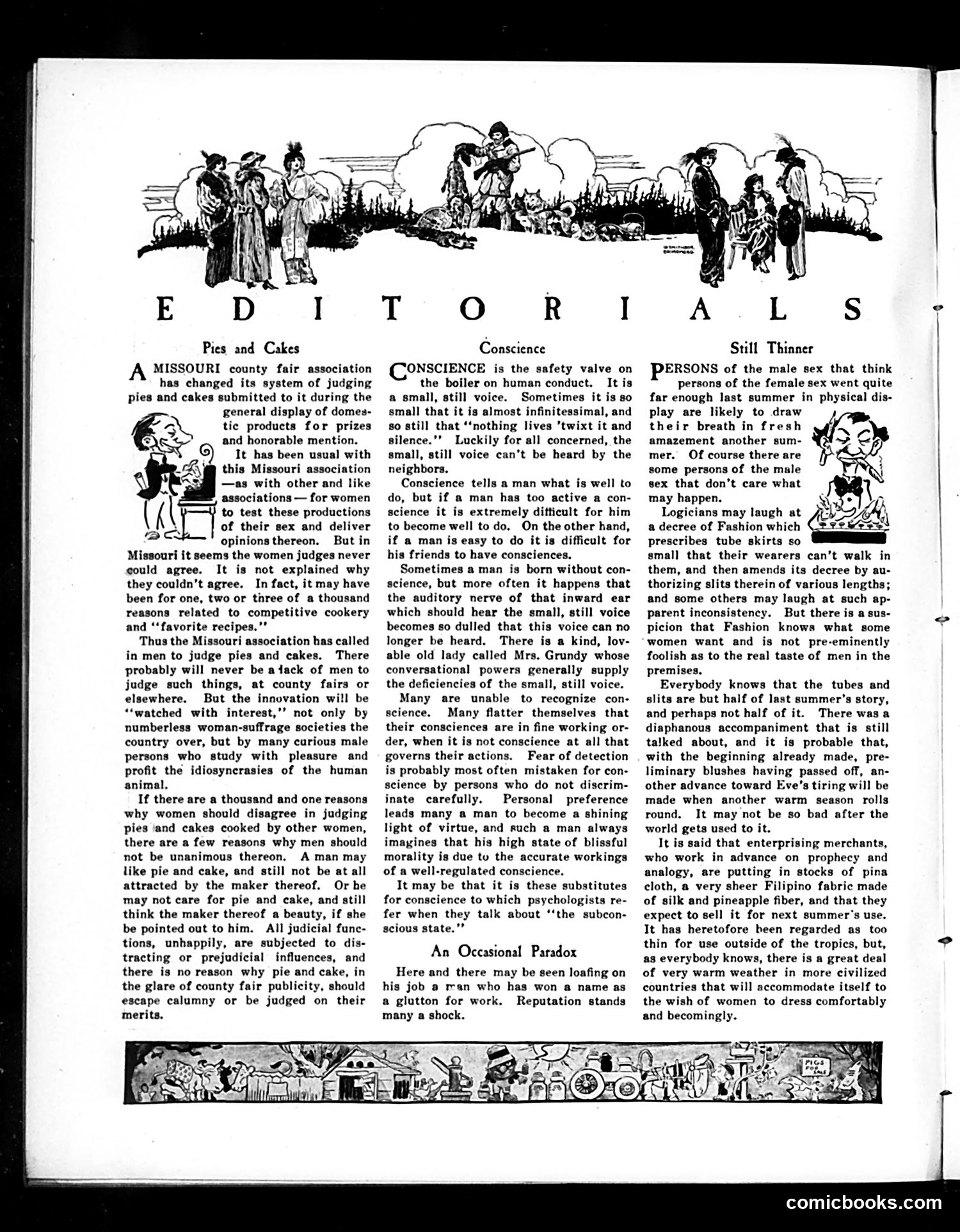
This page from *Judge* magazine presents three opinion pieces with accompanying illustrations: **"Pies and Cakes"** critiques Missouri's county fair system for judging baked goods. The editorial argues the association should rely on objective standards rather than subjective taste preferences, suggesting women-suffrage societies and animal advocates shouldn't influence judging criteria. **"Conscience"** explores the nature of moral conscience as an "inward ear" guiding human conduct, distinguishing between genuine conscience and mere social fear or reputation concerns. **"Still Thinner"** satirizes men who mock women's fashion choices—specifically the controversy over short skirts and tube silhouettes—while hypocritically pursuing their own sartorial trends. The piece argues fashion choices reflect practical judgment, not foolishness. The illustrations use caricature to emphasize these points about social hypocrisy and arbitrary judgment standards.
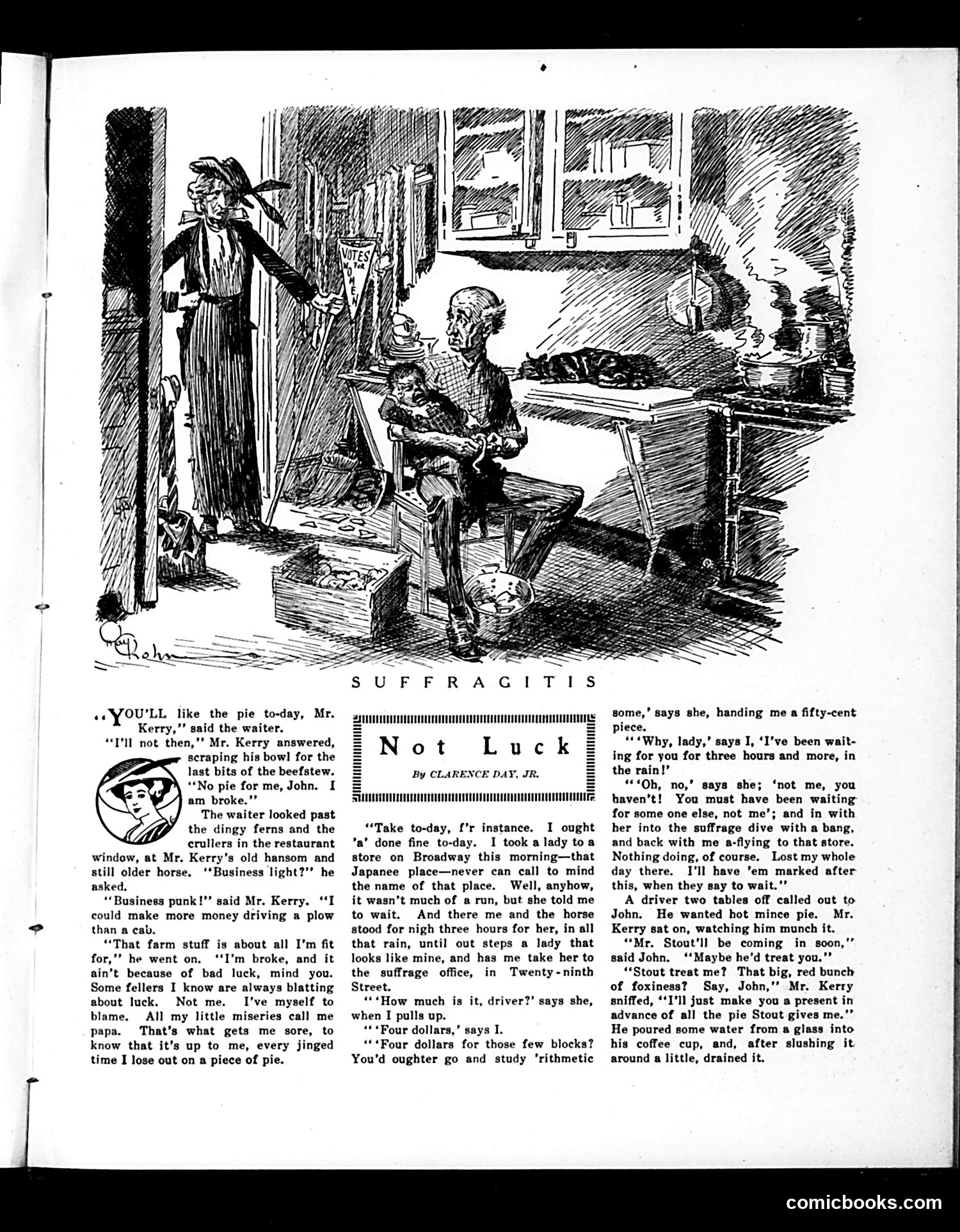
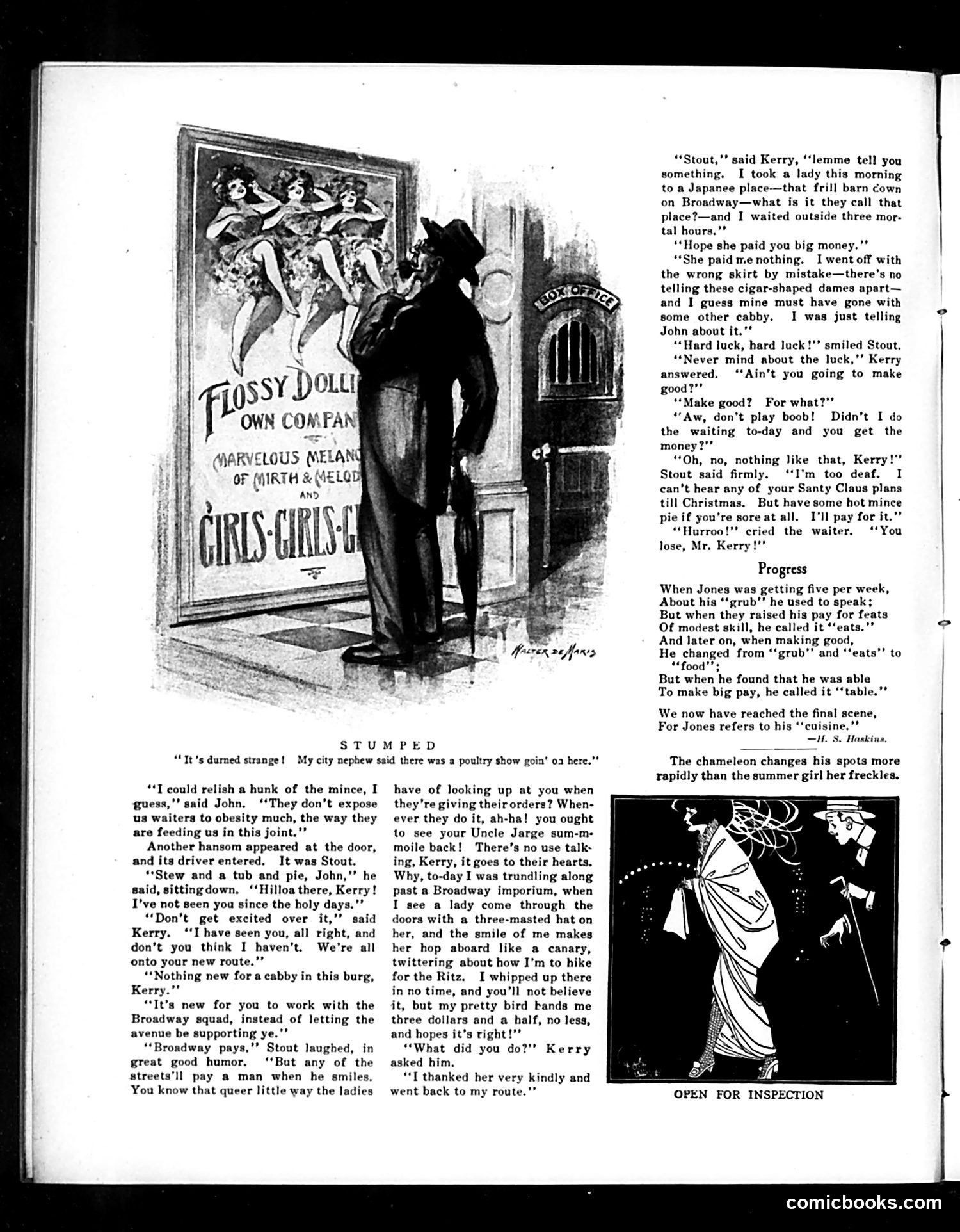
This cartoon mocks the women's suffrage movement through medical metaphor. The title "Suffragitis" presents voting rights activism as a disease afflicting women. The sketch shows a weary waiter named Mr. Kerry complaining to his boss about losing money—his troubles stem from female customers (implied suffragists) monopolizing tables for hours while conducting activism. The satire suggests suffragettes are nuisances disrupting normal business and social order. The accompanying story "Not Luck" by Clarence Day, Jr. elaborates this theme: a taxi driver complains about a female passenger who kept him waiting three hours before going to "the suffrage office." The implication is that suffrage activists are self-absorbed, inconsiderate, and wasteful of working men's time and earnings. The cartoon reflects anti-suffrage sentiment common in early 20th-century publications.
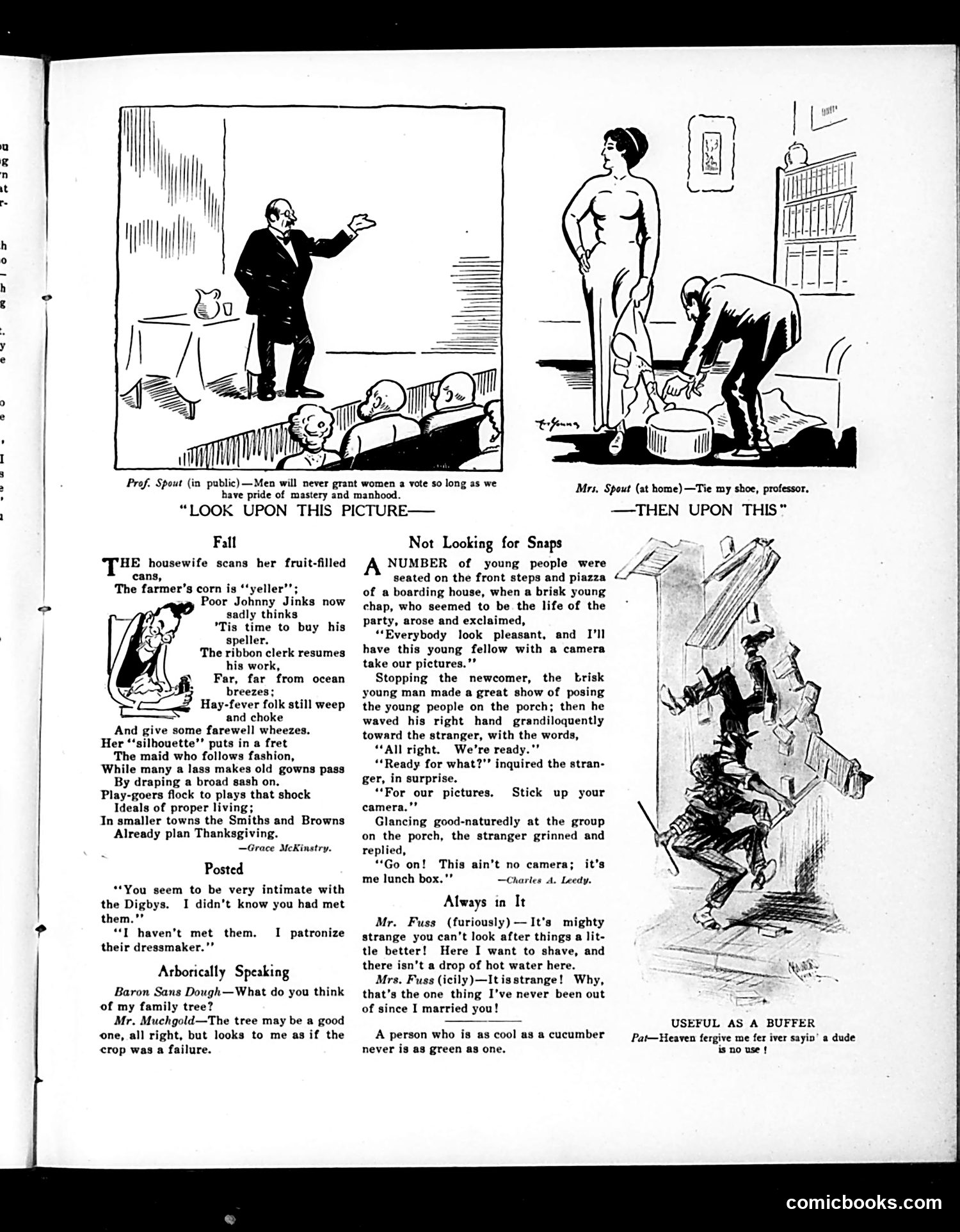
This page satirizes **women's suffrage** through contrasting cartoons. The top panels show "Prof. Spout" publicly arguing men shouldn't grant women votes because of "pride of mastery and manhood"—yet at home, his wife orders him to tie her shoe, revealing male dependence on women's domestic labor. The satire's point: men claiming superiority while relying on women for basic tasks undermines their argument against voting rights. The page also contains lighter humor pieces: a young man's prank where he poses people for a "photo" that's actually his lunch box; wordplay about family trees and dressmakers; and marital banter. These filler pieces were typical of Judge's format. The page reflects early-20th-century debate over women's suffrage, mocking male hypocrisy about "manhood" while women performed essential household and social work.
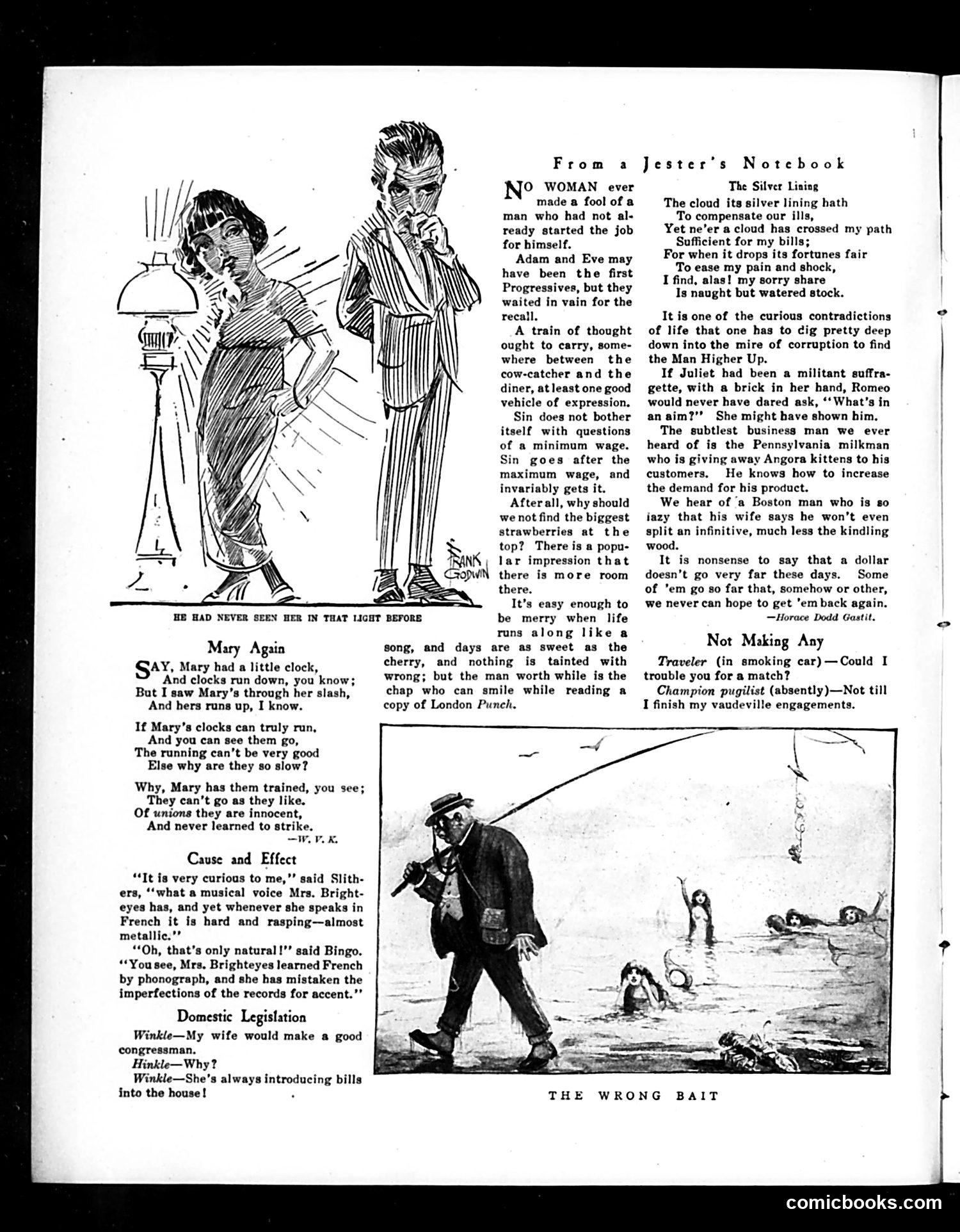
This page contains humor pieces typical of Judge's satirical approach, circa early 1900s. **The main cartoon, "The Wrong Bait,"** shows a man fishing in a pond where people are drowning or struggling in the water. The satire criticizes ineffective or misguided solutions to social problems—the fisherman is using the wrong approach to address the crisis before him. **The text pieces mock contemporary issues:** - "Mary Again" jokes about women's suffrage and labor unions (references to "strike") - "Domestic Legislation" puns on a wife "introducing bills into the house" (legislative wordplay) - "Cause and Effect" ridicules a woman who learned French via phonograph and adopted the machine's mechanical defects as "accent" - The "Jester's Notebook" section contains aphorisms about corruption ("Man Higher Up"), suffragettes, and economic frustration ("watered stock") The overall tone reflects upper-class skepticism toward progressive reforms, labor movements, and women's rights—positions typical of Judge's conservative readership during the Progressive Era.
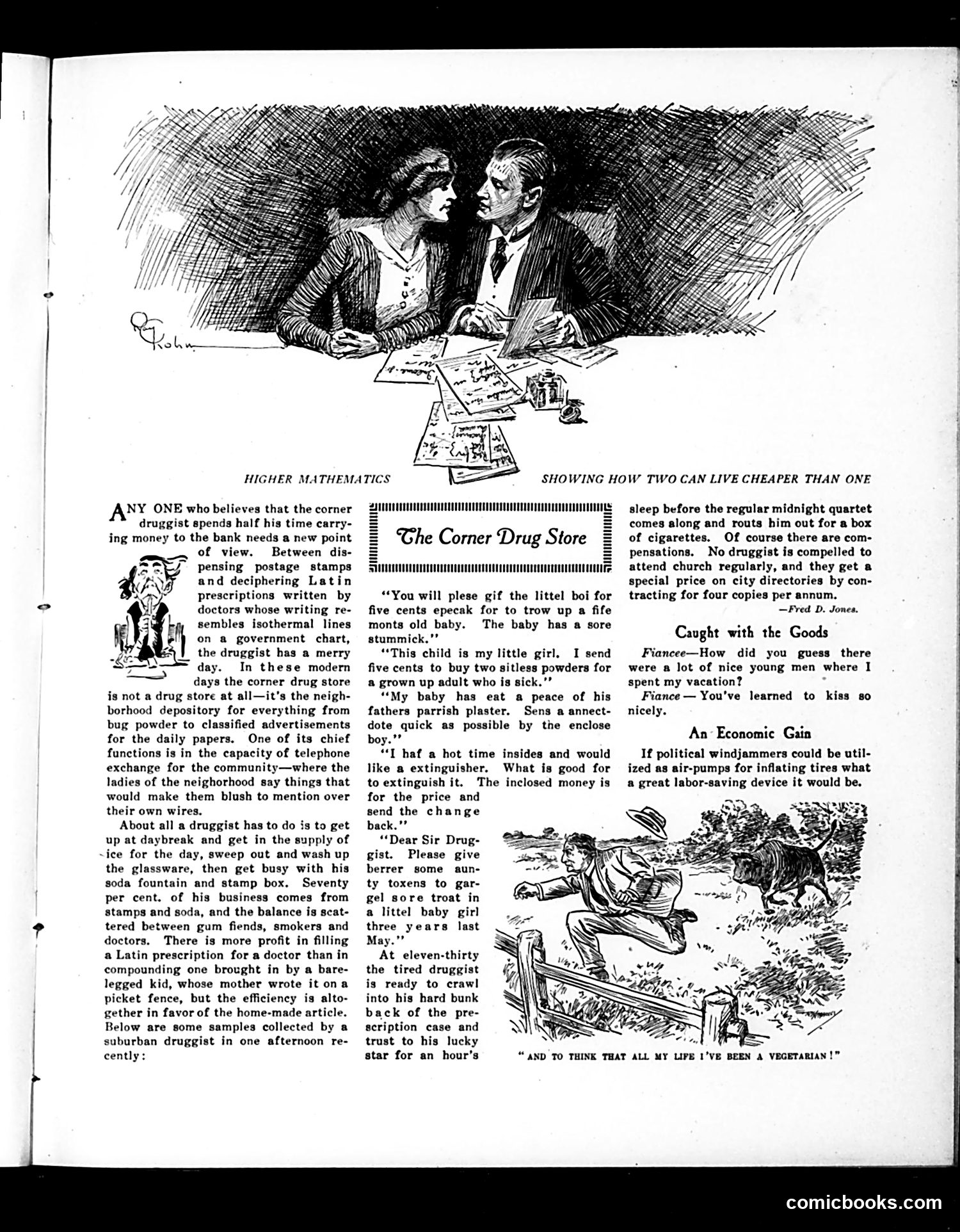
This Judge magazine page contains three satirical pieces: **"Higher Mathematics"** mocks the corner drugstore as a chaotic, multi-purpose community hub. The accompanying sketches show garbled, misspelled customer requests (likely from immigrants or working-class patrons with poor English). The satire targets both the druggist's exhausting workload and the incompetence of common customers—the humor relies on mockery of non-standard English and lower-class incompetence. **"Caught with the Goods"** is a brief joke about a fiancée caught in a lie: she claimed to spend vacation studying but clearly spent it kissing other men, revealing her true activities. **"An Economic Gain"** is a one-liner suggesting politicians should be used as air pumps—calling them "windjammers" (blowhards) and implying their hot air could serve useful purpose. The top illustration shows a couple discussing finances, captioned "showing how two can live cheaper than one"—suggesting cohabitation or marriage as economically practical.
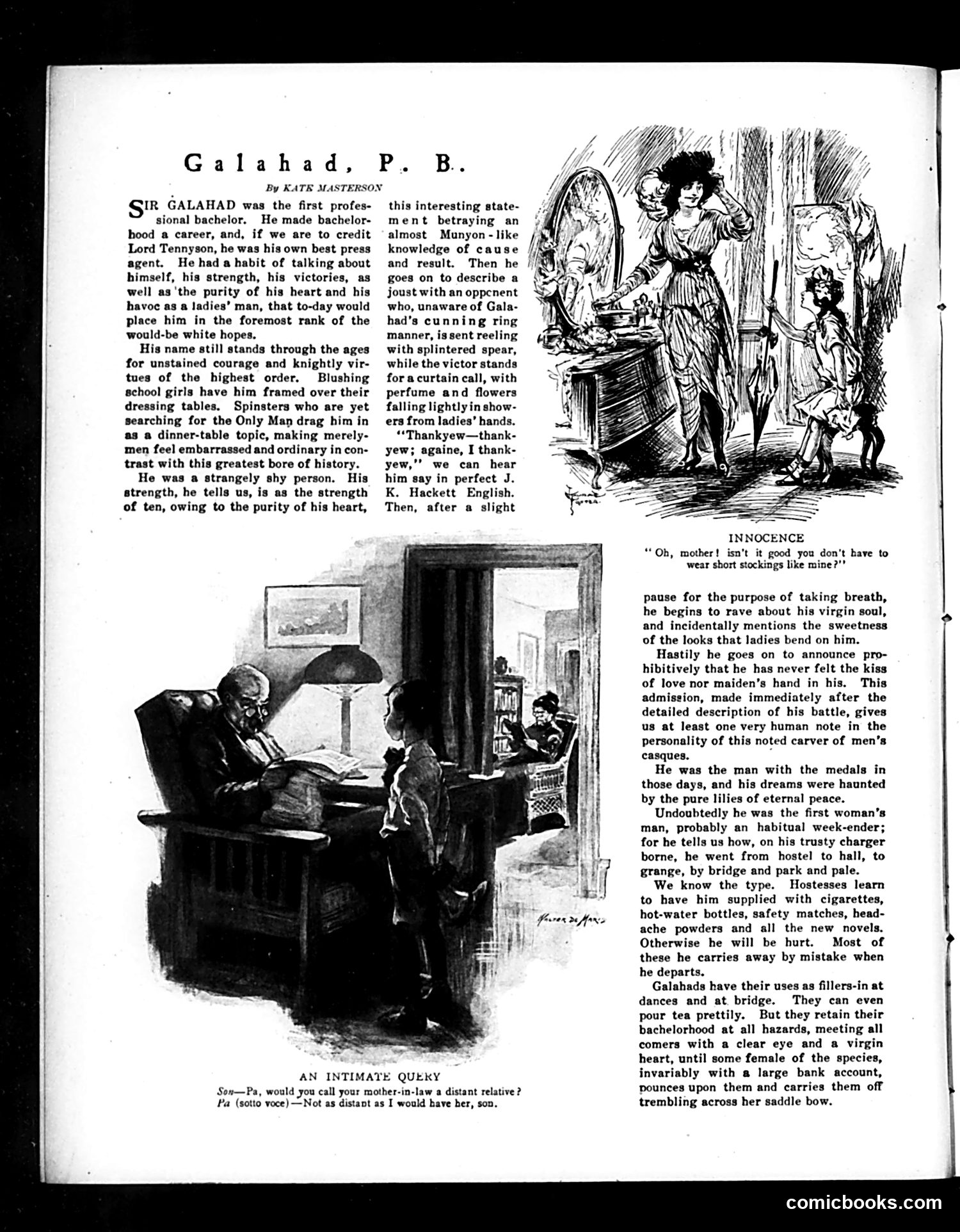
This article by Kate Masterson mocks the archetypal "professional bachelor" — a wealthy, idle man who cultivates an exaggerated image of purity, chivalry, and virtue while actually being a parasitic social climber. The satire targets men who: - Boast endlessly about their own accomplishments and "virgin soul" - Frequent society events (dances, bridge games, house parties) as paid companions - Sponge off hostesses, "accidentally" departing with cigarettes, novels, and other items - Maintain bachelorhood specifically to attract wealthy women with bank accounts, whom they then marry for financial security The reference to "Munyon" (likely patent medicine mogul) suggests fraudulent self-promotion. The accompanying cartoons—one showing a domestic scene, another titled "An Intimate Query" about in-laws—reinforce themes of masculine pretense and marital entanglement. This reflects early 20th-century anxieties about idle, fortune-hunting men exploiting social hospitality while claiming moral superiority.
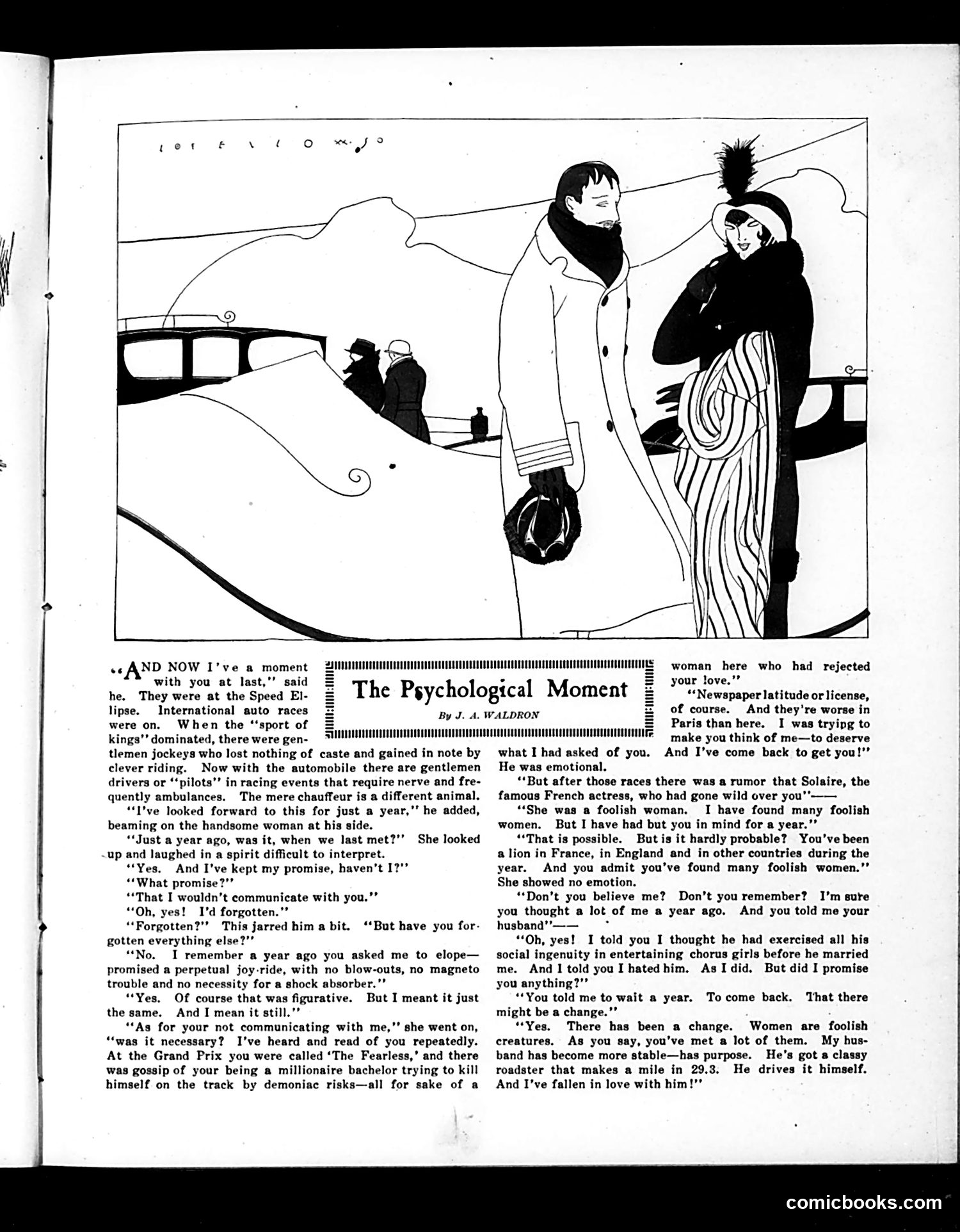
This story-cartoon satirizes early 1900s automobile racing culture and romantic delusion. A wealthy gentleman "pilot" (racing driver) returns after a year to win back a married woman who had rejected him. He claims he raced dangerously—allegedly risking death—to prove his devotion, and expects her to leave her husband. The punchline exposes his self-deception: she's fallen in love with her husband *because* he's become responsible and successful, buying a fast roadster. The satire cuts both ways—mocking the man's romantic grandiosity and self-destructive "passion," while suggesting women are foolishly swayed by material status symbols rather than genuine emotion. The "Grand Prix" and racing references anchor this in the era's fascination with automobile racing as elite sport and masculine proving ground.
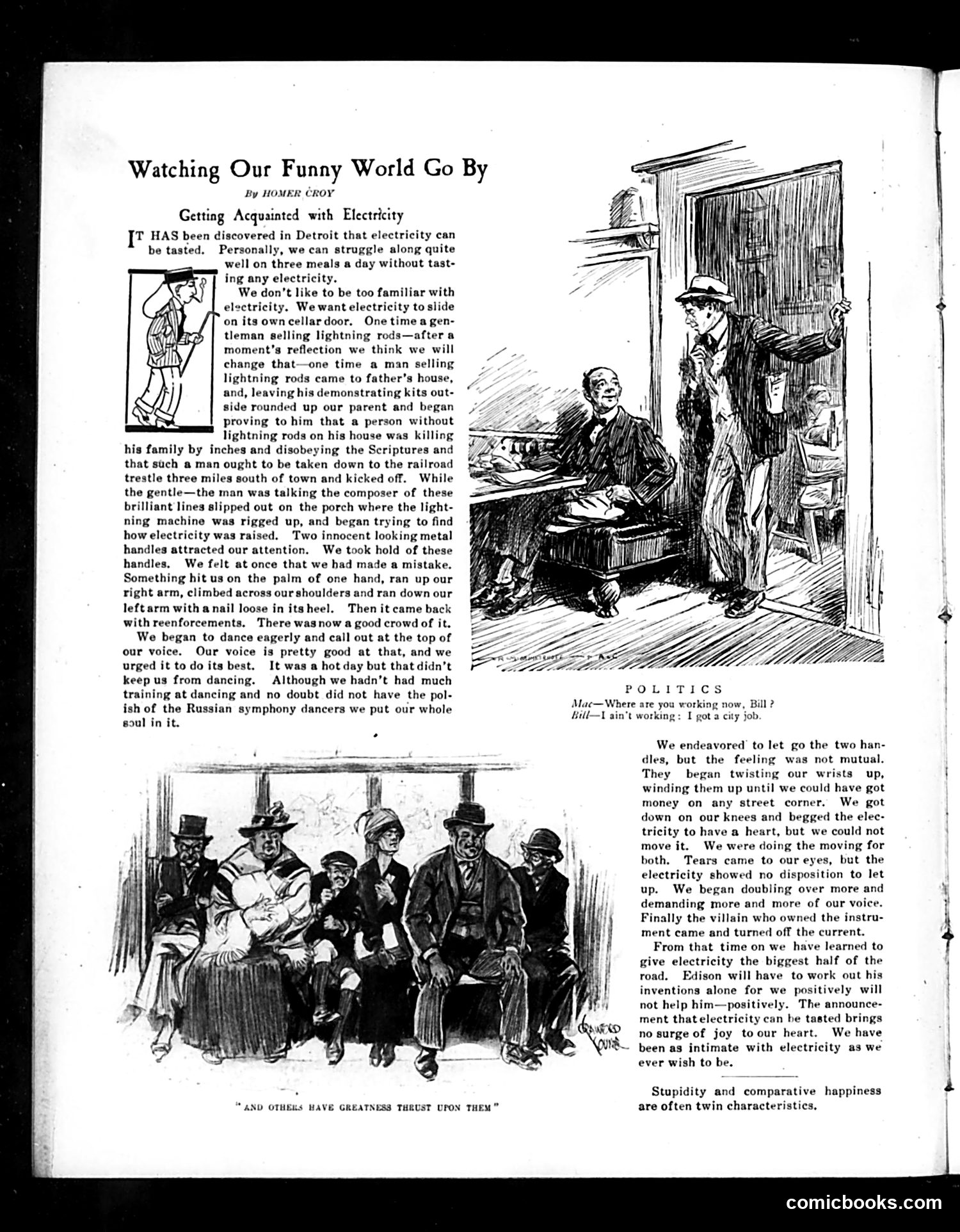
This humorous essay by Homer Croy satirizes humanity's dangerous fascination with new technology through personal anecdotes. **The main story**: A salesman demonstrates lightning rods by electrocuting the author, who touches metal handles connected to a generator. The piece mocks both the salesman's manipulative fearmongering (claiming unprotected homes kill families) and the author's naive curiosity, which results in an uncontrollable electric shock that forces him to dance involuntarily until someone mercifully cuts the power. **The satire**: Early 20th-century Americans were simultaneously awed and terrified by electricity. The piece ridicules this contradictory attitude—people want electricity's benefits but fear its dangers, and naive experimenters often learn painful lessons. **The politics cartoon** (bottom right) makes a separate joke: a man brags he has a "city job" despite not actually working, satirizing political patronage and corruption where unqualified people receive government positions through connections rather than merit. The final aphorism suggests stupidity and happiness coexist—ignorance is bliss.
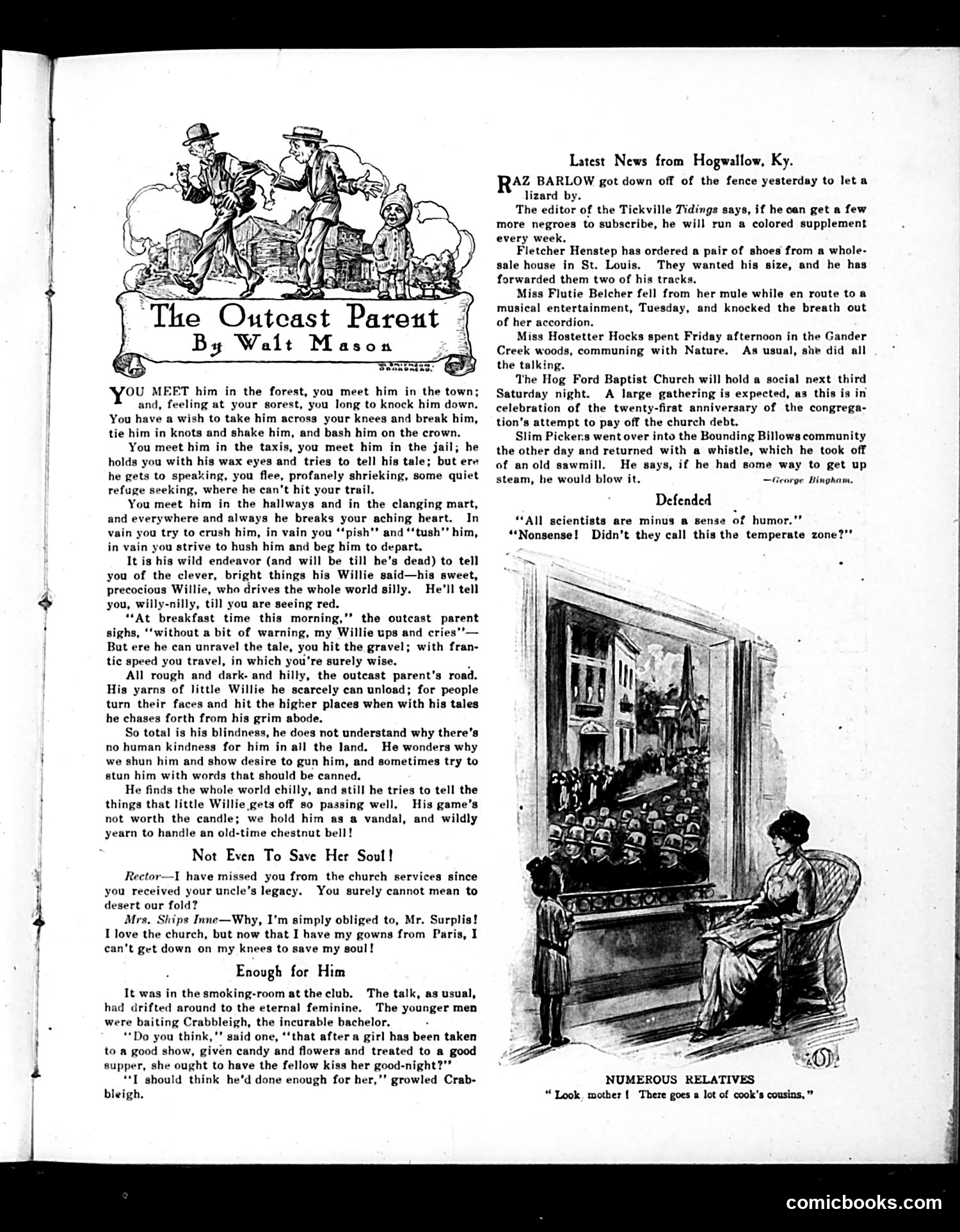
This page satirizes the universally despised social type: the parent obsessed with recounting their child's clever remarks. Walt Mason's poem depicts a man universally avoided—people flee his presence, avoid church to escape him, literally run away when he approaches. His affliction: compulsive storytelling about "little Willie's" precocious sayings. The satire targets not parenting itself, but narcissistic bragging and social obliviousness. The "outcast parent" cannot understand why society rejects him despite his relentless self-imposed mission to share Willie's witticisms. He's simultaneously pitiful and monstrous—a "vandal" driving people to madness. The accompanying jokes mock feminine vanity ("can't get down on my knees to save my soul" for Paris gowns) and bachelor cynicism about courtship obligations. The "Hogwallow, Ky." section provides rustic humor about rural incompetence and provincial life.
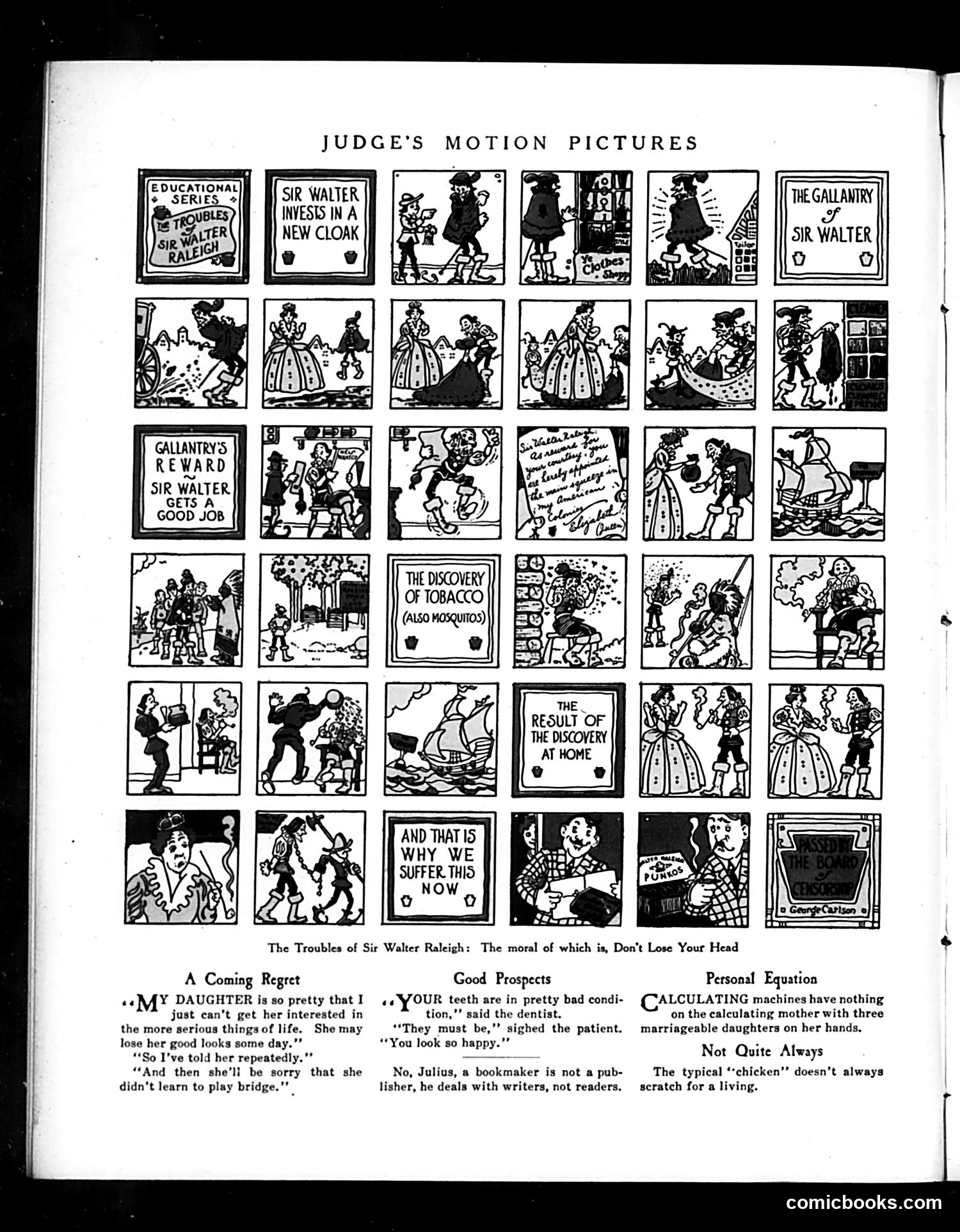
This page showcases Judge magazine's satirical comic strips and humor, primarily featuring a serial titled "The Troubles of Sir Walter Raleigh" with the moral "Don't Lose Your Head"—a pun referencing Raleigh's historical execution. The bottom section contains four separate joke panels with social commentary: 1. **"A Coming Regret"**: Satirizes shallow parenting—a father worries his beautiful daughter neglects serious pursuits, fearing she'll regret not learning practical skills (like bridge) when her looks fade. 2. **"Good Prospects"**: A dentist jokes about a patient's happiness despite bad teeth, suggesting the patient's cheerfulness is unwarranted. 3. **"Personal Equation"**: Mocks the calculating nature of mothers with multiple unmarriageable daughters—suggesting they view marriage prospects as mathematical problems. 4. **"Not Quite Always"**: Plays on wordplay confusion between "bookmaker" (betting operator) and publisher, then includes an unrelated joke about "chickens" (slang for young women) not literally scratching for food. These reflect early-20th-century concerns about women's education, marriage, and social anxieties.
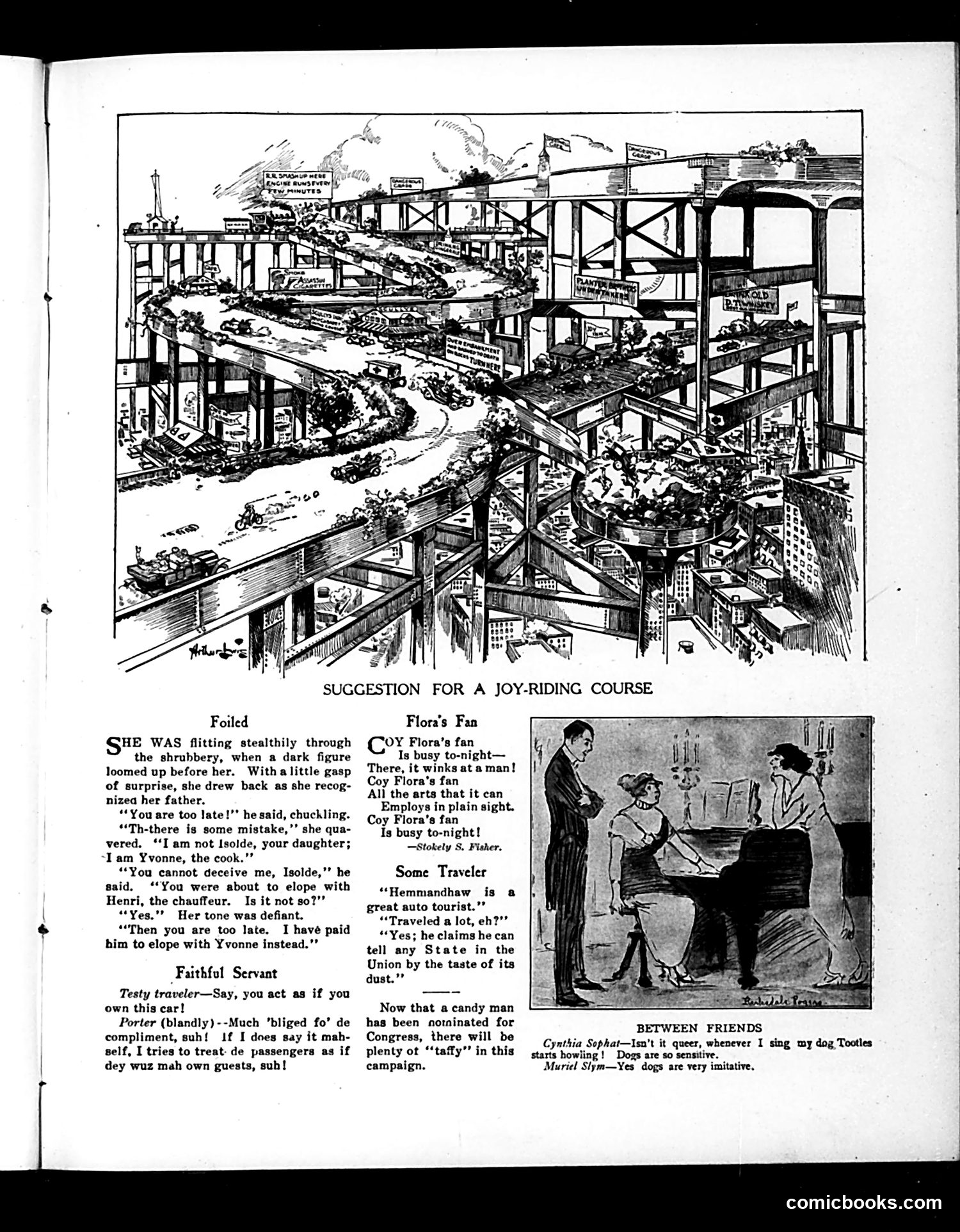
This page contains multiple brief satirical sketches typical of early 20th-century humor magazines: **"Foiled"** mocks elopement melodrama: A father catches his daughter attempting to flee with the chauffeur. The joke's twist—he's already paid the chauffeur to elope with the cook instead—satirizes the predictable romantic entanglements of servant-class narratives popular in period fiction. **"Faithful Servant"** uses dialect humor (common but now offensive) to joke about a porter's obsequiousness, suggesting he treats passengers like personal possessions. **"Flora's Fan"** appears to be flirtatious verse about feminine coquetry. **"Some Traveler"** mocks a boastful motorist who claims to identify states by dust taste—absurd auto-tourist braggadocio. The final political joke references a candy manufacturer's Congressional nomination, predicting campaign "taffy" (insincere flattery). **"Between Friends"** is a mild joke about a dog imitating its owner's singing voice. The page is primarily light social satire with no serious political content, reflecting Judge's mix of domestic comedy and gentle social observation.
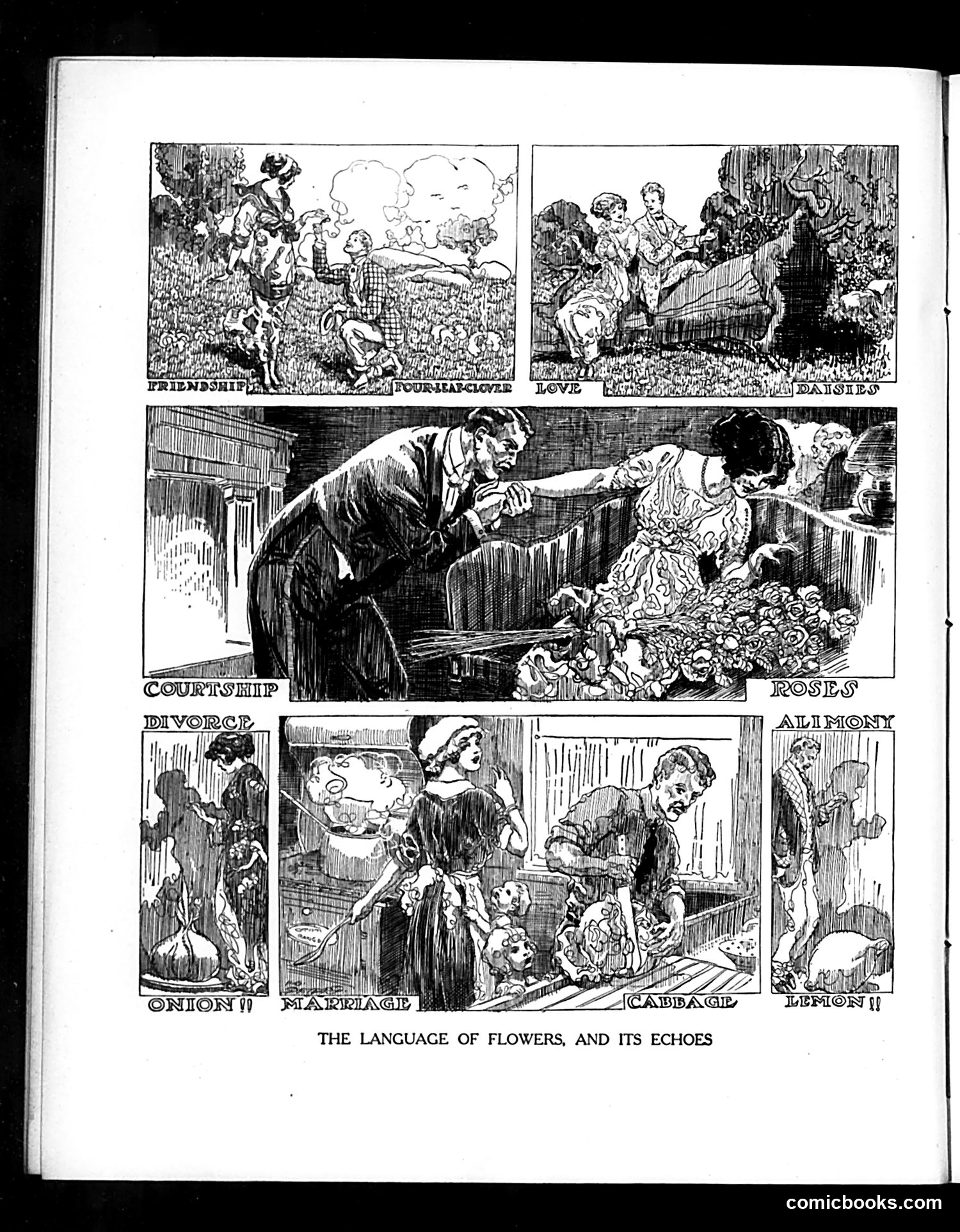
This page presents a satirical visual sequence about romantic and social meanings attributed to different flowers in Victorian culture. The top panels show idealized courtship scenarios (labeled "Courtship," "Love," "Daisies"), depicting genteel romance in pastoral and domestic settings. The larger central panel, labeled "Courtship" and "Roses," shows a man presenting flowers to a woman in a parlor—the romantic ideal. The bottom row inverts these meanings through "echoes," showing flowers' darker associations: "Onion" suggests tears/unhappiness, "Marriage" depicts domestic burden, "Cabbage" implies common/ordinary status, and "Lemon" suggests sourness. The satire mocks the sentimental "language of flowers" popular in Victorian society by juxtaposing romantic fantasy against marital reality—a common Judge magazine theme critiquing bourgeois domesticity.
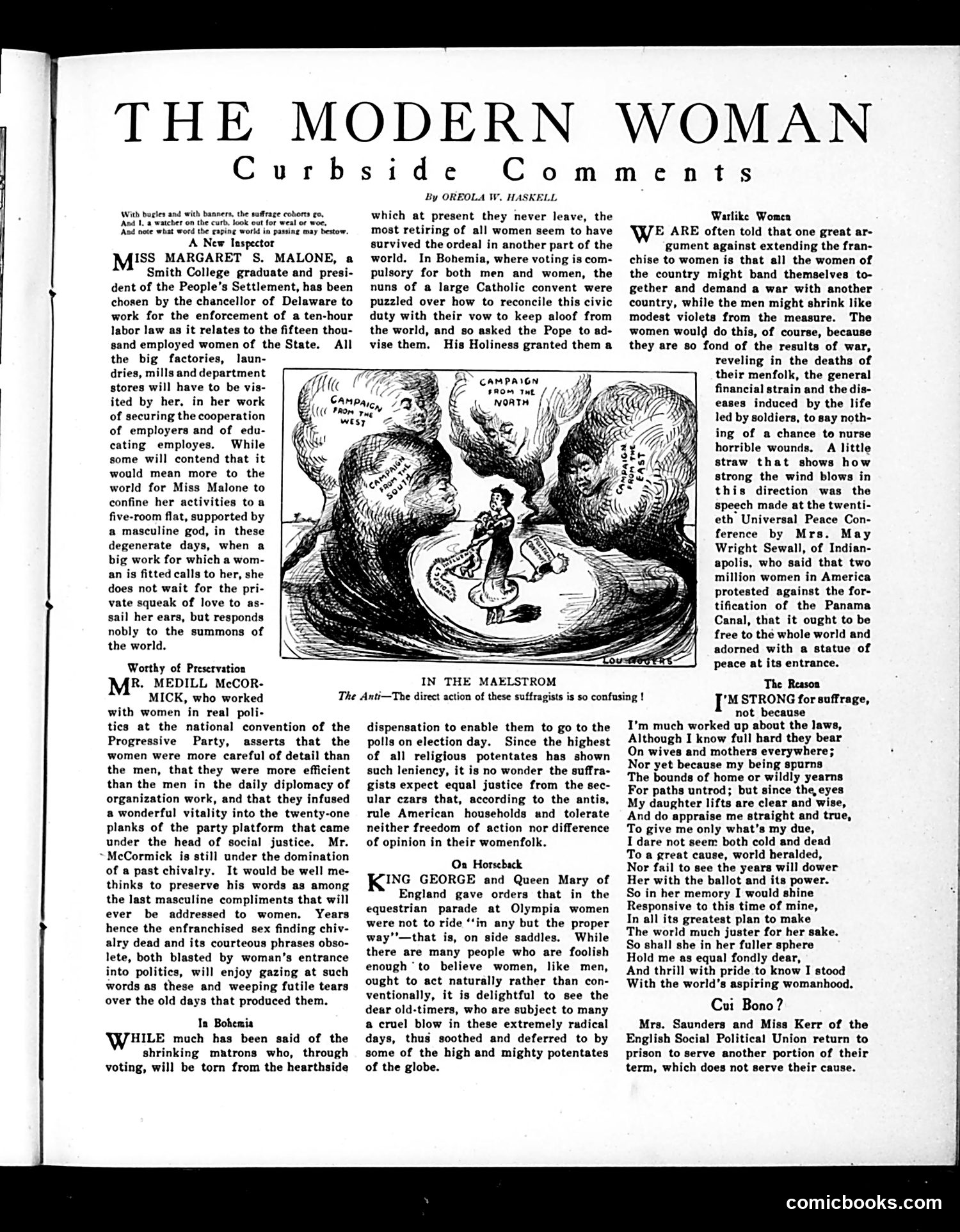
This page satirizes early 20th-century women's activism and anti-suffrage arguments through several sections: **Main Cartoon ("In the Maelstrom"):** Depicts suffragists as confusing, menacing figures engulfing a small man—likely representing male anxieties about women's political power. **Key Arguments Mocked:** 1. **"Warlike Women"**: Sarcastically rebuts the claim that enfranchised women would demand war. The author notes women already suffer war's consequences yet remain peaceful, undermining this anti-suffrage excuse. 2. **Praise for Women's Competence**: McCormick's observations that women excelled at organizational detail are presented as "the last masculine compliments"—implying suffrage will destroy male chivalry. 3. **Religious Authority**: The Pope's dispensation allowing nuns to vote in Bohemia is used to mock claims that women shouldn't vote on traditional grounds. 4. **Horseback Riding**: England's restriction on women's riding posture exemplifies arbitrary social conventions limiting women's freedom. The satire targets both anti-suffrage logic and male resistance to women's equality.
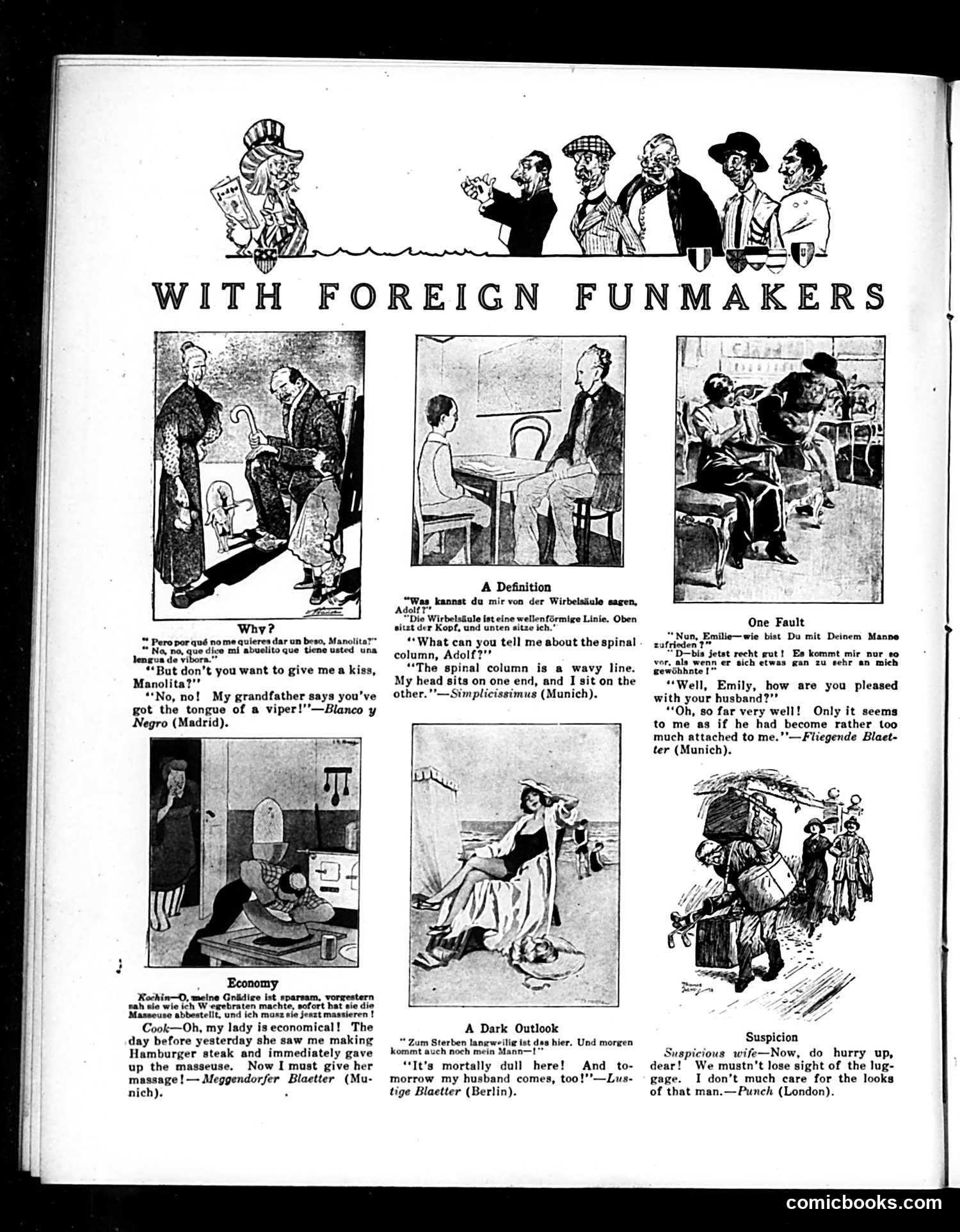
This page collects humorous comics and jokes from European satirical magazines, showcasing international humor circa early 20th century. The cartoons rely on domestic/marital comedy stereotypes: a girl rejecting a suitor because he has a "viper's tongue" (Spanish); a cook now massaging his employer after she saw him make hamburger steak and fired her masseuse (German); a schoolboy's cheeky definition of the spinal column positioning himself below his teacher (German); a bored wife dreading her husband's return (German); a wife complaining her husband is *too* attached to her (German); and a suspicious wife watching luggage, distrustful of a stranger (British). The satire targets class dynamics, gender roles, and marital discord through broad humor. The page's purpose appears to be showcasing "foreign" wit to American *Judge* readers—offering comparative amusement at how Europeans approach similar domestic scenarios differently.
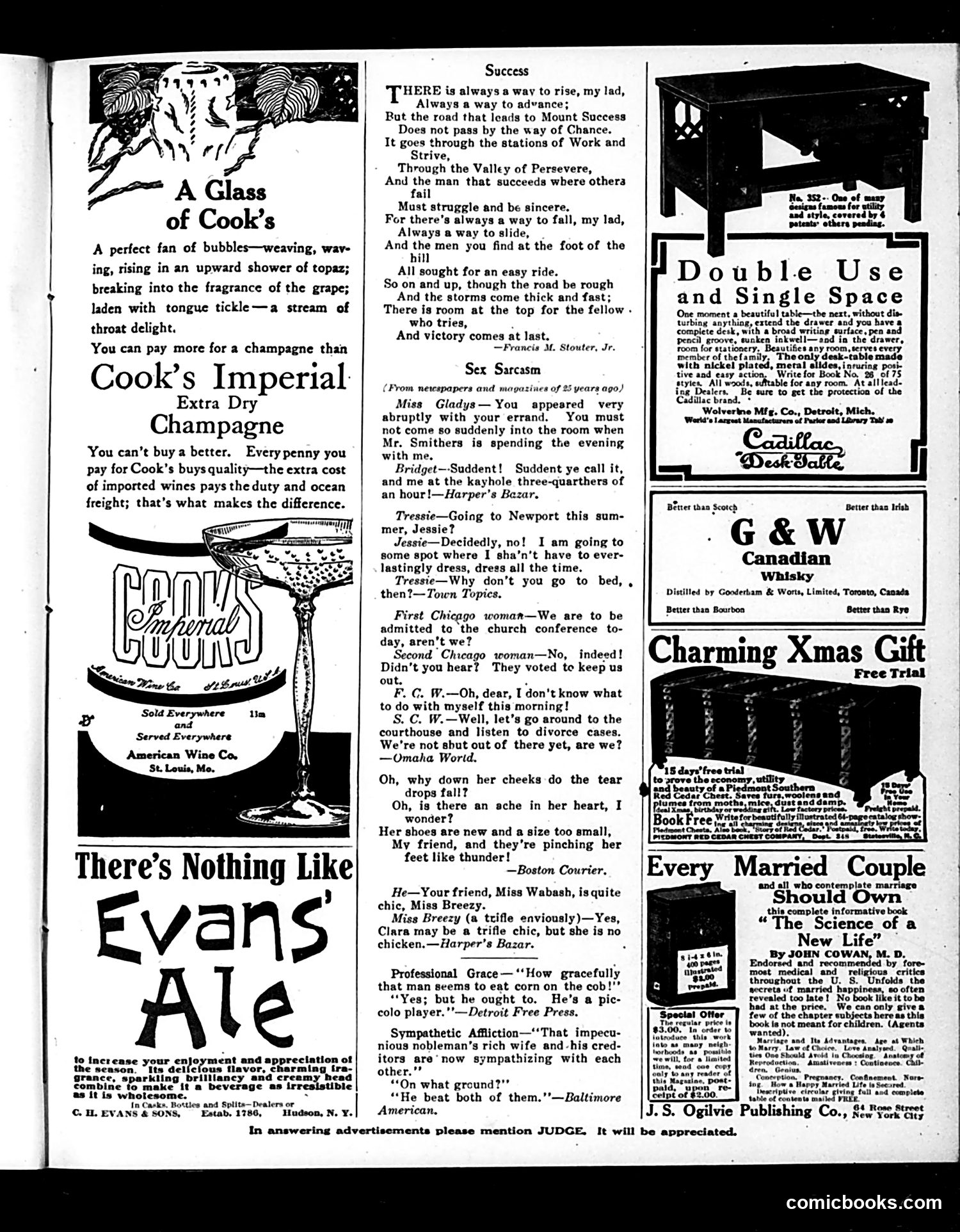
This page is primarily **advertising with some satirical content**. The main pieces are: **Advertisements:** Cook's Imperial Champagne, Evans Ale, and Wolverine furniture dominate the layout with product pitches emphasizing quality and value. **Satirical Content - "Sex Sarcasm":** This section reprints humorous exchanges from newspapers circa 25 years prior (roughly 1890s), poking fun at gender dynamics: - A maid interrupts her employer's evening with a gentleman caller - A woman prefers not dressing up on vacation - Women excluded from church conferences but welcome at divorce proceedings - A woman with painfully tight new shoes - A man's eating technique reflects his musical skill **The humor** targets domestic relations, women's social limitations, fashion discomfort, and marital discord—typical early-20th-century magazine satire. The pieces assume readers will find comedy in women's vanity, marital friction, and social restrictions. **"Success"** is inspirational verse about hard work—standard motivational filler common to era magazines.
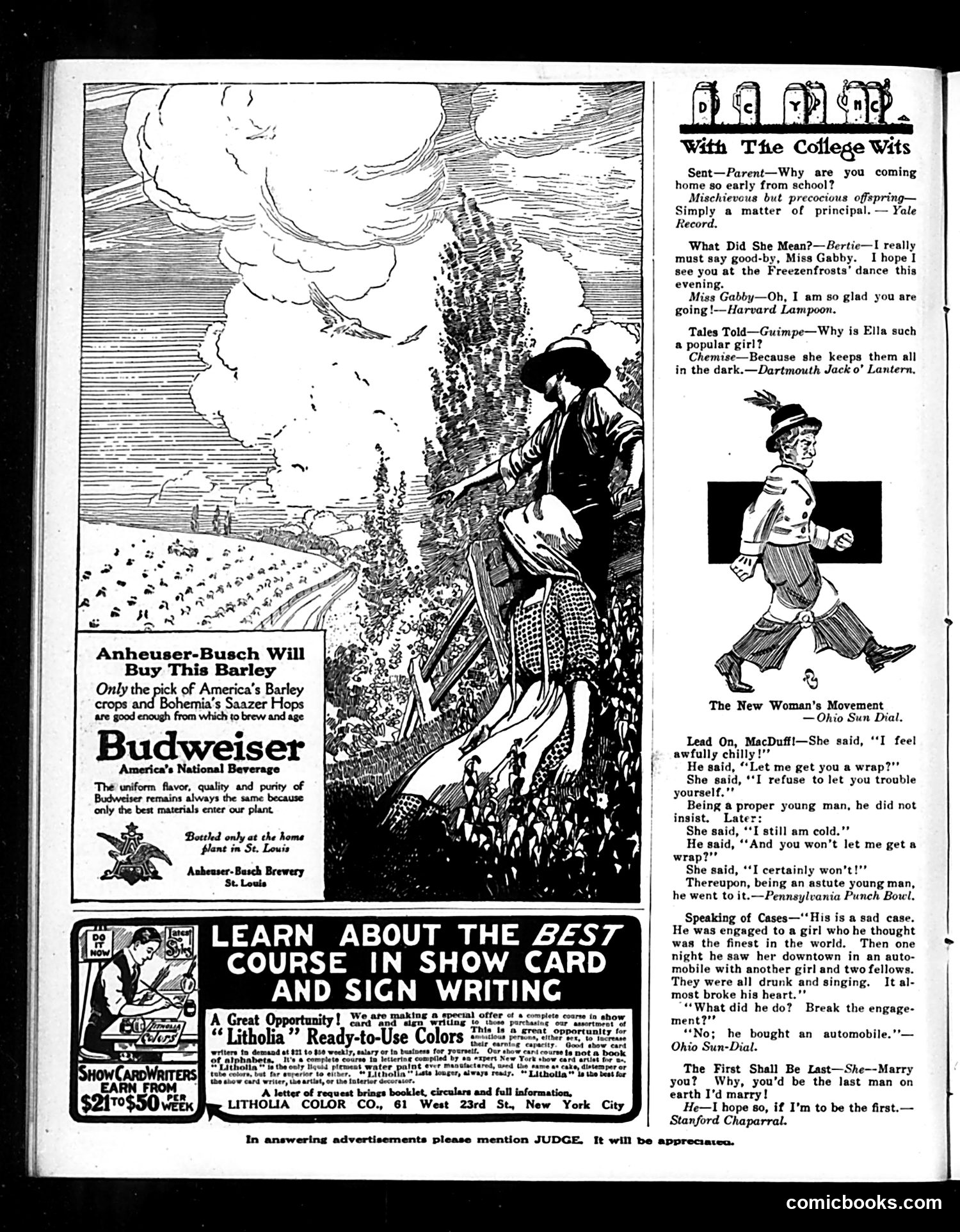
This page from *Judge* magazine contains college humor and advertisements typical of early 20th-century satire. **The College Wits section** reprints jokes from various college publications (Yale Record, Harvard Lampoon, Dartmouth Jack o'Lantern, etc.). These are mild, pun-based jokes about student life—a boy leaving school early "on principle," wordplay about a girl named "Gabby" and her mysterious appeal, and flirtation scenarios. The humor relies on double meanings and gentle social observations about courtship. **The New Woman's Movement cartoon** satirizes changing gender dynamics: a woman refuses a man's offer of a coat, then later complains of being cold but refuses his help—commenting on women's increasing independence and the confusion this creates for traditional male behavior. **The advertisements** promote Budweiser beer and a show-card writing course, representing commercial products targeting young men and aspiring sign-makers. The overall tone is lighthearted college humor with mild social commentary on modern courtship and women's roles.
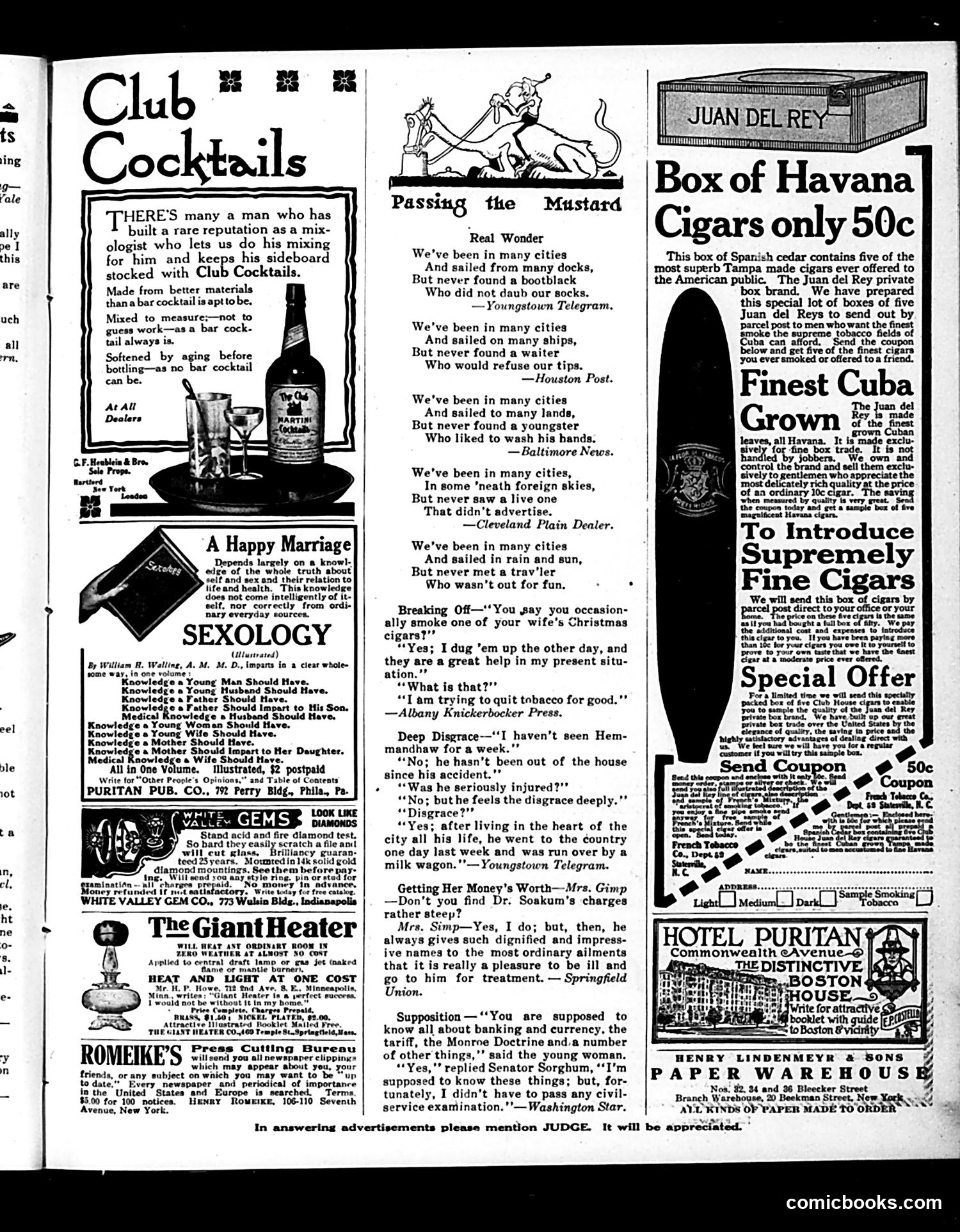
This page is primarily **advertisements and humor columns**, not political cartoons. The "Passing the Mustard" section contains brief, unrelated jokes about universal human behaviors—bootblacks ruining socks, waiters accepting tips, children avoiding washing, and traveling salesmen advertising themselves. These are gentle, observational humor with no political content. The remaining humor pieces ("Breaking Off," "Deep Disgrace," "Getting Her Money's Worth," "Supposition") are domestic comedy sketches about marriage, accidents, and medical expenses—typical early 20th-century magazine humor. The page is dominated by **product advertisements**: Club Cocktails, a "Sexology" book, artificial diamonds, a kerosene heater, and cigars. These reflect contemporary consumer goods and social anxieties (sex education for young men, affordable luxury items). There are no identifiable political figures or satirical targets. This appears to be a standard Judge magazine filler page mixing light humor with paid advertising.
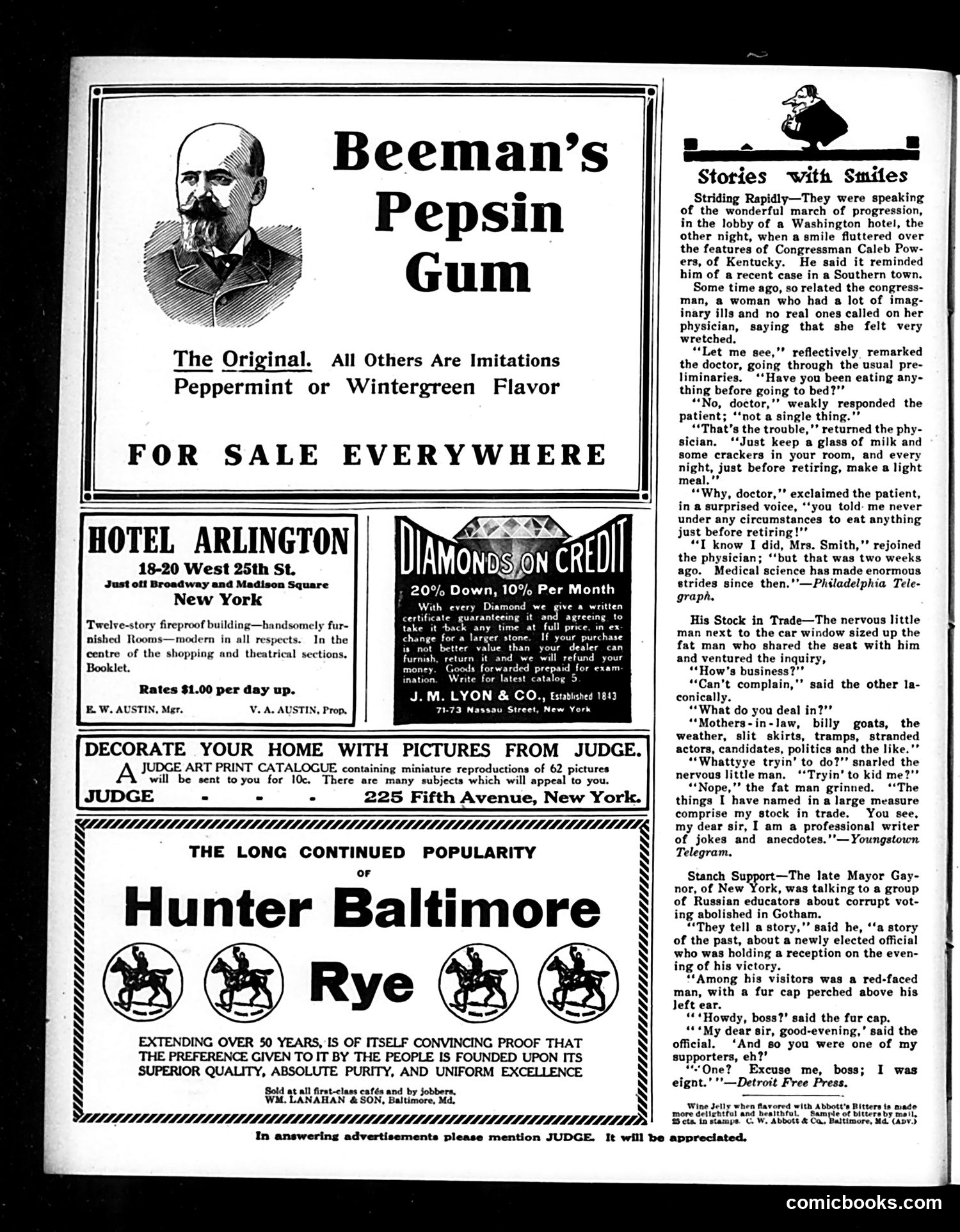
This page is primarily **advertisements and humorous anecdotes**, not political satire. The main content includes: **"Stories with Smiles"** (right column): Three brief jokes attributed to public figures. One features **Congressman Caleb Powers of Kentucky**, recounting a medical anecdote about a patient whose imaginary ailments improve with midnight snacks—satirizing medical advice inconsistency. Another joke involves trading in "mothers-in-law, billy goats, weather, slit skirts, tramps" as a "professional writer of jokes"—mocking sensationalist topics of the era. **Advertisements** dominate: Beeman's Pepsin Gum, Hotel Arlington, diamonds on credit, Judge art prints, and Hunter Baltimore Rye whiskey. The humor is gentle, domestic, and gossipy rather than pointed political commentary. The page reflects *Judge* magazine's blend of light social humor targeting middle-class readers alongside commercial interests, typical of early 20th-century American periodicals.
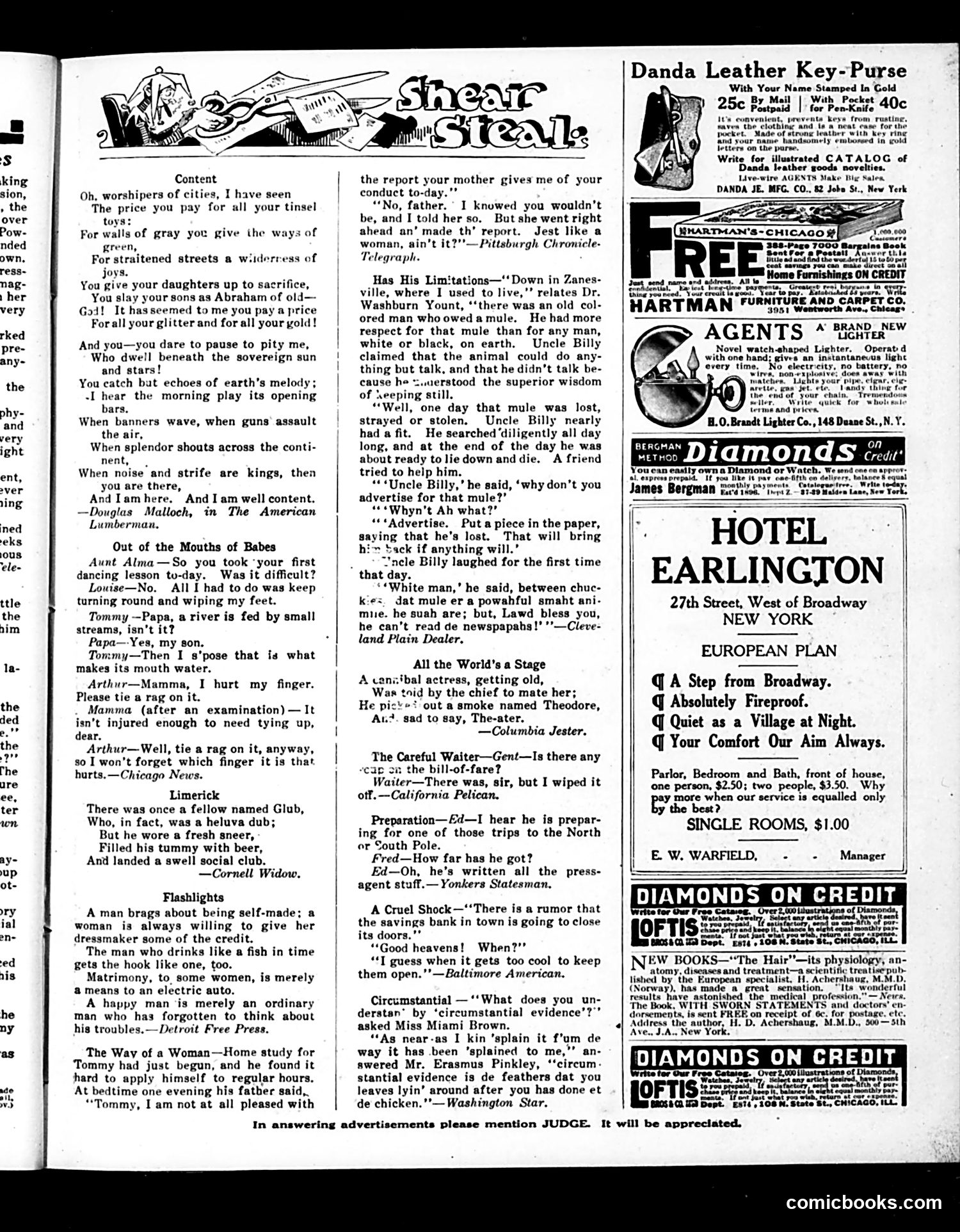
This page is primarily **humor and light satire** rather than political commentary. The main content includes: **"Content"** — A serious poem contrasting rural/natural life favorably against urban artificiality, followed by miscellaneous humorous anecdotes and jokes: - Children's witticisms ("Out of the Mouths of Babes") - A limerick mocking a foolish social climber named Glub - "Flashlights" — brief satirical observations on human nature (vanity, drinking, marriage, self-deception) - Dialect humor featuring "Uncle Billy," an African American character who doesn't understand newspapers (reflecting period racial stereotypes) - Puns and wordplay **The advertisements** (right side) promote hotels, diamonds, and other consumer goods typical of early 20th-century magazines. The page reflects Judge's formula: mixing genteel literary content with accessible humor aimed at middle-class readers, while reinforcing contemporary social attitudes including racial caricature.
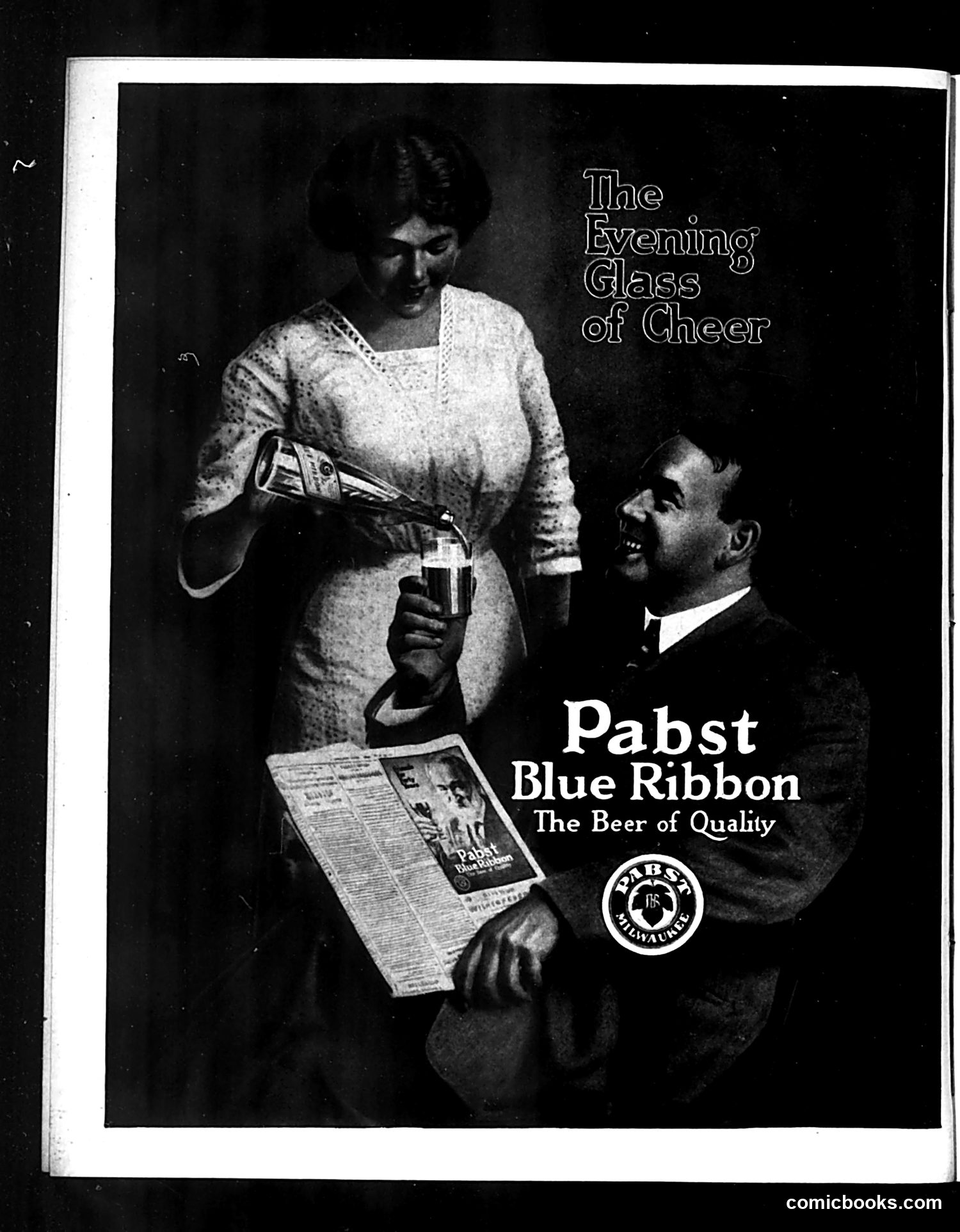
This is a **Pabst Blue Ribbon beer advertisement**, not political satire. The ad depicts a domestic scene where a woman pours beer for a seated man while he reads a newspaper. The tagline "The Evening Glass of Cheer" suggests beer as an everyday leisure beverage for relaxation. The advertisement reflects early 20th-century gender roles and marketing: the woman serves the man, positioning beer consumption as a normal, respectable household activity. The "Beer of Quality" slogan emphasizes product reputation during an era before Prohibition (1920-1933), when breweries actively advertised to maintain their market and social legitimacy. This represents typical period advertising that normalized alcohol consumption within domestic, middle-class settings.