
Judge, 1913-10-18 · page 12 of 24
Judge — October 18, 1913 — page 12: what you’re looking at
What you’re looking at
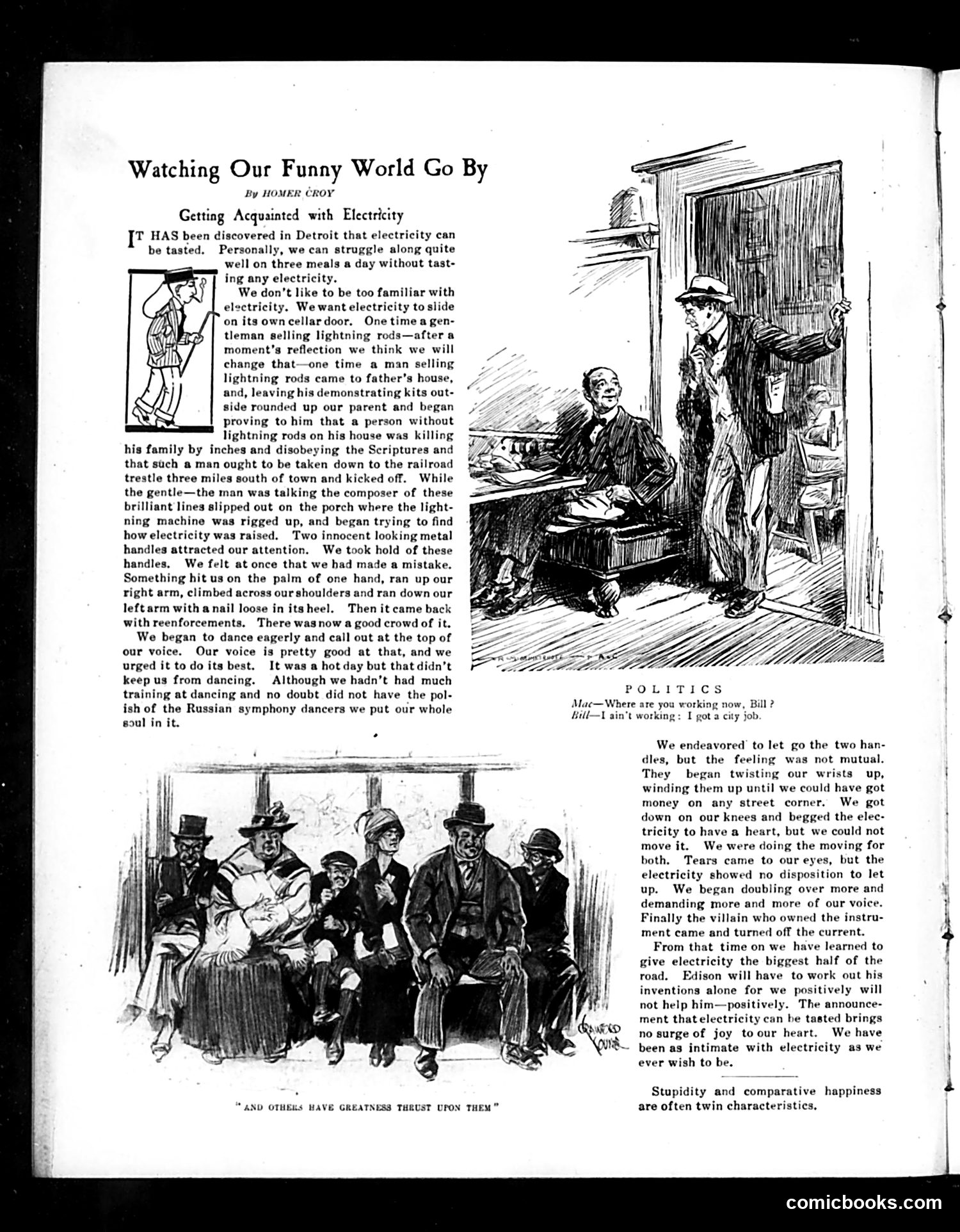
This humorous essay by Homer Croy satirizes humanity's dangerous fascination with new technology through personal anecdotes. **The main story**: A salesman demonstrates lightning rods by electrocuting the author, who touches metal handles connected to a generator. The piece mocks both the salesman's manipulative fearmongering (claiming unprotected homes kill families) and the author's naive curiosity, which results in an uncontrollable electric shock that forces him to dance involuntarily until someone mercifully cuts the power. **The satire**: Early 20th-century Americans were simultaneously awed and terrified by electricity. The piece ridicules this contradictory attitude—people want electricity's benefits but fear its dangers, and naive experimenters often learn painful lessons. **The politics cartoon** (bottom right) makes a separate joke: a man brags he has a "city job" despite not actually working, satirizing political patronage and corruption where unqualified people receive government positions through connections rather than merit. The final aphorism suggests stupidity and happiness coexist—ignorance is bliss.
📄 Transcribed text from this page (OCR, searchable)
Machine-transcribed from the original scan — historical spelling and the odd misread are preserved.
Watching Our Funny World Go By HOMER CROY Getting Acquainted with Electricity I" HAS been discovered in Detroit that electricity can be tasted. Personally, we can struggle along quite well on three meals a day without tast- ing any electricity. We don’t like to be too familiar with electricity. We want electricity to slide on its owncellardoor. One time agen- tleman selling lightning rods—after a moment's reflection we think we will change that—one time a man selling lightning rods came to father’s house, and, leaving his demonstrating kits out- side rounded up our parent and began proving to him that a person without lightning rods on his house was killing his family by inches and disobeying the Scriptures and that such a man ought to be taken down to the railroad trestle three miles south of town and kicked off. While the gentle—the man was talking the composer of these brilliant lines slipped out on the porch where the light- ning machine was rigged up, and began trying to find how electricity was raised. Two innocent looking metal handles attracted our attention. We took hold of these handles, We felt at once that we had made a mistake. Something hit us on the palm of one hand, ran up our right arm, climbed across our shoulders and ran down our left arm with a nail loose in itsheel. Then it came back with reenforcements. There was now a good crowd of it. We began to dance eagerly and call out at the top of our voice. Our voice is pretty good at that, and we urged it to do its best. It was a hot day but that didn’t keep us from dancing. Although we hadn’t had much training at dancing and no doubt did not have the pol- ish of the Russian symphony dancers we put our whole soul in it. POLITICS | Mac—Where are you working now, Bill ? Bill—I ain't working : I got a city job: We endeavored to let go the two han- dles, but the feeling was not mutual. They began twisting our wrists up, | winding them up until we could have got money on any street corner. We got down on our knees and begged the elec- tricity to have a heart, but we could not move it. We were doing the moving for both. Tears came to our eyes, but the electricity showed no disposition to let up. We began doubling over more and demanding more and more of our voice. Finally the villain who owned the instru- ment came and turned off the current. From that time on we have learned to give electricity the biggest half of the \ road. Edison will have to work out his { inventions alone for we positively will i not help him—positively. The announce- ment thatelectricity can be tasted brings no surge of joy toour heart. We have been as intimate with electricity as we | ever wish to be. | ; Stupidity and comparative happiness “AND OTHEKS HAVE GREATNESS THRUST UPON THEM” are often twin characteristics, comicbooks.com