
Judge, 1913-10-18 · page 4 of 24
Judge — October 18, 1913 — page 4: what you’re looking at
What you’re looking at
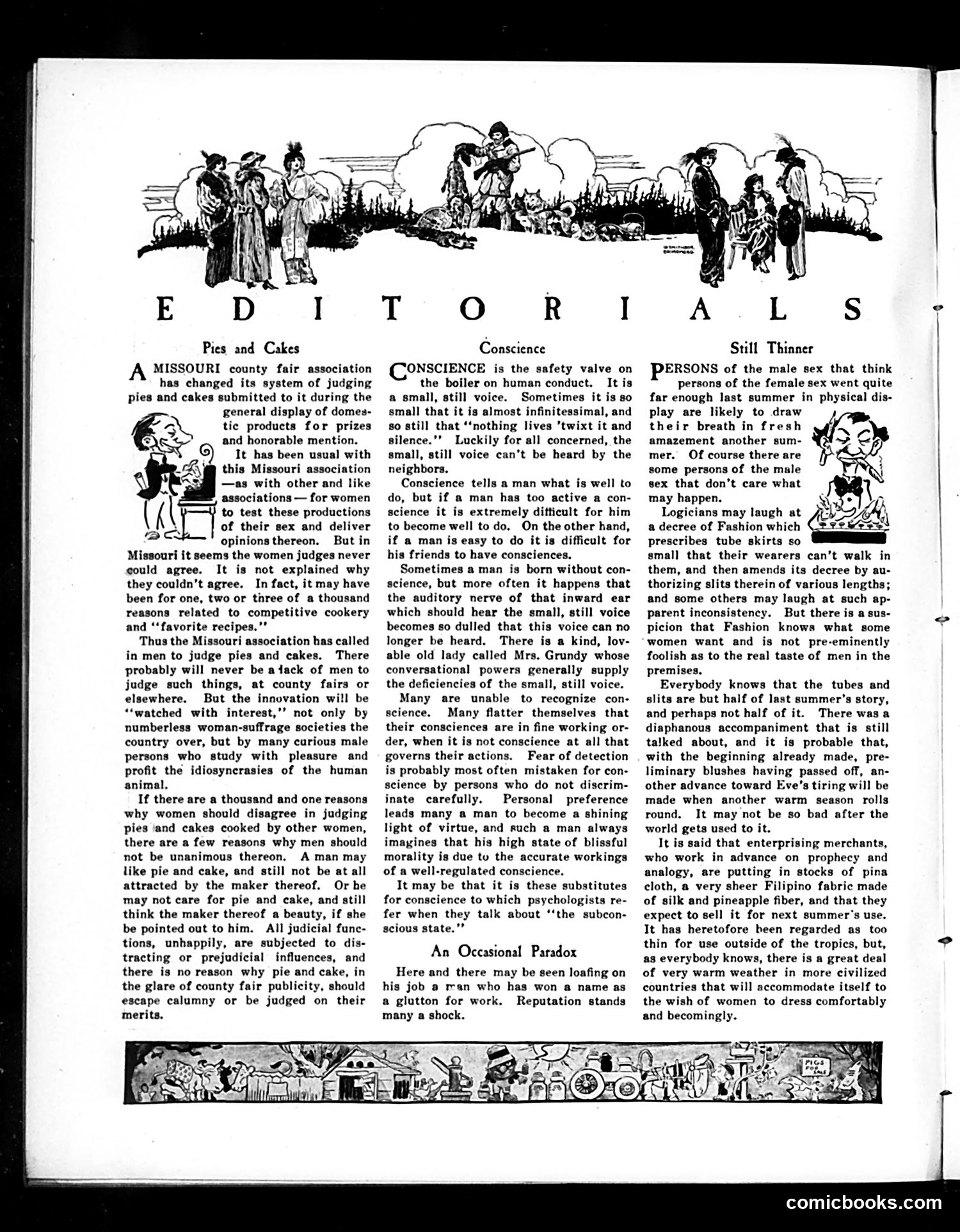
This page from *Judge* magazine presents three opinion pieces with accompanying illustrations: **"Pies and Cakes"** critiques Missouri's county fair system for judging baked goods. The editorial argues the association should rely on objective standards rather than subjective taste preferences, suggesting women-suffrage societies and animal advocates shouldn't influence judging criteria. **"Conscience"** explores the nature of moral conscience as an "inward ear" guiding human conduct, distinguishing between genuine conscience and mere social fear or reputation concerns. **"Still Thinner"** satirizes men who mock women's fashion choices—specifically the controversy over short skirts and tube silhouettes—while hypocritically pursuing their own sartorial trends. The piece argues fashion choices reflect practical judgment, not foolishness. The illustrations use caricature to emphasize these points about social hypocrisy and arbitrary judgment standards.
📄 Transcribed text from this page (OCR, searchable)
Machine-transcribed from the original scan — historical spelling and the odd misread are preserved.
Pies and Cakes A MISSOURI county fair association has changed its system of judging pies and cakes submitted to it during the general display of domes- tie products for prizes and honorable mention. It has been usual with this Missouri association —as with other and like associations — for women to test these productions of their sex and deliver opinions thereon. But in Missouri it seems the women judges never could agree. It is not explained why they couldn’t agree. In fact, it may have been for one, two or three of a thousand reasons related to competitive cookery and ‘‘favorite recipes.” Thus the Missouri association has called in men to judge pies and cakes. There probably will never be adack of men to judge such things, at county fairs or elsewhere. But the innovation will be “‘watched with interest,’’ not only by numberless woman-suffrage societies the country over, but by many carious male persons who study with pleasure and profit the idiosyncrasies of the human animal. If there are a thousand and one reasons why women should disagree in judging pies ‘and cakes cooked by other women, there are a few reasons why men should not be unanimous thereon. A man may like pie and cake, and still not be at all attracted by the maker thereof. Or he may not care for pie and cake, and still think the maker thereof a beauty, if she be pointed out to him. All judicial func- tions, unhappily, are subjected to dis- tracting or prejudicial influences, and there is no reason why pie and cake, in the glare of county fair publicity, should escape calumny or be judged on their merits. Conscience (CONSCIENCE is the safety valve on the boiler on human conduct. It is a small, still voice. Sometimes it is 80 small that it is almost infinitessimal, and so still that ‘‘nothing lives ’twixt it and silence."’ Luckily for all concerned, the small, still voice can’t be heard by the neighbors, Conscience tells a man what is well to do, but if a man has too active a con- science it is extremely difticult for him to become well to do. On the other hand, if a man is easy to do it is difficult for his friends to have consciences. Sometimes a man is born without con- science, but more often it happens that the auditory nerve of that inward ear which should hear the small, still voice becomes so dulled that this voice can no longer be heard. There is a kind, lov- able old lady called Mrs. Grundy whose conversational powers generally supply the deficiencies of the small, still voice. Many are unable to recognize con- science. Many flatter themselves that their consciences are in fine working or- der, when it is not conscience at all that governs their actions. Fear of detection is probably most often mistaken for con- science by persons who do not discrim- inate carefully. Personal preference leads many a man to become a shining light of virtue, and such a man always imagines that his high state of blissful morality is due tu the accurate workings of a well-regulated conscience. It may be that it is these substitutes for conscience to which psychologists re- fer when they talk about ‘‘the subcon- scious state."” An Occasional Paradox Here and there may be seen loafing on his job a ran who has won a name as a glutton for work. Reputation stands many a shock. Still Thinner PERSONS of the male sex that think persons of the female sex went quite far enough last summer in physical dis- play are likely to draw their breath in fresh amazement another sum- mer. Of course there are A some persons of the male ; sex that don’t care what iy may happen. Neo Mi Logicians may laugh at Zea a decree of Fashion which Wee prescribes tube skirts so small that their wearers can’t walk in id then amends its decree by au- ing slits therein of various lengths; and some others may laugh at such ap- parent inconsistency. But there is a sus- picion that Fashion knows what some women want and is not pre-eminently foolish as to the real taste of men in the premises, Everybody knows that the tubes and slits are but half of last summer's story, and perhaps not half of it. There was a diaphanous accompaniment that is still talked about, and it is probable that, with the beginning already made, pre- liminary blushes having passed off, an- other advance toward Eve's tiring will be made when another warm season rolls round. It may not be so bad after the world gets used to it. It is said that enterprising merchants, who work in advance on prophecy and analogy, are putting in stocks of pina cloth, a very sheer Filipino fabric made of silk and pineapple fiber, and that they expect to sell it for next summer's use. It has heretofore been regarded as too thin for use outside of the tropics, but, as everybody knows, there is a great deal of very warm weather in more civilized countries that will accommodate itself to the wish of women to dress comfortably and becomingly. comicbooks.com