
Judge, 1913-10-18 · page 11 of 24
Judge — October 18, 1913 — page 11: what you’re looking at
What you’re looking at
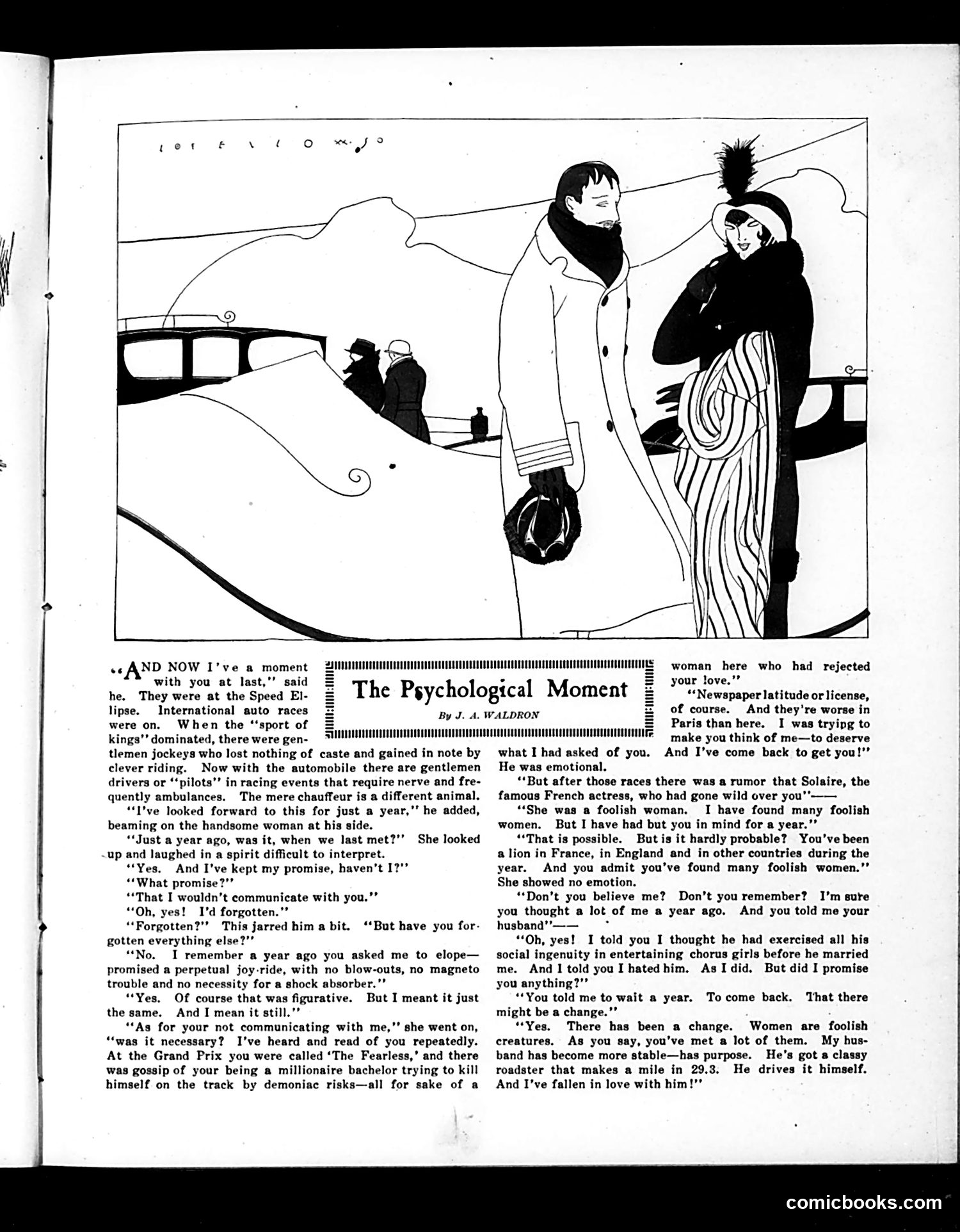
This story-cartoon satirizes early 1900s automobile racing culture and romantic delusion. A wealthy gentleman "pilot" (racing driver) returns after a year to win back a married woman who had rejected him. He claims he raced dangerously—allegedly risking death—to prove his devotion, and expects her to leave her husband. The punchline exposes his self-deception: she's fallen in love with her husband *because* he's become responsible and successful, buying a fast roadster. The satire cuts both ways—mocking the man's romantic grandiosity and self-destructive "passion," while suggesting women are foolishly swayed by material status symbols rather than genuine emotion. The "Grand Prix" and racing references anchor this in the era's fascination with automobile racing as elite sport and masculine proving ground.
📄 Transcribed text from this page (OCR, searchable)
Machine-transcribed from the original scan — historical spelling and the odd misread are preserved.
+s AND NOW I've a moment with you at last,’’ said he. They were at the Speed El- lipse. International auto races were on. When the ‘sport of kings’’ dominated, there were gen- tlemen jockeys who lost nothing of caste and gained in note by clever riding. Now with the automobile there are gentlemen drivers or ‘‘pilots’’ in racing events that require nerve and fre- quently ambulances. The mere chauffeur is a different animal. “I’ve looked forward to this for just a year,’ he added, beaming on the handsome woman at his side. “Just a year ago, was it, when we last met?’’ She looked -up and laughed in a spirit difficult to interpret. “Yes, And I’ve kept my promise, haven’t 1?” “‘What promise?’’ “That I wouldn’t communicate with you.’” “Oh, yes! I'd forgotten.”” “Forgotten?’’ This jarred hima bit. ‘‘But have you for- gotten everything else “*No. I remember a year ago you asked me to elope— promised a perpetual joy-ride, with no blow-outs, no magneto trouble and no necessity for a shock absorber.”” “Yes. Of course that was figurative. But I meant it just the same. And I mean it still.” “‘As for your not communicating with me,’’ she went on, “was it necessary? I’ve heard and read of you repeatedly. At the Grand Prix you were called ‘The Fearless,’ and there was gossip of your being a millionaire bachelor trying to kill himself on the track by demoniac risks—all for sake of a ZANOMANLAAENUANENUUAEALOAOAUAUONUEAEAUOONUEOONONUOGEUOEUEUOUUEUOONEOUEOEOOEOEOOEOOOUEOTEAUOLE The Psychological Moment By J. A. WALDRON ETM make you think of me—to deserve woman here who had rejected your love.” “Newspaper latitude or license, of course. And they're worse in Paris than here. I was tryipg to what I had asked of you. And I’ve come back to get you!"” He was emotional. “But after those races there was a rumor that Solaire, the famous French actress, who had gone wild over you”’ “She was a foolish woman. I have found many foolish women. But I have had but you in mind for a year.”” “That is possible. Butis it hardly probable? You've been a lion in France, in England and in other countries during the year. And you admit you’ve found many foolish women.’’ She showed no emotion. “*Don’t you believe me? Don’t you remember? I’m sure you thought a lot of me a year ago. And you told me your husband’’—— % “Oh, yes! I told you I thought he had exercised all his social ingenuity in entertaining chorus girls before he married me. And 1 told you I hatedhim. AsIdid. But did I promise you anything?” “You told me to wait a year. Tocome back. That there might be a change.”” “*Yes, There has been a change. Women are foolish creatures. As you say, you’ve met a lot of them. My hus- band has become more stable—has purpose. He's got a classy roadster that makes a mile in 29.3. He drives it himself. And I’ve fallen in love with him!"’ comicbooks.com