
Judge, 1913-10-18 · page 17 of 24
Judge — October 18, 1913 — page 17: what you’re looking at
What you’re looking at
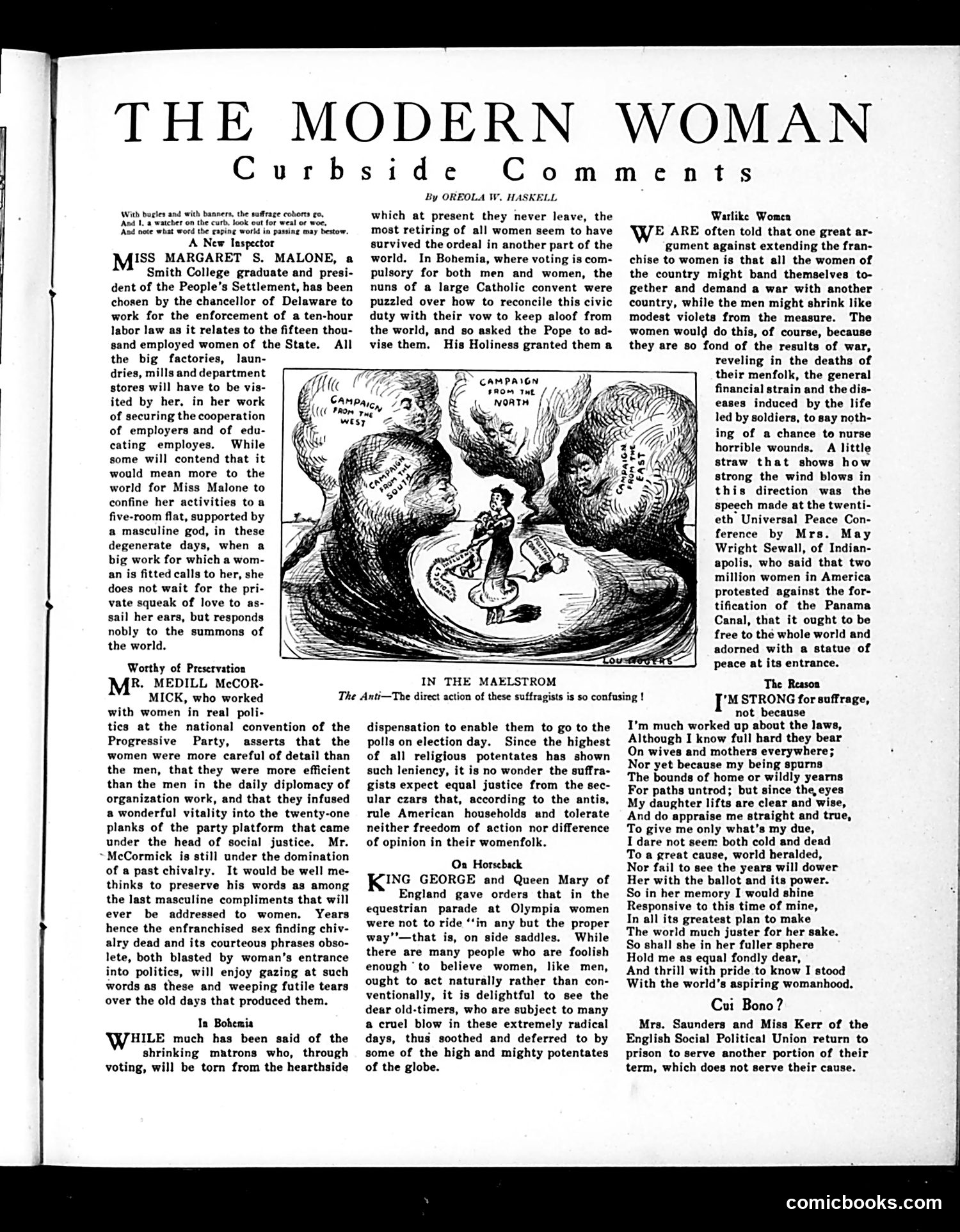
This page satirizes early 20th-century women's activism and anti-suffrage arguments through several sections: **Main Cartoon ("In the Maelstrom"):** Depicts suffragists as confusing, menacing figures engulfing a small man—likely representing male anxieties about women's political power. **Key Arguments Mocked:** 1. **"Warlike Women"**: Sarcastically rebuts the claim that enfranchised women would demand war. The author notes women already suffer war's consequences yet remain peaceful, undermining this anti-suffrage excuse. 2. **Praise for Women's Competence**: McCormick's observations that women excelled at organizational detail are presented as "the last masculine compliments"—implying suffrage will destroy male chivalry. 3. **Religious Authority**: The Pope's dispensation allowing nuns to vote in Bohemia is used to mock claims that women shouldn't vote on traditional grounds. 4. **Horseback Riding**: England's restriction on women's riding posture exemplifies arbitrary social conventions limiting women's freedom. The satire targets both anti-suffrage logic and male resistance to women's equality.
📄 Transcribed text from this page (OCR, searchable)
Machine-transcribed from the original scan — historical spelling and the odd misread are preserved.
THE MODERN WOMAN Curbside With bugles and with banners, the suffrage cohorts £0, ‘And 1. a watcher on the curb, look eut for weal or woe. ‘And note what word the raping world in passing may bestow. A New Inspector ISS MARGARET S. MALONE, a Smith College graduate and presi- dent of the People’s Settlement, has been chosen by the chancellor of Delaware to work for the enforcement of a ten-hour labor law as it relates to the fifteen thou- sand employed women of the State. All the big factories, laun- By OREOLA W. HASKELL which at present they never leave, the most retiring of all women seem to have survived the ordeal in another part of the world. In Bohemia, where voting is com- pulsory for both men and women, the nuns of a large Catholic convent were puzzled over how to reconcile this civic duty with their vow to keep aloof from the world, and so asked the Pope to ad- vise them. His Holiness granted them a Comments Warlike Women E ARE often told that one great ar- gument against extending the fran- chise to women is that all the women of the country might band themselves to- gether and demand a war with another country, while the men might shrink like modest violets from the measure. The women would do this, of course, because they are so fond of the results of war, reveling in the deaths of dries, mills and department 5 stores will have to be vis- Ll (( ited by her. in her work of securing the cooperation of employers and of edu- cating employes. While some will contend that it would mean more to the world for Miss Malone to confine her activities to a five-room flat, supported by a masculine god, in these degenerate days, when a big work for which a wom- an is fitted calls to her, she does not wait for the pri- vate squeak of love to as- sail her ears, but responds nobly to the summons of the world. Worthy of Preservation ME. MEDILL McCOR- MICK, who worked with women in real poli- tics at the national convention of the Progressive Party, asserts that the women were more careful of detail than the men, that they were more efficient than the men in the daily diplomacy of organization work, and that they infused a wonderful vitality into the twenty-one planks of the party platform that came under the head of social justice. Mr. ~McCormick is still under the domination of a past chivalry. It would be well me- thinks to preserve his words as among the last masculine compliments that will ever be addressed to women. Years hence the enfranchised sex finding chiv- alry dead and its courteous phrases obso- lete, both blasted by woman’s entrance into politics, will enjoy gazing at such words as these and weeping futile tears over the old days that produced them. In Bohemia WHILE much has been said of the shrinking matrons who, through voting, will be torn from the hearthside IN THE MAELSTROM dispensation to enable them to go to the polls on election day. Since the highest of all religious potentates has shown such leniency, it is no wonder the suffra- gists expect equal justice from the sec- ular czars that, according to the antis, rule American households and tolerate neither freedom of action nor difference of opinion in their womenfolk. On Horseback KiNG GEORGE and Queen Mary of England gave orders that in the equestrian parade at Olympia women were not to ride ‘‘in any but the proper way’’—that is, on side saddles. While there are many people who are foolish enough ‘to believe women, like men, ought to act naturally rather than con- ventionally, it is delightful to see the dear old-timers, who are subject to many a cruel blow in these extremely radical days, thus soothed and deferred to by some of the high and mighty potentates of the globe. their menfolk, the general financial strain and the dis- eases induced by the life u 4 AN) led by soldiers, to say noth- lag SAY ing of a chance to nurse Mas) VY} horrible wounds. A little l Y straw that shows how sil) strong the wind blows in this direction was the speech made at the twenti- eth Universal Peace Con- ference by Mrs. May Wright Sewall, of Indian- apolis, who said that two million women in America protested against the for- tification of the Panama Canal, that it ought to be free to the whole world and adorned with a statue of peace at its entrance. The Reason The Anti—The direct action of these suffragists is so confusing ! I™ STRONG for suffrage, not because I'm much worked up about the laws, Although I know full hard they bear On wives and mothers everywhere; Nor yet because my being spurns The bounds of home or wildly yearns For paths untrod; but since the, eyes My daughter lifts are clear and wise, And do appraise me straight and true, To give me only what’s my due, I dare not seem both cold and dead To a great cause, world heralded, Nor fail to see the years will dower Her with the ballot and its power. So in her memory I would shine Responsive to this time of mine, In all its greatest plan to make The world much juster for her sake. So shall she in her fuller sphere Hold me as equal fondly dear, And thrill with pride to know I stood With the world’s aspiring womanhood. Cui Bono? Mrs, Saunders and Miss Kerr of the English Social Political Union return to prison to serve another portion of their term, which does not serve their cause. comicbooks.com