
A complete issue · 24 pages · 1913
Judge — August 23, 1913
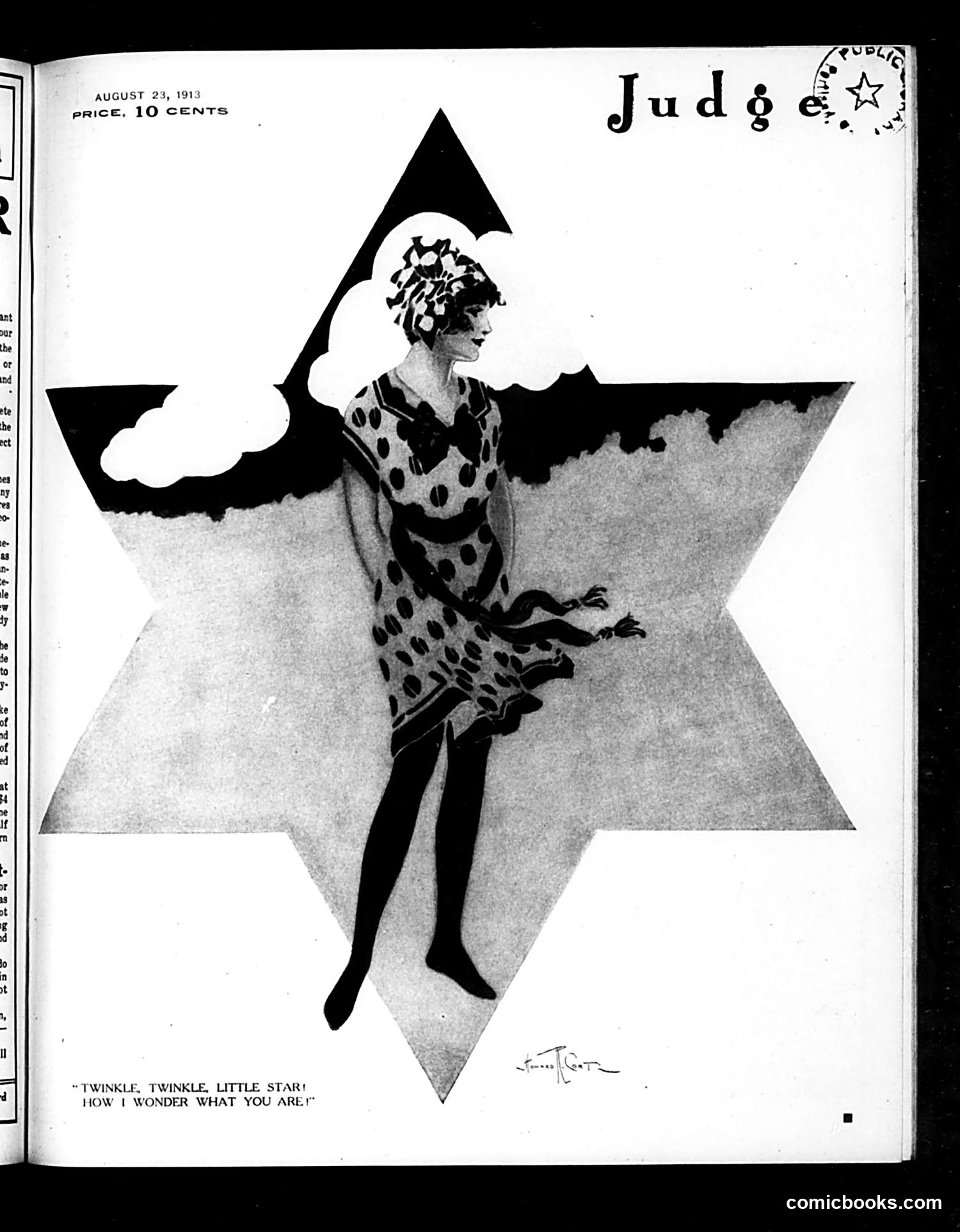
This cover features a woman posed within a large star, wearing a polka-dot dress with an ornate headdress. The caption reads: "TWINKLE, TWINKLE, LITTLE STAR! HOW I WONDER WHAT YOU ARE?" The imagery appears to reference the nursery rhyme while visually treating the woman as a "star"—likely a theatrical or entertainment performer of the era. The star motif combined with the woman's stylized appearance and the questioning caption suggests satire about celebrity, identity, or perhaps the entertainment industry itself. The price of 10 cents and the "Judge" masthead indicate this is the magazine's cover artwork. The specific identity of the woman and whether this references a particular performer or cultural moment remains unclear without additional historical context.
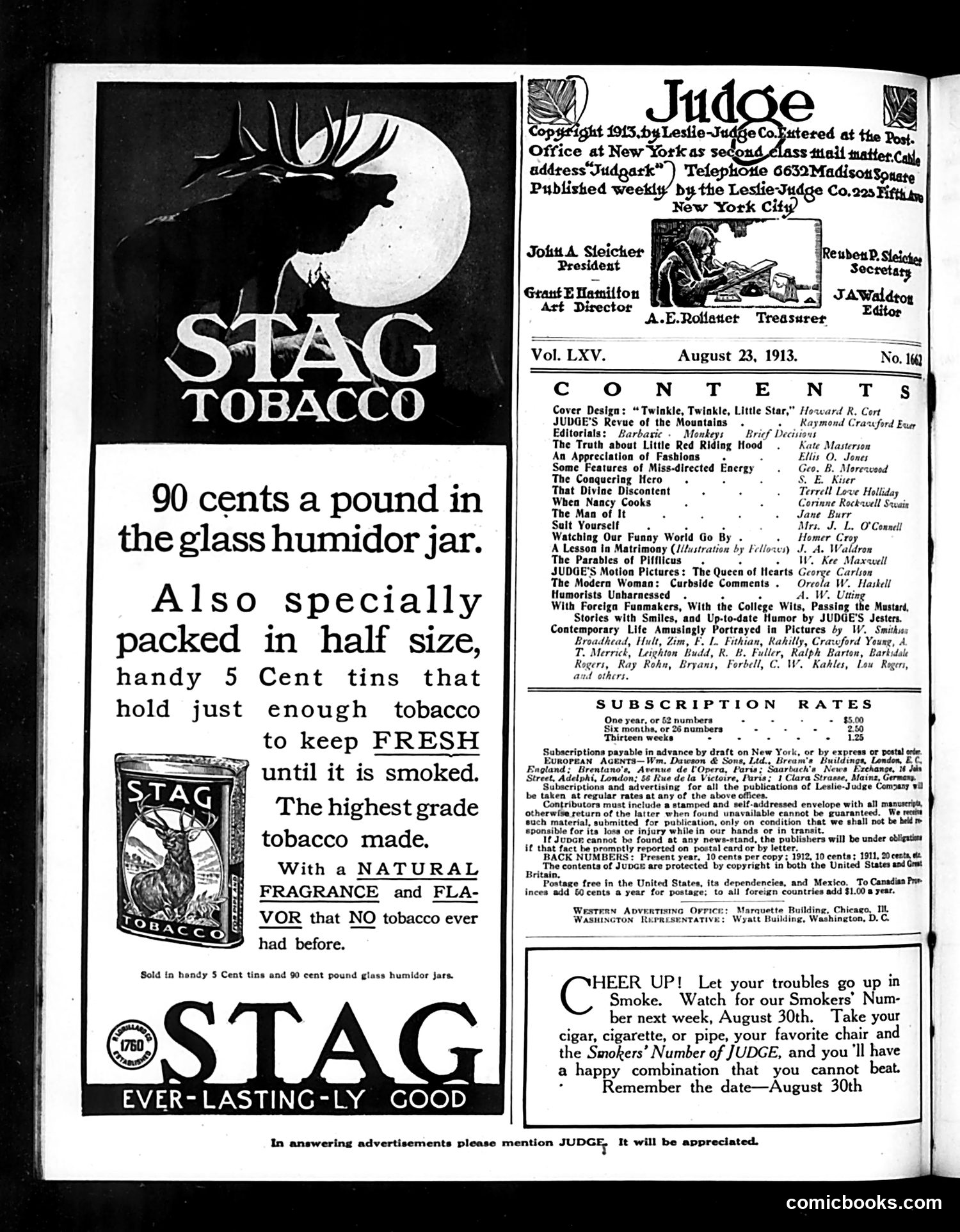
This page is primarily a **Stag Tobacco advertisement** rather than political satire. The ad occupies the left two-thirds of the page, featuring a stag (male deer) silhouetted against a moon—the brand's logo. The copy emphasizes the product's quality and packaging options: 90-cent pound glass jars and specially-packed 5-cent tins for portability. The right side contains the magazine's masthead, table of contents, and subscription information. A small "Cheer Up!" notice promotes Judge's upcoming "Smokers' Number" for August 30th, encouraging readers to enjoy tobacco while reading. The page demonstrates how early 20th-century magazines integrated advertising with editorial content, with tobacco companies being major advertisers during this pre-regulation era.
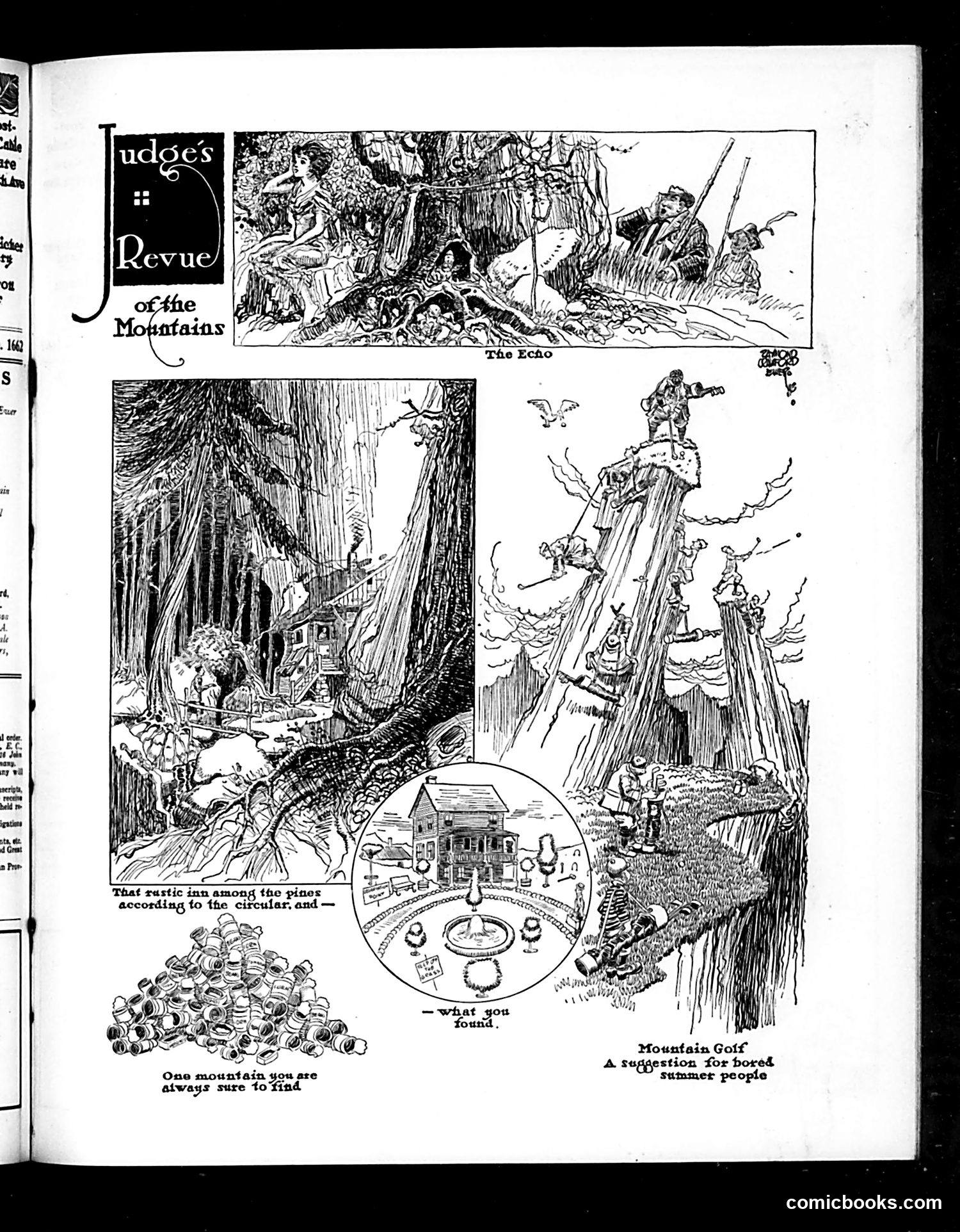
This page presents whimsical mountain-themed illustrations and humor from Judge magazine's "Revue of the Mountains" section. The cartoons depict absurdist scenarios: - "The Echo" shows hunters in a mountainous landscape - A large illustration features a cabin at the center with tiny figures climbing tall tree trunks - "Mountain Golf" suggests an elaborate, dangerous sport using the mountain terrain itself The captions provide gentle humor: "One mountain you are always sure to find" accompanies a pile of bottles, suggesting excessive drinking during mountain vacations. The central inset showing a cabin with organized recreational activities is labeled "what you found," contrasting expectation with reality. These appear to be lighthearted observations about leisure activities and tourist expectations in mountain regions, typical of Judge's satirical approach to contemporary American life and pastimes.
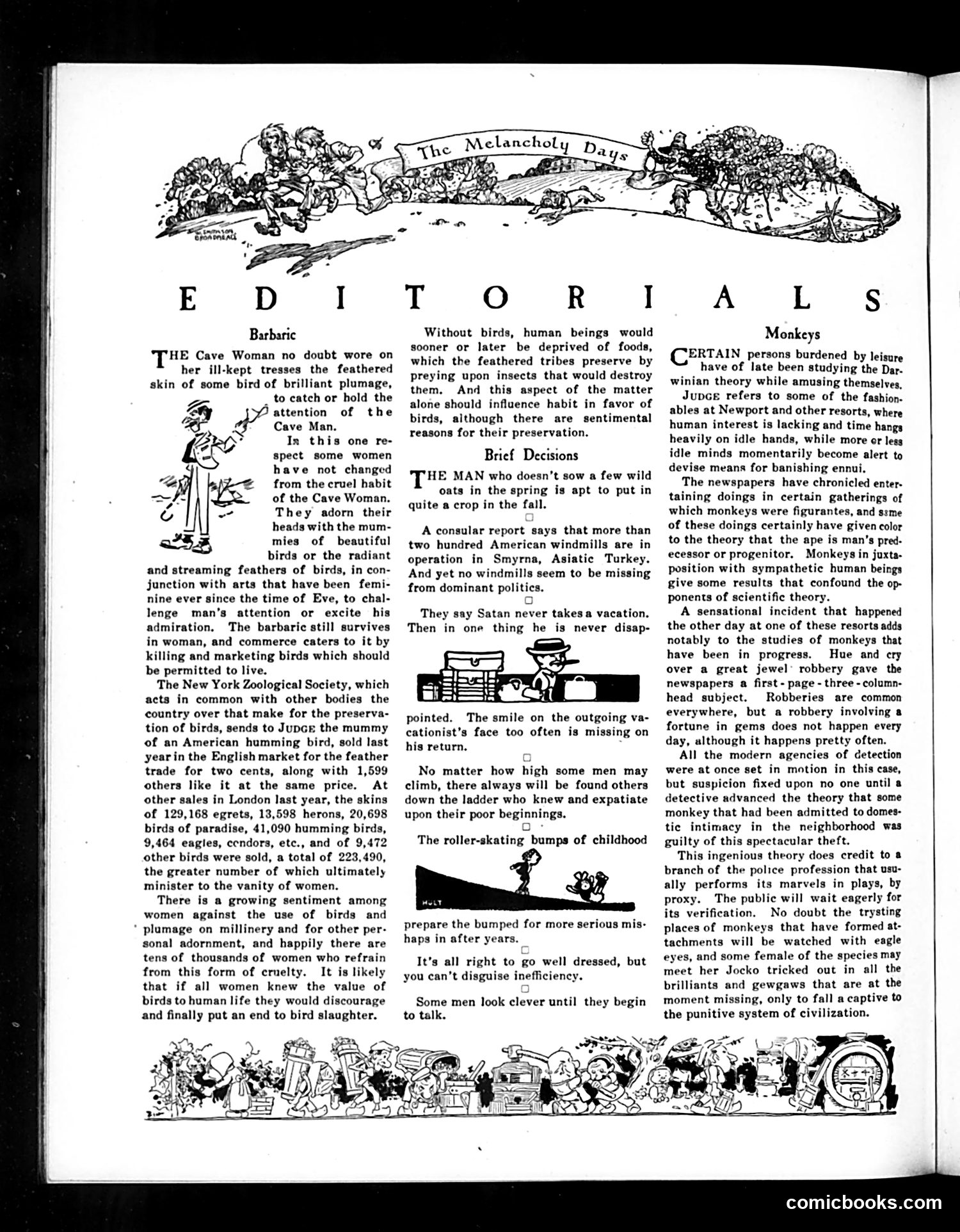
This Judge magazine page contains several editorial pieces satirizing contemporary society. The "Barbarie" section mocks women's adoption of bird feathers and plumage in millinery, referencing the "Cave Woman" who adorned her head with feathered bird skins. The satire criticizes how this fashion perpetuates cruelty to birds for vanity. The "Brief Decisions" section offers short satirical observations on human behavior—about spring planting, vacations, and social climbing. The "Monkeys" piece discusses society's fascination with monkey antics at leisure resorts and zoos, suggesting this reflects poorly on "civilization." Overall, the page uses humor to critique Edwardian-era fashion excess (particularly feathered hats), social pretension, and what the editors viewed as humanity's questionable values and pastimes.
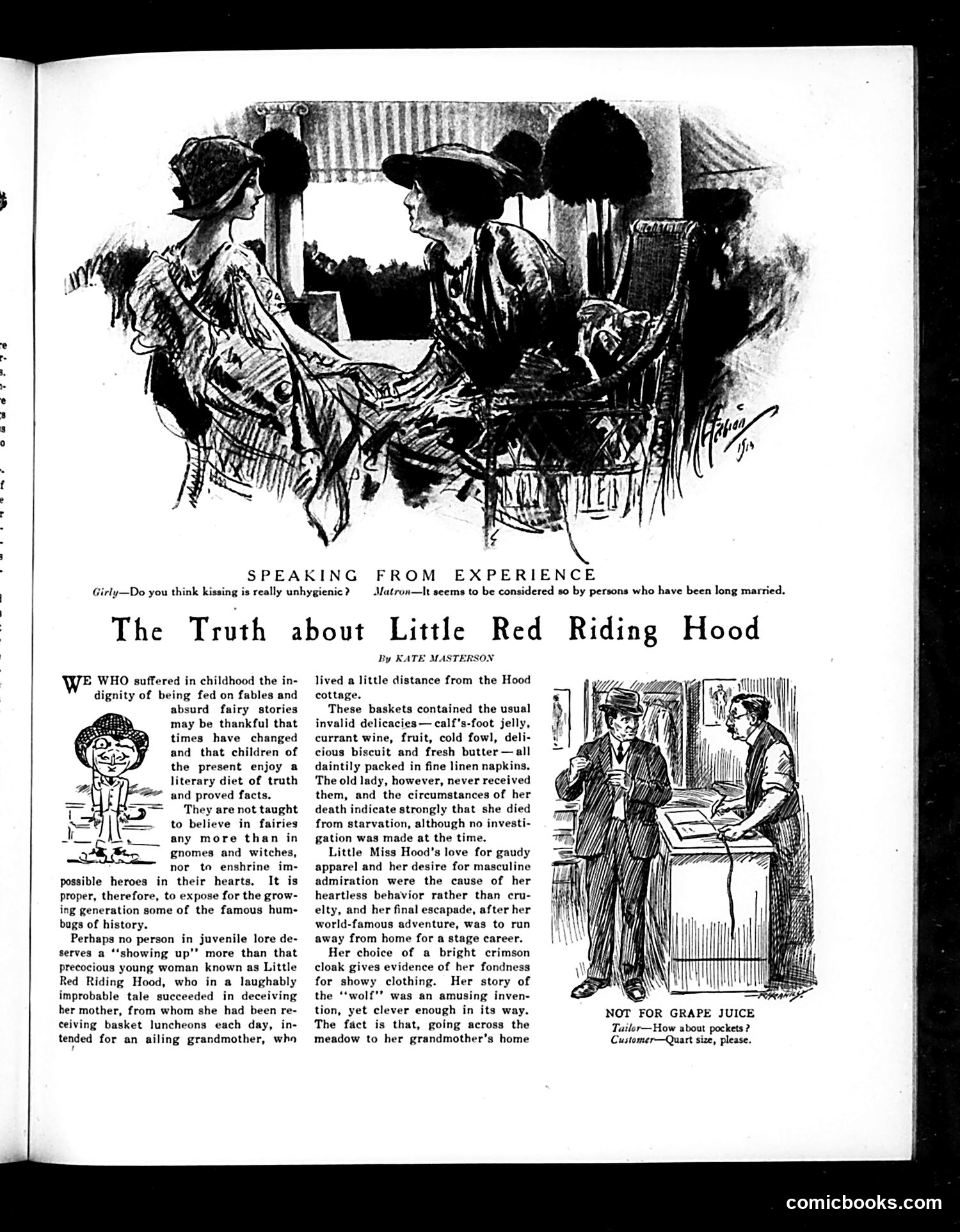
This page contains two separate pieces: **Top illustration**: A social commentary sketch titled "Speaking from Experience" showing women discussing kissing and hygiene. The matron's quip—that kissing seems unhygienic only to those *not* long married—is a wry joke about marital intimacy diminishing romantic ideals over time. **Main article**: "The Truth About Little Red Riding Hood" by Kate Masterson reinterprets the fairy tale as social critique. Rather than a cautionary story about strangers, Masterson argues the tale actually reflects a girl's desire for fashionable clothing and masculine attention, leading her to abandon home for a stage career. The satire mocks both the fairy tale's moral lessons and contemporary attitudes about women's ambitions and materialism. The page reflects early 20th-century anxieties about changing gender roles and female independence.
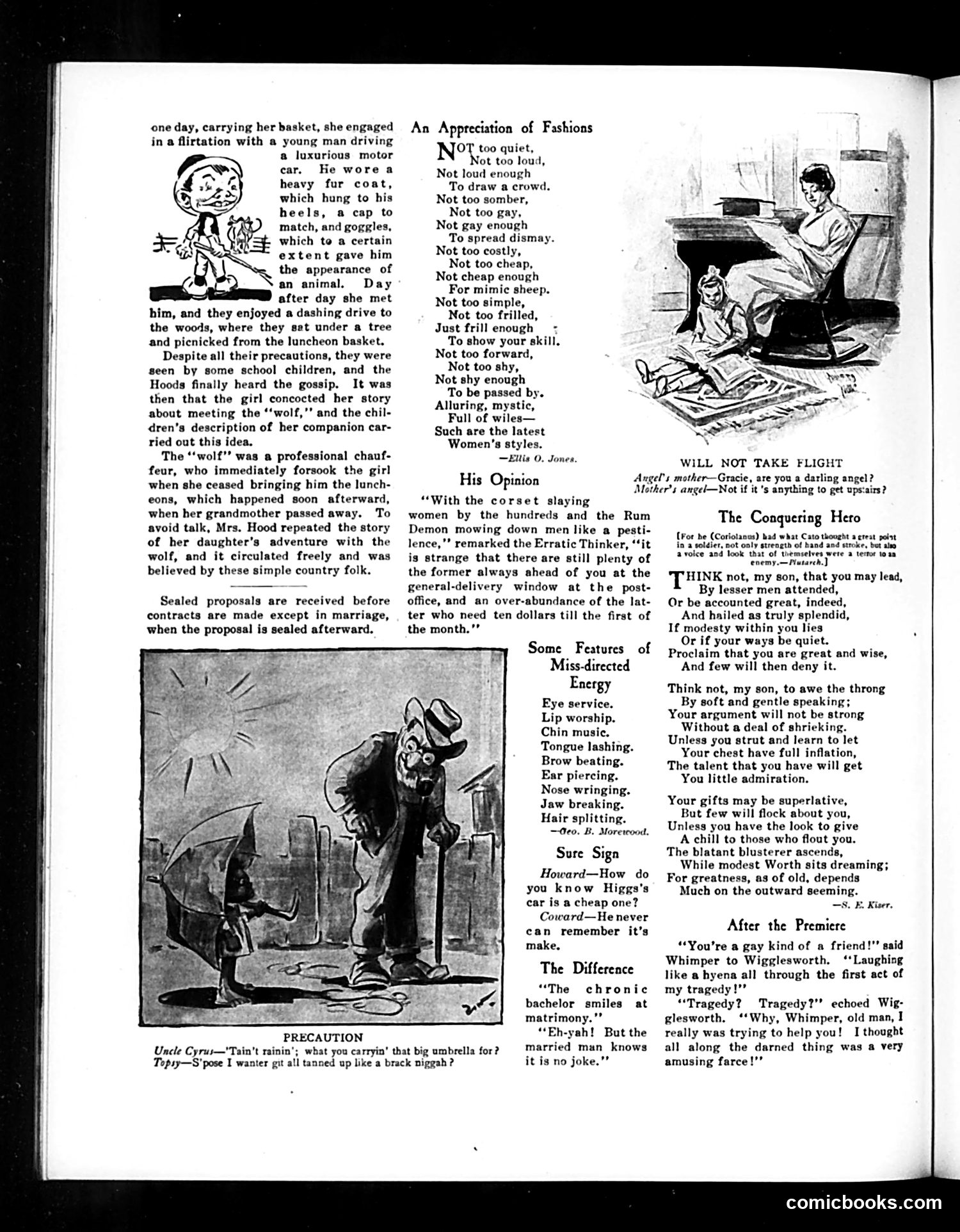
This page from *Judge* contains several satirical pieces typical of early 20th-century American humor: **Main narrative**: A cautionary tale about a country girl who meets a wealthy motorist in a fur coat and goggles. After he abandons her when her grandmother (who provided picnic lunches) dies, she spreads rumors calling him a "wolf"—a then-current slang term for a seducer. Credulous rural folk believe her fabricated story. **The satire**: Mocks both the girl's dishonesty and the gullibility of country people who accept gossip uncritically. **Other content includes**: - A poem on women's fashion paradoxes (must be alluring but not forward) - Social commentary on corsets and alcohol as public health crises, yet women and men remain plentiful - Humorous observations on bachelors versus married men - A poem mocking self-promotion and bluster as necessary for success—satirizing how appearance and noise matter more than actual merit The racist dialect joke at bottom reflects the regrettable conventions of the era. Overall, the page exemplifies *Judge*'s mix of social criticism with light comedy.
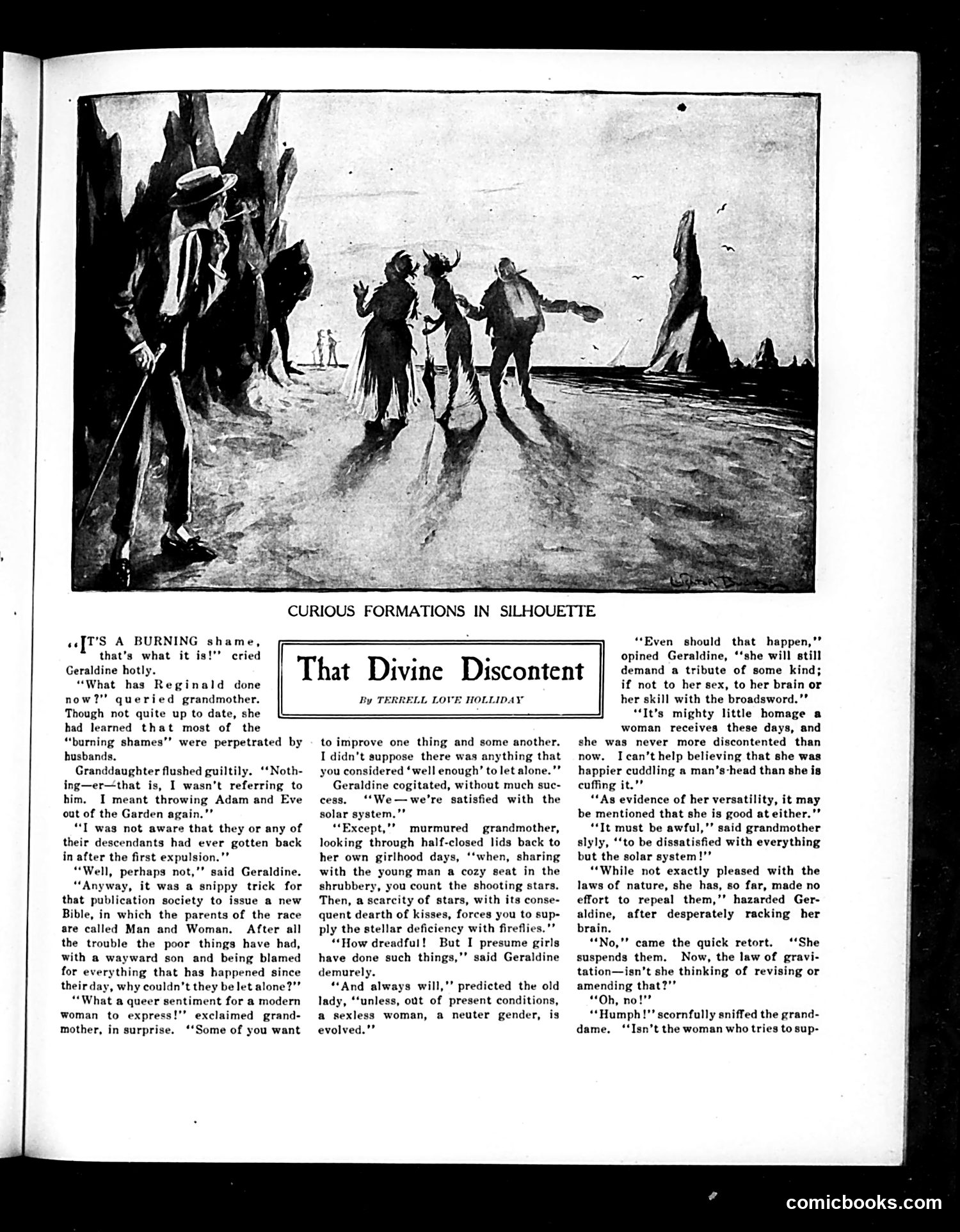
This satirical story mocks early 20th-century feminist demands. Granddaughter Geraldine complains about a publication society issuing a new Bible calling Adam and Eve "Man and Woman" instead of their proper names—suggesting feminists are erasing women's identity even while seeking equality. The grandmother represents traditional values, gently mocking modern women's perpetual dissatisfaction. She notes that women demand tributes "to her sex, to her brain or her skill with the broadsword"—implying feminists want recognition in every sphere simultaneously and will never be satisfied. The story climaxes with the grandmother's accusation that women want to revise even the laws of nature itself (gravity), suggesting feminist ambitions are absurdly grandiose and fundamentally irrational. The Judge satire ridicules women's rights activists as contradictory complainers rather than engaging their actual arguments substantively.
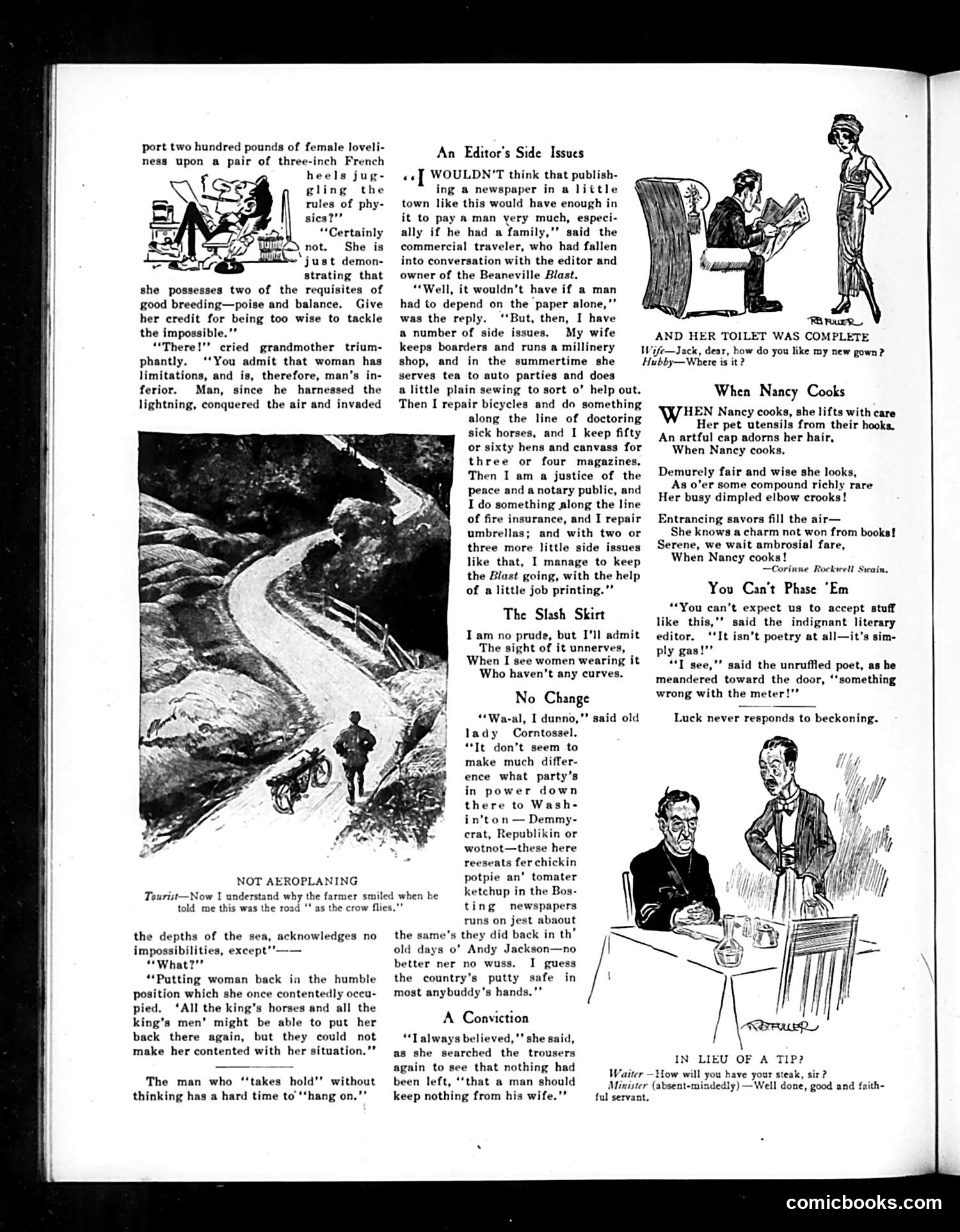
This page from the satirical magazine **Judge** (early 20th century) contains several short humorous pieces mocking social conventions and gender roles: **"The Slash Skirt"** ridicules the fashionable high-hemmed skirt by suggesting it's unflattering on women without curves—a jab at both fashion trends and body image concerns. **"No Change"** features an elderly rural woman (likely representing common sense) noting that political parties make no practical difference to ordinary life—a cynical commentary on politics. **"A Conviction"** shows a wife searching her husband's pockets, with the caption sardonically endorsing her belief that husbands should hide nothing—satirizing both marital suspicion and women's financial control. **"When Nancy Cooks"** is romantic verse celebrating an idealized domestic woman—likely sincere rather than satirical. **"You Can't Phase 'Em"** depicts a literary editor rejecting bad poetry as "gas" (nonsense), with the poet misunderstanding "meter" as plumbing—a simple pun joke. The overall tone blends social satire with gentle humor about marriage, gender, and provincial American life.
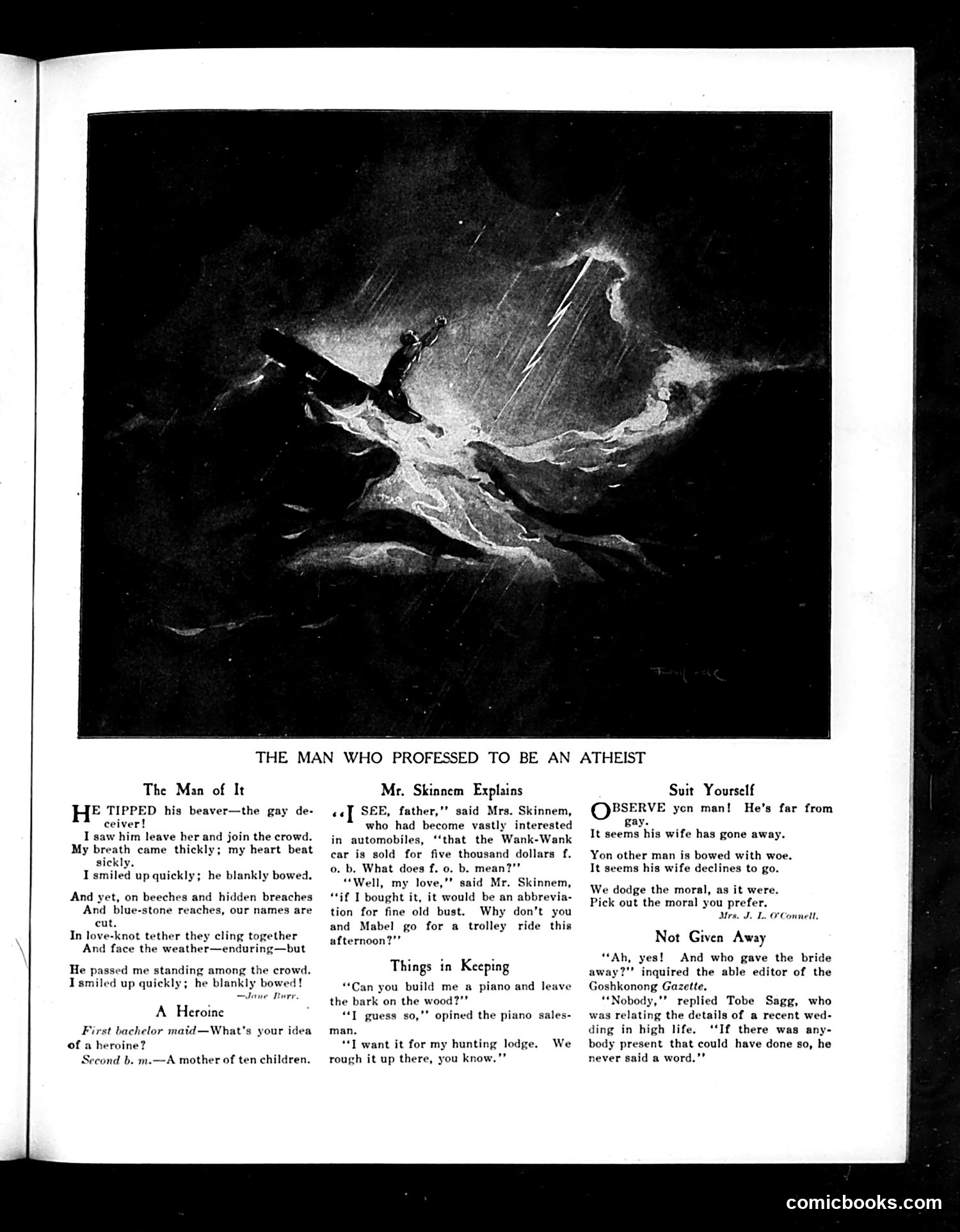
This page contains several brief satirical pieces typical of early 20th-century American humor magazines: **"The Man Who Professed to Be an Atheist"** (main illustration): A dramatic romantic scene where a man encounters his former lover in public. The satire appears to target hypocrisy—the title suggests someone who claims atheism (rejecting religious morality) yet acts according to conventional social codes, remaining silent about a past romantic entanglement to preserve appearances. **"Mr. Skinnem Explains"**: A joke mocking nouveau-riche automobile owners. When his wife asks what "f.o.b." means in car advertisements, he quips it stands for "fine old bust," suggesting wealthy but unsophisticated people buy expensive cars they don't understand. **"A Heroine"** and **"Suit Yourself"**: Brief one-liners about gender roles and marriage—contrasting ideals of womanhood and commenting on marital discord. **"Not Given Away"**: A satirical anecdote about wealthy society weddings, implying scandal is politely ignored among the upper classes. The humor relies on social observation and class commentary typical of Judge's editorial stance.
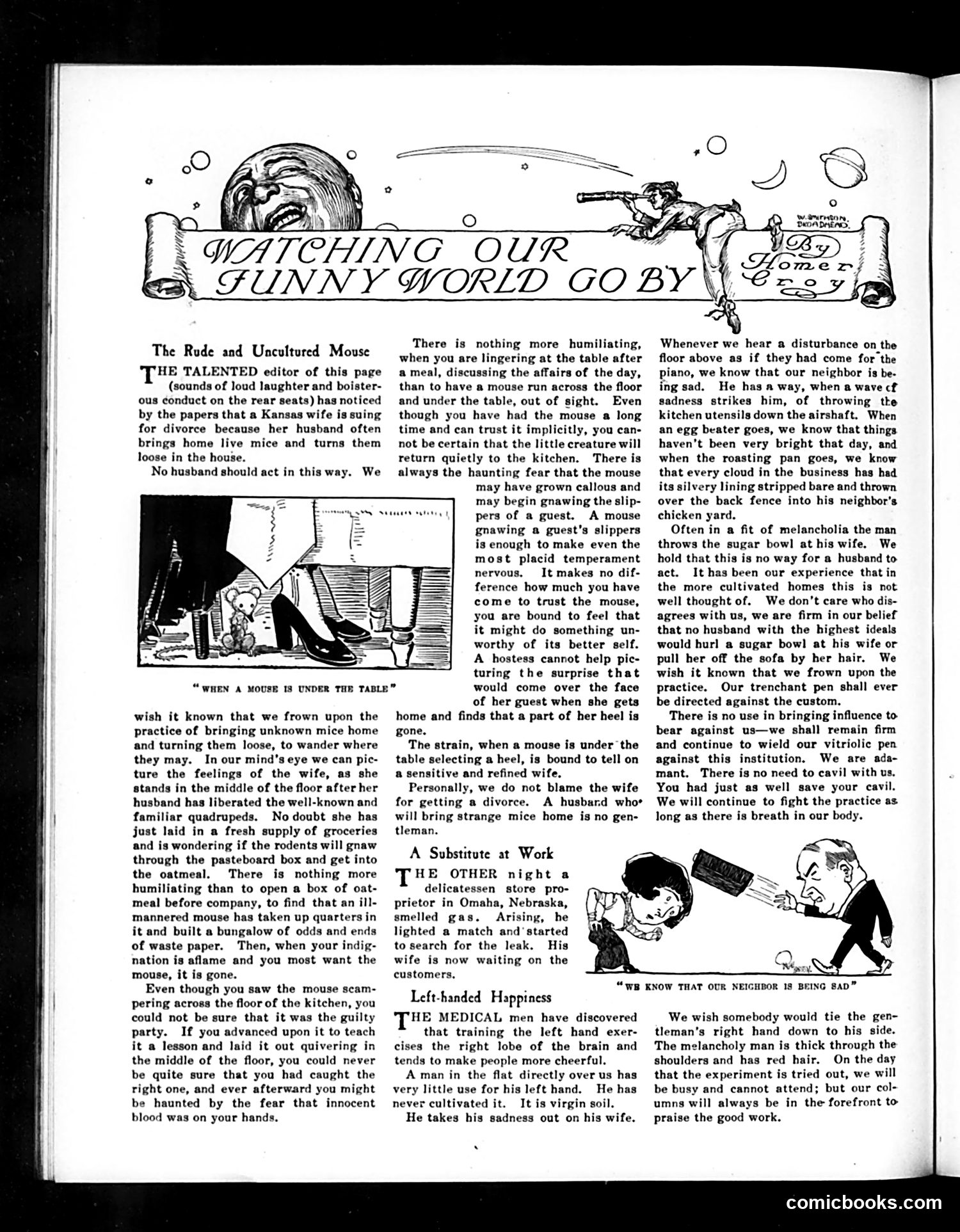
This is a satirical humor page from Judge magazine featuring three separate comedic pieces about domestic life and male behavior. **"The Rude and Uncultured Mouse"** mocks a Kansas husband who releases live mice in his house as a "prank," humiliating his wife. The satire targets inconsiderate husbands generally, using the absurd mouse-releasing scenario to critique men who prioritize crude "entertainment" over their wives' dignity and household management. **"A Substitute at Work"** is a dark joke: an Omaha delicatessen owner smells gas, strikes a match to search for a leak (igniting it), and his wife must now replace him at the counter. **"Left-handed Happiness"** references contemporary medical theory claiming left-handedness relates to brain development, used humorously to explain why a melancholy left-handed man throws things—especially sugar bowls at his wife—when sad. All three pieces satirize inconsiderate or destructive male domestic behavior as marks of being "uncultured" or uncivilized.
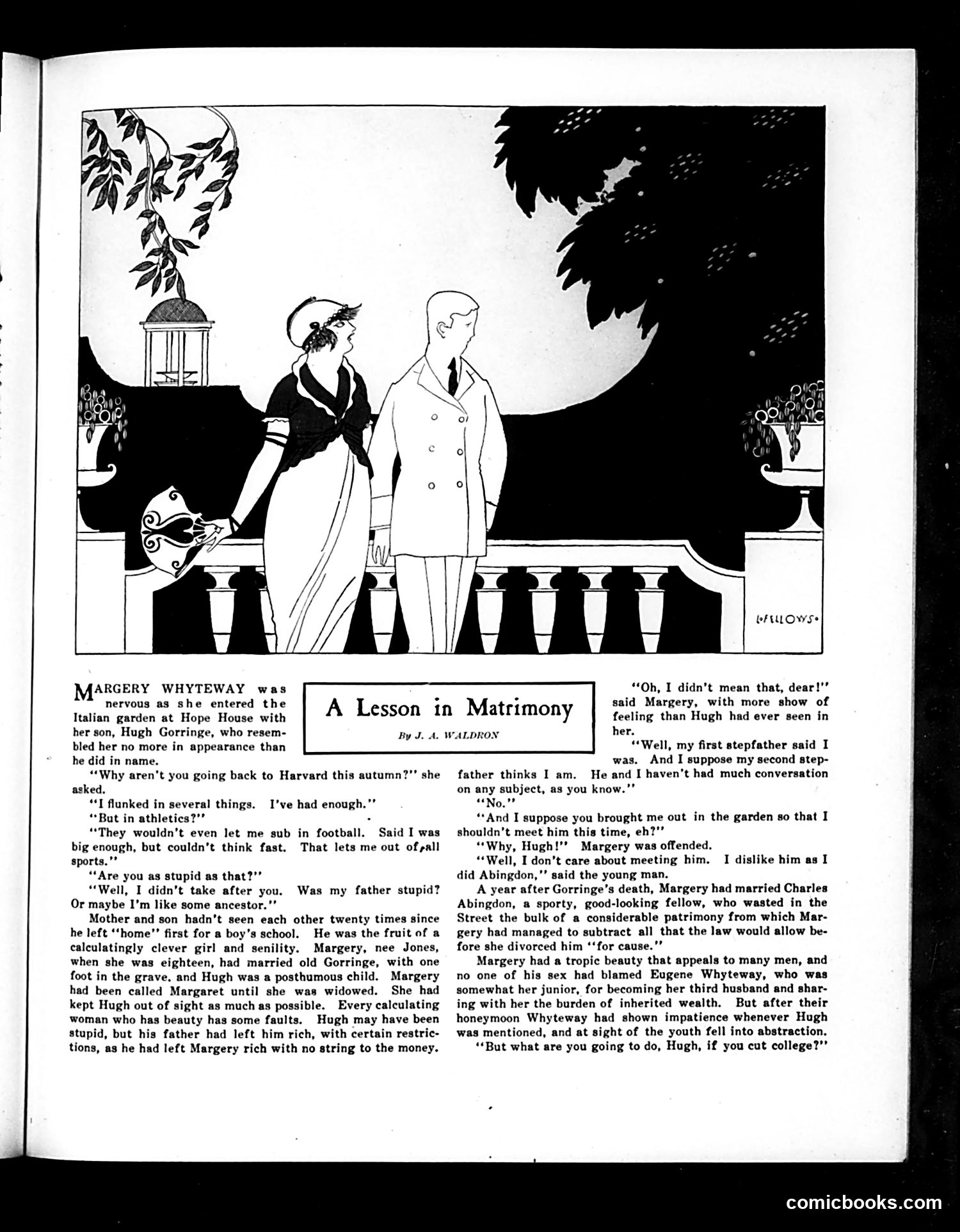
This is a satirical short story (not a political cartoon) about **Margery Whyteway**, a calculating woman of inherited wealth who has married three times. The narrative critiques her shallow materialism and serial marriages. **The premise**: Margery married an elderly man (Gorringe) while young, bore his posthumous son Hugh, then divorced him. She subsequently married Charles Abingdon (squandering his fortune) and is now married to Eugene Whyteway. Each husband represents progressively younger, wealthier targets. **The satire targets**: - Women who strategically marry for money rather than affection - The hypocrisy of "calculating" beautiful women who lack genuine maternal feeling (she kept Hugh hidden) - The legal system allowing women to extract maximum wealth during divorces **The social context**: This reflects 1920s anxieties about women's newfound independence post-suffrage, divorce accessibility, and fears that some women exploited marriage law for financial gain. Hugh—illegitimate, academically failed, and unwanted—serves as the sympathetic counterpoint to his mother's self-interested machinations.
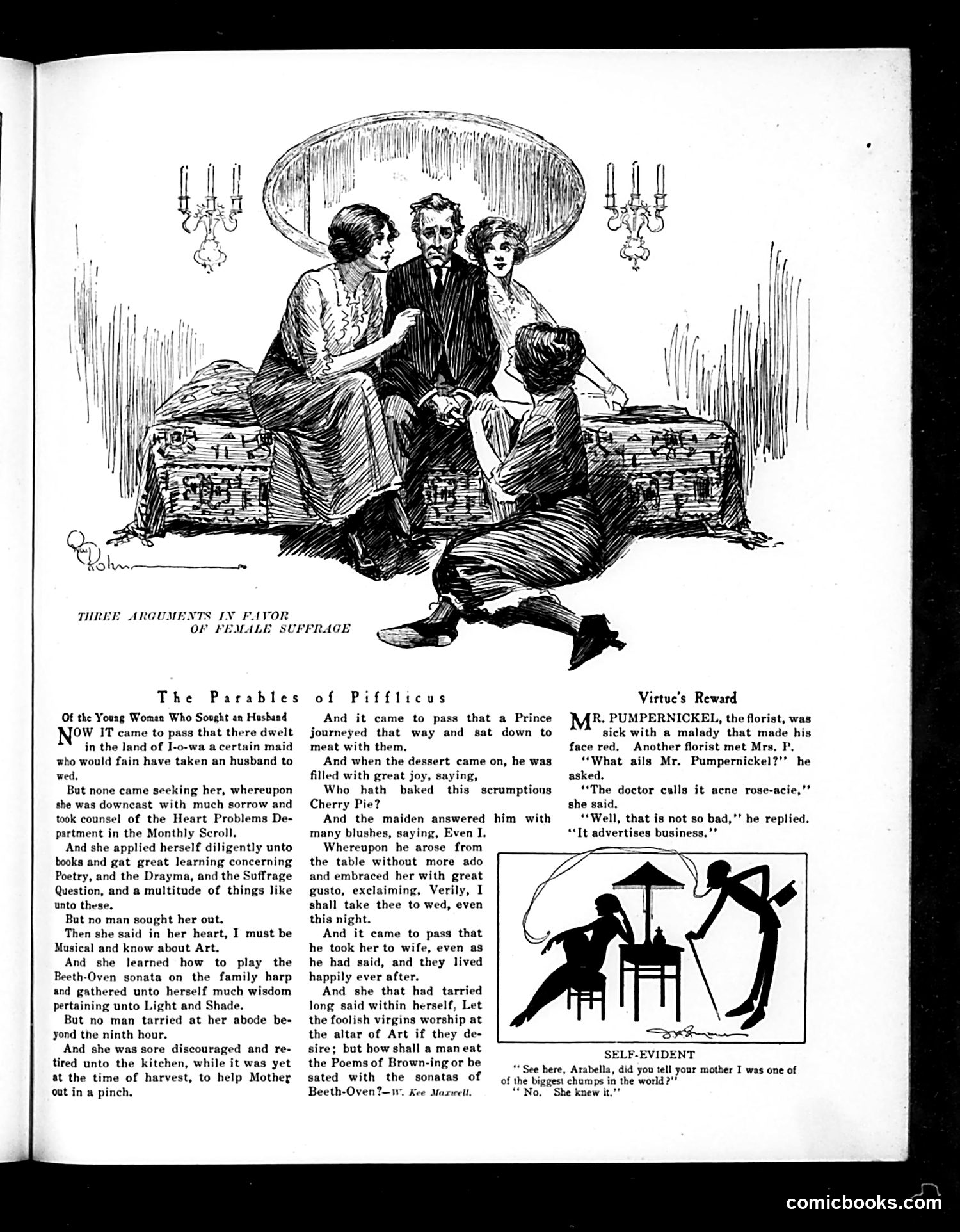
This page satirizes the women's suffrage movement through three pieces: **"Three Arguments in Favor of Female Suffrage"** (main illustration): Shows a man surrounded by women making appeals. The satire suggests that women's arguments for voting rights are frivolous or emotional rather than substantive. **"The Parables of Pifflicus"** (left story): A young Iowa woman studies serious subjects—poetry, drama, suffrage—seeking a husband, but remains unmarried. Only when she returns to domestic cooking (baking cherry pie) does a prince arrive and marry her immediately. The satire mocks educated women, suggesting their learning is useless and that men only value domestic skills. This attacks suffrage advocates by implying women's "proper place" is the home, not politics. **"Virtue's Reward"** and **"Self-Evident"** (right): These are light comedic shorts unrelated to suffrage. The overall message opposes female suffrage by suggesting educated, ambitious women are unattractive and unnatural—a common anti-suffrage argument of the era.
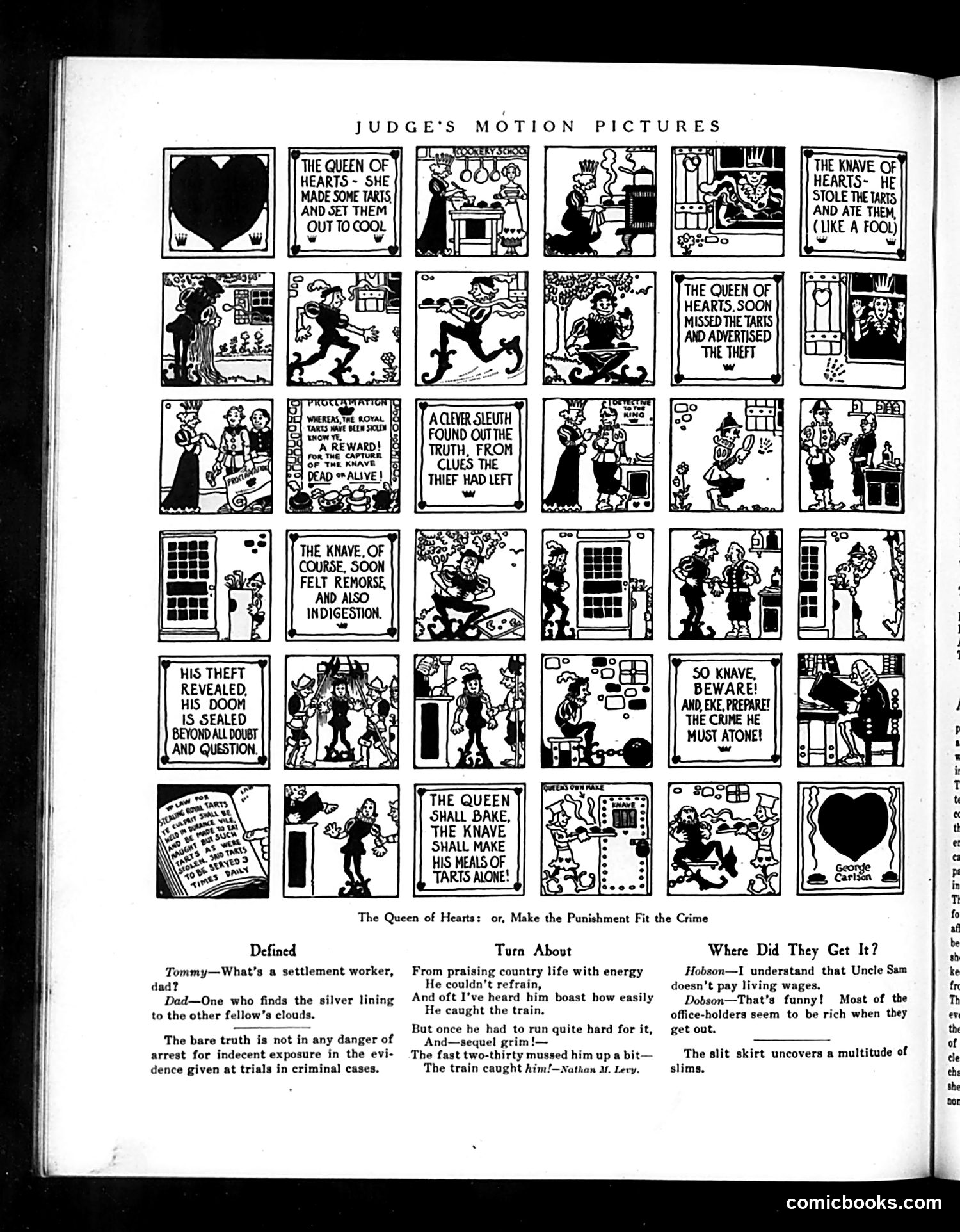
This page presents a comic strip adaptation of the nursery rhyme "The Queen of Hearts," presented as satirical "motion pictures." The strip follows the familiar tale: the Queen of Hearts bakes tarts, the Knave steals them, gets caught, and faces punishment—being forced to bake and eat tarts alone as penance. The satire lies in the subtitle: "Make the Punishment Fit the Crime"—likely a jab at contemporary criminal justice, suggesting that real courts fail to match consequences appropriately to offenses, unlike this fairy-tale justice. Below are unrelated satirical quips mocking settlement workers (who help the poor), the unreliability of trains, government workers who mysteriously become wealthy after leaving office, and women's "slit skirts" as fashion. The cartoon assumes reader familiarity with both the nursery rhyme and American social debates of the era.
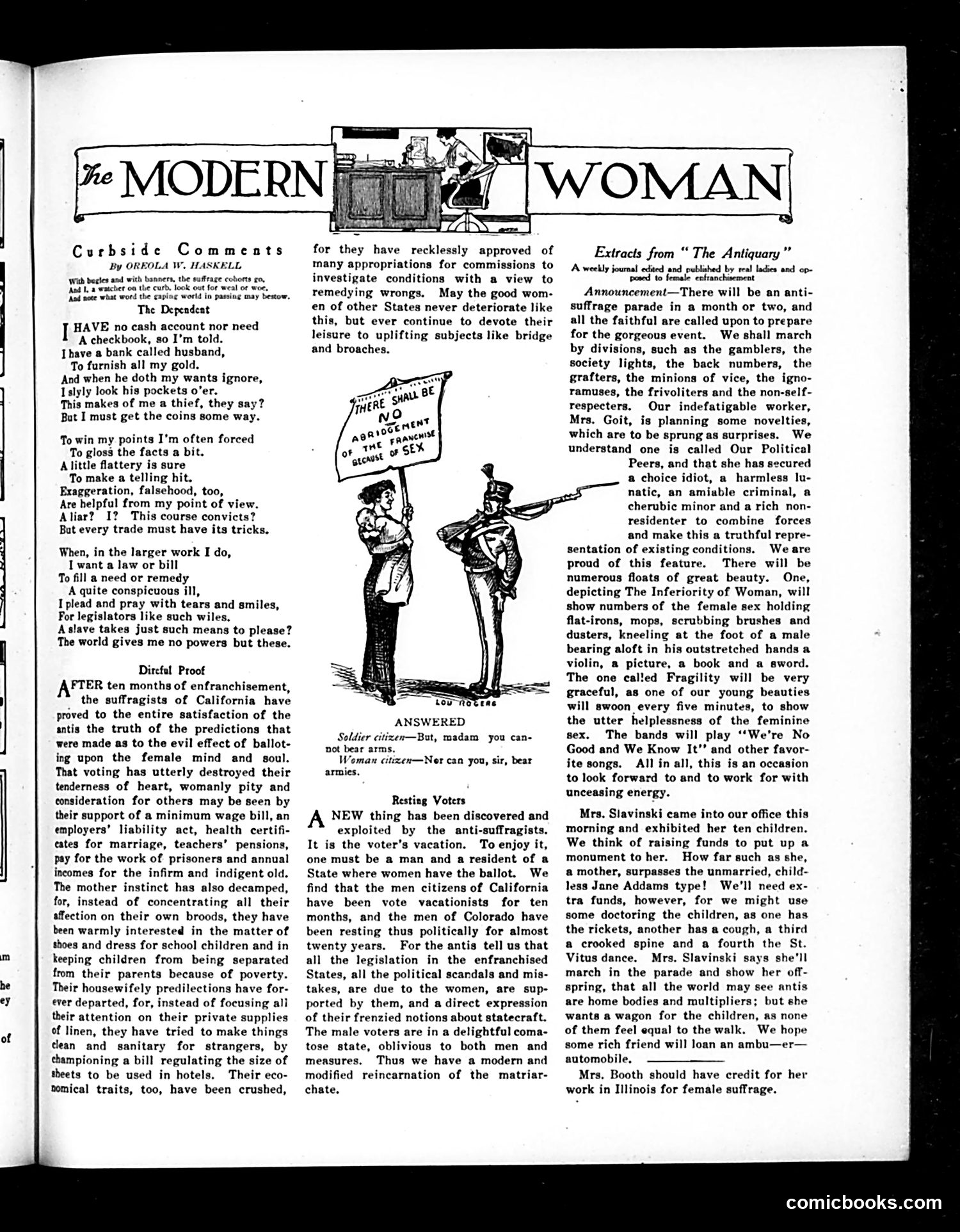
This Judge magazine page satirizes anti-suffrage arguments through three main pieces: **"The Dependent"** poem mocks women's lack of legal/financial independence, showing a wife who must steal from her husband's pockets and use deception ("flattery," "falsehood") to get money—then asks why society denies women political power when they have "no powers but these." **"Direful Proof"** section ridicules anti-suffrage claims that voting destroys women's moral character. It lists California women's votes *for* progressive causes (minimum wage, child welfare, sanitation standards, prisoners' rights, elderly care)—presenting these compassionate policies as evidence that voting has *improved* rather than corrupted women. **"Resting Voters"** sarcastically suggests male voters take "vacations" from politics in suffrage states, blaming women for all legislation while men remain "oblivious"—exposing the illogic of claiming women wield all power while possessing no legal standing. The page uses irony throughout: anti-suffrage rhetoric is presented sympathetically, then undermined by its own absurdity.
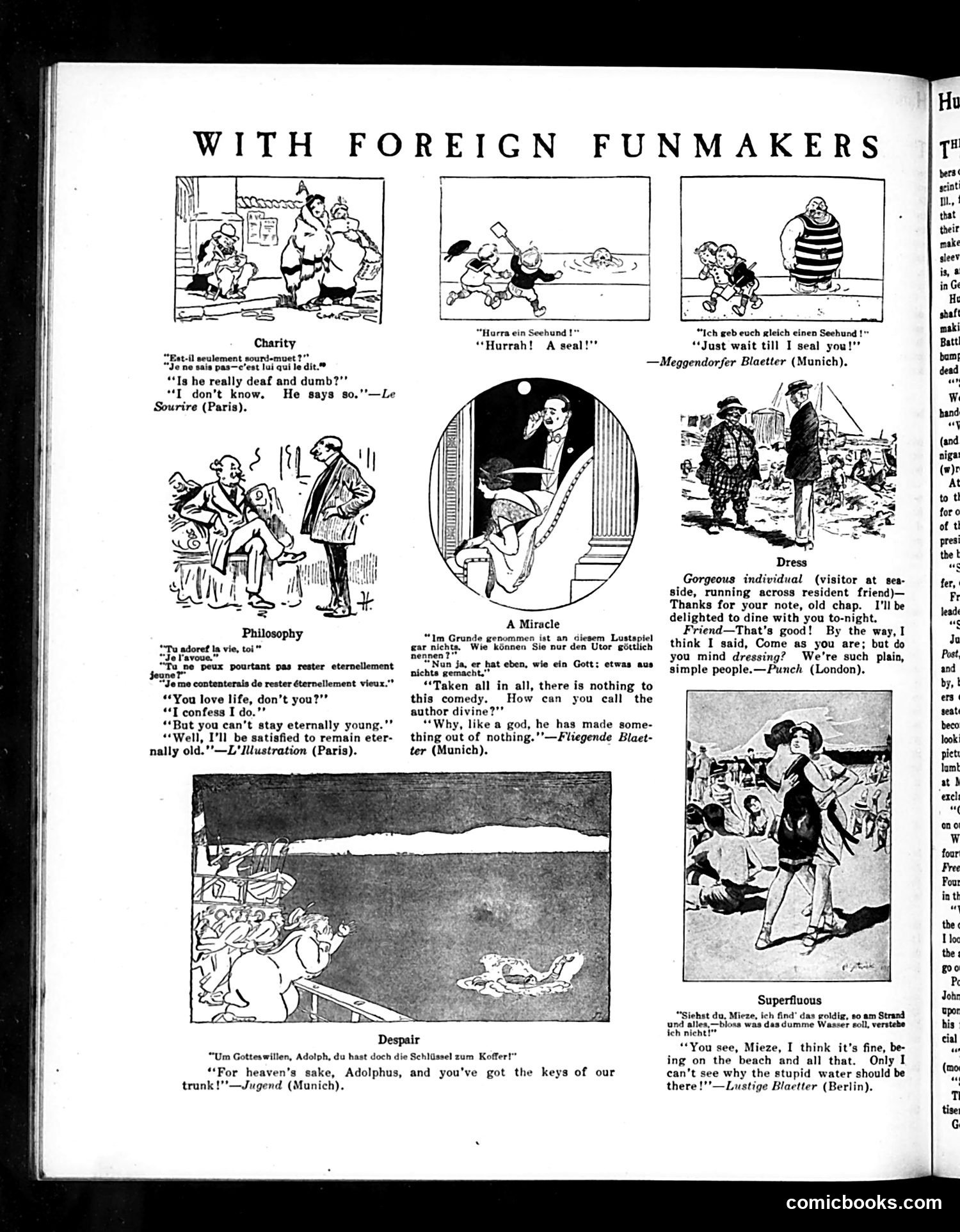
This page compiles humor from European satirical magazines (French, German, and British sources noted). The cartoons showcase common comedic themes of the era: **"Charity"** and **"Philosophy"** present absurdist dialogue—people claiming deafness or preferring eternal oldness, mocking human irrationality. **"A Miracle"** jokes that a playwright created something from nothing like God, satirizing mediocre theater. **"Dress"** ridicules social pretense: a visitor invited to "come as you are" is then asked to dress up because the hosts are "simple people"—mocking false modesty. **"Superfluous"** features a woman questioning why the ocean exists at the beach—absurdist humor about literal-mindedness. The page demonstrates *Judge* magazine's practice of reprinting European comic material, showcasing international satire on universal human follies: vanity, pretentiousness, illogic, and social contradiction. No specific political figures are caricatured; instead, the humor targets everyday human absurdity.
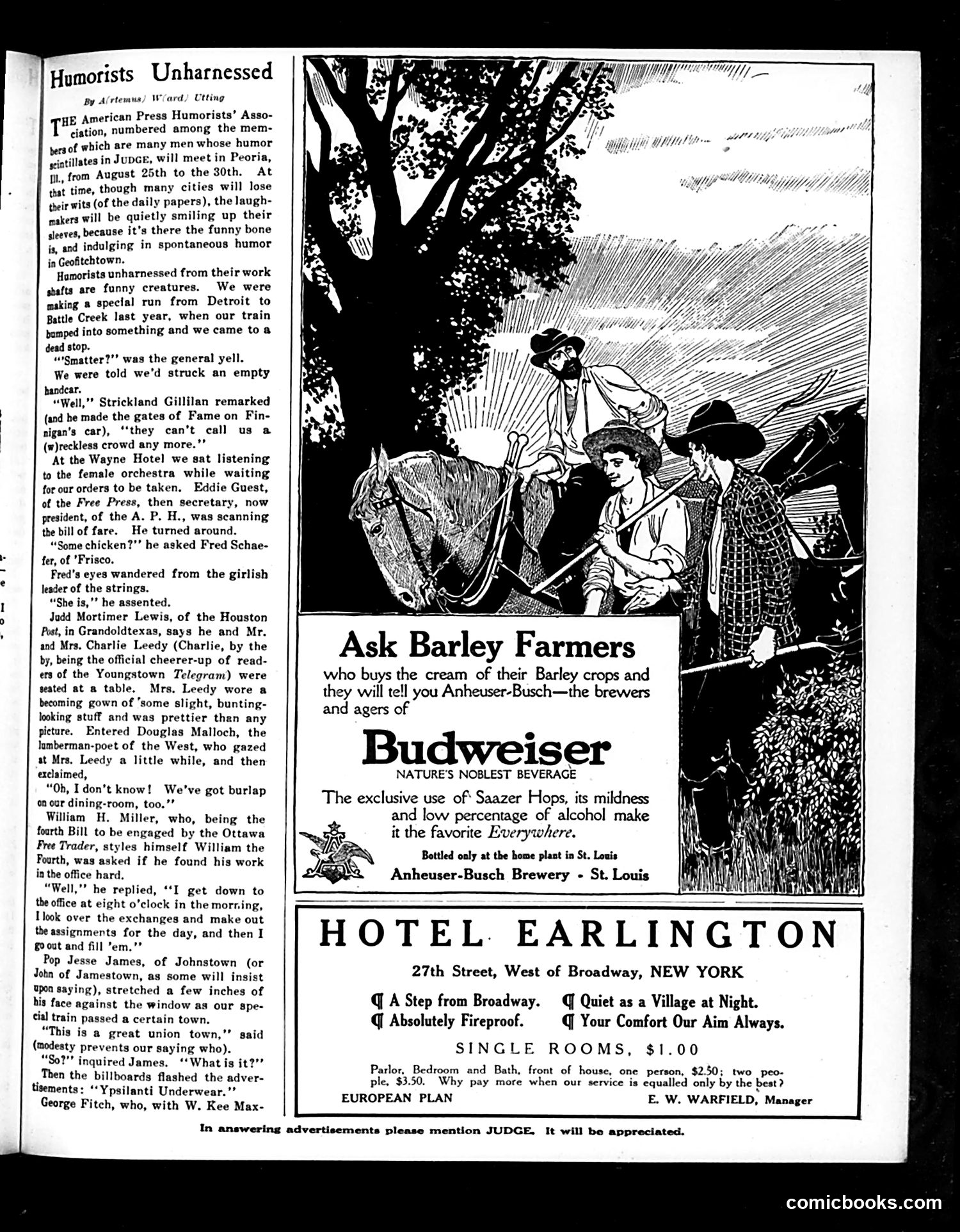
This page contains a humorous column about American newspaper humorists attending a professional convention in Peoria, Illinois. The piece collects anecdotes about various wit writers (Eddie Guest, Fred Schaefer, Douglas Malloch, and others—real figures in early 1900s journalism) and their clever remarks. The humor relies on wordplay and absurdist situations: a train striking an "empty car" prompts a joke about being "wrecked"; a woman's elegant gown is compared dismissively to burlap; a union town is mocked for its "Ypsilanti Underwear" billboard advertising. The satire gently pokes fun at professional humorists themselves—suggesting they're funnier in person than in print, and that when "unharnessed" from their work obligations, they behave amusingly. The page is primarily **advertising** (Budweiser, Hotel Earlington), with the column as filler content typical of *Judge* magazine's satirical-commercial format.
This page from Judge magazine is primarily **advertising and filler content** rather than satirical cartoons. The main elements are: **The Lead Article** ("The Pleasantest and Quick-est Way to Midsummer Comfort") describes anecdotes from a gathering of press humorists—lighthearted stories about people like Tom Daly (Irish-American dialect comedian), Strick Gillilan, and J.U. Higginbotham (a travel writer). The humor is gentle and conversational rather than political. **"His Neutrality"** column presents a moss-backed character defending old-fashioned values against modern women's fashions—particularly criticism of revealing clothing and petticoats. This reflects period anxieties about women's liberation and changing dress codes. **The remaining content** consists almost entirely of advertisements: Evans' Ale, a Red Cross shipping line, Hotel Van Rensselaer, and various business services. No significant political satire or caricature is evident on this page—it represents typical early-20th-century magazine filler combining minor social commentary with commercial content.
This page is primarily **advertising with college humor sidebars**—not political satire. The bulk of the space features product ads (Beeman's Pepsin Gum, Hotel Dresden, Hunter Whiskey, rail lines). The left column reprints jokes from college publications, depicting conventional early-20th-century college humor: a country girl transformed by six weeks into a frivolous "butterfly" who abandons work for dancing; jokes about tango dancing, divorce, and courtship; and a "henpecked husband" joke. These reflect period anxieties about women's newfound mobility and leisure activities—particularly the tango, which was considered scandalous. **The satire is mild and social, not political**: it gently mocks changing gender roles and modern courtship, but presents no identifiable political figures or events. The humor relies on assumptions familiar to 1910s readers: the danger of idleness, the impropriety of women's independence, and traditional marital dynamics. The page captures period attitudes but contains no commentary on governance, current events, or named public figures.
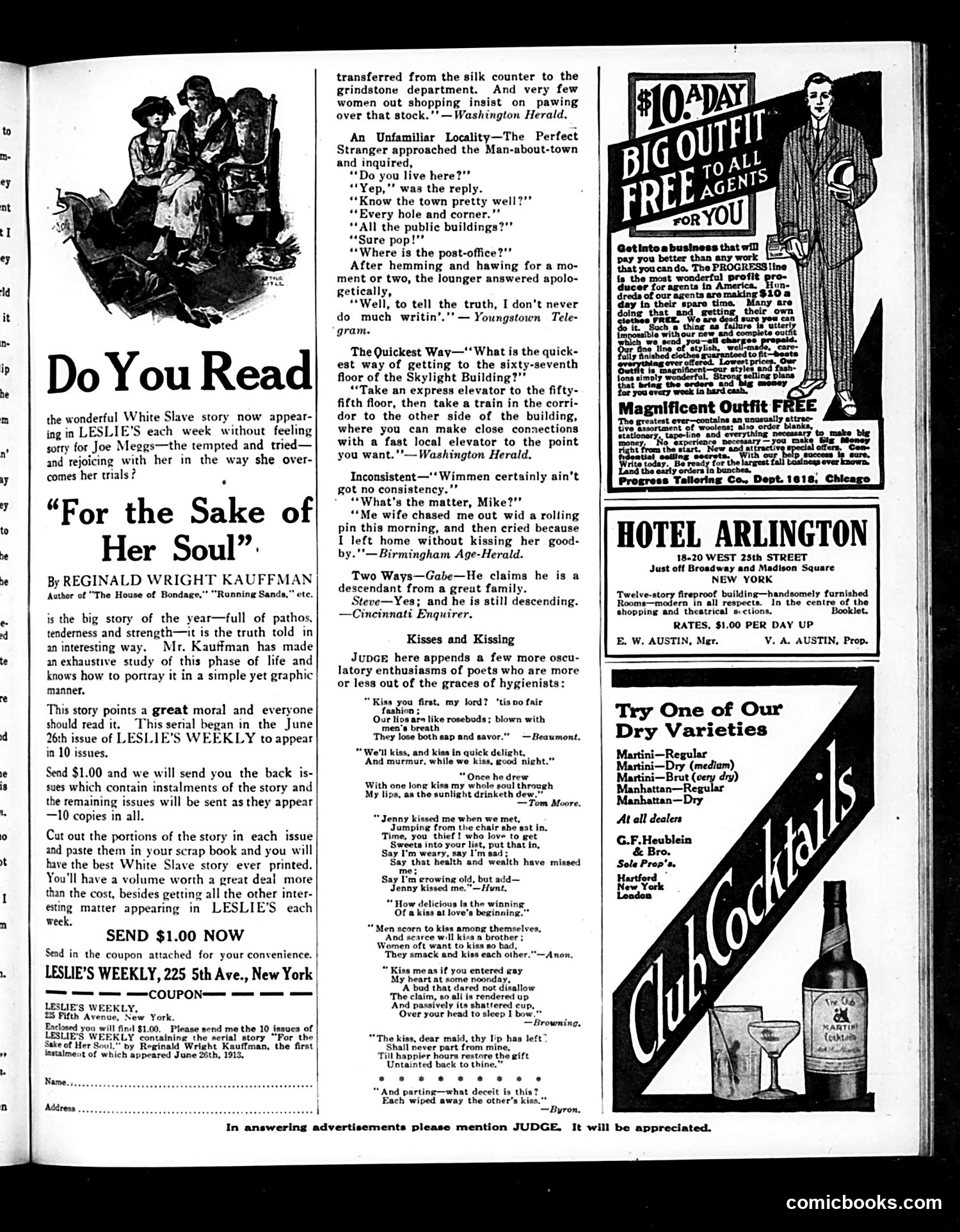
This page is primarily **advertising and literary promotion** rather than political satire. The main content advertises a serialized story called "For the Sake of Her Soul" by Reginald Wright Kauffman, appearing in Leslie's Weekly. The story concerns the "white slave" trade—human trafficking and sexual exploitation—a major Progressive Era reform cause (circa 1913). Readers could purchase back issues for $1.00 to collect the complete story. The page includes several brief **humorous anecdotes** (jokes from various newspapers) about everyday situations: a man who doesn't know where the post office is despite claiming to know his town well; confusion about building elevators; spousal inconsistency. At bottom is a collection of **classical poetry excerpts about kissing**, likely presented ironically as "out of the graces of hygienists"—a gentle joke about Victorian sensibilities around physical affection and cleanliness. The advertisements (Hotel Arlington, Magnificent Outfit, cocktail liqueurs) complete the commercial nature of the page.
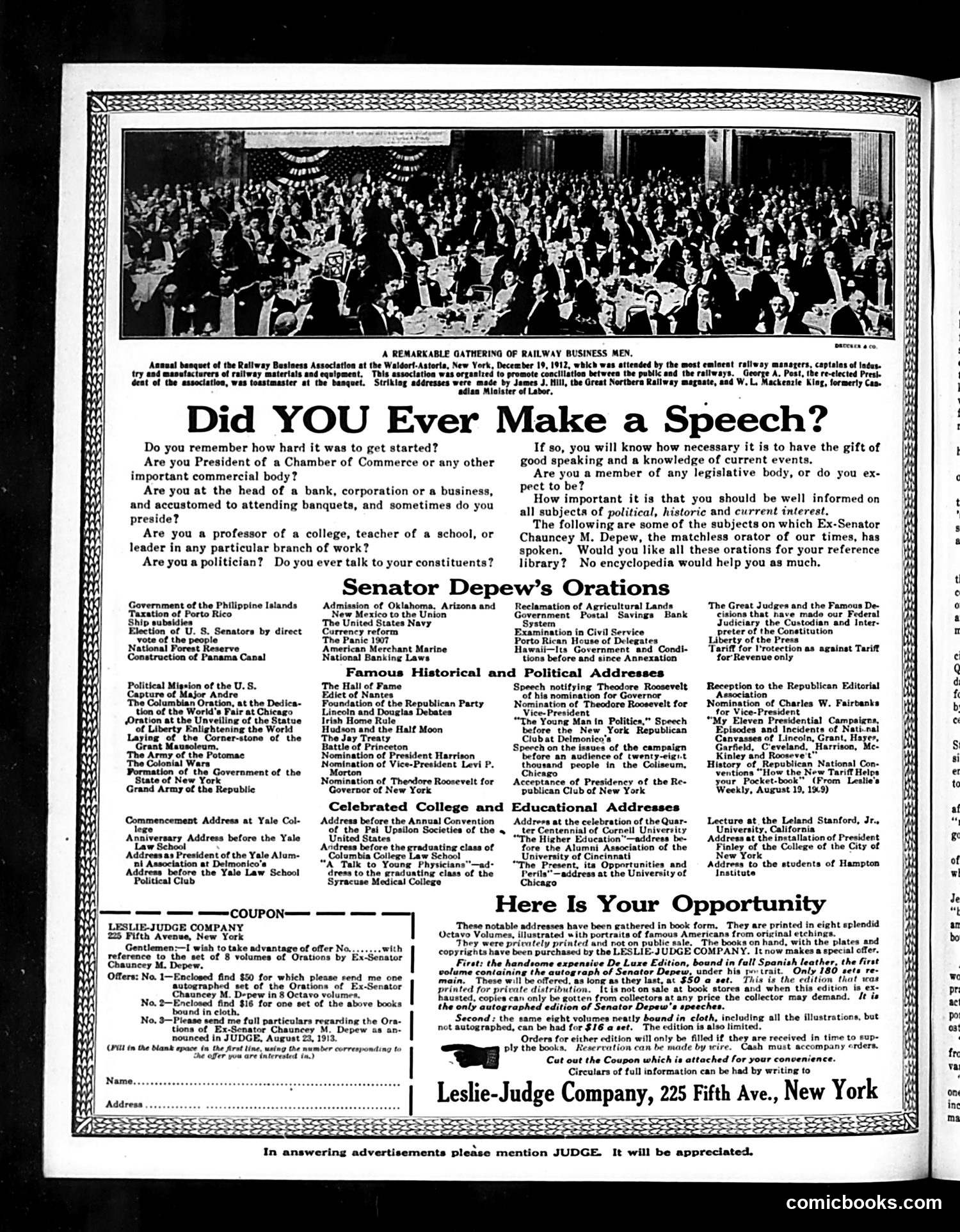
This page is primarily advertising and editorial content, not a political cartoon. The top features a photograph of the 1912 Railway Business Association banquet at New York's Waldorf-Astoria, showing hundreds of railroad executives and businessmen gathered together. The main article promotes the published speeches of Ex-Senator Chauncey M. Depew, a prominent orator of the era, arguing that business and political leaders should study his addresses on topics like tariffs, naval policy, currency reform, and American history. The piece implicitly appeals to ambitious men—politicians, professors, business owners—who need to improve their public speaking and knowledge. The Leslie-Judge Company coupon below advertises bound collections of Depew's orations as desirable reference works. This represents Judge magazine functioning partly as a promotional platform for commercial publishers.
This page contains **humorous anecdotes** rather than political cartoons. The stories satirize rural/working-class American life and social conventions of the early 20th century: 1. **"No Milk"**: Mocks rural Southern poverty and ignorance—a shiftless farmer's cow won't produce milk because his dog (who herds them) is dead, illustrating comic incompetence. 2. **"Reversing Judgment"**: A child's innocent punishment backfires when she reveals she sat on her mother's expensive new hat—mildly satirizing parental authority. 3. **"As Bad as Hats"**: Uses a lady's enormous feathered hat as social satire. An opera patron paid for his seat to *see*; she paid for her hat to be *seen*—critiquing vanity and women's fashion priorities, also touching on the era's feather-trade controversy (note the Audubon reference above). The page is primarily **advertising** for hosiery, leather cases, and other goods. No specific political figures are identifiable; the humor targets class, gender, and fashion conventions of the period.
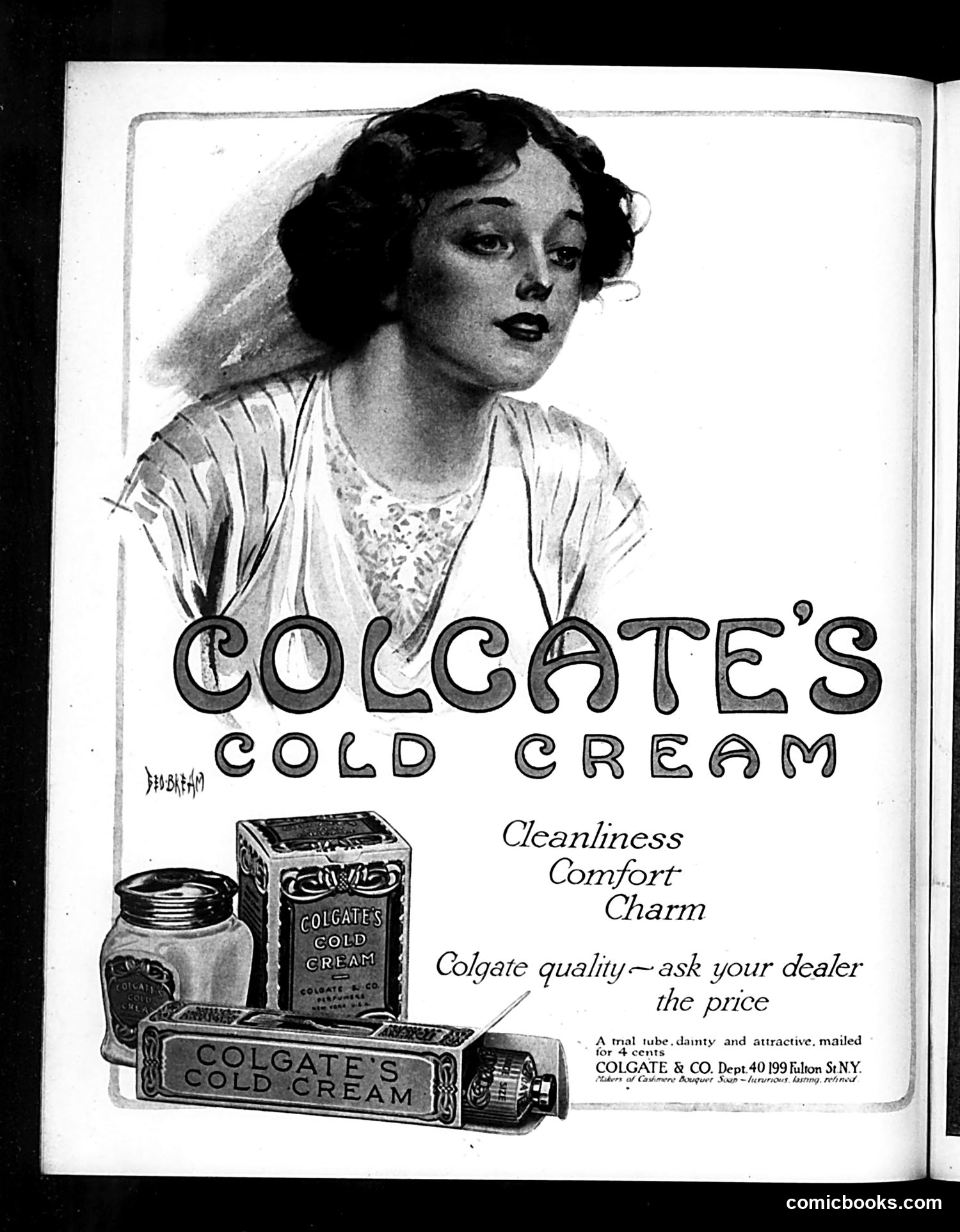
This page is primarily an advertisement, not political satire. It promotes Colgate's Cold Cream, featuring a glamorous woman in 1920s styling (bobbed hair, period makeup). The ad emphasizes three qualities: "Cleanliness, Comfort, Charm" — messaging typical of beauty product marketing from this era, which often linked personal grooming to social desirability and feminine appeal. The layout shows product packaging and offers a trial tube for 4 cents. There is no cartoon, caricature, or political commentary visible. Judge magazine, though known for satire, frequently carried advertisements to fund publication. This appears to be a straightforward commercial promotion rather than editorial content.